SATELLITE AND IT ORBITS
CONTENTS
 SATELLITE
 TYPES OF SATELLITE
 HISTORY OF SATELLITE
 WORKING OF SATELLITE
 TYPES OF ORBITS
 EARTH PLANETARY MOTION
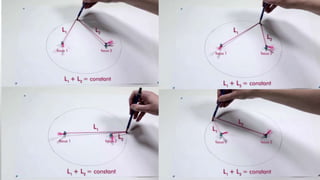
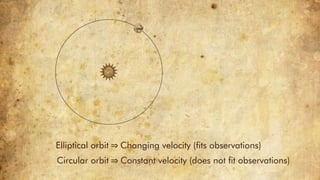
 KEPLERS LAW OF EARTH PLANETARY MOTION
 CONCLUSION
what’s mean by satellite ?
A Satellite is a solid object which revolves around some body due to the effect
of gravitational forces
Types of satellites :-
1) Passive satellites
2) Active satellites
Passive satellites :
A passive satellite only reflects received signals back to earth.
Ex. moon is a natural satellite of earth
Active satellites :
Active satellites are complicated structures having a processing equipment called
Transponder .
An active satellite acts as a REPEATER
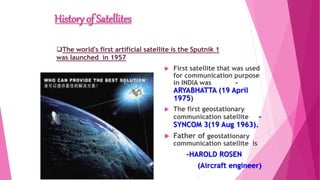
History of Satellites
 First satellite that was used
for communication purpose
in INDIA was -
ARYABHATTA (19 April
1975)
 The first geostationary
communication satellite -
SYNCOM 3(19 Aug 1963).
 Father of geostationary
communication satellite is
-HAROLD ROSEN
(Aircraft engineer)
The world's first artificial satellite is the Sputnik 1
was launched in 1957
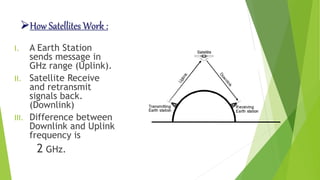
How Satellites Work :
I. A Earth Station
sends message in
GHz range (Uplink).
II. Satellite Receive
and retransmit
signals back.
(Downlink)
III. Difference between
Downlink and Uplink
frequency is
2 GHz.
TYPES OF ORBITS
Low-Earth-Orbit (LEOs)
Medium-Earth-Orbit (MEOs)
Geostationary ORBIT(GEOs)
LOW-EARTH-ORBIT (LEO)
Altitude (600-1000 KM)
 satellite gives it a better signal
strength
Advantages:
Reduces transmission
delay
Disadvantages:
Smaller coverage area.
Shorter life span (5-8 yrs.)
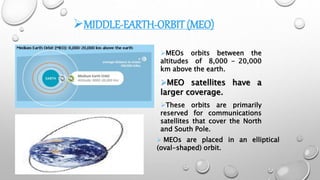
MIDDLE-EARTH-ORBIT (MEO)
MEOs orbits between the
altitudes of 8,000 - 20,000
km above the earth.
MEO satellites have a
larger coverage.
These orbits are primarily
reserved for communications
satellites that cover the North
and South Pole.
 MEOs are placed in an elliptical
(oval-shaped) orbit.
Geostationary-Earth-Orbit (GEO)
 From the ground level the
satellite appears fixed.
 GEO satellites have a 24 hour
view of a particular area.
 Coverage to 40% of area Of
planet by this satellite
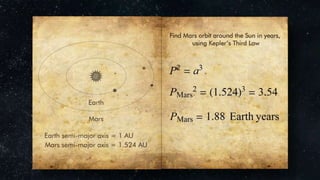
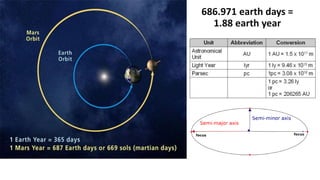
Earth planetary motion
686.971 earth days =
1.88 earth year
23-Aug-19. 23
Communication satellites bring the world to you
anywhere and any time…..
BY
HEMANTH

Satellite and its orbits

  • 1.
  • 2.
    CONTENTS  SATELLITE  TYPESOF SATELLITE  HISTORY OF SATELLITE  WORKING OF SATELLITE  TYPES OF ORBITS  EARTH PLANETARY MOTION  KEPLERS LAW OF EARTH PLANETARY MOTION  CONCLUSION
  • 3.
    what’s mean bysatellite ? A Satellite is a solid object which revolves around some body due to the effect of gravitational forces Types of satellites :- 1) Passive satellites 2) Active satellites Passive satellites : A passive satellite only reflects received signals back to earth. Ex. moon is a natural satellite of earth Active satellites : Active satellites are complicated structures having a processing equipment called Transponder . An active satellite acts as a REPEATER
  • 4.
    History of Satellites First satellite that was used for communication purpose in INDIA was - ARYABHATTA (19 April 1975)  The first geostationary communication satellite - SYNCOM 3(19 Aug 1963).  Father of geostationary communication satellite is -HAROLD ROSEN (Aircraft engineer) The world's first artificial satellite is the Sputnik 1 was launched in 1957
  • 5.
    How Satellites Work: I. A Earth Station sends message in GHz range (Uplink). II. Satellite Receive and retransmit signals back. (Downlink) III. Difference between Downlink and Uplink frequency is 2 GHz.
  • 6.
    TYPES OF ORBITS Low-Earth-Orbit(LEOs) Medium-Earth-Orbit (MEOs) Geostationary ORBIT(GEOs)
  • 7.
    LOW-EARTH-ORBIT (LEO) Altitude (600-1000KM)  satellite gives it a better signal strength Advantages: Reduces transmission delay Disadvantages: Smaller coverage area. Shorter life span (5-8 yrs.)
  • 8.
    MIDDLE-EARTH-ORBIT (MEO) MEOs orbitsbetween the altitudes of 8,000 - 20,000 km above the earth. MEO satellites have a larger coverage. These orbits are primarily reserved for communications satellites that cover the North and South Pole.  MEOs are placed in an elliptical (oval-shaped) orbit.
  • 9.
    Geostationary-Earth-Orbit (GEO)  Fromthe ground level the satellite appears fixed.  GEO satellites have a 24 hour view of a particular area.  Coverage to 40% of area Of planet by this satellite
  • 10.
  • 22.
    686.971 earth days= 1.88 earth year
  • 23.
    23-Aug-19. 23 Communication satellitesbring the world to you anywhere and any time…..
  • 24.