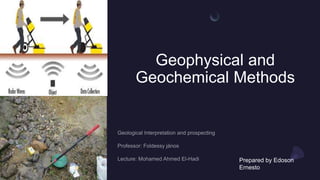
Geophysical and
Geochemical Methods
Prepared by Edoson
Ernesto
Outline
Introduction
In prospective areas where outcrop is poor, or
mature exploration areas, the use of
geophysical and geochemical techniques are
necessary to get information about of that
areas where the observation/studies cannot
be performed directly.
Based on the aim of the survey (study of the
regional geology or to locate ore), one
specific geophysical or geochemical technic
might be used.
Geophysical methods
Method Physical parameter
Magnetic Magnetic susceptibility
Gravity Density
Electromagnetic Electrical conductivity
Electric Apparent resistivity
Radiometry Natural radioactivity
Magnetic and Gravity Methods
known as the “Potential Fields” methods, are used in natural-resource exploration to help locate
mineral, petroleum and groundwater resources.
Magnetic Methods
The magnetic methods investigate magnetic anomalies caused by the earths magnetic field. And
this magnetic anomalies are caused by the rocks which contain enough magnetic minerals such
magnetite, hematite or ilmenite.
The instrument used for magnetic surveys is called a magnetometer, which record disturbances in
the earth’s magnetic field caused by magnetically susceptible rocks.
Gravity Methods
Electrical methods
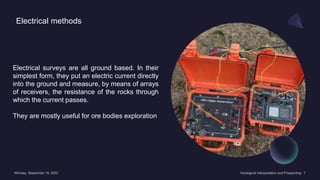
Electrical surveys are all ground based. In their
simplest form, they put an electric current directly
into the ground and measure, by means of arrays
of receivers, the resistance of the rocks through
which the current passes.
They are mostly useful for ore bodies exploration
Geochemical Methods
The geochemical exploration methods consist of carrying out chemical analyzes of different geological
and biological materials (sediments of streams, soils, rocks, waters and plants) in a systematic way.
1. Stream Sediment Sampling
It consists in measure semimobile and mobile sediments from river or stream sediments.
In so many case, this technique is used to detect ore bodies;
The following conditions should be met for the effectiveness of this technique:
 The area should be one of active erosion with an incised drainage pattern.
 Only the active sediment on the stream bed should be sampled.
 As much detail as possible about the sample site should be recorded.
Geochemical methods
Conclusion
References
Thank You

Geophysical and Geochemical Methods.pptx

  • 1.
  • 2.
  • 3.
    Introduction In prospective areaswhere outcrop is poor, or mature exploration areas, the use of geophysical and geochemical techniques are necessary to get information about of that areas where the observation/studies cannot be performed directly. Based on the aim of the survey (study of the regional geology or to locate ore), one specific geophysical or geochemical technic might be used.
  • 4.
    Geophysical methods Method Physicalparameter Magnetic Magnetic susceptibility Gravity Density Electromagnetic Electrical conductivity Electric Apparent resistivity Radiometry Natural radioactivity
  • 5.
    Magnetic and GravityMethods known as the “Potential Fields” methods, are used in natural-resource exploration to help locate mineral, petroleum and groundwater resources. Magnetic Methods The magnetic methods investigate magnetic anomalies caused by the earths magnetic field. And this magnetic anomalies are caused by the rocks which contain enough magnetic minerals such magnetite, hematite or ilmenite. The instrument used for magnetic surveys is called a magnetometer, which record disturbances in the earth’s magnetic field caused by magnetically susceptible rocks.
  • 6.
  • 7.
    Electrical methods Electrical surveysare all ground based. In their simplest form, they put an electric current directly into the ground and measure, by means of arrays of receivers, the resistance of the rocks through which the current passes. They are mostly useful for ore bodies exploration
  • 8.
    Geochemical Methods The geochemicalexploration methods consist of carrying out chemical analyzes of different geological and biological materials (sediments of streams, soils, rocks, waters and plants) in a systematic way. 1. Stream Sediment Sampling It consists in measure semimobile and mobile sediments from river or stream sediments. In so many case, this technique is used to detect ore bodies; The following conditions should be met for the effectiveness of this technique:  The area should be one of active erosion with an incised drainage pattern.  Only the active sediment on the stream bed should be sampled.  As much detail as possible about the sample site should be recorded.
  • 9.
  • 10.
  • 11.
  • 12.