A GEOMETRIC APPROACH TO SPECTRAL
SUBSTRACTION AND ADDITIVE WHITE GAUSSIAN
NOISE REMOVAL USING WAVELETS
P. S. Manasa :BL.EN.U4ECE10138
Keerthi Thallam :BL.EN.U4ECE10190
Guided by
Dr. Shikha Tripathi
Presented by
5/19/2014 ECE Dept, ASE BLR 1
Contents
• Introduction
• Outline of mid-semester presentation
• White noise
• Wavelet theory
• De-noising using wavelet theory
1. Algorithm
2. Simulation results
3. Conclusion
• A Geometric approach to Spectral Subtraction
1. Algorithm
2. Simulation results
3. Conclusion
5/19/2014 ECE Dept, ASE BLR 2
Introduction
• Speech enhancement (i.e removal noise from speech) is
necessary to improve user perception
• Noise degrades the quality of the information signal
• De-Noising plays a major role in communication
• Different de-noising techniques can be employed for different
noises
5/19/2014 ECE Dept, ASE BLR 3
Transient noise reduction using diffusion
filters
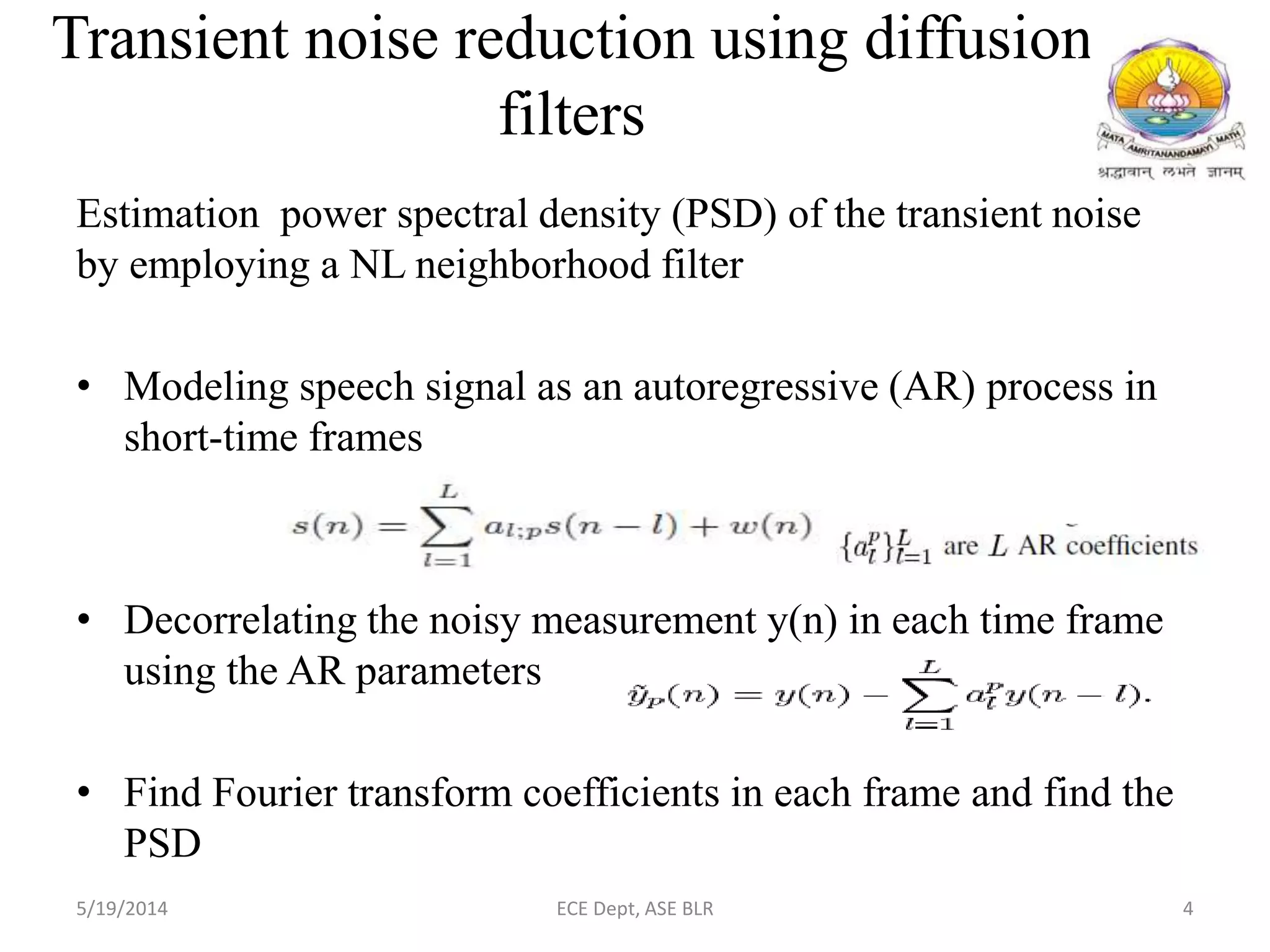
Estimation power spectral density (PSD) of the transient noise
by employing a NL neighborhood filter
• Modeling speech signal as an autoregressive (AR) process in
short-time frames
• Decorrelating the noisy measurement y(n) in each time frame
using the AR parameters
• Find Fourier transform coefficients in each frame and find the
PSD
5/19/2014 ECE Dept, ASE BLR 4
Transient noise reduction using diffusion
filters (Contd…)
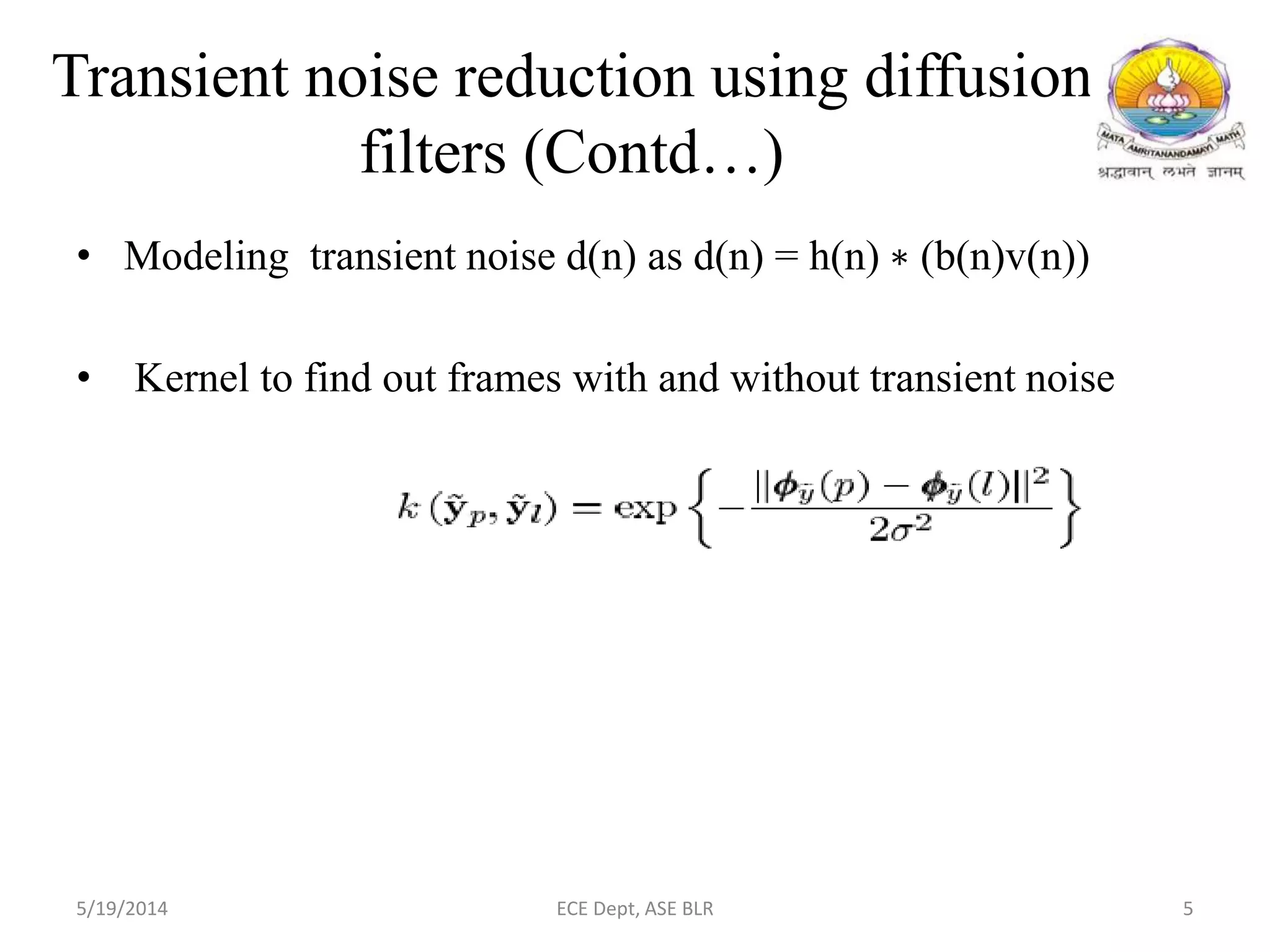
• Modeling transient noise d(n) as d(n) = h(n) ∗ (b(n)v(n))
• Kernel to find out frames with and without transient noise
5/19/2014 ECE Dept, ASE BLR 5
Methods Implemented
Method 1: Reduction of noise(AWGN) using
wavelets (Roopali Goel et al.,2013)
Method 2: Geometric approach to spectral
subtraction (Yang Lu et al.,2008)
5/19/2014 ECE Dept, ASE BLR 6
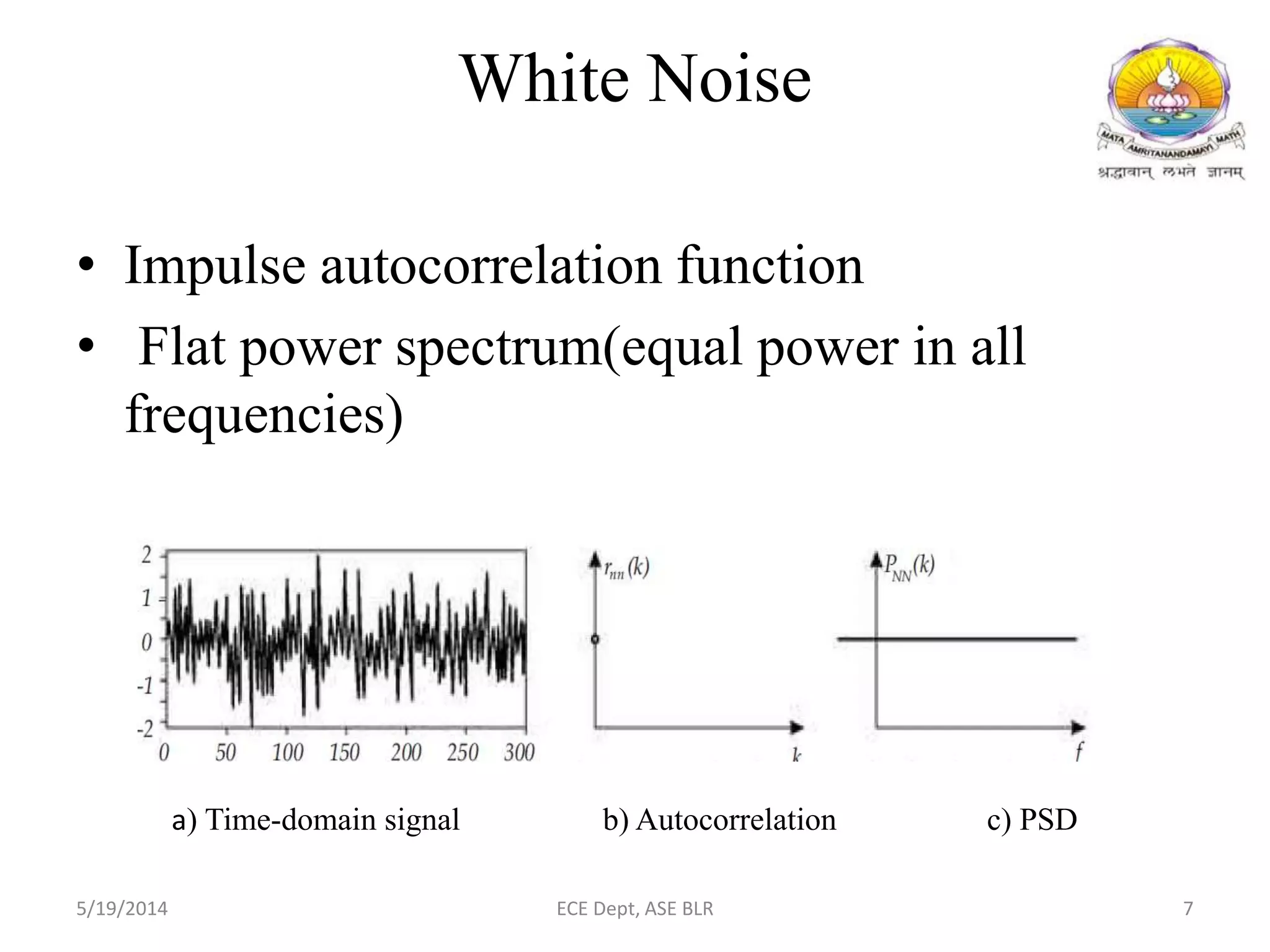
White Noise
• Impulse autocorrelation function
• Flat power spectrum(equal power in all
frequencies)
a) Time-domain signal b) Autocorrelation c) PSD
5/19/2014 ECE Dept, ASE BLR 7
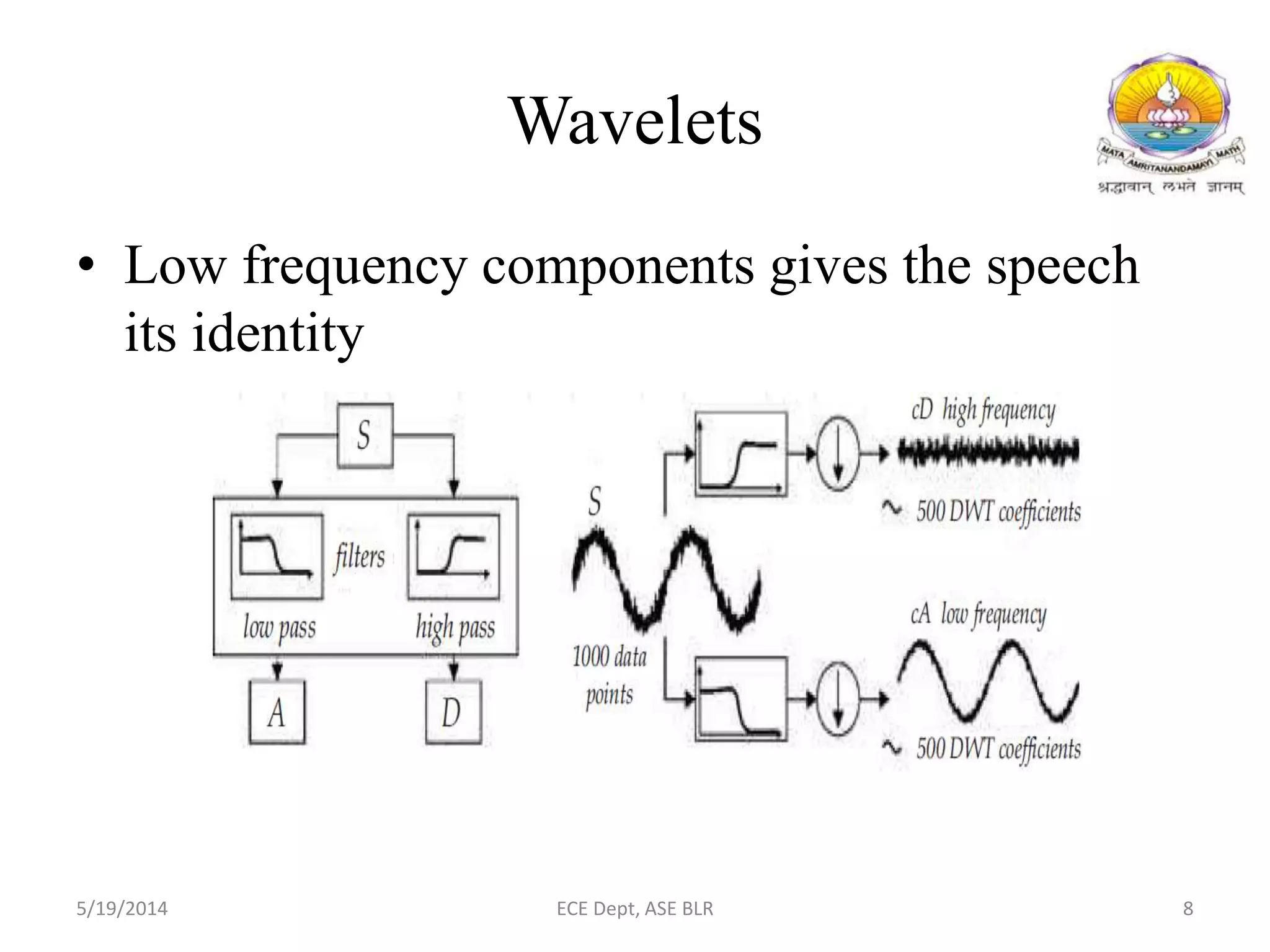
Wavelets
• Low frequency components gives the speech
its identity
5/19/2014 ECE Dept, ASE BLR 8
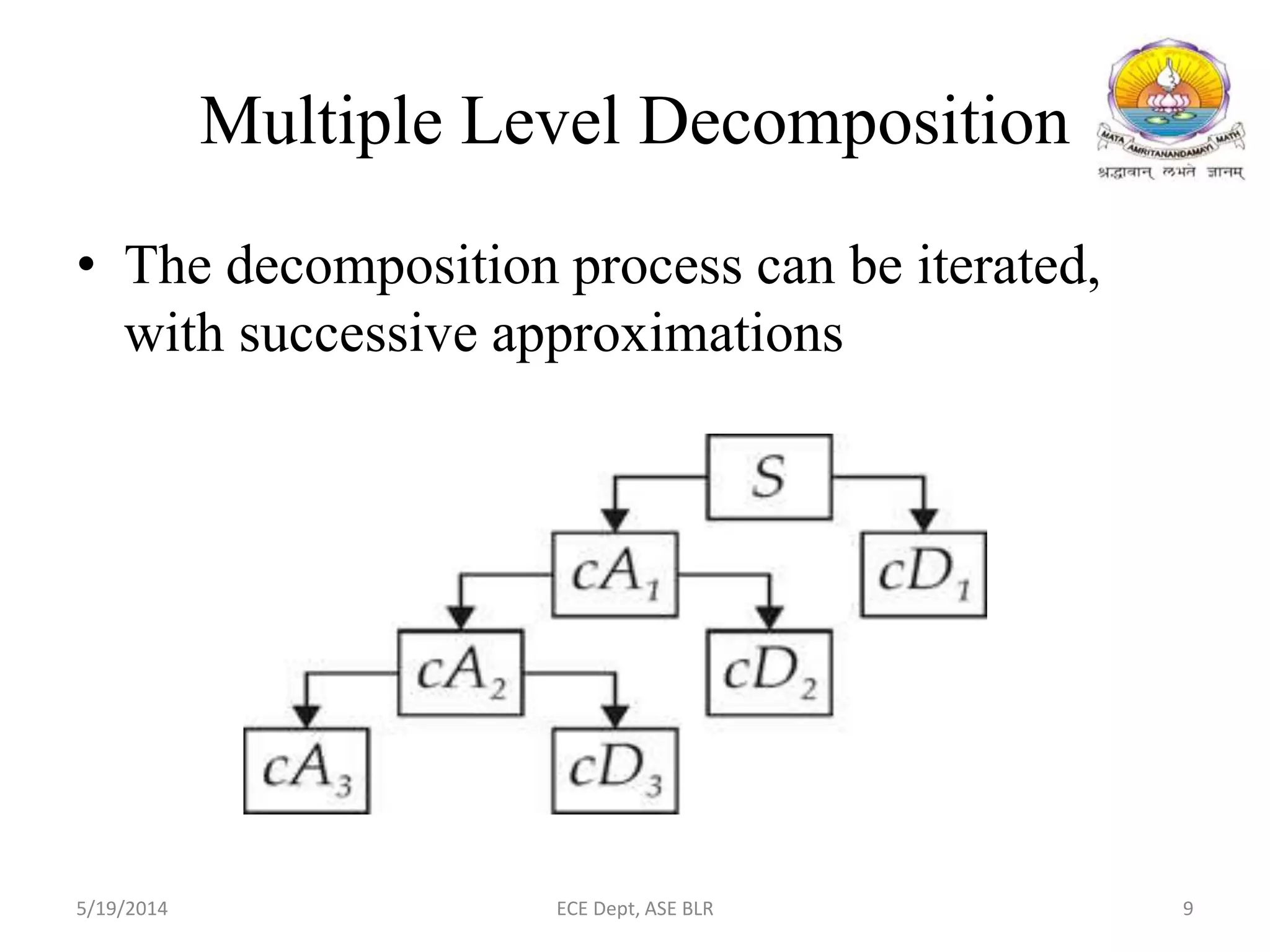
Multiple Level Decomposition
• The decomposition process can be iterated,
with successive approximations
5/19/2014 ECE Dept, ASE BLR 9
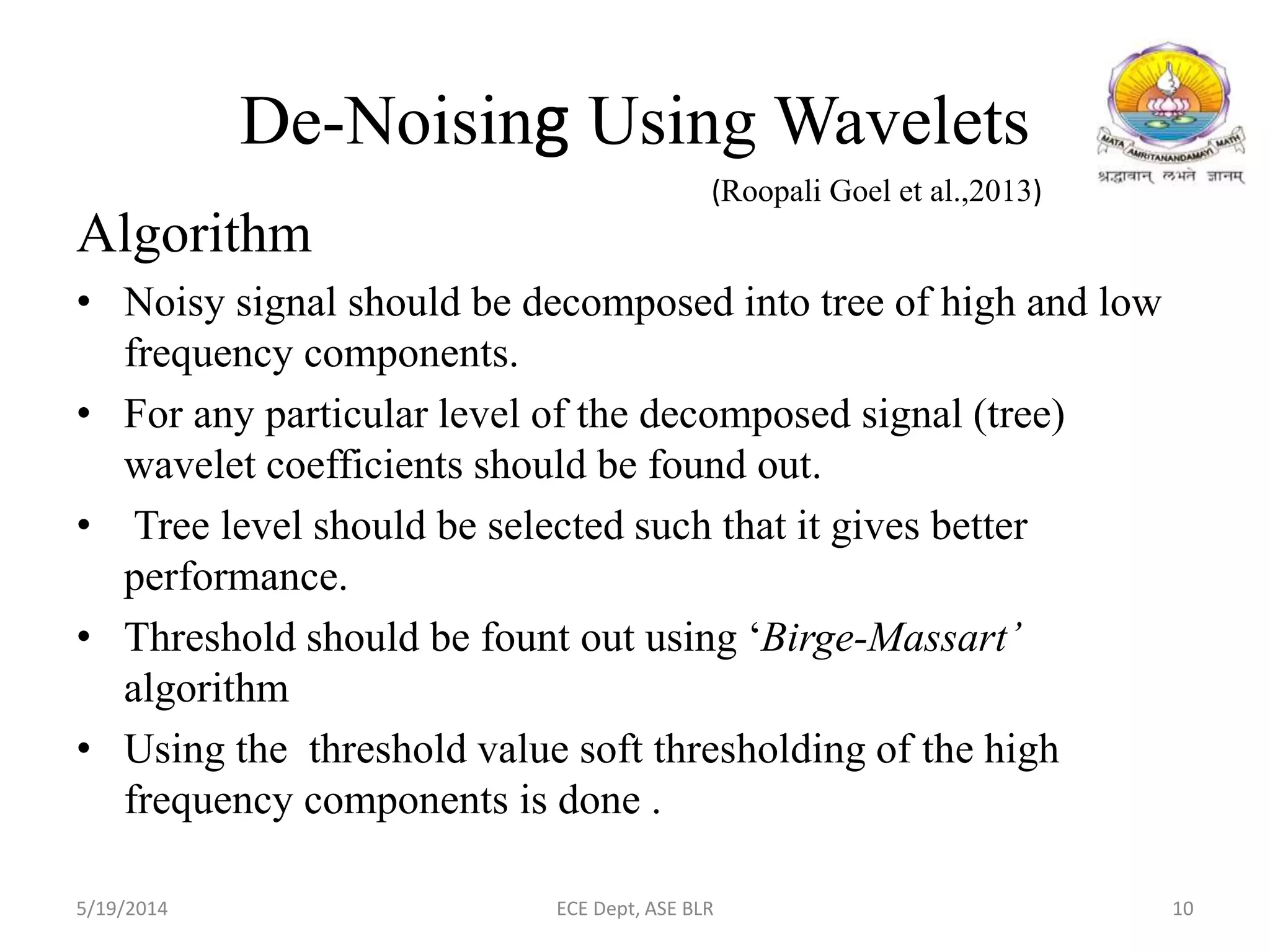
De-Noising Using Wavelets
Algorithm
• Noisy signal should be decomposed into tree of high and low
frequency components.
• For any particular level of the decomposed signal (tree)
wavelet coefficients should be found out.
• Tree level should be selected such that it gives better
performance.
• Threshold should be fount out using ‘Birge-Massart’
algorithm
• Using the threshold value soft thresholding of the high
frequency components is done .
5/19/2014 ECE Dept, ASE BLR 10
(Roopali Goel et al.,2013)
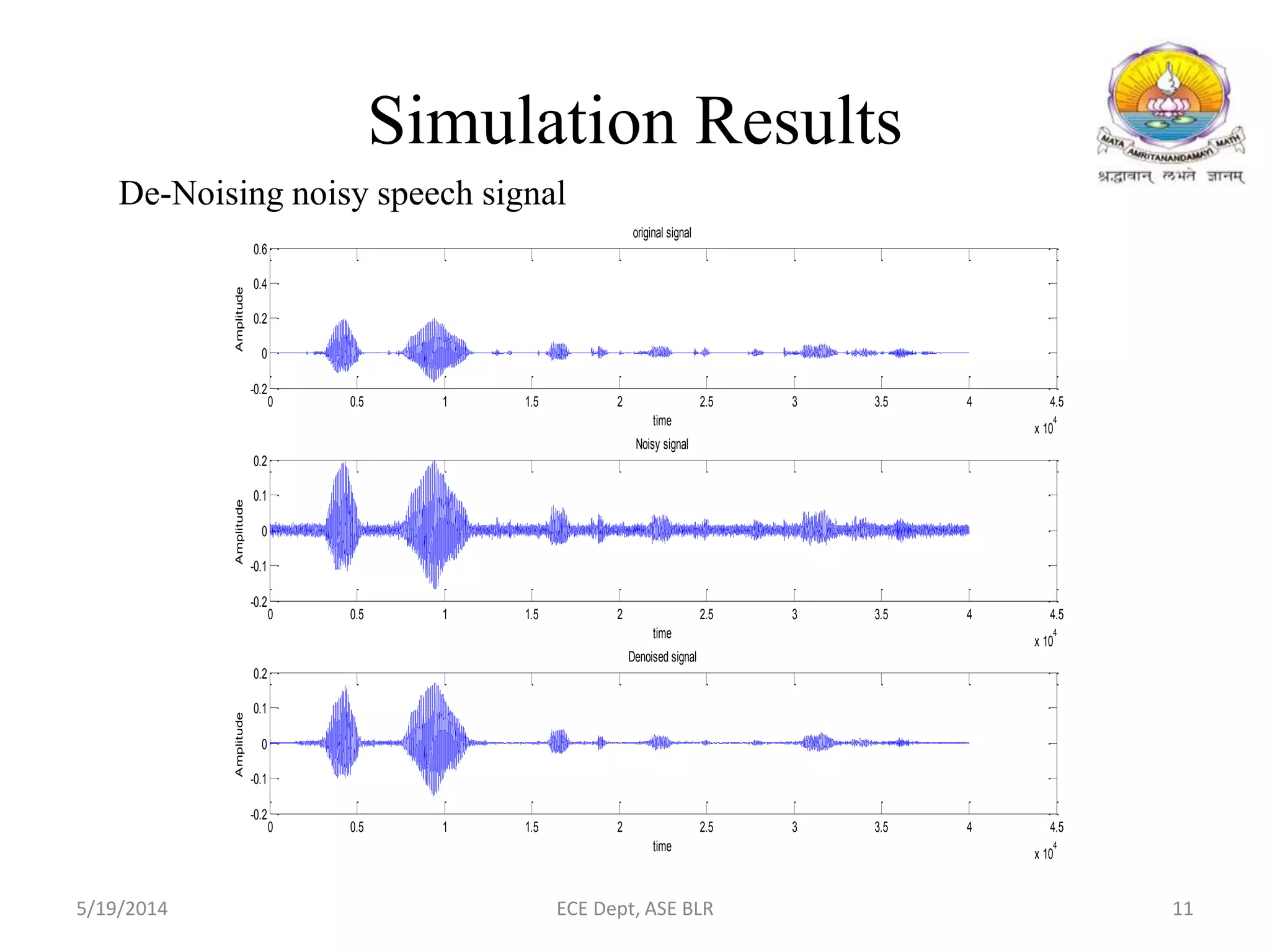
Simulation Results
0 0.5 1 1.5 2 2.5 3 3.5 4 4.5
x 10
4
-0.2
0
0.2
0.4
0.6
time
Amplitude
original signal
0 0.5 1 1.5 2 2.5 3 3.5 4 4.5
x 10
4
-0.2
-0.1
0
0.1
0.2
time
Amplitude
Noisy signal
0 0.5 1 1.5 2 2.5 3 3.5 4 4.5
x 10
4
-0.2
-0.1
0
0.1
0.2
time
Amplitude
Denoised signal
5/19/2014 ECE Dept, ASE BLR 11
De-Noising noisy speech signal
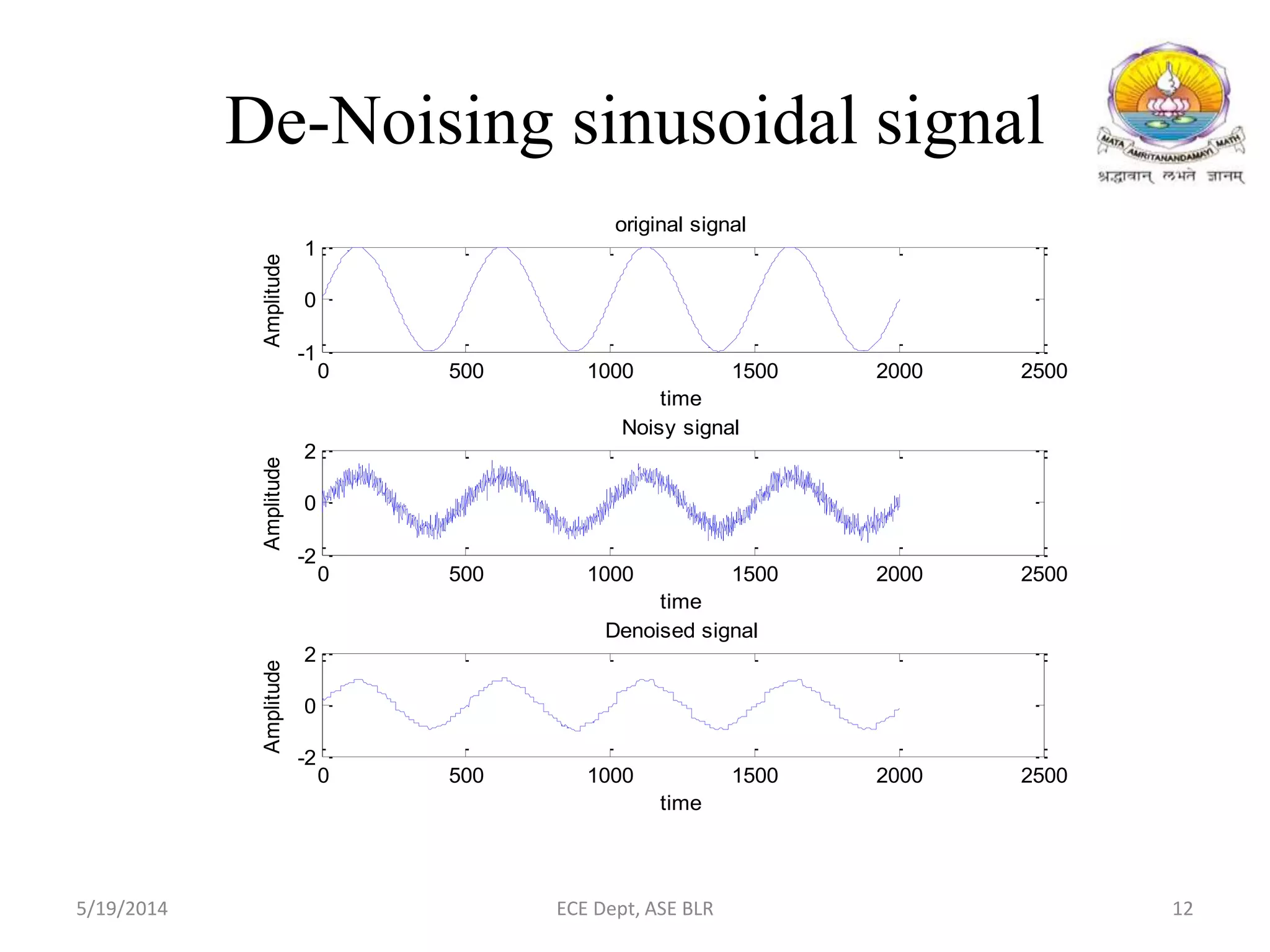
De-Noising sinusoidal signal
0 500 1000 1500 2000 2500
-1
0
1
time
Amplitude
original signal
0 500 1000 1500 2000 2500
-2
0
2
time
Amplitude
Noisy signal
0 500 1000 1500 2000 2500
-2
0
2
time
Amplitude
Denoised signal
5/19/2014 ECE Dept, ASE BLR 12
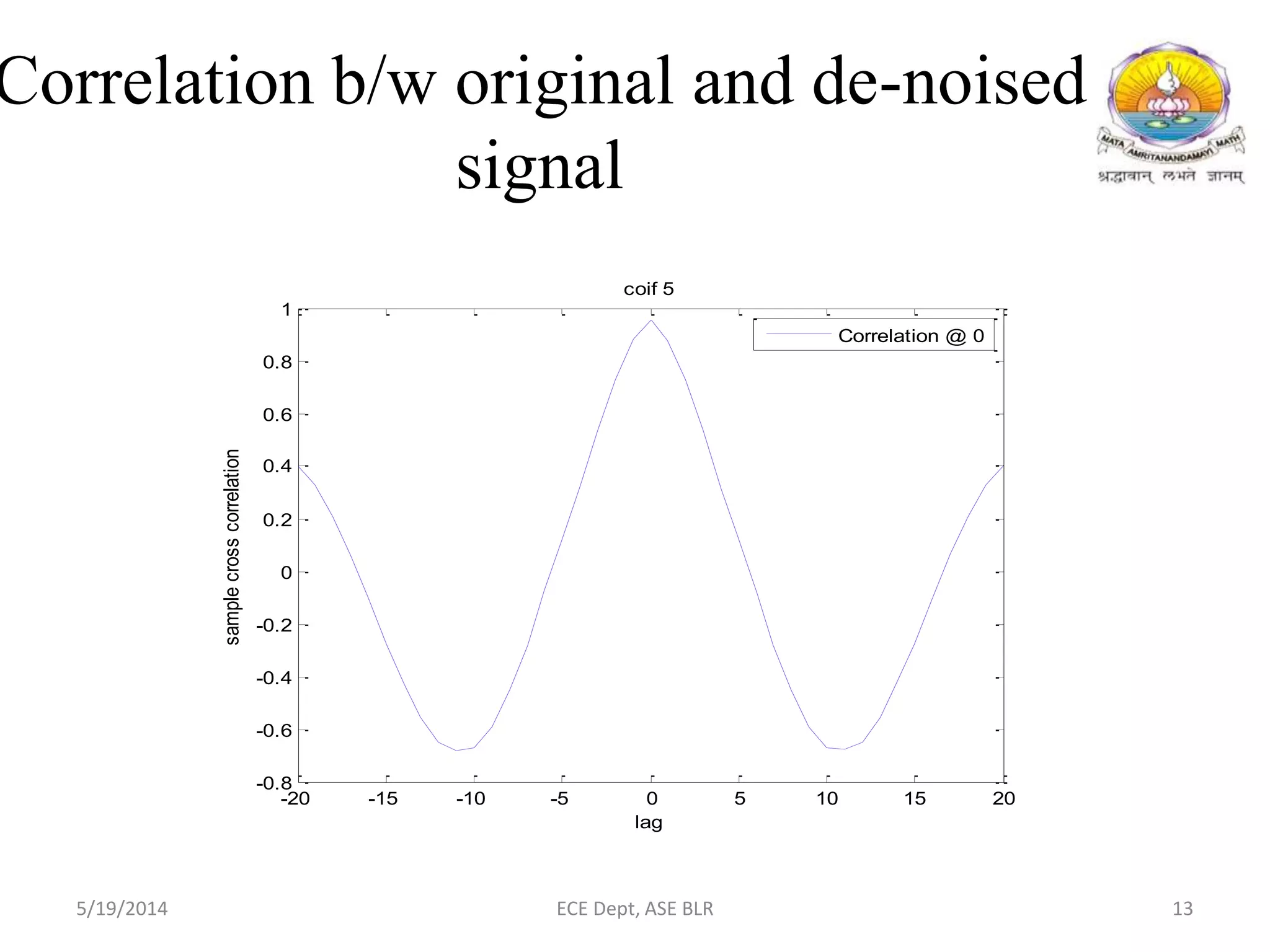
Correlation b/w original and de-noised
signal
-20 -15 -10 -5 0 5 10 15 20
-0.8
-0.6
-0.4
-0.2
0
0.2
0.4
0.6
0.8
1
coif 5
lag
samplecrosscorrelation
Correlation @ 0
5/19/2014 ECE Dept, ASE BLR 13
Conclusion
• Successfully able to remove AWGN
• A high correlation value above 98% at lag
value of zero has been achieved
5/19/2014 ECE Dept, ASE BLR 14
A geometric approach to spectral
subtraction (Yang Lu et al.,2008)
• Does not suffer from musical noise distortion
• Does not assume that the cross terms are zero
• Performs significantly better than the traditional spectral subtractive
algorithm
• Based on representing the noisy speech spectrum in the complex plane
as the sum of the clean signal and noise vectors
5/19/2014 ECE Dept, ASE BLR 15
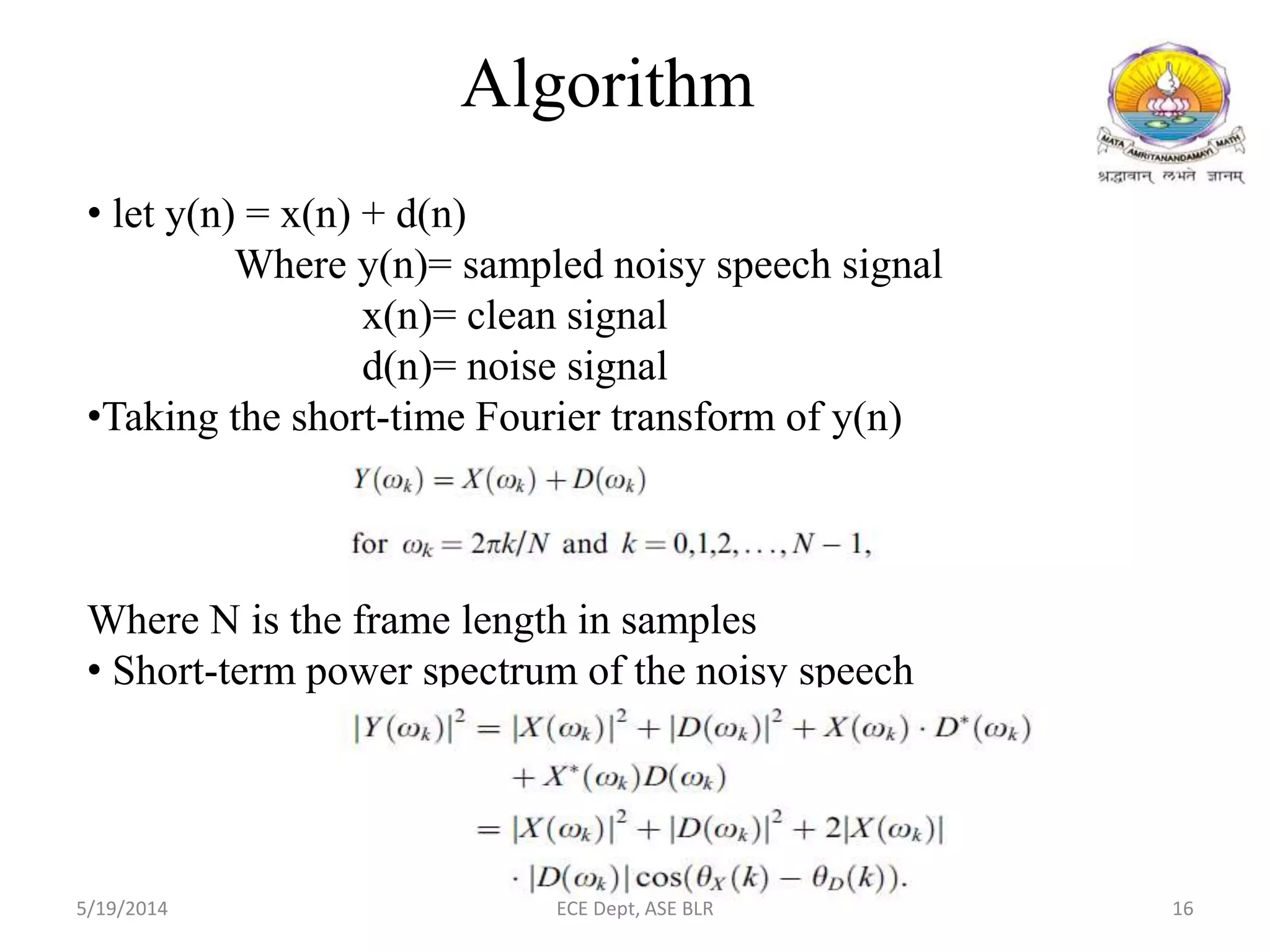
• let y(n) = x(n) + d(n)
Where y(n)= sampled noisy speech signal
x(n)= clean signal
d(n)= noise signal
•Taking the short-time Fourier transform of y(n)
Where N is the frame length in samples
• Short-term power spectrum of the noisy speech
Algorithm
5/19/2014 ECE Dept, ASE BLR 16
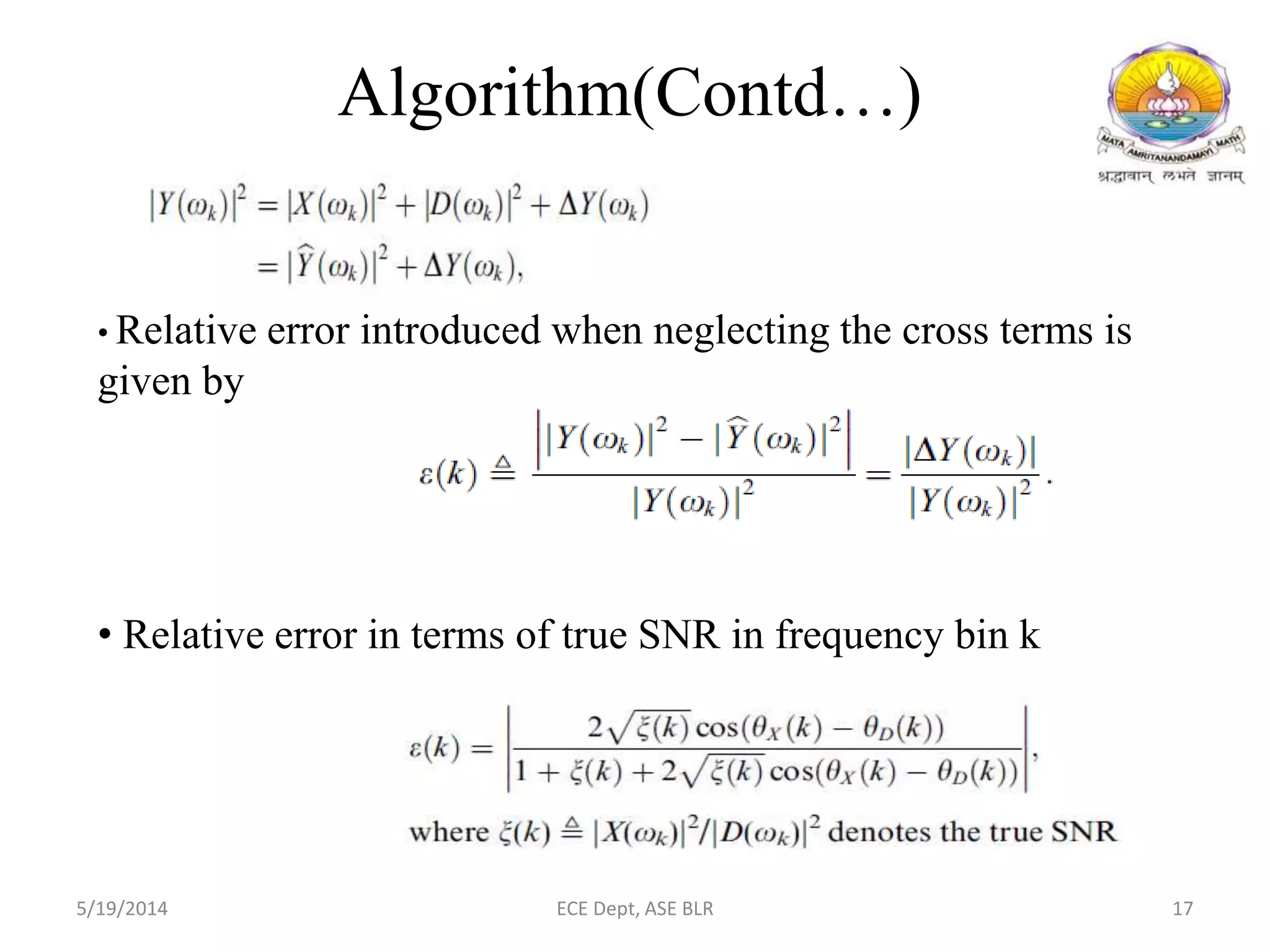
• Relative error introduced when neglecting the cross terms is
given by
• Relative error in terms of true SNR in frequency bin k
Algorithm(Contd…)
5/19/2014 ECE Dept, ASE BLR 17
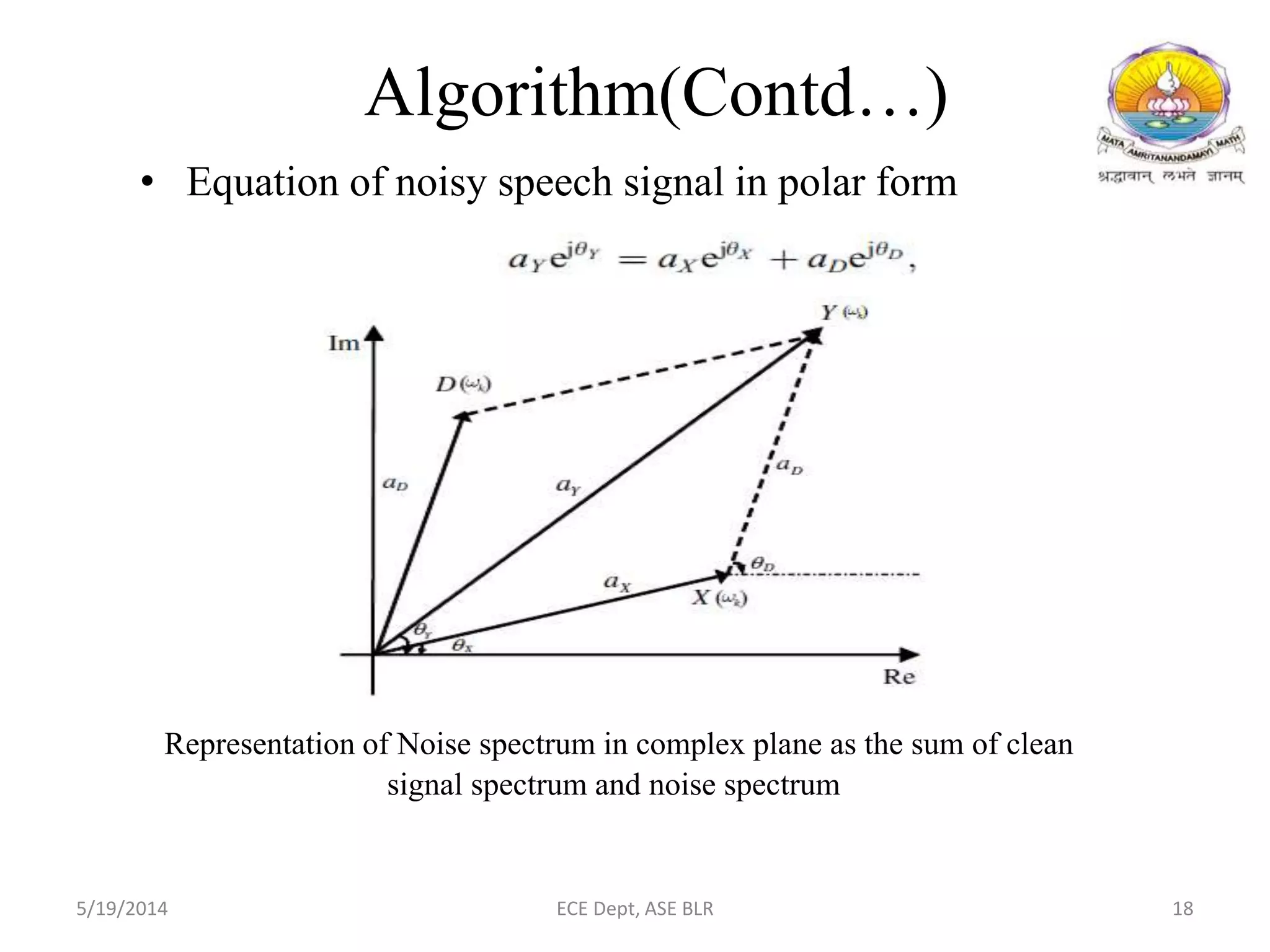
• Equation of noisy speech signal in polar form
Representation of Noise spectrum in complex plane as the sum of clean
signal spectrum and noise spectrum
Algorithm(Contd…)
5/19/2014 ECE Dept, ASE BLR 18
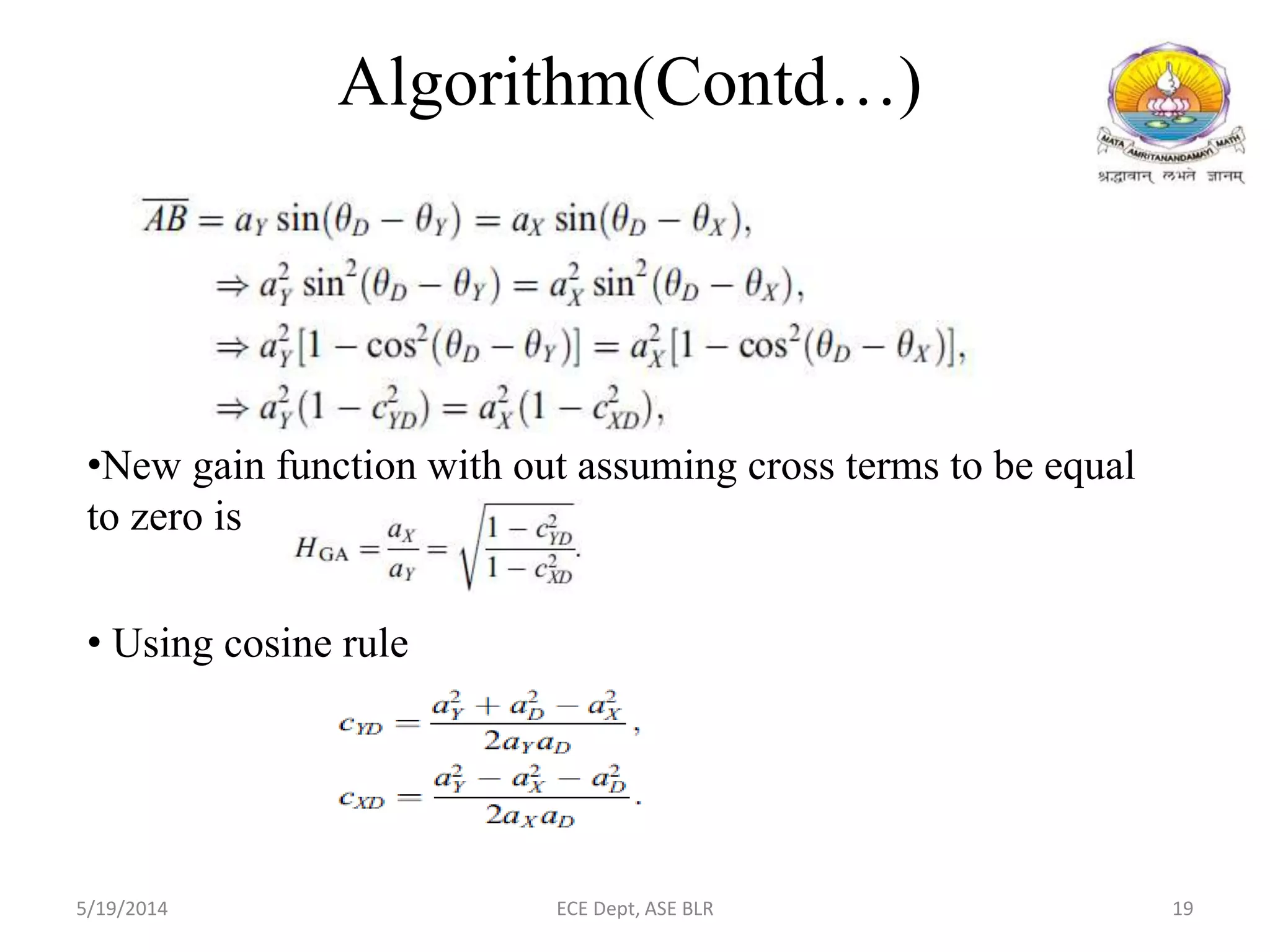
•New gain function with out assuming cross terms to be equal
to zero is
• Using cosine rule
Algorithm(Contd…)
5/19/2014 ECE Dept, ASE BLR 19
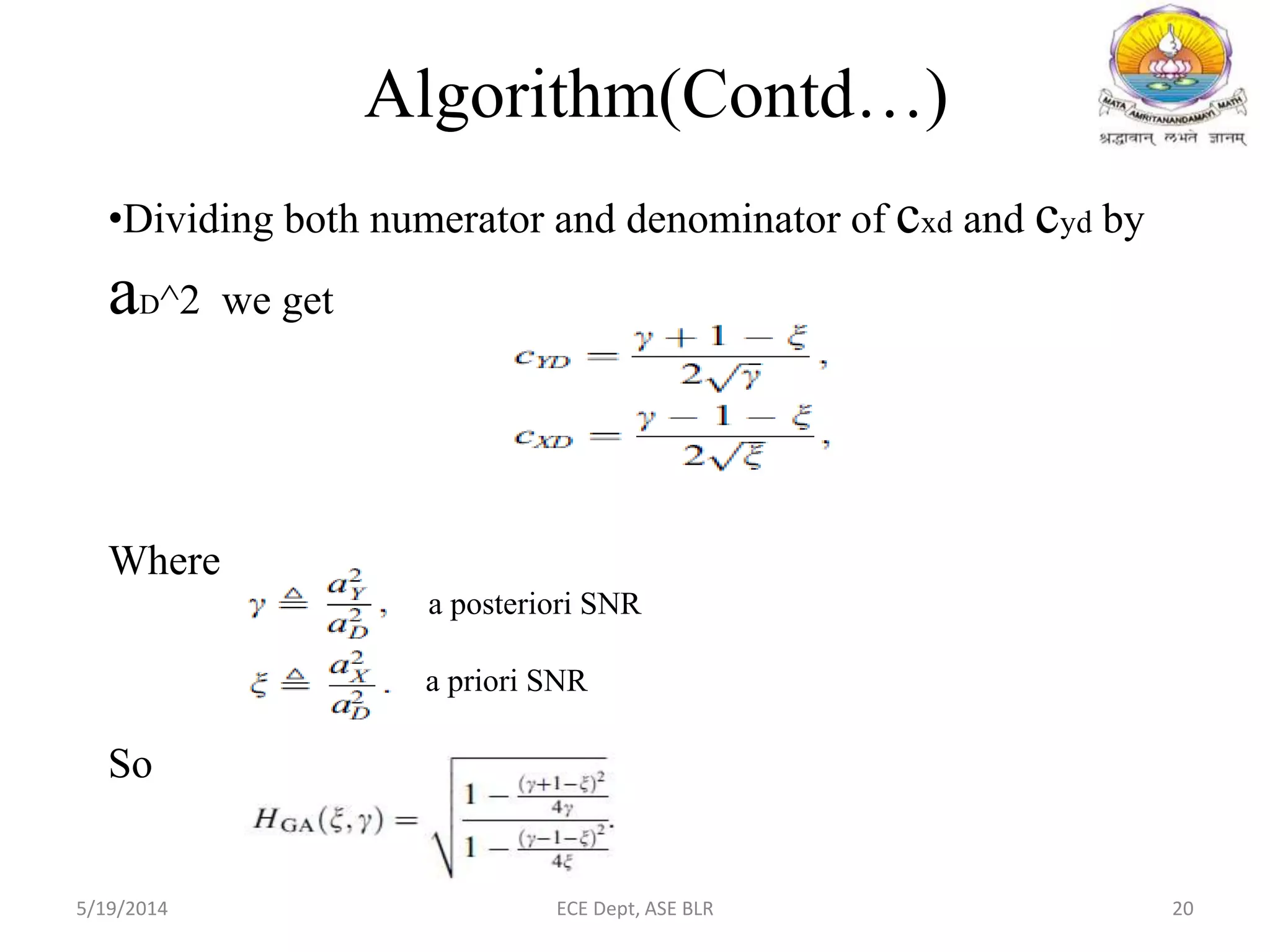
•Dividing both numerator and denominator of cxd and cyd by
aD^2 we get
Where
a posteriori SNR
a priori SNR
So
Algorithm(Contd…)
5/19/2014 ECE Dept, ASE BLR 20
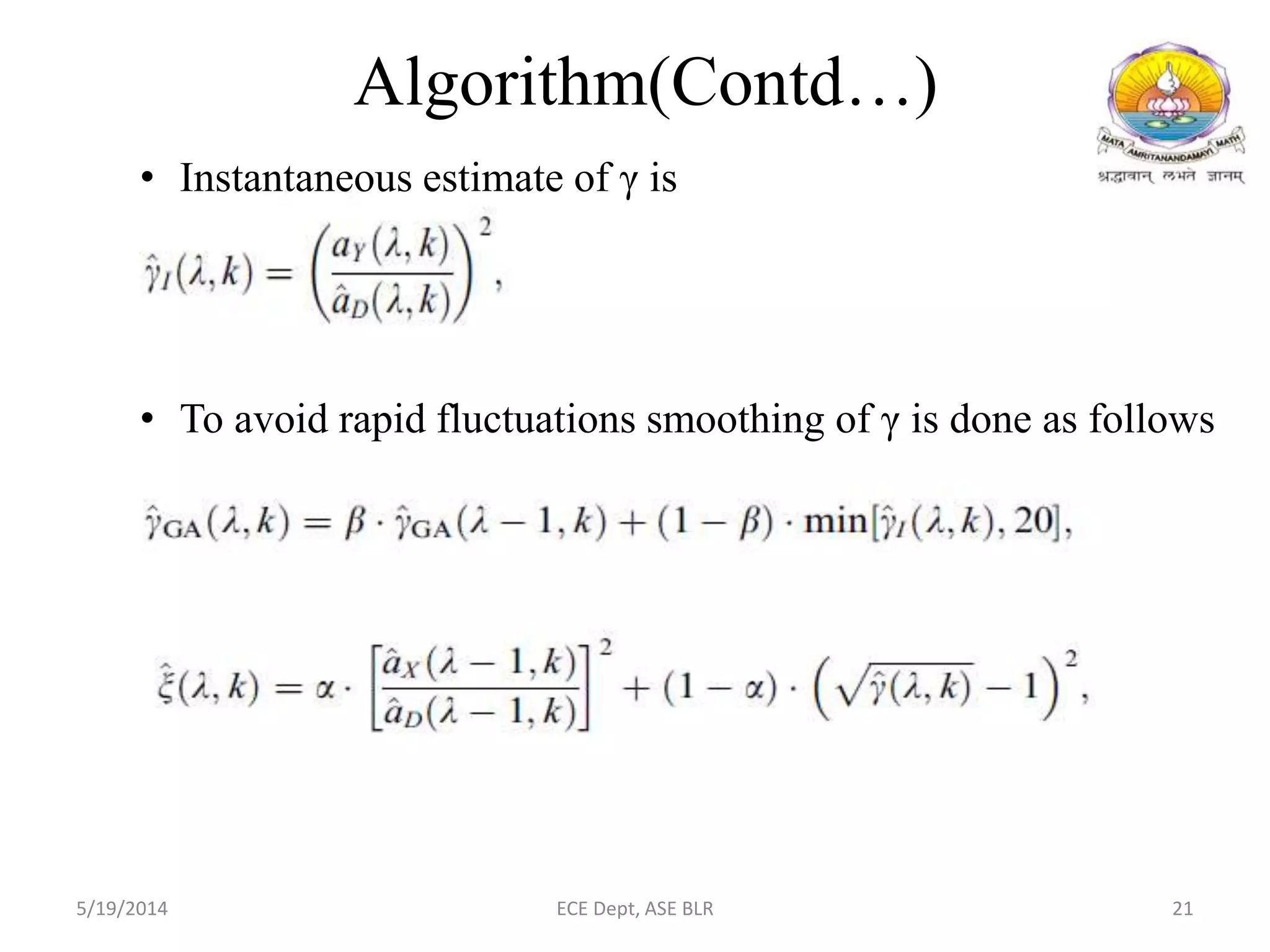
• Instantaneous estimate of γ is
• To avoid rapid fluctuations smoothing of γ is done as follows
Algorithm(Contd…)
5/19/2014 ECE Dept, ASE BLR 21
• Does not use a voice activity detector
• Tracks spectral minima in each frequency band
• Optimally smoothed power spectral density is estimated
• Develops an unbiased noise power spectral density estimator
Noise Power Spectral Density
Estimation
5/19/2014 ECE Dept, ASE BLR 22
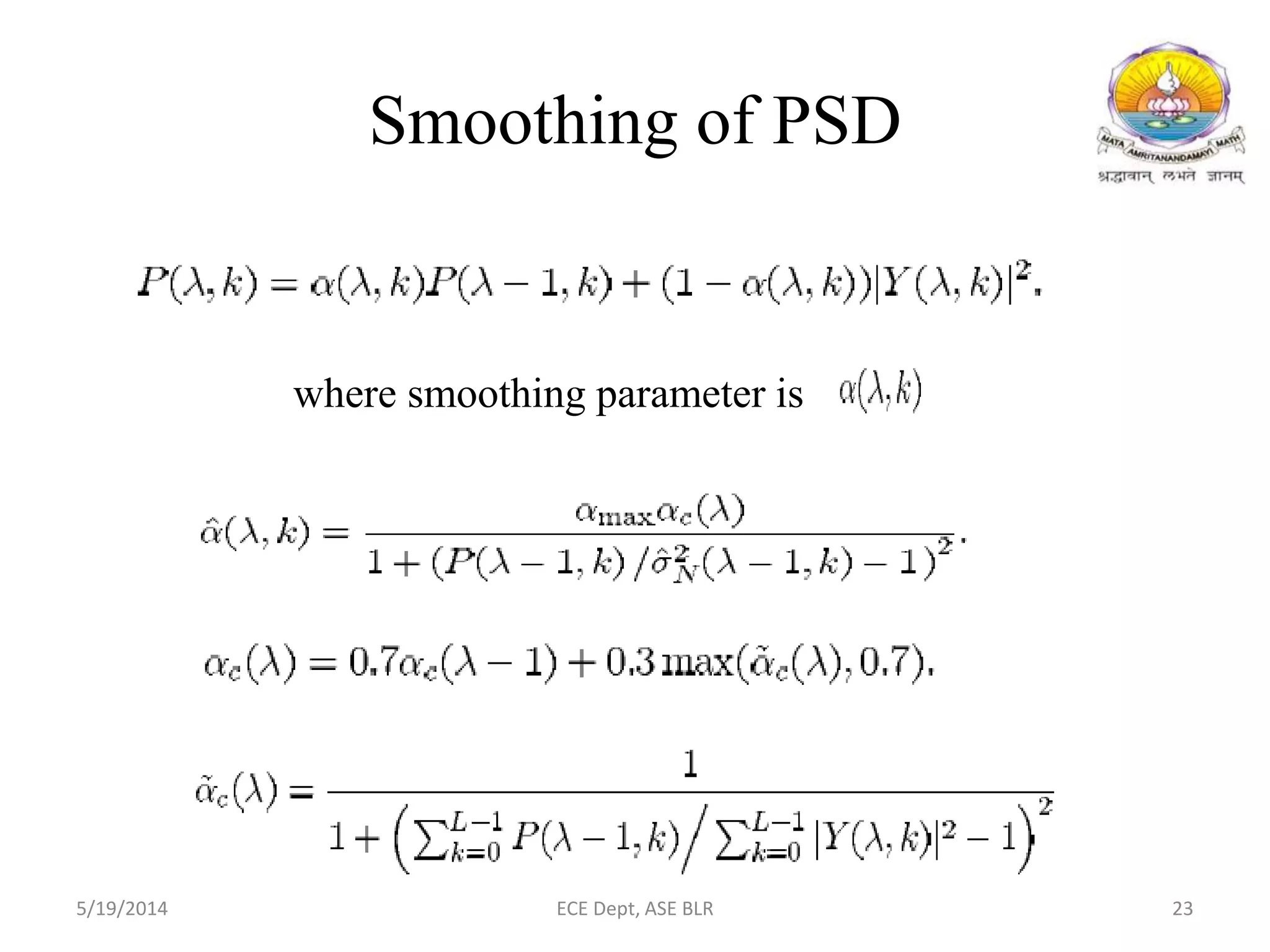
Smoothing of PSD
where smoothing parameter is
5/19/2014 ECE Dept, ASE BLR 23
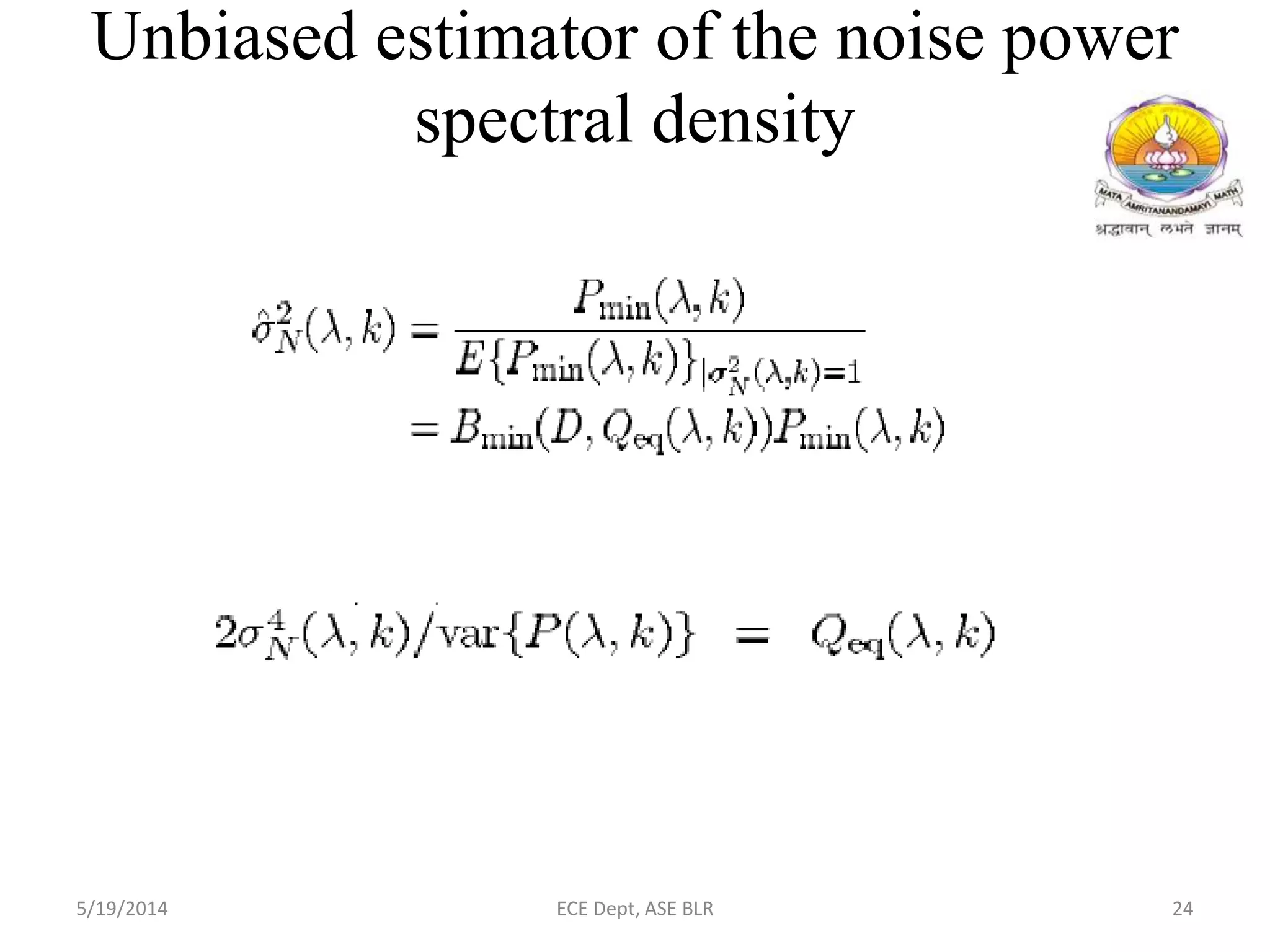
Unbiased estimator of the noise power
spectral density
5/19/2014 ECE Dept, ASE BLR 24
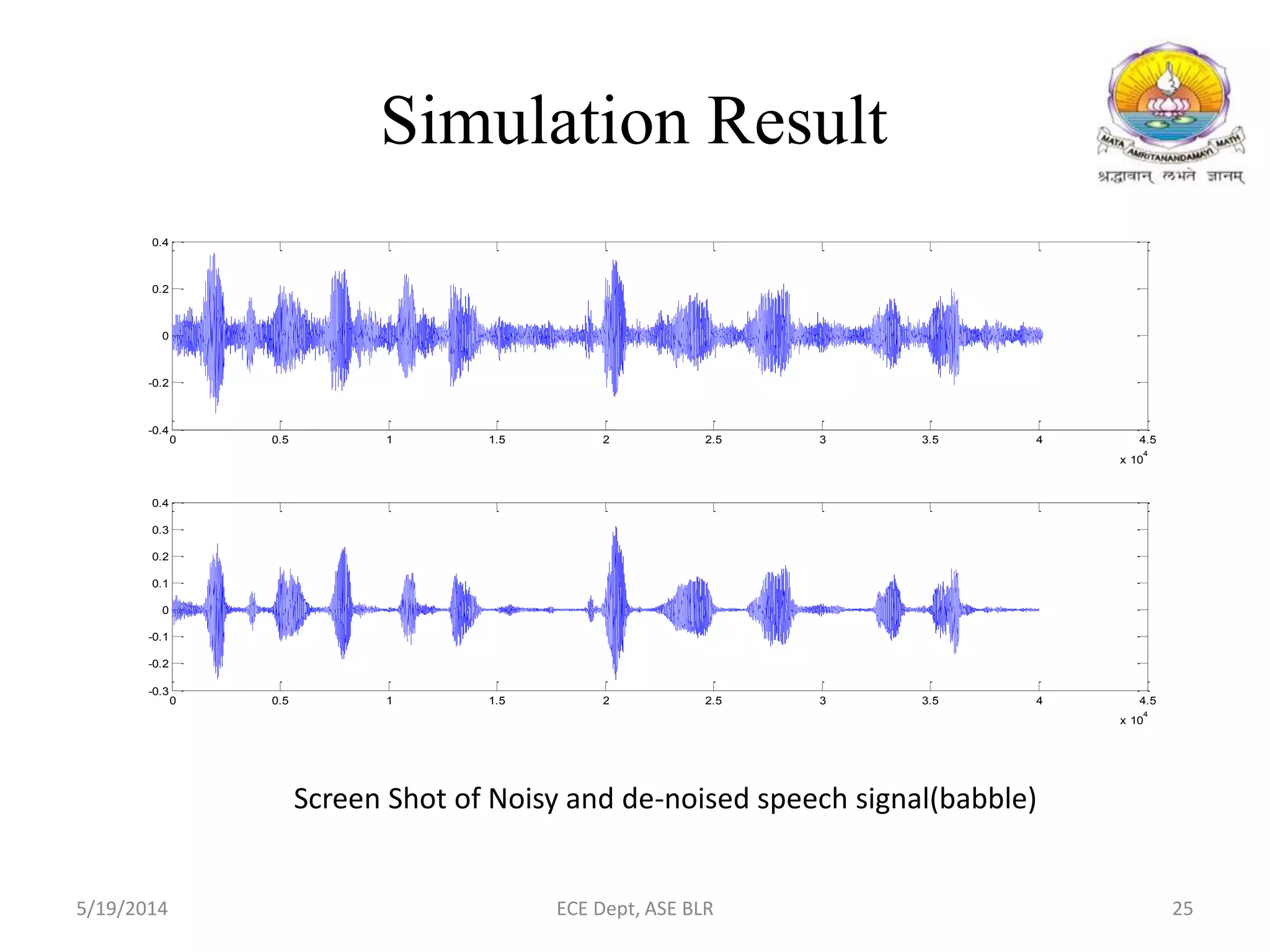
Simulation Result
0 0.5 1 1.5 2 2.5 3 3.5 4 4.5
x 10
4
-0.3
-0.2
-0.1
0
0.1
0.2
0.3
0.4
0 0.5 1 1.5 2 2.5 3 3.5 4 4.5
x 10
4
-0.4
-0.2
0
0.2
0.4
Screen Shot of Noisy and de-noised speech signal(babble)
5/19/2014 ECE Dept, ASE BLR 25
0 2 4 6 8 10 12 14
x 10
4
-1
-0.5
0
0.5
1
1.5
0 2 4 6 8 10 12 14
x 10
4
-1
-0.5
0
0.5
1
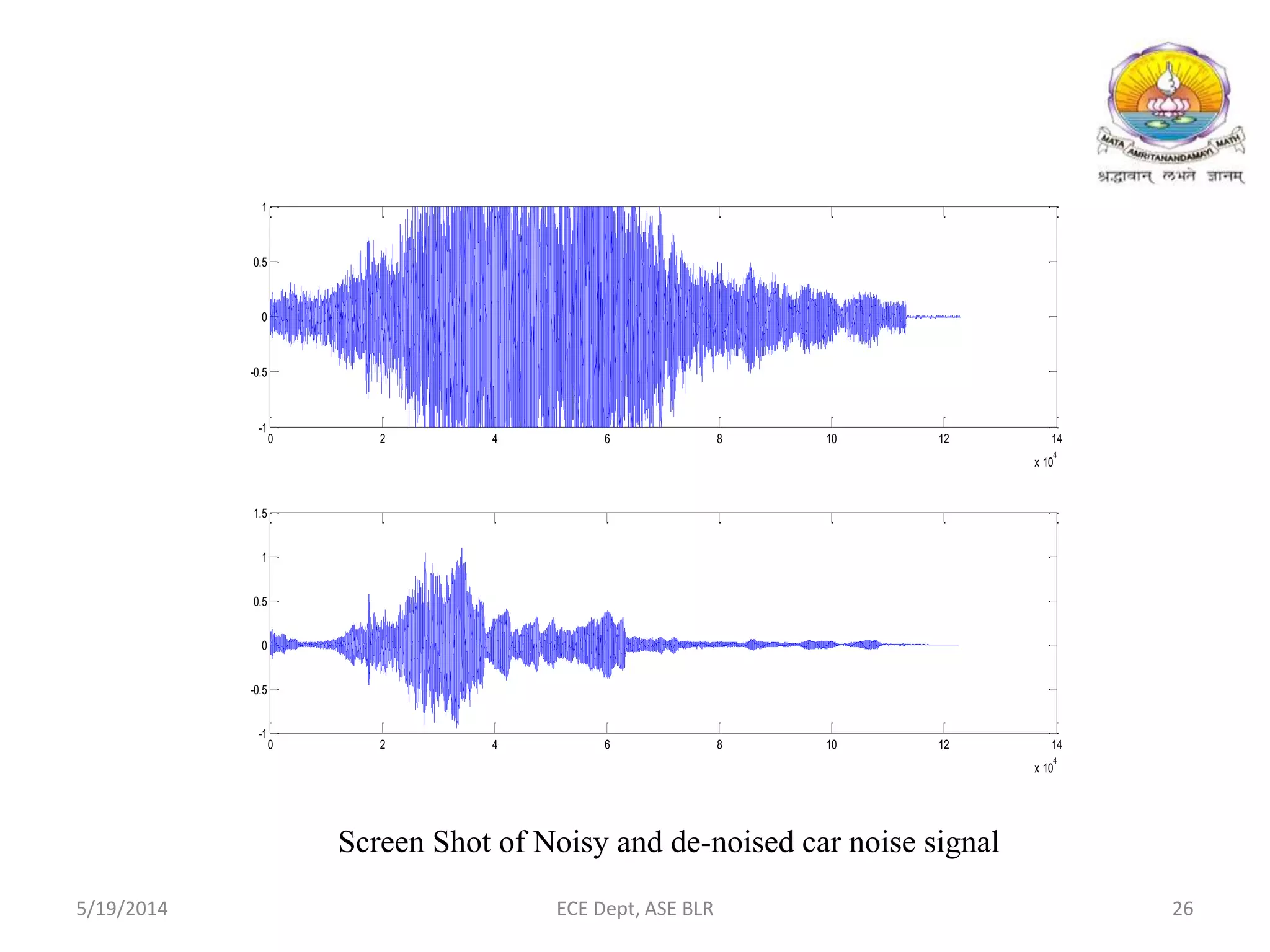
Screen Shot of Noisy and de-noised car noise signal
5/19/2014 ECE Dept, ASE BLR 26
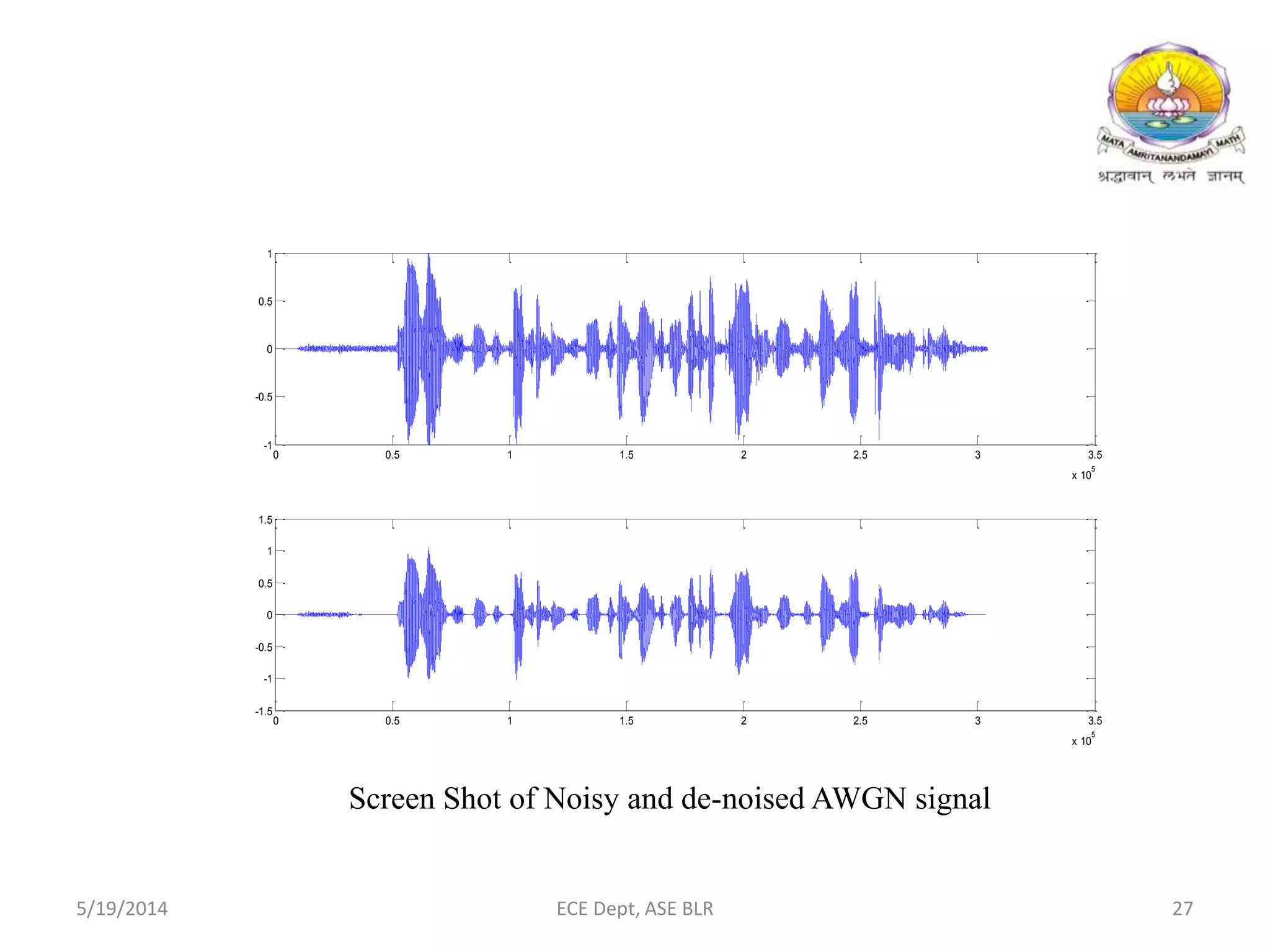
Screen Shot of Noisy and de-noised AWGN signal
0 0.5 1 1.5 2 2.5 3 3.5
x 10
5
-1.5
-1
-0.5
0
0.5
1
1.5
0 0.5 1 1.5 2 2.5 3 3.5
x 10
5
-1
-0.5
0
0.5
1
5/19/2014 ECE Dept, ASE BLR 27
5/19/2014 ECE Dept, ASE BLR 28
0 0.5 1 1.5 2 2.5
x 10
5
-2
-1
0
1
2
0 0.5 1 1.5 2 2.5
x 10
5
-1
-0.5
0
0.5
1
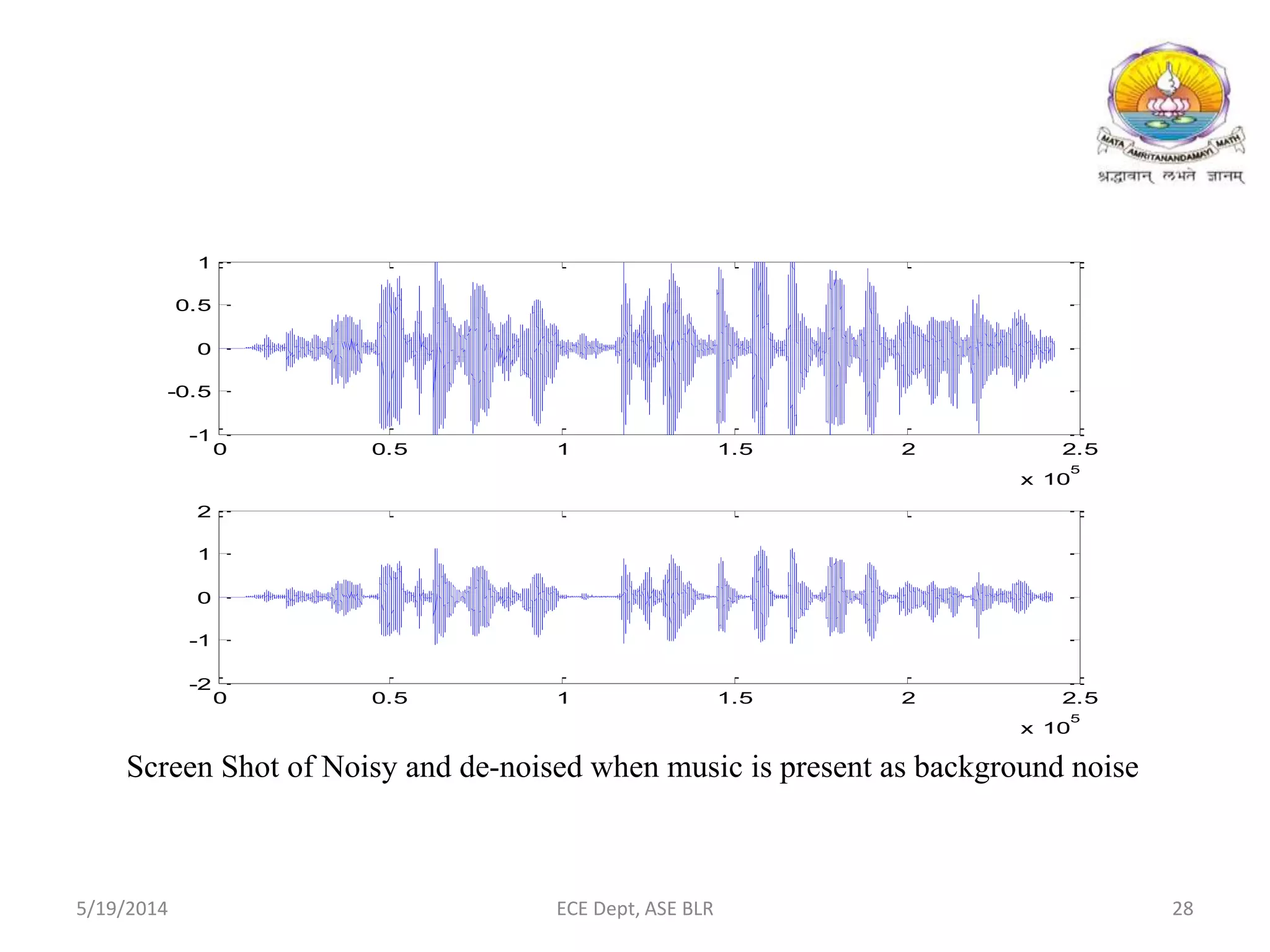
Screen Shot of Noisy and de-noised when music is present as background noise
Conclusion
• Successfully able to reduce several types of
noise like babble, white , music , AWGN
• It shows better performance compared to that
of traditional spectral subtraction algorithms
• It can remove noise from low as well as high
SNR speech
5/19/2014 ECE Dept, ASE BLR 29
Future Scope
• De-noising the signal without assuming that
the first 5 frames is only noise.
• To remove the background noise completely
5/19/2014 ECE Dept, ASE BLR 30
References
• Roopali Goel, Ritesh Jain “Speech Signal Noise Reduction by Wavelets”
International Journal of Innovative Technology and Exploring Engineering
(IJITEE) ISSN: 2278-3075, Volume-2, Issue-4, March 2013
• Yang Lu, Philipos C. Loizou “A geometric approach to spectral subtraction”
Department of Electrical Engineering, University of Texas-Dallas, Richardson,
TX 75083-0688, United States 24 January 2008.
• Adrian E. Villanueva- Luna1, Alberto Jaramillo-Nuñez1, Daniel Sanchez-
Lucero1, Carlos M. Ortiz-Lima1,J. Gabriel Aguilar-Soto1, Aaron Flores-Gil2 and
Manuel May-Alarcon “Denoising audio signals” using matlab Instituto
Nacional de Astrofisica, Optica y Electronica (INAOE) Universidad Autonoma
del Carmen (UNACAR) Mexico.
• Martin R., 2001. Noise power spectral density estimation based on
optimal smoothing and minimum statistics. IEEE Trans. Speech
Audio Process. 9 (5), 504–512
5/19/2014 ECE Dept, ASE BLR 31

Geometric Approach to Spectral Substraction

  • 1.
    A GEOMETRIC APPROACHTO SPECTRAL SUBSTRACTION AND ADDITIVE WHITE GAUSSIAN NOISE REMOVAL USING WAVELETS P. S. Manasa :BL.EN.U4ECE10138 Keerthi Thallam :BL.EN.U4ECE10190 Guided by Dr. Shikha Tripathi Presented by 5/19/2014 ECE Dept, ASE BLR 1
  • 2.
    Contents • Introduction • Outlineof mid-semester presentation • White noise • Wavelet theory • De-noising using wavelet theory 1. Algorithm 2. Simulation results 3. Conclusion • A Geometric approach to Spectral Subtraction 1. Algorithm 2. Simulation results 3. Conclusion 5/19/2014 ECE Dept, ASE BLR 2
  • 3.
    Introduction • Speech enhancement(i.e removal noise from speech) is necessary to improve user perception • Noise degrades the quality of the information signal • De-Noising plays a major role in communication • Different de-noising techniques can be employed for different noises 5/19/2014 ECE Dept, ASE BLR 3
  • 4.
    Transient noise reductionusing diffusion filters Estimation power spectral density (PSD) of the transient noise by employing a NL neighborhood filter • Modeling speech signal as an autoregressive (AR) process in short-time frames • Decorrelating the noisy measurement y(n) in each time frame using the AR parameters • Find Fourier transform coefficients in each frame and find the PSD 5/19/2014 ECE Dept, ASE BLR 4
  • 5.
    Transient noise reductionusing diffusion filters (Contd…) • Modeling transient noise d(n) as d(n) = h(n) ∗ (b(n)v(n)) • Kernel to find out frames with and without transient noise 5/19/2014 ECE Dept, ASE BLR 5
  • 6.
    Methods Implemented Method 1:Reduction of noise(AWGN) using wavelets (Roopali Goel et al.,2013) Method 2: Geometric approach to spectral subtraction (Yang Lu et al.,2008) 5/19/2014 ECE Dept, ASE BLR 6
  • 7.
    White Noise • Impulseautocorrelation function • Flat power spectrum(equal power in all frequencies) a) Time-domain signal b) Autocorrelation c) PSD 5/19/2014 ECE Dept, ASE BLR 7
  • 8.
    Wavelets • Low frequencycomponents gives the speech its identity 5/19/2014 ECE Dept, ASE BLR 8
  • 9.
    Multiple Level Decomposition •The decomposition process can be iterated, with successive approximations 5/19/2014 ECE Dept, ASE BLR 9
  • 10.
    De-Noising Using Wavelets Algorithm •Noisy signal should be decomposed into tree of high and low frequency components. • For any particular level of the decomposed signal (tree) wavelet coefficients should be found out. • Tree level should be selected such that it gives better performance. • Threshold should be fount out using ‘Birge-Massart’ algorithm • Using the threshold value soft thresholding of the high frequency components is done . 5/19/2014 ECE Dept, ASE BLR 10 (Roopali Goel et al.,2013)
  • 11.
    Simulation Results 0 0.51 1.5 2 2.5 3 3.5 4 4.5 x 10 4 -0.2 0 0.2 0.4 0.6 time Amplitude original signal 0 0.5 1 1.5 2 2.5 3 3.5 4 4.5 x 10 4 -0.2 -0.1 0 0.1 0.2 time Amplitude Noisy signal 0 0.5 1 1.5 2 2.5 3 3.5 4 4.5 x 10 4 -0.2 -0.1 0 0.1 0.2 time Amplitude Denoised signal 5/19/2014 ECE Dept, ASE BLR 11 De-Noising noisy speech signal
  • 12.
    De-Noising sinusoidal signal 0500 1000 1500 2000 2500 -1 0 1 time Amplitude original signal 0 500 1000 1500 2000 2500 -2 0 2 time Amplitude Noisy signal 0 500 1000 1500 2000 2500 -2 0 2 time Amplitude Denoised signal 5/19/2014 ECE Dept, ASE BLR 12
  • 13.
    Correlation b/w originaland de-noised signal -20 -15 -10 -5 0 5 10 15 20 -0.8 -0.6 -0.4 -0.2 0 0.2 0.4 0.6 0.8 1 coif 5 lag samplecrosscorrelation Correlation @ 0 5/19/2014 ECE Dept, ASE BLR 13
  • 14.
    Conclusion • Successfully ableto remove AWGN • A high correlation value above 98% at lag value of zero has been achieved 5/19/2014 ECE Dept, ASE BLR 14
  • 15.
    A geometric approachto spectral subtraction (Yang Lu et al.,2008) • Does not suffer from musical noise distortion • Does not assume that the cross terms are zero • Performs significantly better than the traditional spectral subtractive algorithm • Based on representing the noisy speech spectrum in the complex plane as the sum of the clean signal and noise vectors 5/19/2014 ECE Dept, ASE BLR 15
  • 16.
    • let y(n)= x(n) + d(n) Where y(n)= sampled noisy speech signal x(n)= clean signal d(n)= noise signal •Taking the short-time Fourier transform of y(n) Where N is the frame length in samples • Short-term power spectrum of the noisy speech Algorithm 5/19/2014 ECE Dept, ASE BLR 16
  • 17.
    • Relative errorintroduced when neglecting the cross terms is given by • Relative error in terms of true SNR in frequency bin k Algorithm(Contd…) 5/19/2014 ECE Dept, ASE BLR 17
  • 18.
    • Equation ofnoisy speech signal in polar form Representation of Noise spectrum in complex plane as the sum of clean signal spectrum and noise spectrum Algorithm(Contd…) 5/19/2014 ECE Dept, ASE BLR 18
  • 19.
    •New gain functionwith out assuming cross terms to be equal to zero is • Using cosine rule Algorithm(Contd…) 5/19/2014 ECE Dept, ASE BLR 19
  • 20.
    •Dividing both numeratorand denominator of cxd and cyd by aD^2 we get Where a posteriori SNR a priori SNR So Algorithm(Contd…) 5/19/2014 ECE Dept, ASE BLR 20
  • 21.
    • Instantaneous estimateof γ is • To avoid rapid fluctuations smoothing of γ is done as follows Algorithm(Contd…) 5/19/2014 ECE Dept, ASE BLR 21
  • 22.
    • Does notuse a voice activity detector • Tracks spectral minima in each frequency band • Optimally smoothed power spectral density is estimated • Develops an unbiased noise power spectral density estimator Noise Power Spectral Density Estimation 5/19/2014 ECE Dept, ASE BLR 22
  • 23.
    Smoothing of PSD wheresmoothing parameter is 5/19/2014 ECE Dept, ASE BLR 23
  • 24.
    Unbiased estimator ofthe noise power spectral density 5/19/2014 ECE Dept, ASE BLR 24
  • 25.
    Simulation Result 0 0.51 1.5 2 2.5 3 3.5 4 4.5 x 10 4 -0.3 -0.2 -0.1 0 0.1 0.2 0.3 0.4 0 0.5 1 1.5 2 2.5 3 3.5 4 4.5 x 10 4 -0.4 -0.2 0 0.2 0.4 Screen Shot of Noisy and de-noised speech signal(babble) 5/19/2014 ECE Dept, ASE BLR 25
  • 26.
    0 2 46 8 10 12 14 x 10 4 -1 -0.5 0 0.5 1 1.5 0 2 4 6 8 10 12 14 x 10 4 -1 -0.5 0 0.5 1 Screen Shot of Noisy and de-noised car noise signal 5/19/2014 ECE Dept, ASE BLR 26
  • 27.
    Screen Shot ofNoisy and de-noised AWGN signal 0 0.5 1 1.5 2 2.5 3 3.5 x 10 5 -1.5 -1 -0.5 0 0.5 1 1.5 0 0.5 1 1.5 2 2.5 3 3.5 x 10 5 -1 -0.5 0 0.5 1 5/19/2014 ECE Dept, ASE BLR 27
  • 28.
    5/19/2014 ECE Dept,ASE BLR 28 0 0.5 1 1.5 2 2.5 x 10 5 -2 -1 0 1 2 0 0.5 1 1.5 2 2.5 x 10 5 -1 -0.5 0 0.5 1 Screen Shot of Noisy and de-noised when music is present as background noise
  • 29.
    Conclusion • Successfully ableto reduce several types of noise like babble, white , music , AWGN • It shows better performance compared to that of traditional spectral subtraction algorithms • It can remove noise from low as well as high SNR speech 5/19/2014 ECE Dept, ASE BLR 29
  • 30.
    Future Scope • De-noisingthe signal without assuming that the first 5 frames is only noise. • To remove the background noise completely 5/19/2014 ECE Dept, ASE BLR 30
  • 31.
    References • Roopali Goel,Ritesh Jain “Speech Signal Noise Reduction by Wavelets” International Journal of Innovative Technology and Exploring Engineering (IJITEE) ISSN: 2278-3075, Volume-2, Issue-4, March 2013 • Yang Lu, Philipos C. Loizou “A geometric approach to spectral subtraction” Department of Electrical Engineering, University of Texas-Dallas, Richardson, TX 75083-0688, United States 24 January 2008. • Adrian E. Villanueva- Luna1, Alberto Jaramillo-Nuñez1, Daniel Sanchez- Lucero1, Carlos M. Ortiz-Lima1,J. Gabriel Aguilar-Soto1, Aaron Flores-Gil2 and Manuel May-Alarcon “Denoising audio signals” using matlab Instituto Nacional de Astrofisica, Optica y Electronica (INAOE) Universidad Autonoma del Carmen (UNACAR) Mexico. • Martin R., 2001. Noise power spectral density estimation based on optimal smoothing and minimum statistics. IEEE Trans. Speech Audio Process. 9 (5), 504–512 5/19/2014 ECE Dept, ASE BLR 31