Noise Suppression using Wiener Filtering
Swayam Mittal, Richard Gormley
Acoustic Signal Processing
OXDS 2017-2018
Topics
 Algorithm
 Wiener Filtering
 Noise Power Spectral Distribution (PSD) estimation
 Speech PSD estimation : all-pole model
 Voice Activity Detector
 Results
 Evaluation metrics
 Sentence and word denoising
 Conclusion
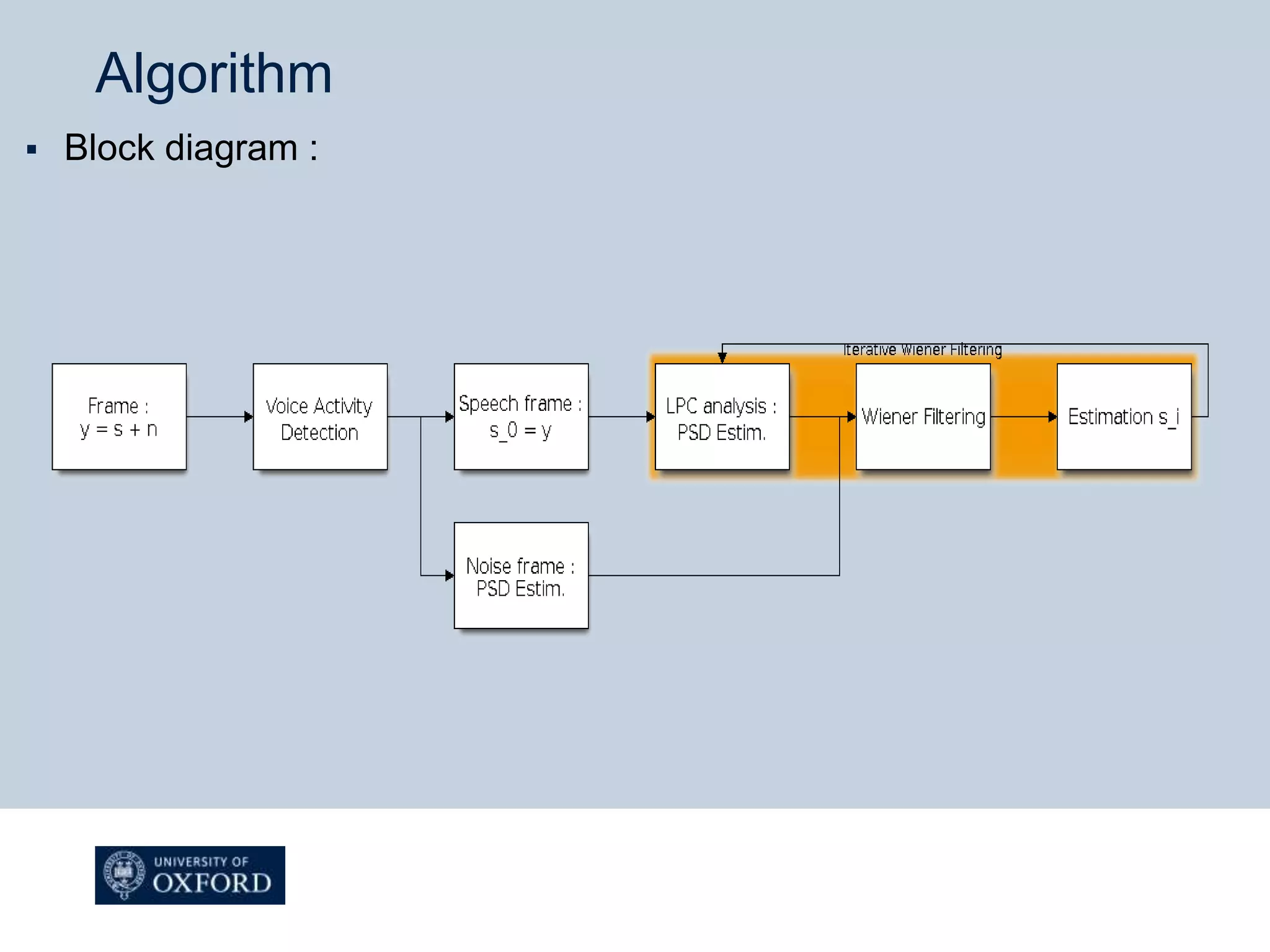
Algorithm
 Block diagram :
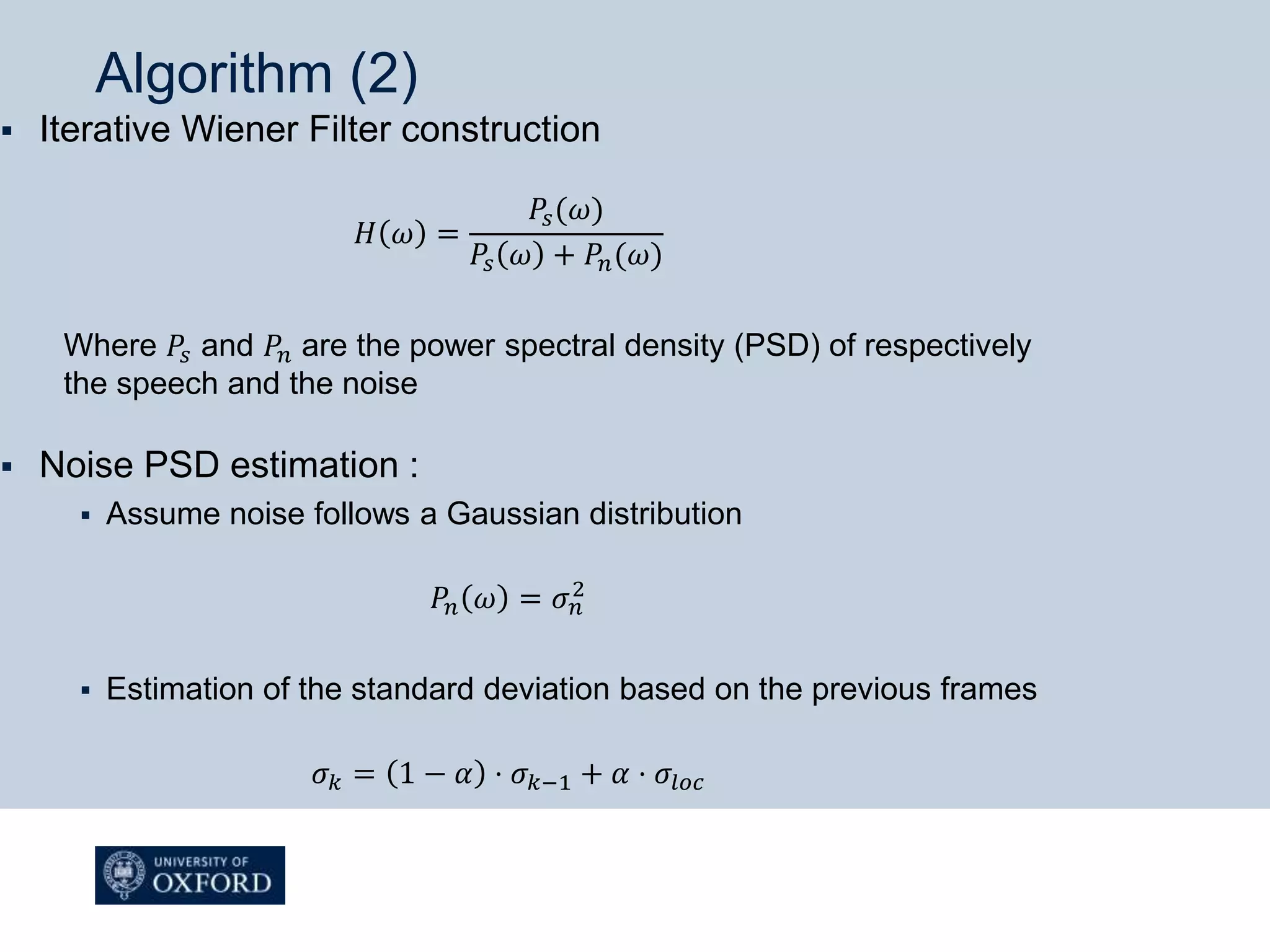
Algorithm (2)
 Iterative Wiener Filter construction
𝐻 𝜔 =
𝑃𝑠(𝜔)
𝑃𝑠 𝜔 + 𝑃𝑛(𝜔)
Where 𝑃𝑠 and 𝑃𝑛 are the power spectral density (PSD) of respectively
the speech and the noise
 Noise PSD estimation :
 Assume noise follows a Gaussian distribution
𝑃𝑛 𝜔 = 𝜎 𝑛
2
 Estimation of the standard deviation based on the previous frames
𝜎 𝑘 = 1 − 𝛼 ⋅ 𝜎 𝑘−1 + 𝛼 ⋅ 𝜎𝑙𝑜𝑐
Algorithm (3)
 Speech PSD estimation : all-pole modeling
 Auto-regressive process
𝑠 𝑙 =
𝑘=1
𝑝
𝑎 𝑘 𝑠 𝑙 − 𝑘 + 𝑔 ⋅ 𝑤 𝑙
 Where 𝑔 is a gain factor, 𝑤 𝑙 is a simple periodic excitation, 𝑎 𝑘 is the DFT
coefficient
 The estimated PSD is given by :
𝑃𝑠 𝜔 =
𝑔2
1 − 𝑘=1
𝑝
𝑎 𝑘 𝑒−𝑗𝑘𝜔 2
Improving the algorithm ?
 Add Voice Activity Detector
 Allows to calculate 𝑃𝑛 𝜔 only on speechless frames
 Wiener filter computation is expensive
 Compute the signal energy level :
 𝐿 𝑛
=
1
𝐾 𝑘=0
𝐾−1
𝑊𝑘 ⋅ 𝑌𝑘
𝑛
2
 Where 𝑊𝑘 is a weighting function and 𝑌𝑘
𝑛
is the DFT of frame
𝑛
Improving the algorithm (2)
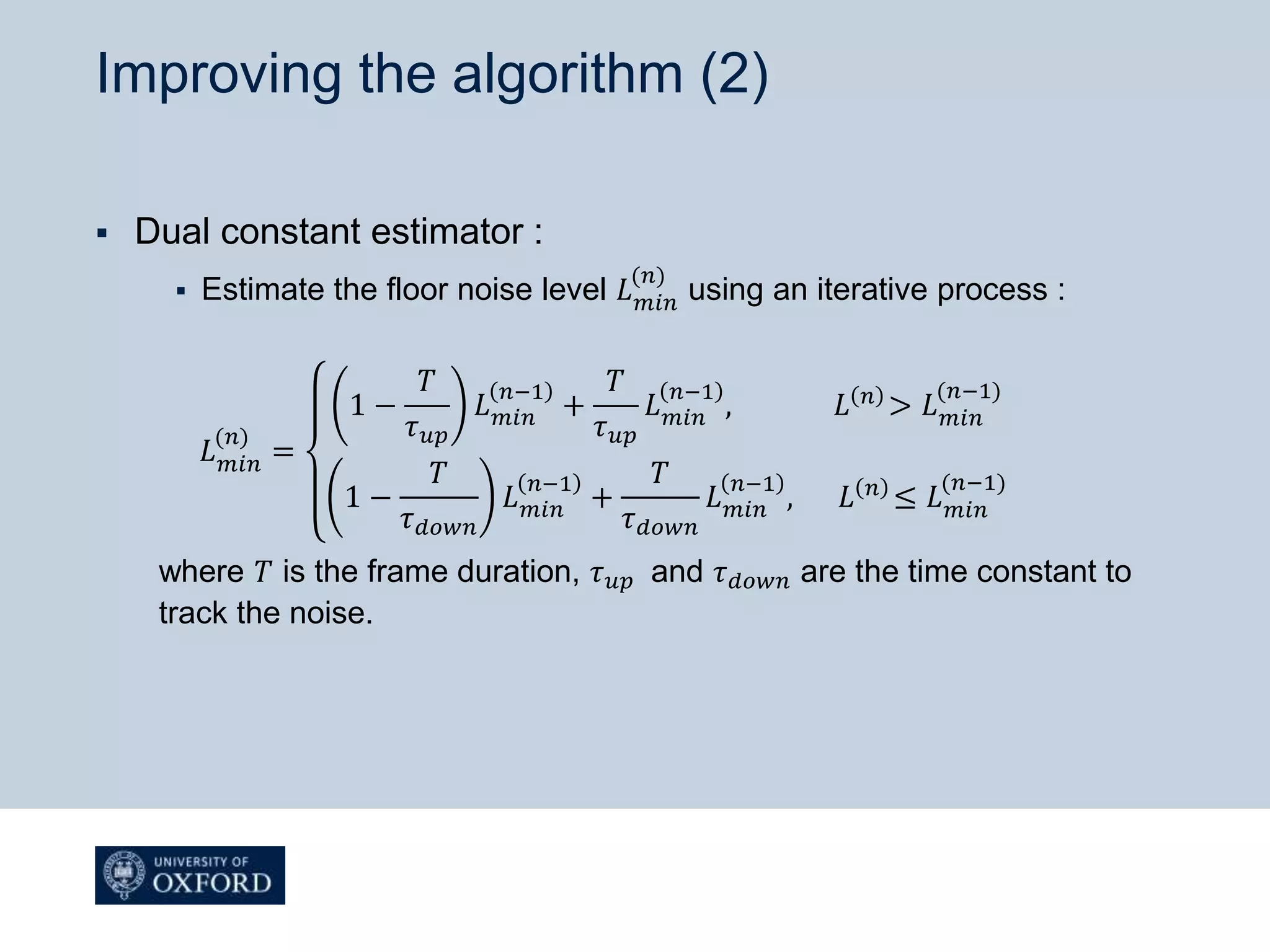
 Dual constant estimator :
 Estimate the floor noise level 𝐿 𝑚𝑖𝑛
(𝑛)
using an iterative process :
𝐿 𝑚𝑖𝑛
(𝑛)
=
1 −
𝑇
𝜏 𝑢𝑝
𝐿 𝑚𝑖𝑛
𝑛−1
+
𝑇
𝜏 𝑢𝑝
𝐿 𝑚𝑖𝑛
𝑛−1
, 𝐿 𝑛
> 𝐿 𝑚𝑖𝑛
(𝑛−1)
1 −
𝑇
𝜏 𝑑𝑜𝑤𝑛
𝐿 𝑚𝑖𝑛
𝑛−1
+
𝑇
𝜏 𝑑𝑜𝑤𝑛
𝐿 𝑚𝑖𝑛
𝑛−1
, 𝐿 𝑛 ≤ 𝐿 𝑚𝑖𝑛
(𝑛−1)
where 𝑇 is the frame duration, 𝜏 𝑢𝑝 and 𝜏 𝑑𝑜𝑤𝑛 are the time constant to
track the noise.
Improving the algorithm (3)
 Final decision :
 𝑉 𝑛
=
0, if
𝐿 𝑛
𝐿 𝑚𝑖𝑛
(𝑛) > 𝑇𝑑𝑜𝑤𝑛
1, if
𝐿 𝑛
𝐿 𝑚𝑖𝑛
(𝑛) > 𝑇𝑑𝑜𝑤𝑛
𝑉 𝑛−1
, otherwise
Evaluation
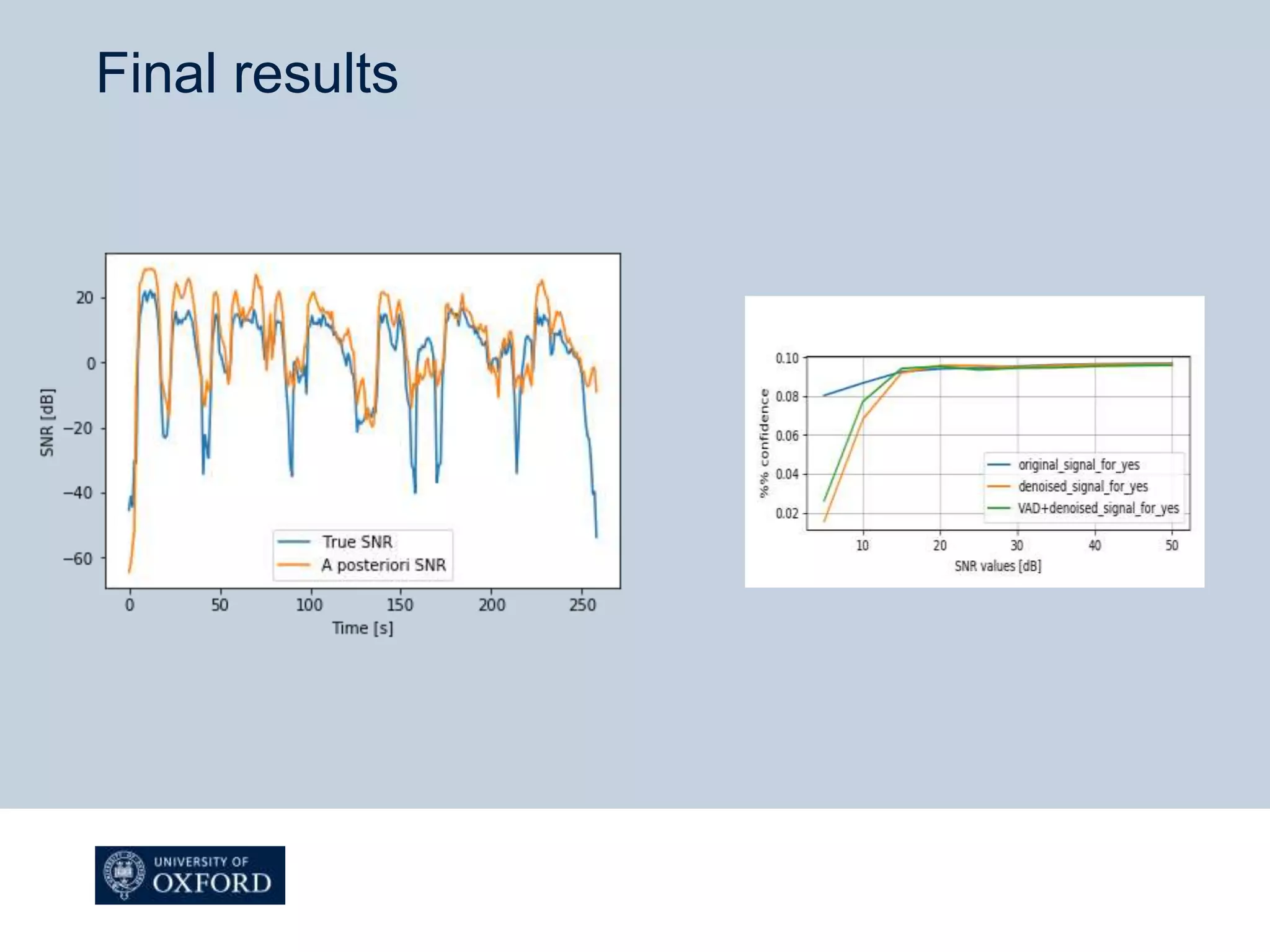
 A posteriori SNR
 Build estimate of noise
 Compute SNR of the denoised signal
 Intelligibility
 A network is asked to classify speech signals at various SNR ratios,
and we compare its classification certainty for noisy speech and
denoised speech
Final results
Conclusion
 We have shown an algorithm used for speech denoising
 Based on LPC modelling
 The necessity of a VAD has been established
 For low SNR, a statistical model could be developped
 Lower computation time
 We improved the a posteriori SNR for all the noisy speech
samples
 Can be improved by correctly tuning the parameters in the
code
Questions ?

Noise suppression Algorithm

  • 1.
    Noise Suppression usingWiener Filtering Swayam Mittal, Richard Gormley Acoustic Signal Processing OXDS 2017-2018
  • 2.
    Topics  Algorithm  WienerFiltering  Noise Power Spectral Distribution (PSD) estimation  Speech PSD estimation : all-pole model  Voice Activity Detector  Results  Evaluation metrics  Sentence and word denoising  Conclusion
  • 3.
  • 4.
    Algorithm (2)  IterativeWiener Filter construction 𝐻 𝜔 = 𝑃𝑠(𝜔) 𝑃𝑠 𝜔 + 𝑃𝑛(𝜔) Where 𝑃𝑠 and 𝑃𝑛 are the power spectral density (PSD) of respectively the speech and the noise  Noise PSD estimation :  Assume noise follows a Gaussian distribution 𝑃𝑛 𝜔 = 𝜎 𝑛 2  Estimation of the standard deviation based on the previous frames 𝜎 𝑘 = 1 − 𝛼 ⋅ 𝜎 𝑘−1 + 𝛼 ⋅ 𝜎𝑙𝑜𝑐
  • 5.
    Algorithm (3)  SpeechPSD estimation : all-pole modeling  Auto-regressive process 𝑠 𝑙 = 𝑘=1 𝑝 𝑎 𝑘 𝑠 𝑙 − 𝑘 + 𝑔 ⋅ 𝑤 𝑙  Where 𝑔 is a gain factor, 𝑤 𝑙 is a simple periodic excitation, 𝑎 𝑘 is the DFT coefficient  The estimated PSD is given by : 𝑃𝑠 𝜔 = 𝑔2 1 − 𝑘=1 𝑝 𝑎 𝑘 𝑒−𝑗𝑘𝜔 2
  • 6.
    Improving the algorithm?  Add Voice Activity Detector  Allows to calculate 𝑃𝑛 𝜔 only on speechless frames  Wiener filter computation is expensive  Compute the signal energy level :  𝐿 𝑛 = 1 𝐾 𝑘=0 𝐾−1 𝑊𝑘 ⋅ 𝑌𝑘 𝑛 2  Where 𝑊𝑘 is a weighting function and 𝑌𝑘 𝑛 is the DFT of frame 𝑛
  • 7.
    Improving the algorithm(2)  Dual constant estimator :  Estimate the floor noise level 𝐿 𝑚𝑖𝑛 (𝑛) using an iterative process : 𝐿 𝑚𝑖𝑛 (𝑛) = 1 − 𝑇 𝜏 𝑢𝑝 𝐿 𝑚𝑖𝑛 𝑛−1 + 𝑇 𝜏 𝑢𝑝 𝐿 𝑚𝑖𝑛 𝑛−1 , 𝐿 𝑛 > 𝐿 𝑚𝑖𝑛 (𝑛−1) 1 − 𝑇 𝜏 𝑑𝑜𝑤𝑛 𝐿 𝑚𝑖𝑛 𝑛−1 + 𝑇 𝜏 𝑑𝑜𝑤𝑛 𝐿 𝑚𝑖𝑛 𝑛−1 , 𝐿 𝑛 ≤ 𝐿 𝑚𝑖𝑛 (𝑛−1) where 𝑇 is the frame duration, 𝜏 𝑢𝑝 and 𝜏 𝑑𝑜𝑤𝑛 are the time constant to track the noise.
  • 8.
    Improving the algorithm(3)  Final decision :  𝑉 𝑛 = 0, if 𝐿 𝑛 𝐿 𝑚𝑖𝑛 (𝑛) > 𝑇𝑑𝑜𝑤𝑛 1, if 𝐿 𝑛 𝐿 𝑚𝑖𝑛 (𝑛) > 𝑇𝑑𝑜𝑤𝑛 𝑉 𝑛−1 , otherwise
  • 9.
    Evaluation  A posterioriSNR  Build estimate of noise  Compute SNR of the denoised signal  Intelligibility  A network is asked to classify speech signals at various SNR ratios, and we compare its classification certainty for noisy speech and denoised speech
  • 10.
  • 11.
    Conclusion  We haveshown an algorithm used for speech denoising  Based on LPC modelling  The necessity of a VAD has been established  For low SNR, a statistical model could be developped  Lower computation time  We improved the a posteriori SNR for all the noisy speech samples  Can be improved by correctly tuning the parameters in the code
  • 12.