International Research Journal of Engineering and Technology (IRJET) e-ISSN: 2395-0056
Volume: 09 Issue: 08 | Aug 2022 www.irjet.net p-ISSN: 2395-0072
© 2022, IRJET | Impact Factor value: 7.529 | ISO 9001:2008 Certified Journal | Page 517
Automatic Speech Recognition Incorporating Modulation Domain
Enhancement
Ms. Jyoti Londhe1
1,2Dept. Of Electronics and Telecommunication Engineering, TPCT’s college of engineering ,
Osmanabad, Maharashtra, India
---------------------------------------------------------------------***---------------------------------------------------------------------
Introduction
A clean and clear speech signal is linked to the amount of
sound in speech development. There are many waystomake
a speech signal without a clamor signal. In this paper we are
going to study emotion recognition by using KNN
filter(Wiener filter), FFT, and melcepts methods.In many
places Phones and cell phonesgetnoisyairDomainslikecars,
airports, roads, trains, stations. Therefore, we attempt to
eliminate the clamor signal by using a spectral reduction
method. The main purpose of this paper is for real-time
device to reduce or decreasebackground sound withavisual
speech signal, this is called speech development. Variety of
languages of speech are present, in that background noise
loweringspeech.Applicationslikemobilecommunicationcan
be learned a lot in recent years, speech improvement is
required. The purpose of this speech development is to
reverse the noise from a noisy speech, such as the speech
phase or accessibility. It is often difficult to remove the
background sound without interrupting the speech,
therefore, the exit of the speech enhancement system is not
allowed between speech contradiction and noise reduction.
There may be other techniques such as Wiener filtering,
wavelet-based, dynamic filtering and opticaloutputremaina
useful method. In order to reduce the spectral, we must
measure the clamor spectrum and reduce it from the
clamorous acoustic spectrum. Completely this approach,
there are the following three scenarios to consider: sound
adds speech signal and sound is not related to a single
channel in the market. During this paper, we attempted to
reduce the audio spectrum in order to improve distorted
speech by using spectral output. We have described the
method tested in theactualspeechdataframeintheMATLAB
area. The signals we receive from Real speech signals are a
website used for various tests. Then we suggest how to
reduce the noise between the average noise level and the
noise spectrum.
In general, only one medium system is set up based on a
variety of speech data andunwantedscreamingthat,itworks
in difficult situationswherenopreviousclamorintelligenceis
available. Genres often assume thatsoundisstablewhenever
the speech is alert. They usually allow for disturbed sound
during speech operations but in reality, when the sound is
not moving, the performance of the speech signal is greatly
reduced.
WAYS TO REDUCE NOISE
How to Remove the Spectral
Many additional variations ofthe various conclusionsare
designed to improve speech.The one we are using is thought
to be the end of the phantom release. This type works within
the scope of the spread and creates the hope that the help
cycle is said to be due to the phantom additon sound and
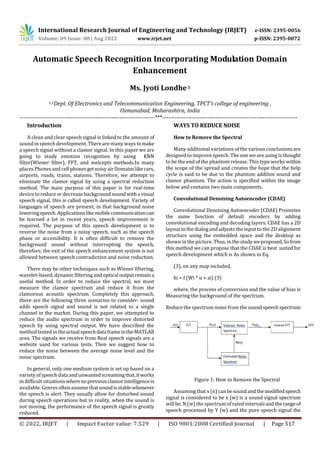
clamor phantom. The action is specified within the image
below and contains two main components.
Convolutional Denoising Autoencoder (CDAE)
Convolutional Denoising Autoencoder (CDAE) Promotes
the same function of default encoders by adding
convolutional encoding and decoding layers. CDAE has a 2D
layout in the dialogand adjusts the input to the 2D alignment
structure using the embedded space and the desktop as
shown in the picture. Thus, inthestudyweproposed,Sofrom
this method we can propose that the CDAE is best suited for
speech development which is As shown in Eq.
(3), on any map included,
hi = f (Wi * α + ai) (3)
where, the process of conversion and the value of bias is
Measuring the background of the spectrum.
Reduce the spectrum noise from the sound speechspectrum
Figure 1: How to Remove the Spectral
Assuming that x (n) canbesoundandthemodifiedspeech
signal is considered to be x (w) is a sound signal spectrum
will be, N (w) the spectrum ofrated intervalsandtherangeof
speech processed by Y (w) and the pure speech signal the
International Research Journal of Engineering and Technology (IRJET) e-ISSN: 2395-0056
Volume: 09 Issue: 08 | Aug 2022 www.irjet.net p-ISSN: 2395-0072
© 2022, IRJET | Impact Factor value: 7.529 | ISO 9001:2008 Certified Journal | Page 518
first is y (n). therefore, the processed spectrum of the
unpolluted speech signal will be provided as follows:
Y (w) = X (w) - N (w)
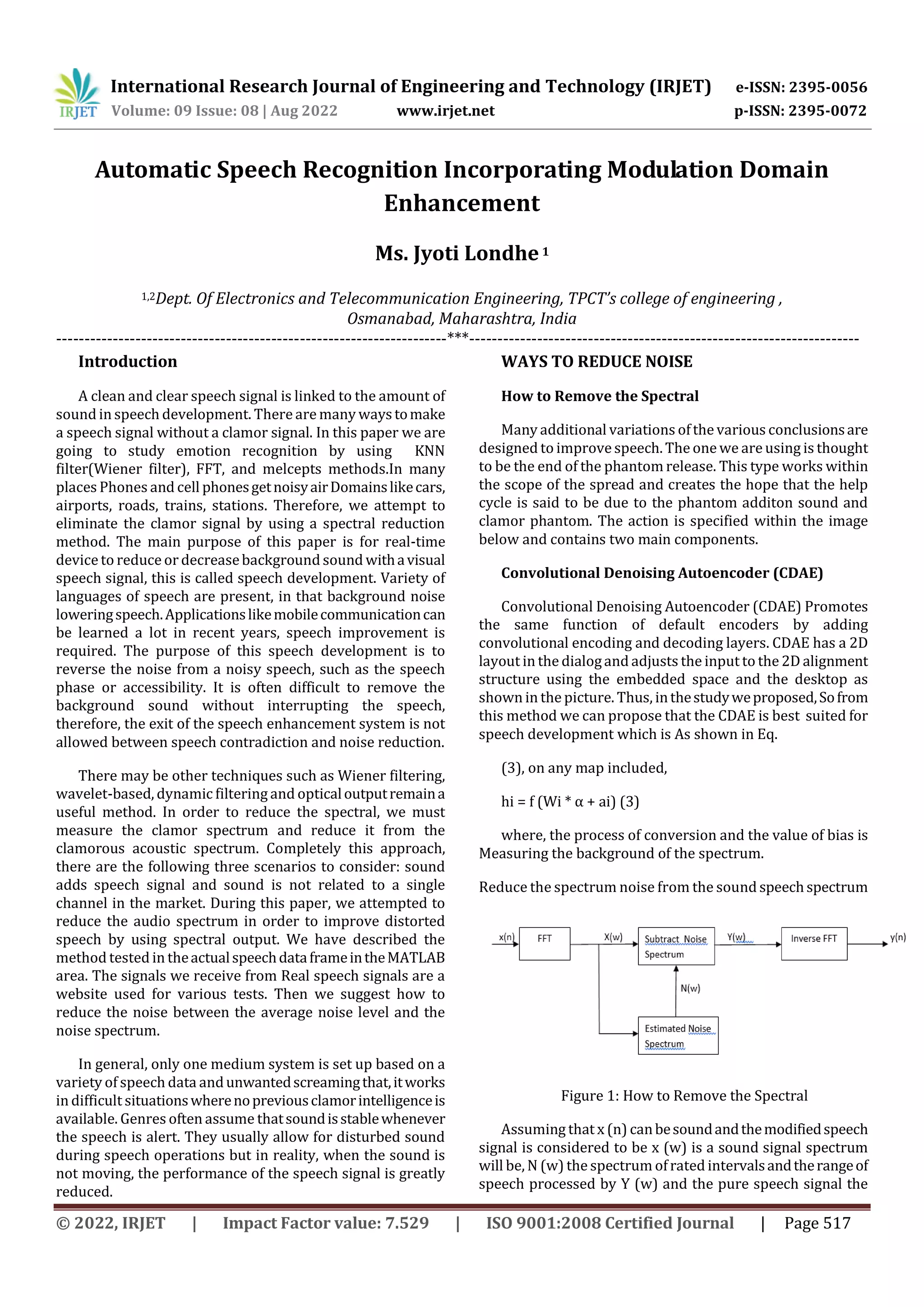
Next Drawing Speech Block Impression By Spectral
Removal.
Figure 2: Speech development block diagram
Here, create a continuous output signal. Each frame is
50% overwhelmed. FFT (Finite Fourier transform) is usedin
each frame.
FFTs are often useful in determining a signal hidden in a
noisy time zone in parts of frequency. The functions Y = FFT
(x)and y = IFFT (X)suggest the alternating rotationgiventhe
vectors length N by
Here,
The proposed method of noise reduction is provided for
visual removal that relied on thereductionofthebackground
sound level and the development of the speech signal.
Evaluate the volume of sound enhanced by reduced visual
acuity and the type of sound reduction recommended.
Sound spectrum measurement:
The spectrum soundcannotbe calculated in advance, but
it will be about the time for some instance speech is not
present within the sound speech. When the people are
speaking, one should definitely pause to take a deep breath.
We can take these gaps within speech to balance the
background.
We can calculate the average size which is calculated for
any frame in the last few seconds.
Removing Noise Spectrum:
After removing,all data of spectral signal which is appear
unlikely in positive values. Some chances are available for
removing unwantedparts.Fourierconversions,usingsection
segments directly from the Fourier conversion unit, and
additional additions are made to reconstruct the speech rate
within the time zone.
The basic idea is to reduce the noise fromtheinputsignal:
Y (w) = X (w) - N (w)
Suggest workflow and simulation results
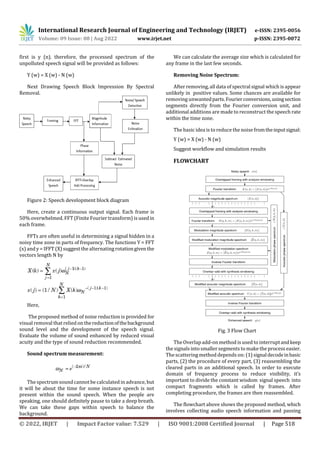
FLOWCHART
Fig. 3 Flow Chart
The Overlapadd-on method is used to interruptandkeep
the signals into smaller segments to make the process easier.
The scattering method depends on: (1) signaldecodeinbasic
parts, (2) the procedure of every part, (3) reassembling the
cleared parts in an additional speech. In order to execute
domain of frequency process to reduce visibility, it’s
important to divide the constant wisdom signal speech into
compact fragments which is called by frames. After
completing procedure, the frames are then reassembled.
The flowchart above shows the proposed method, which
involves collecting audio speech information and passing
International Research Journal of Engineering and Technology (IRJET) e-ISSN: 2395-0056
Volume: 09 Issue: 08 | Aug 2022 www.irjet.net p-ISSN: 2395-0072
© 2022, IRJET | Impact Factor value: 7.529 | ISO 9001:2008 Certified Journal | Page 519
through a window to extract existing art objects within the
Clamorous signal and use the FFT algorithm that detects the
phase and magnitude of the audio signal, during which the
Technology focuses on the size of the clamor to produce a
different refined speech signal. By using the type of visual
reduction the noise is measured and reduced by the value of
the required magnitude. Then use theIFFTalgorithmandthe
overlap adds the process to wish for a refined expression in
the time zone.
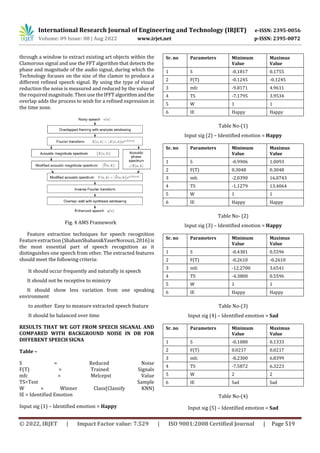
Fig. 4 AMS Framework
Feature extraction techniques for speech recognition
Featureextraction (ShahamShabani&YaserNorouzi,2016)is
the most essential part of speech recognition as it
distinguishes one speech from other. The extracted features
should meet the following criteria:
It should occur frequently and naturally in speech
It should not be receptive to mimicry
It should show less variation from one speaking
environment
to another Easy to measure extracted speech feature
It should be balanced over time
RESULTS THAT WE GOT FROM SPEECH SIGANAL AND
COMPARED WITH BACKGROUND NOISE IN DB FOR
DIFFERENT SPEECH SIGNA
Table –
S = Reduced Noise
F(T) = Trained Signals
mfc = Melcepst Value
TS=Test Sample
W = Winner Class(Classify KNN)
IE = Identified Emotion
Input sig (1) – Identified emotion = Happy
Sr. no Parameters Minimum
Value
Maximus
Value
1 S -0.1817 0.1755
2 F(T) -0.1245 -0.1245
3 mfc -9.8171 4.9611
4 TS -7.1795 3.9534
5 W 1 1
6 IE Happy Happy
Table No-(1)
Input sig (2) – Identified emotion = Happy
Sr. no Parameters Minimum
Value
Maximus
Value
1 S -0.9906 1.0093
2 F(T) 0.3048 0.3048
3 mfc -2.0390 16.0743
4 TS -1.1279 13.4064
5 W 1 1
6 IE Happy Happy
Table No- (2)
Input sig (3) – Identified emotion = Happy
Sr. no Parameters Minimum
Value
Maximus
Value
1 S -0.4381 0.5596
2 F(T) -0.2610 -0.2610
3 mfc -12.2700 3.6541
4 TS -4.3800 0.5596
5 W 1 1
6 IE Happy Happy
Table No-(3)
Input sig (4) – Identified emotion = Sad
Sr. no Parameters Minimum
Value
Maximus
Value
1 S -0.1080 0.1333
2 F(T) 0.0217 0.0217
3 mfc -8.2300 6.8399
4 TS -7.5872 6.3223
5 W 2 2
6 IE Sad Sad
Table No-(4)
Input sig (5) – Identified emotion = Sad
International Research Journal of Engineering and Technology (IRJET) e-ISSN: 2395-0056
Volume: 09 Issue: 08 | Aug 2022 www.irjet.net p-ISSN: 2395-0072
© 2022, IRJET | Impact Factor value: 7.529 | ISO 9001:2008 Certified Journal | Page 520
Sr. no Parameters Minimum
Value
Maximus
Value
1 S -0.3765 0.3768
2 F(T) -0.7768 1.6781
3 mfc -3.3124 5.2504
4 TS -0.7768 1.6781
5 W 2 2
6 IE Sad Sad
Table No-(5)
Input sig (6) – Identified emotion = Sad
Sr. no Parameters Minimum
Value
Maximus
Value
1 S -0.2380 0.2939
2 F(T) -0.0324 -0.0324
3 mfc -2.1412 3.9279
4 TS -1.2917 1.4274
5 W 2 2
6 IE Sad Sad
Table No-(6)
From Reduced noise level for male, It will be found the
amplitude stages of male andfemale sound getting inputand
output different. This indicates that it has a significant effect
on sound speech. It promotes the clamor reduction phase.
This type of spectral reduction creates a signal of speech but
also of shouting. Noise reduction was not properly
guaranteed and can be guaranteed if separated by input and
output.
The Clamor Stage of the input and output speech signal and
amplitude reduction updates are different from using the
table. Table 1 shows the background stage division for the
male and female speech signal site.
Emotions Recognition Accuracy Table :
Sr.No Sample
signal
Emotion
Recognition
Yes / No
Accuracy
Accuracy in
Percentage
(%)
1 jyoti.mp3 Happy yes 100%
2 Baba.mp3 Happy yes 100%
3 jyoti.mp3 Happy yes 100%
Table No (7)-Recognized happy emotion
Sr.No Sample
signal
Emotion
Recognition
Yes / No
Accuracy
Accuracy in
Percentage
(%)
1 umesh.mp3 Sad yes 66.66%
2 jyoti.mp3 Sad yes 66.66%
3 Baba.mp3 Happy No 66.66%
Table No (8)- Recognized Sad emotion
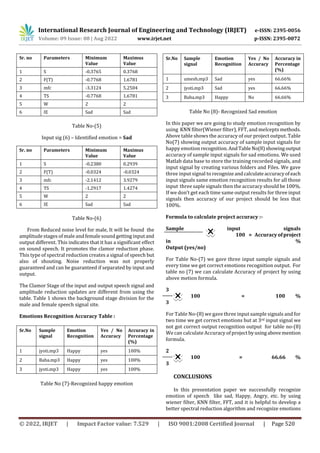
In this paper we are going to study emotion recognition by
using KNN filter(Wiener filter), FFT, and melcepts methods.
Above table shows the accuracy of our project output. Table
No(7) showing output accuracy of sample input signals for
happy emotion recognition. AndTableNo(8)showingoutput
accuracy of sample input signals for sad emotions. We used
Matlab data base to store the training recorded signals, and
input signal by creating various folders and Files. We gave
three input signal to recognizeandcalculateaccuracyofeach
input signals same emotion recognition results for all those
input three saple signals then the accuracy should be100%.
If we don’t get each time same output results for three input
signals then accuracy of our project should be less that
100%.
Formula to calculate project accuracy :-
Sample input signals
100 = Accuracy ofproject
in %
Output (yes/no)
For Table No-(7) we gave three input sample signals and
every time we get correct emotions recognition output. For
table no (7) we can calculate Accuracy of project by using
above metion formula.
3
100 = 100 %
3
For Table No-(8) we gave three input sample signals and for
two time we get correct emotions but at 3rd input signal we
not got correct output recognition output for table no-(8)
We can calculate Accuracy of projectbyusingabovemention
formula.
2
100 = 66.66 %
3
CONCLUSIONS
In this presentation paper we successfully recognize
emotion of speech like sad, Happy, Angry, etc. by using
wiener filter, KNN filter, FFT, and it is helpful to develop a
better spectral reduction algorithm and recognize emotions
International Research Journal of Engineering and Technology (IRJET) e-ISSN: 2395-0056
Volume: 09 Issue: 08 | Aug 2022 www.irjet.net p-ISSN: 2395-0072
© 2022, IRJET | Impact Factor value: 7.529 | ISO 9001:2008 Certified Journal | Page 521
of a speech by using methods like melcepts, MFCC, Spectral
subtraction. It has recently been observed in the fictional
results that the suggested type significantly reduces low
noise compared to the algorithm of many ways to reduce
visibility. This type of speech causes the signal to be visible
but is accompanied by a negative screaming.Thesoundisnot
very low and it is very low compared to input and output.
These forces will also be adjusted and expanded to
accommodate static noise. From this type of domain design
we have reached 70% and that we can build this system for
embedded organizations that are subject to speech
processing or communication purpose. For better
comparisons, weshowed resultsandthereforespectrograms
of clear, sound and preparedspeech.Deletethesite-prepared
speech sentence.
REFERENCES
[1] S. Kamath, and P. Loizou, A multi-band spectral
subtraction method for enhancing speech corrupted by
colored noise, ProceedingsofICASSP-2002,Orlando,FL,May
2002. R. Nicole, “Title of paper with only first word
capitalized,” J. Name Stand. Abbrev., in press.
[2] S. F. Boll, Suppression of acoustic noise in speech using
spectral subtraction, IEEE Trans. on Acoust. Speech & Signal
Processing, Vol. ASSP-27 , April 1979, 113- 120.
[3] M. Berouti, R. Schwartz, and J. Makhoul, Enhancement of
speech corrupted by acoustic noise, Proc. IEEE ICASSP ,
Washington DC, April 1979, 208- 211.
[4] H. Sameti, H. Sheikhzadeh, Li Deng, R. L. Brennan, HMM-
Based Strategies for Improvement of Speech Signals
Embedded in Non-stationary Noise, IEEE Transactions on
Speech and Audio Processing, Vol. 6, No. 5, September 1998.
International Research Journal of Engineering and
Technology (IRJET) e-ISSN:2395-0056Volume:04Issue:03
| Mar -2017 www.irjet.net p-ISSN:2395-0072©2017,IRJET
| Impact Factor value: 5.181 | ISO 9001:2008 Certified
Journal | Page 2488
[5] Yasser Ghanbari, Mohammad Reza Karami-Mollaei,
Behnam Ameritard “Improved Multi-Band Spectral
Subtraction Method For Speech Enhancement” IEEE
International Conference On Signal And Image Processing,
august 2004.
[6] Pinki, Sahil Gupta “Speech Enhancement using Spectral
Subtraction-type Algorithms” IEEE International Journal of
Engineering, Oct 2015.
[7] S. Kamath, A multi-band spectral subtraction method for
speech enhancement, MSc Thesis in Electrical Eng.,
University of Texas at Dallas, December 2001.
[8] Ganga Prasad, Surendar “A Review of Different
Approaches of Spectral Subtraction Algorithms for Speech
Enhancement” Current ResearchinEngineering,Scienceand
Technology (CREST) Journals, Vol 01 | Issue 02|April 2013|
57-64.
[9] Lalchhandami and Rajat Gupta “Different Approaches of
Spectral Subtraction Method for Speech Enhancement”
International Journal of Mathematical Sciences, Technology
and Humanities 95 (2013) 1056 – 1062 ISSN 2249 5460 .
[10]Ekaterina Verteletskaya,BorisSimak “Enhancedspectral
subtraction method for noise reductionwithminimal speech
distortion” IWSSIP 2010 - 17th International Conference on
Systems, Signals and Image Processing .
[11] D. Deepa, A. Shanmugam “Spectral Subtraction Method
of Speech Enhancement using Adaptive Estimation of Noise
with PDE method as a preprocessing technique” ICTACT
Journal Of Communication Technology, March 2010, Issue:
01.
[12]M. Berouti, R. Schwartz, & J. Makhoul, “Enhancement of
Speech Corrupted by Acoustic Noise,” Proc. ICASSP, pp. 208-
211, 1979.
[13] Prince Priya Malla, Amrit Mukherjee, Sidheswar
Routary, G Palai “Design and analysis of direction of arrival
using hybrid expectation-maximization and MUSIC for
wireless communication” IJLEO International Journal for
Light and Electron Optics, Vol. 170,October 2018.
[14] Pavan Paikrao, Amit Mukherjee, Deepak kumar Jain
“Smart emotion recognition framework: A secured IOVT
perspective”, IEEE Consumer Electronics Society, March
2021.
[15] Amrit Mukhrerjee, Pratik Goswani, Lixia Yang “DAI
based wireless sensor network for multimedia applications”
Multimedia Tools & Applications, May2021,Vol.80Issue11,
p16619-16633.15p.
[16] Sweta Alpana, Sagarika Choudhary, Amrit Mukhrjee,
Amlan Datta “Analysis of different error correcting methods
for high data rates cognitive radio applications based on
energy detection technique” , Journal of Advanced Research
in Dynamic and Control Systems, Volume:9 | Issue:4.
[17] Pavan D Paikrao, Sanjay L. Nalbalwar, ‘Analysis
Modification synthesis based Opti-mized Modulation
Spectral Subtraction for speech enhancement‘,International
jour-nal of Circuits Systems and Signal Processing,Vol.11, pg
343-352,2017.

Automatic Speech Recognition Incorporating Modulation Domain Enhancement

  • 1.
    International Research Journalof Engineering and Technology (IRJET) e-ISSN: 2395-0056 Volume: 09 Issue: 08 | Aug 2022 www.irjet.net p-ISSN: 2395-0072 © 2022, IRJET | Impact Factor value: 7.529 | ISO 9001:2008 Certified Journal | Page 517 Automatic Speech Recognition Incorporating Modulation Domain Enhancement Ms. Jyoti Londhe1 1,2Dept. Of Electronics and Telecommunication Engineering, TPCT’s college of engineering , Osmanabad, Maharashtra, India ---------------------------------------------------------------------***--------------------------------------------------------------------- Introduction A clean and clear speech signal is linked to the amount of sound in speech development. There are many waystomake a speech signal without a clamor signal. In this paper we are going to study emotion recognition by using KNN filter(Wiener filter), FFT, and melcepts methods.In many places Phones and cell phonesgetnoisyairDomainslikecars, airports, roads, trains, stations. Therefore, we attempt to eliminate the clamor signal by using a spectral reduction method. The main purpose of this paper is for real-time device to reduce or decreasebackground sound withavisual speech signal, this is called speech development. Variety of languages of speech are present, in that background noise loweringspeech.Applicationslikemobilecommunicationcan be learned a lot in recent years, speech improvement is required. The purpose of this speech development is to reverse the noise from a noisy speech, such as the speech phase or accessibility. It is often difficult to remove the background sound without interrupting the speech, therefore, the exit of the speech enhancement system is not allowed between speech contradiction and noise reduction. There may be other techniques such as Wiener filtering, wavelet-based, dynamic filtering and opticaloutputremaina useful method. In order to reduce the spectral, we must measure the clamor spectrum and reduce it from the clamorous acoustic spectrum. Completely this approach, there are the following three scenarios to consider: sound adds speech signal and sound is not related to a single channel in the market. During this paper, we attempted to reduce the audio spectrum in order to improve distorted speech by using spectral output. We have described the method tested in theactualspeechdataframeintheMATLAB area. The signals we receive from Real speech signals are a website used for various tests. Then we suggest how to reduce the noise between the average noise level and the noise spectrum. In general, only one medium system is set up based on a variety of speech data andunwantedscreamingthat,itworks in difficult situationswherenopreviousclamorintelligenceis available. Genres often assume thatsoundisstablewhenever the speech is alert. They usually allow for disturbed sound during speech operations but in reality, when the sound is not moving, the performance of the speech signal is greatly reduced. WAYS TO REDUCE NOISE How to Remove the Spectral Many additional variations ofthe various conclusionsare designed to improve speech.The one we are using is thought to be the end of the phantom release. This type works within the scope of the spread and creates the hope that the help cycle is said to be due to the phantom additon sound and clamor phantom. The action is specified within the image below and contains two main components. Convolutional Denoising Autoencoder (CDAE) Convolutional Denoising Autoencoder (CDAE) Promotes the same function of default encoders by adding convolutional encoding and decoding layers. CDAE has a 2D layout in the dialogand adjusts the input to the 2D alignment structure using the embedded space and the desktop as shown in the picture. Thus, inthestudyweproposed,Sofrom this method we can propose that the CDAE is best suited for speech development which is As shown in Eq. (3), on any map included, hi = f (Wi * α + ai) (3) where, the process of conversion and the value of bias is Measuring the background of the spectrum. Reduce the spectrum noise from the sound speechspectrum Figure 1: How to Remove the Spectral Assuming that x (n) canbesoundandthemodifiedspeech signal is considered to be x (w) is a sound signal spectrum will be, N (w) the spectrum ofrated intervalsandtherangeof speech processed by Y (w) and the pure speech signal the
  • 2.
    International Research Journalof Engineering and Technology (IRJET) e-ISSN: 2395-0056 Volume: 09 Issue: 08 | Aug 2022 www.irjet.net p-ISSN: 2395-0072 © 2022, IRJET | Impact Factor value: 7.529 | ISO 9001:2008 Certified Journal | Page 518 first is y (n). therefore, the processed spectrum of the unpolluted speech signal will be provided as follows: Y (w) = X (w) - N (w) Next Drawing Speech Block Impression By Spectral Removal. Figure 2: Speech development block diagram Here, create a continuous output signal. Each frame is 50% overwhelmed. FFT (Finite Fourier transform) is usedin each frame. FFTs are often useful in determining a signal hidden in a noisy time zone in parts of frequency. The functions Y = FFT (x)and y = IFFT (X)suggest the alternating rotationgiventhe vectors length N by Here, The proposed method of noise reduction is provided for visual removal that relied on thereductionofthebackground sound level and the development of the speech signal. Evaluate the volume of sound enhanced by reduced visual acuity and the type of sound reduction recommended. Sound spectrum measurement: The spectrum soundcannotbe calculated in advance, but it will be about the time for some instance speech is not present within the sound speech. When the people are speaking, one should definitely pause to take a deep breath. We can take these gaps within speech to balance the background. We can calculate the average size which is calculated for any frame in the last few seconds. Removing Noise Spectrum: After removing,all data of spectral signal which is appear unlikely in positive values. Some chances are available for removing unwantedparts.Fourierconversions,usingsection segments directly from the Fourier conversion unit, and additional additions are made to reconstruct the speech rate within the time zone. The basic idea is to reduce the noise fromtheinputsignal: Y (w) = X (w) - N (w) Suggest workflow and simulation results FLOWCHART Fig. 3 Flow Chart The Overlapadd-on method is used to interruptandkeep the signals into smaller segments to make the process easier. The scattering method depends on: (1) signaldecodeinbasic parts, (2) the procedure of every part, (3) reassembling the cleared parts in an additional speech. In order to execute domain of frequency process to reduce visibility, it’s important to divide the constant wisdom signal speech into compact fragments which is called by frames. After completing procedure, the frames are then reassembled. The flowchart above shows the proposed method, which involves collecting audio speech information and passing
  • 3.
    International Research Journalof Engineering and Technology (IRJET) e-ISSN: 2395-0056 Volume: 09 Issue: 08 | Aug 2022 www.irjet.net p-ISSN: 2395-0072 © 2022, IRJET | Impact Factor value: 7.529 | ISO 9001:2008 Certified Journal | Page 519 through a window to extract existing art objects within the Clamorous signal and use the FFT algorithm that detects the phase and magnitude of the audio signal, during which the Technology focuses on the size of the clamor to produce a different refined speech signal. By using the type of visual reduction the noise is measured and reduced by the value of the required magnitude. Then use theIFFTalgorithmandthe overlap adds the process to wish for a refined expression in the time zone. Fig. 4 AMS Framework Feature extraction techniques for speech recognition Featureextraction (ShahamShabani&YaserNorouzi,2016)is the most essential part of speech recognition as it distinguishes one speech from other. The extracted features should meet the following criteria: It should occur frequently and naturally in speech It should not be receptive to mimicry It should show less variation from one speaking environment to another Easy to measure extracted speech feature It should be balanced over time RESULTS THAT WE GOT FROM SPEECH SIGANAL AND COMPARED WITH BACKGROUND NOISE IN DB FOR DIFFERENT SPEECH SIGNA Table – S = Reduced Noise F(T) = Trained Signals mfc = Melcepst Value TS=Test Sample W = Winner Class(Classify KNN) IE = Identified Emotion Input sig (1) – Identified emotion = Happy Sr. no Parameters Minimum Value Maximus Value 1 S -0.1817 0.1755 2 F(T) -0.1245 -0.1245 3 mfc -9.8171 4.9611 4 TS -7.1795 3.9534 5 W 1 1 6 IE Happy Happy Table No-(1) Input sig (2) – Identified emotion = Happy Sr. no Parameters Minimum Value Maximus Value 1 S -0.9906 1.0093 2 F(T) 0.3048 0.3048 3 mfc -2.0390 16.0743 4 TS -1.1279 13.4064 5 W 1 1 6 IE Happy Happy Table No- (2) Input sig (3) – Identified emotion = Happy Sr. no Parameters Minimum Value Maximus Value 1 S -0.4381 0.5596 2 F(T) -0.2610 -0.2610 3 mfc -12.2700 3.6541 4 TS -4.3800 0.5596 5 W 1 1 6 IE Happy Happy Table No-(3) Input sig (4) – Identified emotion = Sad Sr. no Parameters Minimum Value Maximus Value 1 S -0.1080 0.1333 2 F(T) 0.0217 0.0217 3 mfc -8.2300 6.8399 4 TS -7.5872 6.3223 5 W 2 2 6 IE Sad Sad Table No-(4) Input sig (5) – Identified emotion = Sad
  • 4.
    International Research Journalof Engineering and Technology (IRJET) e-ISSN: 2395-0056 Volume: 09 Issue: 08 | Aug 2022 www.irjet.net p-ISSN: 2395-0072 © 2022, IRJET | Impact Factor value: 7.529 | ISO 9001:2008 Certified Journal | Page 520 Sr. no Parameters Minimum Value Maximus Value 1 S -0.3765 0.3768 2 F(T) -0.7768 1.6781 3 mfc -3.3124 5.2504 4 TS -0.7768 1.6781 5 W 2 2 6 IE Sad Sad Table No-(5) Input sig (6) – Identified emotion = Sad Sr. no Parameters Minimum Value Maximus Value 1 S -0.2380 0.2939 2 F(T) -0.0324 -0.0324 3 mfc -2.1412 3.9279 4 TS -1.2917 1.4274 5 W 2 2 6 IE Sad Sad Table No-(6) From Reduced noise level for male, It will be found the amplitude stages of male andfemale sound getting inputand output different. This indicates that it has a significant effect on sound speech. It promotes the clamor reduction phase. This type of spectral reduction creates a signal of speech but also of shouting. Noise reduction was not properly guaranteed and can be guaranteed if separated by input and output. The Clamor Stage of the input and output speech signal and amplitude reduction updates are different from using the table. Table 1 shows the background stage division for the male and female speech signal site. Emotions Recognition Accuracy Table : Sr.No Sample signal Emotion Recognition Yes / No Accuracy Accuracy in Percentage (%) 1 jyoti.mp3 Happy yes 100% 2 Baba.mp3 Happy yes 100% 3 jyoti.mp3 Happy yes 100% Table No (7)-Recognized happy emotion Sr.No Sample signal Emotion Recognition Yes / No Accuracy Accuracy in Percentage (%) 1 umesh.mp3 Sad yes 66.66% 2 jyoti.mp3 Sad yes 66.66% 3 Baba.mp3 Happy No 66.66% Table No (8)- Recognized Sad emotion In this paper we are going to study emotion recognition by using KNN filter(Wiener filter), FFT, and melcepts methods. Above table shows the accuracy of our project output. Table No(7) showing output accuracy of sample input signals for happy emotion recognition. AndTableNo(8)showingoutput accuracy of sample input signals for sad emotions. We used Matlab data base to store the training recorded signals, and input signal by creating various folders and Files. We gave three input signal to recognizeandcalculateaccuracyofeach input signals same emotion recognition results for all those input three saple signals then the accuracy should be100%. If we don’t get each time same output results for three input signals then accuracy of our project should be less that 100%. Formula to calculate project accuracy :- Sample input signals 100 = Accuracy ofproject in % Output (yes/no) For Table No-(7) we gave three input sample signals and every time we get correct emotions recognition output. For table no (7) we can calculate Accuracy of project by using above metion formula. 3 100 = 100 % 3 For Table No-(8) we gave three input sample signals and for two time we get correct emotions but at 3rd input signal we not got correct output recognition output for table no-(8) We can calculate Accuracy of projectbyusingabovemention formula. 2 100 = 66.66 % 3 CONCLUSIONS In this presentation paper we successfully recognize emotion of speech like sad, Happy, Angry, etc. by using wiener filter, KNN filter, FFT, and it is helpful to develop a better spectral reduction algorithm and recognize emotions
  • 5.
    International Research Journalof Engineering and Technology (IRJET) e-ISSN: 2395-0056 Volume: 09 Issue: 08 | Aug 2022 www.irjet.net p-ISSN: 2395-0072 © 2022, IRJET | Impact Factor value: 7.529 | ISO 9001:2008 Certified Journal | Page 521 of a speech by using methods like melcepts, MFCC, Spectral subtraction. It has recently been observed in the fictional results that the suggested type significantly reduces low noise compared to the algorithm of many ways to reduce visibility. This type of speech causes the signal to be visible but is accompanied by a negative screaming.Thesoundisnot very low and it is very low compared to input and output. These forces will also be adjusted and expanded to accommodate static noise. From this type of domain design we have reached 70% and that we can build this system for embedded organizations that are subject to speech processing or communication purpose. For better comparisons, weshowed resultsandthereforespectrograms of clear, sound and preparedspeech.Deletethesite-prepared speech sentence. REFERENCES [1] S. Kamath, and P. Loizou, A multi-band spectral subtraction method for enhancing speech corrupted by colored noise, ProceedingsofICASSP-2002,Orlando,FL,May 2002. R. Nicole, “Title of paper with only first word capitalized,” J. Name Stand. Abbrev., in press. [2] S. F. Boll, Suppression of acoustic noise in speech using spectral subtraction, IEEE Trans. on Acoust. Speech & Signal Processing, Vol. ASSP-27 , April 1979, 113- 120. [3] M. Berouti, R. Schwartz, and J. Makhoul, Enhancement of speech corrupted by acoustic noise, Proc. IEEE ICASSP , Washington DC, April 1979, 208- 211. [4] H. Sameti, H. Sheikhzadeh, Li Deng, R. L. Brennan, HMM- Based Strategies for Improvement of Speech Signals Embedded in Non-stationary Noise, IEEE Transactions on Speech and Audio Processing, Vol. 6, No. 5, September 1998. International Research Journal of Engineering and Technology (IRJET) e-ISSN:2395-0056Volume:04Issue:03 | Mar -2017 www.irjet.net p-ISSN:2395-0072©2017,IRJET | Impact Factor value: 5.181 | ISO 9001:2008 Certified Journal | Page 2488 [5] Yasser Ghanbari, Mohammad Reza Karami-Mollaei, Behnam Ameritard “Improved Multi-Band Spectral Subtraction Method For Speech Enhancement” IEEE International Conference On Signal And Image Processing, august 2004. [6] Pinki, Sahil Gupta “Speech Enhancement using Spectral Subtraction-type Algorithms” IEEE International Journal of Engineering, Oct 2015. [7] S. Kamath, A multi-band spectral subtraction method for speech enhancement, MSc Thesis in Electrical Eng., University of Texas at Dallas, December 2001. [8] Ganga Prasad, Surendar “A Review of Different Approaches of Spectral Subtraction Algorithms for Speech Enhancement” Current ResearchinEngineering,Scienceand Technology (CREST) Journals, Vol 01 | Issue 02|April 2013| 57-64. [9] Lalchhandami and Rajat Gupta “Different Approaches of Spectral Subtraction Method for Speech Enhancement” International Journal of Mathematical Sciences, Technology and Humanities 95 (2013) 1056 – 1062 ISSN 2249 5460 . [10]Ekaterina Verteletskaya,BorisSimak “Enhancedspectral subtraction method for noise reductionwithminimal speech distortion” IWSSIP 2010 - 17th International Conference on Systems, Signals and Image Processing . [11] D. Deepa, A. Shanmugam “Spectral Subtraction Method of Speech Enhancement using Adaptive Estimation of Noise with PDE method as a preprocessing technique” ICTACT Journal Of Communication Technology, March 2010, Issue: 01. [12]M. Berouti, R. Schwartz, & J. Makhoul, “Enhancement of Speech Corrupted by Acoustic Noise,” Proc. ICASSP, pp. 208- 211, 1979. [13] Prince Priya Malla, Amrit Mukherjee, Sidheswar Routary, G Palai “Design and analysis of direction of arrival using hybrid expectation-maximization and MUSIC for wireless communication” IJLEO International Journal for Light and Electron Optics, Vol. 170,October 2018. [14] Pavan Paikrao, Amit Mukherjee, Deepak kumar Jain “Smart emotion recognition framework: A secured IOVT perspective”, IEEE Consumer Electronics Society, March 2021. [15] Amrit Mukhrerjee, Pratik Goswani, Lixia Yang “DAI based wireless sensor network for multimedia applications” Multimedia Tools & Applications, May2021,Vol.80Issue11, p16619-16633.15p. [16] Sweta Alpana, Sagarika Choudhary, Amrit Mukhrjee, Amlan Datta “Analysis of different error correcting methods for high data rates cognitive radio applications based on energy detection technique” , Journal of Advanced Research in Dynamic and Control Systems, Volume:9 | Issue:4. [17] Pavan D Paikrao, Sanjay L. Nalbalwar, ‘Analysis Modification synthesis based Opti-mized Modulation Spectral Subtraction for speech enhancement‘,International jour-nal of Circuits Systems and Signal Processing,Vol.11, pg 343-352,2017.