
ELEMENTS OF
STRUCTURAL
GEOLOGY
ARUN.A,
RESHMA.B
University College,
Thiruvananthapuram
SRUCTURAL GEOLOGY
 Structural geology is the study of the three
dimensional distribution of large bodies of
rock, their surfaces, and their composition.
 We try to learn about their tectonic history,
past geological environments and event that
could have changed or deformed them.
DEFORMATION
In earth science, deformation means
alternation of size or shape of rock.
Deformation is caused by,
1. Deformative forces
2.Mechanical properties of Rock
3.Time period
4.Depth of formation
1 DEFORMATIVE FORCES
“The shape and size of a rock material change due
to the action of STRESS.”
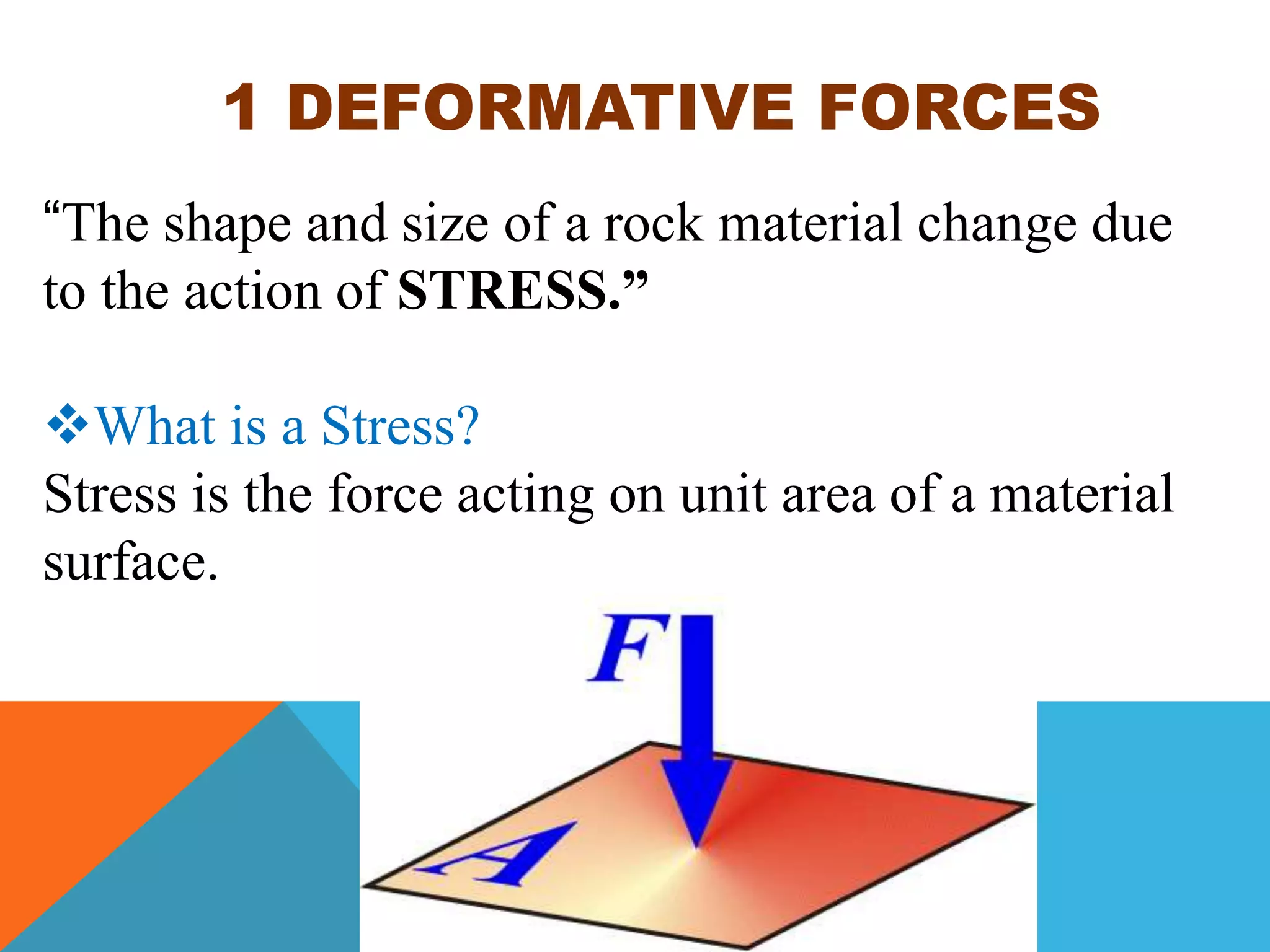
What is a Stress?
Stress is the force acting on unit area of a material
surface.
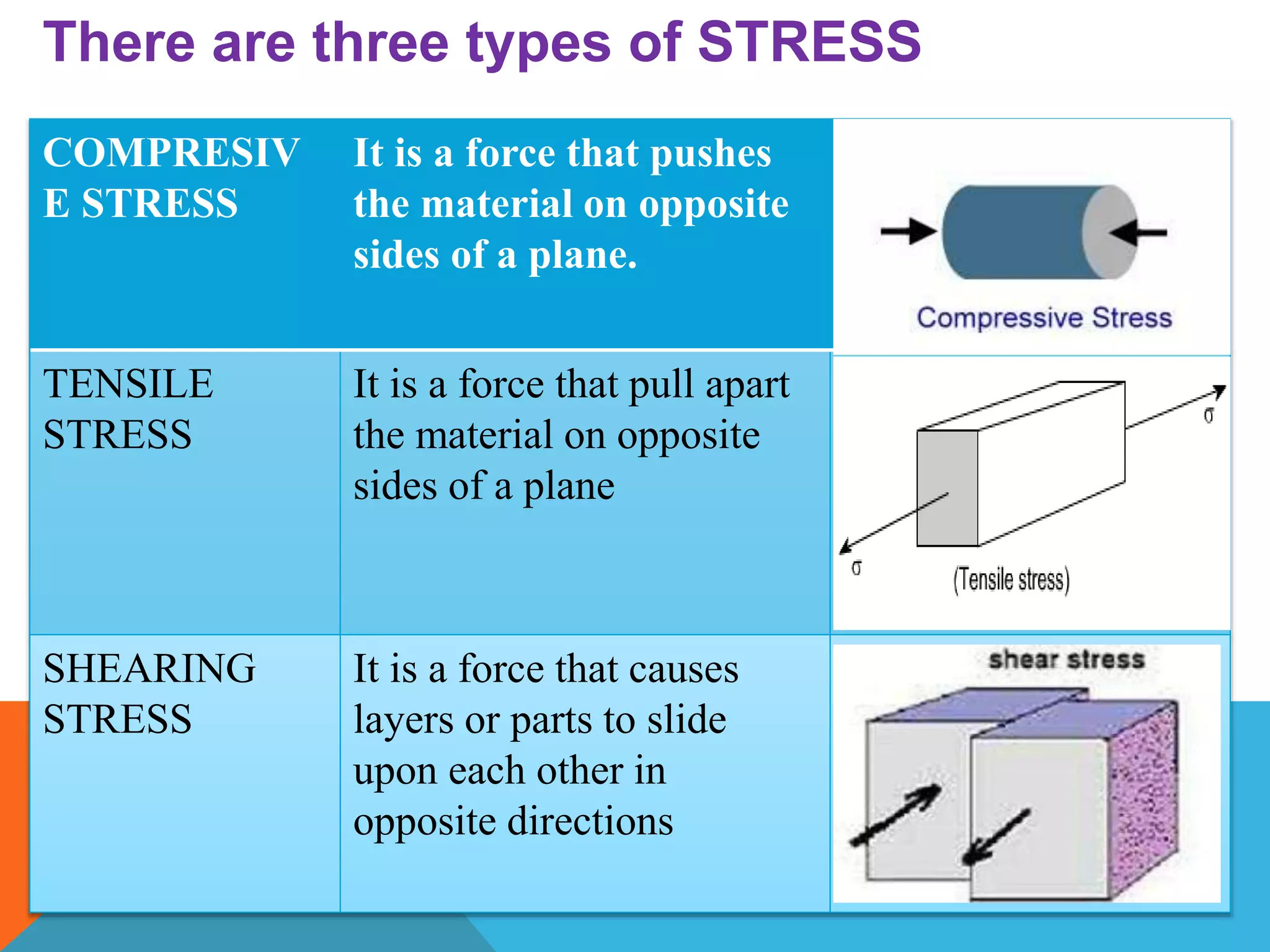
There are three types of STRESS
COMPRESIV
E STRESS
It is a force that pushes
the material on opposite
sides of a plane.
TENSILE
STRESS
It is a force that pull apart
the material on opposite
sides of a plane
SHEARING
STRESS
It is a force that causes
layers or parts to slide
upon each other in
opposite directions
“When rocks deform they are said to STRAIN”
What is a Strain?
A strain is a change in size, shape, or volume of a
material.
2 MECHANICAL PROPERTIES
OF ROCK
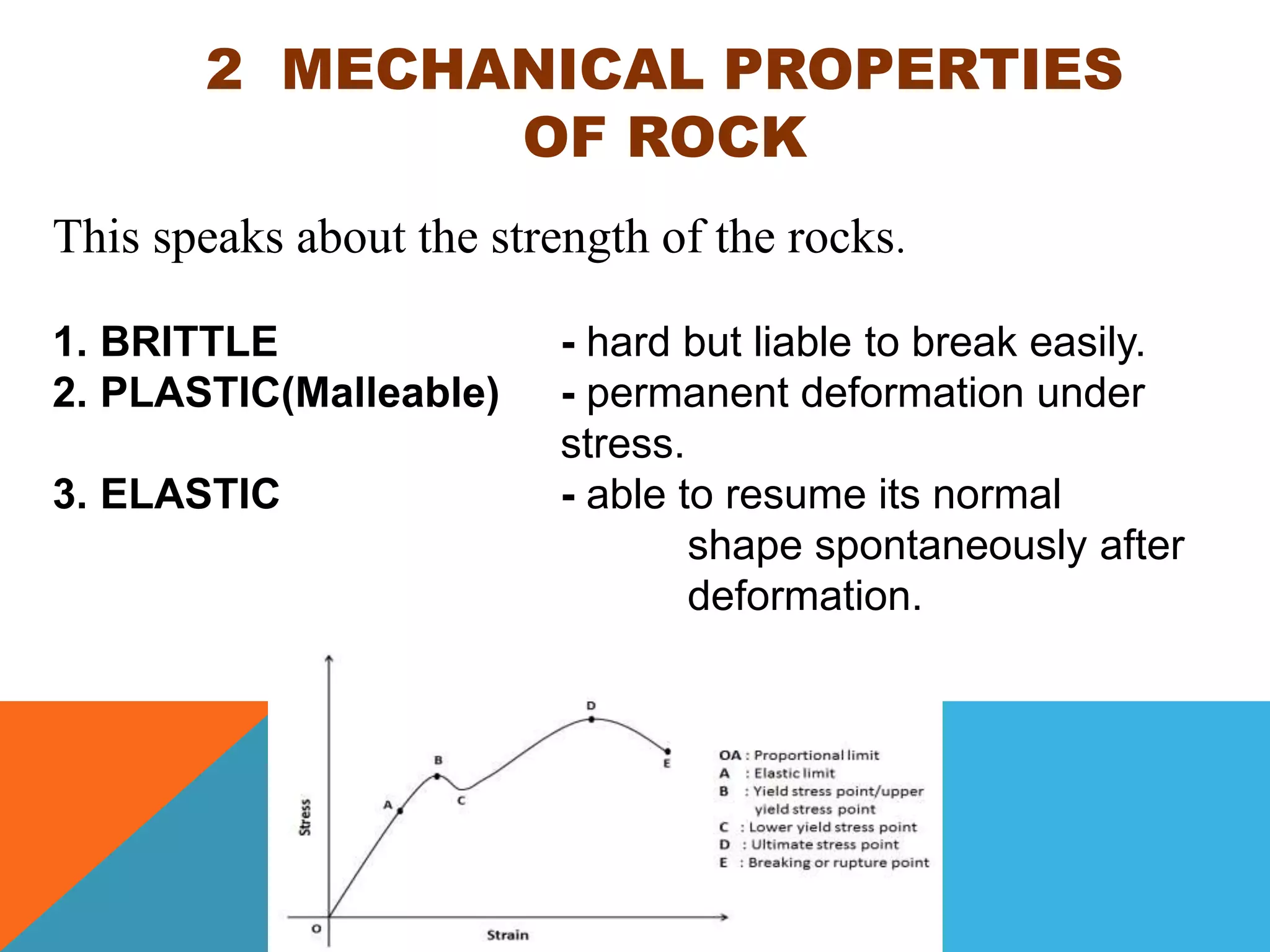
This speaks about the strength of the rocks.
1. BRITTLE - hard but liable to break easily.
2. PLASTIC(Malleable) - permanent deformation under
stress.
3. ELASTIC - able to resume its normal
shape spontaneously after
deformation.
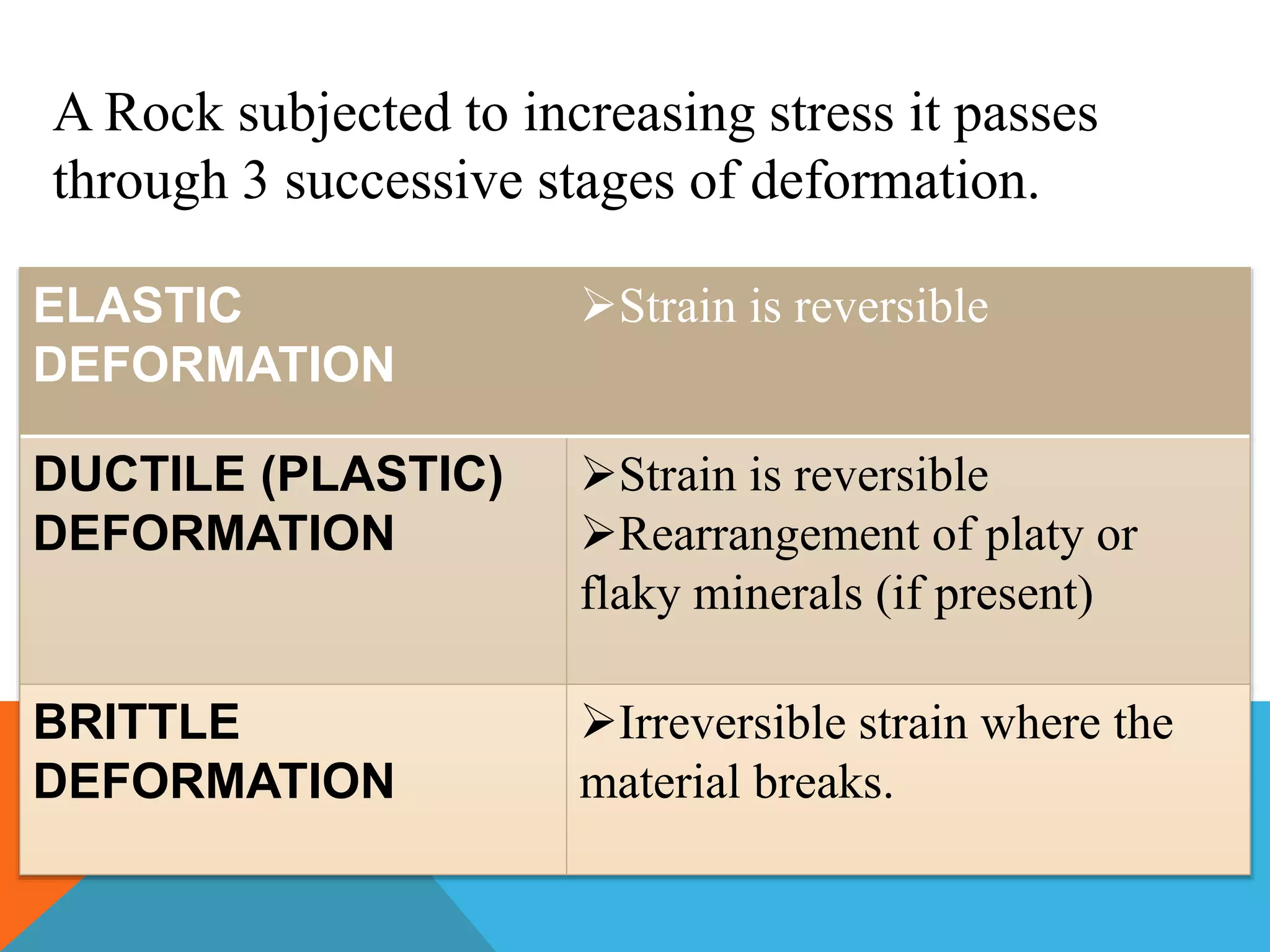
A Rock subjected to increasing stress it passes
through 3 successive stages of deformation.
ELASTIC
DEFORMATION
Strain is reversible
DUCTILE (PLASTIC)
DEFORMATION
Strain is reversible
Rearrangement of platy or
flaky minerals (if present)
BRITTLE
DEFORMATION
Irreversible strain where the
material breaks.
3 TIME
•A Small force acting over a great length of time
can bring about the same type of structure like
that produced by a large force acting over a short
period of time.
•Forces that are unable to deform rocks may
cause rock to flow, if it is maintained for a long
period of time.
4 DEPTH OF FORMATION
•A Rock situated in the shallow depth and
greater depth behave differently.
•Physical properties like Temperature, Litho
static pressure differ with respect to depth.
•The factor of Depth is called by the term
“Environment of Structural deformation”
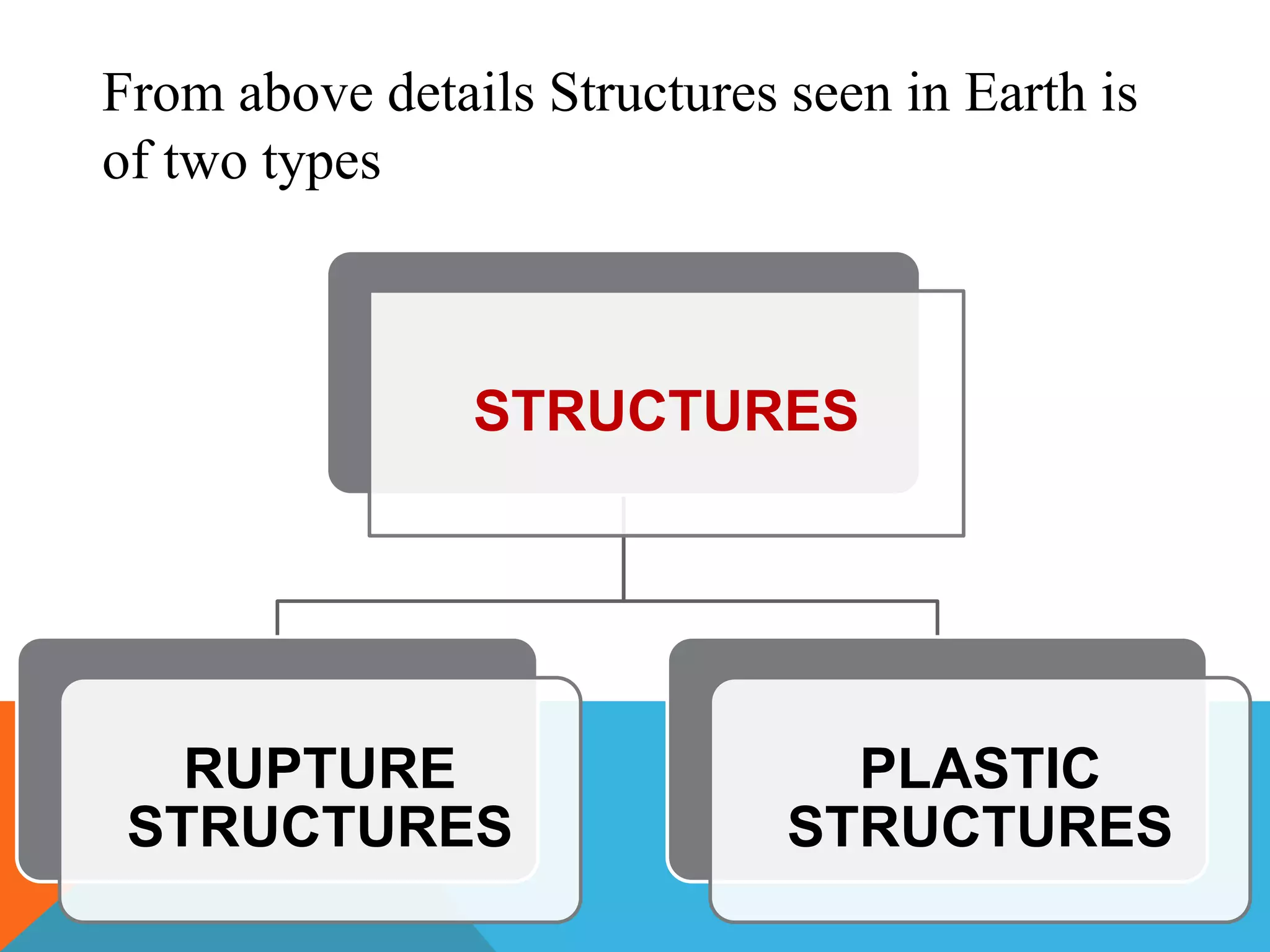
From above details Structures seen in Earth is
of two types
STRUCTURES
RUPTURE
STRUCTURES
PLASTIC
STRUCTURES
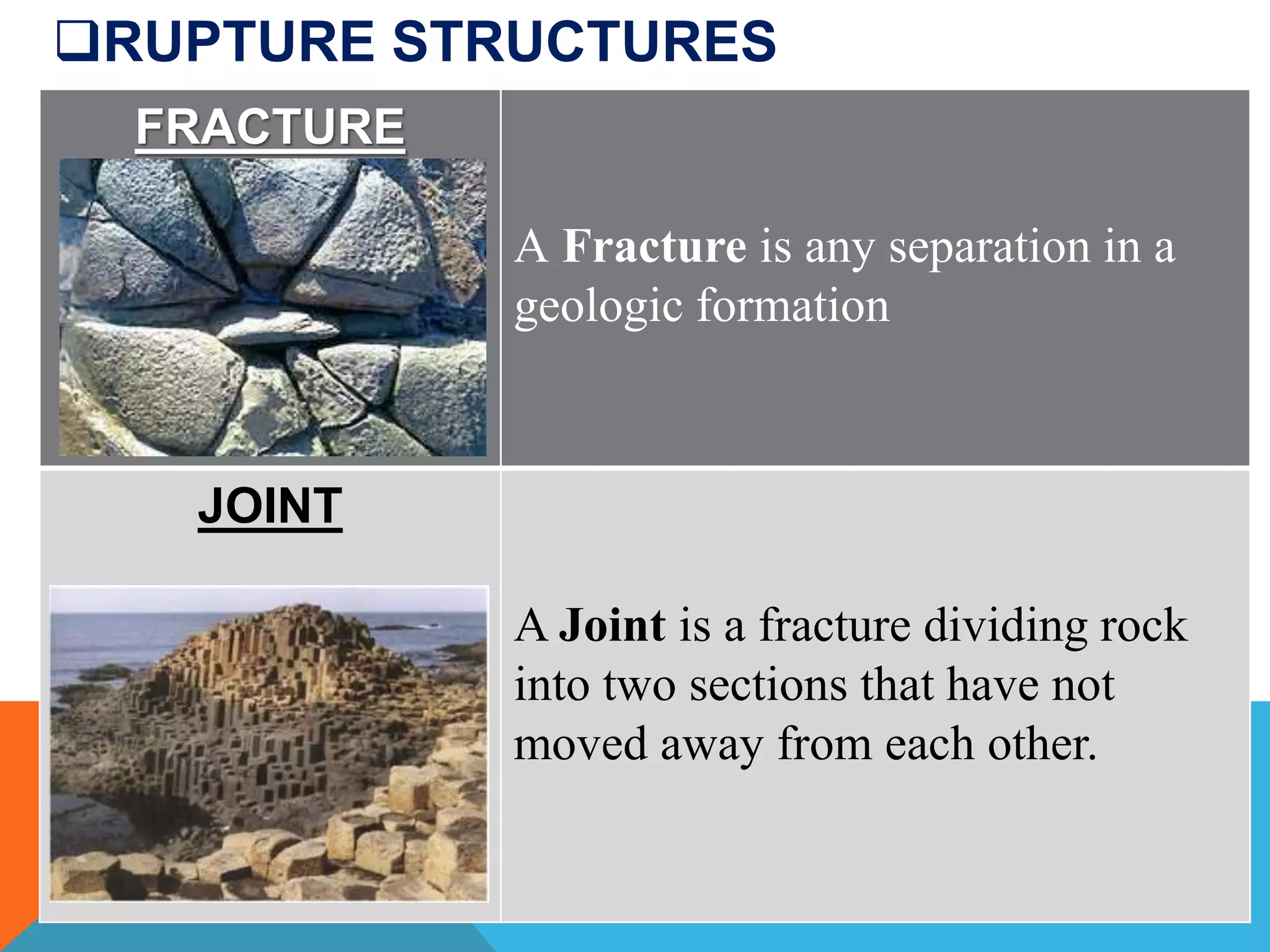
RUPTURE STRUCTURES
FRACTURE
A Fracture is any separation in a
geologic formation
JOINT
A Joint is a fracture dividing rock
into two sections that have not
moved away from each other.
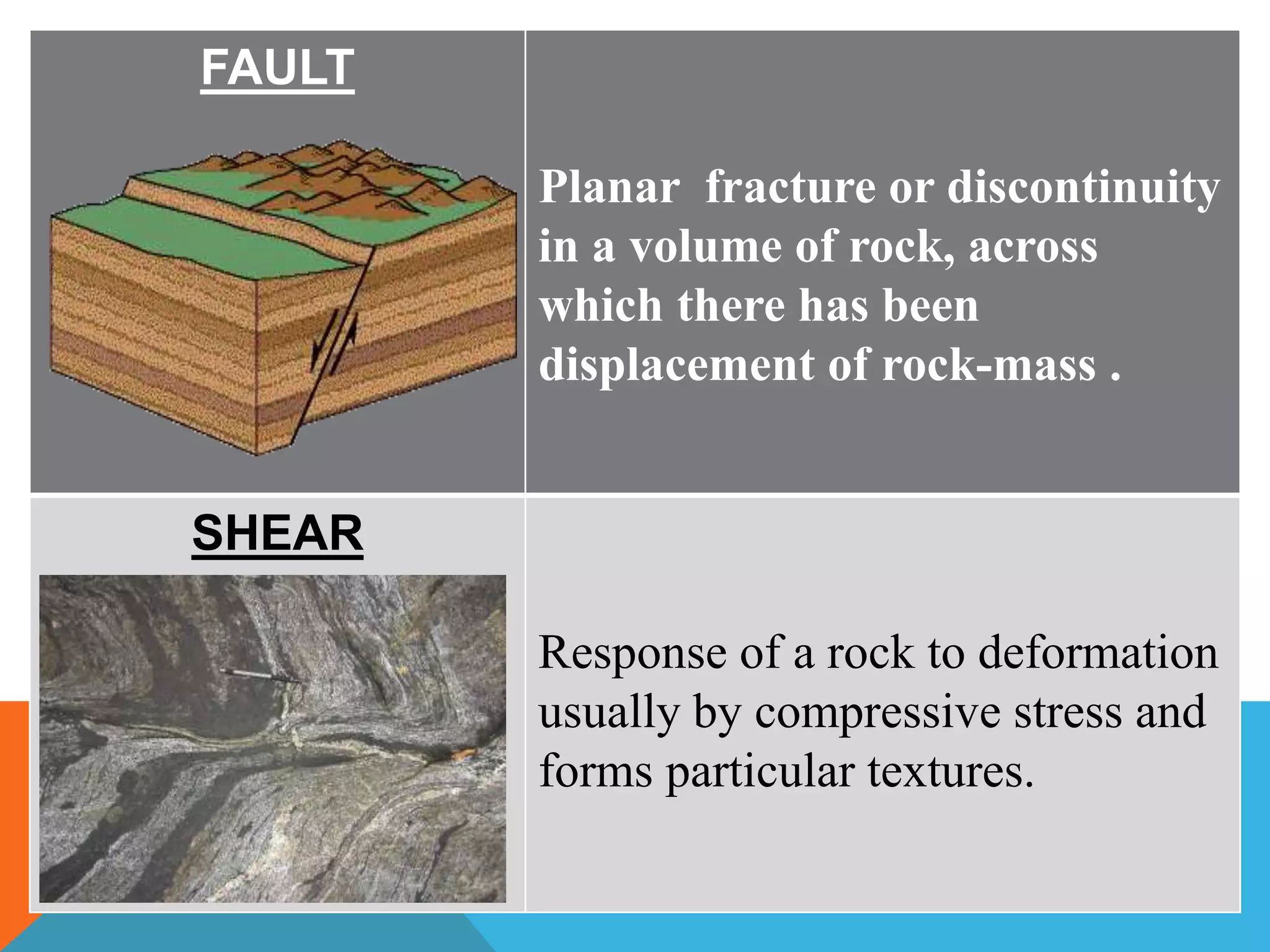
FAULT
Planar fracture or discontinuity
in a volume of rock, across
which there has been
displacement of rock-mass .
SHEAR
Response of a rock to deformation
usually by compressive stress and
forms particular textures.
PLASTIC STRUCTURES
FOLDS
One or a stack of originally flat
and planar surfaces are bent
or curved as a result of
permanent deformation
FOLIATION
Repetitive layering in
metamorphic rocks
LINEATION
Linear structural features within
rocks
MEASUREMENT OF GEOLOGIC
STRUCTURES
•All geologic structures are mathematical models
we designed for studying.
•To convert these real life figures to mathematical
data we need to be aware of certain terms.
1. OUTCROP
Any Geological formation exposed on the surface is
called an OUTCROP
2. STRIKE & SLIP
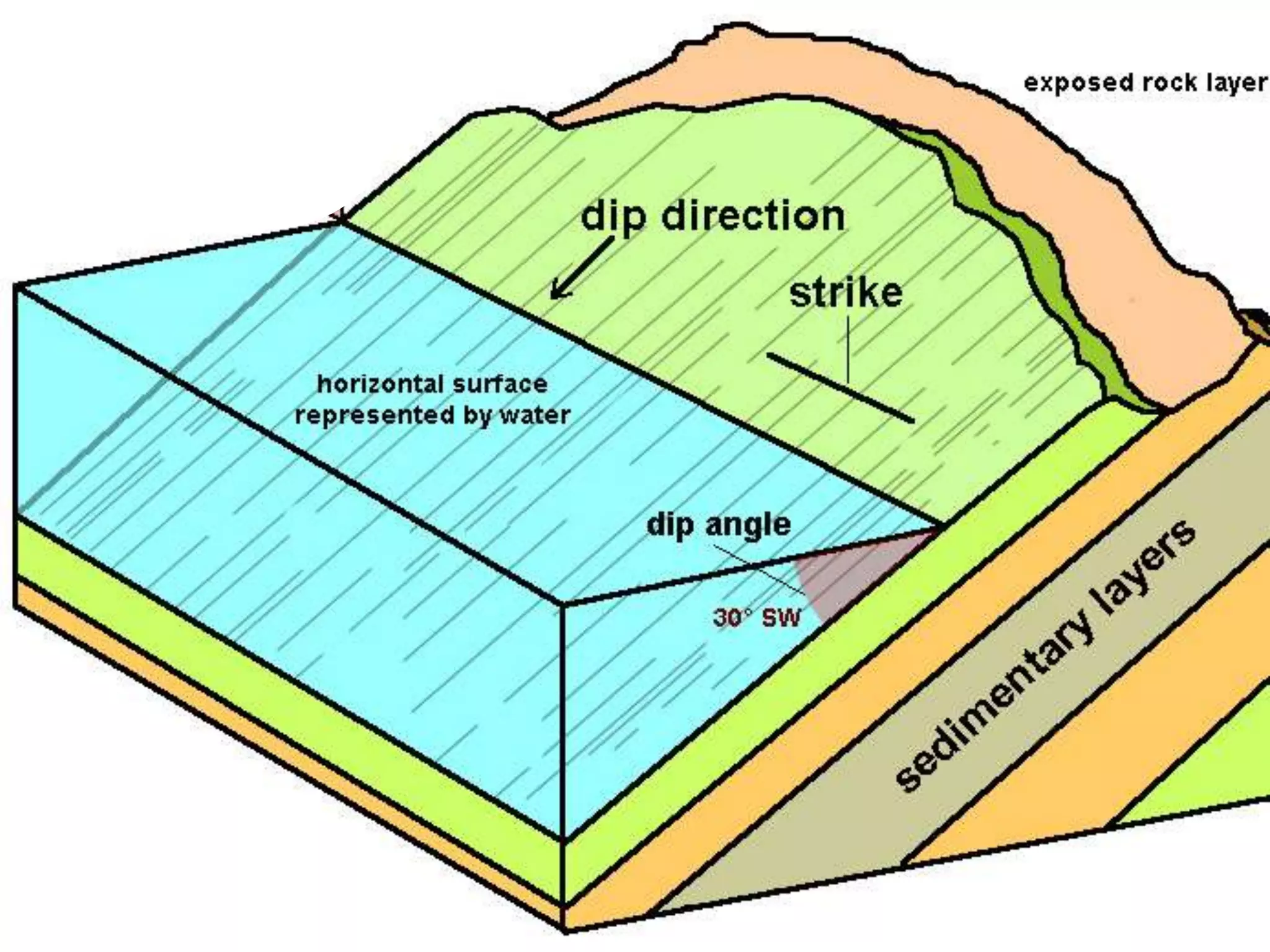
STRIKE - Direction in which a geological structure is
present.
*STRIKE DIRECTION may be defined as direction of trace of
Intersection between horizontal plane and the bedding plane
*Usually Clinometer compass or Brunton compass are used
to measure STRIKE.
DIP - It means SLOPE or INCLINATION.
Expressed both as amount and direction.
*Dip direction- Direction along which inclination of bedding plane
occurs.
*Dip amount - Angle at which a planar feature is inclined to the
horizontal plane
STRIKE direction will always be
perpendicular to DIP direction.
Apparent dip is the name of any dip
measured in a vertical plane that is not
perpendicular to the strike line
Structural Geology elements

Structural Geology elements

  • 1.
  • 2.
    SRUCTURAL GEOLOGY  Structuralgeology is the study of the three dimensional distribution of large bodies of rock, their surfaces, and their composition.  We try to learn about their tectonic history, past geological environments and event that could have changed or deformed them.
  • 3.
    DEFORMATION In earth science,deformation means alternation of size or shape of rock. Deformation is caused by, 1. Deformative forces 2.Mechanical properties of Rock 3.Time period 4.Depth of formation
  • 4.
    1 DEFORMATIVE FORCES “Theshape and size of a rock material change due to the action of STRESS.” What is a Stress? Stress is the force acting on unit area of a material surface.
  • 5.
    There are threetypes of STRESS COMPRESIV E STRESS It is a force that pushes the material on opposite sides of a plane. TENSILE STRESS It is a force that pull apart the material on opposite sides of a plane SHEARING STRESS It is a force that causes layers or parts to slide upon each other in opposite directions
  • 6.
    “When rocks deformthey are said to STRAIN” What is a Strain? A strain is a change in size, shape, or volume of a material.
  • 7.
    2 MECHANICAL PROPERTIES OFROCK This speaks about the strength of the rocks. 1. BRITTLE - hard but liable to break easily. 2. PLASTIC(Malleable) - permanent deformation under stress. 3. ELASTIC - able to resume its normal shape spontaneously after deformation.
  • 8.
    A Rock subjectedto increasing stress it passes through 3 successive stages of deformation. ELASTIC DEFORMATION Strain is reversible DUCTILE (PLASTIC) DEFORMATION Strain is reversible Rearrangement of platy or flaky minerals (if present) BRITTLE DEFORMATION Irreversible strain where the material breaks.
  • 9.
    3 TIME •A Smallforce acting over a great length of time can bring about the same type of structure like that produced by a large force acting over a short period of time. •Forces that are unable to deform rocks may cause rock to flow, if it is maintained for a long period of time.
  • 10.
    4 DEPTH OFFORMATION •A Rock situated in the shallow depth and greater depth behave differently. •Physical properties like Temperature, Litho static pressure differ with respect to depth. •The factor of Depth is called by the term “Environment of Structural deformation”
  • 11.
    From above detailsStructures seen in Earth is of two types STRUCTURES RUPTURE STRUCTURES PLASTIC STRUCTURES
  • 12.
    RUPTURE STRUCTURES FRACTURE A Fractureis any separation in a geologic formation JOINT A Joint is a fracture dividing rock into two sections that have not moved away from each other.
  • 13.
    FAULT Planar fracture ordiscontinuity in a volume of rock, across which there has been displacement of rock-mass . SHEAR Response of a rock to deformation usually by compressive stress and forms particular textures.
  • 14.
    PLASTIC STRUCTURES FOLDS One ora stack of originally flat and planar surfaces are bent or curved as a result of permanent deformation FOLIATION Repetitive layering in metamorphic rocks LINEATION Linear structural features within rocks
  • 15.
    MEASUREMENT OF GEOLOGIC STRUCTURES •Allgeologic structures are mathematical models we designed for studying. •To convert these real life figures to mathematical data we need to be aware of certain terms.
  • 16.
    1. OUTCROP Any Geologicalformation exposed on the surface is called an OUTCROP
  • 17.
    2. STRIKE &SLIP STRIKE - Direction in which a geological structure is present. *STRIKE DIRECTION may be defined as direction of trace of Intersection between horizontal plane and the bedding plane *Usually Clinometer compass or Brunton compass are used to measure STRIKE.
  • 19.
    DIP - Itmeans SLOPE or INCLINATION. Expressed both as amount and direction. *Dip direction- Direction along which inclination of bedding plane occurs. *Dip amount - Angle at which a planar feature is inclined to the horizontal plane
  • 20.
    STRIKE direction willalways be perpendicular to DIP direction. Apparent dip is the name of any dip measured in a vertical plane that is not perpendicular to the strike line