TSUNAMI
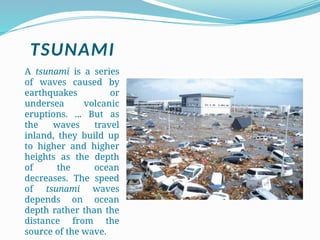
A tsunami isa series
of waves caused by
earthquakes or
undersea volcanic
eruptions. ... But as
the waves travel
inland, they build up
to higher and higher
heights as the depth
of the ocean
decreases. The speed
of tsunami waves
depends on ocean
depth rather than the
distance from the
source of the wave.
3.
Loss By ADestructive Tsunami
More specifically, the damage caused directly by
tsunamis can be summarized into the following:
1) Deaths and injuries. 2) Houses destroyed,
partially destroyed, inundated, flooded, or
burned. 3) Other property damage and loss.4)
Boats washed away, damaged or destroyed. 5)
Lumber washed away. 6) Marine installations
destroyed. 7) Damage to public utilities such as
railroads, roads, bridges, power plants, water or
fuel storage tanks, or wastewater facilities, etc.
4.
IF YOU AREUNDER A TSUNAMI
WARNING
First, protect yourself from an Earthquake. Drop,
Cover, then Hold On. Get to high ground as far inland
as possible. You can protect yourself from a tsunami
while also protecting yourself and your family from
COVID-19. Protect yourself from the effects of a
tsunami by moving from the shore to safe, high
grounds outside tsunami hazard areas. Be alert to
signs of a tsunami, such as a sudden rise or draining of
ocean waters. Listen to emergency information and
alerts. Evacuate: DO NOT wait! Leave as soon as you
see any natural signs of a tsunami or receive an official
tsunami warning.
5.
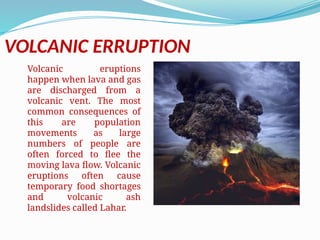
VOLCANIC ERRUPTION
Volcanic eruptions
happenwhen lava and gas
are discharged from a
volcanic vent. The most
common consequences of
this are population
movements as large
numbers of people are
often forced to flee the
moving lava flow. Volcanic
eruptions often cause
temporary food shortages
and volcanic ash
landslides called Lahar.
6.
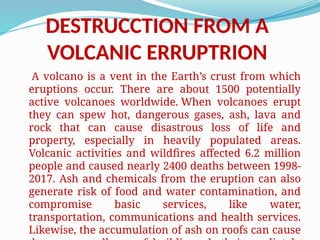
DESTRUCCTION FROM A
VOLCANICERRUPTRION
A volcano is a vent in the Earth’s crust from which
eruptions occur. There are about 1500 potentially
active volcanoes worldwide. When volcanoes erupt
they can spew hot, dangerous gases, ash, lava and
rock that can cause disastrous loss of life and
property, especially in heavily populated areas.
Volcanic activities and wildfires affected 6.2 million
people and caused nearly 2400 deaths between 1998-
2017. Ash and chemicals from the eruption can also
generate risk of food and water contamination, and
compromise basic services, like water,
transportation, communications and health services.
Likewise, the accumulation of ash on roofs can cause
7.
IF YOU AREUNDER A VOLCANIC WARNING
Listen for emergency information and alerts.
Follow evacuation or shelter orders. If advised to
evacuate, then do so early.
Avoid areas downstream of the eruption.
Protect yourself from falling ash.
Do not drive in heavy ash fall.
8.
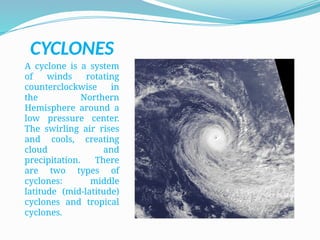
CYCLONES
A cyclone isa system
of winds rotating
counterclockwise in
the Northern
Hemisphere around a
low pressure center.
The swirling air rises
and cools, creating
cloud and
precipitation. There
are two types of
cyclones: middle
latitude (mid-latitude)
cyclones and tropical
cyclones.
9.
DESTRUCTION CAUSED BYCYCLONES
Very strong winds may damage installations,
dwellings, communication systems, trees., etc.
resulting in loss of life and property. Heavy and
prolonged rains due to cyclones may cause river
floods and submergence of low lying areas by
rain causing loss of life and property.
10.
DESTRUCTION CAUSED BYCYCLONES
A strong cyclone can be very destructive.
Since cyclone is accompanied with high speed
wind, it can damage houses, telephone poles,
electric poles and uproot trees.
Strong wind of the cyclone may push the sea
water towards the sea shore in the form of high
wave. These high waves may damage houses and
push water to low land which may be
accompanied with loss of life and properties.