Malnutrition can be defined as the insufficient,
excessive or imbalanced consumption of nutrients.
Several different nutrition disorders may develop,
depending on which nutrients are lacking or
consumed in excess.
The children of today are the future of tomorrow .
However, even today, after six decades of
independence and despite various initiatives , the
condition of children remains a cause of concern in
the country.
Facts
As much as 48 % of
children under the age
of five in the country
are stunted.
One of every three
malnourished child
lives in India.
Children
Half of India's children
are chronically
malnourished.
Malnutrition is higher
among kids whose
mothers are
uneducated or have
less than 5 years of
education.
Statistics
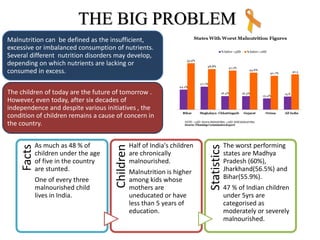
The worst performing
states are Madhya
Pradesh (60%),
Jharkhand(56.5%) and
Bihar(55.9%).
47 % of Indian children
under 5yrs are
categorised as
moderately or severely
malnourished.
THE BIG PROBLEM
Types of Malnutrition
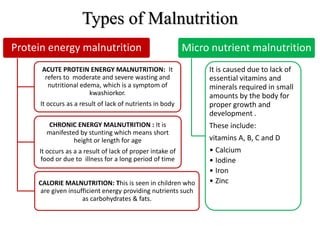
Protein energy malnutrition
ACUTE PROTEIN ENERGY MALNUTRITION: It
refers to moderate and severe wasting and
nutritional edema, which is a symptom of
kwashiorkor.
It occurs as a result of lack of nutrients in body
CHRONIC ENERGY MALNUTRITION : It is
manifested by stunting which means short
height or length for age
It occurs as a a result of lack of proper intake of
food or due to illness for a long period of time
CALORIE MALNUTRITION: This is seen in children who
are given insufficient energy providing nutrients such
as carbohydrates & fats.
Micro nutrient malnutrition
It is caused due to lack of
essential vitamins and
minerals required in small
amounts by the body for
proper growth and
development .
These include:
vitamins A, B, C and D
โ€ข Calcium
โ€ข Iodine
โ€ข Iron
โ€ข Zinc
โ€ข Widespread poverty
resulting in chronic
and persistent hunger
is the single biggest
scourge of the
developing world
today.
โ€ข The physical
expression of this
tragedy is the
condition of under-
nutrition which
manifests itself among
large sections of the
poor, particularly
amongst the women
and children.
โ€ข Under nutrition is a
condition resulting
from inadequate
intake of Food or
more essential
nutrients resulting in
deterioration of
physical health.
โ€ข The inadequancy in
the food & nutrients
needed to maintain
good health reduces
work capacity and
productivity
amongst adults and
enhances mortality
and morbidity
amongst children.
โ€ข Such reduced
productivity
translates into
reduced earning
capacity, leading to
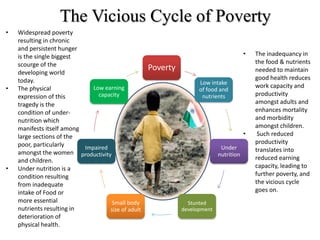
further poverty, and
the vicious cycle
goes on.
The Vicious Cycle of Poverty
Poverty
Low intake
of food and
nutrients
Under
nutrition
Stunted
development
Small body
size of adult
Impaired
productivity
Low earning
capacity
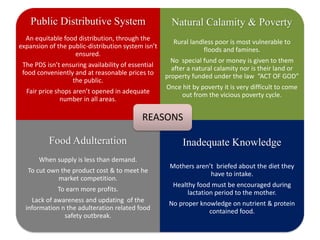
Public Distributive System
An equitable food distribution, through the
expansion of the public-distribution system isnโ€™t
ensured.
The PDS isnโ€™t ensuring availability of essential
food conveniently and at reasonable prices to
the public.
Fair price shops arenโ€™t opened in adequate
number in all areas.
Natural Calamity & Poverty
Rural landless poor is most vulnerable to
floods and famines.
No special fund or money is given to them
after a natural calamity nor is their land or
property funded under the law โ€œACT OF GODโ€
Once hit by poverty it is very difficult to come
out from the vicious poverty cycle.
Food Adulteration
When supply is less than demand.
To cut own the product cost & to meet he
market competition.
To earn more profits.
Lack of awareness and updating of the
information n the adulteration related food
safety outbreak.
Inadequate Knowledge
Mothers arenโ€™t briefed about the diet they
have to intake.
Healthy food must be encouraged during
lactation period to the mother.
No proper knowledge on nutrient & protein
contained food.
REASONS
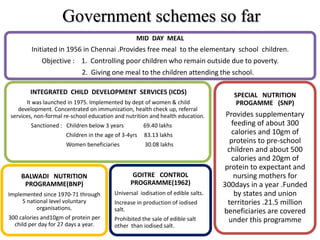
MID DAY MEAL
Initiated in 1956 in Chennai .Provides free meal to the elementary school children.
Objective : 1. Controlling poor children who remain outside due to poverty.
2. Giving one meal to the children attending the school.
INTEGRATED CHILD DEVELOPMENT SERVICES (ICDS)
It was launched in 1975. Implemented by dept of women & child
development. Concentrated on immunization, health check up, referral
services, non-formal re-school education and nutrition and health education.
Sanctioned : Children below 3 years 69.40 lakhs
Children in the age of 3-4yrs 83.13 lakhs
Women beneficiaries 30.08 lakhs
BALWADI NUTRITION
PROGRAMME(BNP)
Implemented since 1970-71 through
5 national level voluntary
organisations.
300 calories and10gm of protein per
child per day for 27 days a year.
GOITRE CONTROL
PROGRAMME(1962)
Universal iodisation of edible salts.
Increase in production of iodised
salt.
Prohibited the sale of edible salt
other than iodised salt.
SPECIAL NUTRITION
PROGAMME (SNP)
Provides supplementary
feeding of about 300
calories and 10gm of
proteins to pre-school
children and about 500
calories and 20gm of
protein to expectant and
nursing mothers for
300days in a year .Funded
by states and union
territories .21.5 million
beneficiaries are covered
under this programme
Government schemes so far
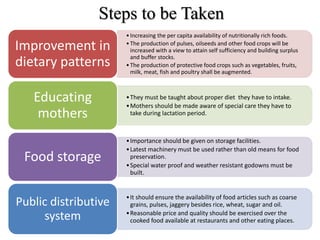
โ€ขIncreasing the per capita availability of nutritionally rich foods.
โ€ขThe production of pulses, oilseeds and other food crops will be
increased with a view to attain self sufficiency and building surplus
and buffer stocks.
โ€ขThe production of protective food crops such as vegetables, fruits,
milk, meat, fish and poultry shall be augmented.
Improvement in
dietary patterns
โ€ขThey must be taught about proper diet they have to intake.
โ€ขMothers should be made aware of special care they have to
take during lactation period.
Educating
mothers
โ€ขImportance should be given on storage facilities.
โ€ขLatest machinery must be used rather than old means for food
preservation.
โ€ขSpecial water proof and weather resistant godowns must be
built.
Food storage
โ€ขIt should ensure the availability of food articles such as coarse
grains, pulses, jaggery besides rice, wheat, sugar and oil.
โ€ขReasonable price and quality should be exercised over the
cooked food available at restaurants and other eating places.
Public distributive
system
Steps to be Taken
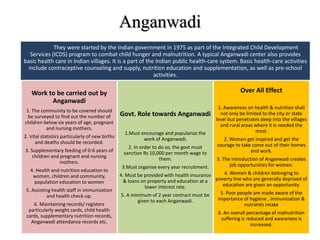
Anganwadi
They were started by the Indian government in 1975 as part of the Integrated Child Development
Services (ICDS) program to combat child hunger and malnutrition. A typical Anganwadi center also provides
basic health care in Indian villages. It is a part of the Indian public health-care system. Basic health-care activities
include contraceptive counseling and supply, nutrition education and supplementation, as well as pre-school
activities.
Work to be carried out by
Anganwadi
1. The community to be covered should
be surveyed to find out the number of
children below six years of age, pregnant
and nursing mothers.
2. Vital statistics particularly of new births
and deaths should be recorded.
3. Supplementary feeding of 0-6 years of
children and pregnant and nursing
mothers.
4. Health and nutrition education to
women, children and community,
population education to women
5. Assisting health staff in immunization
and health check-up.
6. Maintaining records/ registers
particularly weight cards, child health
cards, supplementary nutrition records,
Anganwadi attendance records etc.
Govt. Role towards Anganwadi
1.Must encourage and popularize the
work of Anganwadi.
2. In order to do so, the govt must
sanction Rs 10,000 per month wage to
them.
3.Must organise every year recruitment.
4. Must be provided with health insurance
& loans on property and education at a
lower interest rate.
5. A minimum of 2 year contract must be
given to each Anganwadi.
Over All Effect
1. Awareness on health & nutrition shall
not only be limited to the city or state
level but penetrates deep into the villages
and rural areas where it is needed the
most.
2. Women get inspired and get the
courage to take come out of their homes
and work.
3. The introduction of Anganwadi creates
job opportunities for women.
4. Women & children belonging to
poverty line who are generally deprived of
education are given an opportunity.
5. Poor people are made aware of the
importance of hygiene , immunization &
nutrients intake
6. An overall percentage of malnutrition
suffering is reduced and awareness is
increased.
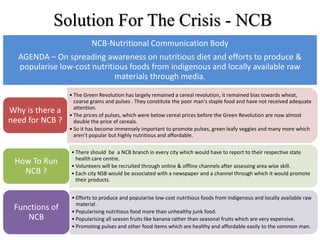
Solution For The Crisis - NCB
โ€ข The Green Revolution has largely remained a cereal revolution, it remained bias towards wheat,
coarse grains and pulses . They constitute the poor man's staple food and have not received adequate
attention.
โ€ข The prices of pulses, which were below cereal prices before the Green Revolution are now almost
double the price of cereals.
โ€ข So it has become immensely important to promote pulses, green leafy veggies and many more which
arenโ€™t popular but highly nutritious and affordable.
Why is there a
need for NCB ?
โ€ข There should be a NCB branch in every city which would have to report to their respective state
health care centre.
โ€ข Volunteers will be recruited through online & offline channels after assessing area wise skill.
โ€ข Each city NSB would be associated with a newspaper and a channel through which it would promote
their products.
How To Run
NCB ?
โ€ข Efforts to produce and popularise low-cost nutritious foods from indigenous and locally available raw
material .
โ€ข Popularising nutritious food more than unhealthy junk food.
โ€ข Popularising all season fruits like banana rather than seasonal fruits which are very expensive.
โ€ข Promoting pulses and other food items which are healthy and affordable easily to the common man.
Functions of
NCB
NCB-Nutritional Communication Body
AGENDA โ€“ On spreading awareness on nutritious diet and efforts to produce &
popularise low-cost nutritious foods from indigenous and locally available raw
materials through media.
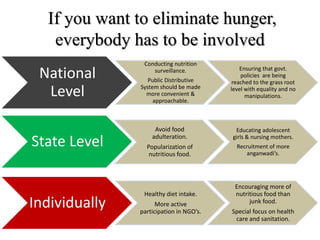
If you want to eliminate hunger,
everybody has to be involved
National
Level
Conducting nutrition
surveillance.
Public Distributive
System should be made
more convenient &
approachable.
Ensuring that govt.
policies are being
reached to the grass root
level with equality and no
manipulations.
State Level
Avoid food
adulteration.
Popularization of
nutritious food.
Educating adolescent
girls & nursing mothers.
Recruitment of more
anganwadiโ€™s.
Individually
Healthy diet intake.
More active
participation in NGOโ€™s.
Encouraging more of
nutritious food than
junk food.
Special focus on health
care and sanitation.
Impact
Contribution by Village Level City level
Anganwadi
โ€ข Help educating poor women,
adolescent girls and children.
โ€ข Spreading awareness even in the
most remote areas.
โ€ข Employment opportunity
to women.
Govt. Policies &
NGOโ€™s
โ€ข With the proper implementation
of food security bill , staple food for
the poor is ensured.
โ€ข Finally a break through in the
vicious poverty cycle can be
expected.
โ€ข Improved and enhanced
hygienic city.
โ€ข A fathomable decrease in
he number of beggars is
witnessed.
Media
โ€ข Attracting the attention of people
through endorsements of
celebrities n the form of posters
and adds.
โ€ข Advertising of healthy
food will lead to mass
reduction in obesity &
eradicate malnutrition.
โ€ข Providing a wide variety
in nutritious food.
References
๏ฑ CHILDREN IN INDIA 2012- A Statistical Appraisal by Ministry of statistics
and Programme Implementation Government of India.
๏ฑ Analyzing Nutrition Governance : India Country Report by Shandana Khan
Mohammed.
๏ฑ NATIONAL NUTRITION POLICY 1993 & 2012.
๏ฑ Role and responsibilities of AWW by Smt. Urmila Sharma AWH.
๏ฑ KNOWLEDGE OF ANGANWADI WORKERS AND THEIR PROBLEMS by
Thakare Meenal M from Dept.of Community Medicine, Aurangabad.
๏ฑ NUTRITION MONITORING AND SURVEILLANCE by K. Ramachandran,
Former Professor and Head, Deptt. of Biostatistics, AIIMS, New Delhi.
๏ฑ National Nutrition Monitoring Bureau (NNMB) report 2010.
๏ฑ Performance Evaluation of Targeted Public Distribution System(TPDS)by
Planning Commission Government of India , New Delhi .

GEN-YUVA

  • 2.
    Malnutrition can bedefined as the insufficient, excessive or imbalanced consumption of nutrients. Several different nutrition disorders may develop, depending on which nutrients are lacking or consumed in excess. The children of today are the future of tomorrow . However, even today, after six decades of independence and despite various initiatives , the condition of children remains a cause of concern in the country. Facts As much as 48 % of children under the age of five in the country are stunted. One of every three malnourished child lives in India. Children Half of India's children are chronically malnourished. Malnutrition is higher among kids whose mothers are uneducated or have less than 5 years of education. Statistics The worst performing states are Madhya Pradesh (60%), Jharkhand(56.5%) and Bihar(55.9%). 47 % of Indian children under 5yrs are categorised as moderately or severely malnourished. THE BIG PROBLEM
  • 3.
    Types of Malnutrition Proteinenergy malnutrition ACUTE PROTEIN ENERGY MALNUTRITION: It refers to moderate and severe wasting and nutritional edema, which is a symptom of kwashiorkor. It occurs as a result of lack of nutrients in body CHRONIC ENERGY MALNUTRITION : It is manifested by stunting which means short height or length for age It occurs as a a result of lack of proper intake of food or due to illness for a long period of time CALORIE MALNUTRITION: This is seen in children who are given insufficient energy providing nutrients such as carbohydrates & fats. Micro nutrient malnutrition It is caused due to lack of essential vitamins and minerals required in small amounts by the body for proper growth and development . These include: vitamins A, B, C and D โ€ข Calcium โ€ข Iodine โ€ข Iron โ€ข Zinc
  • 4.
    โ€ข Widespread poverty resultingin chronic and persistent hunger is the single biggest scourge of the developing world today. โ€ข The physical expression of this tragedy is the condition of under- nutrition which manifests itself among large sections of the poor, particularly amongst the women and children. โ€ข Under nutrition is a condition resulting from inadequate intake of Food or more essential nutrients resulting in deterioration of physical health. โ€ข The inadequancy in the food & nutrients needed to maintain good health reduces work capacity and productivity amongst adults and enhances mortality and morbidity amongst children. โ€ข Such reduced productivity translates into reduced earning capacity, leading to further poverty, and the vicious cycle goes on. The Vicious Cycle of Poverty Poverty Low intake of food and nutrients Under nutrition Stunted development Small body size of adult Impaired productivity Low earning capacity
  • 5.
    Public Distributive System Anequitable food distribution, through the expansion of the public-distribution system isnโ€™t ensured. The PDS isnโ€™t ensuring availability of essential food conveniently and at reasonable prices to the public. Fair price shops arenโ€™t opened in adequate number in all areas. Natural Calamity & Poverty Rural landless poor is most vulnerable to floods and famines. No special fund or money is given to them after a natural calamity nor is their land or property funded under the law โ€œACT OF GODโ€ Once hit by poverty it is very difficult to come out from the vicious poverty cycle. Food Adulteration When supply is less than demand. To cut own the product cost & to meet he market competition. To earn more profits. Lack of awareness and updating of the information n the adulteration related food safety outbreak. Inadequate Knowledge Mothers arenโ€™t briefed about the diet they have to intake. Healthy food must be encouraged during lactation period to the mother. No proper knowledge on nutrient & protein contained food. REASONS
  • 6.
    MID DAY MEAL Initiatedin 1956 in Chennai .Provides free meal to the elementary school children. Objective : 1. Controlling poor children who remain outside due to poverty. 2. Giving one meal to the children attending the school. INTEGRATED CHILD DEVELOPMENT SERVICES (ICDS) It was launched in 1975. Implemented by dept of women & child development. Concentrated on immunization, health check up, referral services, non-formal re-school education and nutrition and health education. Sanctioned : Children below 3 years 69.40 lakhs Children in the age of 3-4yrs 83.13 lakhs Women beneficiaries 30.08 lakhs BALWADI NUTRITION PROGRAMME(BNP) Implemented since 1970-71 through 5 national level voluntary organisations. 300 calories and10gm of protein per child per day for 27 days a year. GOITRE CONTROL PROGRAMME(1962) Universal iodisation of edible salts. Increase in production of iodised salt. Prohibited the sale of edible salt other than iodised salt. SPECIAL NUTRITION PROGAMME (SNP) Provides supplementary feeding of about 300 calories and 10gm of proteins to pre-school children and about 500 calories and 20gm of protein to expectant and nursing mothers for 300days in a year .Funded by states and union territories .21.5 million beneficiaries are covered under this programme Government schemes so far
  • 7.
    โ€ขIncreasing the percapita availability of nutritionally rich foods. โ€ขThe production of pulses, oilseeds and other food crops will be increased with a view to attain self sufficiency and building surplus and buffer stocks. โ€ขThe production of protective food crops such as vegetables, fruits, milk, meat, fish and poultry shall be augmented. Improvement in dietary patterns โ€ขThey must be taught about proper diet they have to intake. โ€ขMothers should be made aware of special care they have to take during lactation period. Educating mothers โ€ขImportance should be given on storage facilities. โ€ขLatest machinery must be used rather than old means for food preservation. โ€ขSpecial water proof and weather resistant godowns must be built. Food storage โ€ขIt should ensure the availability of food articles such as coarse grains, pulses, jaggery besides rice, wheat, sugar and oil. โ€ขReasonable price and quality should be exercised over the cooked food available at restaurants and other eating places. Public distributive system Steps to be Taken
  • 8.
    Anganwadi They were startedby the Indian government in 1975 as part of the Integrated Child Development Services (ICDS) program to combat child hunger and malnutrition. A typical Anganwadi center also provides basic health care in Indian villages. It is a part of the Indian public health-care system. Basic health-care activities include contraceptive counseling and supply, nutrition education and supplementation, as well as pre-school activities. Work to be carried out by Anganwadi 1. The community to be covered should be surveyed to find out the number of children below six years of age, pregnant and nursing mothers. 2. Vital statistics particularly of new births and deaths should be recorded. 3. Supplementary feeding of 0-6 years of children and pregnant and nursing mothers. 4. Health and nutrition education to women, children and community, population education to women 5. Assisting health staff in immunization and health check-up. 6. Maintaining records/ registers particularly weight cards, child health cards, supplementary nutrition records, Anganwadi attendance records etc. Govt. Role towards Anganwadi 1.Must encourage and popularize the work of Anganwadi. 2. In order to do so, the govt must sanction Rs 10,000 per month wage to them. 3.Must organise every year recruitment. 4. Must be provided with health insurance & loans on property and education at a lower interest rate. 5. A minimum of 2 year contract must be given to each Anganwadi. Over All Effect 1. Awareness on health & nutrition shall not only be limited to the city or state level but penetrates deep into the villages and rural areas where it is needed the most. 2. Women get inspired and get the courage to take come out of their homes and work. 3. The introduction of Anganwadi creates job opportunities for women. 4. Women & children belonging to poverty line who are generally deprived of education are given an opportunity. 5. Poor people are made aware of the importance of hygiene , immunization & nutrients intake 6. An overall percentage of malnutrition suffering is reduced and awareness is increased.
  • 9.
    Solution For TheCrisis - NCB โ€ข The Green Revolution has largely remained a cereal revolution, it remained bias towards wheat, coarse grains and pulses . They constitute the poor man's staple food and have not received adequate attention. โ€ข The prices of pulses, which were below cereal prices before the Green Revolution are now almost double the price of cereals. โ€ข So it has become immensely important to promote pulses, green leafy veggies and many more which arenโ€™t popular but highly nutritious and affordable. Why is there a need for NCB ? โ€ข There should be a NCB branch in every city which would have to report to their respective state health care centre. โ€ข Volunteers will be recruited through online & offline channels after assessing area wise skill. โ€ข Each city NSB would be associated with a newspaper and a channel through which it would promote their products. How To Run NCB ? โ€ข Efforts to produce and popularise low-cost nutritious foods from indigenous and locally available raw material . โ€ข Popularising nutritious food more than unhealthy junk food. โ€ข Popularising all season fruits like banana rather than seasonal fruits which are very expensive. โ€ข Promoting pulses and other food items which are healthy and affordable easily to the common man. Functions of NCB NCB-Nutritional Communication Body AGENDA โ€“ On spreading awareness on nutritious diet and efforts to produce & popularise low-cost nutritious foods from indigenous and locally available raw materials through media.
  • 10.
    If you wantto eliminate hunger, everybody has to be involved National Level Conducting nutrition surveillance. Public Distributive System should be made more convenient & approachable. Ensuring that govt. policies are being reached to the grass root level with equality and no manipulations. State Level Avoid food adulteration. Popularization of nutritious food. Educating adolescent girls & nursing mothers. Recruitment of more anganwadiโ€™s. Individually Healthy diet intake. More active participation in NGOโ€™s. Encouraging more of nutritious food than junk food. Special focus on health care and sanitation.
  • 11.
    Impact Contribution by VillageLevel City level Anganwadi โ€ข Help educating poor women, adolescent girls and children. โ€ข Spreading awareness even in the most remote areas. โ€ข Employment opportunity to women. Govt. Policies & NGOโ€™s โ€ข With the proper implementation of food security bill , staple food for the poor is ensured. โ€ข Finally a break through in the vicious poverty cycle can be expected. โ€ข Improved and enhanced hygienic city. โ€ข A fathomable decrease in he number of beggars is witnessed. Media โ€ข Attracting the attention of people through endorsements of celebrities n the form of posters and adds. โ€ข Advertising of healthy food will lead to mass reduction in obesity & eradicate malnutrition. โ€ข Providing a wide variety in nutritious food.
  • 12.
    References ๏ฑ CHILDREN ININDIA 2012- A Statistical Appraisal by Ministry of statistics and Programme Implementation Government of India. ๏ฑ Analyzing Nutrition Governance : India Country Report by Shandana Khan Mohammed. ๏ฑ NATIONAL NUTRITION POLICY 1993 & 2012. ๏ฑ Role and responsibilities of AWW by Smt. Urmila Sharma AWH. ๏ฑ KNOWLEDGE OF ANGANWADI WORKERS AND THEIR PROBLEMS by Thakare Meenal M from Dept.of Community Medicine, Aurangabad. ๏ฑ NUTRITION MONITORING AND SURVEILLANCE by K. Ramachandran, Former Professor and Head, Deptt. of Biostatistics, AIIMS, New Delhi. ๏ฑ National Nutrition Monitoring Bureau (NNMB) report 2010. ๏ฑ Performance Evaluation of Targeted Public Distribution System(TPDS)by Planning Commission Government of India , New Delhi .