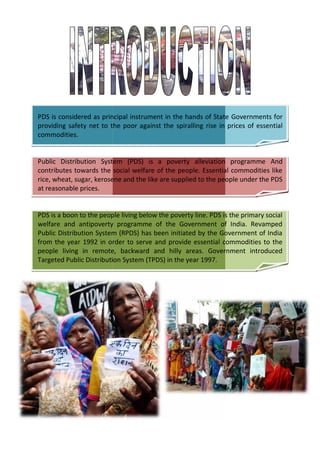
PDS is considered as principal instrument in the hands of State Governments for
providing safety net to the poor against the spiralling rise in prices of essential
commodities.
Public Distribution System (PDS) is a poverty alleviation programme And
contributes towards the social welfare of the people. Essential commodities like
rice, wheat, sugar, kerosene and the like are supplied to the people under the PDS
at reasonable prices.
PDS is a boon to the people living below the poverty line. PDS is the primary social
welfare and antipoverty programme of the Government of India. Revamped
Public Distribution System (RPDS) has been initiated by the Government of India
from the year 1992 in order to serve and provide essential commodities to the
people living in remote, backward and hilly areas. Government introduced
Targeted Public Distribution System (TPDS) in the year 1997.
PDS is considered as principal instrument in the hands of State Governments for
providing safety net to the poor against the spiralling rise in prices of essential
commodities.
Public Distribution System (PDS) is a poverty alleviation programme And
contributes towards the social welfare of the people. Essential commodities like
rice, wheat, sugar, kerosene and the like are supplied to the people under the PDS
at reasonable prices.
PDS is a boon to the people living below the poverty line. PDS is the primary social
welfare and antipoverty programme of the Government of India. Revamped
Public Distribution System (RPDS) has been initiated by the Government of India
from the year 1992 in order to serve and provide essential commodities to the
people living in remote, backward and hilly areas. Government introduced
Targeted Public Distribution System (TPDS) in the year 1997.
PDS is considered as principal instrument in the hands of State Governments for
providing safety net to the poor against the spiralling rise in prices of essential
commodities.
Public Distribution System (PDS) is a poverty alleviation programme And
contributes towards the social welfare of the people. Essential commodities like
rice, wheat, sugar, kerosene and the like are supplied to the people under the PDS
at reasonable prices.
PDS is a boon to the people living below the poverty line. PDS is the primary social
welfare and antipoverty programme of the Government of India. Revamped
Public Distribution System (RPDS) has been initiated by the Government of India
from the year 1992 in order to serve and provide essential commodities to the
people living in remote, backward and hilly areas. Government introduced
Targeted Public Distribution System (TPDS) in the year 1997.
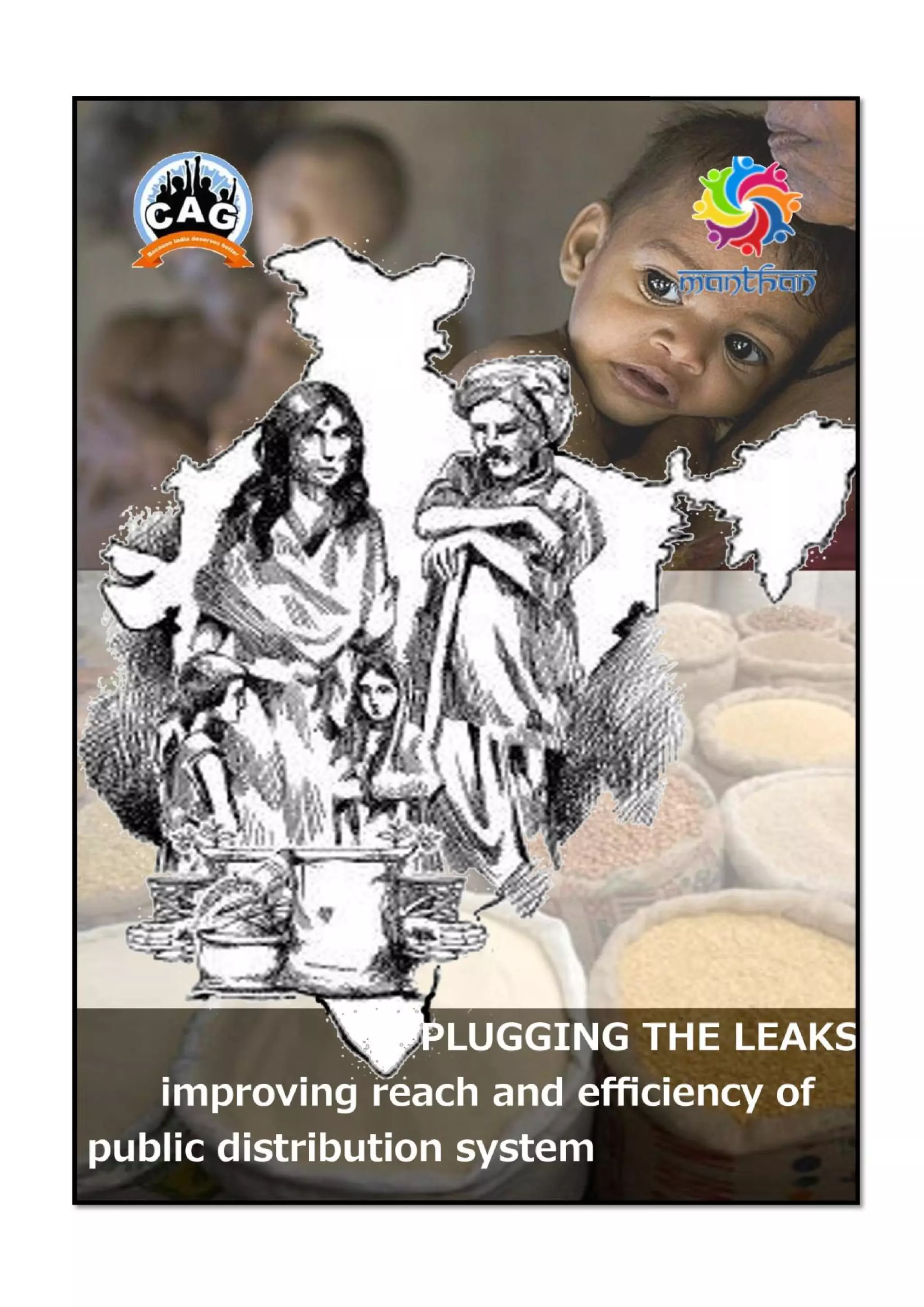
General problems in public
distribution system
COVERAGE
It counts the population being fed by PDS. Although PDS is the largest network of food grain
production, still it is not in reach of every consumer. According to National Sample Survey
(2004-2005), it is estimated that 73% did not get any food grains from PDS. Therefore coverage
is one of the major problem in PDS. Also, stocks arrived in FPS are not always on time due to
which the consumers may have to depend on private shops.
IMPLICIT SUBSIDY
In this government has provided subsidy on various commodities. This government policy aims
at subsidizing price of commodities lower than minimum support price. With the alarming
inflation, the minimum support price will bound to increase. The subsidy will henceforth
increase.
EXCLUSION ERROR
This error occurs due to the proportion of poor left out of PDS. In this a poor person of BPL is
not classified as one and hence is deprived of the benefits of PDS.
UNDERNUTRITION
PDS aims not just to distribute food grains but also aims at providing good quality food grains/
commodities so that the problem of malnutrition is reduced. But malnutrition persists to be the
most important concern of India.
TRANSPORTATION LEAKAGE The distance of grains from go downs to FPS is also a major
filtration point in the distribution mechanism. The grain won’t reach to FPS but goes to open
market for selling, getting the margins which benefits the middle men that is FPS owners and
officials of the distribution wing.
BPL PROBLEMS
The numbers shown by state government for BPL families do not tally with the ration cards
issued and also with the planning commission statistics. Due to this two types of problem arises
- one is the number of ration card holders are less compared to the number of BPL families
announced by the state government. Second is the number of ration cards issued are more
than the real BPL families in the village. In the second case, huge quantity of grains got released
from second but not the concerned but reselling the same at higher margins in market.
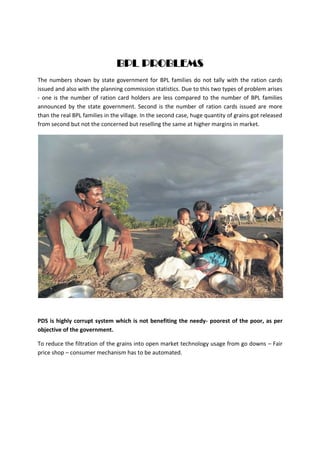
PDS is highly corrupt system which is not benefiting the needy- poorest of the poor, as per
objective of the government.
To reduce the filtration of the grains into open market technology usage from go downs – Fair
price shop – consumer mechanism has to be automated.
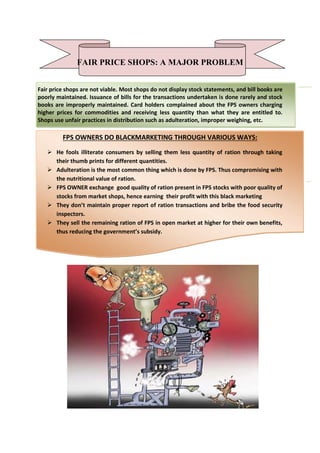
FAIR PRICE SHOPS: A MAJOR PROBLEM
Fair price shops are not viable. Most shops do not display stock statements, and bill books are
poorly maintained. Issuance of bills for the transactions undertaken is done rarely and stock
books are improperly maintained. Card holders complained about the FPS owners charging
higher prices for commodities and receiving less quantity than what they are entitled to.
Shops use unfair practices in distribution such as adulteration, improper weighing, etc.
FPS OWNERS DO BLACKMARKETING THROUGH VARIOUS WAYS:
 He fools illiterate consumers by selling them less quantity of ration through taking
their thumb prints for different quantities.
 Adulteration is the most common thing which is done by FPS. Thus compromising with
the nutritional value of ration.
 FPS OWNER exchange good quality of ration present in FPS stocks with poor quality of
stocks from market shops, hence earning their profit with this black marketing
 They don’t maintain proper report of ration transactions and bribe the food security
inspectors.
 They sell the remaining ration of FPS in open market at higher for their own benefits,
thus reducing the government’s subsidy.
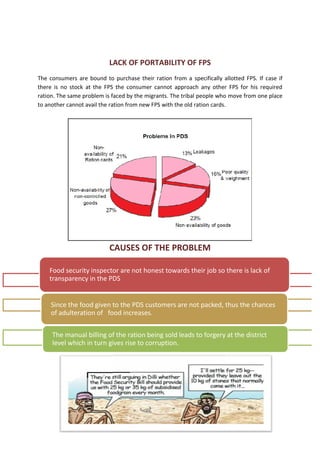
LACK OF PORTABILITY OF FPS
The consumers are bound to purchase their ration from a specifically allotted FPS. If case if
there is no stock at the FPS the consumer cannot approach any other FPS for his required
ration. The same problem is faced by the migrants. The tribal people who move from one place
to another cannot avail the ration from new FPS with the old ration cards.
CAUSES OF THE PROBLEM
Food security inspector are not honest towards their job so there is lack of
transparency in the PDS
Since the food given to the PDS customers are not packed, thus the chances
of adulteration of food increases.
The manual billing of the ration being sold leads to forgery at the district
level which in turn gives rise to corruption.
LACK OF PORTABILITY OF FPS
The consumers are bound to purchase their ration from a specifically allotted FPS. If case if
there is no stock at the FPS the consumer cannot approach any other FPS for his required
ration. The same problem is faced by the migrants. The tribal people who move from one place
to another cannot avail the ration from new FPS with the old ration cards.
CAUSES OF THE PROBLEM
Food security inspector are not honest towards their job so there is lack of
transparency in the PDS
Since the food given to the PDS customers are not packed, thus the chances
of adulteration of food increases.
The manual billing of the ration being sold leads to forgery at the district
level which in turn gives rise to corruption.
LACK OF PORTABILITY OF FPS
The consumers are bound to purchase their ration from a specifically allotted FPS. If case if
there is no stock at the FPS the consumer cannot approach any other FPS for his required
ration. The same problem is faced by the migrants. The tribal people who move from one place
to another cannot avail the ration from new FPS with the old ration cards.
CAUSES OF THE PROBLEM
Food security inspector are not honest towards their job so there is lack of
transparency in the PDS
Since the food given to the PDS customers are not packed, thus the chances
of adulteration of food increases.
The manual billing of the ration being sold leads to forgery at the district
level which in turn gives rise to corruption.
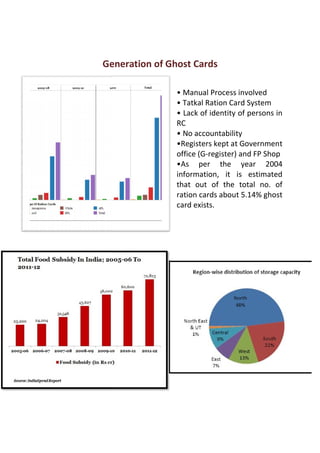
Generation of Ghost Cards
• Manual Process involved
• Tatkal Ration Card System
• Lack of identity of persons in
RC
• No accountability
•Registers kept at Government
office (G-register) and FP Shop
•As per the year 2004
information, it is estimated
that out of the total no. of
ration cards about 5.14% ghost
card exists.
Generation of Ghost Cards
• Manual Process involved
• Tatkal Ration Card System
• Lack of identity of persons in
RC
• No accountability
•Registers kept at Government
office (G-register) and FP Shop
•As per the year 2004
information, it is estimated
that out of the total no. of
ration cards about 5.14% ghost
card exists.
Generation of Ghost Cards
• Manual Process involved
• Tatkal Ration Card System
• Lack of identity of persons in
RC
• No accountability
•Registers kept at Government
office (G-register) and FP Shop
•As per the year 2004
information, it is estimated
that out of the total no. of
ration cards about 5.14% ghost
card exists.
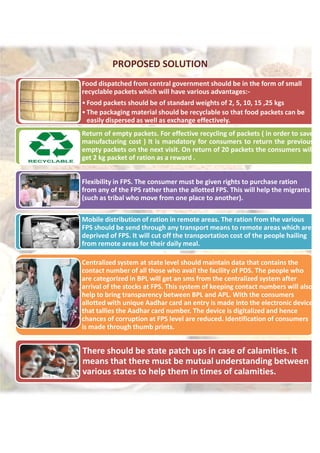
PROPOSED SOLUTION
Food dispatched from central government should be in the form of small
recyclable packets which will have various advantages:-
•Food packets should be of standard weights of 2, 5, 10, 15 ,25 kgs
•The packaging material should be recyclable so that food packets can be
easily dispersed as well as exchange effectively.
Return of empty packets. For effective recycling of packets ( in order to save
manufacturing cost ) It is mandatory for consumers to return the previous
empty packets on the next visit. On return of 20 packets the consumers will
get 2 kg packet of ration as a reward .
Flexibility in FPS. The consumer must be given rights to purchase ration
from any of the FPS rather than the allotted FPS. This will help the migrants
(such as tribal who move from one place to another).
Mobile distribution of ration in remote areas. The ration from the various
FPS should be send through any transport means to remote areas which are
deprived of FPS. It will cut off the transportation cost of the people hailing
from remote areas for their daily meal.
Centralized system at state level should maintain data that contains the
contact number of all those who avail the facility of PDS. The people who
are categorized in BPL will get an sms from the centralized system after
arrival of the stocks at FPS. This system of keeping contact numbers will also
help to bring transparency between BPL and APL. With the consumers
allotted with unique Aadhar card an entry is made into the electronic device
that tallies the Aadhar card number. The device is digitalized and hence
chances of corruption at FPS level are reduced. Identification of consumers
is made through thumb prints.
There should be state patch ups in case of calamities. It
means that there must be mutual understanding between
various states to help them in times of calamities.
PROPOSED SOLUTION
Food dispatched from central government should be in the form of small
recyclable packets which will have various advantages:-
•Food packets should be of standard weights of 2, 5, 10, 15 ,25 kgs
•The packaging material should be recyclable so that food packets can be
easily dispersed as well as exchange effectively.
Return of empty packets. For effective recycling of packets ( in order to save
manufacturing cost ) It is mandatory for consumers to return the previous
empty packets on the next visit. On return of 20 packets the consumers will
get 2 kg packet of ration as a reward .
Flexibility in FPS. The consumer must be given rights to purchase ration
from any of the FPS rather than the allotted FPS. This will help the migrants
(such as tribal who move from one place to another).
Mobile distribution of ration in remote areas. The ration from the various
FPS should be send through any transport means to remote areas which are
deprived of FPS. It will cut off the transportation cost of the people hailing
from remote areas for their daily meal.
Centralized system at state level should maintain data that contains the
contact number of all those who avail the facility of PDS. The people who
are categorized in BPL will get an sms from the centralized system after
arrival of the stocks at FPS. This system of keeping contact numbers will also
help to bring transparency between BPL and APL. With the consumers
allotted with unique Aadhar card an entry is made into the electronic device
that tallies the Aadhar card number. The device is digitalized and hence
chances of corruption at FPS level are reduced. Identification of consumers
is made through thumb prints.
There should be state patch ups in case of calamities. It
means that there must be mutual understanding between
various states to help them in times of calamities.
PROPOSED SOLUTION
Food dispatched from central government should be in the form of small
recyclable packets which will have various advantages:-
•Food packets should be of standard weights of 2, 5, 10, 15 ,25 kgs
•The packaging material should be recyclable so that food packets can be
easily dispersed as well as exchange effectively.
Return of empty packets. For effective recycling of packets ( in order to save
manufacturing cost ) It is mandatory for consumers to return the previous
empty packets on the next visit. On return of 20 packets the consumers will
get 2 kg packet of ration as a reward .
Flexibility in FPS. The consumer must be given rights to purchase ration
from any of the FPS rather than the allotted FPS. This will help the migrants
(such as tribal who move from one place to another).
Mobile distribution of ration in remote areas. The ration from the various
FPS should be send through any transport means to remote areas which are
deprived of FPS. It will cut off the transportation cost of the people hailing
from remote areas for their daily meal.
Centralized system at state level should maintain data that contains the
contact number of all those who avail the facility of PDS. The people who
are categorized in BPL will get an sms from the centralized system after
arrival of the stocks at FPS. This system of keeping contact numbers will also
help to bring transparency between BPL and APL. With the consumers
allotted with unique Aadhar card an entry is made into the electronic device
that tallies the Aadhar card number. The device is digitalized and hence
chances of corruption at FPS level are reduced. Identification of consumers
is made through thumb prints.
There should be state patch ups in case of calamities. It
means that there must be mutual understanding between
various states to help them in times of calamities.
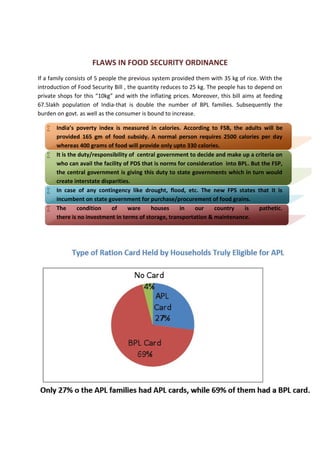
FLAWS IN FOOD SECURITY ORDINANCE
If a family consists of 5 people the previous system provided them with 35 kg of rice. With the
introduction of Food Security Bill , the quantity reduces to 25 kg. The people has to depend on
private shops for this “10kg” and with the inflating prices. Moreover, this bill aims at feeding
67.5lakh population of India-that is double the number of BPL families. Subsequently the
burden on govt. as well as the consumer is bound to increase.
 India’s poverty index is measured in calories. According to FSB, the adults will be
provided 165 gm of food subsidy. A normal person requires 2500 calories per day
whereas 400 grams of food will provide only upto 330 calories.
 It is the duty/responsibility of central government to decide and make up a criteria on
who can avail the facility of PDS that is norms for consideration into BPL. But the FSP,
the central government is giving this duty to state governments which in turn would
create interstate disparities.
 In case of any contingency like drought, flood, etc. The new FPS states that it is
incumbent on state government for purchase/procurement of food grains.
 The condition of ware houses in our country is pathetic.
there is no investment in terms of storage, transportation & maintenance.
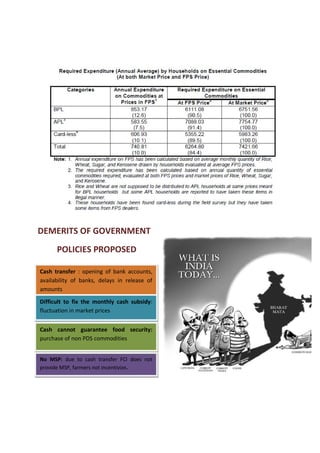
DEMERITS OF GOVERNMENT
POLICIES PROPOSED
Cash transfer : opening of bank accounts,
availability of banks, delays in release of
amounts
Difficult to fix the monthly cash subsidy:
fluctuation in market prices
Cash cannot guarantee food security:
purchase of non PDS commodities
No MSP: due to cash transfer FCI does not
provide MSP, farmers not incentivize.
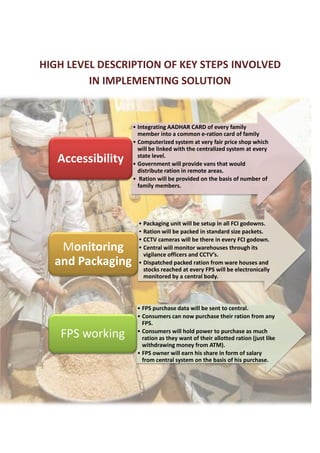
HIGH LEVEL DESCRIPTION OF KEY STEPS INVOLVED
IN IMPLEMENTING SOLUTION
Accessibility
Monitoring
and Packaging
FPS working
HIGH LEVEL DESCRIPTION OF KEY STEPS INVOLVED
IN IMPLEMENTING SOLUTION
• Integrating AADHAR CARD of every family
member into a common e-ration card of family
• Computerized system at very fair price shop which
will be linked with the centralized system at every
state level.
• Government will provide vans that would
distribute ration in remote areas.
• Ration will be provided on the basis of number of
family members.
Accessibility
• Packaging unit will be setup in all FCI godowns.
• Ration will be packed in standard size packets.
• CCTV cameras will be there in every FCI godown.
• Central will monitor warehouses through its
vigilance officers and CCTV’s.
• Dispatched packed ration from ware houses and
stocks reached at every FPS will be electronically
monitored by a central body.
Monitoring
and Packaging
• FPS purchase data will be sent to central.
• Consumers can now purchase their ration from any
FPS.
• Consumers will hold power to purchase as much
ration as they want of their allotted ration (just like
withdrawing money from ATM).
• FPS owner will earn his share in form of salary
from central system on the basis of his purchase.
FPS working
HIGH LEVEL DESCRIPTION OF KEY STEPS INVOLVED
IN IMPLEMENTING SOLUTION
• Integrating AADHAR CARD of every family
member into a common e-ration card of family
• Computerized system at very fair price shop which
will be linked with the centralized system at every
state level.
• Government will provide vans that would
distribute ration in remote areas.
• Ration will be provided on the basis of number of
family members.
• Packaging unit will be setup in all FCI godowns.
• Ration will be packed in standard size packets.
• CCTV cameras will be there in every FCI godown.
• Central will monitor warehouses through its
vigilance officers and CCTV’s.
• Dispatched packed ration from ware houses and
stocks reached at every FPS will be electronically
monitored by a central body.
• FPS purchase data will be sent to central.
• Consumers can now purchase their ration from any
FPS.
• Consumers will hold power to purchase as much
ration as they want of their allotted ration (just like
withdrawing money from ATM).
• FPS owner will earn his share in form of salary
from central system on the basis of his purchase.
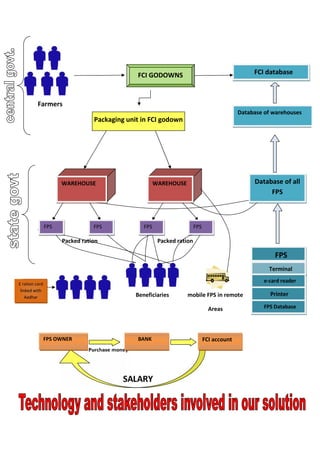
FCI GODOWNS
Farmers
Packaging unit in FCI godown
Packed ration Packed ration
Beneficiaries mobile FPS in remote
Areas
Ration
Purchase money
SALARY
Database of warehouses
FCI database
WAREHOUSE WAREHOUSE Database of all
FPS
FPS FPS FPS FPS
FPS
Terminal
e-card reader
Printer
FPS Database
E ration card
linked with
Aadhar
FPS OWNER BANK FCI account
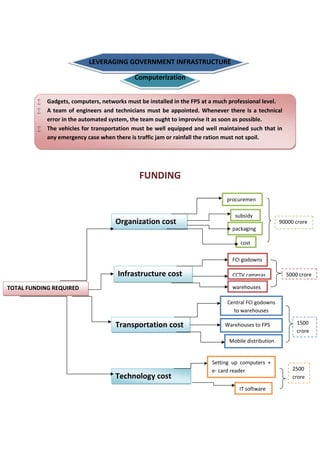
LEVERAGING GOVERNMENT INFRASTRUCTURE
Computerization
 Gadgets, computers, networks must be installed in the FPS at a much professional level.
 A team of engineers and technicians must be appointed. Whenever there is a technical
error in the automated system, the team ought to improvise it as soon as possible.
 The vehicles for transportation must be well equipped and well maintained such that in
any emergency case when there is traffic jam or rainfall the ration must not spoil.
FUNDING
TOTAL FUNDING REQUIRED
Organization cost
Infrastructure cost
Transportation cost
Technology cost
procuremen
t
subsidy
packaging
cost
FCI godowns
CCTV cameras
warehouses
Central FCI godowns
to warehouses
Warehouses to FPS
Mobile distribution
Setting up computers +
e- card reader
IT software
90000 crore
5000 crore
1500
crore
2500
crore
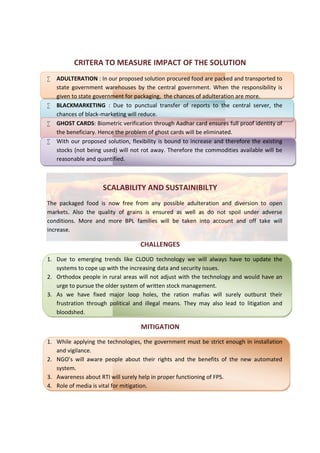
CRITERA TO MEASURE IMPACT OF THE SOLUTION
 ADULTERATION : In our proposed solution procured food are packed and transported to
state government warehouses by the central government. When the responsibility is
given to state government for packaging, the chances of adulteration are more.
 BLACKMARKETING : Due to punctual transfer of reports to the central server, the
chances of black-marketing will reduce.
 GHOST CARDS: Biometric verification through Aadhar card ensures full proof identity of
the beneficiary. Hence the problem of ghost cards will be eliminated.
 With our proposed solution, flexibility is bound to increase and therefore the existing
stocks (not being used) will not rot away. Therefore the commodities available will be
reasonable and quantified.
SCALABILITY AND SUSTAINIBILTY
The packaged food is now free from any possible adulteration and diversion to open
markets. Also the quality of grains is ensured as well as do not spoil under adverse
conditions. More and more BPL families will be taken into account and off take will
increase.
CHALLENGES
1. Due to emerging trends like CLOUD technology we will always have to update the
systems to cope up with the increasing data and security issues.
2. Orthodox people in rural areas will not adjust with the technology and would have an
urge to pursue the older system of written stock management.
3. As we have fixed major loop holes, the ration mafias will surely outburst their
frustration through political and illegal means. They may also lead to litigation and
bloodshed.
MITIGATION
1. While applying the technologies, the government must be strict enough in installation
and vigilance.
2. NGO’s will aware people about their rights and the benefits of the new automated
system.
3. Awareness about RTI will surely help in proper functioning of FPS.
4. Role of media is vital for mitigation.
CRITERA TO MEASURE IMPACT OF THE SOLUTION
 ADULTERATION : In our proposed solution procured food are packed and transported to
state government warehouses by the central government. When the responsibility is
given to state government for packaging, the chances of adulteration are more.
 BLACKMARKETING : Due to punctual transfer of reports to the central server, the
chances of black-marketing will reduce.
 GHOST CARDS: Biometric verification through Aadhar card ensures full proof identity of
the beneficiary. Hence the problem of ghost cards will be eliminated.
 With our proposed solution, flexibility is bound to increase and therefore the existing
stocks (not being used) will not rot away. Therefore the commodities available will be
reasonable and quantified.
SCALABILITY AND SUSTAINIBILTY
The packaged food is now free from any possible adulteration and diversion to open
markets. Also the quality of grains is ensured as well as do not spoil under adverse
conditions. More and more BPL families will be taken into account and off take will
increase.
CHALLENGES
1. Due to emerging trends like CLOUD technology we will always have to update the
systems to cope up with the increasing data and security issues.
2. Orthodox people in rural areas will not adjust with the technology and would have an
urge to pursue the older system of written stock management.
3. As we have fixed major loop holes, the ration mafias will surely outburst their
frustration through political and illegal means. They may also lead to litigation and
bloodshed.
MITIGATION
1. While applying the technologies, the government must be strict enough in installation
and vigilance.
2. NGO’s will aware people about their rights and the benefits of the new automated
system.
3. Awareness about RTI will surely help in proper functioning of FPS.
4. Role of media is vital for mitigation.
CRITERA TO MEASURE IMPACT OF THE SOLUTION
 ADULTERATION : In our proposed solution procured food are packed and transported to
state government warehouses by the central government. When the responsibility is
given to state government for packaging, the chances of adulteration are more.
 BLACKMARKETING : Due to punctual transfer of reports to the central server, the
chances of black-marketing will reduce.
 GHOST CARDS: Biometric verification through Aadhar card ensures full proof identity of
the beneficiary. Hence the problem of ghost cards will be eliminated.
 With our proposed solution, flexibility is bound to increase and therefore the existing
stocks (not being used) will not rot away. Therefore the commodities available will be
reasonable and quantified.
SCALABILITY AND SUSTAINIBILTY
The packaged food is now free from any possible adulteration and diversion to open
markets. Also the quality of grains is ensured as well as do not spoil under adverse
conditions. More and more BPL families will be taken into account and off take will
increase.
CHALLENGES
1. Due to emerging trends like CLOUD technology we will always have to update the
systems to cope up with the increasing data and security issues.
2. Orthodox people in rural areas will not adjust with the technology and would have an
urge to pursue the older system of written stock management.
3. As we have fixed major loop holes, the ration mafias will surely outburst their
frustration through political and illegal means. They may also lead to litigation and
bloodshed.
MITIGATION
1. While applying the technologies, the government must be strict enough in installation
and vigilance.
2. NGO’s will aware people about their rights and the benefits of the new automated
system.
3. Awareness about RTI will surely help in proper functioning of FPS.
4. Role of media is vital for mitigation.
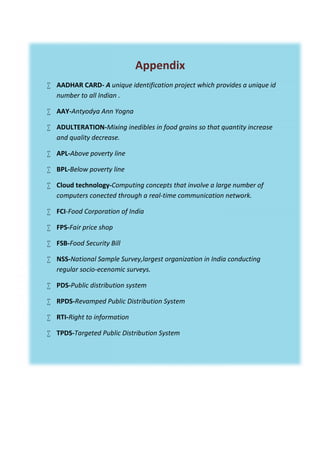
Appendix
 AADHAR CARD- A unique identification project which provides a unique id
number to all Indian .
 AAY-Antyodya Ann Yogna
 ADULTERATION-Mixing inedibles in food grains so that quantity increase
and quality decrease.
 APL-Above poverty line
 BPL-Below poverty line
 Cloud technology-Computing concepts that involve a large number of
computers conected through a real-time communication network.
 FCI-Food Corporation of India
 FPS-Fair price shop
 FSB-Food Security Bill
 NSS-National Sample Survey,largest organization in India conducting
regular socio-ecenomic surveys.
 PDS-Public distribution system
 RPDS-Revamped Public Distribution System
 RTI-Right to information
 TPDS-Targeted Public Distribution System
Appendix
 AADHAR CARD- A unique identification project which provides a unique id
number to all Indian .
 AAY-Antyodya Ann Yogna
 ADULTERATION-Mixing inedibles in food grains so that quantity increase
and quality decrease.
 APL-Above poverty line
 BPL-Below poverty line
 Cloud technology-Computing concepts that involve a large number of
computers conected through a real-time communication network.
 FCI-Food Corporation of India
 FPS-Fair price shop
 FSB-Food Security Bill
 NSS-National Sample Survey,largest organization in India conducting
regular socio-ecenomic surveys.
 PDS-Public distribution system
 RPDS-Revamped Public Distribution System
 RTI-Right to information
 TPDS-Targeted Public Distribution System
Appendix
 AADHAR CARD- A unique identification project which provides a unique id
number to all Indian .
 AAY-Antyodya Ann Yogna
 ADULTERATION-Mixing inedibles in food grains so that quantity increase
and quality decrease.
 APL-Above poverty line
 BPL-Below poverty line
 Cloud technology-Computing concepts that involve a large number of
computers conected through a real-time communication network.
 FCI-Food Corporation of India
 FPS-Fair price shop
 FSB-Food Security Bill
 NSS-National Sample Survey,largest organization in India conducting
regular socio-ecenomic surveys.
 PDS-Public distribution system
 RPDS-Revamped Public Distribution System
 RTI-Right to information
 TPDS-Targeted Public Distribution System
REFERENCE
1. Talk delivered by Mr. Akshay of Boston consultants group on PDS.
2. Ch.Srinivas and S.Abdul Jhaha Global Research and Consultancy Services ,
Hyderabad,Deccan Development Society.
3. Chattisgarh Cheif Minister's letter to Prime Minister on cash transfers in the
PDS.
4. Dr. S. nakkiran,principal (Retd.) , TBML college Poragar, TAmil Nadu.
National Food Security Bill 2013.
REFERENCE
1. Talk delivered by Mr. Akshay of Boston consultants group on PDS.
2. Ch.Srinivas and S.Abdul Jhaha Global Research and Consultancy Services ,
Hyderabad,Deccan Development Society.
3. Chattisgarh Cheif Minister's letter to Prime Minister on cash transfers in the
PDS.
4. Dr. S. nakkiran,principal (Retd.) , TBML college Poragar, TAmil Nadu.
National Food Security Bill 2013.
REFERENCE
1. Talk delivered by Mr. Akshay of Boston consultants group on PDS.
2. Ch.Srinivas and S.Abdul Jhaha Global Research and Consultancy Services ,
Hyderabad,Deccan Development Society.
3. Chattisgarh Cheif Minister's letter to Prime Minister on cash transfers in the
PDS.
4. Dr. S. nakkiran,principal (Retd.) , TBML college Poragar, TAmil Nadu.
National Food Security Bill 2013.
Submitted by :-
TEAM SAMARTHA MANIT BHOPAL
Saumya Shivhare
Shubham Bhatnagar
Rajnandini Sharma
Vishal Jaiswal
Kamakshi Gupta

SAMARTHA

  • 2.
    PDS is consideredas principal instrument in the hands of State Governments for providing safety net to the poor against the spiralling rise in prices of essential commodities. Public Distribution System (PDS) is a poverty alleviation programme And contributes towards the social welfare of the people. Essential commodities like rice, wheat, sugar, kerosene and the like are supplied to the people under the PDS at reasonable prices. PDS is a boon to the people living below the poverty line. PDS is the primary social welfare and antipoverty programme of the Government of India. Revamped Public Distribution System (RPDS) has been initiated by the Government of India from the year 1992 in order to serve and provide essential commodities to the people living in remote, backward and hilly areas. Government introduced Targeted Public Distribution System (TPDS) in the year 1997. PDS is considered as principal instrument in the hands of State Governments for providing safety net to the poor against the spiralling rise in prices of essential commodities. Public Distribution System (PDS) is a poverty alleviation programme And contributes towards the social welfare of the people. Essential commodities like rice, wheat, sugar, kerosene and the like are supplied to the people under the PDS at reasonable prices. PDS is a boon to the people living below the poverty line. PDS is the primary social welfare and antipoverty programme of the Government of India. Revamped Public Distribution System (RPDS) has been initiated by the Government of India from the year 1992 in order to serve and provide essential commodities to the people living in remote, backward and hilly areas. Government introduced Targeted Public Distribution System (TPDS) in the year 1997. PDS is considered as principal instrument in the hands of State Governments for providing safety net to the poor against the spiralling rise in prices of essential commodities. Public Distribution System (PDS) is a poverty alleviation programme And contributes towards the social welfare of the people. Essential commodities like rice, wheat, sugar, kerosene and the like are supplied to the people under the PDS at reasonable prices. PDS is a boon to the people living below the poverty line. PDS is the primary social welfare and antipoverty programme of the Government of India. Revamped Public Distribution System (RPDS) has been initiated by the Government of India from the year 1992 in order to serve and provide essential commodities to the people living in remote, backward and hilly areas. Government introduced Targeted Public Distribution System (TPDS) in the year 1997.
  • 3.
    General problems inpublic distribution system COVERAGE It counts the population being fed by PDS. Although PDS is the largest network of food grain production, still it is not in reach of every consumer. According to National Sample Survey (2004-2005), it is estimated that 73% did not get any food grains from PDS. Therefore coverage is one of the major problem in PDS. Also, stocks arrived in FPS are not always on time due to which the consumers may have to depend on private shops. IMPLICIT SUBSIDY In this government has provided subsidy on various commodities. This government policy aims at subsidizing price of commodities lower than minimum support price. With the alarming inflation, the minimum support price will bound to increase. The subsidy will henceforth increase. EXCLUSION ERROR This error occurs due to the proportion of poor left out of PDS. In this a poor person of BPL is not classified as one and hence is deprived of the benefits of PDS. UNDERNUTRITION PDS aims not just to distribute food grains but also aims at providing good quality food grains/ commodities so that the problem of malnutrition is reduced. But malnutrition persists to be the most important concern of India. TRANSPORTATION LEAKAGE The distance of grains from go downs to FPS is also a major filtration point in the distribution mechanism. The grain won’t reach to FPS but goes to open market for selling, getting the margins which benefits the middle men that is FPS owners and officials of the distribution wing.
  • 4.
    BPL PROBLEMS The numbersshown by state government for BPL families do not tally with the ration cards issued and also with the planning commission statistics. Due to this two types of problem arises - one is the number of ration card holders are less compared to the number of BPL families announced by the state government. Second is the number of ration cards issued are more than the real BPL families in the village. In the second case, huge quantity of grains got released from second but not the concerned but reselling the same at higher margins in market. PDS is highly corrupt system which is not benefiting the needy- poorest of the poor, as per objective of the government. To reduce the filtration of the grains into open market technology usage from go downs – Fair price shop – consumer mechanism has to be automated.
  • 5.
    FAIR PRICE SHOPS:A MAJOR PROBLEM Fair price shops are not viable. Most shops do not display stock statements, and bill books are poorly maintained. Issuance of bills for the transactions undertaken is done rarely and stock books are improperly maintained. Card holders complained about the FPS owners charging higher prices for commodities and receiving less quantity than what they are entitled to. Shops use unfair practices in distribution such as adulteration, improper weighing, etc. FPS OWNERS DO BLACKMARKETING THROUGH VARIOUS WAYS:  He fools illiterate consumers by selling them less quantity of ration through taking their thumb prints for different quantities.  Adulteration is the most common thing which is done by FPS. Thus compromising with the nutritional value of ration.  FPS OWNER exchange good quality of ration present in FPS stocks with poor quality of stocks from market shops, hence earning their profit with this black marketing  They don’t maintain proper report of ration transactions and bribe the food security inspectors.  They sell the remaining ration of FPS in open market at higher for their own benefits, thus reducing the government’s subsidy.
  • 6.
    LACK OF PORTABILITYOF FPS The consumers are bound to purchase their ration from a specifically allotted FPS. If case if there is no stock at the FPS the consumer cannot approach any other FPS for his required ration. The same problem is faced by the migrants. The tribal people who move from one place to another cannot avail the ration from new FPS with the old ration cards. CAUSES OF THE PROBLEM Food security inspector are not honest towards their job so there is lack of transparency in the PDS Since the food given to the PDS customers are not packed, thus the chances of adulteration of food increases. The manual billing of the ration being sold leads to forgery at the district level which in turn gives rise to corruption. LACK OF PORTABILITY OF FPS The consumers are bound to purchase their ration from a specifically allotted FPS. If case if there is no stock at the FPS the consumer cannot approach any other FPS for his required ration. The same problem is faced by the migrants. The tribal people who move from one place to another cannot avail the ration from new FPS with the old ration cards. CAUSES OF THE PROBLEM Food security inspector are not honest towards their job so there is lack of transparency in the PDS Since the food given to the PDS customers are not packed, thus the chances of adulteration of food increases. The manual billing of the ration being sold leads to forgery at the district level which in turn gives rise to corruption. LACK OF PORTABILITY OF FPS The consumers are bound to purchase their ration from a specifically allotted FPS. If case if there is no stock at the FPS the consumer cannot approach any other FPS for his required ration. The same problem is faced by the migrants. The tribal people who move from one place to another cannot avail the ration from new FPS with the old ration cards. CAUSES OF THE PROBLEM Food security inspector are not honest towards their job so there is lack of transparency in the PDS Since the food given to the PDS customers are not packed, thus the chances of adulteration of food increases. The manual billing of the ration being sold leads to forgery at the district level which in turn gives rise to corruption.
  • 7.
    Generation of GhostCards • Manual Process involved • Tatkal Ration Card System • Lack of identity of persons in RC • No accountability •Registers kept at Government office (G-register) and FP Shop •As per the year 2004 information, it is estimated that out of the total no. of ration cards about 5.14% ghost card exists. Generation of Ghost Cards • Manual Process involved • Tatkal Ration Card System • Lack of identity of persons in RC • No accountability •Registers kept at Government office (G-register) and FP Shop •As per the year 2004 information, it is estimated that out of the total no. of ration cards about 5.14% ghost card exists. Generation of Ghost Cards • Manual Process involved • Tatkal Ration Card System • Lack of identity of persons in RC • No accountability •Registers kept at Government office (G-register) and FP Shop •As per the year 2004 information, it is estimated that out of the total no. of ration cards about 5.14% ghost card exists.
  • 8.
    PROPOSED SOLUTION Food dispatchedfrom central government should be in the form of small recyclable packets which will have various advantages:- •Food packets should be of standard weights of 2, 5, 10, 15 ,25 kgs •The packaging material should be recyclable so that food packets can be easily dispersed as well as exchange effectively. Return of empty packets. For effective recycling of packets ( in order to save manufacturing cost ) It is mandatory for consumers to return the previous empty packets on the next visit. On return of 20 packets the consumers will get 2 kg packet of ration as a reward . Flexibility in FPS. The consumer must be given rights to purchase ration from any of the FPS rather than the allotted FPS. This will help the migrants (such as tribal who move from one place to another). Mobile distribution of ration in remote areas. The ration from the various FPS should be send through any transport means to remote areas which are deprived of FPS. It will cut off the transportation cost of the people hailing from remote areas for their daily meal. Centralized system at state level should maintain data that contains the contact number of all those who avail the facility of PDS. The people who are categorized in BPL will get an sms from the centralized system after arrival of the stocks at FPS. This system of keeping contact numbers will also help to bring transparency between BPL and APL. With the consumers allotted with unique Aadhar card an entry is made into the electronic device that tallies the Aadhar card number. The device is digitalized and hence chances of corruption at FPS level are reduced. Identification of consumers is made through thumb prints. There should be state patch ups in case of calamities. It means that there must be mutual understanding between various states to help them in times of calamities. PROPOSED SOLUTION Food dispatched from central government should be in the form of small recyclable packets which will have various advantages:- •Food packets should be of standard weights of 2, 5, 10, 15 ,25 kgs •The packaging material should be recyclable so that food packets can be easily dispersed as well as exchange effectively. Return of empty packets. For effective recycling of packets ( in order to save manufacturing cost ) It is mandatory for consumers to return the previous empty packets on the next visit. On return of 20 packets the consumers will get 2 kg packet of ration as a reward . Flexibility in FPS. The consumer must be given rights to purchase ration from any of the FPS rather than the allotted FPS. This will help the migrants (such as tribal who move from one place to another). Mobile distribution of ration in remote areas. The ration from the various FPS should be send through any transport means to remote areas which are deprived of FPS. It will cut off the transportation cost of the people hailing from remote areas for their daily meal. Centralized system at state level should maintain data that contains the contact number of all those who avail the facility of PDS. The people who are categorized in BPL will get an sms from the centralized system after arrival of the stocks at FPS. This system of keeping contact numbers will also help to bring transparency between BPL and APL. With the consumers allotted with unique Aadhar card an entry is made into the electronic device that tallies the Aadhar card number. The device is digitalized and hence chances of corruption at FPS level are reduced. Identification of consumers is made through thumb prints. There should be state patch ups in case of calamities. It means that there must be mutual understanding between various states to help them in times of calamities. PROPOSED SOLUTION Food dispatched from central government should be in the form of small recyclable packets which will have various advantages:- •Food packets should be of standard weights of 2, 5, 10, 15 ,25 kgs •The packaging material should be recyclable so that food packets can be easily dispersed as well as exchange effectively. Return of empty packets. For effective recycling of packets ( in order to save manufacturing cost ) It is mandatory for consumers to return the previous empty packets on the next visit. On return of 20 packets the consumers will get 2 kg packet of ration as a reward . Flexibility in FPS. The consumer must be given rights to purchase ration from any of the FPS rather than the allotted FPS. This will help the migrants (such as tribal who move from one place to another). Mobile distribution of ration in remote areas. The ration from the various FPS should be send through any transport means to remote areas which are deprived of FPS. It will cut off the transportation cost of the people hailing from remote areas for their daily meal. Centralized system at state level should maintain data that contains the contact number of all those who avail the facility of PDS. The people who are categorized in BPL will get an sms from the centralized system after arrival of the stocks at FPS. This system of keeping contact numbers will also help to bring transparency between BPL and APL. With the consumers allotted with unique Aadhar card an entry is made into the electronic device that tallies the Aadhar card number. The device is digitalized and hence chances of corruption at FPS level are reduced. Identification of consumers is made through thumb prints. There should be state patch ups in case of calamities. It means that there must be mutual understanding between various states to help them in times of calamities.
  • 9.
    FLAWS IN FOODSECURITY ORDINANCE If a family consists of 5 people the previous system provided them with 35 kg of rice. With the introduction of Food Security Bill , the quantity reduces to 25 kg. The people has to depend on private shops for this “10kg” and with the inflating prices. Moreover, this bill aims at feeding 67.5lakh population of India-that is double the number of BPL families. Subsequently the burden on govt. as well as the consumer is bound to increase.  India’s poverty index is measured in calories. According to FSB, the adults will be provided 165 gm of food subsidy. A normal person requires 2500 calories per day whereas 400 grams of food will provide only upto 330 calories.  It is the duty/responsibility of central government to decide and make up a criteria on who can avail the facility of PDS that is norms for consideration into BPL. But the FSP, the central government is giving this duty to state governments which in turn would create interstate disparities.  In case of any contingency like drought, flood, etc. The new FPS states that it is incumbent on state government for purchase/procurement of food grains.  The condition of ware houses in our country is pathetic. there is no investment in terms of storage, transportation & maintenance.
  • 10.
    DEMERITS OF GOVERNMENT POLICIESPROPOSED Cash transfer : opening of bank accounts, availability of banks, delays in release of amounts Difficult to fix the monthly cash subsidy: fluctuation in market prices Cash cannot guarantee food security: purchase of non PDS commodities No MSP: due to cash transfer FCI does not provide MSP, farmers not incentivize.
  • 11.
    HIGH LEVEL DESCRIPTIONOF KEY STEPS INVOLVED IN IMPLEMENTING SOLUTION Accessibility Monitoring and Packaging FPS working HIGH LEVEL DESCRIPTION OF KEY STEPS INVOLVED IN IMPLEMENTING SOLUTION • Integrating AADHAR CARD of every family member into a common e-ration card of family • Computerized system at very fair price shop which will be linked with the centralized system at every state level. • Government will provide vans that would distribute ration in remote areas. • Ration will be provided on the basis of number of family members. Accessibility • Packaging unit will be setup in all FCI godowns. • Ration will be packed in standard size packets. • CCTV cameras will be there in every FCI godown. • Central will monitor warehouses through its vigilance officers and CCTV’s. • Dispatched packed ration from ware houses and stocks reached at every FPS will be electronically monitored by a central body. Monitoring and Packaging • FPS purchase data will be sent to central. • Consumers can now purchase their ration from any FPS. • Consumers will hold power to purchase as much ration as they want of their allotted ration (just like withdrawing money from ATM). • FPS owner will earn his share in form of salary from central system on the basis of his purchase. FPS working HIGH LEVEL DESCRIPTION OF KEY STEPS INVOLVED IN IMPLEMENTING SOLUTION • Integrating AADHAR CARD of every family member into a common e-ration card of family • Computerized system at very fair price shop which will be linked with the centralized system at every state level. • Government will provide vans that would distribute ration in remote areas. • Ration will be provided on the basis of number of family members. • Packaging unit will be setup in all FCI godowns. • Ration will be packed in standard size packets. • CCTV cameras will be there in every FCI godown. • Central will monitor warehouses through its vigilance officers and CCTV’s. • Dispatched packed ration from ware houses and stocks reached at every FPS will be electronically monitored by a central body. • FPS purchase data will be sent to central. • Consumers can now purchase their ration from any FPS. • Consumers will hold power to purchase as much ration as they want of their allotted ration (just like withdrawing money from ATM). • FPS owner will earn his share in form of salary from central system on the basis of his purchase.
  • 12.
    FCI GODOWNS Farmers Packaging unitin FCI godown Packed ration Packed ration Beneficiaries mobile FPS in remote Areas Ration Purchase money SALARY Database of warehouses FCI database WAREHOUSE WAREHOUSE Database of all FPS FPS FPS FPS FPS FPS Terminal e-card reader Printer FPS Database E ration card linked with Aadhar FPS OWNER BANK FCI account
  • 13.
    LEVERAGING GOVERNMENT INFRASTRUCTURE Computerization Gadgets, computers, networks must be installed in the FPS at a much professional level.  A team of engineers and technicians must be appointed. Whenever there is a technical error in the automated system, the team ought to improvise it as soon as possible.  The vehicles for transportation must be well equipped and well maintained such that in any emergency case when there is traffic jam or rainfall the ration must not spoil. FUNDING TOTAL FUNDING REQUIRED Organization cost Infrastructure cost Transportation cost Technology cost procuremen t subsidy packaging cost FCI godowns CCTV cameras warehouses Central FCI godowns to warehouses Warehouses to FPS Mobile distribution Setting up computers + e- card reader IT software 90000 crore 5000 crore 1500 crore 2500 crore
  • 14.
    CRITERA TO MEASUREIMPACT OF THE SOLUTION  ADULTERATION : In our proposed solution procured food are packed and transported to state government warehouses by the central government. When the responsibility is given to state government for packaging, the chances of adulteration are more.  BLACKMARKETING : Due to punctual transfer of reports to the central server, the chances of black-marketing will reduce.  GHOST CARDS: Biometric verification through Aadhar card ensures full proof identity of the beneficiary. Hence the problem of ghost cards will be eliminated.  With our proposed solution, flexibility is bound to increase and therefore the existing stocks (not being used) will not rot away. Therefore the commodities available will be reasonable and quantified. SCALABILITY AND SUSTAINIBILTY The packaged food is now free from any possible adulteration and diversion to open markets. Also the quality of grains is ensured as well as do not spoil under adverse conditions. More and more BPL families will be taken into account and off take will increase. CHALLENGES 1. Due to emerging trends like CLOUD technology we will always have to update the systems to cope up with the increasing data and security issues. 2. Orthodox people in rural areas will not adjust with the technology and would have an urge to pursue the older system of written stock management. 3. As we have fixed major loop holes, the ration mafias will surely outburst their frustration through political and illegal means. They may also lead to litigation and bloodshed. MITIGATION 1. While applying the technologies, the government must be strict enough in installation and vigilance. 2. NGO’s will aware people about their rights and the benefits of the new automated system. 3. Awareness about RTI will surely help in proper functioning of FPS. 4. Role of media is vital for mitigation. CRITERA TO MEASURE IMPACT OF THE SOLUTION  ADULTERATION : In our proposed solution procured food are packed and transported to state government warehouses by the central government. When the responsibility is given to state government for packaging, the chances of adulteration are more.  BLACKMARKETING : Due to punctual transfer of reports to the central server, the chances of black-marketing will reduce.  GHOST CARDS: Biometric verification through Aadhar card ensures full proof identity of the beneficiary. Hence the problem of ghost cards will be eliminated.  With our proposed solution, flexibility is bound to increase and therefore the existing stocks (not being used) will not rot away. Therefore the commodities available will be reasonable and quantified. SCALABILITY AND SUSTAINIBILTY The packaged food is now free from any possible adulteration and diversion to open markets. Also the quality of grains is ensured as well as do not spoil under adverse conditions. More and more BPL families will be taken into account and off take will increase. CHALLENGES 1. Due to emerging trends like CLOUD technology we will always have to update the systems to cope up with the increasing data and security issues. 2. Orthodox people in rural areas will not adjust with the technology and would have an urge to pursue the older system of written stock management. 3. As we have fixed major loop holes, the ration mafias will surely outburst their frustration through political and illegal means. They may also lead to litigation and bloodshed. MITIGATION 1. While applying the technologies, the government must be strict enough in installation and vigilance. 2. NGO’s will aware people about their rights and the benefits of the new automated system. 3. Awareness about RTI will surely help in proper functioning of FPS. 4. Role of media is vital for mitigation. CRITERA TO MEASURE IMPACT OF THE SOLUTION  ADULTERATION : In our proposed solution procured food are packed and transported to state government warehouses by the central government. When the responsibility is given to state government for packaging, the chances of adulteration are more.  BLACKMARKETING : Due to punctual transfer of reports to the central server, the chances of black-marketing will reduce.  GHOST CARDS: Biometric verification through Aadhar card ensures full proof identity of the beneficiary. Hence the problem of ghost cards will be eliminated.  With our proposed solution, flexibility is bound to increase and therefore the existing stocks (not being used) will not rot away. Therefore the commodities available will be reasonable and quantified. SCALABILITY AND SUSTAINIBILTY The packaged food is now free from any possible adulteration and diversion to open markets. Also the quality of grains is ensured as well as do not spoil under adverse conditions. More and more BPL families will be taken into account and off take will increase. CHALLENGES 1. Due to emerging trends like CLOUD technology we will always have to update the systems to cope up with the increasing data and security issues. 2. Orthodox people in rural areas will not adjust with the technology and would have an urge to pursue the older system of written stock management. 3. As we have fixed major loop holes, the ration mafias will surely outburst their frustration through political and illegal means. They may also lead to litigation and bloodshed. MITIGATION 1. While applying the technologies, the government must be strict enough in installation and vigilance. 2. NGO’s will aware people about their rights and the benefits of the new automated system. 3. Awareness about RTI will surely help in proper functioning of FPS. 4. Role of media is vital for mitigation.
  • 15.
    Appendix  AADHAR CARD-A unique identification project which provides a unique id number to all Indian .  AAY-Antyodya Ann Yogna  ADULTERATION-Mixing inedibles in food grains so that quantity increase and quality decrease.  APL-Above poverty line  BPL-Below poverty line  Cloud technology-Computing concepts that involve a large number of computers conected through a real-time communication network.  FCI-Food Corporation of India  FPS-Fair price shop  FSB-Food Security Bill  NSS-National Sample Survey,largest organization in India conducting regular socio-ecenomic surveys.  PDS-Public distribution system  RPDS-Revamped Public Distribution System  RTI-Right to information  TPDS-Targeted Public Distribution System Appendix  AADHAR CARD- A unique identification project which provides a unique id number to all Indian .  AAY-Antyodya Ann Yogna  ADULTERATION-Mixing inedibles in food grains so that quantity increase and quality decrease.  APL-Above poverty line  BPL-Below poverty line  Cloud technology-Computing concepts that involve a large number of computers conected through a real-time communication network.  FCI-Food Corporation of India  FPS-Fair price shop  FSB-Food Security Bill  NSS-National Sample Survey,largest organization in India conducting regular socio-ecenomic surveys.  PDS-Public distribution system  RPDS-Revamped Public Distribution System  RTI-Right to information  TPDS-Targeted Public Distribution System Appendix  AADHAR CARD- A unique identification project which provides a unique id number to all Indian .  AAY-Antyodya Ann Yogna  ADULTERATION-Mixing inedibles in food grains so that quantity increase and quality decrease.  APL-Above poverty line  BPL-Below poverty line  Cloud technology-Computing concepts that involve a large number of computers conected through a real-time communication network.  FCI-Food Corporation of India  FPS-Fair price shop  FSB-Food Security Bill  NSS-National Sample Survey,largest organization in India conducting regular socio-ecenomic surveys.  PDS-Public distribution system  RPDS-Revamped Public Distribution System  RTI-Right to information  TPDS-Targeted Public Distribution System
  • 16.
    REFERENCE 1. Talk deliveredby Mr. Akshay of Boston consultants group on PDS. 2. Ch.Srinivas and S.Abdul Jhaha Global Research and Consultancy Services , Hyderabad,Deccan Development Society. 3. Chattisgarh Cheif Minister's letter to Prime Minister on cash transfers in the PDS. 4. Dr. S. nakkiran,principal (Retd.) , TBML college Poragar, TAmil Nadu. National Food Security Bill 2013. REFERENCE 1. Talk delivered by Mr. Akshay of Boston consultants group on PDS. 2. Ch.Srinivas and S.Abdul Jhaha Global Research and Consultancy Services , Hyderabad,Deccan Development Society. 3. Chattisgarh Cheif Minister's letter to Prime Minister on cash transfers in the PDS. 4. Dr. S. nakkiran,principal (Retd.) , TBML college Poragar, TAmil Nadu. National Food Security Bill 2013. REFERENCE 1. Talk delivered by Mr. Akshay of Boston consultants group on PDS. 2. Ch.Srinivas and S.Abdul Jhaha Global Research and Consultancy Services , Hyderabad,Deccan Development Society. 3. Chattisgarh Cheif Minister's letter to Prime Minister on cash transfers in the PDS. 4. Dr. S. nakkiran,principal (Retd.) , TBML college Poragar, TAmil Nadu. National Food Security Bill 2013.
  • 17.
    Submitted by :- TEAMSAMARTHA MANIT BHOPAL Saumya Shivhare Shubham Bhatnagar Rajnandini Sharma Vishal Jaiswal Kamakshi Gupta