NOURISH TO FLOURISH:REDUCING MALNUTRITION
FOR
BY:
TEAM SWADHAAR-”SWA” MEANS SELF AND “ADHAAR” MEANS DEPENDENCE
-HEARSH VARMA
-HIMANSHU JOSHI
-S RAVI TEJA
-NAGARJUNA TADISETTI
-SAMHITHA TUMMANAPALLI
Introduction
India, today is one of the most malnourished countries in the World.
More than 40% of the World’s under weight children below five years
live in India (Global Hunger Index 2012).
The NFHS (National Family Health Survey)-3 asserts that not much
progress has been achieved in improving human resources.
Poverty is a major, but not the only cause of malnutrition.
Percentage of population suffering from various forms of malnutrition, far
exceeds the percentage below poverty line.
After National Nutrition Policy 1993 and National Plan of Action, 1995 no
national programs or policies for eradicating malnutrition have
appeared.
2
Indicators for Assessing the Nutritional
Status
Indirect Indicators
Access to Hygienic
Sanitation and Toilet
Facilities
Access to Safe Drinking
Water
Female literacy
Direct Indicators
Low Birth Weight
Infant Mortality Rate (IMR)
Under 5 Mortality Rate (U5MR)
Stunting/ Wasting/ Underweight
Anaemia
Immunization
Maternal Mortality Rate (MMR)
Chronic Energy Deficiency and
Anaemia among adults
3
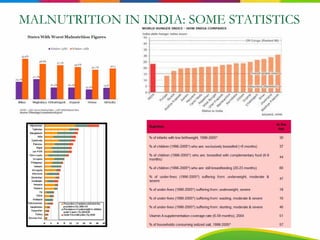
MALNUTRITION IN INDIA: SOME STATISTICS
Analysis of the current situation:
(i) India has no comprehensive National Program for the eradication of
Malnutrition. The ICDS programme in governmental and general
perception is seen as a programme to address malnutrition. However,
ICDS is not a programme for the eradication of malnutrition, but for
Integrated Child Development.
(ii) Other Nutrition and related programmes such as the Mid Day Meal
Programme, Kishori Shakti Yojana, Vitamin A supplementation
programme, National Nutritional Anaemia Control Programme, and
the National Iodine Deficiency Disorder Control Programme address
some of the causes of Malnutrition but not all of them.
(iii) Even the recently introduced Food Security Bill, 2013 provides for
providing rice, wheat and coarse grains at subsidized price, however
there are many more nutrients required to prevent malnutrition.
5
(iv) The population of India suffers from a high Protein Calorie deficit.
Studies reveal that 30% of the households in India consume less than
70% of the energy requirement and calorie intake (NNMB repeat
surveys 1988-1990 and 1996-97).
(v) There is inadequate awareness and information regarding proper
nutritional practices amongst the population.
(vi) Crucial prescriptions of the National Nutrition Policy, 1993, were not
translated into National Programmes, viz., popularization of low cost
nutritious foods, reaching the adolescent girl, fortification of
essential foods and control of micronutrient deficiencies.
(vii) Most importantly, eradication of malnutrition should be articulated as
high priority in the National Development Agenda.
6
A National Strategy is required to Combat Malnutrition
Underlying Principles: Bridging the Calorie-Protein Gap
Introduce nutrition and micro-nutrient interventions for the three critical links
of malnutrition viz. children 6 months – 6 years, adolescent girls, and pregnant
and lactating women to be prepared by SHGs from low cost, locally available
agricultural produce.
Introduce nutrition and micro-nutrient interventions for the general population
to bridge the protein-calorie gap by making available in the market, protein-
energy dense foods.
Make low cost energy foods available for the general population (Corporate
Sector/PPP)
Structure and monitor tightly integrated multi-sectoral interventions to address
all or majority of the direct and indirect causes of malnutrition simultaneously.
Initiate a sustained general public awareness campaign regarding proper
nutritional practices within existing family budgets, and to create demand.
7
Essential Interventions to Combat Malnutrition
(A) Direct interventions –
Related to the consumption and absorption of adequate protein calorie/micro-nutrient rich foods
essential to combat malnutrition, namely:
1. Weighment of child within 6 hours of birth and thereafter at monthly intervals.
2. Timely initiation of breastfeeding within one hour of birth, and feeding of colostrum to the
infant.
3. Exclusive breastfeeding during the first six months of life.
4. Timely introduction of complementary foods at six months and adequate intake of the
same, in terms of quantity, quality and frequency for children between 6-24 months.
5. Dietary supplements of all children between 6 months – 72 months through energy dense
foods made by SHGs from locally available food material to bridge the protein calorie gap.
6. Safe handling of complementary foods and hygienic complementary feeding practices.
7. Complete immunization and Vitamin A supplementation.
8. De-worming of all family members bi-annually.
8
(B) Indirect Interventions –
Related to issues of health, safe drinking water, hygienic sanitation and socio-cultural
factors such as early marriage and pregnancy of girls, female literacy and poverty
reduction, to eradicate malnutrition on a long term, sustainable basis.
1. Access to safe drinking water (treatment, storage, handling and transport),
sanitation and hygiene.
2. Increased female education and completion of secondary schooling for the girl
child.
3. Increased access to basic health services by women.
4. Expanded and improved nutrition education and involvement at Panchayat and
community level to create demand.
5. Increased gender equity.
6. Promotion of nutrition best practices especially for girls and women.
9
Nutrition Monitoring and Surveillance
A computerized Central and Block level monitoring systems
should be devised with deliverable targets and time frames
An effective concurrent monitoring system through an external
agency can also be established for measuring outcomes, and for
effecting changes and mid course corrections
At the AW level, community based nutrition monitoring and
surveillance through ICDS infrastructure could include growth
monitoring of infants and children and weight monitoring of
adolescent girls and women
Creating a data base on the nutritional status of children,
adolescents and women in each Anganwadi
10
Concluding Observations:
Since at least 4% of India’s GDP ($29 Billion) annually is lost on
account of malnutrition, the cost of addressing malnutrition is
far below the cost of not addressing it.
It may be noted that the cost of construction of 3 kilometres of
rural road is in excess of the amount required to address the
nutrition deficit of the key target groups in the Block.
Investing in human resources development for the future – in
the shape of healthy children, adolescents and adults with
higher cognitive and productive capacity, is an investment that
will pay for itself several times over, will eradicate the curse of
malnutrition in the shortest possible time, so that every Indian
is able to reach his or her full physical and cognitive potential,
enhance income generation capacity and contribute to the
country's progress.
11
References
http://www.thehindu.com/multimedia/archive/01404/National_Food_Secu_1
404268a.pdf
http://www.angoc.org/portal/wp-content/uploads/2012/09/12/vietnam-food-
and-nutrition-security-situationer/India.pdf
http://en.wikipedia.org/wiki/Malnutrition
http://www.hindu.com/br/2005/01/11/stories/2005011100491500.htm
TOWARDS HUNGER FREE INDIA — From Vision to Action: M. S.
Swaminathan, Pedro Medrano

Swadhaar

  • 1.
    NOURISH TO FLOURISH:REDUCING MALNUTRITION FOR BY: TEAM SWADHAAR-”SWA” MEANSSELF AND “ADHAAR” MEANS DEPENDENCE -HEARSH VARMA -HIMANSHU JOSHI -S RAVI TEJA -NAGARJUNA TADISETTI -SAMHITHA TUMMANAPALLI
  • 2.
    Introduction India, today isone of the most malnourished countries in the World. More than 40% of the World’s under weight children below five years live in India (Global Hunger Index 2012). The NFHS (National Family Health Survey)-3 asserts that not much progress has been achieved in improving human resources. Poverty is a major, but not the only cause of malnutrition. Percentage of population suffering from various forms of malnutrition, far exceeds the percentage below poverty line. After National Nutrition Policy 1993 and National Plan of Action, 1995 no national programs or policies for eradicating malnutrition have appeared. 2
  • 3.
    Indicators for Assessingthe Nutritional Status Indirect Indicators Access to Hygienic Sanitation and Toilet Facilities Access to Safe Drinking Water Female literacy Direct Indicators Low Birth Weight Infant Mortality Rate (IMR) Under 5 Mortality Rate (U5MR) Stunting/ Wasting/ Underweight Anaemia Immunization Maternal Mortality Rate (MMR) Chronic Energy Deficiency and Anaemia among adults 3
  • 4.
    MALNUTRITION IN INDIA:SOME STATISTICS
  • 5.
    Analysis of thecurrent situation: (i) India has no comprehensive National Program for the eradication of Malnutrition. The ICDS programme in governmental and general perception is seen as a programme to address malnutrition. However, ICDS is not a programme for the eradication of malnutrition, but for Integrated Child Development. (ii) Other Nutrition and related programmes such as the Mid Day Meal Programme, Kishori Shakti Yojana, Vitamin A supplementation programme, National Nutritional Anaemia Control Programme, and the National Iodine Deficiency Disorder Control Programme address some of the causes of Malnutrition but not all of them. (iii) Even the recently introduced Food Security Bill, 2013 provides for providing rice, wheat and coarse grains at subsidized price, however there are many more nutrients required to prevent malnutrition. 5
  • 6.
    (iv) The populationof India suffers from a high Protein Calorie deficit. Studies reveal that 30% of the households in India consume less than 70% of the energy requirement and calorie intake (NNMB repeat surveys 1988-1990 and 1996-97). (v) There is inadequate awareness and information regarding proper nutritional practices amongst the population. (vi) Crucial prescriptions of the National Nutrition Policy, 1993, were not translated into National Programmes, viz., popularization of low cost nutritious foods, reaching the adolescent girl, fortification of essential foods and control of micronutrient deficiencies. (vii) Most importantly, eradication of malnutrition should be articulated as high priority in the National Development Agenda. 6
  • 7.
    A National Strategyis required to Combat Malnutrition Underlying Principles: Bridging the Calorie-Protein Gap Introduce nutrition and micro-nutrient interventions for the three critical links of malnutrition viz. children 6 months – 6 years, adolescent girls, and pregnant and lactating women to be prepared by SHGs from low cost, locally available agricultural produce. Introduce nutrition and micro-nutrient interventions for the general population to bridge the protein-calorie gap by making available in the market, protein- energy dense foods. Make low cost energy foods available for the general population (Corporate Sector/PPP) Structure and monitor tightly integrated multi-sectoral interventions to address all or majority of the direct and indirect causes of malnutrition simultaneously. Initiate a sustained general public awareness campaign regarding proper nutritional practices within existing family budgets, and to create demand. 7
  • 8.
    Essential Interventions toCombat Malnutrition (A) Direct interventions – Related to the consumption and absorption of adequate protein calorie/micro-nutrient rich foods essential to combat malnutrition, namely: 1. Weighment of child within 6 hours of birth and thereafter at monthly intervals. 2. Timely initiation of breastfeeding within one hour of birth, and feeding of colostrum to the infant. 3. Exclusive breastfeeding during the first six months of life. 4. Timely introduction of complementary foods at six months and adequate intake of the same, in terms of quantity, quality and frequency for children between 6-24 months. 5. Dietary supplements of all children between 6 months – 72 months through energy dense foods made by SHGs from locally available food material to bridge the protein calorie gap. 6. Safe handling of complementary foods and hygienic complementary feeding practices. 7. Complete immunization and Vitamin A supplementation. 8. De-worming of all family members bi-annually. 8
  • 9.
    (B) Indirect Interventions– Related to issues of health, safe drinking water, hygienic sanitation and socio-cultural factors such as early marriage and pregnancy of girls, female literacy and poverty reduction, to eradicate malnutrition on a long term, sustainable basis. 1. Access to safe drinking water (treatment, storage, handling and transport), sanitation and hygiene. 2. Increased female education and completion of secondary schooling for the girl child. 3. Increased access to basic health services by women. 4. Expanded and improved nutrition education and involvement at Panchayat and community level to create demand. 5. Increased gender equity. 6. Promotion of nutrition best practices especially for girls and women. 9
  • 10.
    Nutrition Monitoring andSurveillance A computerized Central and Block level monitoring systems should be devised with deliverable targets and time frames An effective concurrent monitoring system through an external agency can also be established for measuring outcomes, and for effecting changes and mid course corrections At the AW level, community based nutrition monitoring and surveillance through ICDS infrastructure could include growth monitoring of infants and children and weight monitoring of adolescent girls and women Creating a data base on the nutritional status of children, adolescents and women in each Anganwadi 10
  • 11.
    Concluding Observations: Since atleast 4% of India’s GDP ($29 Billion) annually is lost on account of malnutrition, the cost of addressing malnutrition is far below the cost of not addressing it. It may be noted that the cost of construction of 3 kilometres of rural road is in excess of the amount required to address the nutrition deficit of the key target groups in the Block. Investing in human resources development for the future – in the shape of healthy children, adolescents and adults with higher cognitive and productive capacity, is an investment that will pay for itself several times over, will eradicate the curse of malnutrition in the shortest possible time, so that every Indian is able to reach his or her full physical and cognitive potential, enhance income generation capacity and contribute to the country's progress. 11
  • 12.