Presented by

Swatanu Mohan Satpathy
Anirudh Pundir
Bharathi Venkit Sharma
Agenda
Company Background
Why India?
The BPO Industry
Firm level considerations
Vendor client relationship
Potential landmines
Issues for Genpact
Company Background
Parent company – General Electric
Priorly – General Electric Capital International Services
GECIS set up in 1997 as fully owned subsidiary of GE
July 2004 – GE divested 60% stake to 2 PE players
September 2005 – renamed „GENPACT‟
First CEO – Pramod Bhasin
Headquartered at Gurgaon, NCR
Currently the largest BPO with over 100,000 employees
Why India?
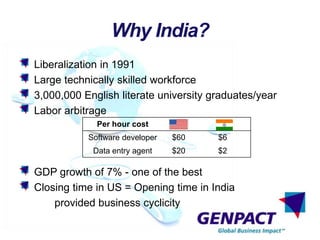
Liberalization in 1991
Large technically skilled workforce
3,000,000 English literate university graduates/year
Labor arbitrage
             Per hour cost
           Software developer   $60    $6
            Data entry agent    $20    $2

GDP growth of 7% - one of the best
Closing time in US = Opening time in India
    provided business cyclicity
Why India?
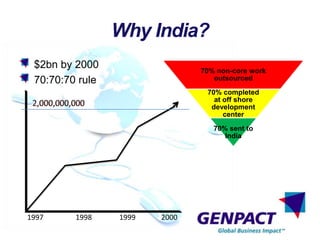
 $2bn by 2000                  70% non-core work
 70:70:70 rule                    outsourced
                                70% completed
                                  at off shore
                                 development
                                     center
                                  70% sent to
                                     India


1997     1998    1999   2000
Why India?
GE outsourced $10mn projects to TCS, Infosys in 1994
Costs doubled in 3 years, so set up GECIS
Started with 20 employees, 14 telephone lines
First project “WHITE MAIL”
Handled GE insurance queries
GE US backend was Indian front end
By 2004, handled all businesses backend
Finance, Insurance, Enterprise apps, SCM, IT infra
Revenues – US$429mn, Employees – 15000+
700+ processes handled globally
The BPO Industry
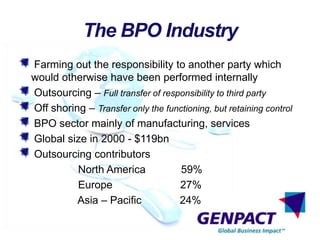
Farming out the responsibility to another party which
would otherwise have been performed internally
Outsourcing – Full transfer of responsibility to third party
Off shoring – Transfer only the functioning, but retaining control
BPO sector mainly of manufacturing, services
Global size in 2000 - $119bn
Outsourcing contributors
          North America             59%
          Europe                   27%
          Asia – Pacific           24%
The BPO Industry
         Evolution of BPO industry in 4 stages
Phase I
- Recruits sent abroad to execute end to end projects at clients site
- Billing in US$, Indian companies made huge amount of money
- Indian engineers very happy
Phase II
- Activities disaggregated
                           off shore( programming and coding)
                           on shore( stabilization, optimization)
- Off shore costs cheaper as salaries in Indian Rupees
The BPO Industry
        Evolution of BPO industry in 4 stages
Phase III
- Setting up of captive facilities i.e. low cost offshore units
- Functioning moved from s/w to transaction activities (Biz. Process)
- More cost saving for parent companies
Phase IV
- Global expansion – units set up all across the globe
- Certain locations were centre of excellence in a particular field
- Clients projects broken down into segments and each handled by
 that particular center of excellence
The BPO Industry
         Why was it so important inspite of
         job losses for the home country ?

Globalization – cross border trade and investments pre-requisite
                 for economic growth
Development of service sector – Services as means of
                        income was not looked upon so widely
                        as it began to be seen now
Firm level Considerations
Cost reduction – outsource standardized process
                    e.g. Reconciliation of bank statements
Efficiency improvement – the way process is carried out
                    e.g. Introduction of new technologies for HR
                        process alignment to firm’s strategy
  - required sharing and openness between firm and BPO
  - build credibility on both sides
Process transformation – altering business processes,
creation of new revenue streams, strategic collaboration
e.g. harvesting hidden sources of value in a Supply Chain
Firm level Considerations
Michael Corning, Senior VP, Global Client Development says

   BPO made economic sense : save 30 – 50% op cost
   BPO improved productivity : Six sigma, 3 – 8% improvement
   BPO improved process excellence : less competitive
                       processes were outsourced by firms to BPOs
   Spirit of partnership : Flexibility achieved
Vendor Client Relationship
“Sticky” : sensitive and confidential client processes
Regular reinforcements of mutual interests
Monty Singh, Senior VP, Lean Six Sigma and transitions says
 “ Comfort level with the partner is a bigger driver ”
Potential Landmines
Client Acquisition
                        Negotiation of         Commencement of work
                                               and ramping up scale
               Master Service Agreement(MSA)
                 Statements of Works(SOW)


        Determine the scope and nature
              required services


   Sales pitch in response to
   a client or vendor’s own
Potential Landmines
 Vendor Selection

- Location Risk      : Currency, Regulations
- Migration Risk      : Interruptions in mission-critical tasks
- Operations Risk    : Variance in time, cost and quality
- Capability Risk     : Risk in scaling up
- Strategic Risk      : Legal requirements in case of breakdown
- Client Expectations : Customer experience management
Potential Landmines
Attributes considered by potential clients while
considering a collaborator

- Process excellence
- Global delivery
- Analytical approach
- IT expertise
- Domain expertise
- Stable workforce
- Scale
Potential Landmines
  The 5 P‟s

- Privacy     : tax issues, privacy issues
- Pricing     : full time equivalent(FTE), based on time/material
- Product      : accounting, operations, decision support
- Performance : business related metrics, service related metrics
- Protection   : deal integrity/corporate governance, data integrity
Issues for Genpact
 Client acquisition once it was free from GE
 Loss of employees = transfer of knowledge base
 Stability of operations
 Shift from captive to independent service provider
 How to come out with IPO in NYSE?
 Quality functional deployment(QFD) – prioritize
industries and sectors as per divisions and segments
 Genpact Virtual Captive – special force dedicated for
individual clients, specially trained personnel
Thank You

Genpact bpo case study

  • 1.
    Presented by Swatanu MohanSatpathy Anirudh Pundir Bharathi Venkit Sharma
  • 2.
    Agenda Company Background Why India? TheBPO Industry Firm level considerations Vendor client relationship Potential landmines Issues for Genpact
  • 3.
    Company Background Parent company– General Electric Priorly – General Electric Capital International Services GECIS set up in 1997 as fully owned subsidiary of GE July 2004 – GE divested 60% stake to 2 PE players September 2005 – renamed „GENPACT‟ First CEO – Pramod Bhasin Headquartered at Gurgaon, NCR Currently the largest BPO with over 100,000 employees
  • 4.
    Why India? Liberalization in1991 Large technically skilled workforce 3,000,000 English literate university graduates/year Labor arbitrage Per hour cost Software developer $60 $6 Data entry agent $20 $2 GDP growth of 7% - one of the best Closing time in US = Opening time in India provided business cyclicity
  • 5.
    Why India? $2bnby 2000 70% non-core work 70:70:70 rule outsourced 70% completed at off shore development center 70% sent to India 1997 1998 1999 2000
  • 6.
    Why India? GE outsourced$10mn projects to TCS, Infosys in 1994 Costs doubled in 3 years, so set up GECIS Started with 20 employees, 14 telephone lines First project “WHITE MAIL” Handled GE insurance queries GE US backend was Indian front end By 2004, handled all businesses backend Finance, Insurance, Enterprise apps, SCM, IT infra Revenues – US$429mn, Employees – 15000+ 700+ processes handled globally
  • 7.
    The BPO Industry Farmingout the responsibility to another party which would otherwise have been performed internally Outsourcing – Full transfer of responsibility to third party Off shoring – Transfer only the functioning, but retaining control BPO sector mainly of manufacturing, services Global size in 2000 - $119bn Outsourcing contributors North America 59% Europe 27% Asia – Pacific 24%
  • 8.
    The BPO Industry Evolution of BPO industry in 4 stages Phase I - Recruits sent abroad to execute end to end projects at clients site - Billing in US$, Indian companies made huge amount of money - Indian engineers very happy Phase II - Activities disaggregated off shore( programming and coding) on shore( stabilization, optimization) - Off shore costs cheaper as salaries in Indian Rupees
  • 9.
    The BPO Industry Evolution of BPO industry in 4 stages Phase III - Setting up of captive facilities i.e. low cost offshore units - Functioning moved from s/w to transaction activities (Biz. Process) - More cost saving for parent companies Phase IV - Global expansion – units set up all across the globe - Certain locations were centre of excellence in a particular field - Clients projects broken down into segments and each handled by that particular center of excellence
  • 10.
    The BPO Industry Why was it so important inspite of job losses for the home country ? Globalization – cross border trade and investments pre-requisite for economic growth Development of service sector – Services as means of income was not looked upon so widely as it began to be seen now
  • 11.
    Firm level Considerations Costreduction – outsource standardized process e.g. Reconciliation of bank statements Efficiency improvement – the way process is carried out e.g. Introduction of new technologies for HR process alignment to firm’s strategy - required sharing and openness between firm and BPO - build credibility on both sides Process transformation – altering business processes, creation of new revenue streams, strategic collaboration e.g. harvesting hidden sources of value in a Supply Chain
  • 12.
    Firm level Considerations MichaelCorning, Senior VP, Global Client Development says BPO made economic sense : save 30 – 50% op cost BPO improved productivity : Six sigma, 3 – 8% improvement BPO improved process excellence : less competitive processes were outsourced by firms to BPOs Spirit of partnership : Flexibility achieved
  • 13.
    Vendor Client Relationship “Sticky”: sensitive and confidential client processes Regular reinforcements of mutual interests Monty Singh, Senior VP, Lean Six Sigma and transitions says “ Comfort level with the partner is a bigger driver ”
  • 14.
    Potential Landmines Client Acquisition Negotiation of Commencement of work and ramping up scale Master Service Agreement(MSA) Statements of Works(SOW) Determine the scope and nature required services Sales pitch in response to a client or vendor’s own
  • 15.
    Potential Landmines VendorSelection - Location Risk : Currency, Regulations - Migration Risk : Interruptions in mission-critical tasks - Operations Risk : Variance in time, cost and quality - Capability Risk : Risk in scaling up - Strategic Risk : Legal requirements in case of breakdown - Client Expectations : Customer experience management
  • 16.
    Potential Landmines Attributes consideredby potential clients while considering a collaborator - Process excellence - Global delivery - Analytical approach - IT expertise - Domain expertise - Stable workforce - Scale
  • 17.
    Potential Landmines The 5 P‟s - Privacy : tax issues, privacy issues - Pricing : full time equivalent(FTE), based on time/material - Product : accounting, operations, decision support - Performance : business related metrics, service related metrics - Protection : deal integrity/corporate governance, data integrity
  • 18.
    Issues for Genpact Client acquisition once it was free from GE Loss of employees = transfer of knowledge base Stability of operations Shift from captive to independent service provider How to come out with IPO in NYSE? Quality functional deployment(QFD) – prioritize industries and sectors as per divisions and segments Genpact Virtual Captive – special force dedicated for individual clients, specially trained personnel
  • 19.