► Do what you say...Say what you do.....!!
► Set of processes, customs, policies, laws, and
  institutions affecting the way a corporation is
  directed, administered or controlled
► Includes relationships among many stakeholders
  involved and the goals for which corporation is governed
► Stakeholders types:
   • External: Shareholders, debt
     holders, trade creditors, suppliers, customers and
     communities affected by the corporation's activities
   • Internal: Board of directors, Executives, Employees
Thursday, December 01, 2011   The United States Corporate Governance Code   2
► Managers did not hold shareholder interests as their
  primary focus
► Corporate managements represented “the corporation”
  rather than the share holders
► The goal of the firm not to maximize shareholder
  wealth, but to ensure the growth (or at least the stability)
  of the enterprise by “balancing” the claims of all
  important corporate “stakeholders”
► Raiders and hostile takeovers were relatively uncommon
► Internal incentives from management ownership of stock
  and options were also modest

Thursday, December 01, 2011   The United States Corporate Governance Code   3
► Enron Scandal
► Dot Com Bubble
► Massive securities fraud and insider trading
► Unethical auditing processes


                 A failure of corporate governance ???

                              New rules, new games


Thursday, December 01, 2011    The United States Corporate Governance Code   4
► Rights of Shareholders
► Insider trading laws
► Role of stake holders
► Disclosure and transparency
► The responsibilities of the board


Thursday, December 01, 2011   The United States Corporate Governance Code   5
► Common stock gives voting rights
► Common stock holders have right of taking net residual
  after liquidation
► Common stock can be traded adhering to SEC norms
  irrespective of the persons in concern
► All stocks give right of registration as shareholders of the
  company
► Voting can be in person or proxy
► For corporate equity securities, the shareholder registry
  is kept by the issuer or an agent of the issuer (called a
  "transfer agent") who affects transfers
Thursday, December 01, 2011   The United States Corporate Governance Code   6
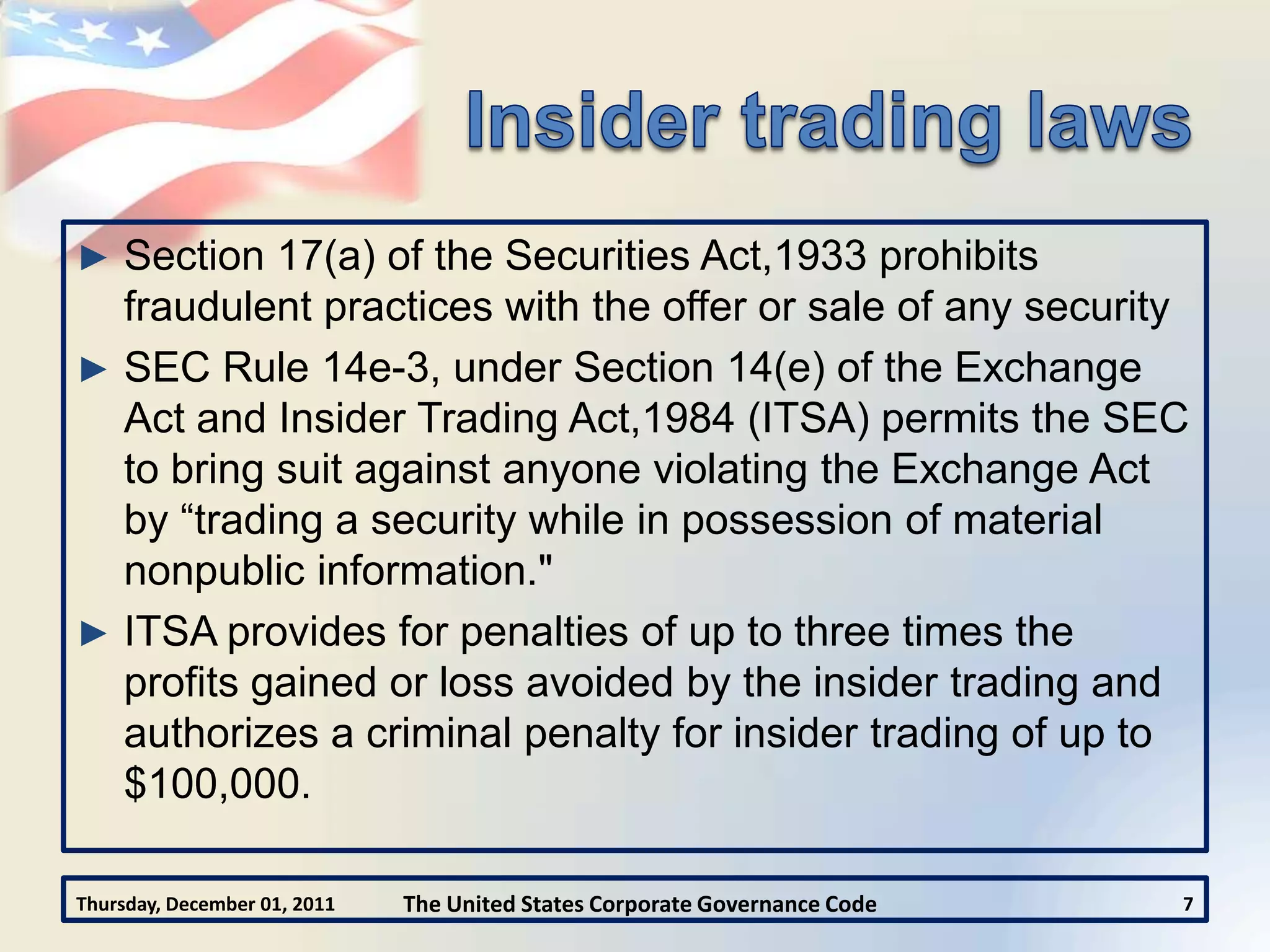
► Section 17(a) of the Securities Act,1933 prohibits
  fraudulent practices with the offer or sale of any security
► SEC Rule 14e-3, under Section 14(e) of the Exchange
  Act and Insider Trading Act,1984 (ITSA) permits the SEC
  to bring suit against anyone violating the Exchange Act
  by “trading a security while in possession of material
  nonpublic information."
► ITSA provides for penalties of up to three times the
  profits gained or loss avoided by the insider trading and
  authorizes a criminal penalty for insider trading of up to
  $100,000.

Thursday, December 01, 2011   The United States Corporate Governance Code   7
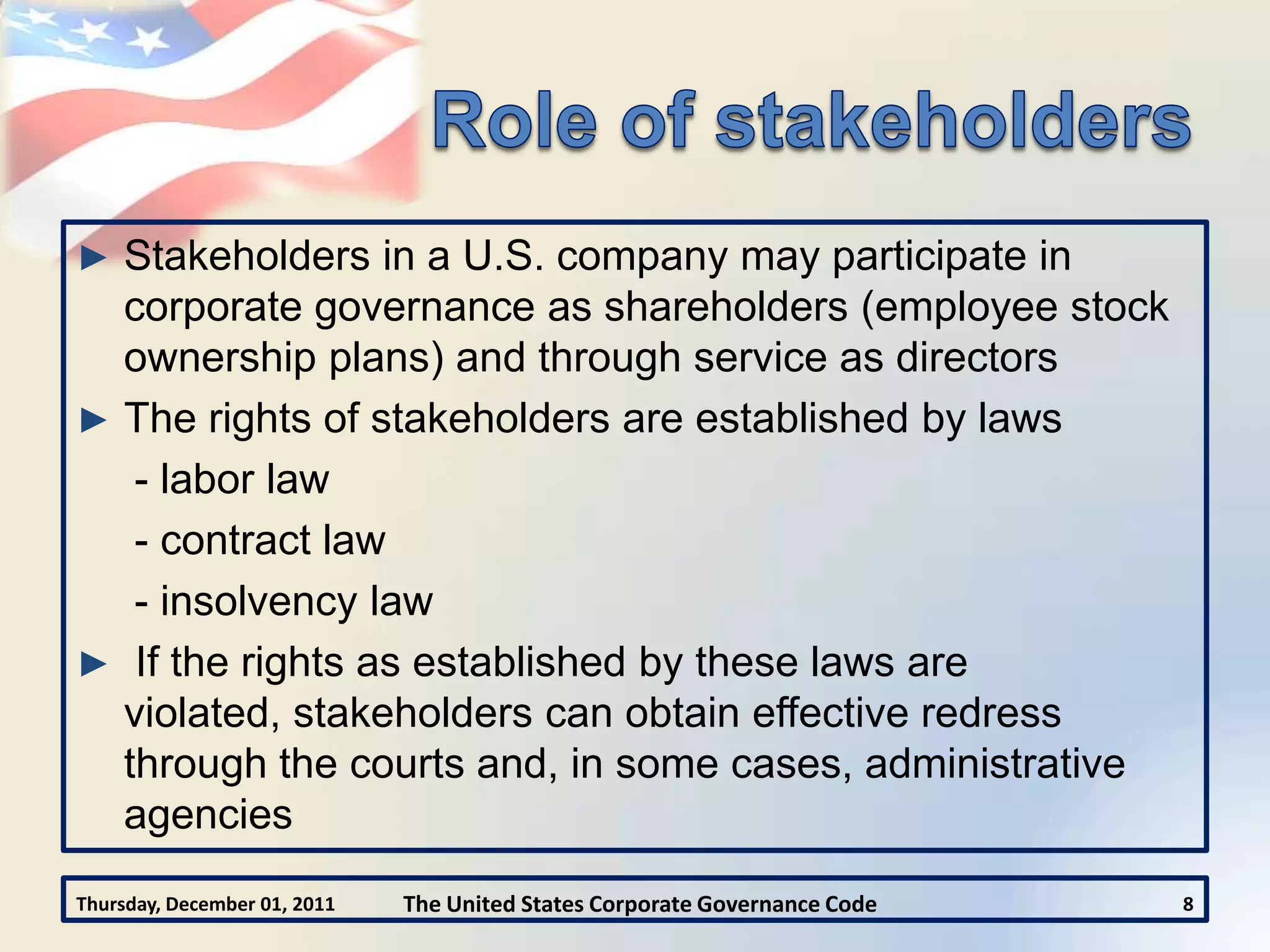
► Stakeholders in a U.S. company may participate in
  corporate governance as shareholders (employee stock
  ownership plans) and through service as directors
► The rights of stakeholders are established by laws
   - labor law
   - contract law
   - insolvency law
► If the rights as established by these laws are
  violated, stakeholders can obtain effective redress
  through the courts and, in some cases, administrative
  agencies
Thursday, December 01, 2011   The United States Corporate Governance Code   8
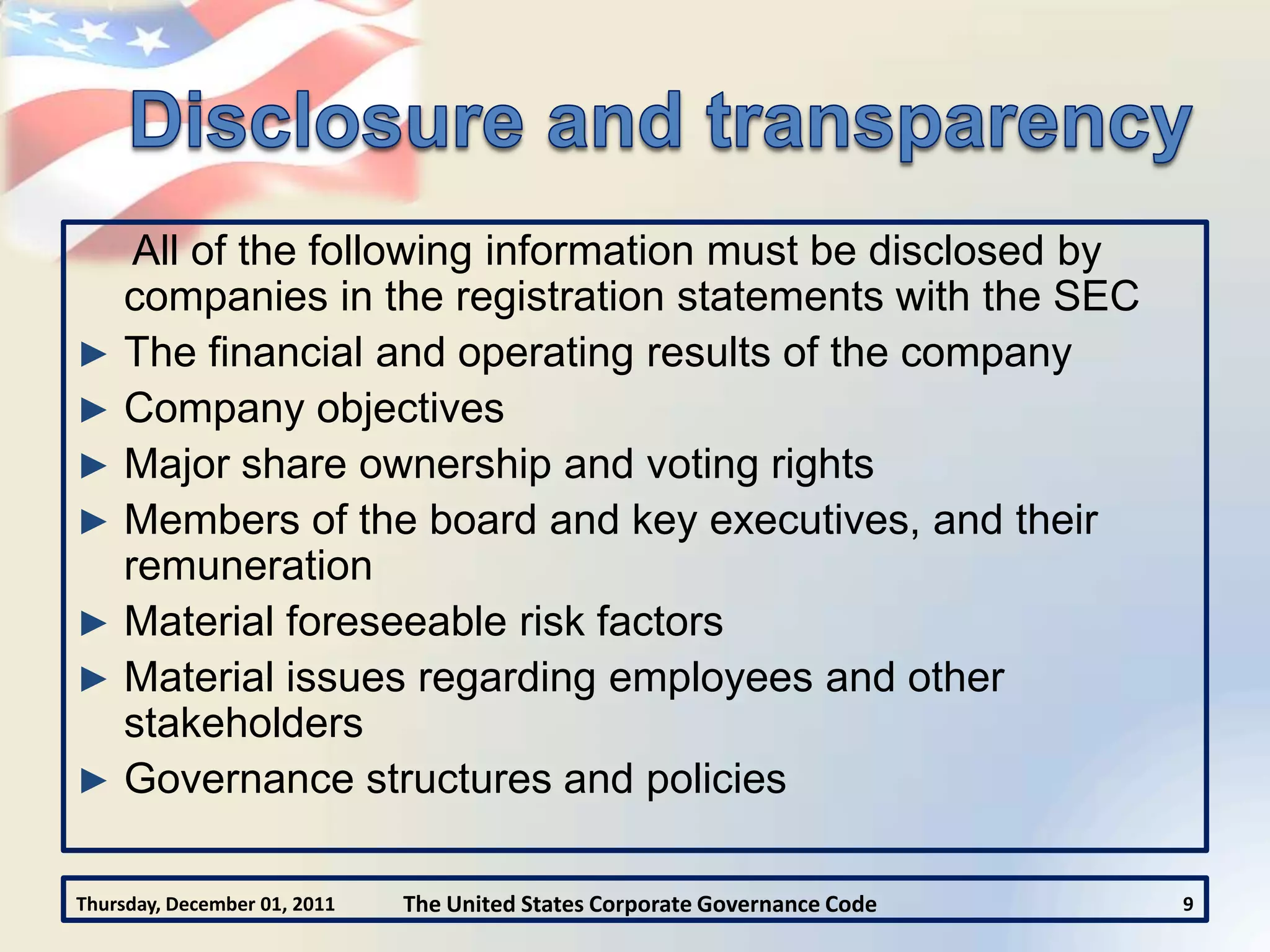
All of the following information must be disclosed by
  companies in the registration statements with the SEC
► The financial and operating results of the company
► Company objectives
► Major share ownership and voting rights
► Members of the board and key executives, and their
  remuneration
► Material foreseeable risk factors
► Material issues regarding employees and other
  stakeholders
► Governance structures and policies


Thursday, December 01, 2011   The United States Corporate Governance Code   9
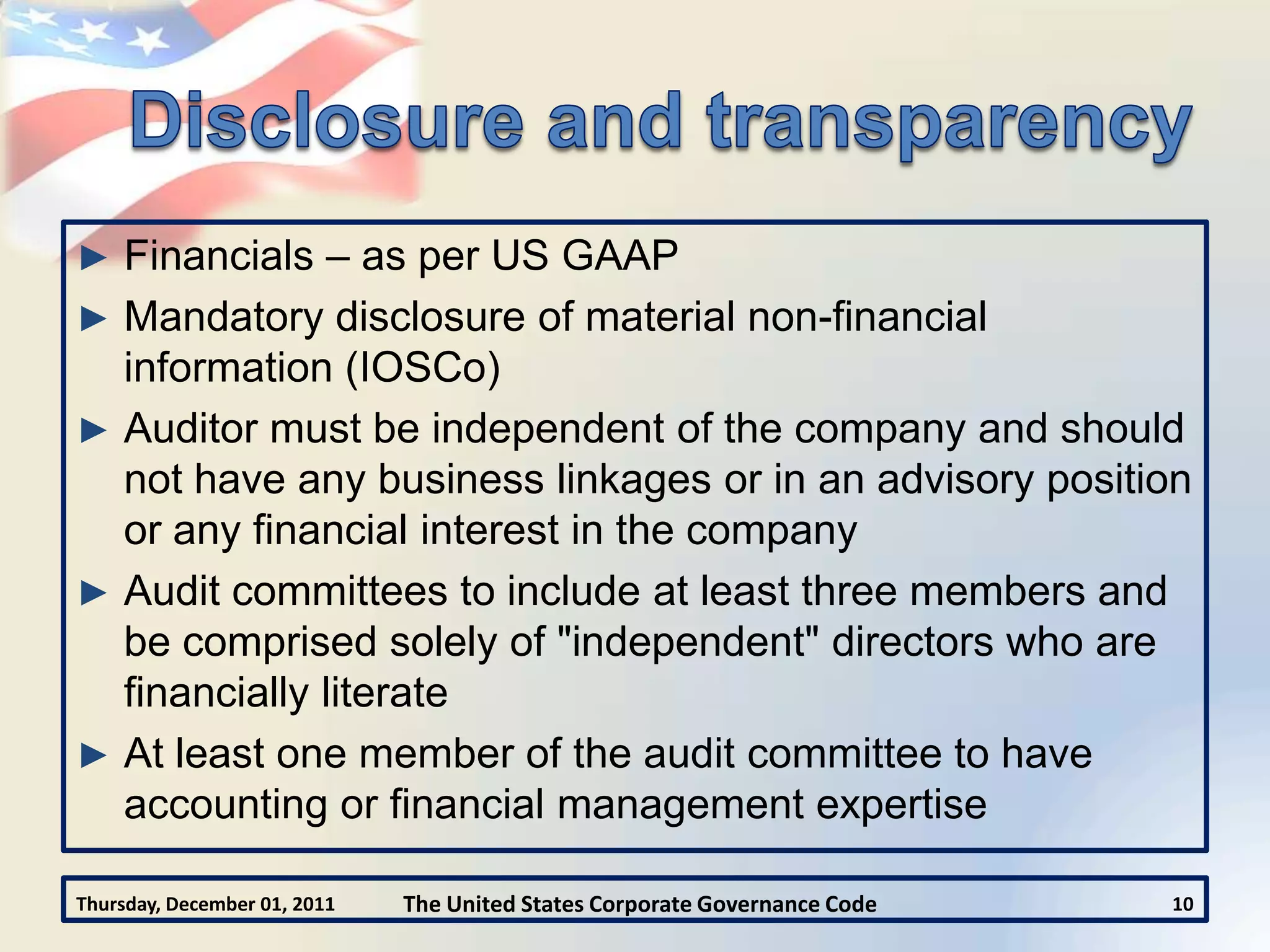
► Financials – as per US GAAP
► Mandatory disclosure of material non-financial
  information (IOSCo)
► Auditor must be independent of the company and should
  not have any business linkages or in an advisory position
  or any financial interest in the company
► Audit committees to include at least three members and
  be comprised solely of "independent" directors who are
  financially literate
► At least one member of the audit committee to have
  accounting or financial management expertise

Thursday, December 01, 2011   The United States Corporate Governance Code   10
► A majority of independent directors
► Directors vacate their position on the board if their term
  of appointment expires, they resign or are removed by
  shareholders on a cause
► Vacancy is filled by vote of the board of directors, and
  the new director stands for reelection at the next annual
  meeting or when the term expires and a successor is
  elected, whichever is later
► Directors set their own compensation unless restricted
  by the corporation’s certificate of incorporation or bylaws
► Directors usually receive an annual fee or a per meeting
  fee plus expenses for their service on the board

Thursday, December 01, 2011   The United States Corporate Governance Code   11
► Most actions by the board are taken by majority vote at
  formally noticed meetings
► Each director has one vote and is not allowed to vote by
  proxy
► Under state law, directors of a corporation are deemed to
  owe their corporations a fiduciary duty of care
► If any statement contains materially false or misleading
  statements or omits statements SEC may also bring an
  action against the directors and against the officers who
  signed the statement, mostly debarring further
  directorships

Thursday, December 01, 2011   The United States Corporate Governance Code   12
► Known as "the unitary system”
► Emphasizes a single-tiered Board of Directors
► Composed of a mixture of executives from the company
  and non-executive directors, all elected by shareholders
► Non-executive directors outnumber executive directors
  and hold key posts in audit and compensation
  committees
► The United States and the United Kingdom differ in one
  critical respect with regard to corporate governance:
- In UK the CEO generally does not serve as Chairman
- In US having the dual role is the norm

Thursday, December 01, 2011   The United States Corporate Governance Code   13
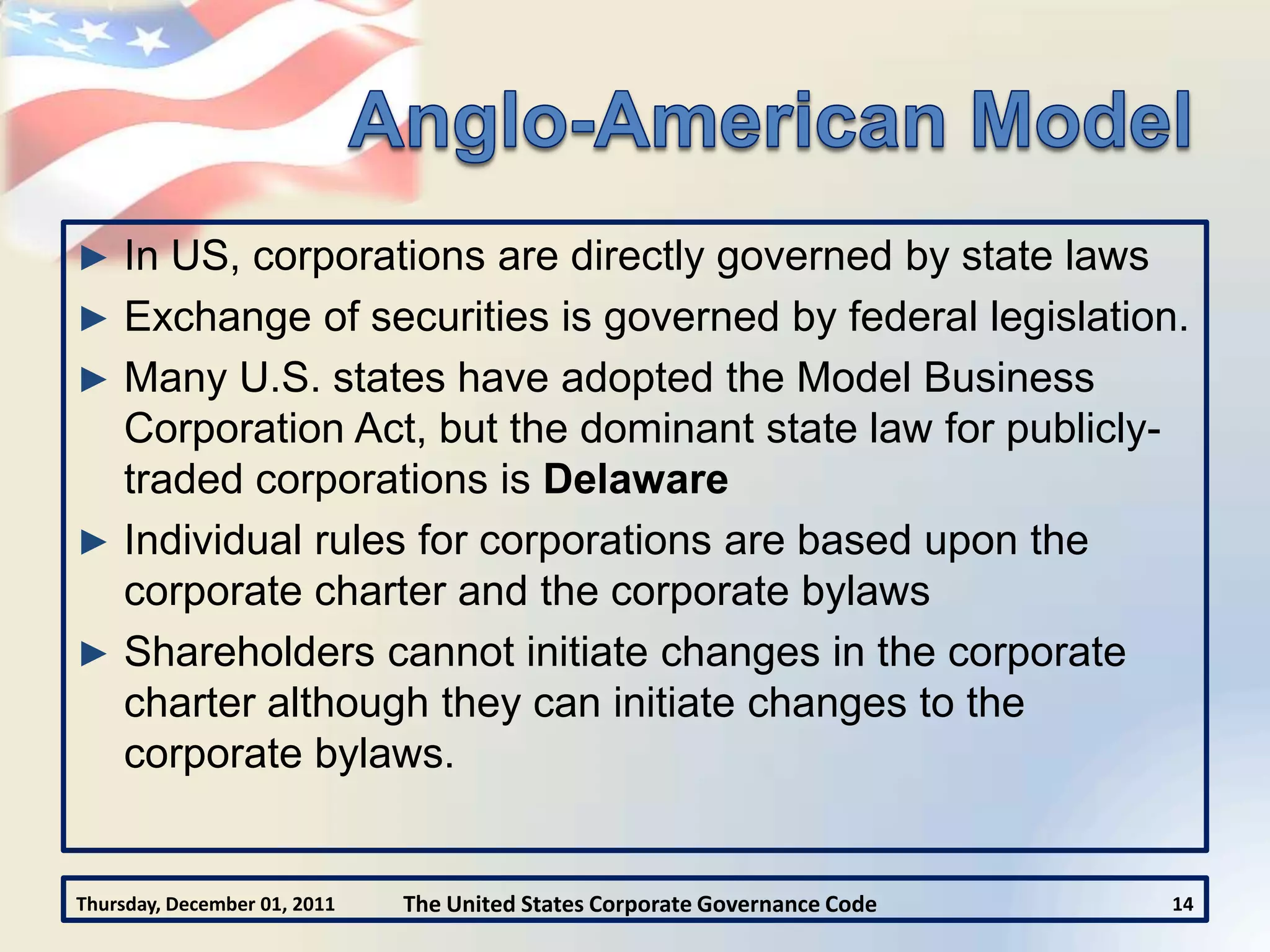
► In US, corporations are directly governed by state laws
► Exchange of securities is governed by federal legislation.
► Many U.S. states have adopted the Model Business
  Corporation Act, but the dominant state law for publicly-
  traded corporations is Delaware
► Individual rules for corporations are based upon the
  corporate charter and the corporate bylaws
► Shareholders cannot initiate changes in the corporate
  charter although they can initiate changes to the
  corporate bylaws.


Thursday, December 01, 2011   The United States Corporate Governance Code   14
Ownership structure Dispersed

                                         Individuals
     Ownership identity
                                         Pension and mutual funds

Changes in ownership Frequent

                                         Shareholder value
     Goals of ownership
                                         Short-term profits
                                         Executives
    Board controlled by
                                         Shareholders

          Key stakeholders Shareholder

Thursday, December 01, 2011   The United States Corporate Governance Code   15
Thursday, December 01, 2011   The United States Corporate Governance Code   16

US Corporate Governance

  • 2.
    ► Do whatyou say...Say what you do.....!! ► Set of processes, customs, policies, laws, and institutions affecting the way a corporation is directed, administered or controlled ► Includes relationships among many stakeholders involved and the goals for which corporation is governed ► Stakeholders types: • External: Shareholders, debt holders, trade creditors, suppliers, customers and communities affected by the corporation's activities • Internal: Board of directors, Executives, Employees Thursday, December 01, 2011 The United States Corporate Governance Code 2
  • 3.
    ► Managers didnot hold shareholder interests as their primary focus ► Corporate managements represented “the corporation” rather than the share holders ► The goal of the firm not to maximize shareholder wealth, but to ensure the growth (or at least the stability) of the enterprise by “balancing” the claims of all important corporate “stakeholders” ► Raiders and hostile takeovers were relatively uncommon ► Internal incentives from management ownership of stock and options were also modest Thursday, December 01, 2011 The United States Corporate Governance Code 3
  • 4.
    ► Enron Scandal ►Dot Com Bubble ► Massive securities fraud and insider trading ► Unethical auditing processes A failure of corporate governance ??? New rules, new games Thursday, December 01, 2011 The United States Corporate Governance Code 4
  • 5.
    ► Rights ofShareholders ► Insider trading laws ► Role of stake holders ► Disclosure and transparency ► The responsibilities of the board Thursday, December 01, 2011 The United States Corporate Governance Code 5
  • 6.
    ► Common stockgives voting rights ► Common stock holders have right of taking net residual after liquidation ► Common stock can be traded adhering to SEC norms irrespective of the persons in concern ► All stocks give right of registration as shareholders of the company ► Voting can be in person or proxy ► For corporate equity securities, the shareholder registry is kept by the issuer or an agent of the issuer (called a "transfer agent") who affects transfers Thursday, December 01, 2011 The United States Corporate Governance Code 6
  • 7.
    ► Section 17(a)of the Securities Act,1933 prohibits fraudulent practices with the offer or sale of any security ► SEC Rule 14e-3, under Section 14(e) of the Exchange Act and Insider Trading Act,1984 (ITSA) permits the SEC to bring suit against anyone violating the Exchange Act by “trading a security while in possession of material nonpublic information." ► ITSA provides for penalties of up to three times the profits gained or loss avoided by the insider trading and authorizes a criminal penalty for insider trading of up to $100,000. Thursday, December 01, 2011 The United States Corporate Governance Code 7
  • 8.
    ► Stakeholders ina U.S. company may participate in corporate governance as shareholders (employee stock ownership plans) and through service as directors ► The rights of stakeholders are established by laws - labor law - contract law - insolvency law ► If the rights as established by these laws are violated, stakeholders can obtain effective redress through the courts and, in some cases, administrative agencies Thursday, December 01, 2011 The United States Corporate Governance Code 8
  • 9.
    All of thefollowing information must be disclosed by companies in the registration statements with the SEC ► The financial and operating results of the company ► Company objectives ► Major share ownership and voting rights ► Members of the board and key executives, and their remuneration ► Material foreseeable risk factors ► Material issues regarding employees and other stakeholders ► Governance structures and policies Thursday, December 01, 2011 The United States Corporate Governance Code 9
  • 10.
    ► Financials –as per US GAAP ► Mandatory disclosure of material non-financial information (IOSCo) ► Auditor must be independent of the company and should not have any business linkages or in an advisory position or any financial interest in the company ► Audit committees to include at least three members and be comprised solely of "independent" directors who are financially literate ► At least one member of the audit committee to have accounting or financial management expertise Thursday, December 01, 2011 The United States Corporate Governance Code 10
  • 11.
    ► A majorityof independent directors ► Directors vacate their position on the board if their term of appointment expires, they resign or are removed by shareholders on a cause ► Vacancy is filled by vote of the board of directors, and the new director stands for reelection at the next annual meeting or when the term expires and a successor is elected, whichever is later ► Directors set their own compensation unless restricted by the corporation’s certificate of incorporation or bylaws ► Directors usually receive an annual fee or a per meeting fee plus expenses for their service on the board Thursday, December 01, 2011 The United States Corporate Governance Code 11
  • 12.
    ► Most actionsby the board are taken by majority vote at formally noticed meetings ► Each director has one vote and is not allowed to vote by proxy ► Under state law, directors of a corporation are deemed to owe their corporations a fiduciary duty of care ► If any statement contains materially false or misleading statements or omits statements SEC may also bring an action against the directors and against the officers who signed the statement, mostly debarring further directorships Thursday, December 01, 2011 The United States Corporate Governance Code 12
  • 13.
    ► Known as"the unitary system” ► Emphasizes a single-tiered Board of Directors ► Composed of a mixture of executives from the company and non-executive directors, all elected by shareholders ► Non-executive directors outnumber executive directors and hold key posts in audit and compensation committees ► The United States and the United Kingdom differ in one critical respect with regard to corporate governance: - In UK the CEO generally does not serve as Chairman - In US having the dual role is the norm Thursday, December 01, 2011 The United States Corporate Governance Code 13
  • 14.
    ► In US,corporations are directly governed by state laws ► Exchange of securities is governed by federal legislation. ► Many U.S. states have adopted the Model Business Corporation Act, but the dominant state law for publicly- traded corporations is Delaware ► Individual rules for corporations are based upon the corporate charter and the corporate bylaws ► Shareholders cannot initiate changes in the corporate charter although they can initiate changes to the corporate bylaws. Thursday, December 01, 2011 The United States Corporate Governance Code 14
  • 15.
    Ownership structure Dispersed Individuals Ownership identity Pension and mutual funds Changes in ownership Frequent Shareholder value Goals of ownership Short-term profits Executives Board controlled by Shareholders Key stakeholders Shareholder Thursday, December 01, 2011 The United States Corporate Governance Code 15
  • 16.
    Thursday, December 01,2011 The United States Corporate Governance Code 16