Presented By:-
Aakrati Gupta
Ashish Kumar
AvinashVarma
Parikshit Soni
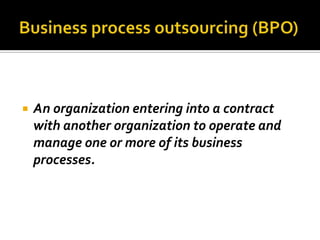
 An organization entering into a contract
with another organization to operate and
manage one or more of its business
processes.
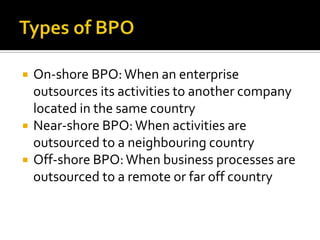
 On-shore BPO:When an enterprise
outsources its activities to another company
located in the same country
 Near-shore BPO:When activities are
outsourced to a neighbouring country
 Off-shore BPO:When business processes are
outsourced to a remote or far off country
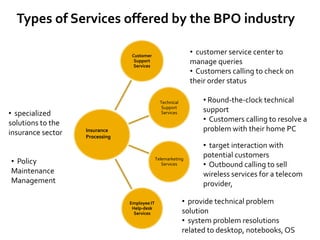
Customer
Support
Services
Technical
Support
Services
Telemarketing
Services
Employee IT
Help-desk
Services
Types of Services offered by the BPO industry
• customer service center to
manage queries
• Customers calling to check on
their order status
• Round-the-clock technical
support
• Customers calling to resolve a
problem with their home PC
• target interaction with
potential customers
• Outbound calling to sell
wireless services for a telecom
provider,
• provide technical problem
solution
• system problem resolutions
related to desktop, notebooks, OS
Insurance
Processing
• specialized
solutions to the
insurance sector
• Policy
Maintenance
Management
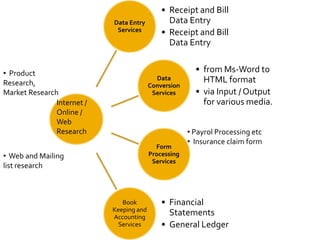
Data Entry
Services
• Receipt and Bill
Data Entry
• Receipt and Bill
Data Entry
Data
Conversion
Services
• from Ms-Word to
HTML format
• via Input / Output
for various media.
Form
Processing
Services
Book
Keeping and
Accounting
Services
• Financial
Statements
• General Ledger
• Payrol Processing etc
• Insurance claim form
Internet /
Online /
Web
Research
• Product
Research,
Market Research
• Web and Mailing
list research
Current Scenario
• Indian BPO industry currently generates USD 11 billion
revenue
• employs approx 700,000 professionals across 25 countries,
• Accounts for 40%of the overall BPO offshore market.
Potential
• the Indian BPO industry has the potential to generate USD 50 billion
revenue by 2012.
• Employment opportunities for approx 2 million professionals in India.
• the BPOs can contribute up to 2.5 percent to the country's global
GDP by 2012.
Sectors
• merely 5 percent of the total opportunity exploited,
• sectors include banking, retail, insurance, media, telecom,
and government
INDIAN BPO INDUSTRY -
Updated: August 2009
Inadequate
infrastructure*
Limited
Bandwidth
availability
Lack of
production
skills
Technologies
Inability to
attract foreign
investment
Poor
penetration
Erosion of
competition*
Lack of
standards
CHALLENGES FACED BY INDIAN BPO
INDUSTRY
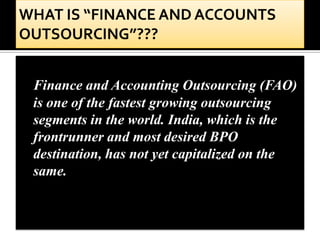
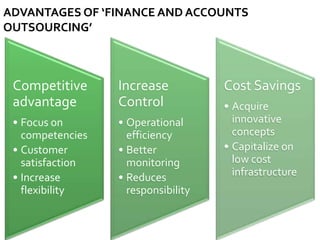
Finance and Accounting Outsourcing (FAO)
is one of the fastest growing outsourcing
segments in the world. India, which is the
frontrunner and most desired BPO
destination, has not yet capitalized on the
same.
Competitive
advantage
• Focus on
competencies
• Customer
satisfaction
• Increase
flexibility
Increase
Control
• Operational
efficiency
• Better
monitoring
• Reduces
responsibility
Cost Savings
• Acquire
innovative
concepts
• Capitalize on
low cost
infrastructure
ADVANTAGES OF ‘FINANCE AND ACCOUNTS
OUTSOURCING’
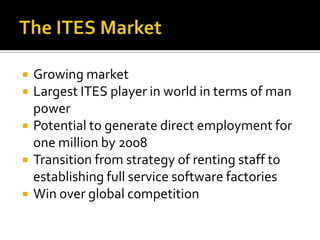
 Growing market
 Largest ITES player in world in terms of man
power
 Potential to generate direct employment for
one million by 2008
 Transition from strategy of renting staff to
establishing full service software factories
 Win over global competition
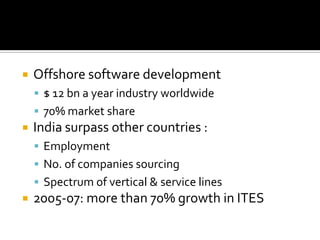
 Offshore software development
 $ 12 bn a year industry worldwide
 70% market share
 India surpass other countries :
 Employment
 No. of companies sourcing
 Spectrum of vertical & service lines
 2005-07: more than 70% growth in ITES
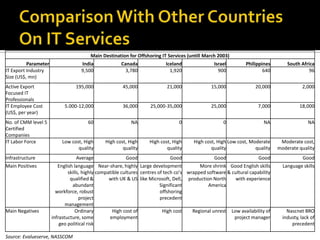
Main Destination for Offshoring IT Services (untill March 2003)
Parameter India Canada Iceland Israel Philippines South Africa
IT Export Industry
Size (US$, mn)
9,500 3,780 1,920 900 640 96
Active Export
Focused IT
Professionals
195,000 45,000 21,000 15,000 20,000 2,000
IT Employee Cost
(US$, per year)
5.000-12,000 36,000 25,000-35,000 25,000 7,000 18,000
No. of CMM level 5
Certified
Companies
60 NA 0 0 NA NA
IT Labor Force Low cost, High
quality
High cost, High
quality
High cost, High
quality
High cost, High
quality
Low cost, Moderate
quality
Moderate cost,
moderate quality
Infrastructure Average Good Good Good Good Good
Main Positives English language
skills, highly
qualified &
abundant
workforce, robust
project
management
Near-share, highly
compatible cultures
with UK & US
Large development
centres of tech co's
like Microsoft, Dell,
Significant
offshoring
precedent
More shrink
wrapped software
production North
America
Good English skills
& cultural capability
with experience
Language skills
Main Negatives Ordinary
infrastucture, some
geo political risk
High cost of
employment
High cost Regional unrest Low availability of
project manager
Nascnet BRO
industy, lack of
precedent
Source: Evalueserve, NASSCOM
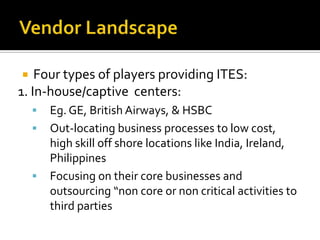
 Four types of players providing ITES:
1. In-house/captive centers:
 Eg. GE, British Airways, & HSBC
 Out-locating business processes to low cost,
high skill off shore locations like India, Ireland,
Philippines
 Focusing on their core businesses and
outsourcing “non core or non critical activities to
third parties
2. Spin offs:
 leveraging their domain knowledge and parent
brand to offer industry specific services
 e.g. Sabre (Airline Reservation) and First Data
(Card processing)
3. Focused BPO providers:
 specializing in narrow “non core, non critical”
processes and offering standard services to
multiple verticals
 e.g.ADP (HR),Teletech (Customer Care)
4. Broad based service providers:
 offering bundled BPO and ITO services in an
effort to develop into a one stop shop
 e.g. Pricewaterhouse Cooper
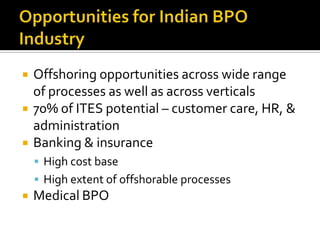
 Offshoring opportunities across wide range
of processes as well as across verticals
 70% of ITES potential – customer care, HR, &
administration
 Banking & insurance
 High cost base
 High extent of offshorable processes
 Medical BPO
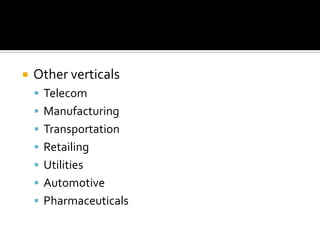
 Other verticals
 Telecom
 Manufacturing
 Transportation
 Retailing
 Utilities
 Automotive
 Pharmaceuticals
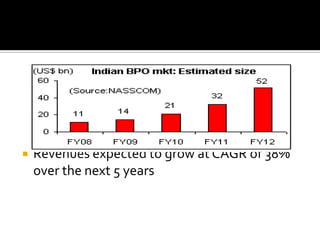
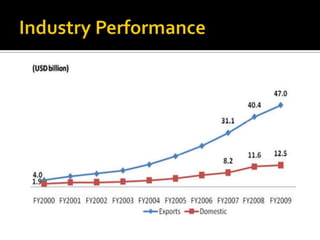
 Revenues expected to grow at CAGR of 38%
over the next 5 years
 Improved efficiency and higher service levels
due to streamlined processes
 Quality improvements due to a better
educated workforce
 Cost savings between 40-50 per cent
 Increase in offshoring by existing customers
 Superior project management skills
 Availability of a highly skilled, educated and
English-speaking labour pool
 From non-engineering colleges every year:
 2.7 mn Graduates in India
 0.4 mn Post-graduates
• Out of this 7-7.5 % of students works in IT
industry.
• At this rate: 20 mn people by 2010
 Indian Software employs 6.3 mn
programmers
 Qualified labor pool grew 17% annually
 By NASSCOM (end of 2010):
 Software and Services professional – 22.3mn
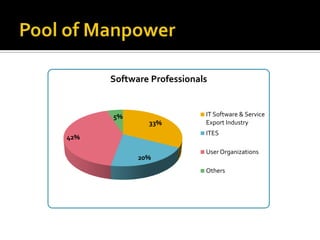
 The distribution of Software Professional is as
follows
33%
20%
42%
5%
Software Professionals
IT Software & Service
Export Industry
ITES
User Organizations
Others
 Starting from Pre-Nursery, English is the
main subject.
 One of the largest pool of English speaking
professionals
 More emphasis on Science and Engineering
 Specialized Engineering talent in India
 Eagerness to accommodate clients
 Reform process makes licensing process easier
 Government promotes FDI from NRIs
 Government supports the IT enabled start ups
 Ministry of Information & Communication
Technology plays an active role
 Developing infrastructure
 IT Bill 2000
 NationalVenture Capital Fund of Rs 1000 crore with
SIDBI & IDBI
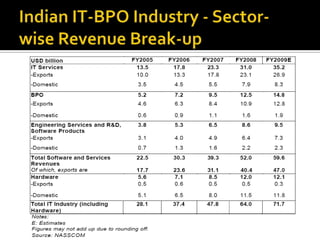
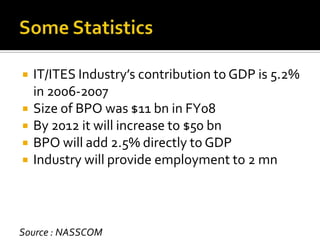
 IT/ITES Industry’s contribution to GDP is 5.2%
in 2006-2007
 Size of BPO was $11 bn in FY08
 By 2012 it will increase to $50 bn
 BPO will add 2.5% directly to GDP
 Industry will provide employment to 2 mn
Source : NASSCOM
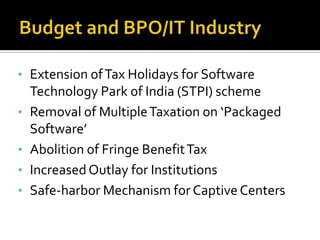
• Extension ofTax Holidays for Software
Technology Park of India (STPI) scheme
• Removal of MultipleTaxation on ‘Packaged
Software’
• Abolition of Fringe BenefitTax
• IncreasedOutlay for Institutions
• Safe-harbor Mechanism for CaptiveCenters
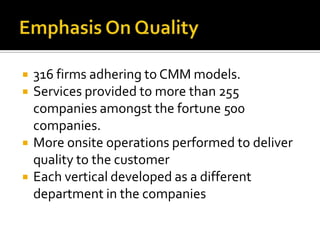
 316 firms adhering to CMM models.
 Services provided to more than 255
companies amongst the fortune 500
companies.
 More onsite operations performed to deliver
quality to the customer
 Each vertical developed as a different
department in the companies
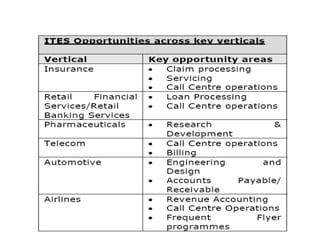
AREA
• INSURANCE
• BANKING
• PHARMACEUTICALS
• TELECOM
• AUTOMOTIVE
• AIRLINES
OVERALLCOST
• 10.0 – 15.0
• 8.0 -- 12.0
• 5.00 -- 6.50
• 1.50 -- 2.50
• 1.00 -- 2.00
• 0.80 – 1.80
KEY AREAS
• Claims Processing
• Loan processing
• Billing
• Accounts Payable
• Engineering and Design
• Request flying programme
IT – Enabled Services
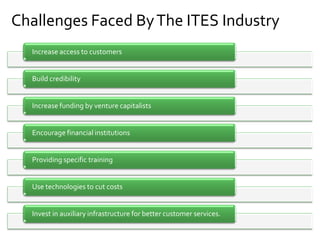
Increase access to customers
Build credibility
Increase funding by venture capitalists
Encourage financial institutions
Providing specific training
Use technologies to cut costs
Invest in auxiliary infrastructure for better customer services.
Challenges Faced ByThe ITES Industry
 Global technology related spending is
expected to reduce for the first 2-3 quarters
of 2009
 Greater focus on cost and operational
efficiencies in the recessionary environment
 There would be pricing pressures coupled
with contract renegotiations
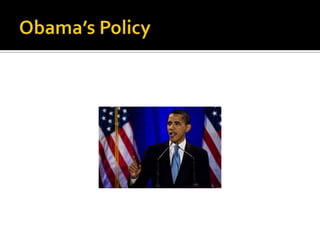
‘It's a tax code that says you should pay lower
taxes if you create a job in
Bangalore, India, than if you create one in
Buffalo, NewYork‘
--- President BarackObama
‘It's a more US-US issue rather than one aimed
at stopping outsourcing, or off-shoring, or
anything to do with India‘
--- Som Mittal (President NASSCOM)
 Infosys felt:
 US proposal aimed at closing corporate tax
loopholes
 aimed at closing corporate tax loopholes
 nothing to do with IT outsourcing
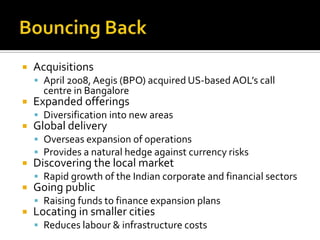
 Acquisitions
 April 2008, Aegis (BPO) acquired US-based AOL’s call
centre in Bangalore
 Expanded offerings
 Diversification into new areas
 Global delivery
 Overseas expansion of operations
 Provides a natural hedge against currency risks
 Discovering the local market
 Rapid growth of the Indian corporate and financial sectors
 Going public
 Raising funds to finance expansion plans
 Locating in smaller cities
 Reduces labour & infrastructure costs
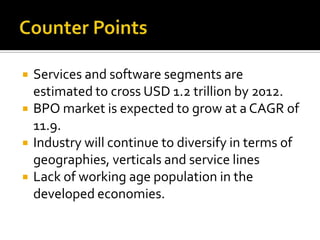
 Services and software segments are
estimated to cross USD 1.2 trillion by 2012.
 BPO market is expected to grow at a CAGR of
11.9.
 Industry will continue to diversify in terms of
geographies, verticals and service lines
 Lack of working age population in the
developed economies.
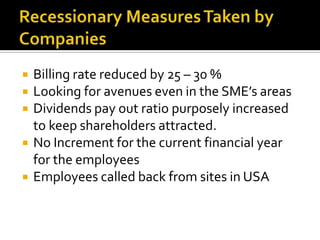
 Billing rate reduced by 25 – 30 %
 Looking for avenues even in the SME’s areas
 Dividends pay out ratio purposely increased
to keep shareholders attracted.
 No Increment for the current financial year
for the employees
 Employees called back from sites in USA
 Operational costs reduced highly –
 Conveyance facility now paid by employees
instead by the company
 Budget for stationary reduced.
 Using both sides of the paper for printing
 Finding new scopes ahead earlier than the
competitors
The Indian BPO Industry

The Indian BPO Industry

  • 1.
    Presented By:- Aakrati Gupta AshishKumar AvinashVarma Parikshit Soni
  • 2.
     An organizationentering into a contract with another organization to operate and manage one or more of its business processes.
  • 3.
     On-shore BPO:Whenan enterprise outsources its activities to another company located in the same country  Near-shore BPO:When activities are outsourced to a neighbouring country  Off-shore BPO:When business processes are outsourced to a remote or far off country
  • 4.
    Customer Support Services Technical Support Services Telemarketing Services Employee IT Help-desk Services Types ofServices offered by the BPO industry • customer service center to manage queries • Customers calling to check on their order status • Round-the-clock technical support • Customers calling to resolve a problem with their home PC • target interaction with potential customers • Outbound calling to sell wireless services for a telecom provider, • provide technical problem solution • system problem resolutions related to desktop, notebooks, OS Insurance Processing • specialized solutions to the insurance sector • Policy Maintenance Management
  • 5.
    Data Entry Services • Receiptand Bill Data Entry • Receipt and Bill Data Entry Data Conversion Services • from Ms-Word to HTML format • via Input / Output for various media. Form Processing Services Book Keeping and Accounting Services • Financial Statements • General Ledger • Payrol Processing etc • Insurance claim form Internet / Online / Web Research • Product Research, Market Research • Web and Mailing list research
  • 6.
    Current Scenario • IndianBPO industry currently generates USD 11 billion revenue • employs approx 700,000 professionals across 25 countries, • Accounts for 40%of the overall BPO offshore market. Potential • the Indian BPO industry has the potential to generate USD 50 billion revenue by 2012. • Employment opportunities for approx 2 million professionals in India. • the BPOs can contribute up to 2.5 percent to the country's global GDP by 2012. Sectors • merely 5 percent of the total opportunity exploited, • sectors include banking, retail, insurance, media, telecom, and government INDIAN BPO INDUSTRY -
  • 7.
  • 8.
    Inadequate infrastructure* Limited Bandwidth availability Lack of production skills Technologies Inability to attractforeign investment Poor penetration Erosion of competition* Lack of standards CHALLENGES FACED BY INDIAN BPO INDUSTRY
  • 9.
    Finance and AccountingOutsourcing (FAO) is one of the fastest growing outsourcing segments in the world. India, which is the frontrunner and most desired BPO destination, has not yet capitalized on the same.
  • 10.
    Competitive advantage • Focus on competencies •Customer satisfaction • Increase flexibility Increase Control • Operational efficiency • Better monitoring • Reduces responsibility Cost Savings • Acquire innovative concepts • Capitalize on low cost infrastructure ADVANTAGES OF ‘FINANCE AND ACCOUNTS OUTSOURCING’
  • 12.
     Growing market Largest ITES player in world in terms of man power  Potential to generate direct employment for one million by 2008  Transition from strategy of renting staff to establishing full service software factories  Win over global competition
  • 13.
     Offshore softwaredevelopment  $ 12 bn a year industry worldwide  70% market share  India surpass other countries :  Employment  No. of companies sourcing  Spectrum of vertical & service lines  2005-07: more than 70% growth in ITES
  • 14.
    Main Destination forOffshoring IT Services (untill March 2003) Parameter India Canada Iceland Israel Philippines South Africa IT Export Industry Size (US$, mn) 9,500 3,780 1,920 900 640 96 Active Export Focused IT Professionals 195,000 45,000 21,000 15,000 20,000 2,000 IT Employee Cost (US$, per year) 5.000-12,000 36,000 25,000-35,000 25,000 7,000 18,000 No. of CMM level 5 Certified Companies 60 NA 0 0 NA NA IT Labor Force Low cost, High quality High cost, High quality High cost, High quality High cost, High quality Low cost, Moderate quality Moderate cost, moderate quality Infrastructure Average Good Good Good Good Good Main Positives English language skills, highly qualified & abundant workforce, robust project management Near-share, highly compatible cultures with UK & US Large development centres of tech co's like Microsoft, Dell, Significant offshoring precedent More shrink wrapped software production North America Good English skills & cultural capability with experience Language skills Main Negatives Ordinary infrastucture, some geo political risk High cost of employment High cost Regional unrest Low availability of project manager Nascnet BRO industy, lack of precedent Source: Evalueserve, NASSCOM
  • 15.
     Four typesof players providing ITES: 1. In-house/captive centers:  Eg. GE, British Airways, & HSBC  Out-locating business processes to low cost, high skill off shore locations like India, Ireland, Philippines  Focusing on their core businesses and outsourcing “non core or non critical activities to third parties
  • 16.
    2. Spin offs: leveraging their domain knowledge and parent brand to offer industry specific services  e.g. Sabre (Airline Reservation) and First Data (Card processing) 3. Focused BPO providers:  specializing in narrow “non core, non critical” processes and offering standard services to multiple verticals  e.g.ADP (HR),Teletech (Customer Care)
  • 17.
    4. Broad basedservice providers:  offering bundled BPO and ITO services in an effort to develop into a one stop shop  e.g. Pricewaterhouse Cooper
  • 18.
     Offshoring opportunitiesacross wide range of processes as well as across verticals  70% of ITES potential – customer care, HR, & administration  Banking & insurance  High cost base  High extent of offshorable processes  Medical BPO
  • 19.
     Other verticals Telecom  Manufacturing  Transportation  Retailing  Utilities  Automotive  Pharmaceuticals
  • 21.
     Revenues expectedto grow at CAGR of 38% over the next 5 years
  • 22.
     Improved efficiencyand higher service levels due to streamlined processes  Quality improvements due to a better educated workforce  Cost savings between 40-50 per cent  Increase in offshoring by existing customers  Superior project management skills  Availability of a highly skilled, educated and English-speaking labour pool
  • 25.
     From non-engineeringcolleges every year:  2.7 mn Graduates in India  0.4 mn Post-graduates • Out of this 7-7.5 % of students works in IT industry. • At this rate: 20 mn people by 2010
  • 26.
     Indian Softwareemploys 6.3 mn programmers  Qualified labor pool grew 17% annually  By NASSCOM (end of 2010):  Software and Services professional – 22.3mn  The distribution of Software Professional is as follows
  • 27.
    33% 20% 42% 5% Software Professionals IT Software& Service Export Industry ITES User Organizations Others
  • 29.
     Starting fromPre-Nursery, English is the main subject.  One of the largest pool of English speaking professionals  More emphasis on Science and Engineering  Specialized Engineering talent in India  Eagerness to accommodate clients
  • 30.
     Reform processmakes licensing process easier  Government promotes FDI from NRIs  Government supports the IT enabled start ups  Ministry of Information & Communication Technology plays an active role  Developing infrastructure  IT Bill 2000  NationalVenture Capital Fund of Rs 1000 crore with SIDBI & IDBI
  • 31.
     IT/ITES Industry’scontribution to GDP is 5.2% in 2006-2007  Size of BPO was $11 bn in FY08  By 2012 it will increase to $50 bn  BPO will add 2.5% directly to GDP  Industry will provide employment to 2 mn Source : NASSCOM
  • 32.
    • Extension ofTaxHolidays for Software Technology Park of India (STPI) scheme • Removal of MultipleTaxation on ‘Packaged Software’ • Abolition of Fringe BenefitTax • IncreasedOutlay for Institutions • Safe-harbor Mechanism for CaptiveCenters
  • 33.
     316 firmsadhering to CMM models.  Services provided to more than 255 companies amongst the fortune 500 companies.  More onsite operations performed to deliver quality to the customer  Each vertical developed as a different department in the companies
  • 34.
    AREA • INSURANCE • BANKING •PHARMACEUTICALS • TELECOM • AUTOMOTIVE • AIRLINES OVERALLCOST • 10.0 – 15.0 • 8.0 -- 12.0 • 5.00 -- 6.50 • 1.50 -- 2.50 • 1.00 -- 2.00 • 0.80 – 1.80 KEY AREAS • Claims Processing • Loan processing • Billing • Accounts Payable • Engineering and Design • Request flying programme IT – Enabled Services
  • 35.
    Increase access tocustomers Build credibility Increase funding by venture capitalists Encourage financial institutions Providing specific training Use technologies to cut costs Invest in auxiliary infrastructure for better customer services. Challenges Faced ByThe ITES Industry
  • 36.
     Global technologyrelated spending is expected to reduce for the first 2-3 quarters of 2009  Greater focus on cost and operational efficiencies in the recessionary environment  There would be pricing pressures coupled with contract renegotiations
  • 38.
    ‘It's a taxcode that says you should pay lower taxes if you create a job in Bangalore, India, than if you create one in Buffalo, NewYork‘ --- President BarackObama ‘It's a more US-US issue rather than one aimed at stopping outsourcing, or off-shoring, or anything to do with India‘ --- Som Mittal (President NASSCOM)
  • 39.
     Infosys felt: US proposal aimed at closing corporate tax loopholes  aimed at closing corporate tax loopholes  nothing to do with IT outsourcing
  • 40.
     Acquisitions  April2008, Aegis (BPO) acquired US-based AOL’s call centre in Bangalore  Expanded offerings  Diversification into new areas  Global delivery  Overseas expansion of operations  Provides a natural hedge against currency risks  Discovering the local market  Rapid growth of the Indian corporate and financial sectors  Going public  Raising funds to finance expansion plans  Locating in smaller cities  Reduces labour & infrastructure costs
  • 41.
     Services andsoftware segments are estimated to cross USD 1.2 trillion by 2012.  BPO market is expected to grow at a CAGR of 11.9.  Industry will continue to diversify in terms of geographies, verticals and service lines  Lack of working age population in the developed economies.
  • 42.
     Billing ratereduced by 25 – 30 %  Looking for avenues even in the SME’s areas  Dividends pay out ratio purposely increased to keep shareholders attracted.  No Increment for the current financial year for the employees  Employees called back from sites in USA
  • 43.
     Operational costsreduced highly –  Conveyance facility now paid by employees instead by the company  Budget for stationary reduced.  Using both sides of the paper for printing  Finding new scopes ahead earlier than the competitors