Genome Editing Using Engineered
Nucleases
AJEET SINGH
Department of Genetics and Plant Breeding
CCS, University, Meerut
Genome Editing
Genome editing with engineered nucleases (GEEN) is a type of
genetic engineering in which DNA is inserted, replaced, or
removed from a genome using artificially engineered nucleases,
or "molecular scissors”
The method can be used for
 Delete a gene
 Remove exons
 Add a gene
 Introduce point mutations
It can be used for any gene, regardless of transcriptional activity or gene size
Double stranded breaks and their repair
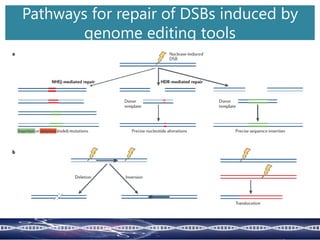
• Genome editing depends; DNA double stranded break (DSB)
and its repair mechanisms
• DSB repair is one of the most essential mechanisms found in
all organisms
• Two pathways are found to be in central of DSB repair
mechanisms;
1. Nonhomologous end joining (NHEJ)
2. Homology directed repair (HDR)
Pathways for repair of DSBs induced by
genome editing tools
Engineered Nucleases
• Artificial proteins composed of a customizable sequence-
specific DNA-binding domain fused to a nuclease that
cleaves DNA in a non-sequence-specific manner
• These targetable nucleases are used to induce DSBs into
specific DNA sites, which are then repaired by
mechanisms that can be exploited to create sequence
alterations at the cleavage site.
• Zinc-finger nucleases (ZFNs)
• Transcription activator like effector nucleases (TALENs)
• Meganucleases (MNs)
• Clustered regulatory interspaced short palindromic
repeats CRISPR/Cas (CRISPR associated) systems
Zinc-finger nucleases (ZFNs)
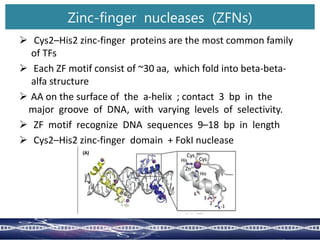
 Cys2–His2 zinc-finger proteins are the most common family
of TFs
 Each ZF motif consist of ~30 aa, which fold into beta-beta-
alfa structure
 AA on the surface of the a-helix ; contact 3 bp in the
major groove of DNA, with varying levels of selectivity.
 ZF motif recognize DNA sequences 9–18 bp in length
 Cys2–His2 zinc-finger domain + FokI nuclease
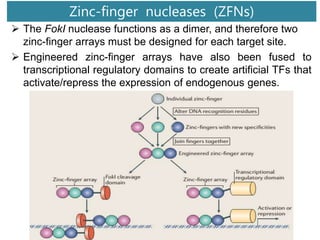
 The FokI nuclease functions as a dimer, and therefore two
zinc-finger arrays must be designed for each target site.
 Engineered zinc-finger arrays have also been fused to
transcriptional regulatory domains to create artificial TFs that
activate/repress the expression of endogenous genes.
Zinc-finger nucleases (ZFNs)
• Several types of genomic alterations can be introduced
with ZFNs, including point mutations, deletions
insertions, inversions, duplications and translocations.
• Normal cellular repair of ZFN-induced DSBs by non-
homologous end-joining (NHEJ) or homology-directed
repair (HDR) can be exploited to introduce targeted
genome alterations
• NHEJ-mediated repair , leads to insertion or deletion
(indel) mutation of variable length: can lead to the
knockout of gene function
• HDR: introduce precise nucleotide substitutions or
insertions of up to 7.6 kb at or near the site of the
break
Zinc-finger nucleases (ZFNs)
An Example of ZFN technology
ZFNs used to cleave and stimulate mutations at an endogenous target gene [ABA-
INSENSITIVE4 (ABI4)] in Arabidopsis
This gene controls a number of agronomically important traits, including plant responses
to abiotic stress and seed development
They achieved targeted mutagenesis at a rate of ~ 0.26% to 2.86% in Arabidopsis somatic
cells, and transmission of the induced mutation in the target gene to subsequent
generations
Consensus ZFN target sites in the Arabidopsis ABI4
gene. Asterisk indicates the position of the mutation
in the abi4 mutant. Target sites of ZFN monomers
are highlighted with gray bars. The putative
cleavage sites are shown by arrows.
Advantages
1) Relatively easy to tailor the substrate specificity
2) Well characterized in term of affinity and toxicity
3) Targeted gene disruption with high efficiency
Disadvantages
1) Screening and assembly of ZFN modules is technically
challenging
2) Commercial ZFN modules are expensive
3) Off-target effect
4) Requires screening to detect targeted events in animals
5) Sequence bias; prefer G rich sequence
Advantages & disadvantages of ZFN technology
Transcription activator-like effector nucleases
(TALENs)
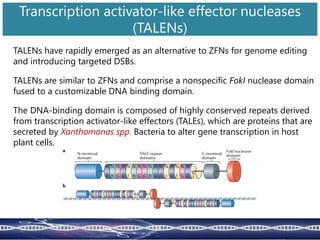
TALENs have rapidly emerged as an alternative to ZFNs for genome editing
and introducing targeted DSBs.
TALENs are similar to ZFNs and comprise a nonspecific FokI nuclease domain
fused to a customizable DNA binding domain.
The DNA-binding domain is composed of highly conserved repeats derived
from transcription activator-like effectors (TALEs), which are proteins that are
secreted by Xanthomonas spp. Bacteria to alter gene transcription in host
plant cells.
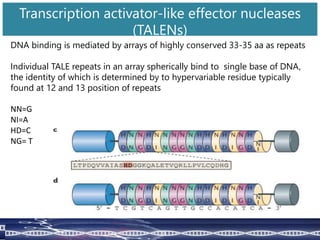
DNA binding is mediated by arrays of highly conserved 33-35 aa as repeats
Individual TALE repeats in an array spherically bind to single base of DNA,
the identity of which is determined by to hypervariable residue typically
found at 12 and 13 position of repeats
NN=G
NI=A
HD=C
NG= T
Transcription activator-like effector nucleases
(TALENs)
An Example of TALEN technology
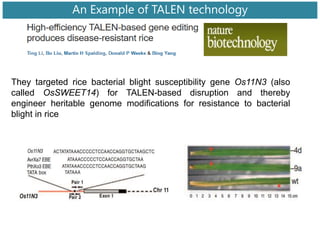
They targeted rice bacterial blight susceptibility gene Os11N3 (also
called OsSWEET14) for TALEN-based disruption and thereby
engineer heritable genome modifications for resistance to bacterial
blight in rice
• Advantages
1. Easy to tailor the substrate specificity
2. Length of the recognition site can be freely adjusted
• Disadvantages
1. No code for recognizing guanine (G) specifically
2. Specificity and toxicity have not been determined
systematically
3. Large protein size may cause difficulty in delivery
Advantages & disadvantages of ZFN technology
Meganucleases (MNs)
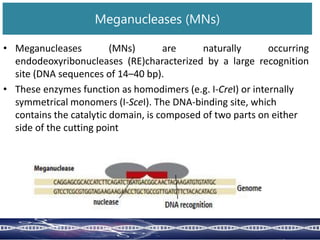
• Meganucleases (MNs) are naturally occurring
endodeoxyribonucleases (RE)characterized by a large recognition
site (DNA sequences of 14–40 bp).
• These enzymes function as homodimers (e.g. I-CreI) or internally
symmetrical monomers (I-SceI). The DNA-binding site, which
contains the catalytic domain, is composed of two parts on either
side of the cutting point
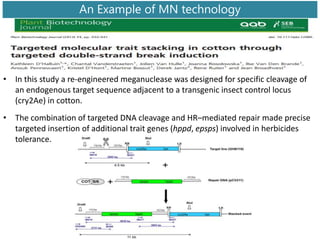
• In this study a re-engineered meganuclease was designed for specific cleavage of
an endogenous target sequence adjacent to a transgenic insect control locus
(cry2Ae) in cotton.
• The combination of targeted DNA cleavage and HR–mediated repair made precise
targeted insertion of additional trait genes (hppd, epsps) involved in herbicides
tolerance.
An Example of MN technology
• Advantages
1. Non-specific FokI DNA cleavage domain is not required
2. High DNA cleavage efficiency
• Disadvantages
1. Difficult to tailor the substrate specificity
2. Specificity and toxicity have not been determined
systematically
Advantages & disadvantages of Meganucleases
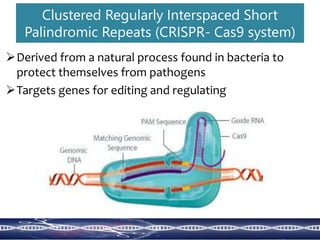
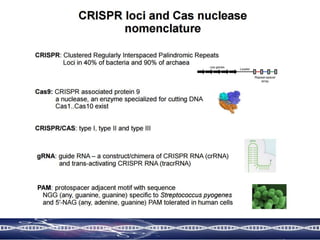
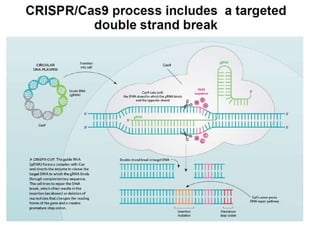
Clustered Regularly Interspaced Short
Palindromic Repeats (CRISPR- Cas9 system)
Derived from a natural process found in bacteria to
protect themselves from pathogens
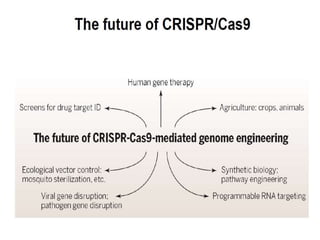
Targets genes for editing and regulating
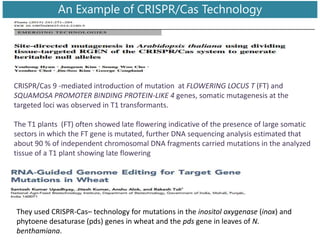
An Example of CRISPR/Cas Technology
They used CRISPR-Cas– technology for mutations in the inositol oxygenase (inox) and
phytoene desaturase (pds) genes in wheat and the pds gene in leaves of N.
benthamiana.
CRISPR/Cas 9 -mediated introduction of mutation at FLOWERING LOCUS T (FT) and
SQUAMOSA PROMOTER BINDING PROTEIN-LIKE 4 genes, somatic mutagenesis at the
targeted loci was observed in T1 transformants.
The T1 plants (FT) often showed late flowering indicative of the presence of large somatic
sectors in which the FT gene is mutated, further DNA sequencing analysis estimated that
about 90 % of independent chromosomal DNA fragments carried mutations in the analyzed
tissue of a T1 plant showing late flowering
• Advantages
1. Highly efficent
2. Easy to be constructed
3. Capable of editing multiple sites
4. Minimize off-target effect
• Disadvantages
1. PAM motif next to target sequence is required
Advantages & disadvantages of CRISPR/Cas
Thank You !

Genome editing presentation.pptx

  • 1.
    Genome Editing UsingEngineered Nucleases AJEET SINGH Department of Genetics and Plant Breeding CCS, University, Meerut
  • 2.
    Genome Editing Genome editingwith engineered nucleases (GEEN) is a type of genetic engineering in which DNA is inserted, replaced, or removed from a genome using artificially engineered nucleases, or "molecular scissors” The method can be used for  Delete a gene  Remove exons  Add a gene  Introduce point mutations It can be used for any gene, regardless of transcriptional activity or gene size
  • 3.
    Double stranded breaksand their repair • Genome editing depends; DNA double stranded break (DSB) and its repair mechanisms • DSB repair is one of the most essential mechanisms found in all organisms • Two pathways are found to be in central of DSB repair mechanisms; 1. Nonhomologous end joining (NHEJ) 2. Homology directed repair (HDR)
  • 4.
    Pathways for repairof DSBs induced by genome editing tools
  • 5.
    Engineered Nucleases • Artificialproteins composed of a customizable sequence- specific DNA-binding domain fused to a nuclease that cleaves DNA in a non-sequence-specific manner • These targetable nucleases are used to induce DSBs into specific DNA sites, which are then repaired by mechanisms that can be exploited to create sequence alterations at the cleavage site. • Zinc-finger nucleases (ZFNs) • Transcription activator like effector nucleases (TALENs) • Meganucleases (MNs) • Clustered regulatory interspaced short palindromic repeats CRISPR/Cas (CRISPR associated) systems
  • 6.
    Zinc-finger nucleases (ZFNs) Cys2–His2 zinc-finger proteins are the most common family of TFs  Each ZF motif consist of ~30 aa, which fold into beta-beta- alfa structure  AA on the surface of the a-helix ; contact 3 bp in the major groove of DNA, with varying levels of selectivity.  ZF motif recognize DNA sequences 9–18 bp in length  Cys2–His2 zinc-finger domain + FokI nuclease
  • 7.
     The FokInuclease functions as a dimer, and therefore two zinc-finger arrays must be designed for each target site.  Engineered zinc-finger arrays have also been fused to transcriptional regulatory domains to create artificial TFs that activate/repress the expression of endogenous genes. Zinc-finger nucleases (ZFNs)
  • 8.
    • Several typesof genomic alterations can be introduced with ZFNs, including point mutations, deletions insertions, inversions, duplications and translocations. • Normal cellular repair of ZFN-induced DSBs by non- homologous end-joining (NHEJ) or homology-directed repair (HDR) can be exploited to introduce targeted genome alterations • NHEJ-mediated repair , leads to insertion or deletion (indel) mutation of variable length: can lead to the knockout of gene function • HDR: introduce precise nucleotide substitutions or insertions of up to 7.6 kb at or near the site of the break Zinc-finger nucleases (ZFNs)
  • 9.
    An Example ofZFN technology ZFNs used to cleave and stimulate mutations at an endogenous target gene [ABA- INSENSITIVE4 (ABI4)] in Arabidopsis This gene controls a number of agronomically important traits, including plant responses to abiotic stress and seed development They achieved targeted mutagenesis at a rate of ~ 0.26% to 2.86% in Arabidopsis somatic cells, and transmission of the induced mutation in the target gene to subsequent generations Consensus ZFN target sites in the Arabidopsis ABI4 gene. Asterisk indicates the position of the mutation in the abi4 mutant. Target sites of ZFN monomers are highlighted with gray bars. The putative cleavage sites are shown by arrows.
  • 10.
    Advantages 1) Relatively easyto tailor the substrate specificity 2) Well characterized in term of affinity and toxicity 3) Targeted gene disruption with high efficiency Disadvantages 1) Screening and assembly of ZFN modules is technically challenging 2) Commercial ZFN modules are expensive 3) Off-target effect 4) Requires screening to detect targeted events in animals 5) Sequence bias; prefer G rich sequence Advantages & disadvantages of ZFN technology
  • 11.
    Transcription activator-like effectornucleases (TALENs) TALENs have rapidly emerged as an alternative to ZFNs for genome editing and introducing targeted DSBs. TALENs are similar to ZFNs and comprise a nonspecific FokI nuclease domain fused to a customizable DNA binding domain. The DNA-binding domain is composed of highly conserved repeats derived from transcription activator-like effectors (TALEs), which are proteins that are secreted by Xanthomonas spp. Bacteria to alter gene transcription in host plant cells.
  • 12.
    DNA binding ismediated by arrays of highly conserved 33-35 aa as repeats Individual TALE repeats in an array spherically bind to single base of DNA, the identity of which is determined by to hypervariable residue typically found at 12 and 13 position of repeats NN=G NI=A HD=C NG= T Transcription activator-like effector nucleases (TALENs)
  • 13.
    An Example ofTALEN technology They targeted rice bacterial blight susceptibility gene Os11N3 (also called OsSWEET14) for TALEN-based disruption and thereby engineer heritable genome modifications for resistance to bacterial blight in rice
  • 14.
    • Advantages 1. Easyto tailor the substrate specificity 2. Length of the recognition site can be freely adjusted • Disadvantages 1. No code for recognizing guanine (G) specifically 2. Specificity and toxicity have not been determined systematically 3. Large protein size may cause difficulty in delivery Advantages & disadvantages of ZFN technology
  • 15.
    Meganucleases (MNs) • Meganucleases(MNs) are naturally occurring endodeoxyribonucleases (RE)characterized by a large recognition site (DNA sequences of 14–40 bp). • These enzymes function as homodimers (e.g. I-CreI) or internally symmetrical monomers (I-SceI). The DNA-binding site, which contains the catalytic domain, is composed of two parts on either side of the cutting point
  • 16.
    • In thisstudy a re-engineered meganuclease was designed for specific cleavage of an endogenous target sequence adjacent to a transgenic insect control locus (cry2Ae) in cotton. • The combination of targeted DNA cleavage and HR–mediated repair made precise targeted insertion of additional trait genes (hppd, epsps) involved in herbicides tolerance. An Example of MN technology
  • 17.
    • Advantages 1. Non-specificFokI DNA cleavage domain is not required 2. High DNA cleavage efficiency • Disadvantages 1. Difficult to tailor the substrate specificity 2. Specificity and toxicity have not been determined systematically Advantages & disadvantages of Meganucleases
  • 18.
    Clustered Regularly InterspacedShort Palindromic Repeats (CRISPR- Cas9 system) Derived from a natural process found in bacteria to protect themselves from pathogens Targets genes for editing and regulating
  • 21.
    An Example ofCRISPR/Cas Technology They used CRISPR-Cas– technology for mutations in the inositol oxygenase (inox) and phytoene desaturase (pds) genes in wheat and the pds gene in leaves of N. benthamiana. CRISPR/Cas 9 -mediated introduction of mutation at FLOWERING LOCUS T (FT) and SQUAMOSA PROMOTER BINDING PROTEIN-LIKE 4 genes, somatic mutagenesis at the targeted loci was observed in T1 transformants. The T1 plants (FT) often showed late flowering indicative of the presence of large somatic sectors in which the FT gene is mutated, further DNA sequencing analysis estimated that about 90 % of independent chromosomal DNA fragments carried mutations in the analyzed tissue of a T1 plant showing late flowering
  • 22.
    • Advantages 1. Highlyefficent 2. Easy to be constructed 3. Capable of editing multiple sites 4. Minimize off-target effect • Disadvantages 1. PAM motif next to target sequence is required Advantages & disadvantages of CRISPR/Cas
  • 25.