FOOD
Food Means any article used as food or
drink for Human Consumption other
than Drug and also includes:
- Any article which enters or used in the
composition or preparation of food
- Any flavoring matter or condiments
- Any other article notified by the
Central Govt. e.g. Packaged Drinking
Water.
http://cegtesthouse.com
Law of Land
No person shall manufacture,
sell, stock, distribute, Transport
or exhibit for sale any article of
food, including prepared, ready
to serve or irradiated food
except under a
license/Registration by FSSAI.
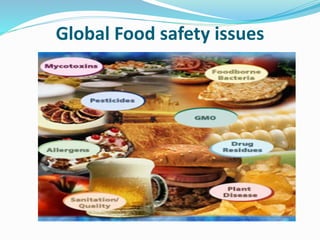
Food Safety Issues
Physical Hazards
Chemical Hazards
Biological Hazards
Adulteration Hazards
Global Food safety issues
Important Pillars of National Food Control System
Legislation/Regulation
Inspection
Testing (Backbone)/ Food Chemist
Enforcement
categories of food poisoning
1.Natural Food Poisoning
 This is caused by type of plant and fish that are
toxin to humans
 E.g. rhubarb leaves, poisonous mushroom,
puffer, fish.
2.Chemical Food Poisoning
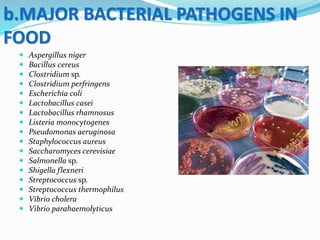
 This is caused by chemicals accidentally or
negligently getting into food.
 E.g. Overuse of insecticides, cleaning
agents, heavy metal contamination of fish
from industrial areas.
Continued-------------
 3. Bacterial Food Poisoning
 Five most common bacterial poisoning are:
 1. Salmonella-infection
 2. Staphylococcus aureus-intoxication
 3. Clostridium perfringens-infection and
intoxication
 4. Bacillus cereus- infection and intoxication
 5. Vibrio parahaemolyticus- infectio
 4. Viral Food borne Infection
 Viruses are transported by the food to the human
body and then multiply. e.g. hapatitis A,
gastroenteritis
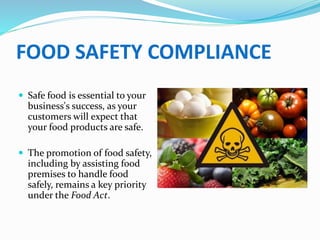
FOOD SAFETY COMPLIANCE
 Safe food is essential to your
business's success, as your
customers will expect that
your food products are safe.
 The promotion of food safety,
including by assisting food
premises to handle food
safely, remains a key priority
under the Food Act.
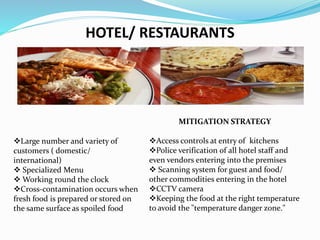
HOTEL/ RESTAURANTS
Large number and variety of
customers ( domestic/
international)
 Specialized Menu
 Working round the clock
Cross-contamination occurs when
fresh food is prepared or stored on
the same surface as spoiled food
MITIGATION STRATEGY
Access controls at entry of kitchens
Police verification of all hotel staff and
even vendors entering into the premises
 Scanning system for guest and food/
other commodities entering in the hotel
CCTV camera
Keeping the food at the right temperature
to avoid the "temperature danger zone."
Food Testing
1. Testing: To do something in order to discover
that Food Product is safe, meets the
requirements of standard and implied needs
2. Analysis: To study or examine Food Product in
detail to discover more about its quality and
safety
3. Inspection: Look at Food Product including
label carefully that everything is correct and legal
4. Sampling: A sample which is representative of a
lot/consignment
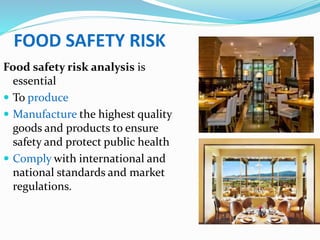
FOOD SAFETY RISK
Food safety risk analysis is
essential
 To produce
 Manufacture the highest quality
goods and products to ensure
safety and protect public health
 Comply with international and
national standards and market
regulations.
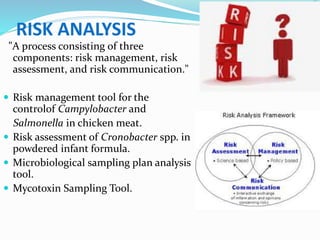
RISK ANALYSIS
"A process consisting of three
components: risk management, risk
assessment, and risk communication."
 Risk management tool for the
controlof Campylobacter and
Salmonella in chicken meat.
 Risk assessment of Cronobacter spp. in
powdered infant formula.
 Microbiological sampling plan analysis
tool.
 Mycotoxin Sampling Tool.
 FSSAI
 BIS
 AGMARK (DMI)
 Essential Commodities Act, 1954
 Cold Storage Order, 1980
 Standards on Weights & Measures Act, 1976 (Packaged
Commodities) Rules, 1977
 Export(Quality Control & Inspection) Act, 1963
 Consumer Protection Act, 1986
 APEDA
 MPEDA
 Commodity Boards
FOOD STANDARDS ENFORCING
AGENCIES
CEGTH-Credentials
 NABL (National Accreditation Board For Testing and
Calibration Laboratories) Accredited
 BIS (Bureau of Indian Standards) Approved
 FSSAI (Food Safety and Standards Authority of India)
Notified
 MSME (Micro Small and Medium Enterprises), GOI
National Award 2012
INSTRUMENTS
AT
CEGTH
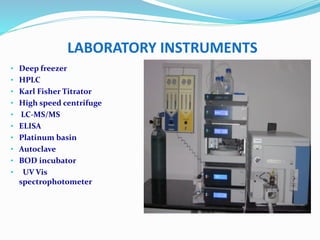
• Deep freezer
• HPLC
• Karl Fisher Titrator
• High speed centrifuge
• LC-MS/MS
• ELISA
• Platinum basin
• Autoclave
• BOD incubator
• UV Vis
spectrophotometer
LABORATORY INSTRUMENTS
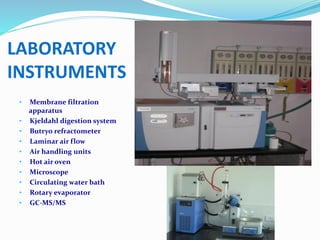
• Membrane filtration
apparatus
• Kjeldahl digestion system
• Butryo refractometer
• Laminar air flow
• Air handling units
• Hot air oven
• Microscope
• Circulating water bath
• Rotary evaporator
• GC-MS/MS
LABORATORY
INSTRUMENTS
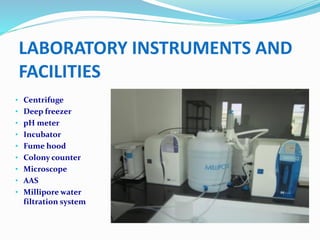
• Centrifuge
• Deep freezer
• pH meter
• Incubator
• Fume hood
• Colony counter
• Microscope
• AAS
• Millipore water
filtration system
LABORATORY INSTRUMENTS AND
FACILITIES
LABORATORY INSTRUMENTS
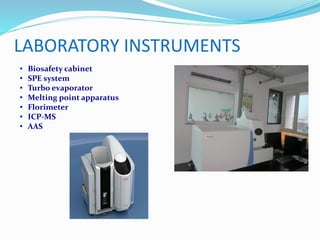
• Biosafety cabinet
• SPE system
• Turbo evaporator
• Melting point apparatus
• Florimeter
• ICP-MS
• AAS
HIGH END INSTRUMENTS
1. AAS (ATOMIC ABSORPTION SPECTROPHOTOMETER )
2. ICP-MS (NDUCTIVELY COUPLED PLASMA
MASS SPECTROMETER)
3. LC-MS/MS (Liquid Chromatograph-Mass)
4. FTIR (Fourier Transform Infrared)
5. GC-MS/MS (Gas Chromatograph-Mass)
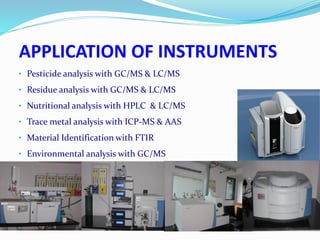
• Pesticide analysis with GC/MS & LC/MS
• Residue analysis with GC/MS & LC/MS
• Nutritional analysis with HPLC & LC/MS
• Trace metal analysis with ICP-MS & AAS
• Material Identification with FTIR
• Environmental analysis with GC/MS
APPLICATION OF INSTRUMENTS
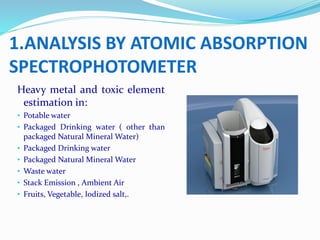
Heavy metal and toxic element
estimation in:
• Potable water
• Packaged Drinking water ( other than
packaged Natural Mineral Water)
• Packaged Drinking water
• Packaged Natural Mineral Water
• Waste water
• Stack Emission , Ambient Air
• Fruits, Vegetable, Iodized salt,.
1.ANALYSIS BY ATOMIC ABSORPTION
SPECTROPHOTOMETER
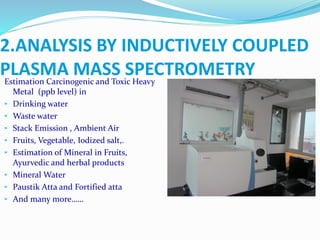
Estimation Carcinogenic and Toxic Heavy
Metal (ppb level) in
• Drinking water
• Waste water
• Stack Emission , Ambient Air
• Fruits, Vegetable, Iodized salt,.
• Estimation of Mineral in Fruits,
Ayurvedic and herbal products
• Mineral Water
• Paustik Atta and Fortified atta
• And many more……
2.ANALYSIS BY INDUCTIVELY COUPLED
PLASMA MASS SPECTROMETRY
HEAVY METALS AND MINERALS
 Sugar & sugar Product
 Lead
 Cadmium
 Arsenic
 Mercury
 Copper
 Zinc
 Nickel
 Iron
 Calcium
 Magnesium
 Sodium
 Potassium
 Nuts & Resins product
 Lead
 Cadmium
 Arsenic
 Mercury
 Copper
 Zinc
 Nickel
 Iron
 Calcium
 Magnesium
 Sodium
 Potassium
 Oil,Fat & Related product
 Lead
 Cadmium
 Arsenic
 Mercury
 Copper
 Zinc
 Nickel
 Iron
 Calcium
 Magnesium
 Sodium
 Potassium
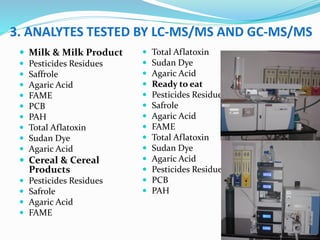
3. ANALYTES TESTED BY LC-MS/MS AND GC-MS/MS
 Milk & Milk Product
 Pesticides Residues
 Saffrole
 Agaric Acid
 FAME
 PCB
 PAH
 Total Aflatoxin
 Sudan Dye
 Agaric Acid
 Cereal & Cereal
Products
 Pesticides Residues
 Safrole
 Agaric Acid
 FAME
 Total Aflatoxin
 Sudan Dye
 Agaric Acid
 Ready to eat
 Pesticides Residues
 Safrole
 Agaric Acid
 FAME
 Total Aflatoxin
 Sudan Dye
 Agaric Acid
 Pesticides Residues
 PCB
 PAH
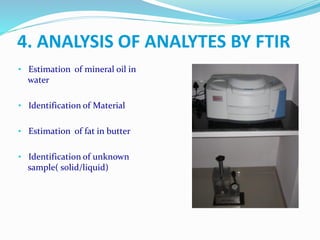
• Estimation of mineral oil in
water
• Identification of Material
• Estimation of fat in butter
• Identification of unknown
sample( solid/liquid)
4. ANALYSIS OF ANALYTES BY FTIR
CHEMICAL AND BIOLOGICAL
TESTING
1. FSSAI REQUIREMENT
2. WATER TESTING
3. FOOD TESTING
1.1.FSSAI REQUIREMENT
 Test for metal contamination
 Test for crop contamination
 Naturally occurring toxic
substances
 Test for cereals
 Test for pesticides and
insecticides
 Test for antibiotics and
pharmacologically active
substances
 Test for fish and fish products
 Test for meat and meat products
 Microbiological test for milk
products
1.2.FSSAI REQUIREMENT
 Microbiological test for food
products
 Test for spices and condiments
 Tests for edible oil
 Test for preservation
 Test for melamine
 Drinking water
 Packaged drinking water
 Mineral water
 Environmental testing analysis
 Swab test analysis
 Crop contaminants analysis
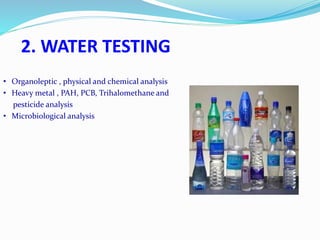
2. WATER TESTING
• Organoleptic , physical and chemical analysis
• Heavy metal , PAH, PCB, Trihalomethane and
pesticide analysis
• Microbiological analysis
a.ORGANOLEPTIC ,PHYSICAL AND
CHEMICAL ANALYSIS
• Packaged Drinking Water ( IS 14543:2004)
• Packaged Natural Mineral Water( IS 13428:2005)
• Drinking Water ( IS 10500:2012)
• Process water (IS: 4251))
• Bore well water
• Swimming pool (IS: 3328)
• Sewage treatment plant ( STP) Water
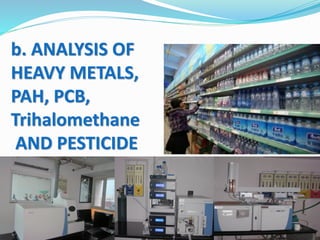
b. ANALYSIS OF
HEAVY METALS,
PAH, PCB,
Trihalomethane
AND PESTICIDE
 E. coli
 Total Coliform
 Faecal coliform
 Faecal streptococci
 Staphylococcus aureus
 Pseudomonas aeruginosa
 Sulphite reducing bacteria
 Salmonella
 Shigella
 Yeast and mould count
 Vibrio cholerae
 Vibrio parahaemolyticus
 Aerobic microbial count
 Legionella
 Listeria
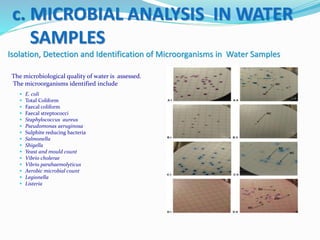
c. MICROBIAL ANALYSIS IN WATER
SAMPLES
Isolation, Detection and Identification of Microorganisms in Water Samples
The microbiological quality of water is assessed.
The microorganisms identified include
3. FOOD TESTING
 Various incidence of contaminated food like Beef, Pork and Poultry , Milk,
Cheese and Butter , Strawberries, Raspberries and Cherries , Apples and
Pears ,Tomatoes, Potatoes
 Testing for presence of harmful chemicals and microorganisms in food
causing consumer illness.
 Sources of contamination
1.Agrochemicals
2.Environmental contaminants
3. Pesticides and carcinogens
4.Rodent Hair and excreta in food
5. Processing contaminants
6. Microorganisms
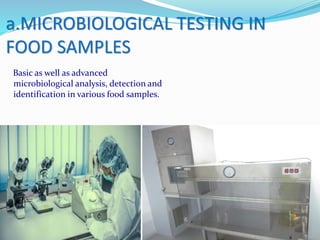
Basic as well as advanced
microbiological analysis, detection and
identification in various food samples.
a.MICROBIOLOGICAL TESTING IN
FOOD SAMPLES
 Aspergillus niger
 Bacillus cereus
 Clostridium sp.
 Clostridium perfringens
 Escherichia coli
 Lactobacillus casei
 Lactobacillus rhamnosus
 Listeria monocytogenes
 Pseudomonas aeruginosa
 Staphylococcus aureus
 Saccharomyces cerevisiae
 Salmonella sp.
 Shigella flexneri
 Streptococcus sp.
 Streptococcus thermophilus
 Vibrio cholera
 Vibrio parahaemolyticus
b.MAJOR BACTERIAL PATHOGENS IN
FOOD
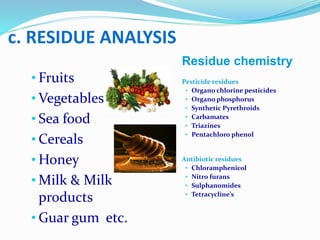
c. RESIDUE ANALYSIS
• Fruits
• Vegetables
• Sea food
• Cereals
• Honey
• Milk & Milk
products
• Guar gum etc.
Residue chemistry
Pesticide residues
• Organo chlorine pesticides
• Organo phosphorus
• Synthetic Pyrethroids
• Carbamates
• Triazines
• Pentachloro phenol
Antibiotic residues
• Chloramphenicol
• Nitro furans
• Sulphanomides
• Tetracycline's
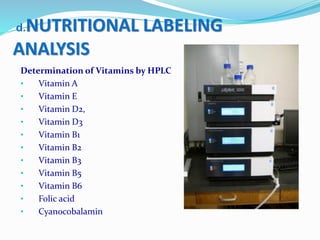
Determination of Vitamins by HPLC
• Vitamin A
• Vitamin E
• Vitamin D2,
• Vitamin D3
• Vitamin B1
• Vitamin B2
• Vitamin B3
• Vitamin B5
• Vitamin B6
• Folic acid
• Cyanocobalamin
d.NUTRITIONAL LABELING
ANALYSIS
VARIOUS PRODUCTS UNDER NABL
SCOPE OF TESTING AND ANALYSIS
 Food and agriculture products testing
 Milk and dairy products
 Cereals and pulses and by products
 Bakery and confectionary
 Sugar and sugar byproduct
 Nuts , raisins and dry fruits
 Food additives
 Processed food, animal feed and pet food
 Oil, fat and related products
 Pesticide residue in milk , food grains, vegetables and oils ,Oil seeds and by products
 Water testing
 IS 14543
 IS 10500
 IS 13428
 IS 4251
 IS 3328
 IS 456
 Waste water
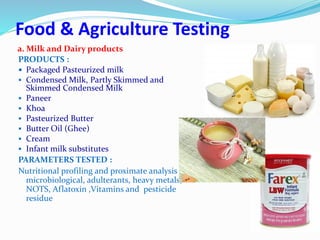
a. Milk and Dairy products
PRODUCTS :
 Packaged Pasteurized milk
 Condensed Milk, Partly Skimmed and
Skimmed Condensed Milk
 Paneer
 Khoa
 Pasteurized Butter
 Butter Oil (Ghee)
 Cream
 Infant milk substitutes
PARAMETERS TESTED :
Nutritional profiling and proximate analysis ,
microbiological, adulterants, heavy metals,
NOTS, Aflatoxin ,Vitamins and pesticide
residue
Food & Agriculture Testing
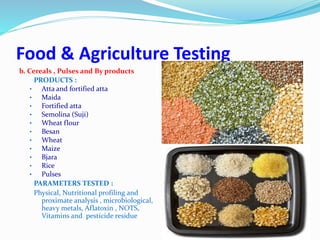
b. Cereals , Pulses and By products
PRODUCTS :
• Atta and fortified atta
• Maida
• Fortified atta
• Semolina (Suji)
• Wheat flour
• Besan
• Wheat
• Maize
• Bjara
• Rice
• Pulses
PARAMETERS TESTED :
Physical, Nutritional profiling and
proximate analysis , microbiological,
heavy metals, Aflatoxin , NOTS,
Vitamins and pesticide residue
Food & Agriculture Testing
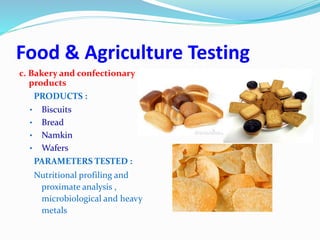
c. Bakery and confectionary
products
PRODUCTS :
• Biscuits
• Bread
• Namkin
• Wafers
PARAMETERS TESTED :
Nutritional profiling and
proximate analysis ,
microbiological and heavy
metals
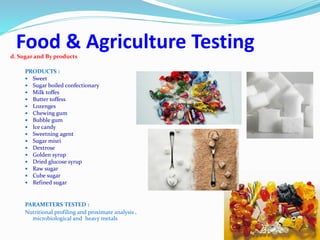
Food & Agriculture Testingd. Sugar and By products
PRODUCTS :
 Sweet
 Sugar boiled confectionary
 Milk toffes
 Butter toffess
 Lozenges
 Chewing gum
 Bubble gum
 Ice candy
 Sweetning agent
 Sugar misri
 Dextrose
 Golden syrup
 Dried glucose syrup
 Raw sugar
 Cube sugar
 Refined sugar
PARAMETERS TESTED :
Nutritional profiling and proximate analysis ,
microbiological and heavy metals
Food & Agriculture Testing
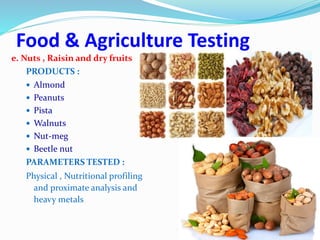
e. Nuts , Raisin and dry fruits
PRODUCTS :
 Almond
 Peanuts
 Pista
 Walnuts
 Nut-meg
 Beetle nut
PARAMETERS TESTED :
Physical , Nutritional profiling
and proximate analysis and
heavy metals
Food & Agriculture Testing
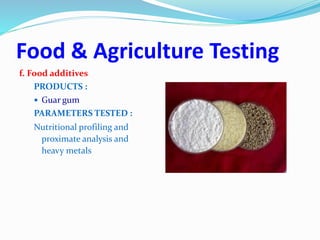
f. Food additives
PRODUCTS :
 Guar gum
PARAMETERS TESTED :
Nutritional profiling and
proximate analysis and
heavy metals
Food & Agriculture Testing
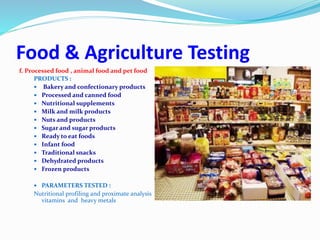
f. Processed food , animal food and pet food
PRODUCTS :
 Bakery and confectionary products
 Processed and canned food
 Nutritional supplements
 Milk and milk products
 Nuts and products
 Sugar and sugar products
 Ready to eat foods
 Infant food
 Traditional snacks
 Dehydrated products
 Frozen products
 PARAMETERS TESTED :
Nutritional profiling and proximate analysis
vitamins and heavy metals
Food & Agriculture Testing
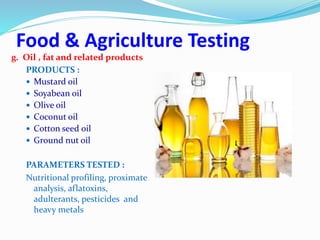
g. Oil , fat and related products
PRODUCTS :
 Mustard oil
 Soyabean oil
 Olive oil
 Coconut oil
 Cotton seed oil
 Ground nut oil
PARAMETERS TESTED :
Nutritional profiling, proximate
analysis, aflatoxins,
adulterants, pesticides and
heavy metals
Food & Agriculture Testing
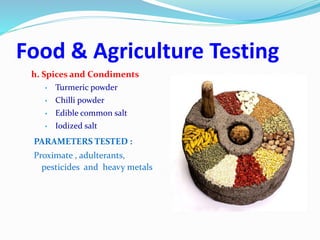
h. Spices and Condiments
• Turmeric powder
• Chilli powder
• Edible common salt
• Iodized salt
PARAMETERS TESTED :
Proximate , adulterants,
pesticides and heavy metals
Food & Agriculture Testing
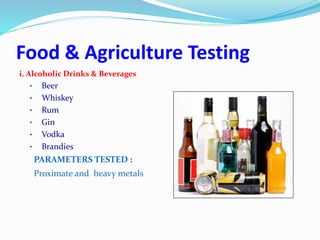
i. Alcoholic Drinks & Beverages
• Beer
• Whiskey
• Rum
• Gin
• Vodka
• Brandies
PARAMETERS TESTED :
Proximate and heavy metals
CEG Test House and Research
Center Pvt. Ltd.
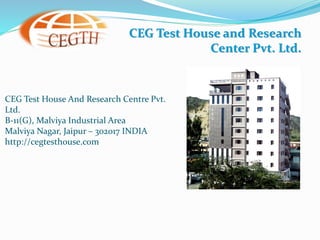
CEG Test House And Research Centre Pvt.
Ltd.
B-11(G), Malviya Industrial Area
Malviya Nagar, Jaipur – 302017 INDIA
http://cegtesthouse.com

Food Testing Lab

  • 2.
    FOOD Food Means anyarticle used as food or drink for Human Consumption other than Drug and also includes: - Any article which enters or used in the composition or preparation of food - Any flavoring matter or condiments - Any other article notified by the Central Govt. e.g. Packaged Drinking Water. http://cegtesthouse.com
  • 3.
    Law of Land Noperson shall manufacture, sell, stock, distribute, Transport or exhibit for sale any article of food, including prepared, ready to serve or irradiated food except under a license/Registration by FSSAI.
  • 4.
    Food Safety Issues PhysicalHazards Chemical Hazards Biological Hazards Adulteration Hazards
  • 5.
  • 6.
    Important Pillars ofNational Food Control System Legislation/Regulation Inspection Testing (Backbone)/ Food Chemist Enforcement
  • 7.
    categories of foodpoisoning 1.Natural Food Poisoning  This is caused by type of plant and fish that are toxin to humans  E.g. rhubarb leaves, poisonous mushroom, puffer, fish. 2.Chemical Food Poisoning  This is caused by chemicals accidentally or negligently getting into food.  E.g. Overuse of insecticides, cleaning agents, heavy metal contamination of fish from industrial areas.
  • 8.
    Continued-------------  3. BacterialFood Poisoning  Five most common bacterial poisoning are:  1. Salmonella-infection  2. Staphylococcus aureus-intoxication  3. Clostridium perfringens-infection and intoxication  4. Bacillus cereus- infection and intoxication  5. Vibrio parahaemolyticus- infectio  4. Viral Food borne Infection  Viruses are transported by the food to the human body and then multiply. e.g. hapatitis A, gastroenteritis
  • 9.
    FOOD SAFETY COMPLIANCE Safe food is essential to your business's success, as your customers will expect that your food products are safe.  The promotion of food safety, including by assisting food premises to handle food safely, remains a key priority under the Food Act.
  • 10.
    HOTEL/ RESTAURANTS Large numberand variety of customers ( domestic/ international)  Specialized Menu  Working round the clock Cross-contamination occurs when fresh food is prepared or stored on the same surface as spoiled food MITIGATION STRATEGY Access controls at entry of kitchens Police verification of all hotel staff and even vendors entering into the premises  Scanning system for guest and food/ other commodities entering in the hotel CCTV camera Keeping the food at the right temperature to avoid the "temperature danger zone."
  • 11.
    Food Testing 1. Testing:To do something in order to discover that Food Product is safe, meets the requirements of standard and implied needs 2. Analysis: To study or examine Food Product in detail to discover more about its quality and safety 3. Inspection: Look at Food Product including label carefully that everything is correct and legal 4. Sampling: A sample which is representative of a lot/consignment
  • 12.
    FOOD SAFETY RISK Foodsafety risk analysis is essential  To produce  Manufacture the highest quality goods and products to ensure safety and protect public health  Comply with international and national standards and market regulations.
  • 13.
    RISK ANALYSIS "A processconsisting of three components: risk management, risk assessment, and risk communication."  Risk management tool for the controlof Campylobacter and Salmonella in chicken meat.  Risk assessment of Cronobacter spp. in powdered infant formula.  Microbiological sampling plan analysis tool.  Mycotoxin Sampling Tool.
  • 14.
     FSSAI  BIS AGMARK (DMI)  Essential Commodities Act, 1954  Cold Storage Order, 1980  Standards on Weights & Measures Act, 1976 (Packaged Commodities) Rules, 1977  Export(Quality Control & Inspection) Act, 1963  Consumer Protection Act, 1986  APEDA  MPEDA  Commodity Boards FOOD STANDARDS ENFORCING AGENCIES
  • 15.
    CEGTH-Credentials  NABL (NationalAccreditation Board For Testing and Calibration Laboratories) Accredited  BIS (Bureau of Indian Standards) Approved  FSSAI (Food Safety and Standards Authority of India) Notified  MSME (Micro Small and Medium Enterprises), GOI National Award 2012
  • 16.
  • 17.
    • Deep freezer •HPLC • Karl Fisher Titrator • High speed centrifuge • LC-MS/MS • ELISA • Platinum basin • Autoclave • BOD incubator • UV Vis spectrophotometer LABORATORY INSTRUMENTS
  • 18.
    • Membrane filtration apparatus •Kjeldahl digestion system • Butryo refractometer • Laminar air flow • Air handling units • Hot air oven • Microscope • Circulating water bath • Rotary evaporator • GC-MS/MS LABORATORY INSTRUMENTS
  • 19.
    • Centrifuge • Deepfreezer • pH meter • Incubator • Fume hood • Colony counter • Microscope • AAS • Millipore water filtration system LABORATORY INSTRUMENTS AND FACILITIES
  • 20.
    LABORATORY INSTRUMENTS • Biosafetycabinet • SPE system • Turbo evaporator • Melting point apparatus • Florimeter • ICP-MS • AAS
  • 21.
    HIGH END INSTRUMENTS 1.AAS (ATOMIC ABSORPTION SPECTROPHOTOMETER ) 2. ICP-MS (NDUCTIVELY COUPLED PLASMA MASS SPECTROMETER) 3. LC-MS/MS (Liquid Chromatograph-Mass) 4. FTIR (Fourier Transform Infrared) 5. GC-MS/MS (Gas Chromatograph-Mass)
  • 22.
    • Pesticide analysiswith GC/MS & LC/MS • Residue analysis with GC/MS & LC/MS • Nutritional analysis with HPLC & LC/MS • Trace metal analysis with ICP-MS & AAS • Material Identification with FTIR • Environmental analysis with GC/MS APPLICATION OF INSTRUMENTS
  • 23.
    Heavy metal andtoxic element estimation in: • Potable water • Packaged Drinking water ( other than packaged Natural Mineral Water) • Packaged Drinking water • Packaged Natural Mineral Water • Waste water • Stack Emission , Ambient Air • Fruits, Vegetable, Iodized salt,. 1.ANALYSIS BY ATOMIC ABSORPTION SPECTROPHOTOMETER
  • 24.
    Estimation Carcinogenic andToxic Heavy Metal (ppb level) in • Drinking water • Waste water • Stack Emission , Ambient Air • Fruits, Vegetable, Iodized salt,. • Estimation of Mineral in Fruits, Ayurvedic and herbal products • Mineral Water • Paustik Atta and Fortified atta • And many more…… 2.ANALYSIS BY INDUCTIVELY COUPLED PLASMA MASS SPECTROMETRY
  • 25.
    HEAVY METALS ANDMINERALS  Sugar & sugar Product  Lead  Cadmium  Arsenic  Mercury  Copper  Zinc  Nickel  Iron  Calcium  Magnesium  Sodium  Potassium  Nuts & Resins product  Lead  Cadmium  Arsenic  Mercury  Copper  Zinc  Nickel  Iron  Calcium  Magnesium  Sodium  Potassium  Oil,Fat & Related product  Lead  Cadmium  Arsenic  Mercury  Copper  Zinc  Nickel  Iron  Calcium  Magnesium  Sodium  Potassium
  • 26.
    3. ANALYTES TESTEDBY LC-MS/MS AND GC-MS/MS  Milk & Milk Product  Pesticides Residues  Saffrole  Agaric Acid  FAME  PCB  PAH  Total Aflatoxin  Sudan Dye  Agaric Acid  Cereal & Cereal Products  Pesticides Residues  Safrole  Agaric Acid  FAME  Total Aflatoxin  Sudan Dye  Agaric Acid  Ready to eat  Pesticides Residues  Safrole  Agaric Acid  FAME  Total Aflatoxin  Sudan Dye  Agaric Acid  Pesticides Residues  PCB  PAH
  • 27.
    • Estimation ofmineral oil in water • Identification of Material • Estimation of fat in butter • Identification of unknown sample( solid/liquid) 4. ANALYSIS OF ANALYTES BY FTIR
  • 28.
    CHEMICAL AND BIOLOGICAL TESTING 1.FSSAI REQUIREMENT 2. WATER TESTING 3. FOOD TESTING
  • 29.
    1.1.FSSAI REQUIREMENT  Testfor metal contamination  Test for crop contamination  Naturally occurring toxic substances  Test for cereals  Test for pesticides and insecticides  Test for antibiotics and pharmacologically active substances  Test for fish and fish products  Test for meat and meat products  Microbiological test for milk products
  • 30.
    1.2.FSSAI REQUIREMENT  Microbiologicaltest for food products  Test for spices and condiments  Tests for edible oil  Test for preservation  Test for melamine  Drinking water  Packaged drinking water  Mineral water  Environmental testing analysis  Swab test analysis  Crop contaminants analysis
  • 31.
    2. WATER TESTING •Organoleptic , physical and chemical analysis • Heavy metal , PAH, PCB, Trihalomethane and pesticide analysis • Microbiological analysis
  • 32.
    a.ORGANOLEPTIC ,PHYSICAL AND CHEMICALANALYSIS • Packaged Drinking Water ( IS 14543:2004) • Packaged Natural Mineral Water( IS 13428:2005) • Drinking Water ( IS 10500:2012) • Process water (IS: 4251)) • Bore well water • Swimming pool (IS: 3328) • Sewage treatment plant ( STP) Water
  • 33.
    b. ANALYSIS OF HEAVYMETALS, PAH, PCB, Trihalomethane AND PESTICIDE
  • 34.
     E. coli Total Coliform  Faecal coliform  Faecal streptococci  Staphylococcus aureus  Pseudomonas aeruginosa  Sulphite reducing bacteria  Salmonella  Shigella  Yeast and mould count  Vibrio cholerae  Vibrio parahaemolyticus  Aerobic microbial count  Legionella  Listeria c. MICROBIAL ANALYSIS IN WATER SAMPLES Isolation, Detection and Identification of Microorganisms in Water Samples The microbiological quality of water is assessed. The microorganisms identified include
  • 35.
    3. FOOD TESTING Various incidence of contaminated food like Beef, Pork and Poultry , Milk, Cheese and Butter , Strawberries, Raspberries and Cherries , Apples and Pears ,Tomatoes, Potatoes  Testing for presence of harmful chemicals and microorganisms in food causing consumer illness.  Sources of contamination 1.Agrochemicals 2.Environmental contaminants 3. Pesticides and carcinogens 4.Rodent Hair and excreta in food 5. Processing contaminants 6. Microorganisms
  • 36.
    Basic as wellas advanced microbiological analysis, detection and identification in various food samples. a.MICROBIOLOGICAL TESTING IN FOOD SAMPLES
  • 37.
     Aspergillus niger Bacillus cereus  Clostridium sp.  Clostridium perfringens  Escherichia coli  Lactobacillus casei  Lactobacillus rhamnosus  Listeria monocytogenes  Pseudomonas aeruginosa  Staphylococcus aureus  Saccharomyces cerevisiae  Salmonella sp.  Shigella flexneri  Streptococcus sp.  Streptococcus thermophilus  Vibrio cholera  Vibrio parahaemolyticus b.MAJOR BACTERIAL PATHOGENS IN FOOD
  • 38.
    c. RESIDUE ANALYSIS •Fruits • Vegetables • Sea food • Cereals • Honey • Milk & Milk products • Guar gum etc. Residue chemistry Pesticide residues • Organo chlorine pesticides • Organo phosphorus • Synthetic Pyrethroids • Carbamates • Triazines • Pentachloro phenol Antibiotic residues • Chloramphenicol • Nitro furans • Sulphanomides • Tetracycline's
  • 39.
    Determination of Vitaminsby HPLC • Vitamin A • Vitamin E • Vitamin D2, • Vitamin D3 • Vitamin B1 • Vitamin B2 • Vitamin B3 • Vitamin B5 • Vitamin B6 • Folic acid • Cyanocobalamin d.NUTRITIONAL LABELING ANALYSIS
  • 40.
    VARIOUS PRODUCTS UNDERNABL SCOPE OF TESTING AND ANALYSIS  Food and agriculture products testing  Milk and dairy products  Cereals and pulses and by products  Bakery and confectionary  Sugar and sugar byproduct  Nuts , raisins and dry fruits  Food additives  Processed food, animal feed and pet food  Oil, fat and related products  Pesticide residue in milk , food grains, vegetables and oils ,Oil seeds and by products  Water testing  IS 14543  IS 10500  IS 13428  IS 4251  IS 3328  IS 456  Waste water
  • 41.
    a. Milk andDairy products PRODUCTS :  Packaged Pasteurized milk  Condensed Milk, Partly Skimmed and Skimmed Condensed Milk  Paneer  Khoa  Pasteurized Butter  Butter Oil (Ghee)  Cream  Infant milk substitutes PARAMETERS TESTED : Nutritional profiling and proximate analysis , microbiological, adulterants, heavy metals, NOTS, Aflatoxin ,Vitamins and pesticide residue Food & Agriculture Testing
  • 42.
    Food & AgricultureTesting b. Cereals , Pulses and By products PRODUCTS : • Atta and fortified atta • Maida • Fortified atta • Semolina (Suji) • Wheat flour • Besan • Wheat • Maize • Bjara • Rice • Pulses PARAMETERS TESTED : Physical, Nutritional profiling and proximate analysis , microbiological, heavy metals, Aflatoxin , NOTS, Vitamins and pesticide residue
  • 43.
    Food & AgricultureTesting c. Bakery and confectionary products PRODUCTS : • Biscuits • Bread • Namkin • Wafers PARAMETERS TESTED : Nutritional profiling and proximate analysis , microbiological and heavy metals
  • 44.
    Food & AgricultureTestingd. Sugar and By products PRODUCTS :  Sweet  Sugar boiled confectionary  Milk toffes  Butter toffess  Lozenges  Chewing gum  Bubble gum  Ice candy  Sweetning agent  Sugar misri  Dextrose  Golden syrup  Dried glucose syrup  Raw sugar  Cube sugar  Refined sugar PARAMETERS TESTED : Nutritional profiling and proximate analysis , microbiological and heavy metals
  • 45.
    Food & AgricultureTesting e. Nuts , Raisin and dry fruits PRODUCTS :  Almond  Peanuts  Pista  Walnuts  Nut-meg  Beetle nut PARAMETERS TESTED : Physical , Nutritional profiling and proximate analysis and heavy metals
  • 46.
    Food & AgricultureTesting f. Food additives PRODUCTS :  Guar gum PARAMETERS TESTED : Nutritional profiling and proximate analysis and heavy metals
  • 47.
    Food & AgricultureTesting f. Processed food , animal food and pet food PRODUCTS :  Bakery and confectionary products  Processed and canned food  Nutritional supplements  Milk and milk products  Nuts and products  Sugar and sugar products  Ready to eat foods  Infant food  Traditional snacks  Dehydrated products  Frozen products  PARAMETERS TESTED : Nutritional profiling and proximate analysis vitamins and heavy metals
  • 48.
    Food & AgricultureTesting g. Oil , fat and related products PRODUCTS :  Mustard oil  Soyabean oil  Olive oil  Coconut oil  Cotton seed oil  Ground nut oil PARAMETERS TESTED : Nutritional profiling, proximate analysis, aflatoxins, adulterants, pesticides and heavy metals
  • 49.
    Food & AgricultureTesting h. Spices and Condiments • Turmeric powder • Chilli powder • Edible common salt • Iodized salt PARAMETERS TESTED : Proximate , adulterants, pesticides and heavy metals
  • 50.
    Food & AgricultureTesting i. Alcoholic Drinks & Beverages • Beer • Whiskey • Rum • Gin • Vodka • Brandies PARAMETERS TESTED : Proximate and heavy metals
  • 51.
    CEG Test Houseand Research Center Pvt. Ltd. CEG Test House And Research Centre Pvt. Ltd. B-11(G), Malviya Industrial Area Malviya Nagar, Jaipur – 302017 INDIA http://cegtesthouse.com