Generous Interfaces Evaluated
Aron Ambrosiani, Nordic Museum
@AronAmbrosiani
Albin Larsson, Swedish National Heritage Board
@AlbinPCLarsson
What Is a Generous Interface?
(Mitchell Whitelaw, 2012 and onwards)
• show first, don’t ask
• provide rich overviews
• encourage browsing/exploring
• show relationships
Project: Evaluate & Prototype
Participants:
• Swedish National Heritage Board (facilitating mission)
• Nationalmuseum
• Nordic Museum
• Swedish Museums of World Culture
• Malmö museer
A Collaborative Process
Design sprints + coding in between
Participants: collections staff, digital media producers & developers
• always use open data & open source
• lots of user testing
• shared project workspace in between design sprints
We Evaluated a Few Interfaces
• Barnes Foundation: Collection Online
• Münzkabinett Berlin: Coins
• Google Arts & Culture: Art Palette
11 formal evaluations (30–45 minutes each)
Lessons Learned: Interfaces
• transparency is key!
• pick one: sorting or filtering
• two modes: browse content or use tools
• bonus: it’s a tool for finding data errors
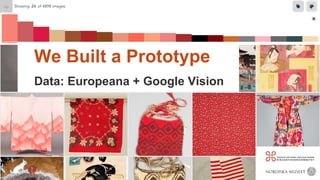
Data: Europeana + Google Vision
We Built a Prototype
Lessons Learned: Prototype
• introducing a new interface is difficult
• don’t be afraid to remove functionality
• frequent user testing helps to set priorities
Lessons Learned: Collaboration
• the learning is in the process
• involve staff with different expertise
• involve all participants in face-to-face meetings
• fulfills the facilitating mission
Repository, report
& more info here:
bit.ly/2CNsNna
Thank You!

Generous Interfaces Evaluated

  • 1.
    Generous Interfaces Evaluated AronAmbrosiani, Nordic Museum @AronAmbrosiani Albin Larsson, Swedish National Heritage Board @AlbinPCLarsson
  • 2.
    What Is aGenerous Interface? (Mitchell Whitelaw, 2012 and onwards) • show first, don’t ask • provide rich overviews • encourage browsing/exploring • show relationships
  • 3.
    Project: Evaluate &Prototype Participants: • Swedish National Heritage Board (facilitating mission) • Nationalmuseum • Nordic Museum • Swedish Museums of World Culture • Malmö museer
  • 4.
    A Collaborative Process Designsprints + coding in between Participants: collections staff, digital media producers & developers • always use open data & open source • lots of user testing • shared project workspace in between design sprints
  • 5.
    We Evaluated aFew Interfaces • Barnes Foundation: Collection Online • Münzkabinett Berlin: Coins • Google Arts & Culture: Art Palette 11 formal evaluations (30–45 minutes each)
  • 6.
    Lessons Learned: Interfaces •transparency is key! • pick one: sorting or filtering • two modes: browse content or use tools • bonus: it’s a tool for finding data errors
  • 7.
    Data: Europeana +Google Vision We Built a Prototype
  • 8.
    Lessons Learned: Prototype •introducing a new interface is difficult • don’t be afraid to remove functionality • frequent user testing helps to set priorities
  • 9.
    Lessons Learned: Collaboration •the learning is in the process • involve staff with different expertise • involve all participants in face-to-face meetings • fulfills the facilitating mission
  • 10.
    Repository, report & moreinfo here: bit.ly/2CNsNna Thank You!

Editor's Notes

  • #3 länka till Whitelaw
  • #4 beskriv RAÄs uppdrag gentemot museerna/GLAMs ”främja utveckling och samverkan” – ALLA museer dvs inte bara deltagande museer i projektet principer: öppen process, öppna data, öppen källkod, öppna sinnen
  • #7 transparency: filters, metadata (curated or machine created?), sources etc fyll på ur utvärderingen kolla med David
  • #8 +skärmdump/animering +nämna Albins hjälpbibliotek
  • #9 simplify tools increase–reduce complexity challenge assumptions finns det något vi lärt oss som andra inte tänkt på? utgå från vad vi lärt oss i utvärderingen – löste vi problemen där?
  • #10 viktigt att få med lärdomar/utvärdering från Nationalmuseum/Världskultur och från Nordiska/malmö museer styrgrupp (kolla med David) deltagare i projektet
  • #11 samla länkar i wiki på repositoryt?