Katherine Woollard, Head of Innovation & Digital
November 2022
Balancing Enhancement,
Innovation and Invention
The Vyne
Hampshire
Me and the National Trust
2
Katherine Woollard
Head of Innovation and Digital
“Anything digital for
the people we serve”
The Digital Roadmap
3
Digital
Future
Covid
Car Park
Emerging to a New Normal
4
us
Compton Bay
Isle of Wight
Walking, Running or Jumping
5
Enhancement Innovation Invention
Materiality
6
Importance
to
National
Trust
Importance to Users
Don’t do these
now
Don’t do these
Do these!
Don’t do these
now
Evaluate
7
Personalisatio
n
Accessibility Relevance Digital
Interpretation
Income
Generation
Low
Med
High
Maturity
Plan
8
Basic features: Removing blockers
Materiality
Competitor analysis to add ideas
Cross-Directorate collaboration to create varied shortlist, including
Excitement features: Unexpected delighters
Performance features: Delivering the expected
Digital investment plan 2022-2026
Quick wins
Pilots
Enhancements
Big investment
Different types of ideas… Delivered through…
Deliver
9
Thank You!
10
Katherine Woollard
Katherine.woollard@nationaltrust.org.uk
linkedin.com/in/katherinewoollard/

Balancing enhancement, innovation and invention

Editor's Notes

  • #3 Hi, I’m Katherine Woollard, Head of Innovation and Digital at the National Trust. That basically means I look after all of the national audience-facing digital journeys and products, so the website, mobile app, visit and event booking, online shop and holidays booking, and our funnels for joining, renewing or donating. I also lead an Innovation Hub team testing new digital technologies both on and off property. Digital is really important to us, but it is never going to replace the thing that makes us unique – the special places and collections we look after. We look after over 500 special places across England, Wales and Northern Ireland for the benefit of everyone, from coast lines, to historic mansions, landscape to the Beatles Childhood Homes, gardens and urban landmarks and everything in between. Digital at the National Trust is about enabling and enhancing the experiences of our supporters and potential supporters to build enjoyment, engagement, advocacy and deeper relationships.
  • #4 No presentation on digital would be complete without a roadmap of some kind so here we go… Back in 2019 (before my time at the Trust) there was a clear view of what the digital future looked like. The roadmap of change was in place and the wheels in motion to deliver. New underlying technologies first and building on them to deliver some great new experiences. All going nicely until Covid hit… (click) Suddenly we have to re-evaluate everything. No one knew what the future would hold, if there would be enough income to keep going at all, let alone continue delivering everything in the plans. So we headed into the Covid Car Park – stopped our journey and waited to see what happened. A few things emerged – the biggest being that although our indoor places remained closed, we were able to open access to our outdoor places but needed to control numbers to ensure social distancing measures could be maintained so moved many of them from free-flowing access to booked tickets having to implement a new platform at speed (and then replace it with a better solution as we understood the challenges of this through experience). But other than these things, we saw a significant restructure and downsizing of the organisation, the majority of staff furloughed at least for a while and the organisation watched and waited to see what the future would hold.
  • #5 About as predictable as the roadmap – the new normal has got to be as overused as the word unprecedented when it comes to Covid! For me this was my only normal at the Trust, I joined in February 2021 as we started emerging from ‘absolute essentials only’ to being able to think about where we wanted to go. The simple approach would be to dust off the old plan and pick up where we left off, but the reality is, the plans we had pre-pandemic were focused around delivering for a very different audience than the one we were now trying to serve. Digital adoption went through the roof during the pandemic, especially in the older generation who suddenly found they needed to adopt technology to be able to access the basics of an online shop as well as to connect with their loved ones and world outside their front door. Which is great, right? – suddenly there are so many new ways to engage with your members and supporters as well as reach new audiences. Or is it? As digital adoption snowballed, so did customer expectations and for an organisation who had put the brakes on digital development during the pandemic the gap was widening rapidly between expectations and reality. So how to bridge that gap?
  • #6 Looking across everything we needed to improve we had some difficult choices to make. Where did we keep walking - making small enhancements to incrementally improve? Where did we need to start running - being more innovative and ambitious, taking things on at a faster pace and delivering digital experiences which were new to the Trust or the sector? And finally, where did we need to take a massive leap forward, bypassing everything to deliver something brand new and groundbreaking?
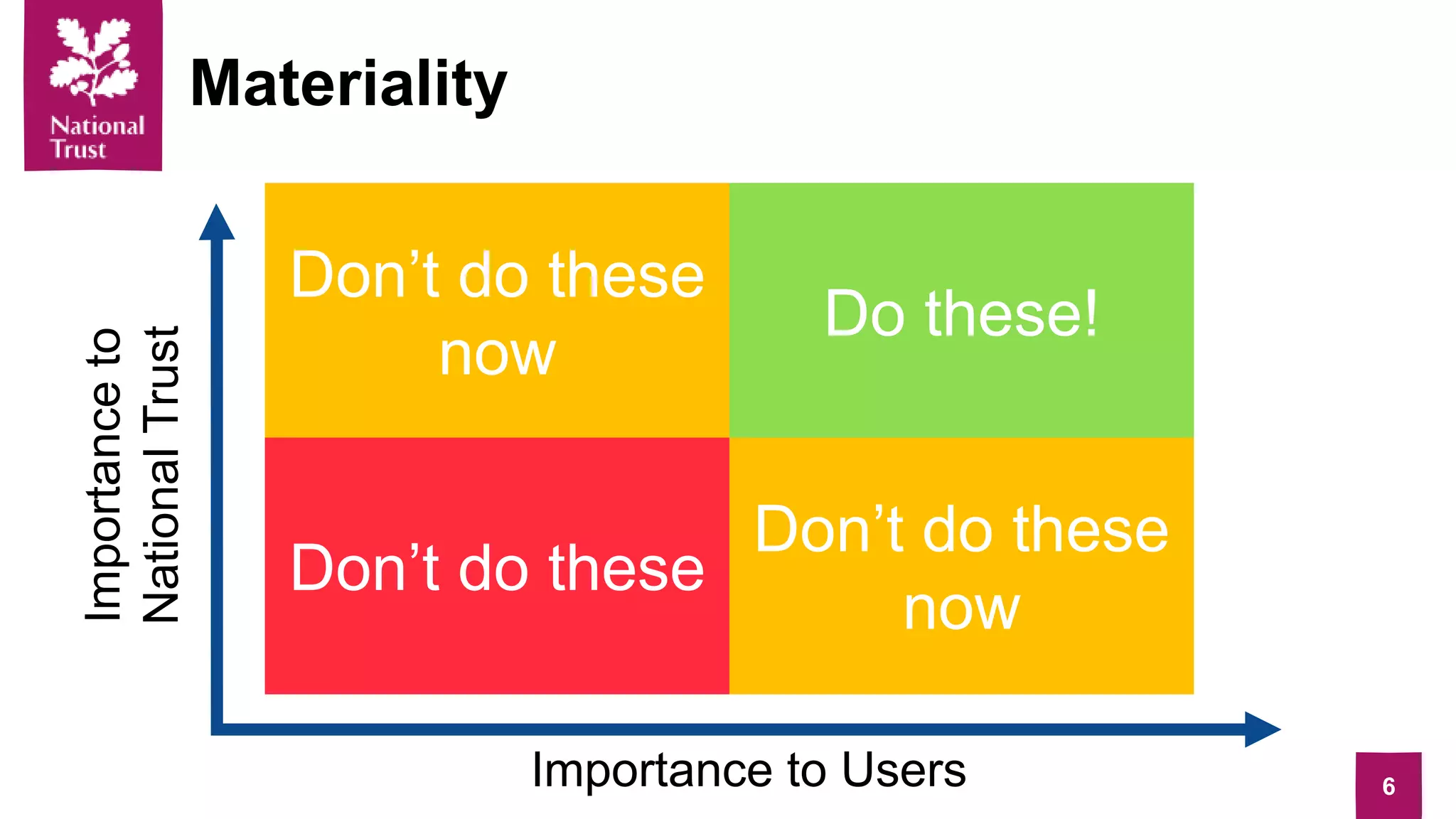
  • #7 The first step has got to be to understand what is most important to your users and what is most important to your organisation collecting a large number of ideas from our internal stakeholders and translating them into a list of user neds we felt they were trying to address. We the asked c. 1300 people internally and externally to rank the user needs they wanted to resolve – this gave us a clear view of those things in each of the quadrants shown. We looked at them and those that were important to both users and the Trust clearly fell into 4 themes: - personalisation - accessibility (in a broad sense – accessing things which the individual can’t access whether through disability or location) - relevance (making it much easier to find and access the things of most interest. - digital interpretation on property We also made a conscious decision to look at income generation – although not important to our users it is strategically important to the organisation.
  • #8 We then looked at what we had and our maturity in these areas. (click) Is everything still being used? Could we streamline and simplify to focus limited resources into fewer more developed experiences? Do we have nothing in this area and need to start from scratch, do we need to tweak what we have to meet expectations or are we just really unclear on what we need to deliver?
  • #9 We then plotted a three year programme of work to move each of these key areas forward. We included a mixture of - pilots and research where we lacked understanding of the need and potential solutions. - quick wins which could be delivered in the next year with no additional budget - enhancements to our existing digital estate - plans to build business cases and deliver the big ticket items where a significant step forward was needed. We also identified whether these were just removing pain points, if they were bringing us up to meet current customer expectations or if they were sprinkling a little bit of digital magic to surprise and delight. We knew we wanted to focus most on removing blockers and only a tiny bit of surprise and delight. Looking at it from a customer’s perspective, if th, one shiny things after a painful journey to get there is probably more likely to irritate than to delight – we really don’t want people asking why we’re wasting money on the sprinkle of icing sugar if we haven’t baked the scone!
  • #10 And now we’re in delivery of the plan… watch this space for the improvements for the better.