Five Perspectives of
              Business Strategy?
                          By
                Dr. Michael McDermott
                mcdermottm1@nku.edu


24/01/2013                              1
Perspectives on Strategy:
                   Five Schools of thought
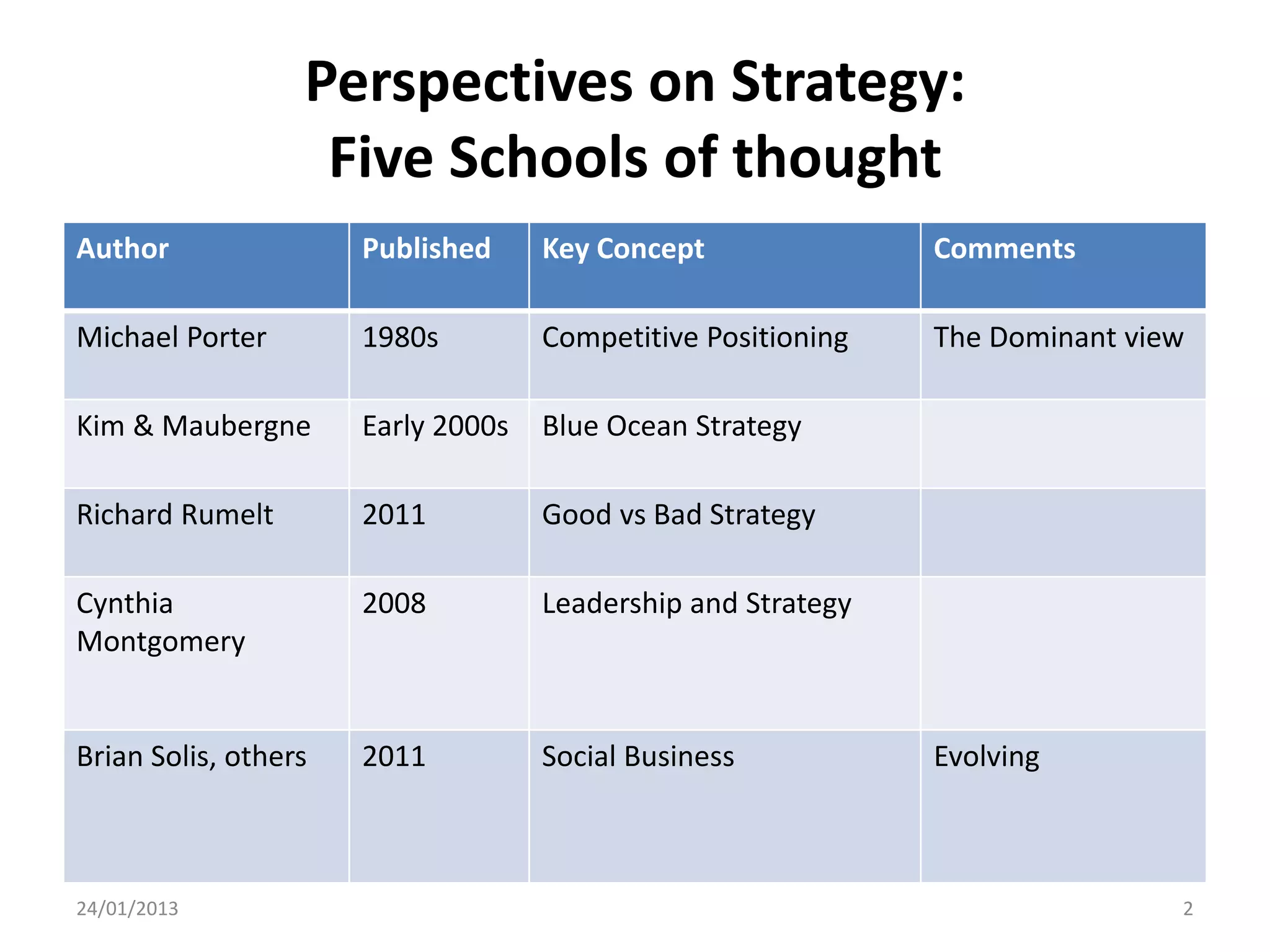
Author                Published     Key Concept               Comments

Michael Porter        1980s         Competitive Positioning   The Dominant view

Kim & Maubergne       Early 2000s   Blue Ocean Strategy

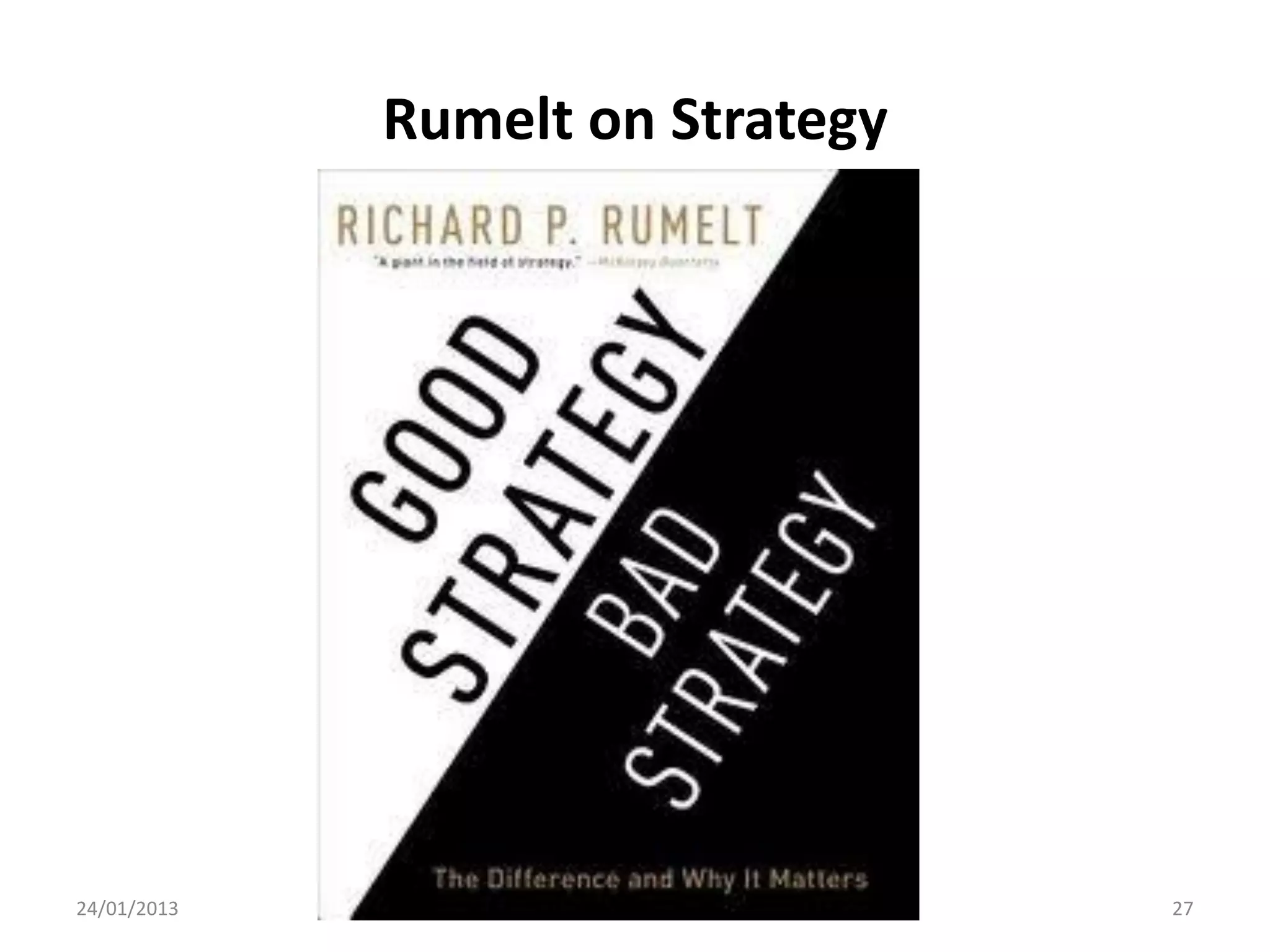
Richard Rumelt        2011          Good vs Bad Strategy

Cynthia               2008          Leadership and Strategy
Montgomery


Brian Solis, others   2011          Social Business           Evolving


24/01/2013                                                                    2
Perspectives on Strategy:
                       Five Schools of thought
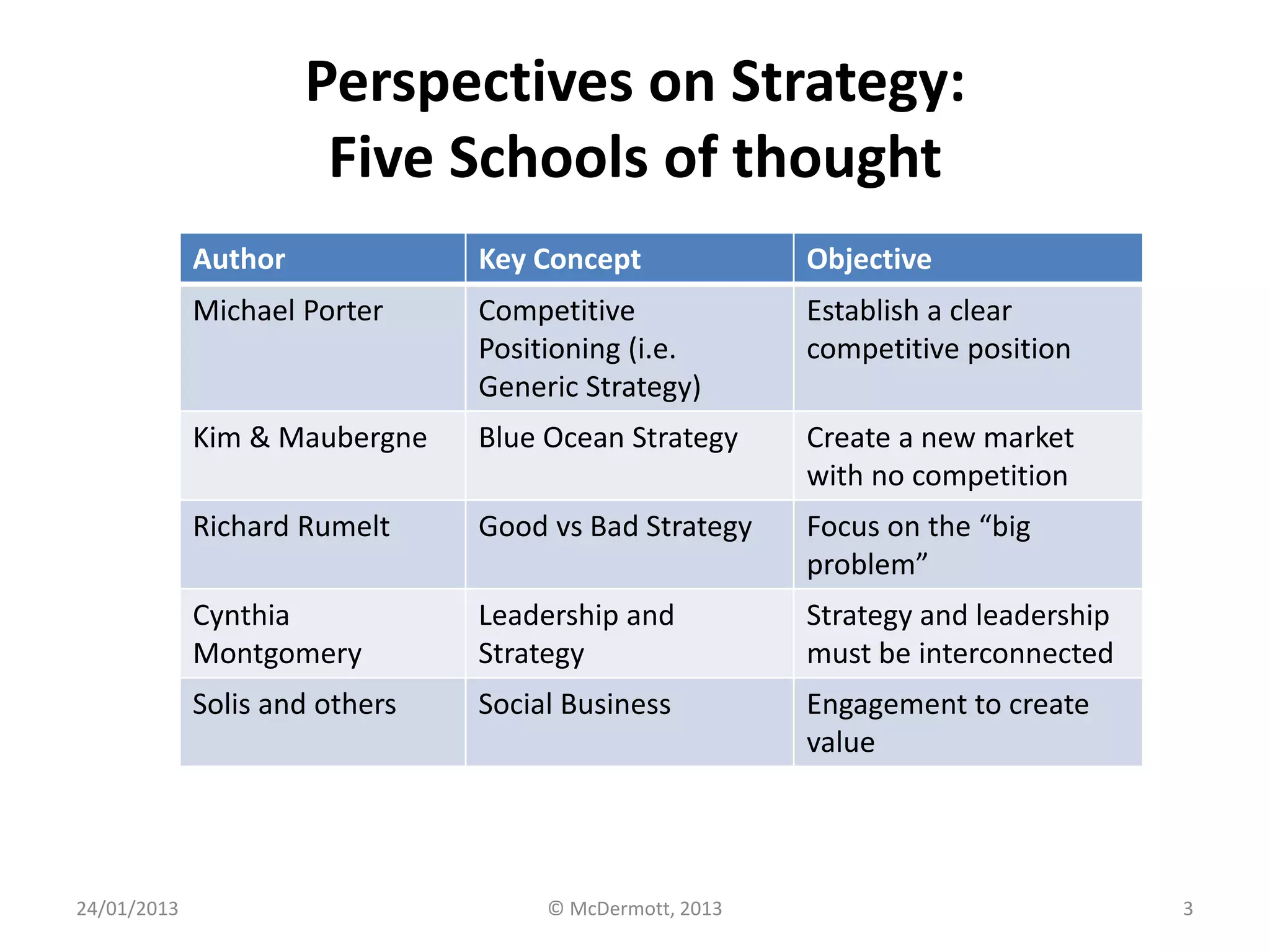
             Author             Key Concept              Objective
             Michael Porter     Competitive              Establish a clear
                                Positioning (i.e.        competitive position
                                Generic Strategy)
             Kim & Maubergne    Blue Ocean Strategy      Create a new market
                                                         with no competition
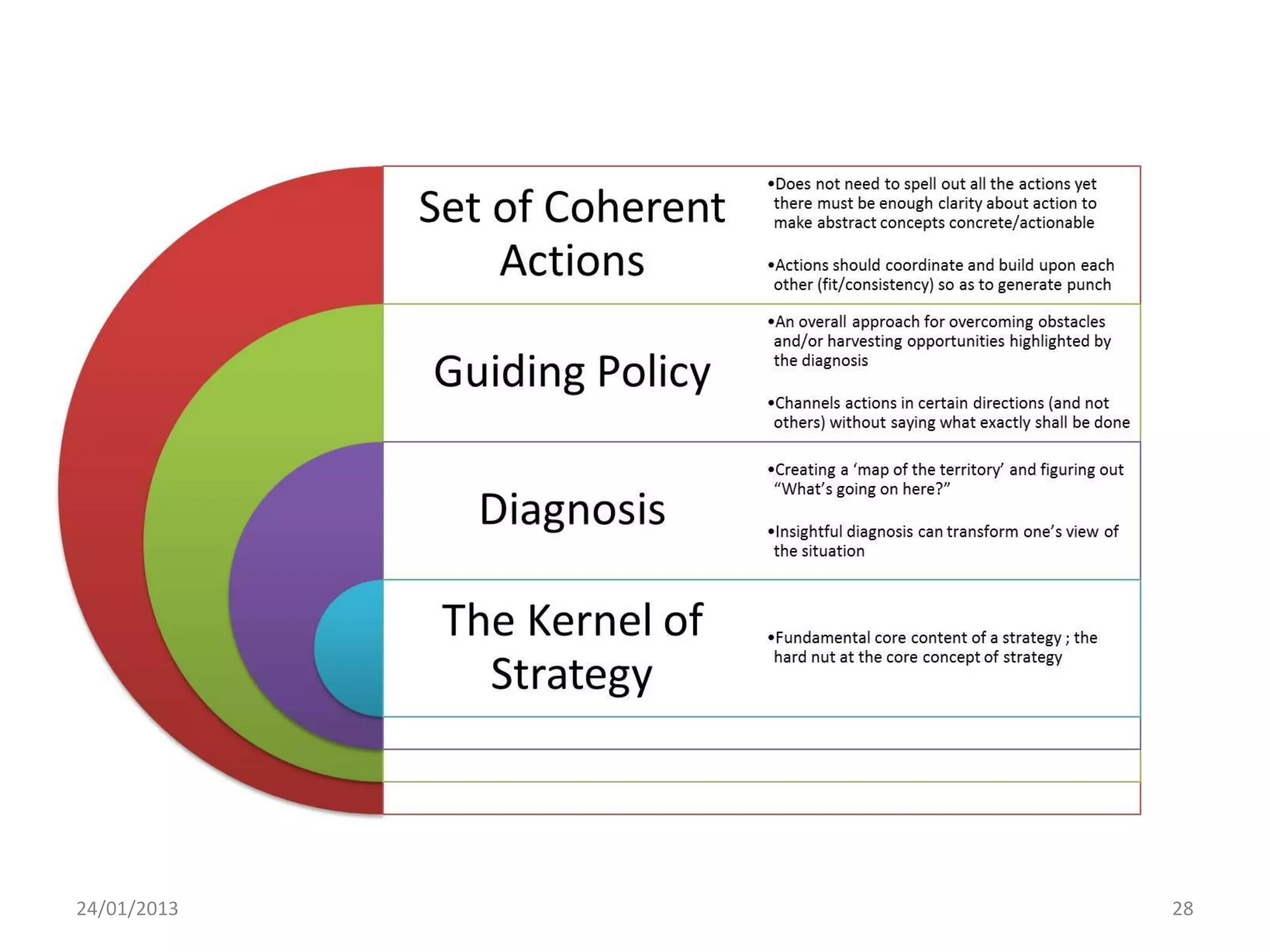
             Richard Rumelt     Good vs Bad Strategy     Focus on the “big
                                                         problem”
             Cynthia            Leadership and           Strategy and leadership
             Montgomery         Strategy                 must be interconnected
             Solis and others   Social Business          Engagement to create
                                                         value


24/01/2013                           © McDermott, 2013                             3
Michael Porter and Strategy


24/01/2013                                 4
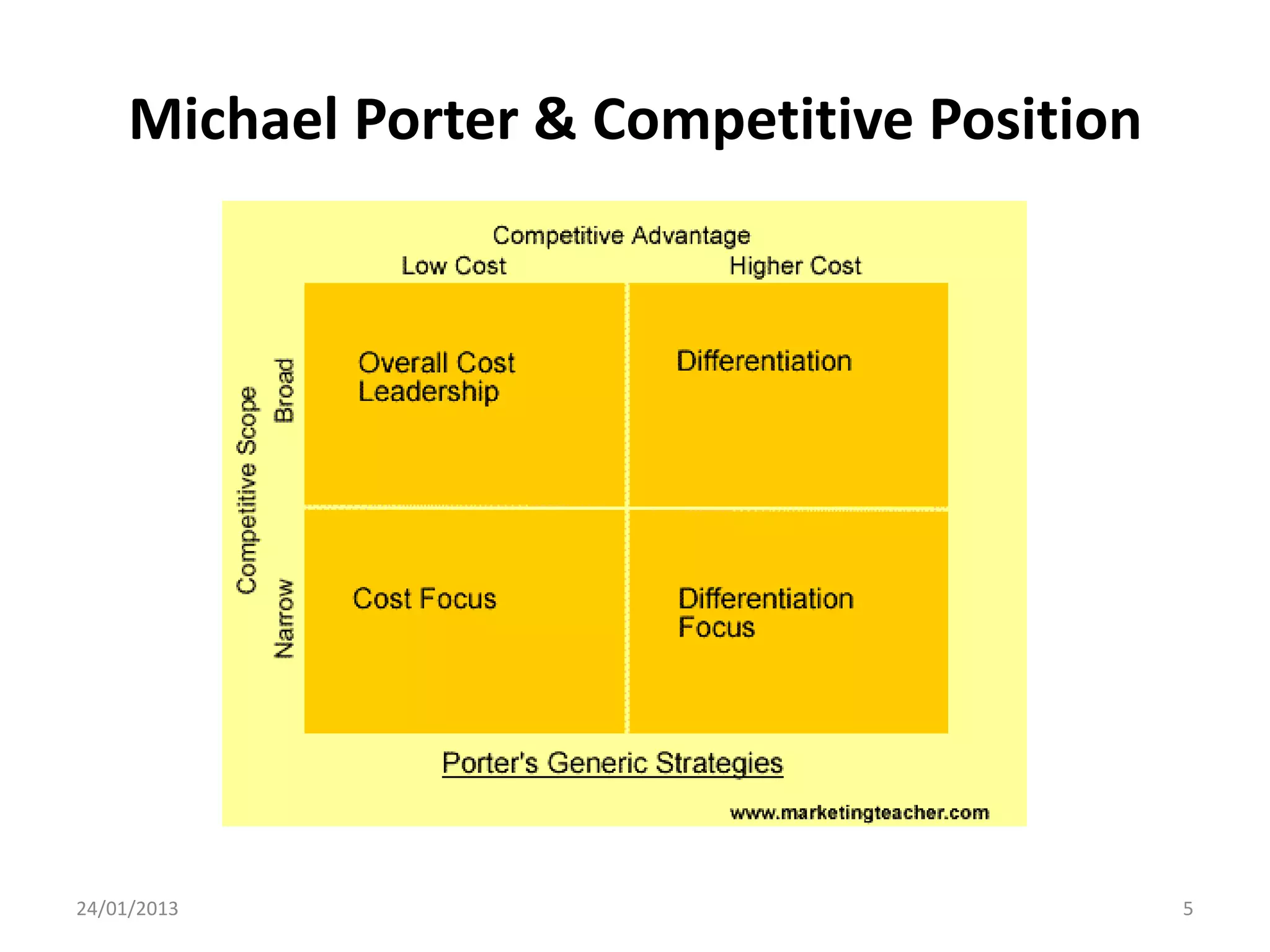
Michael Porter & Competitive Position


24/01/2013                                   5
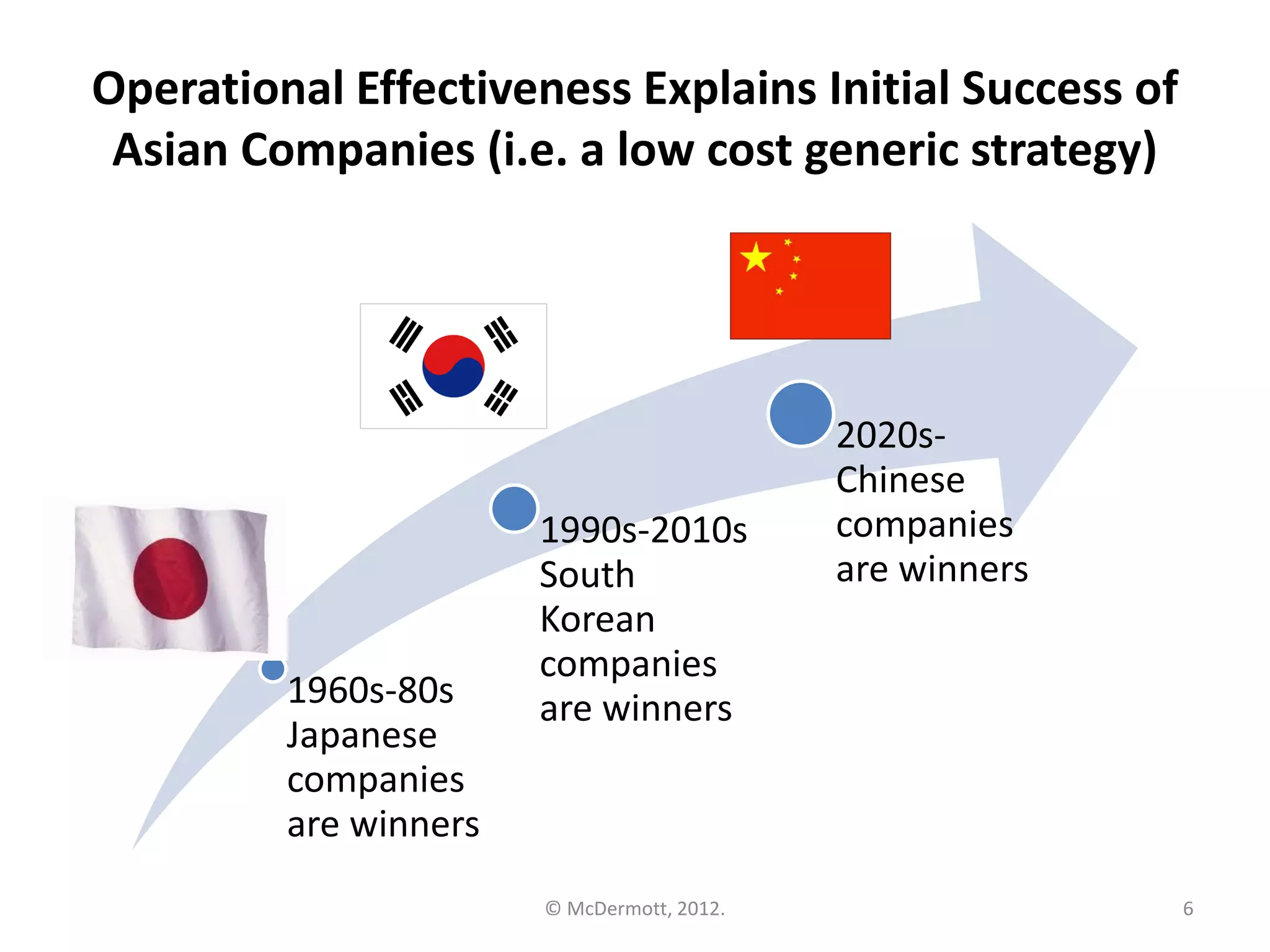
Operational Effectiveness Explains Initial Success of
 Asian Companies (i.e. a low cost generic strategy)


                                            2020s-
                                            Chinese
                       1990s-2010s          companies
                       South                are winners
                       Korean
                       companies
         1960s-80s     are winners
         Japanese
         companies
         are winners
                       © McDermott, 2012.                 6
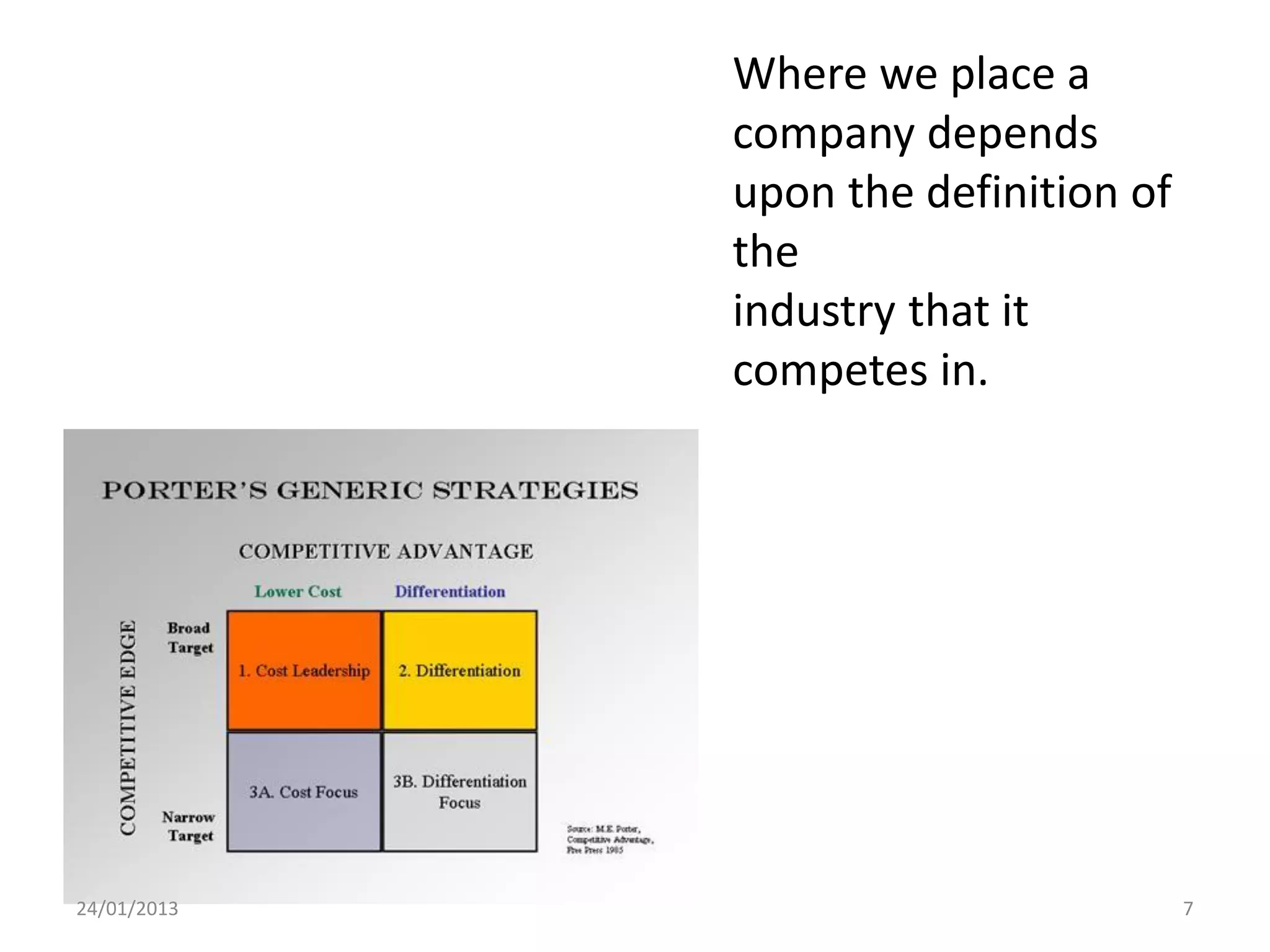
Where we place a
             company depends
             upon the definition of
             the
             industry that it
             competes in.


24/01/2013                            7
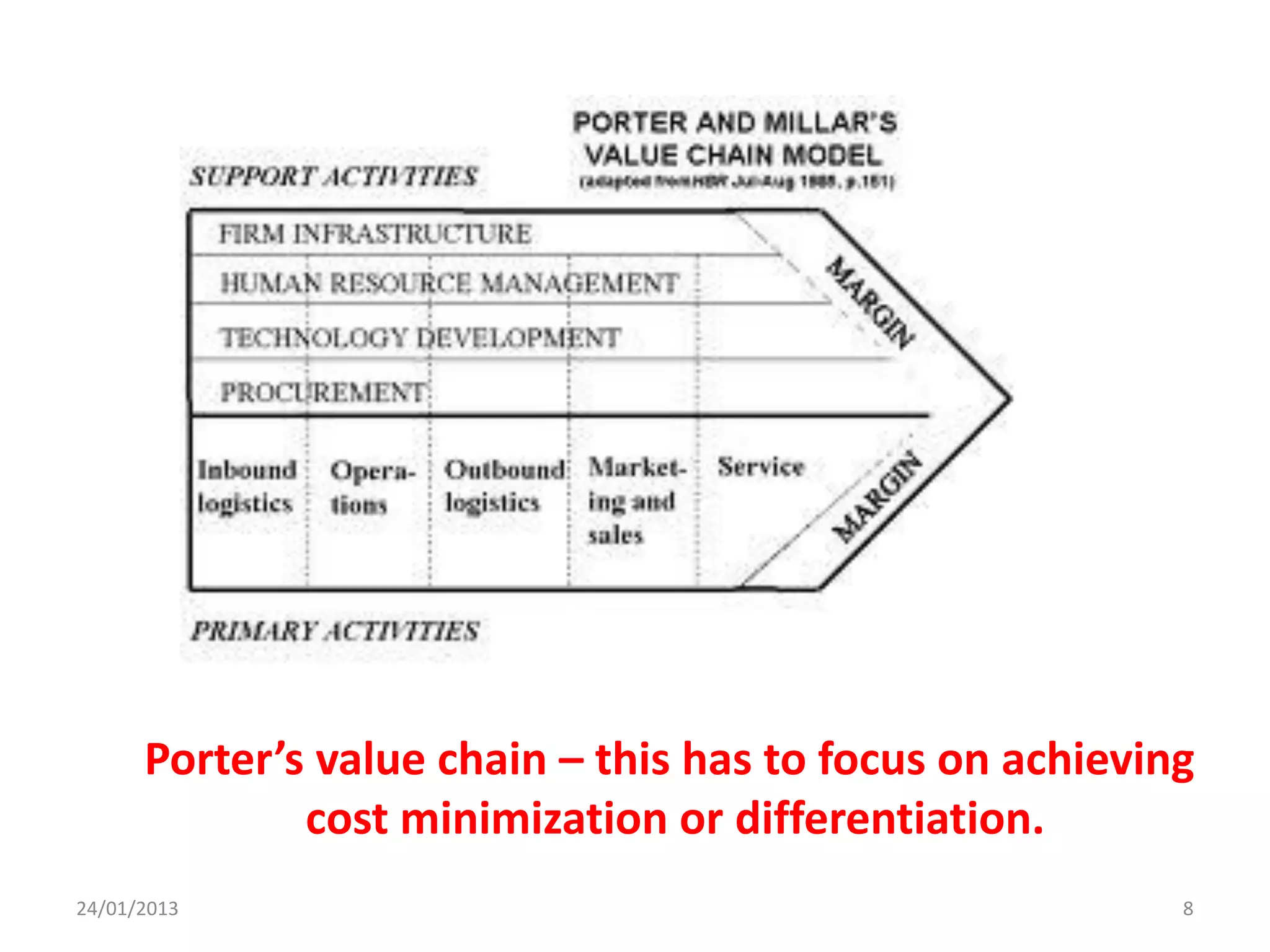
Porter’s value chain – this has to focus on achieving
              cost minimization or differentiation.
24/01/2013                                                8
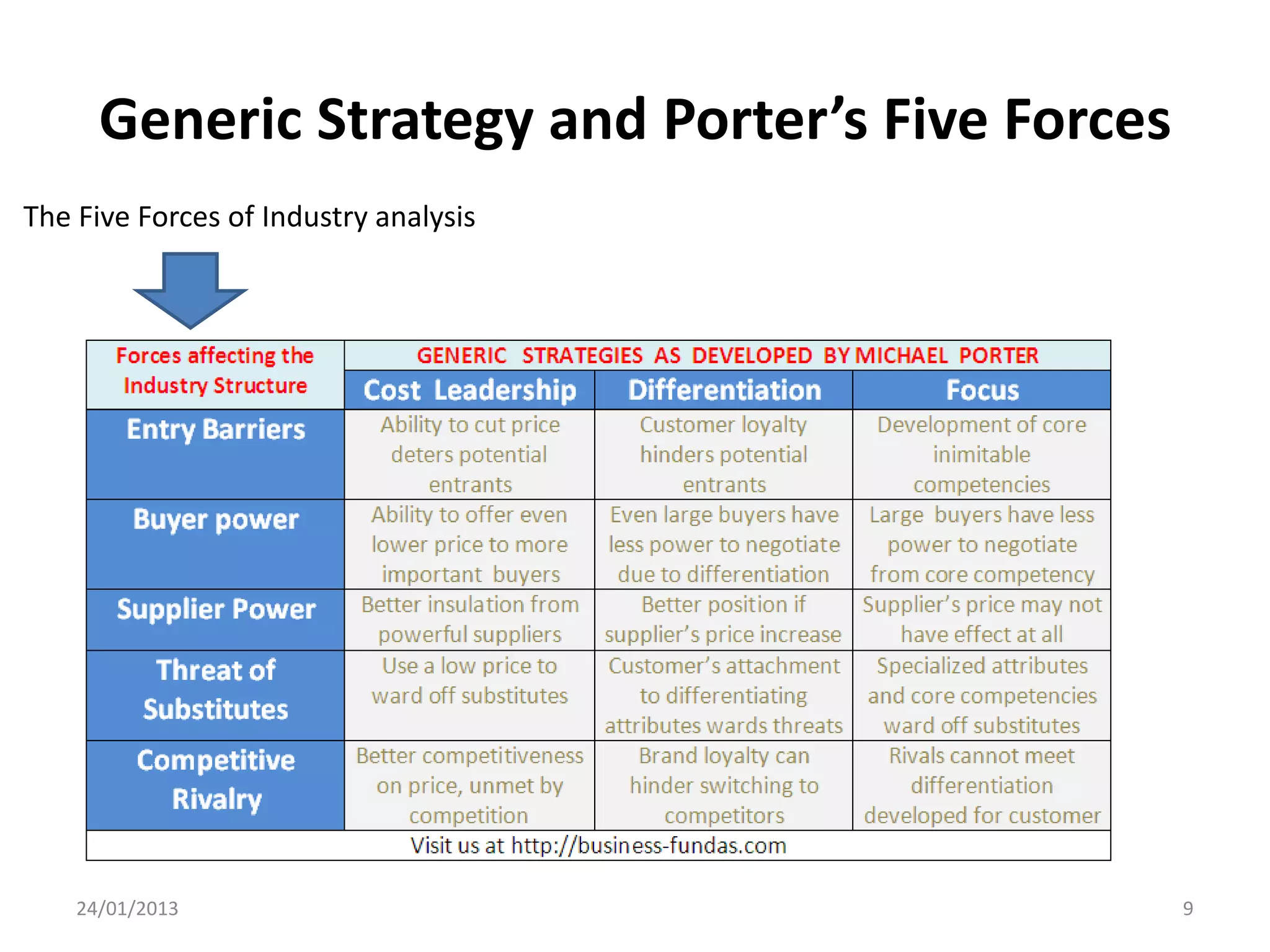
Generic Strategy and Porter’s Five Forces
The Five Forces of Industry analysis


    24/01/2013                                    9
24/01/2013   10
24/01/2013   11
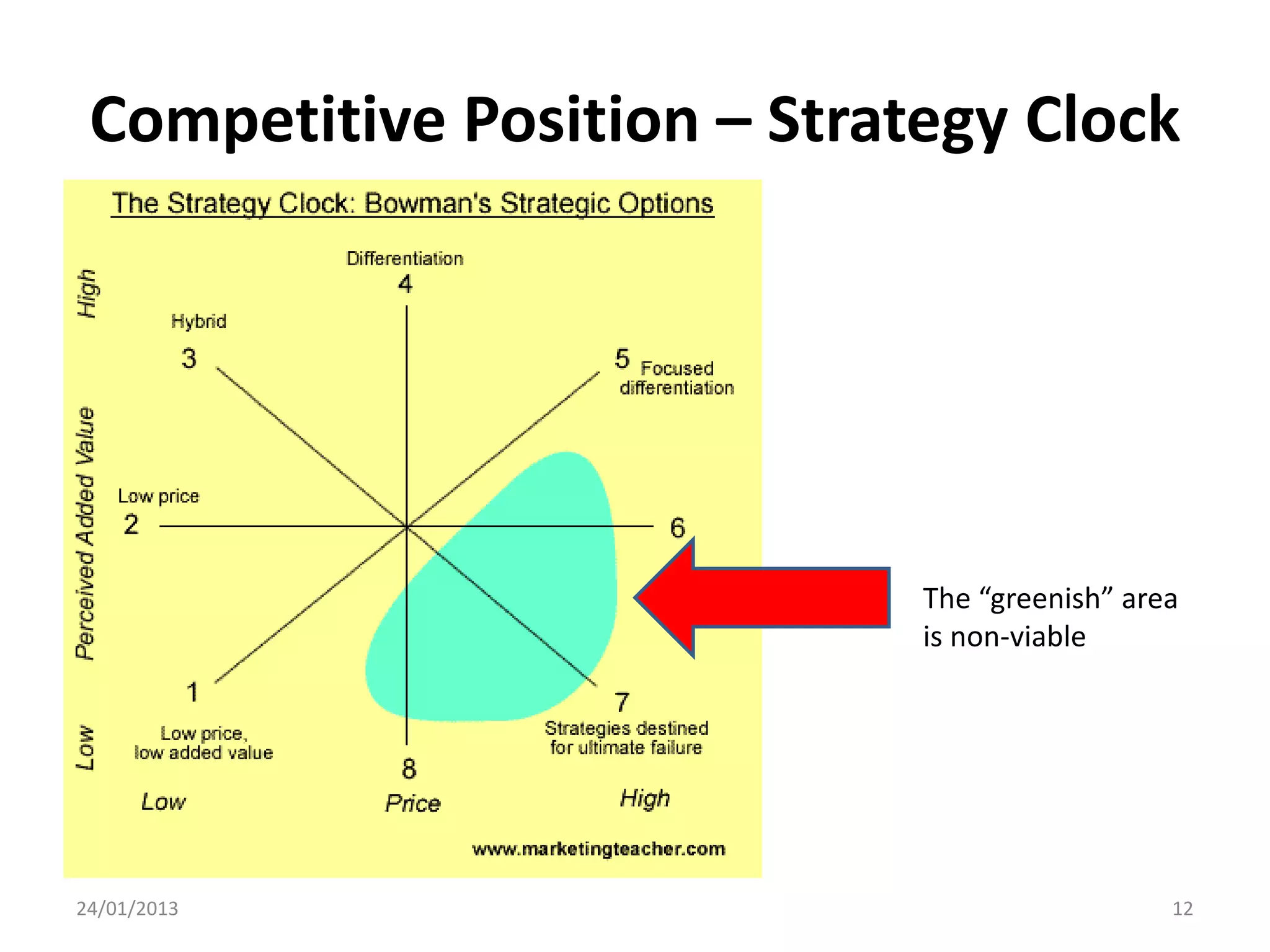
Competitive Position – Strategy Clock


                             The “greenish” area
                             is non-viable


24/01/2013                                     12
2. Blue Ocean Strategy


24/01/2013                            13
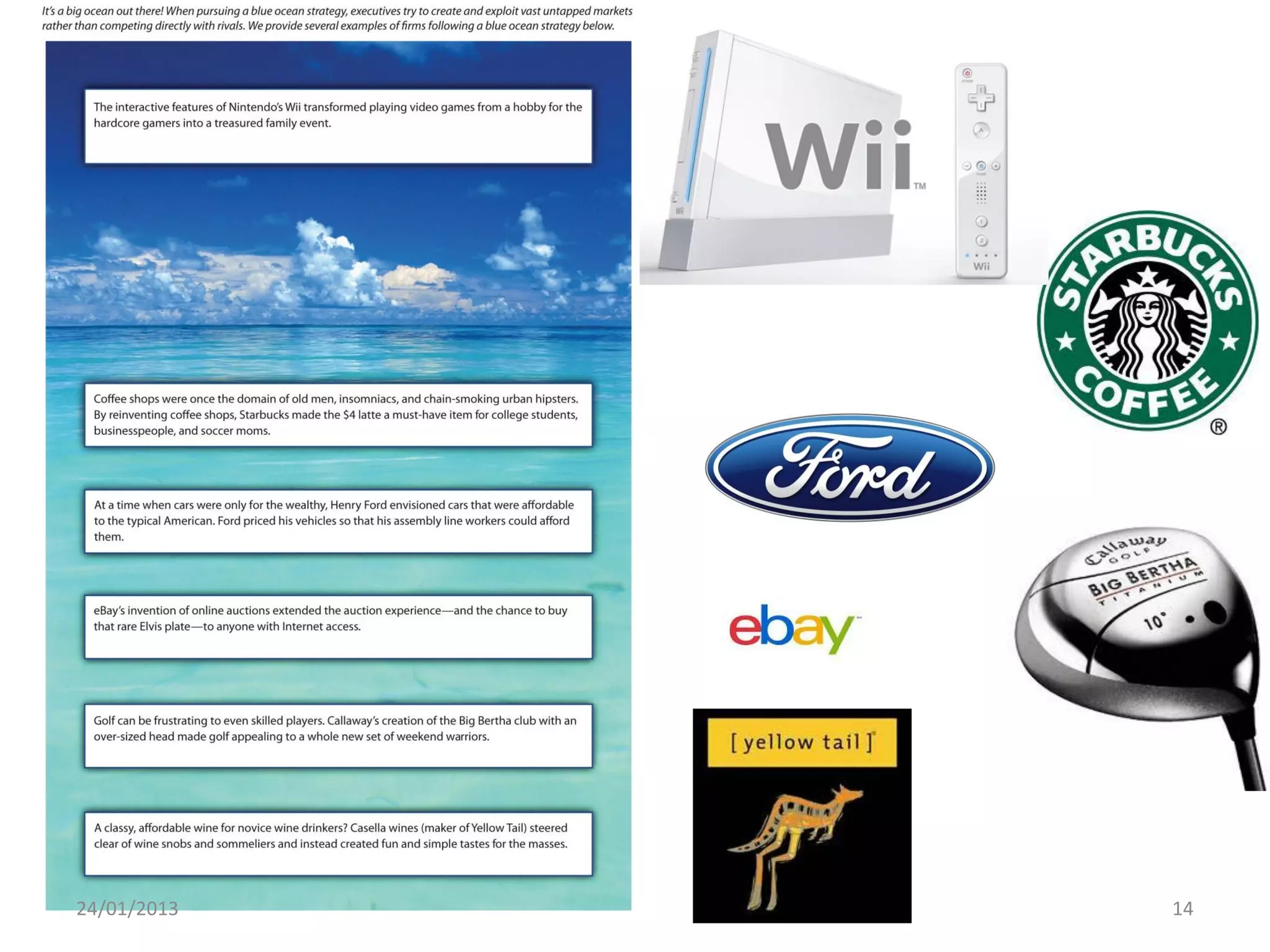
24/01/2013   14
24/01/2013   15
24/01/2013   16
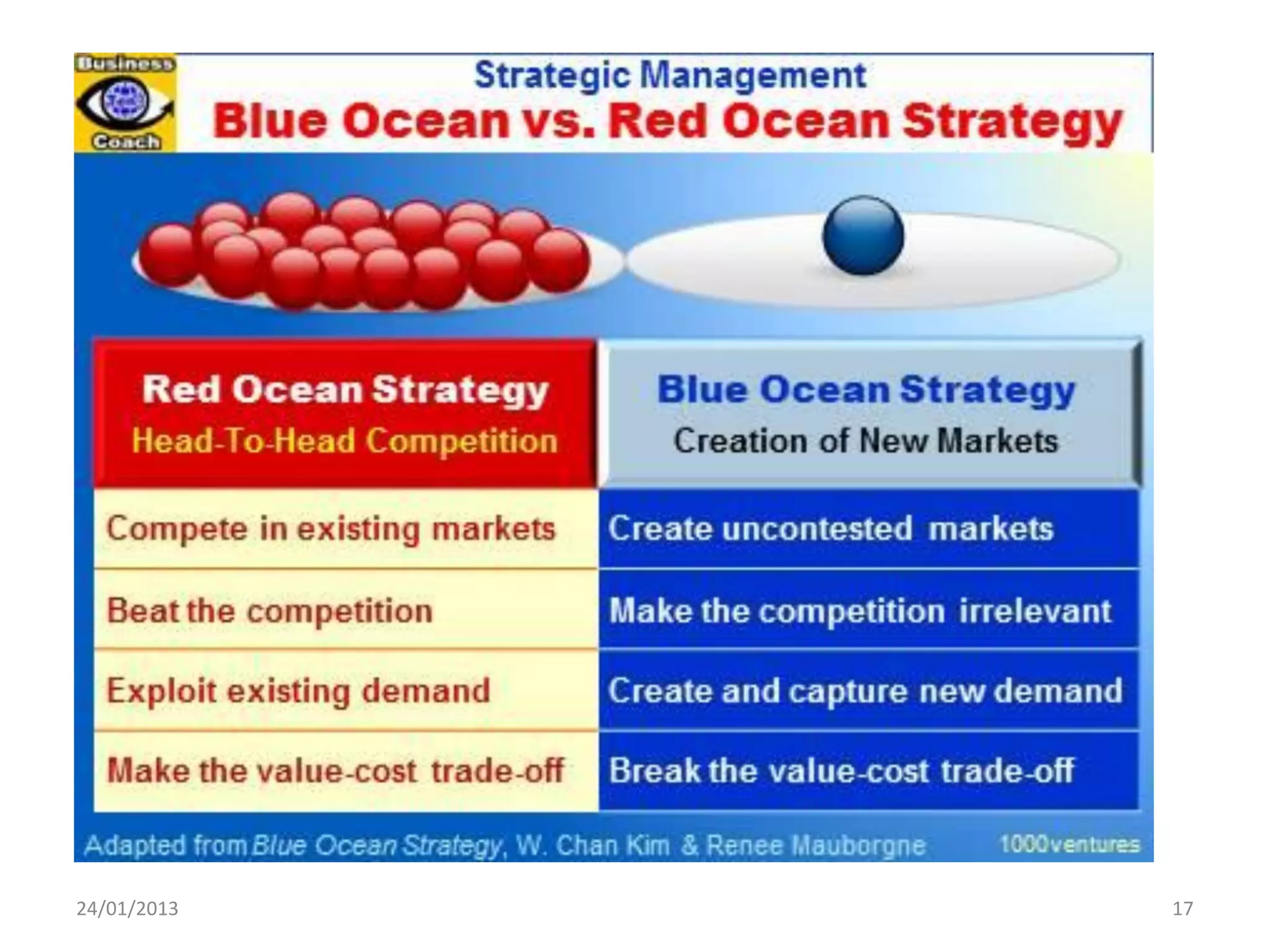
24/01/2013   17
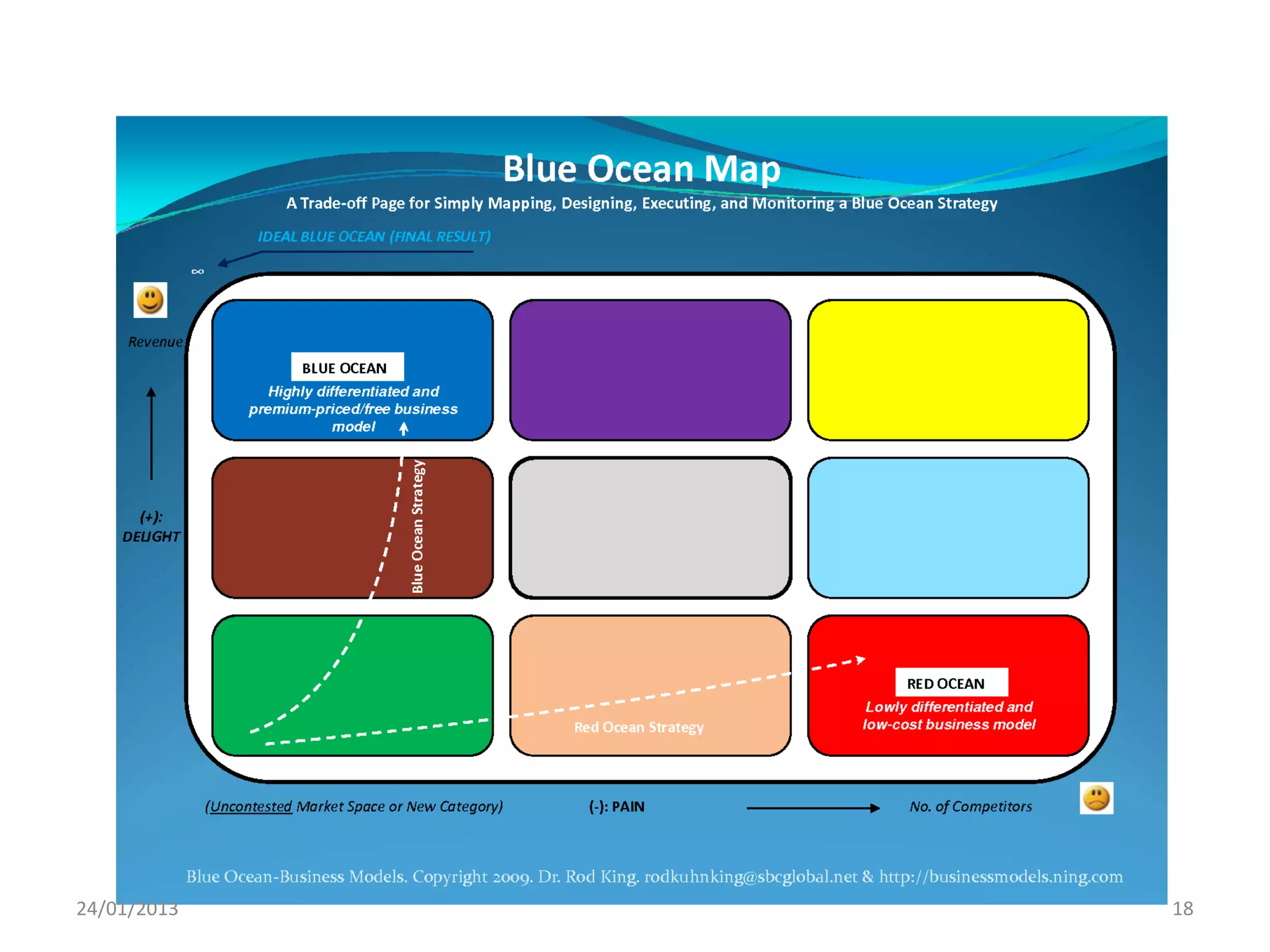
24/01/2013   18
24/01/2013   19
24/01/2013   20
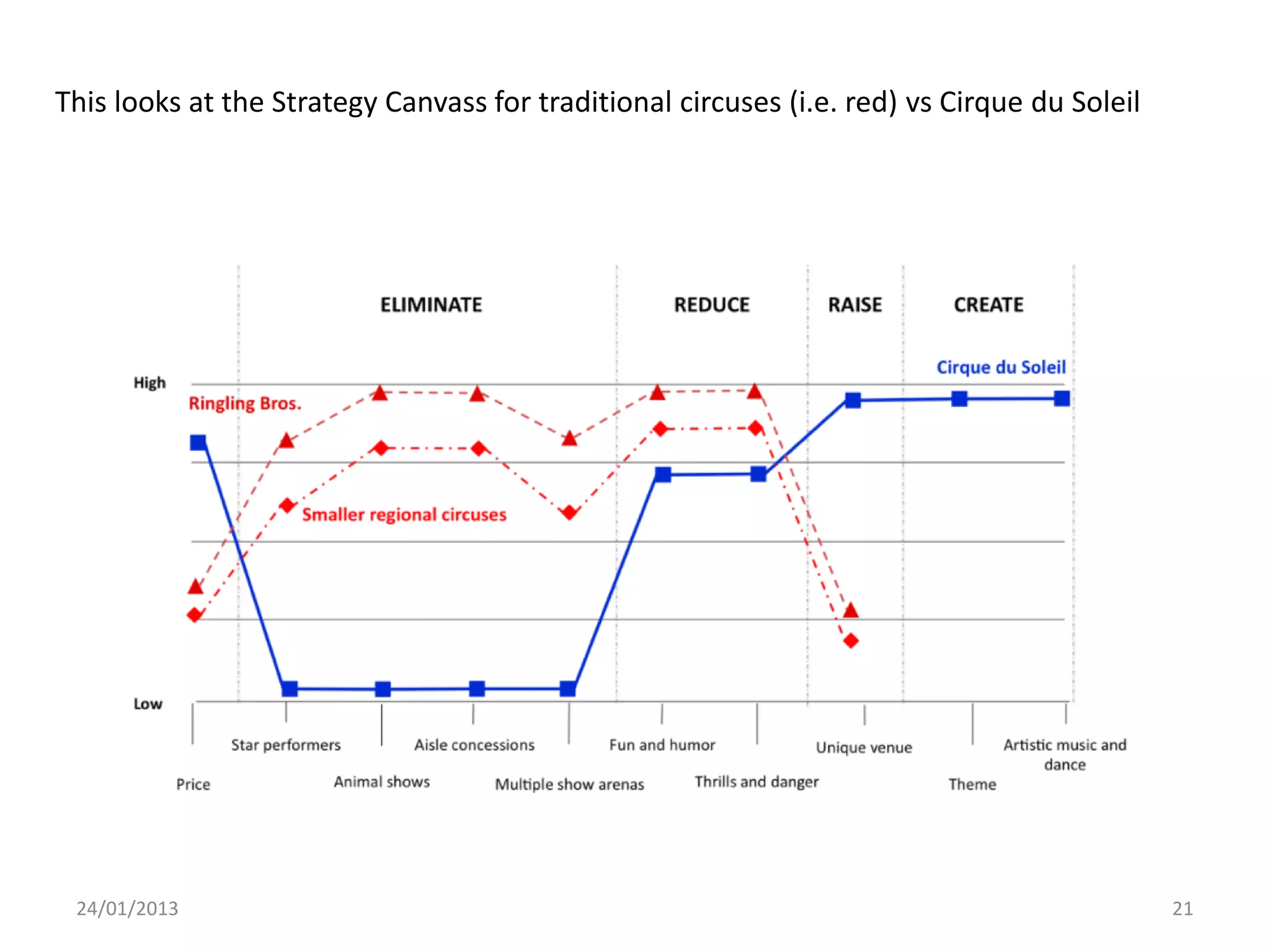
This looks at the Strategy Canvass for traditional circuses (i.e. red) vs Cirque du Soleil


 24/01/2013                                                                                  21
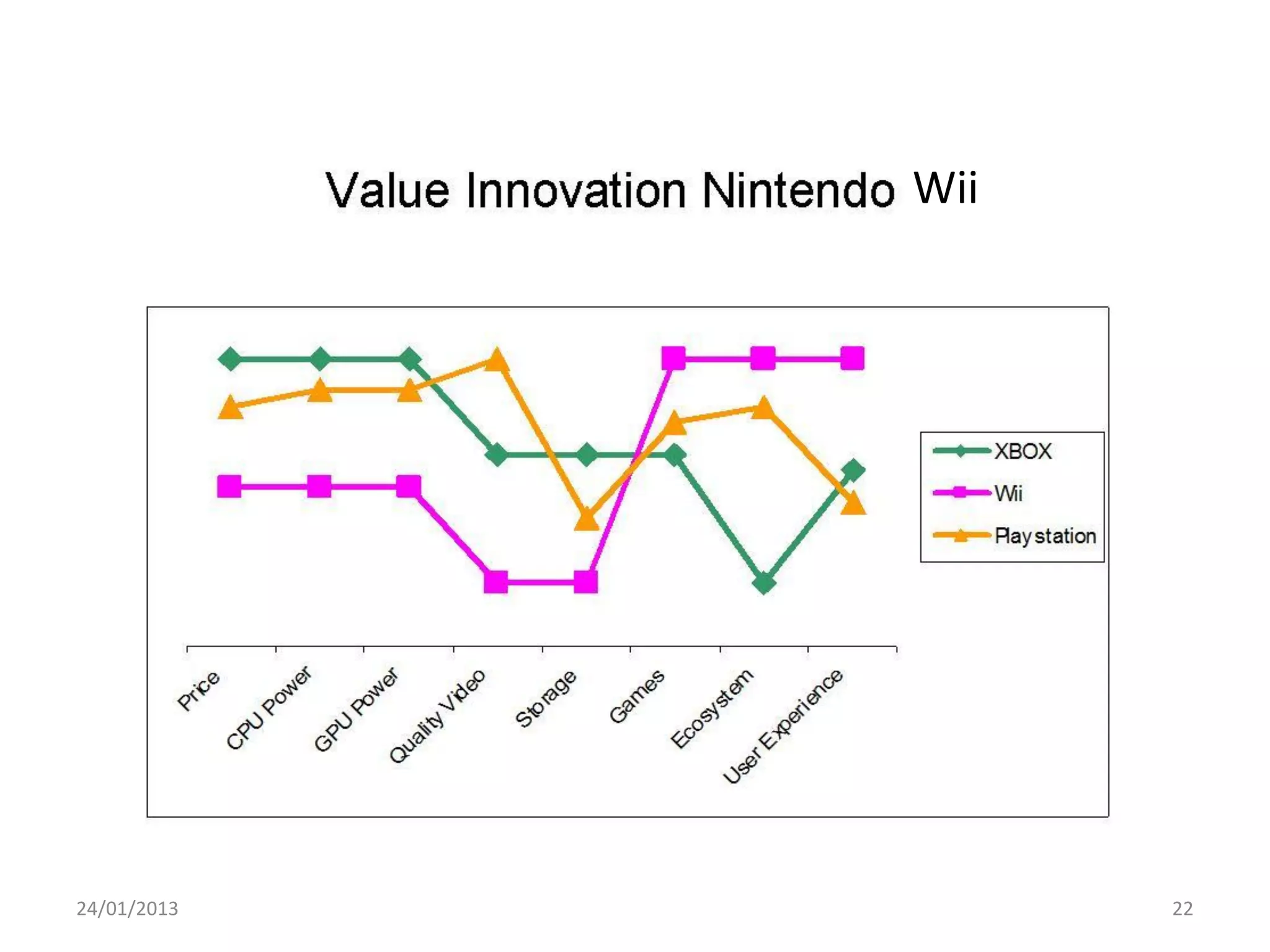
Wii


24/01/2013         22
24/01/2013   23
24/01/2013   24
24/01/2013   25
24/01/2013   26
Rumelt on Strategy


24/01/2013                        27
24/01/2013   28
24/01/2013   29
24/01/2013   30
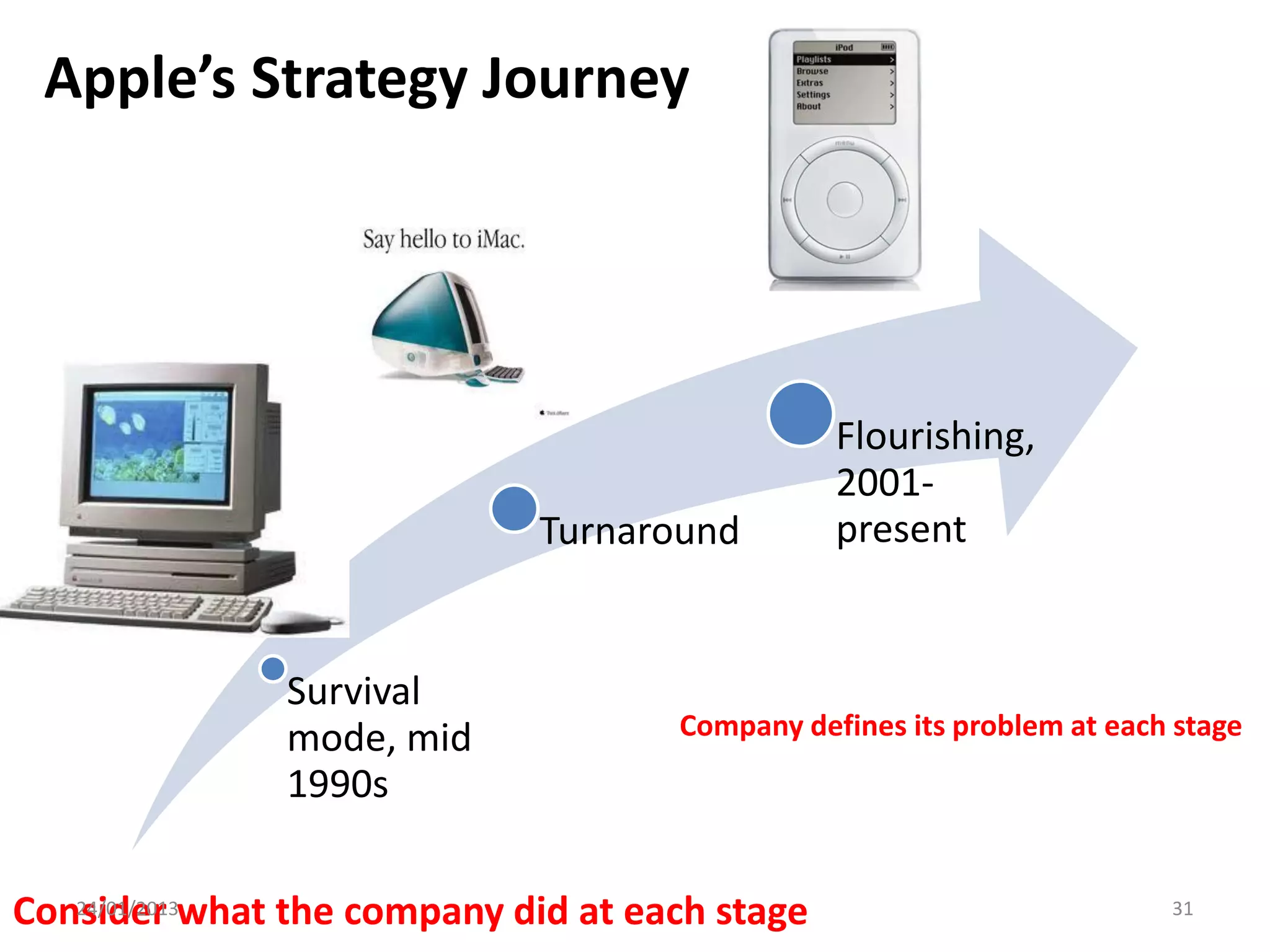
Apple’s Strategy Journey


                                               Flourishing,
                                               2001-
                            Turnaround         present


              Survival
              mode, mid             Company defines its problem at each stage
              1990s


Consider what the company did at each stage
   24/01/2013                                                          31
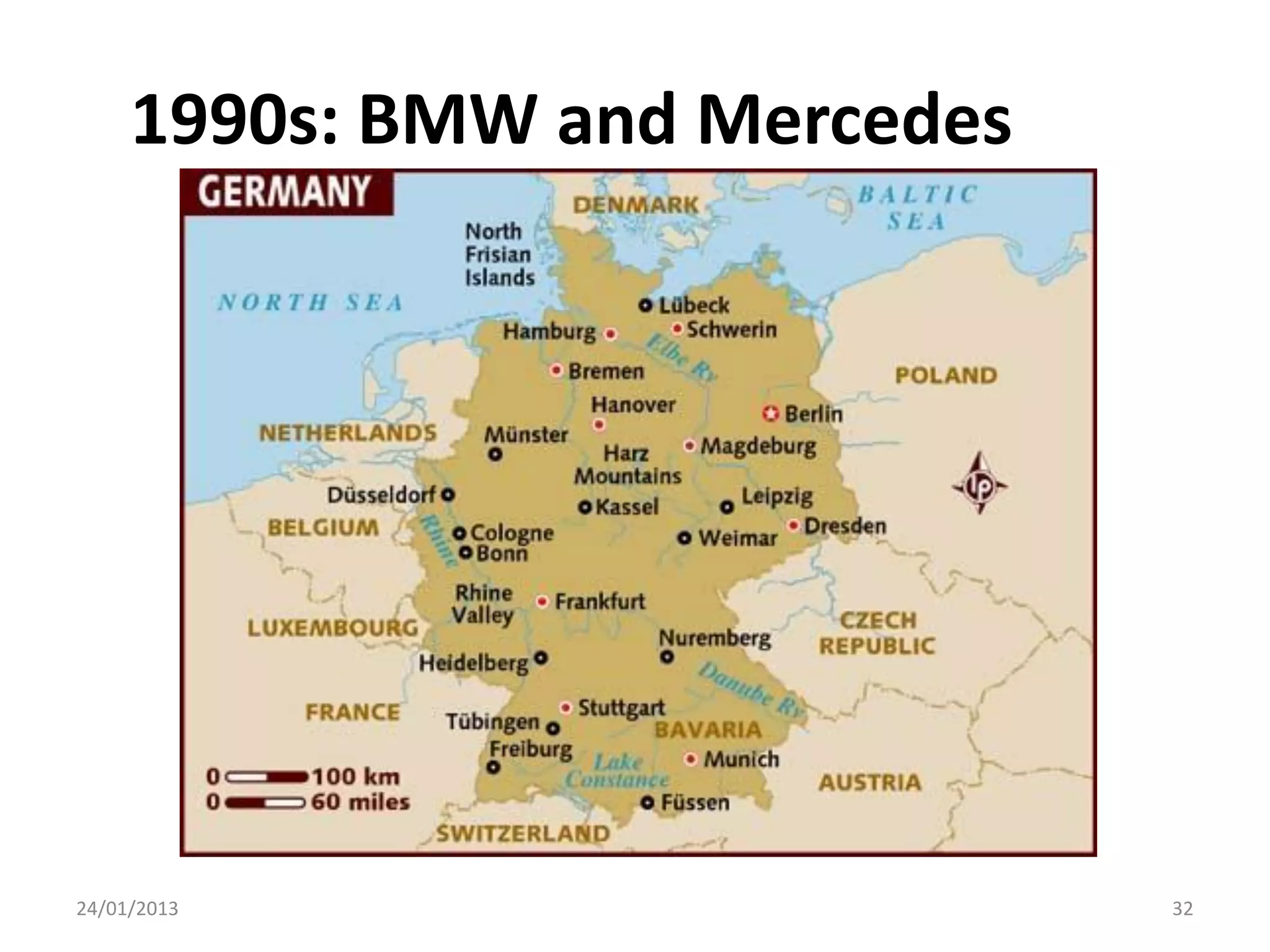
1990s: BMW and Mercedes


24/01/2013                     32
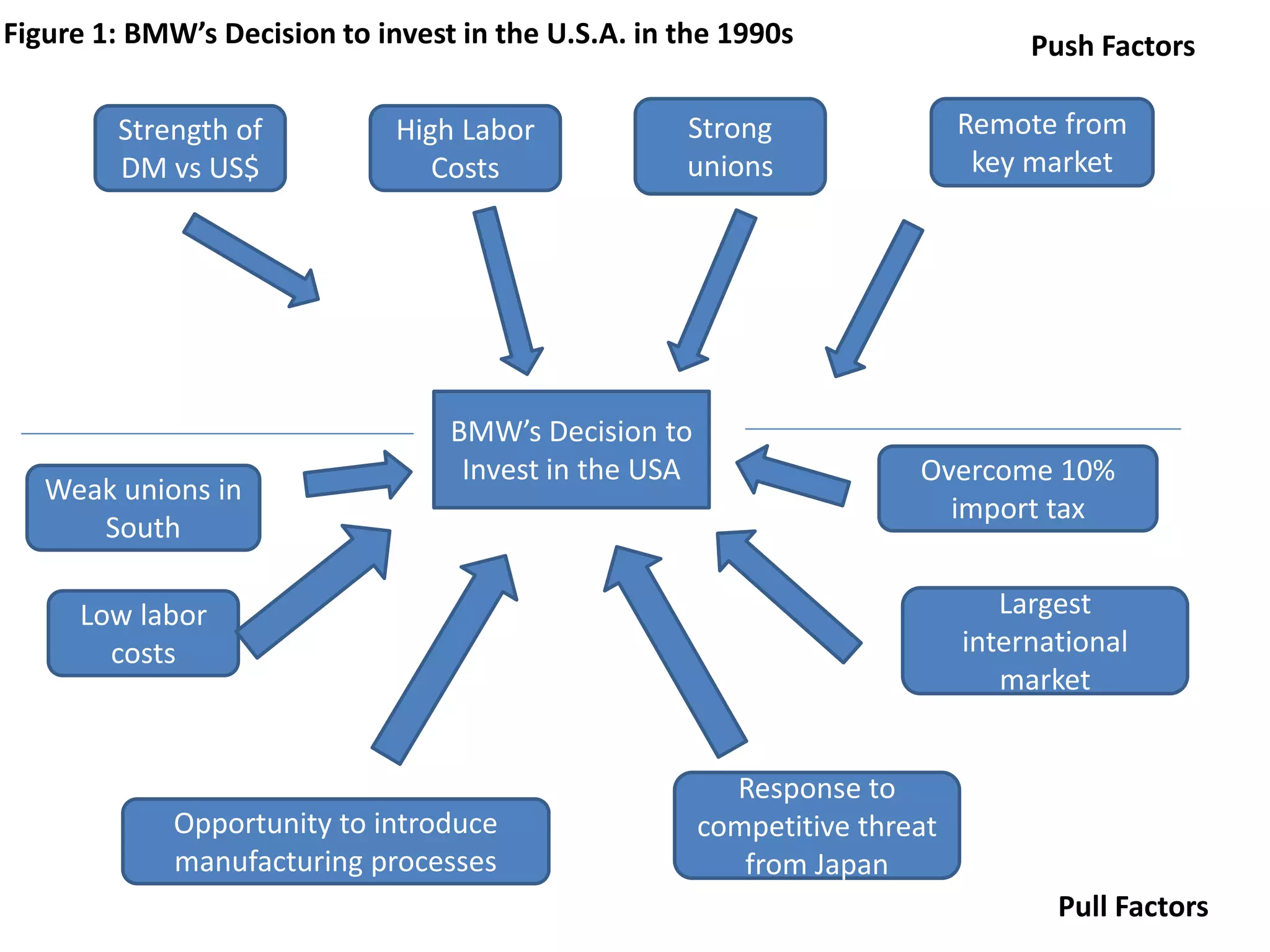
Figure 1: BMW’s Decision to invest in the U.S.A. in the 1990s                    Push Factors

        Strength of           High Labor            Strong                  Remote from
        DM vs US$                Costs              unions                   key market


                                  BMW’s Decision to
                                   Invest in the USA                   Overcome 10%
   Weak unions in
                                                                         import tax
      South

     Low labor                                                                 Largest
       costs                                                                international
                                                                               market


                                                         Response to
             Opportunity to introduce                  competitive threat
             manufacturing processes                      from Japan
                                                                                   Pull Factors
What’s the “Big problem” facing these
                         companies?


24/01/2013                                           34
Moneyball (2011)


24/01/2013                      35
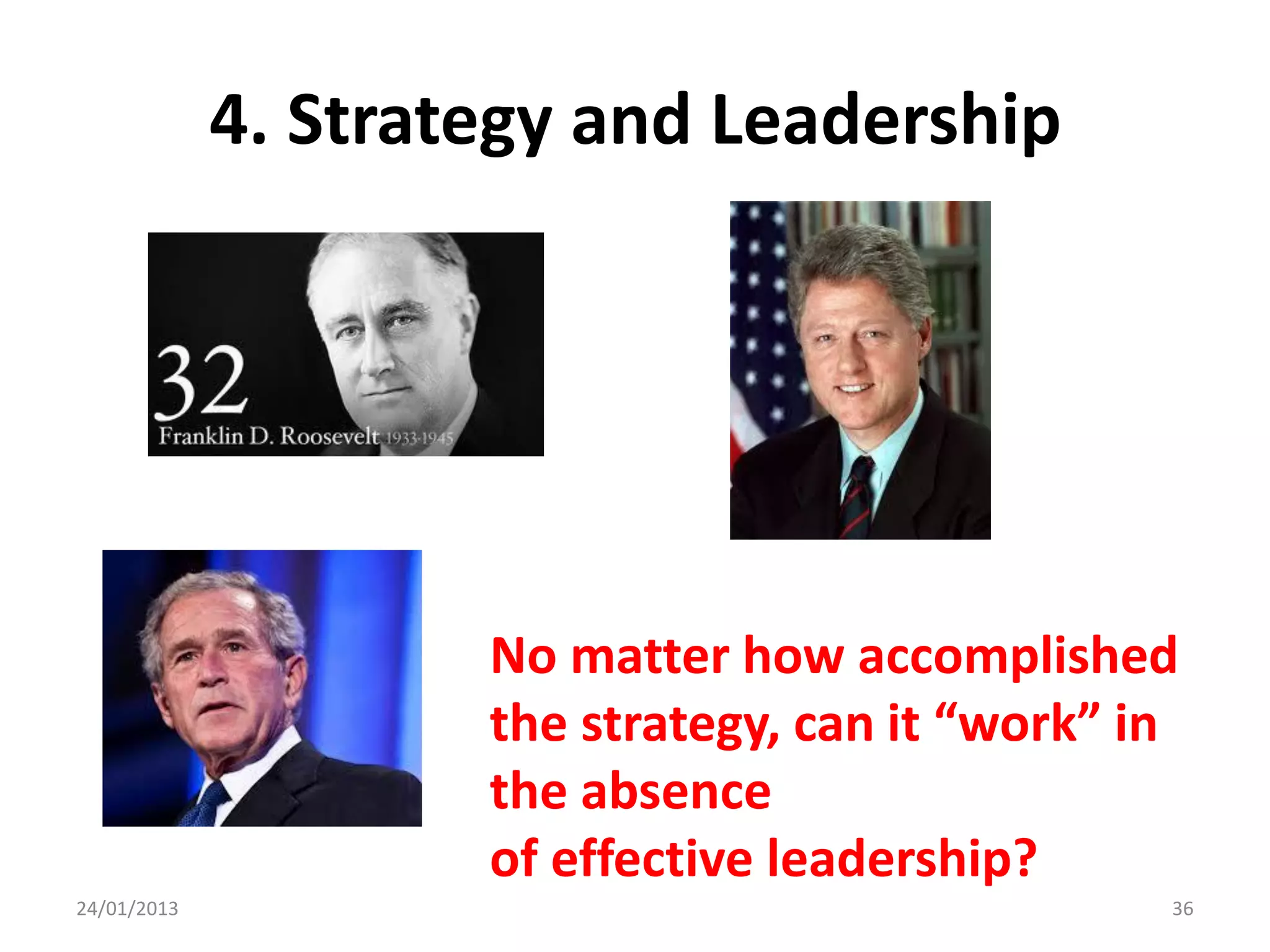
4. Strategy and Leadership


                     No matter how accomplished
                     the strategy, can it “work” in
                     the absence
                     of effective leadership?
24/01/2013                                        36
24/01/2013   37
24/01/2013   38
The Role of the Strategist
• To find and examine all the evidence to
  determine the problem
      – It’s vital to be able to ask the right questions
      – If you do not ask the right questions, then you
        cannot find the right answer
• To design a solution


24/01/2013                                                 39
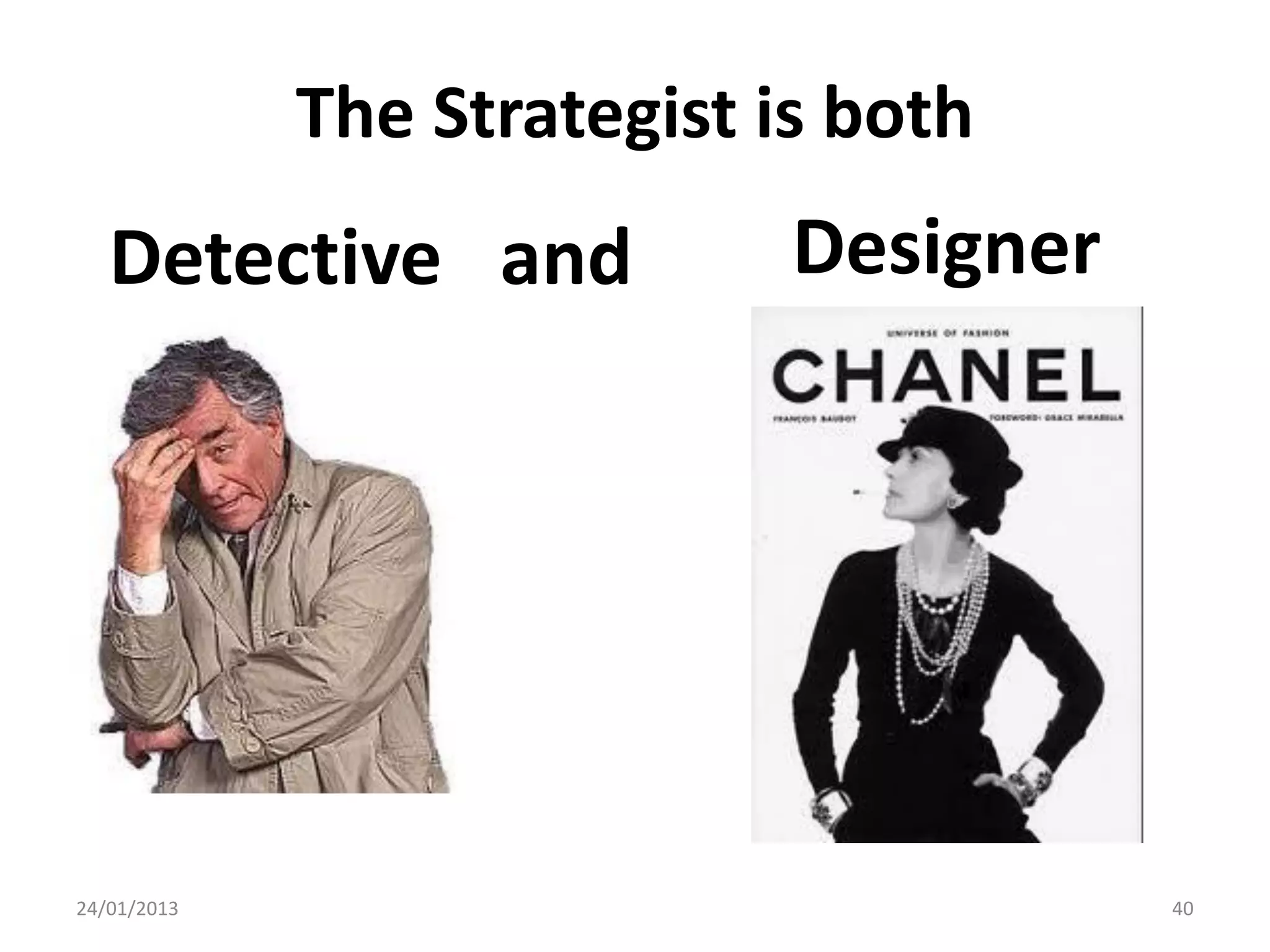
The Strategist is both
   Detective and             Designer


24/01/2013                              40
Strategy at the Corporate Level
• A blurring of competitive position is clearly a
  problem

• This causes rampant confusion internally and
  externally

• So establish an unambiguous competitive
  position
24/01/2013                                          41
Strategy at the Corporate Level
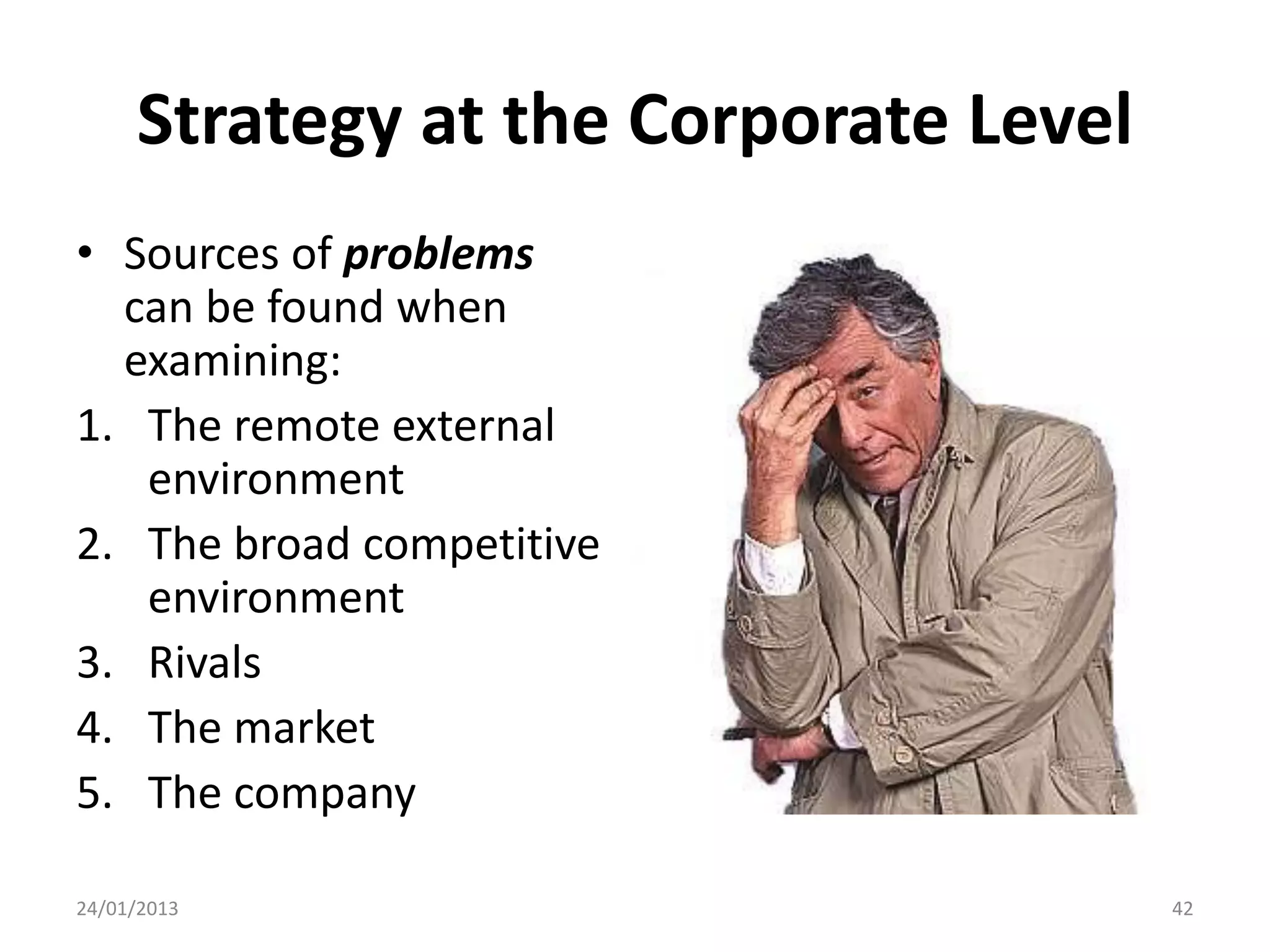
• Sources of problems
  can be found when
  examining:
1. The remote external
   environment
2. The broad competitive
   environment
3. Rivals
4. The market
5. The company

24/01/2013                             42
The Strategy Detective’s Tools:
               The External Environment
      The External
                       • PEST or PESTEL analysis
        Remote         • Political, Economic, Social, Technological
      Environment

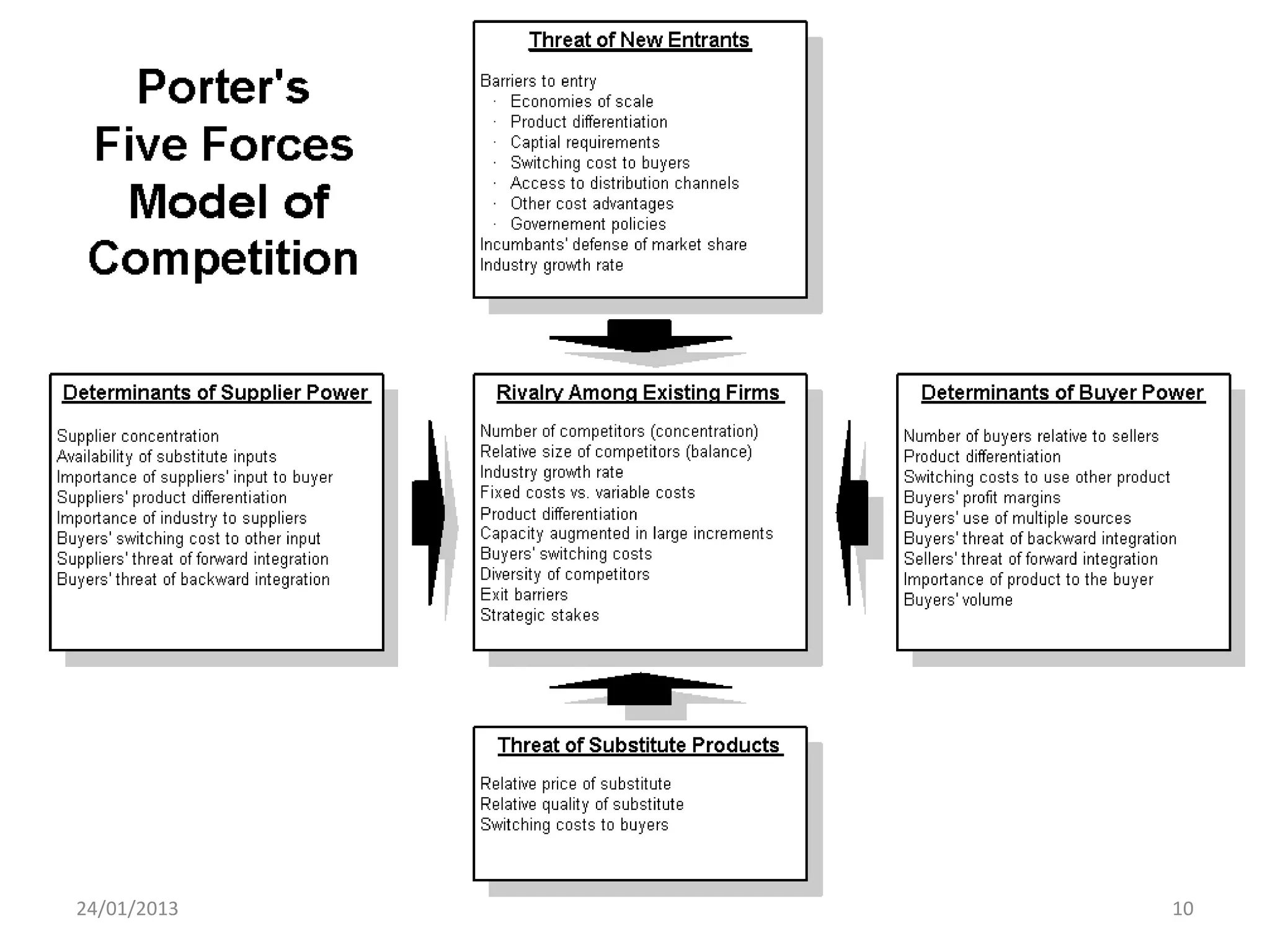
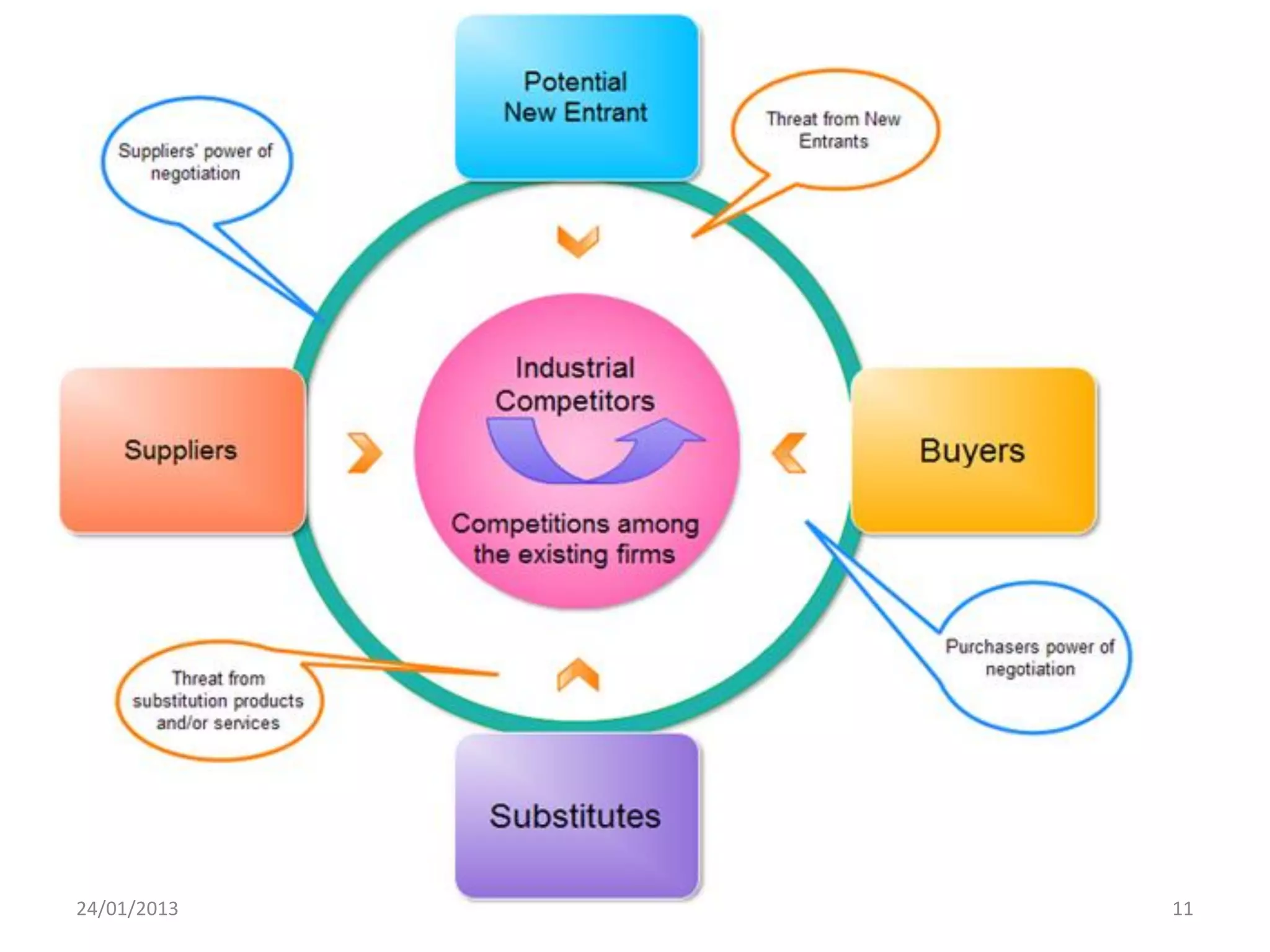
       The Broad       • Porter’s Industry Analysis Five Forces Model
      Competitive      • Industry Life Cycle
                       • Company analysis (see section on internal analysis)
      Environment

                       • Market Segmentation
       The Market      • Customer Relationships
                       • Product Life Cycle


24/01/2013                                                                     43
The Strategy Detective’s Tools:
               The Internal Environment

               •Core competencies;
  The Internal
               •Porter’s Value Chain;
  Environment   Functional Analysis;
                BCG Matrix; Ansoff’s
                Matrix

24/01/2013                                     44
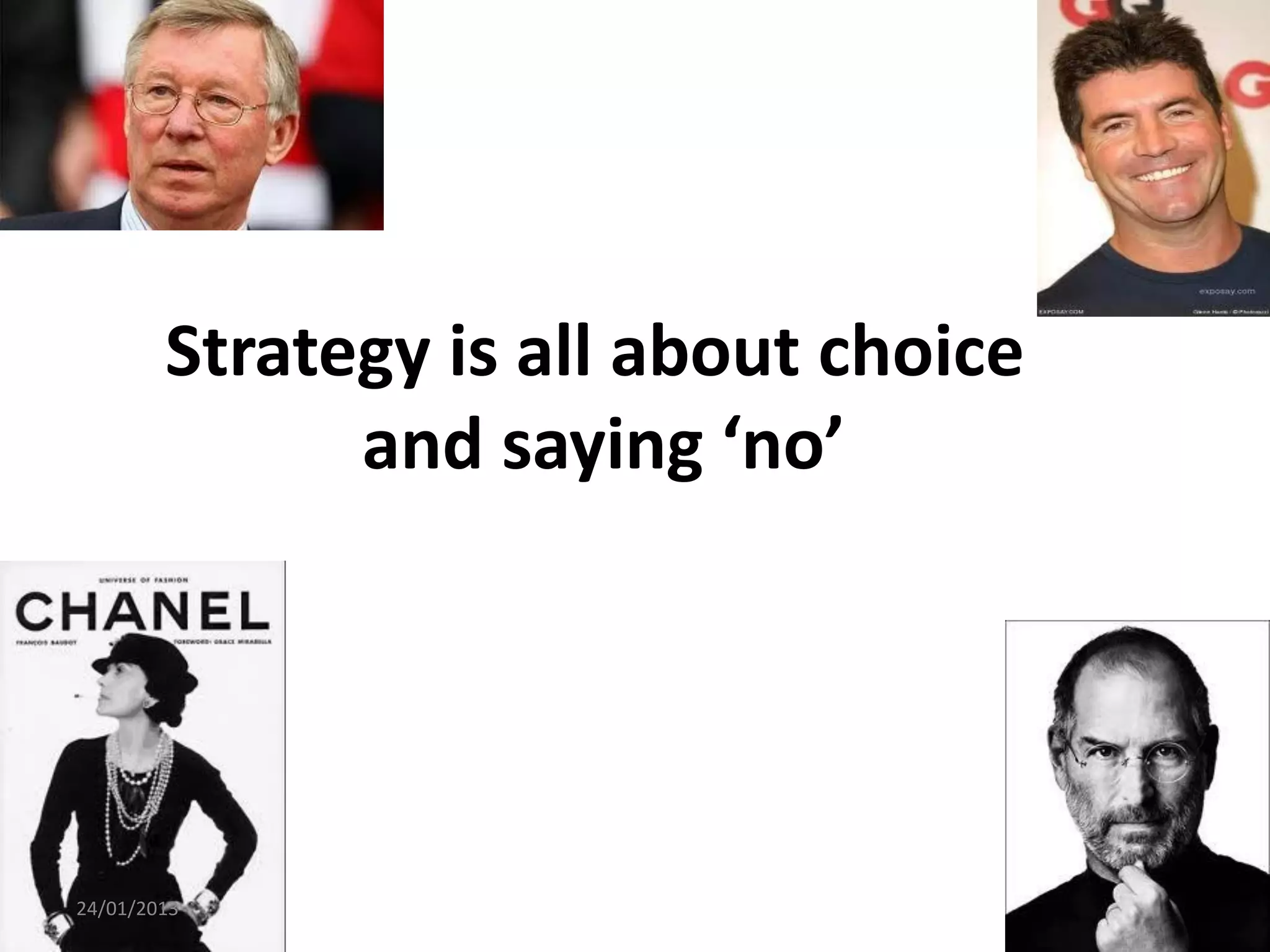
Strategy is all about choice
              and saying ‘no’


24/01/2013                             45
What is a Strategist?
• A decision-maker?
      – Look at options and pick ‘the best’


• Or a designer?
• Yes, he/she designs a novel response


24/01/2013                                    46
The Strategy Designer


• You are allowed only one objective and it must be
  feasible

• What one single feasible objective, when
  accomplished, would make the biggest
  difference?

• Now design a strategy and make it happen.

24/01/2013                                        47
Leadership Casualties in 2012

• How many CEOs of US Fortune 500 companies
  were fired in 2012?
• How many coaches/managers in the NBA,
  NFL, English Premier League were sacked?
• How many incumbent politicians were
  defeated in the polls?
• Clearly employers believe that strategy and
  leadership are interconnected

24/01/2013                                   48
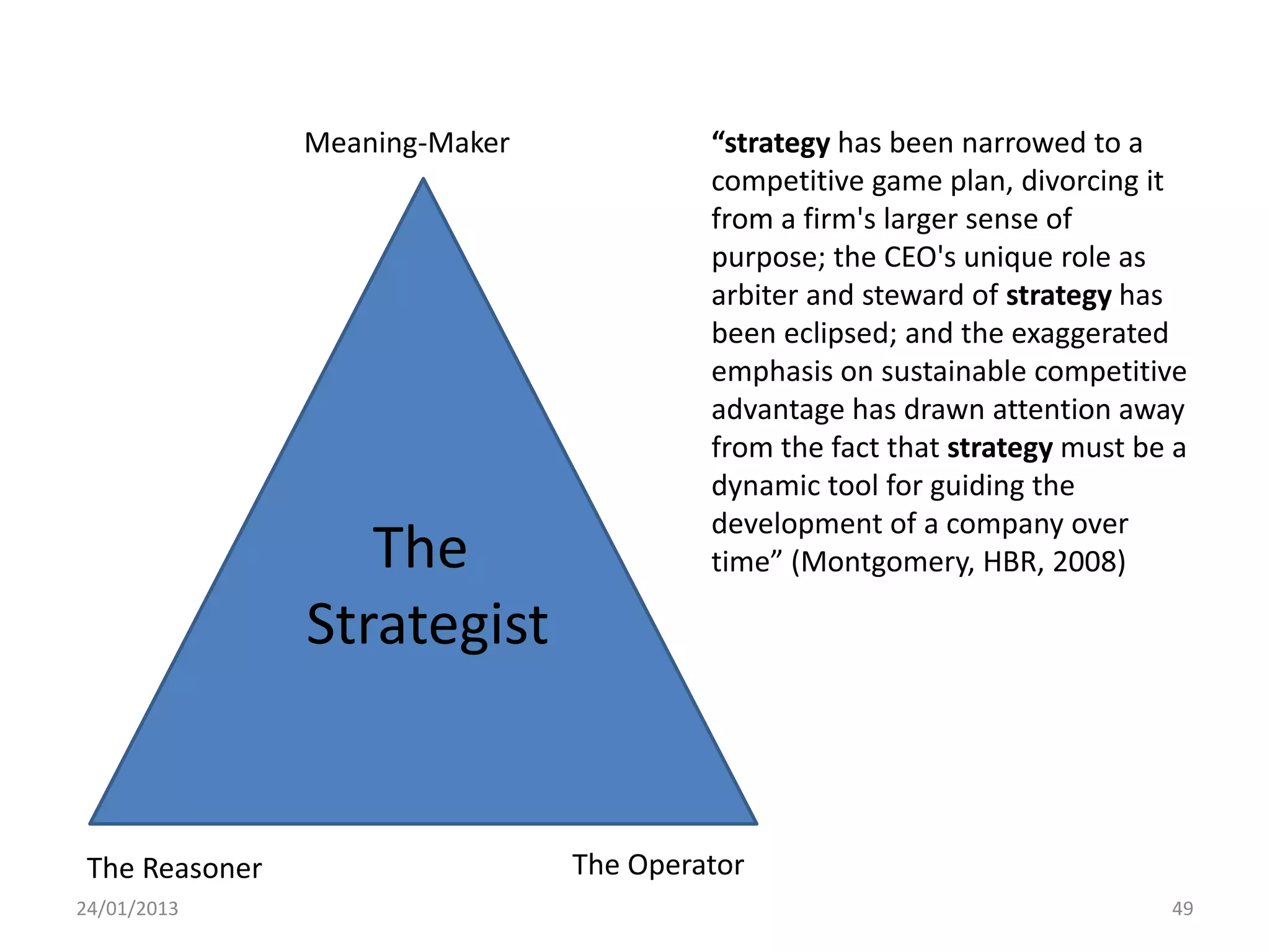
Meaning-Maker            “strategy has been narrowed to a
                                         competitive game plan, divorcing it
                                         from a firm's larger sense of
                                         purpose; the CEO's unique role as
                                         arbiter and steward of strategy has
                                         been eclipsed; and the exaggerated
                                         emphasis on sustainable competitive
                                         advantage has drawn attention away
                                         from the fact that strategy must be a
                                         dynamic tool for guiding the
                                         development of a company over
                   The                   time” (Montgomery, HBR, 2008)

                Strategist


 The Reasoner                   The Operator
24/01/2013                                                                  49
• If you ask young men what they want to accomplish by the time
  they are 40, the answers you get fall into two distinct categories.
  There are those - the great majority - who will respond in terms of
  what they want to have. This is especially true of graduate students
  of business administration. There are some men, however, who will
  answer in terms of the kind of men they hope to be. These are the
  only ones who have a clear idea of where they are going. The same
  is true of companies. For far too many companies, what little
  thinking goes on about the future is done primarily in money terms.
  There is nothing wrong with financial planning. Most companies
  should do more of it. But there is a basic fallacy in confusing a
  financial plan with thinking about the kind of company you want
  yours to become. It is like saying, "When I'm 40, I'm going to be
  rich." It leaves too many basic questions unanswered. Rich in what
  way? Rich doing what?


24/01/2013                                                          50
• Strategy and the Strategist In most popular
  portrayals the strategist's job would seem to be
  finished once a carefully articulated strategy has
  been made ready for implementation. The idea
  has been formed, the next steps specified, the
  problem solved. But don't be fooled. The job of
  the strategist never ends. No matter how
  compelling a strategy is, or how clearly defined, it
  is unlikely to be a sufficient guide for a firm that
  aspires to a long and prosperous life

24/01/2013                                           51
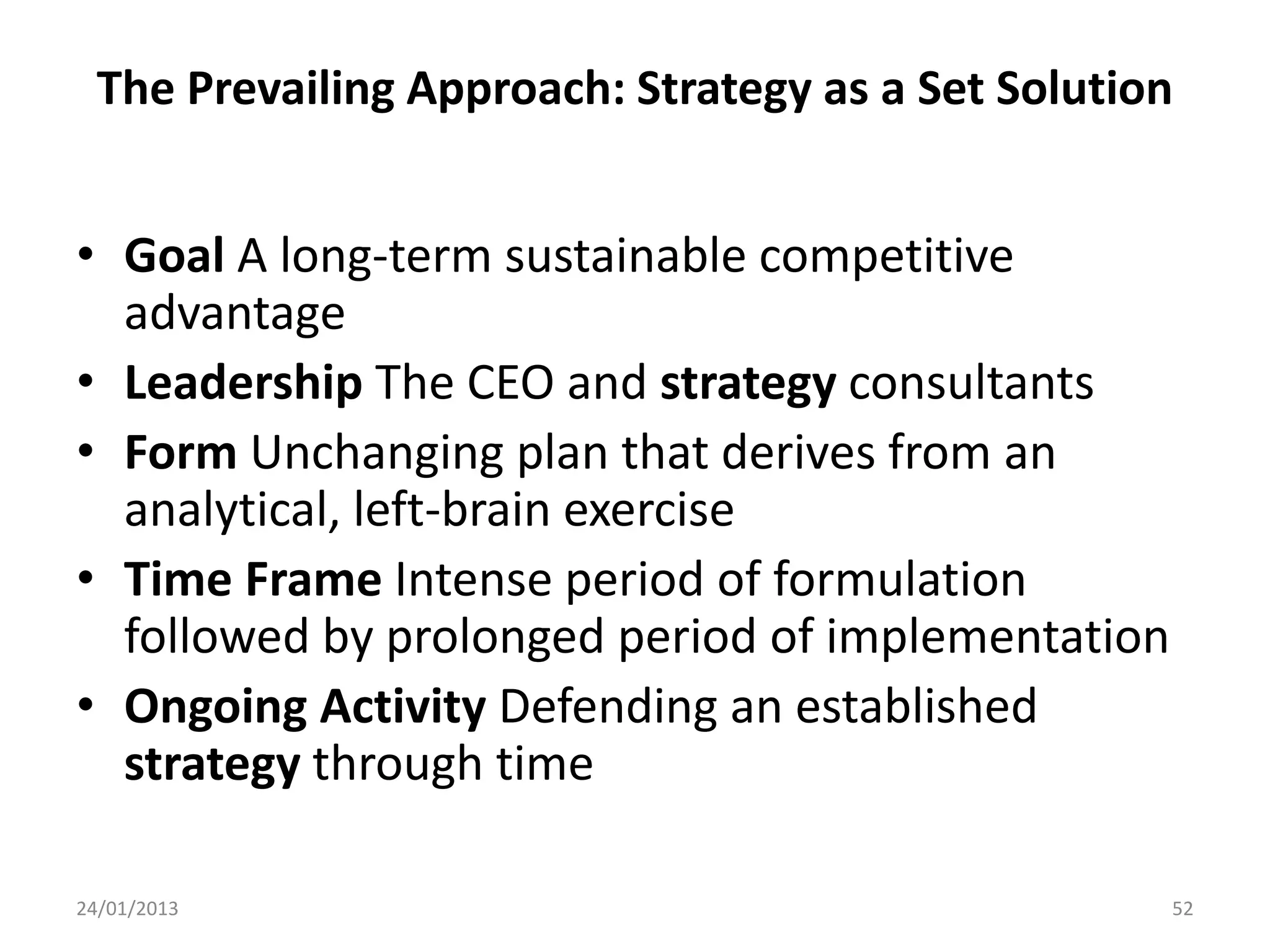
The Prevailing Approach: Strategy as a Set Solution


• Goal A long-term sustainable competitive
  advantage
• Leadership The CEO and strategy consultants
• Form Unchanging plan that derives from an
  analytical, left-brain exercise
• Time Frame Intense period of formulation
  followed by prolonged period of implementation
• Ongoing Activity Defending an established
  strategy through time

24/01/2013                                         52
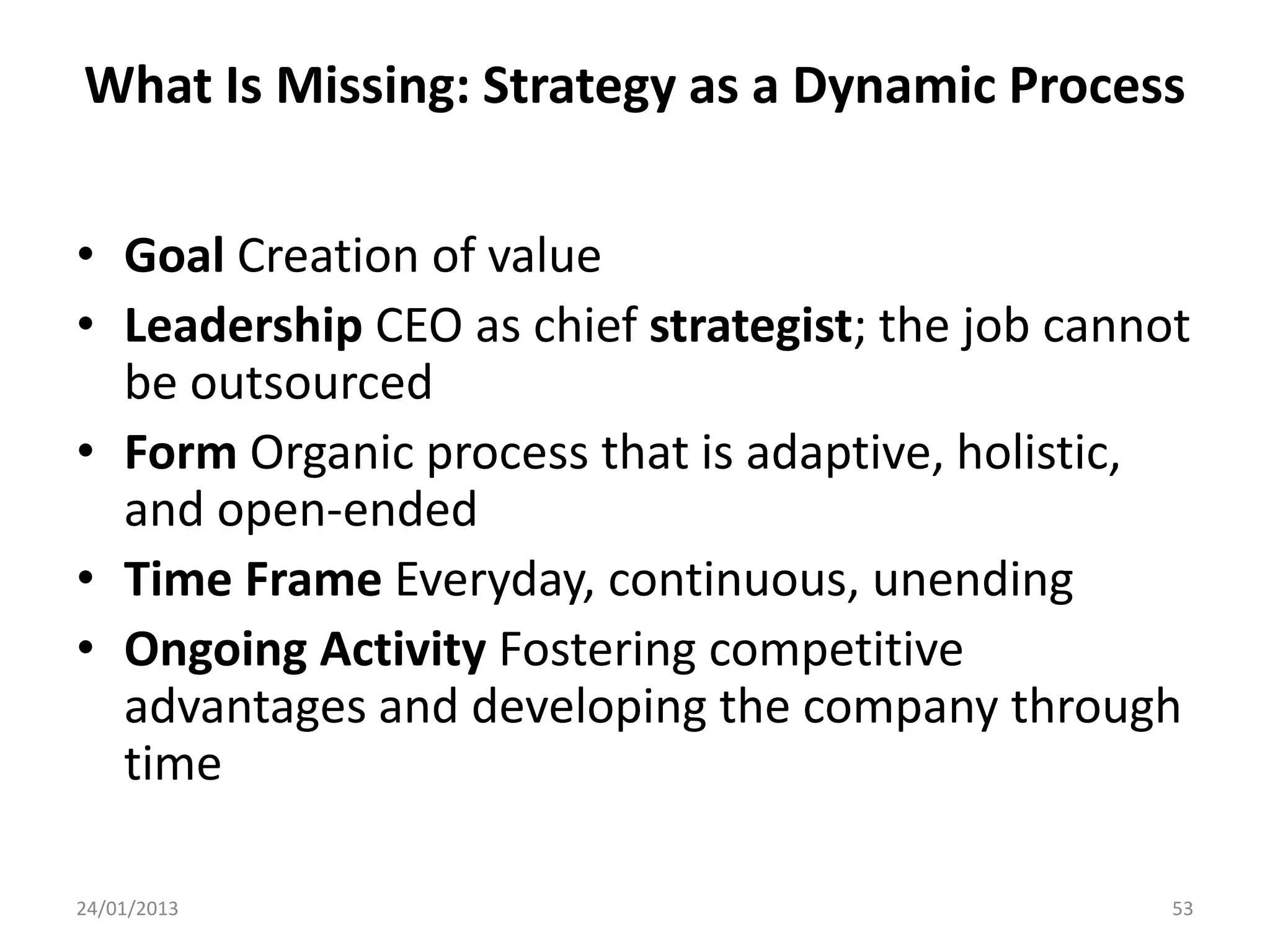
What Is Missing: Strategy as a Dynamic Process

• Goal Creation of value
• Leadership CEO as chief strategist; the job cannot
  be outsourced
• Form Organic process that is adaptive, holistic,
  and open-ended
• Time Frame Everyday, continuous, unending
• Ongoing Activity Fostering competitive
  advantages and developing the company through
  time

24/01/2013                                         53
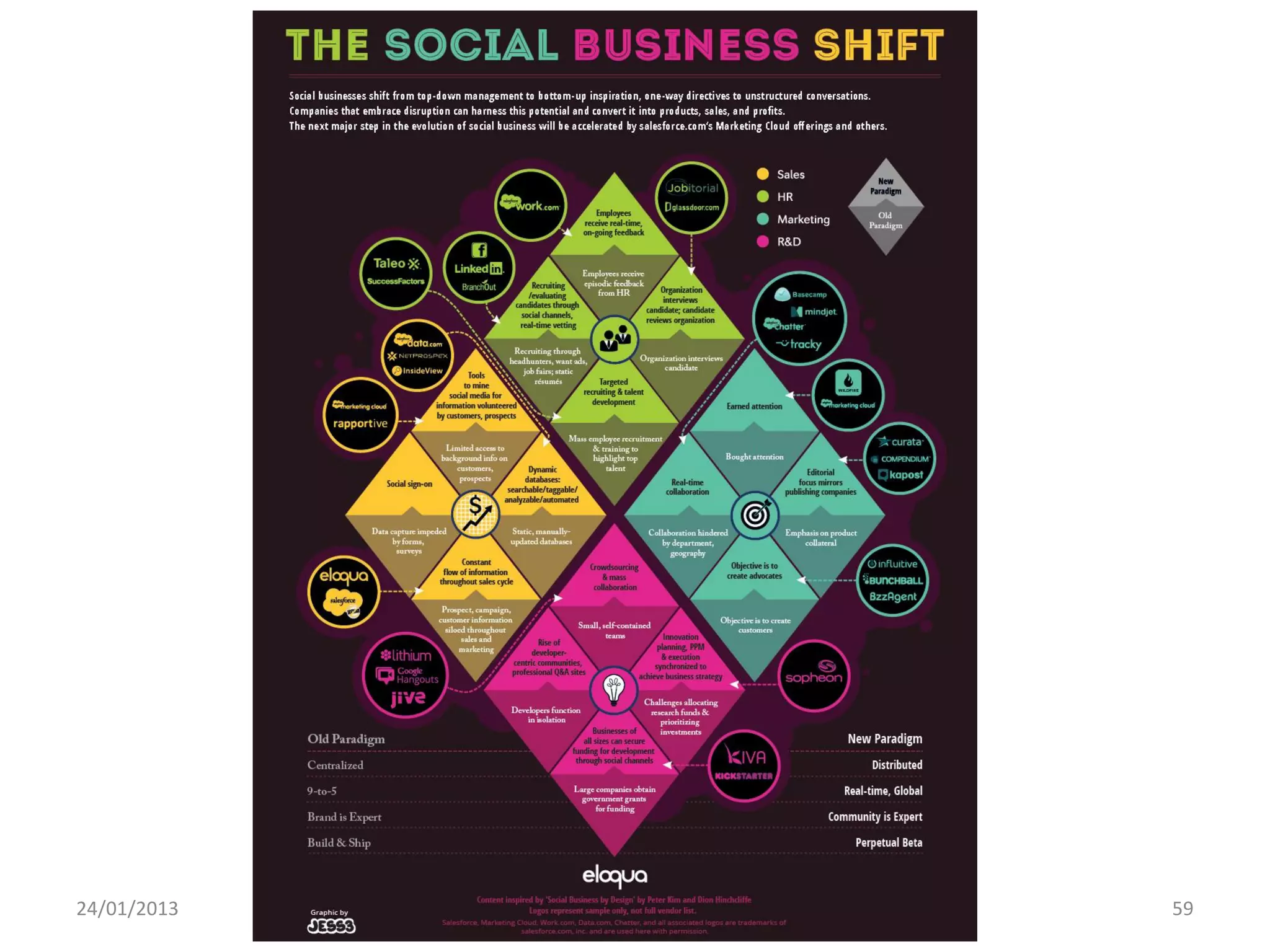
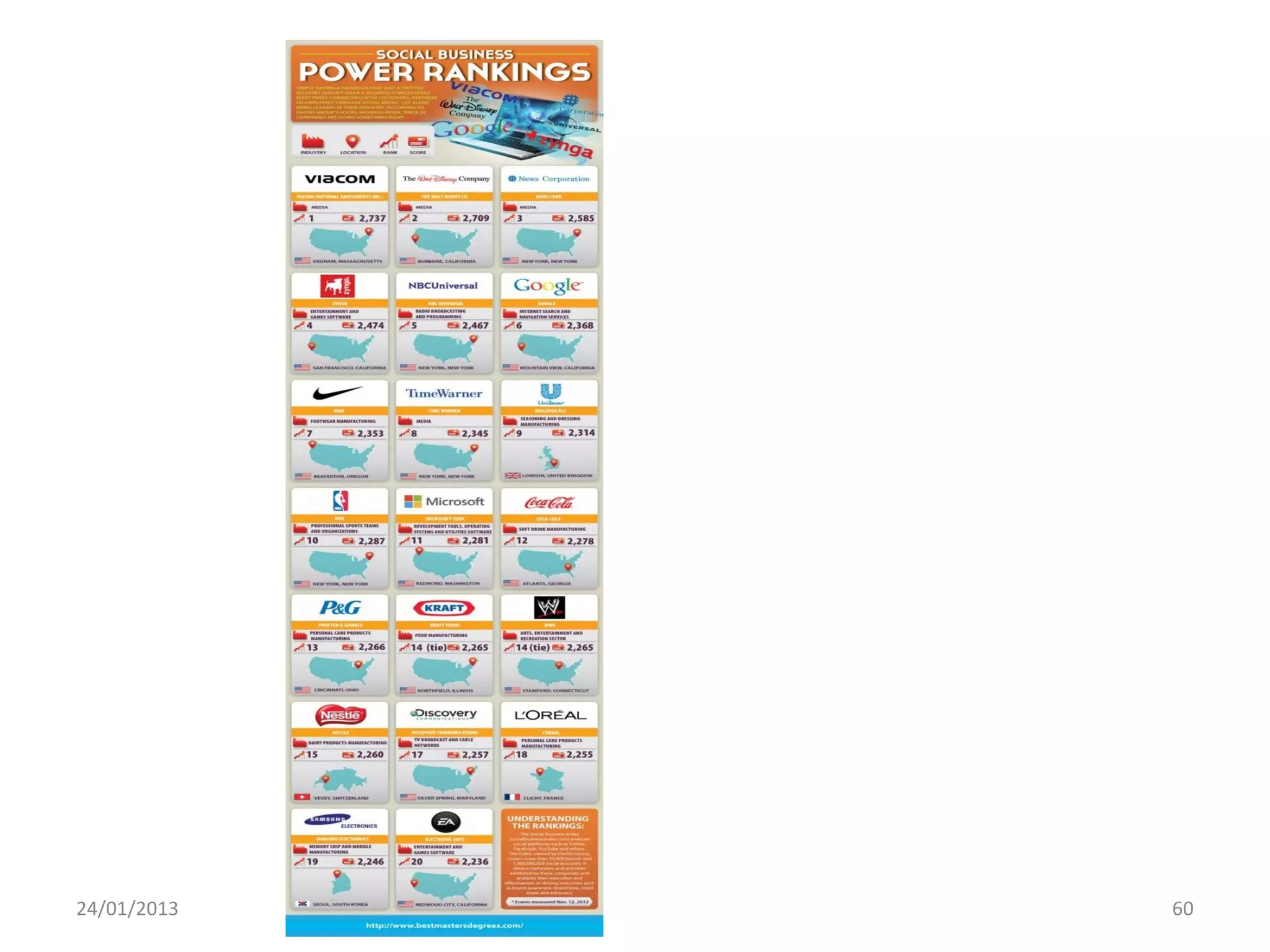
5. THE SOCIAL BUSINESS


24/01/2013                  54
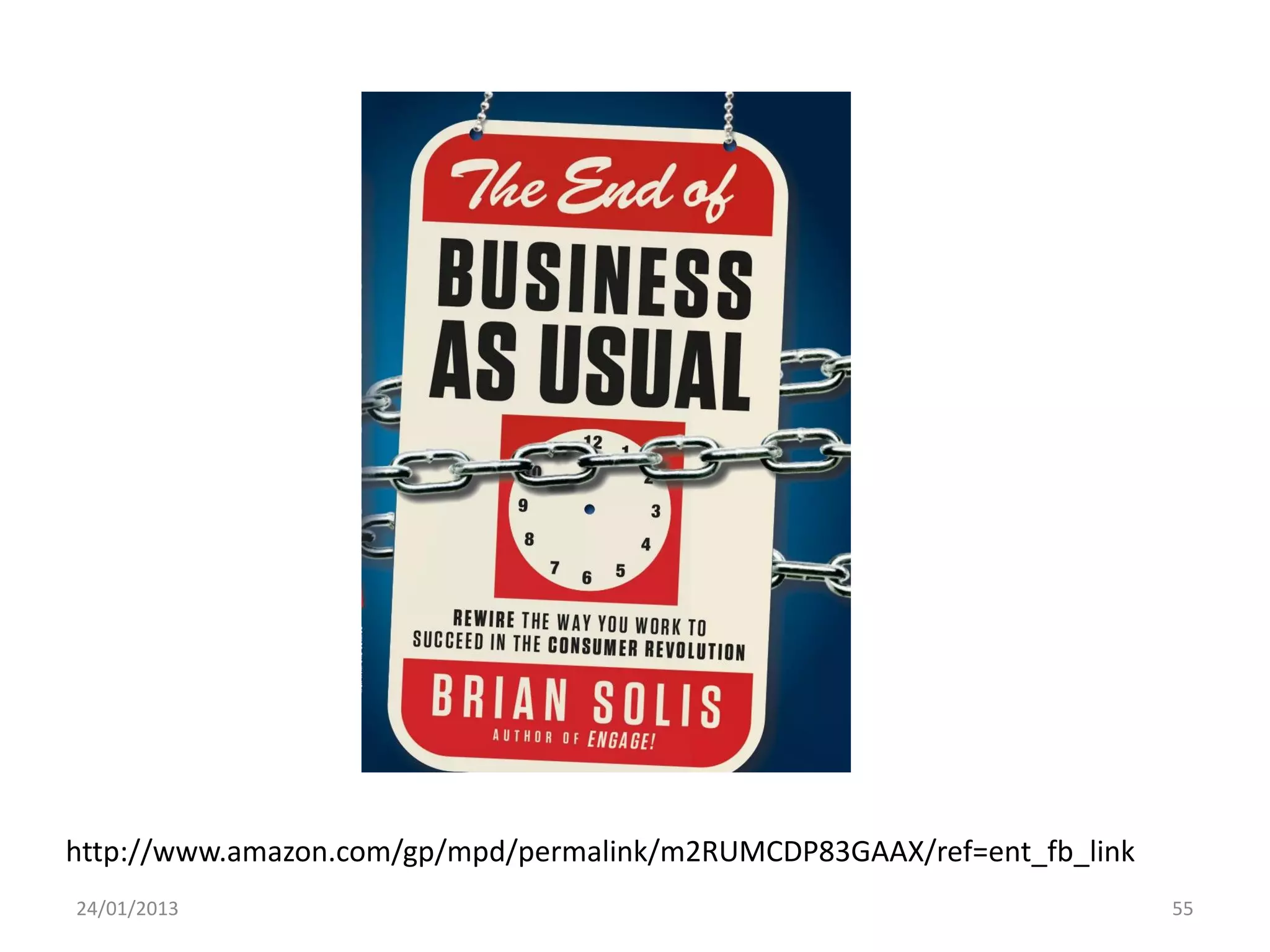
http://www.amazon.com/gp/mpd/permalink/m2RUMCDP83GAAX/ref=ent_fb_link
24/01/2013                                                              55
24/01/2013   56
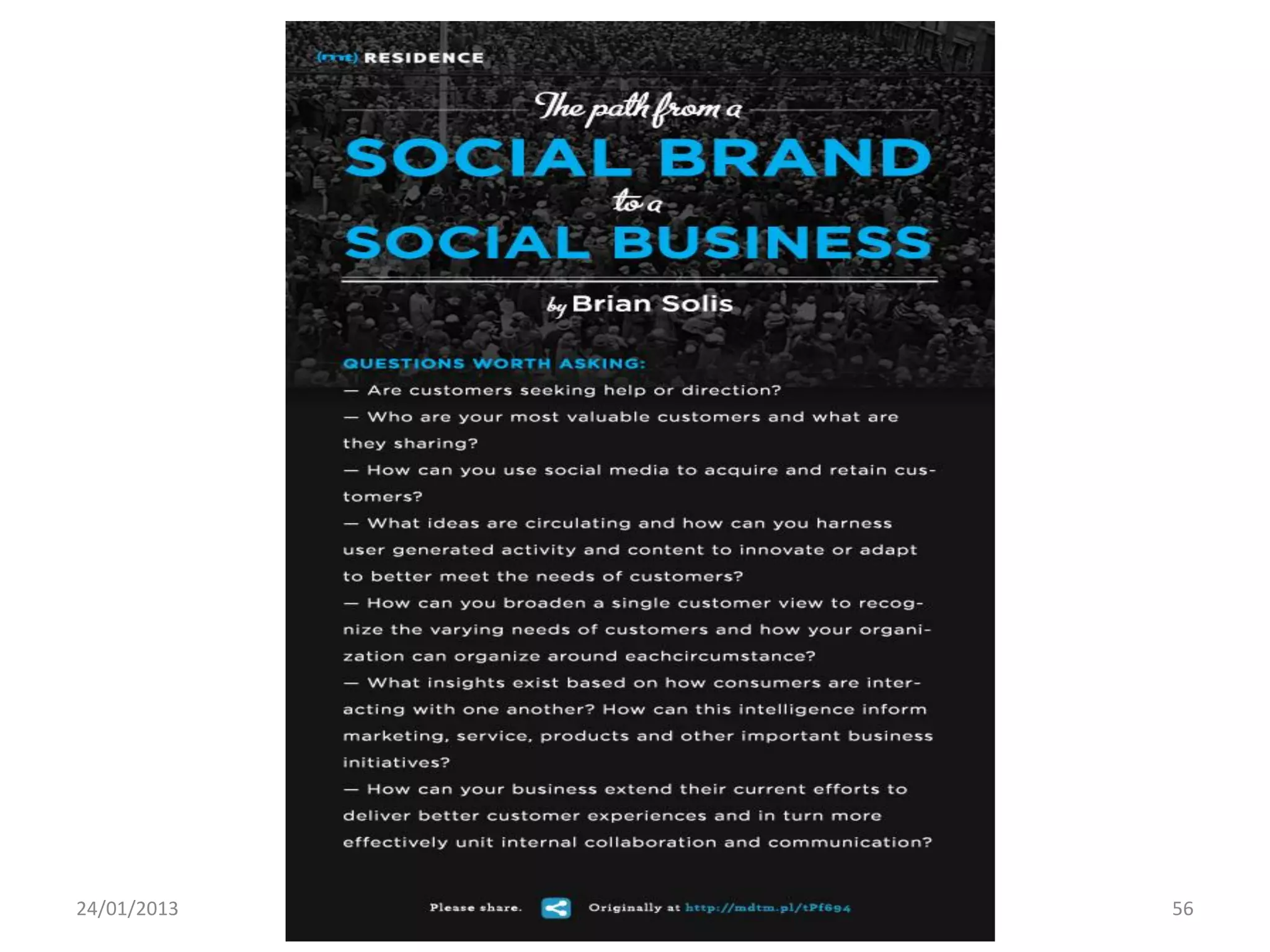
Social CRM
• “The underlying principle for Social CRM’s
  success is very different from its
  predecessor….traditional CRM is based on an
  internal operational approach to manage
  customer relationships effectively. But Social CRM
  is based on the ability of a company to meet the
  personal agendas of [its] customers while, at the
  same time, meeting the objectives of [its] own
  business plan. It is aimed at customer
  engagement rather than customer
  management.”

24/01/2013                                         57
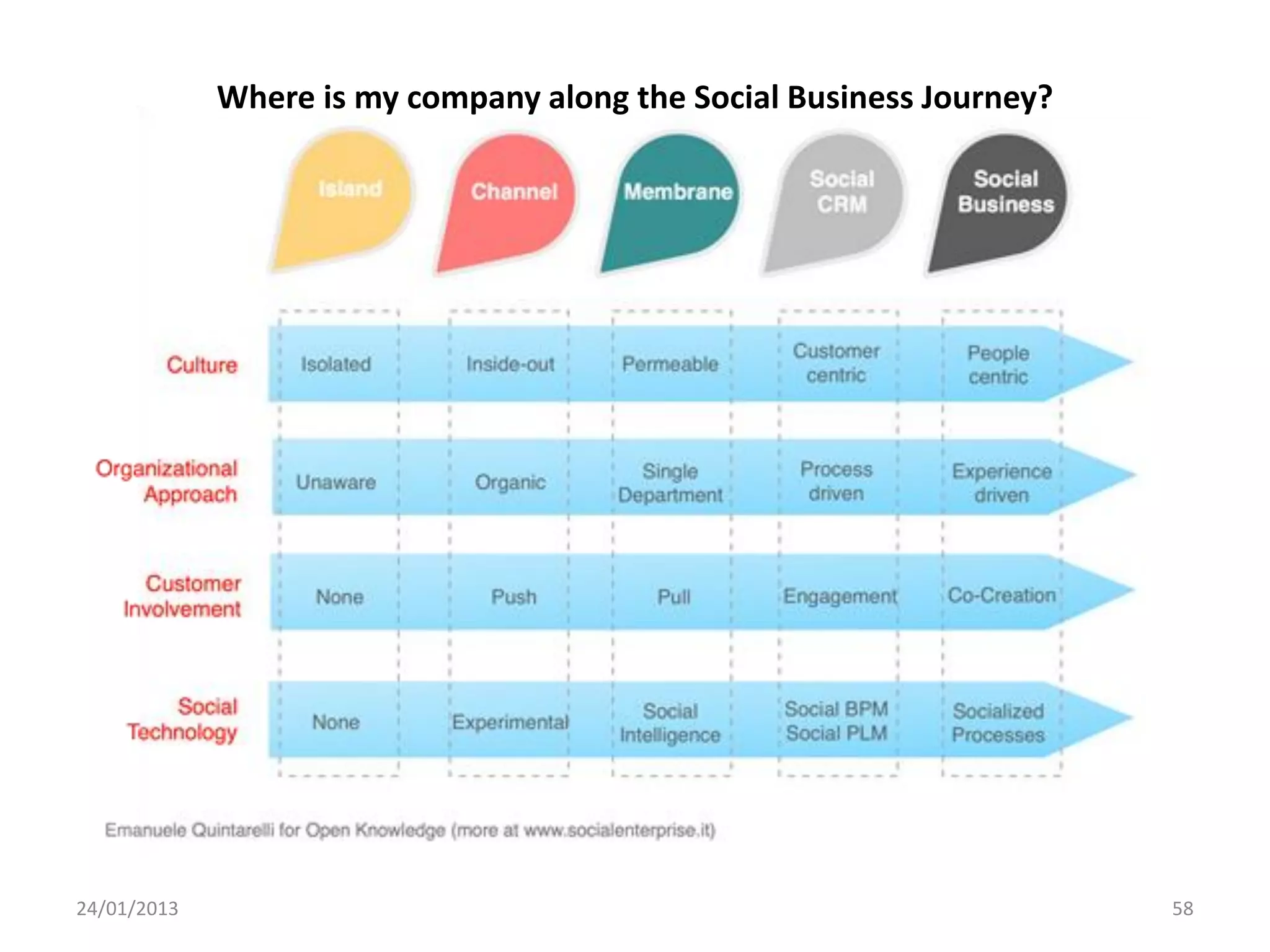
Where is my company along the Social Business Journey?


24/01/2013                                                            58
24/01/2013   59
24/01/2013   60
GENUINE STRATEGY AND OPERATIONAL
   EFFECTIVENESS: THE UNBEATABLE
   COMBINATION
24/01/2013                            61
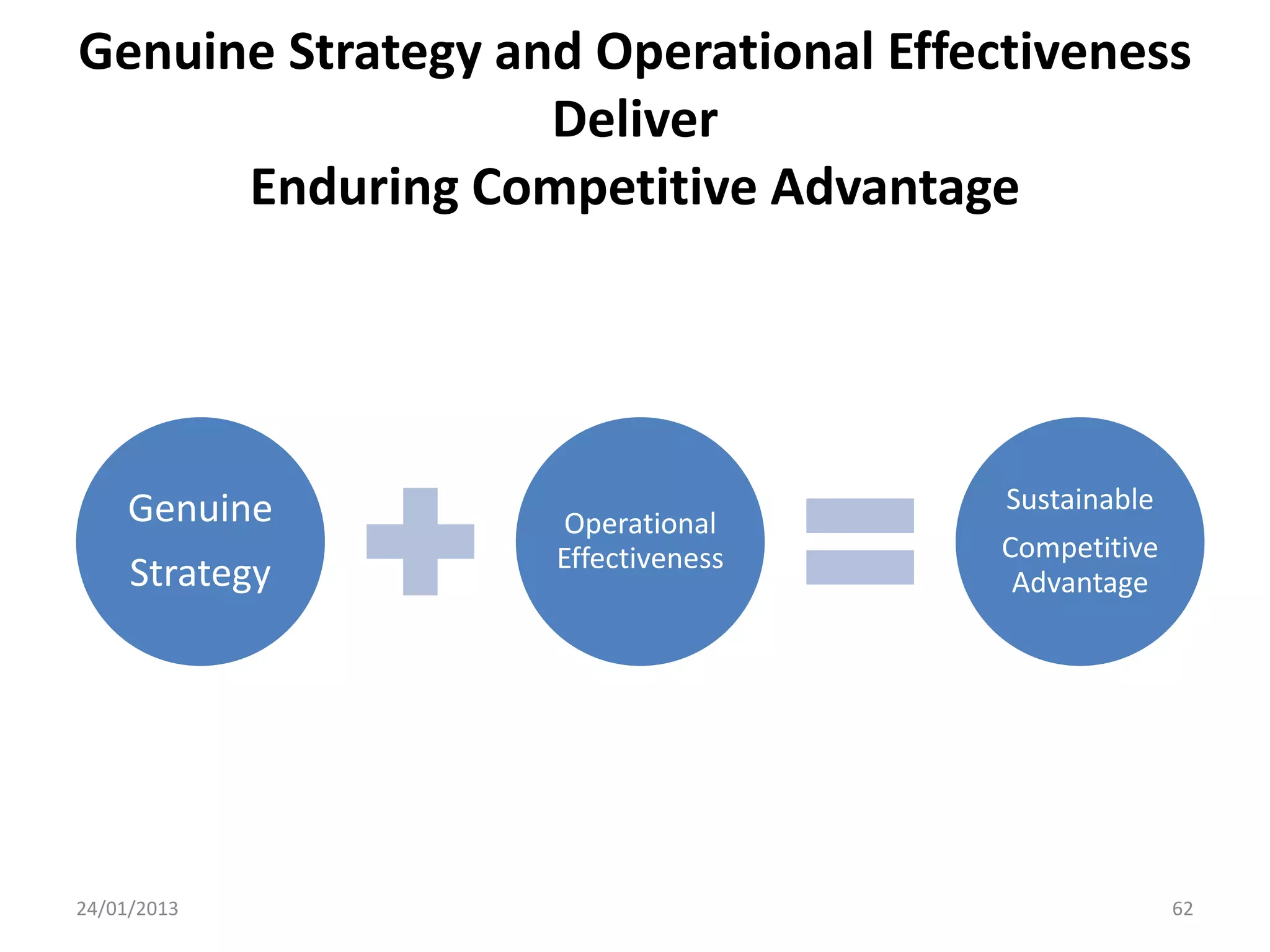
Genuine Strategy and Operational Effectiveness
                   Deliver
      Enduring Competitive Advantage


     Genuine                          Sustainable
                    Operational
                   Effectiveness      Competitive
     Strategy                          Advantage


24/01/2013                                          62
Genuine Strategy and OE

    Both are essential for superior performance

    Excellence in one is not enough for enduring
           success or competitive advantage


24/01/2013                                         63
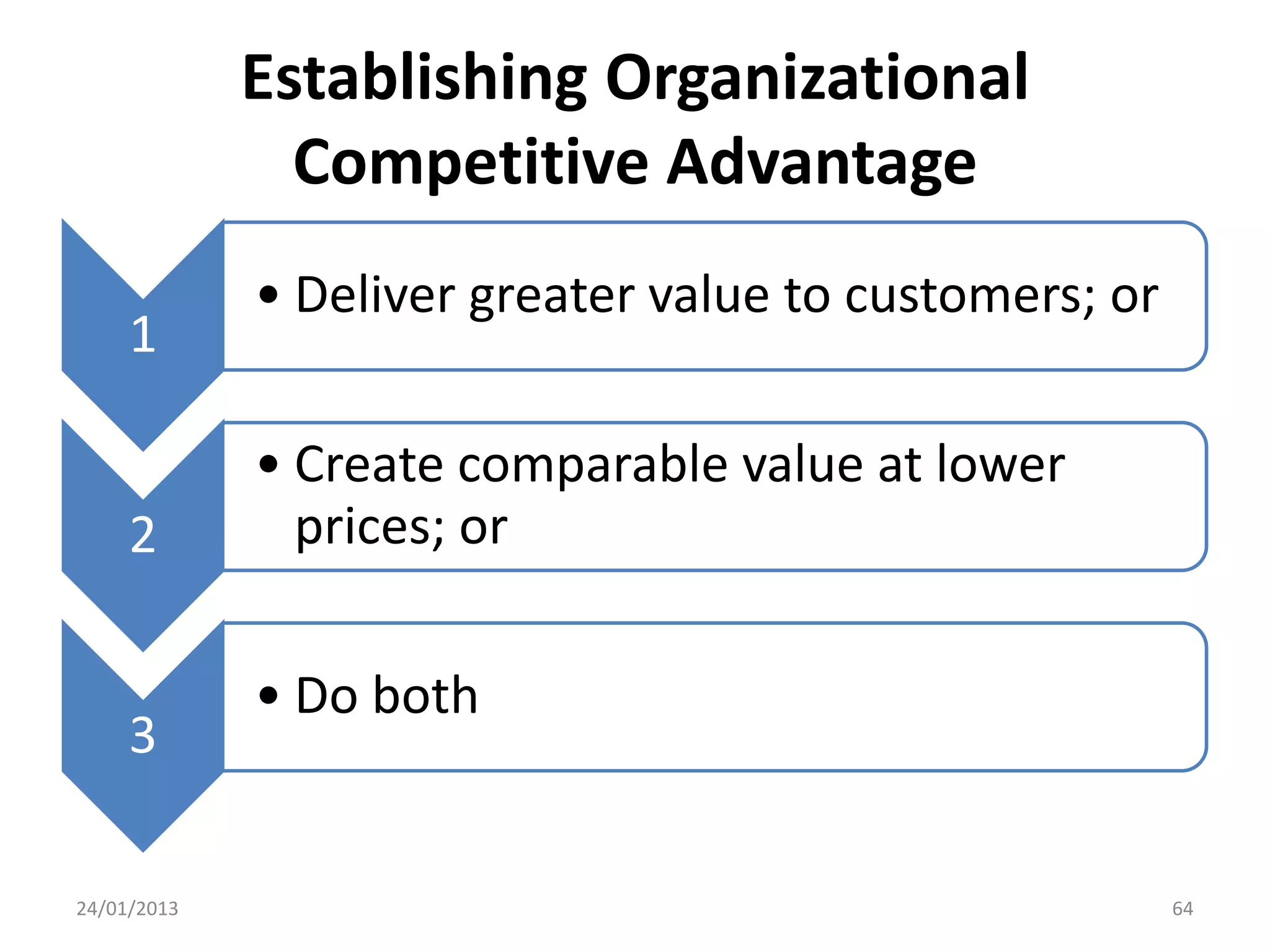
Establishing Organizational
               Competitive Advantage
             • Deliver greater value to customers; or
     1

             • Create comparable value at lower
     2         prices; or

             • Do both
     3

24/01/2013                                              64
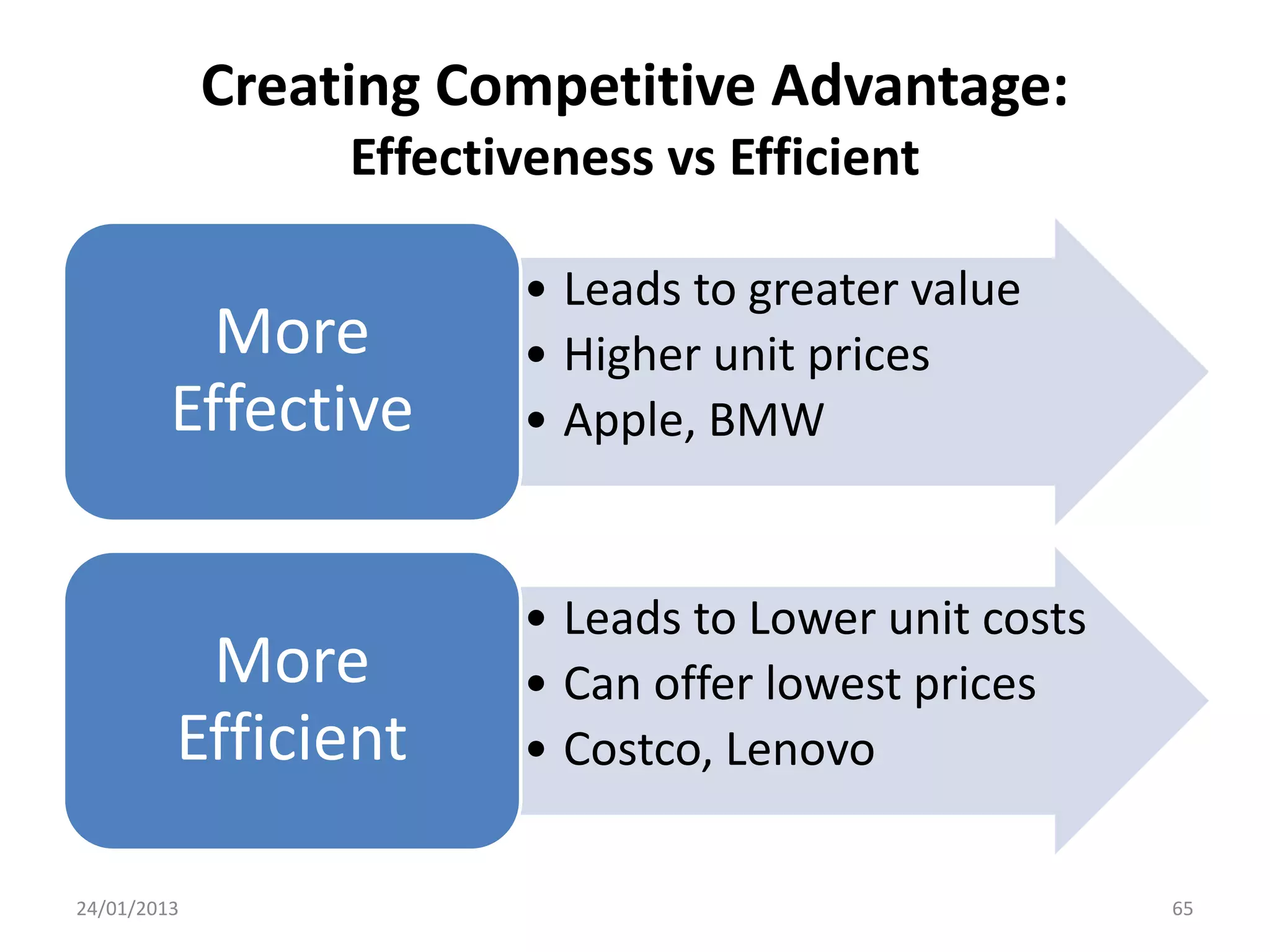
Creating Competitive Advantage:
                  Effectiveness vs Efficient

                         • Leads to greater value
           More          • Higher unit prices
         Effective       • Apple, BMW


                         • Leads to Lower unit costs
          More           • Can offer lowest prices
         Efficient       • Costco, Lenovo

24/01/2013                                             65
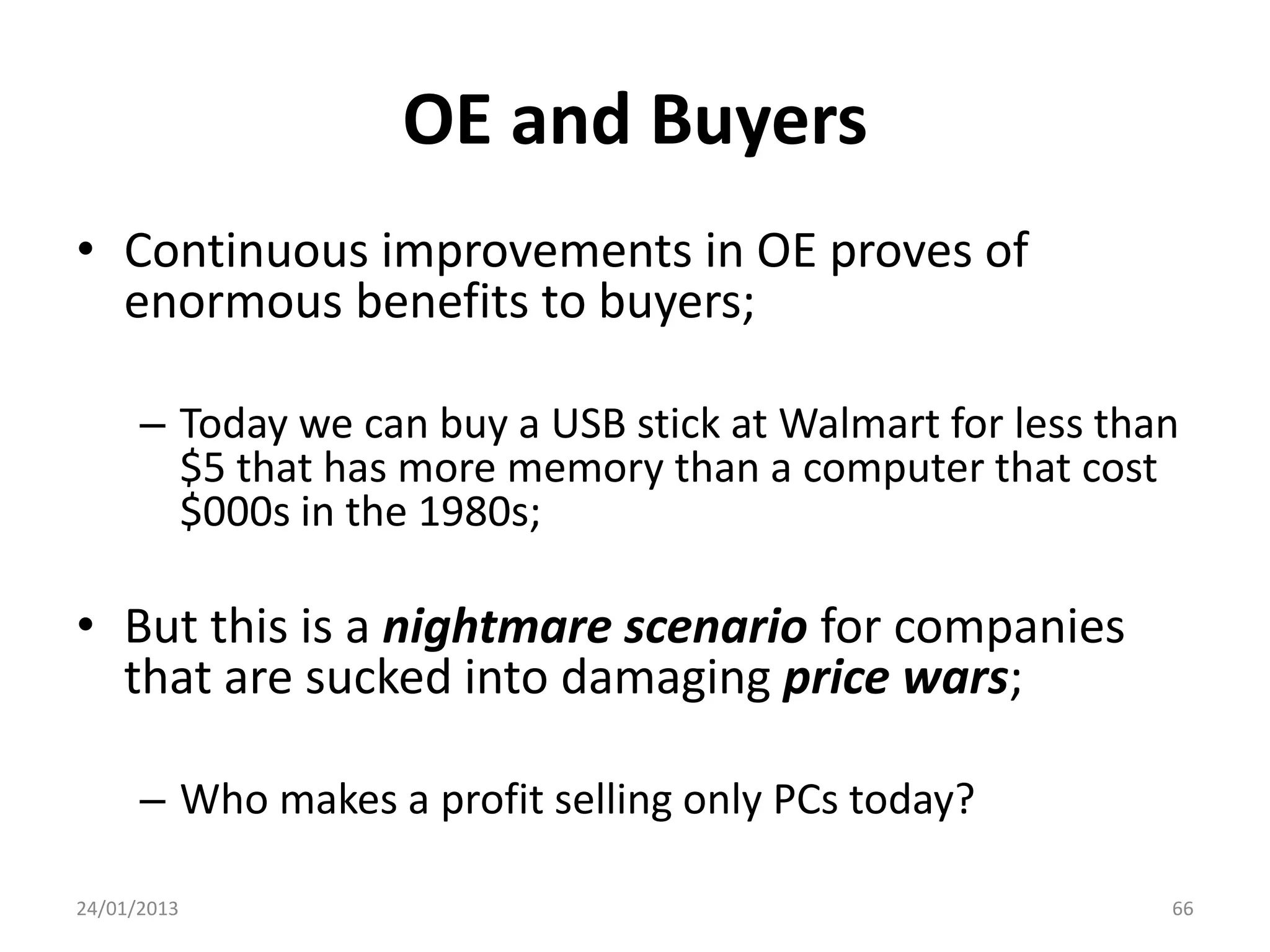
OE and Buyers
• Continuous improvements in OE proves of
  enormous benefits to buyers;

      – Today we can buy a USB stick at Walmart for less than
        $5 that has more memory than a computer that cost
        $000s in the 1980s;

• But this is a nightmare scenario for companies
  that are sucked into damaging price wars;

      – Who makes a profit selling only PCs today?

24/01/2013                                                  66
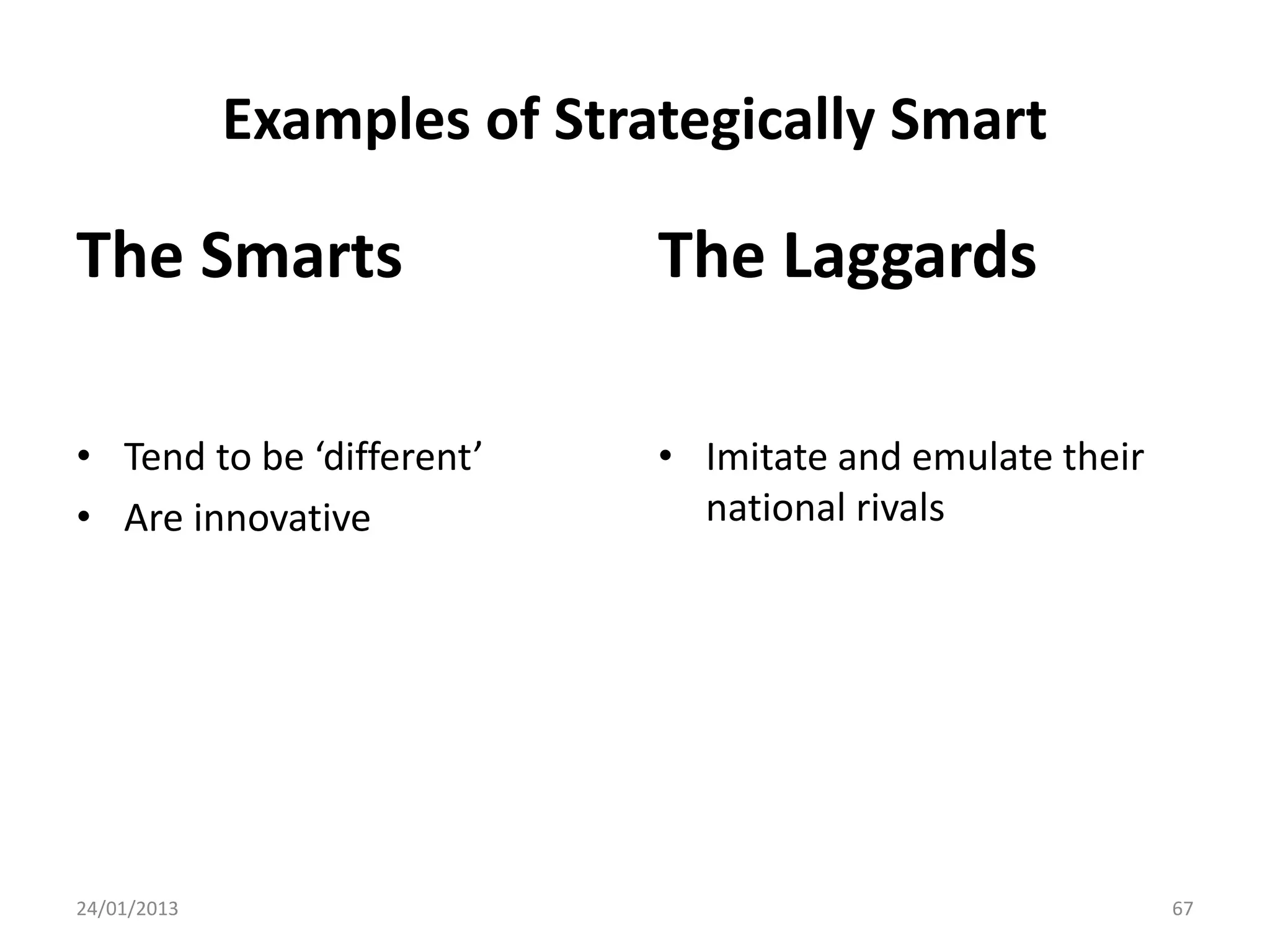
Examples of Strategically Smart

The Smarts                   The Laggards

• Tend to be ‘different’     • Imitate and emulate their
• Are innovative               national rivals


24/01/2013                                                 67
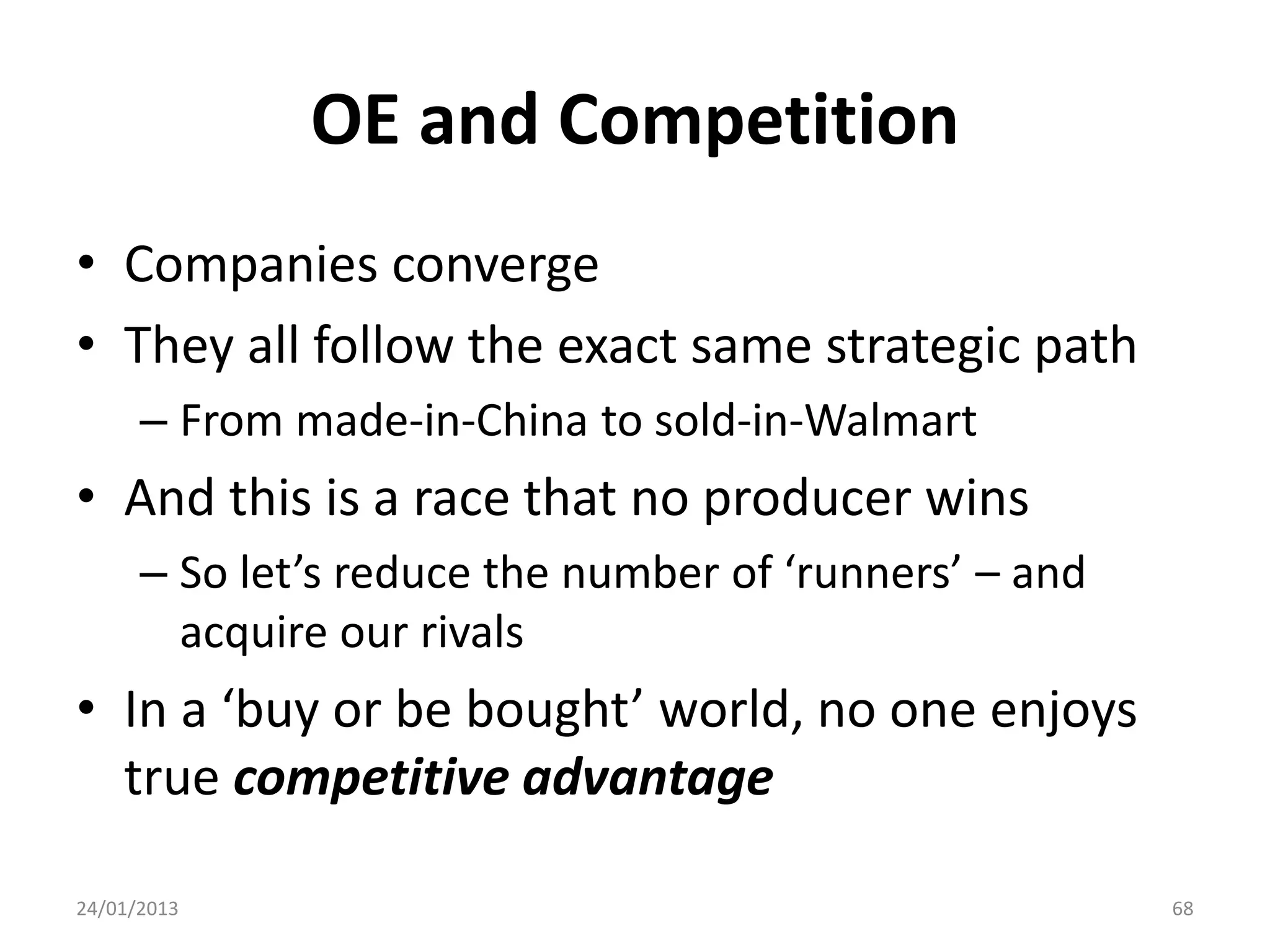
OE and Competition
• Companies converge
• They all follow the exact same strategic path
      – From made-in-China to sold-in-Walmart
• And this is a race that no producer wins
      – So let’s reduce the number of ‘runners’ – and
        acquire our rivals
• In a ‘buy or be bought’ world, no one enjoys
  true competitive advantage

24/01/2013                                              68
It does not
             have to be
              this way!
24/01/2013                 69

Business strategy from michael porter to blue oceans to what's the problem

  • 1.
    Five Perspectives of Business Strategy? By Dr. Michael McDermott mcdermottm1@nku.edu 24/01/2013 1
  • 2.
    Perspectives on Strategy: Five Schools of thought Author Published Key Concept Comments Michael Porter 1980s Competitive Positioning The Dominant view Kim & Maubergne Early 2000s Blue Ocean Strategy Richard Rumelt 2011 Good vs Bad Strategy Cynthia 2008 Leadership and Strategy Montgomery Brian Solis, others 2011 Social Business Evolving 24/01/2013 2
  • 3.
    Perspectives on Strategy: Five Schools of thought Author Key Concept Objective Michael Porter Competitive Establish a clear Positioning (i.e. competitive position Generic Strategy) Kim & Maubergne Blue Ocean Strategy Create a new market with no competition Richard Rumelt Good vs Bad Strategy Focus on the “big problem” Cynthia Leadership and Strategy and leadership Montgomery Strategy must be interconnected Solis and others Social Business Engagement to create value 24/01/2013 © McDermott, 2013 3
  • 4.
    Michael Porter andStrategy 24/01/2013 4
  • 5.
    Michael Porter &Competitive Position 24/01/2013 5
  • 6.
    Operational Effectiveness ExplainsInitial Success of Asian Companies (i.e. a low cost generic strategy) 2020s- Chinese 1990s-2010s companies South are winners Korean companies 1960s-80s are winners Japanese companies are winners © McDermott, 2012. 6
  • 7.
    Where we placea company depends upon the definition of the industry that it competes in. 24/01/2013 7
  • 8.
    Porter’s value chain– this has to focus on achieving cost minimization or differentiation. 24/01/2013 8
  • 9.
    Generic Strategy andPorter’s Five Forces The Five Forces of Industry analysis 24/01/2013 9
  • 10.
  • 11.
  • 12.
    Competitive Position –Strategy Clock The “greenish” area is non-viable 24/01/2013 12
  • 13.
    2. Blue OceanStrategy 24/01/2013 13
  • 14.
  • 15.
  • 16.
  • 17.
  • 18.
  • 19.
  • 20.
  • 21.
    This looks atthe Strategy Canvass for traditional circuses (i.e. red) vs Cirque du Soleil 24/01/2013 21
  • 22.
  • 23.
  • 24.
  • 25.
  • 26.
  • 27.
  • 28.
  • 29.
  • 30.
  • 31.
    Apple’s Strategy Journey Flourishing, 2001- Turnaround present Survival mode, mid Company defines its problem at each stage 1990s Consider what the company did at each stage 24/01/2013 31
  • 32.
    1990s: BMW andMercedes 24/01/2013 32
  • 33.
    Figure 1: BMW’sDecision to invest in the U.S.A. in the 1990s Push Factors Strength of High Labor Strong Remote from DM vs US$ Costs unions key market BMW’s Decision to Invest in the USA Overcome 10% Weak unions in import tax South Low labor Largest costs international market Response to Opportunity to introduce competitive threat manufacturing processes from Japan Pull Factors
  • 34.
    What’s the “Bigproblem” facing these companies? 24/01/2013 34
  • 35.
  • 36.
    4. Strategy andLeadership No matter how accomplished the strategy, can it “work” in the absence of effective leadership? 24/01/2013 36
  • 37.
  • 38.
  • 39.
    The Role ofthe Strategist • To find and examine all the evidence to determine the problem – It’s vital to be able to ask the right questions – If you do not ask the right questions, then you cannot find the right answer • To design a solution 24/01/2013 39
  • 40.
    The Strategist isboth Detective and Designer 24/01/2013 40
  • 41.
    Strategy at theCorporate Level • A blurring of competitive position is clearly a problem • This causes rampant confusion internally and externally • So establish an unambiguous competitive position 24/01/2013 41
  • 42.
    Strategy at theCorporate Level • Sources of problems can be found when examining: 1. The remote external environment 2. The broad competitive environment 3. Rivals 4. The market 5. The company 24/01/2013 42
  • 43.
    The Strategy Detective’sTools: The External Environment The External • PEST or PESTEL analysis Remote • Political, Economic, Social, Technological Environment The Broad • Porter’s Industry Analysis Five Forces Model Competitive • Industry Life Cycle • Company analysis (see section on internal analysis) Environment • Market Segmentation The Market • Customer Relationships • Product Life Cycle 24/01/2013 43
  • 44.
    The Strategy Detective’sTools: The Internal Environment •Core competencies; The Internal •Porter’s Value Chain; Environment Functional Analysis; BCG Matrix; Ansoff’s Matrix 24/01/2013 44
  • 45.
    Strategy is allabout choice and saying ‘no’ 24/01/2013 45
  • 46.
    What is aStrategist? • A decision-maker? – Look at options and pick ‘the best’ • Or a designer? • Yes, he/she designs a novel response 24/01/2013 46
  • 47.
    The Strategy Designer •You are allowed only one objective and it must be feasible • What one single feasible objective, when accomplished, would make the biggest difference? • Now design a strategy and make it happen. 24/01/2013 47
  • 48.
    Leadership Casualties in2012 • How many CEOs of US Fortune 500 companies were fired in 2012? • How many coaches/managers in the NBA, NFL, English Premier League were sacked? • How many incumbent politicians were defeated in the polls? • Clearly employers believe that strategy and leadership are interconnected 24/01/2013 48
  • 49.
    Meaning-Maker “strategy has been narrowed to a competitive game plan, divorcing it from a firm's larger sense of purpose; the CEO's unique role as arbiter and steward of strategy has been eclipsed; and the exaggerated emphasis on sustainable competitive advantage has drawn attention away from the fact that strategy must be a dynamic tool for guiding the development of a company over The time” (Montgomery, HBR, 2008) Strategist The Reasoner The Operator 24/01/2013 49
  • 50.
    • If youask young men what they want to accomplish by the time they are 40, the answers you get fall into two distinct categories. There are those - the great majority - who will respond in terms of what they want to have. This is especially true of graduate students of business administration. There are some men, however, who will answer in terms of the kind of men they hope to be. These are the only ones who have a clear idea of where they are going. The same is true of companies. For far too many companies, what little thinking goes on about the future is done primarily in money terms. There is nothing wrong with financial planning. Most companies should do more of it. But there is a basic fallacy in confusing a financial plan with thinking about the kind of company you want yours to become. It is like saying, "When I'm 40, I'm going to be rich." It leaves too many basic questions unanswered. Rich in what way? Rich doing what? 24/01/2013 50
  • 51.
    • Strategy andthe Strategist In most popular portrayals the strategist's job would seem to be finished once a carefully articulated strategy has been made ready for implementation. The idea has been formed, the next steps specified, the problem solved. But don't be fooled. The job of the strategist never ends. No matter how compelling a strategy is, or how clearly defined, it is unlikely to be a sufficient guide for a firm that aspires to a long and prosperous life 24/01/2013 51
  • 52.
    The Prevailing Approach:Strategy as a Set Solution • Goal A long-term sustainable competitive advantage • Leadership The CEO and strategy consultants • Form Unchanging plan that derives from an analytical, left-brain exercise • Time Frame Intense period of formulation followed by prolonged period of implementation • Ongoing Activity Defending an established strategy through time 24/01/2013 52
  • 53.
    What Is Missing:Strategy as a Dynamic Process • Goal Creation of value • Leadership CEO as chief strategist; the job cannot be outsourced • Form Organic process that is adaptive, holistic, and open-ended • Time Frame Everyday, continuous, unending • Ongoing Activity Fostering competitive advantages and developing the company through time 24/01/2013 53
  • 54.
    5. THE SOCIALBUSINESS 24/01/2013 54
  • 55.
  • 56.
  • 57.
    Social CRM • “Theunderlying principle for Social CRM’s success is very different from its predecessor….traditional CRM is based on an internal operational approach to manage customer relationships effectively. But Social CRM is based on the ability of a company to meet the personal agendas of [its] customers while, at the same time, meeting the objectives of [its] own business plan. It is aimed at customer engagement rather than customer management.” 24/01/2013 57
  • 58.
    Where is mycompany along the Social Business Journey? 24/01/2013 58
  • 59.
  • 60.
  • 61.
    GENUINE STRATEGY ANDOPERATIONAL EFFECTIVENESS: THE UNBEATABLE COMBINATION 24/01/2013 61
  • 62.
    Genuine Strategy andOperational Effectiveness Deliver Enduring Competitive Advantage Genuine Sustainable Operational Effectiveness Competitive Strategy Advantage 24/01/2013 62
  • 63.
    Genuine Strategy andOE Both are essential for superior performance Excellence in one is not enough for enduring success or competitive advantage 24/01/2013 63
  • 64.
    Establishing Organizational Competitive Advantage • Deliver greater value to customers; or 1 • Create comparable value at lower 2 prices; or • Do both 3 24/01/2013 64
  • 65.
    Creating Competitive Advantage: Effectiveness vs Efficient • Leads to greater value More • Higher unit prices Effective • Apple, BMW • Leads to Lower unit costs More • Can offer lowest prices Efficient • Costco, Lenovo 24/01/2013 65
  • 66.
    OE and Buyers •Continuous improvements in OE proves of enormous benefits to buyers; – Today we can buy a USB stick at Walmart for less than $5 that has more memory than a computer that cost $000s in the 1980s; • But this is a nightmare scenario for companies that are sucked into damaging price wars; – Who makes a profit selling only PCs today? 24/01/2013 66
  • 67.
    Examples of StrategicallySmart The Smarts The Laggards • Tend to be ‘different’ • Imitate and emulate their • Are innovative national rivals 24/01/2013 67
  • 68.
    OE and Competition •Companies converge • They all follow the exact same strategic path – From made-in-China to sold-in-Walmart • And this is a race that no producer wins – So let’s reduce the number of ‘runners’ – and acquire our rivals • In a ‘buy or be bought’ world, no one enjoys true competitive advantage 24/01/2013 68
  • 69.
    It does not have to be this way! 24/01/2013 69