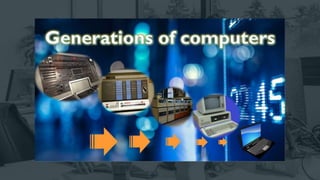
GENERATIONS OF
COMPUTERS
Even more so the generation who have grown from
infancy within the global desktop and laptop revolution
since the 1980s.
The history of the computer goes back several decades
however and there are five definable generations of
computers.
Each generation is defined by a significant
technological development that changes fundamentally
how computers operate – leading to more compact,
less expensive, but more powerful, efficient and robust
machines.
INTRODUCTION
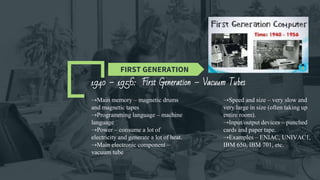
1940 – 1956: First Generation – Vacuum Tubes
FIRST GENERATION
⇢Main memory – magnetic drums
and magnetic tapes
⇢Programming language – machine
language
⇢Power – consume a lot of
electricity and generate a lot of heat.
⇢Main electronic component –
vacuum tube
⇢Speed and size – very slow and
very large in size (often taking up
entire room).
⇢Input/output devices – punched
cards and paper tape.
⇢Examples – ENIAC, UNIVAC1,
IBM 650, IBM 701, etc.
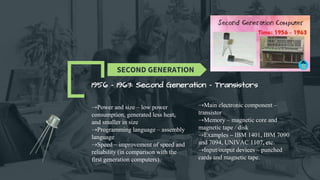
1956 – 1963: Second Generation – Transistors
SECOND GENERATION
⇢Main electronic component –
transistor
⇢Memory – magnetic core and
magnetic tape / disk
⇢Examples – IBM 1401, IBM 7090
and 7094, UNIVAC 1107, etc.
⇢Input/output devices – punched
cards and magnetic tape.
⇢Power and size – low power
consumption, generated less heat,
and smaller in size
⇢Programming language – assembly
language
⇢Speed – improvement of speed and
reliability (in comparison with the
first generation computers).
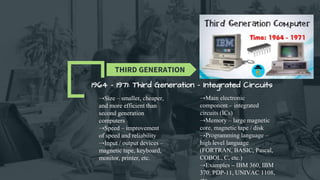
1964 – 1971: Third Generation – Integrated Circuits
THIRD GENERATION
⇢Main electronic
component – integrated
circuits (ICs)
⇢Memory – large magnetic
core, magnetic tape / disk
⇢Programming language –
high level language
(FORTRAN, BASIC, Pascal,
COBOL, C, etc.)
⇢Examples – IBM 360, IBM
370, PDP-11, UNIVAC 1108,
⇢Size – smaller, cheaper,
and more efficient than
second generation
computers
⇢Speed – improvement
of speed and reliability
⇢Input / output devices –
magnetic tape, keyboard,
monitor, printer, etc.
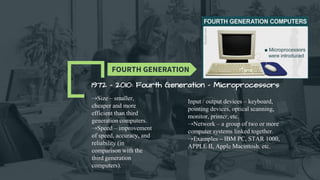
1972 – 2010: Fourth Generation – Microprocessors
FOURTH GENERATION
⇢Size – smaller,
cheaper and more
efficient than third
generation computers.
⇢Speed – improvement
of speed, accuracy, and
reliability (in
comparison with the
third generation
computers).
Input / output devices – keyboard,
pointing devices, optical scanning,
monitor, printer, etc.
⇢Network – a group of two or more
computer systems linked together.
⇢Examples – IBM PC, STAR 1000,
APPLE II, Apple Macintosh, etc.
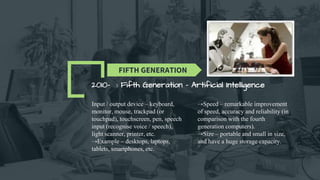
2010- : Fifth Generation – Artificial Intelligence
FIFTH GENERATION
⇢Speed – remarkable improvement
of speed, accuracy and reliability (in
comparison with the fourth
generation computers).
⇢Size – portable and small in size,
and have a huge storage capacity.
Input / output device – keyboard,
monitor, mouse, trackpad (or
touchpad), touchscreen, pen, speech
input (recognise voice / speech),
light scanner, printer, etc.
⇢Example – desktops, laptops,
tablets, smartphones, etc.
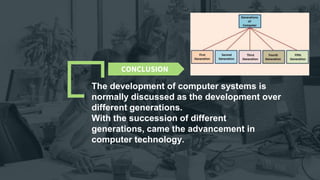
The development of computer systems is
normally discussed as the development over
different generations.
With the succession of different
generations, came the advancement in
computer technology.
CONCLUSION
Generations of computers  ppt

Generations of computers ppt

  • 1.
  • 2.
    Even more sothe generation who have grown from infancy within the global desktop and laptop revolution since the 1980s. The history of the computer goes back several decades however and there are five definable generations of computers. Each generation is defined by a significant technological development that changes fundamentally how computers operate – leading to more compact, less expensive, but more powerful, efficient and robust machines. INTRODUCTION
  • 3.
    1940 – 1956:First Generation – Vacuum Tubes FIRST GENERATION ⇢Main memory – magnetic drums and magnetic tapes ⇢Programming language – machine language ⇢Power – consume a lot of electricity and generate a lot of heat. ⇢Main electronic component – vacuum tube ⇢Speed and size – very slow and very large in size (often taking up entire room). ⇢Input/output devices – punched cards and paper tape. ⇢Examples – ENIAC, UNIVAC1, IBM 650, IBM 701, etc.
  • 4.
    1956 – 1963:Second Generation – Transistors SECOND GENERATION ⇢Main electronic component – transistor ⇢Memory – magnetic core and magnetic tape / disk ⇢Examples – IBM 1401, IBM 7090 and 7094, UNIVAC 1107, etc. ⇢Input/output devices – punched cards and magnetic tape. ⇢Power and size – low power consumption, generated less heat, and smaller in size ⇢Programming language – assembly language ⇢Speed – improvement of speed and reliability (in comparison with the first generation computers).
  • 5.
    1964 – 1971:Third Generation – Integrated Circuits THIRD GENERATION ⇢Main electronic component – integrated circuits (ICs) ⇢Memory – large magnetic core, magnetic tape / disk ⇢Programming language – high level language (FORTRAN, BASIC, Pascal, COBOL, C, etc.) ⇢Examples – IBM 360, IBM 370, PDP-11, UNIVAC 1108, ⇢Size – smaller, cheaper, and more efficient than second generation computers ⇢Speed – improvement of speed and reliability ⇢Input / output devices – magnetic tape, keyboard, monitor, printer, etc.
  • 6.
    1972 – 2010:Fourth Generation – Microprocessors FOURTH GENERATION ⇢Size – smaller, cheaper and more efficient than third generation computers. ⇢Speed – improvement of speed, accuracy, and reliability (in comparison with the third generation computers). Input / output devices – keyboard, pointing devices, optical scanning, monitor, printer, etc. ⇢Network – a group of two or more computer systems linked together. ⇢Examples – IBM PC, STAR 1000, APPLE II, Apple Macintosh, etc.
  • 7.
    2010- : FifthGeneration – Artificial Intelligence FIFTH GENERATION ⇢Speed – remarkable improvement of speed, accuracy and reliability (in comparison with the fourth generation computers). ⇢Size – portable and small in size, and have a huge storage capacity. Input / output device – keyboard, monitor, mouse, trackpad (or touchpad), touchscreen, pen, speech input (recognise voice / speech), light scanner, printer, etc. ⇢Example – desktops, laptops, tablets, smartphones, etc.
  • 8.
    The development ofcomputer systems is normally discussed as the development over different generations. With the succession of different generations, came the advancement in computer technology. CONCLUSION