generations of computer and basic information about the 5th Gen
1.
Dr B TSampath Kumar
Professor
Department of Library and Information Science
Tumkur University, Tumakuru, INDIA
www.sampathkumar.info
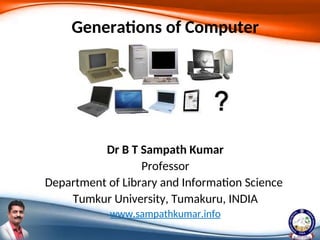
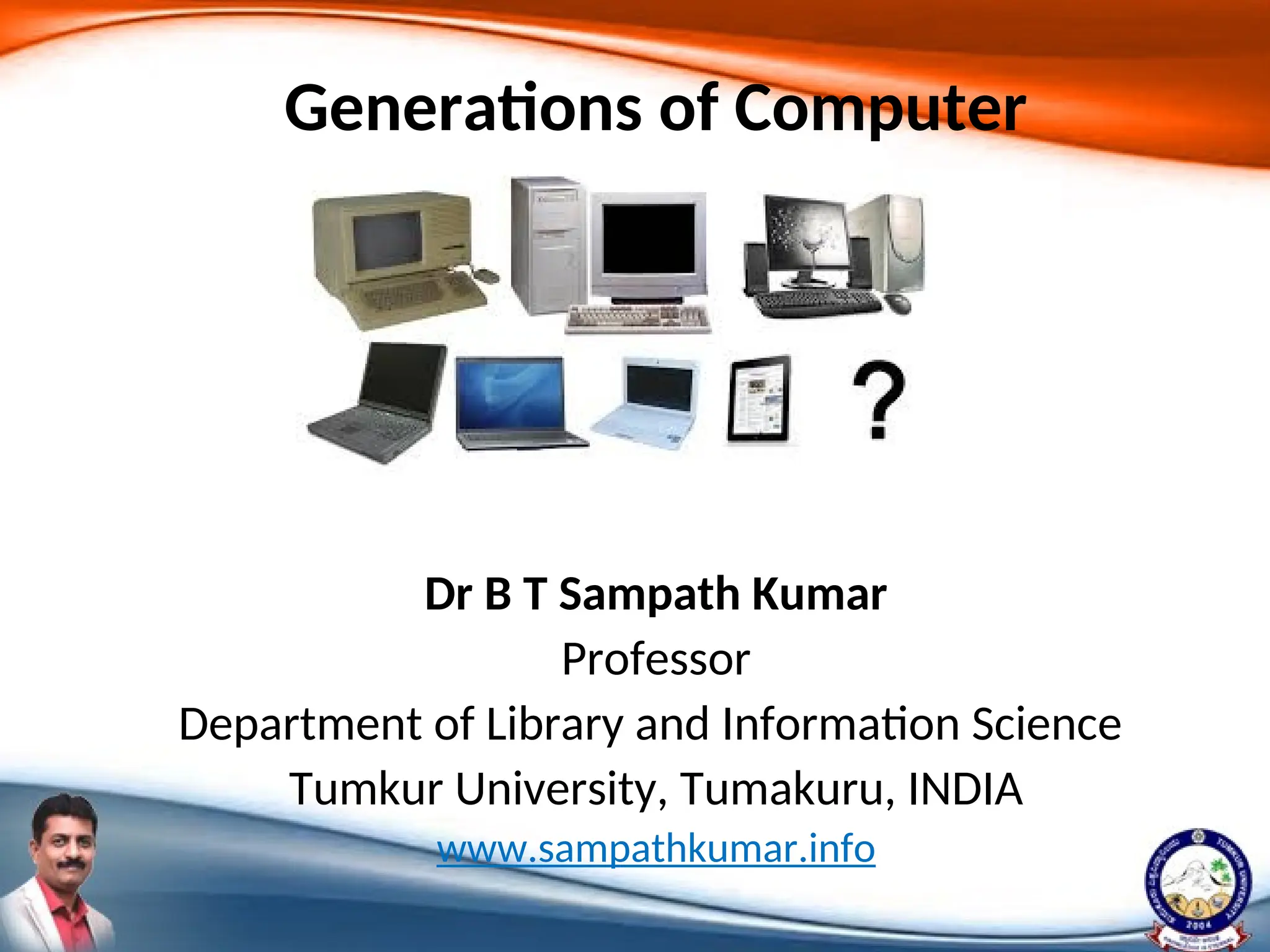
Generations of Computer
2.
Generations of computers
•A computer is an electronic device that
manipulates information or data.
• It has the ability to store, retrieve and process
data.
• Computer can be used to type text, send
email, play games and browse the Web.
3.
Cont..
• It canalso be used to edit or create
spreadsheets, presentations, and even videos.
• The evolution of this complex system started
around 1940’s with the first generation of
Computer and evolving ever since.
• There are five generations of computers.
4.
First generation
(1940-1956)
• Theseearly computers used vacuum tubes as
circuitry and magnetic drums for memory.
• These were inefficient materials which
generated a lot of heat.
• Consumed huge electricity and subsequently
generated a lot of heat.
• Comparatively larger in size as compared to
present day computers.
5.
Cont..
• These wererelied on machine language.
• These were limited to solve one problem at a
time.
• Input was based on punched cards and paper
tape.
• The two notable machines of this era were the
UNIVAC and ENIAC machines.
• Processor operated in the millisecond speed.
6.
Second generation
(1956 –1963)
• The vacuum tubes were replaced by
transistors.
• Smaller in size compared to the first
generation computers.
• Generated a lower level of heat, as
components were much smaller.
• Higher capacity of internal storage.
• Processor operated in the microsecond speed.
7.
Third generation
(1964 –1971)
• The development of the Integrated Circuit
(IC) was the hallmark of the third generation
of computers.
• Smaller in size as compared to second
generation computers.
8.
Cont..
• Assembly languagewas used for
programming.
• Processors, which operated in nanoseconds
speed range.
• Higher capacity internal storage.
9.
Fourth generation
(1972 –2010)
• The fourth generation computers were
developed by using microprocessor technology.
• High-level languages were used for
programming.
• Fast processing with less power consumption.
10.
Cont..
• Smaller insize and used for commercial
production.
• They are much faster and accuracy became
more reliable.
• Processors, which operate in Picoseconds
speed range.
11.
Fifth generation
(2010-)
• Fifthgeneration computing devices, based
on artificial intelligence.
• They are still in development, though there are
some applications, such as voice recognition,
that are being used today.
• The goal of fifth-generation computing is to
develop devices that respond to natural
language input and are capable of learning and
self-organization.
12.
Cont..
• This generationis based on ULSI (Ultra Large
Scale Integration) technology.
• Solve highly complex problem including
decision making, logical reasoning.


![[ generation of computer ].pdf for BCA students](https://cdn.slidesharecdn.com/ss_thumbnails/generationofcomputer-250323073209-53bfd3d1-thumbnail.jpg?width=640&height=640&fit=bounds)


