GENERATIONS OF
COMPUTER
PRESENTED BY: ZARA ASHI
PRESENTED TO: Dr.BUSHRA
KANWAL
SUBJECT: COMPUTER SCIENCE
BS.BIOCHEM
AGENDA
GENERATIONS
OF COMPUTER
EXAMPLES
BASIC COMPONENT
ADVANTAGES
DISADVAN
TAGES
GENERATIONS OF COMPUTER
• A generation refers to the state of
improvement in the development of a
product. This term is also used in the
different advancements of computer
technology.
• With each new generation, the circuitry
has gotten smaller and more advanced
than the previous generation before it.
GENERATIONS.
• Currently, there
are five
generations of
computer.
• Comparison of
the technology
used by them
(hardware and
software),
computing
characteristics
(speed, i.e.,
number of
instructions
executed per
second),
physical
appearance,
and their
applications
First Generation The period of first
generation : 1942-1955. Vacuum tube based
Second Generation The period of second
generation : 1955-1964. Transistor based.
Third Generation The period of third
generation : 1964-1975. Integrated Circuit
based.
Fourth Generation The period of fourth
generation : 1975-1990. LIC and VLIC
microprocessor based.
Fifth Generation The period of fifth
generation : 1990-onwards.ULIC
microprocessor , Nanotechnology
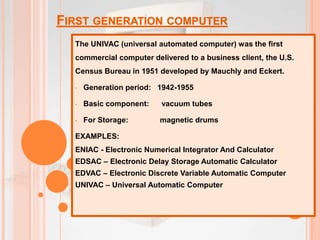
The UNIVAC (universal automated computer) was the first
commercial computer delivered to a business client, the U.S.
Census Bureau in 1951 developed by Mauchly and Eckert.
• Generation period: 1942-1955
• Basic component: vacuum tubes
• For Storage: magnetic drums
EXAMPLES:
ENIAC - Electronic Numerical Integrator And Calculator
EDSAC – Electronic Delay Storage Automatic Calculator
EDVAC – Electronic Discrete Variable Automatic Computer
UNIVAC – Universal Automatic Computer
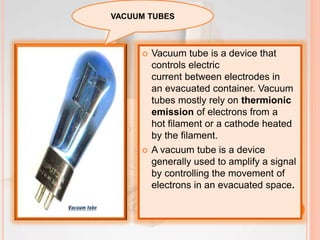
 Vacuum tube is a device that
controls electric
current between electrodes in
an evacuated container. Vacuum
tubes mostly rely on thermionic
emission of electrons from a
hot filament or a cathode heated
by the filament.
 A vacuum tube is a device
generally used to amplify a signal
by controlling the movement of
electrons in an evacuated space.
VACUUM TUBES
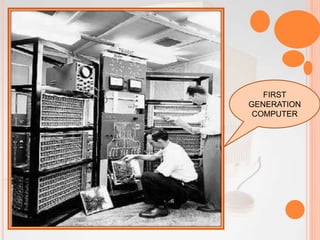
FIRST
GENERATION
COMPUTER
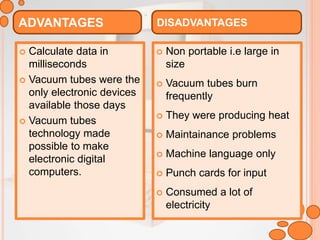
 Calculate data in
milliseconds
 Vacuum tubes were the
only electronic devices
available those days
 Vacuum tubes
technology made
possible to make
electronic digital
computers.
 Non portable i.e large in
size
 Vacuum tubes burn
frequently
 They were producing heat
 Maintainance problems
 Machine language only
 Punch cards for input
 Consumed a lot of
electricity
ADVANTAGES DISADVANTAGES
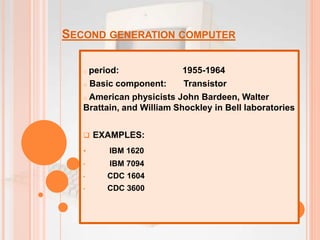
SECOND GENERATION COMPUTER
o period: 1955-1964
o Basic component: Transistor
o American physicists John Bardeen, Walter
Brattain, and William Shockley in Bell laboratories
 EXAMPLES:
• IBM 1620
• IBM 7094
• CDC 1604
• CDC 3600
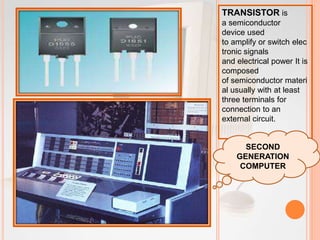
TRANSISTOR is
a semiconductor
device used
to amplify or switch elec
tronic signals
and electrical power It is
composed
of semiconductor materi
al usually with at least
three terminals for
connection to an
external circuit.
SECOND
GENERATION
COMPUTER
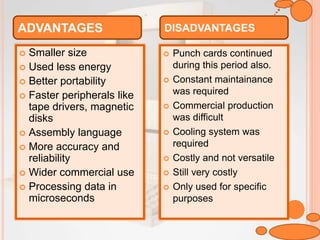
 Smaller size
 Used less energy
 Better portability
 Faster peripherals like
tape drivers, magnetic
disks
 Assembly language
 More accuracy and
reliability
 Wider commercial use
 Processing data in
microseconds
 Punch cards continued
during this period also.
 Constant maintainance
was required
 Commercial production
was difficult
 Cooling system was
required
 Costly and not versatile
 Still very costly
 Only used for specific
purposes
ADVANTAGES DISADVANTAGES
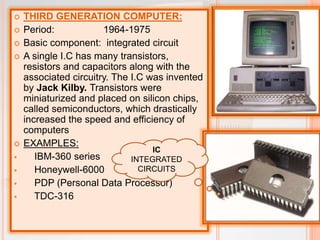
 THIRD GENERATION COMPUTER:
 Period: 1964-1975
 Basic component: integrated circuit
 A single I.C has many transistors,
resistors and capacitors along with the
associated circuitry. The I.C was invented
by Jack Kilby. Transistors were
miniaturized and placed on silicon chips,
called semiconductors, which drastically
increased the speed and efficiency of
computers
 EXAMPLES:
 IBM-360 series
 Honeywell-6000
 PDP (Personal Data Processor)
 TDC-316
IC
INTEGRATED
CIRCUITS
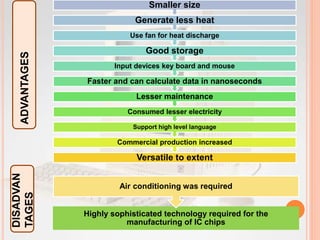
Versatile to extent
Commercial production increased
Support high level language
Consumed lesser electricity
Lesser maintenance
Faster and can calculate data in nanoseconds
Input devices key board and mouse
Good storage
Use fan for heat discharge
Generate less heat
Smaller size
Highly sophisticated technology required for the
manufacturing of IC chips
Air conditioning was required
ADVANTAGES
DISADVAN
TAGES
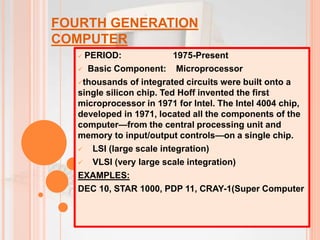
FOURTH GENERATION
COMPUTER
 PERIOD: 1975-Present
 Basic Component: Microprocessor
thousands of integrated circuits were built onto a
single silicon chip. Ted Hoff invented the first
microprocessor in 1971 for Intel. The Intel 4004 chip,
developed in 1971, located all the components of the
computer—from the central processing unit and
memory to input/output controls—on a single chip.
 LSI (large scale integration)
 VLSI (very large scale integration)
EXAMPLES:
DEC 10, STAR 1000, PDP 11, CRAY-1(Super Computer
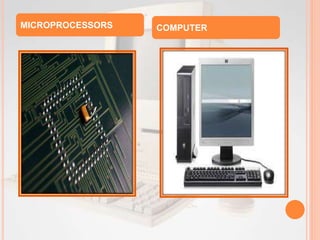
MICROPROCESSORS COMPUTER
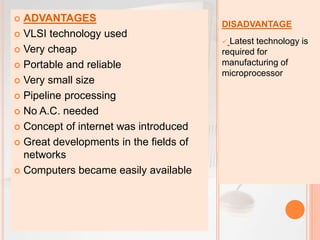
DISADVANTAGE
 Latest technology is
required for
manufacturing of
microprocessor
 ADVANTAGES
 VLSI technology used
 Very cheap
 Portable and reliable
 Very small size
 Pipeline processing
 No A.C. needed
 Concept of internet was introduced
 Great developments in the fields of
networks
 Computers became easily available
FIFTH GENERATION COMPUTER
artificial intelligence
 voice recognition.
Quantum computation and nanotechnology
natural language input
capable of learning and self-organization.
Respond to environment
 neural networks
 EXAMPLE
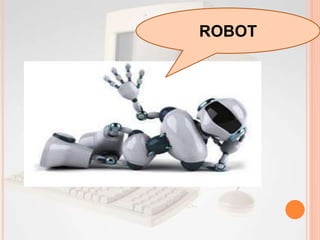
robots
ROBOT
QUESTIONS

Generations of computer

  • 2.
    GENERATIONS OF COMPUTER PRESENTED BY:ZARA ASHI PRESENTED TO: Dr.BUSHRA KANWAL SUBJECT: COMPUTER SCIENCE BS.BIOCHEM
  • 3.
  • 4.
    GENERATIONS OF COMPUTER •A generation refers to the state of improvement in the development of a product. This term is also used in the different advancements of computer technology. • With each new generation, the circuitry has gotten smaller and more advanced than the previous generation before it.
  • 5.
    GENERATIONS. • Currently, there arefive generations of computer. • Comparison of the technology used by them (hardware and software), computing characteristics (speed, i.e., number of instructions executed per second), physical appearance, and their applications First Generation The period of first generation : 1942-1955. Vacuum tube based Second Generation The period of second generation : 1955-1964. Transistor based. Third Generation The period of third generation : 1964-1975. Integrated Circuit based. Fourth Generation The period of fourth generation : 1975-1990. LIC and VLIC microprocessor based. Fifth Generation The period of fifth generation : 1990-onwards.ULIC microprocessor , Nanotechnology
  • 6.
    The UNIVAC (universalautomated computer) was the first commercial computer delivered to a business client, the U.S. Census Bureau in 1951 developed by Mauchly and Eckert. • Generation period: 1942-1955 • Basic component: vacuum tubes • For Storage: magnetic drums EXAMPLES: ENIAC - Electronic Numerical Integrator And Calculator EDSAC – Electronic Delay Storage Automatic Calculator EDVAC – Electronic Discrete Variable Automatic Computer UNIVAC – Universal Automatic Computer
  • 7.
     Vacuum tubeis a device that controls electric current between electrodes in an evacuated container. Vacuum tubes mostly rely on thermionic emission of electrons from a hot filament or a cathode heated by the filament.  A vacuum tube is a device generally used to amplify a signal by controlling the movement of electrons in an evacuated space. VACUUM TUBES
  • 8.
  • 9.
     Calculate datain milliseconds  Vacuum tubes were the only electronic devices available those days  Vacuum tubes technology made possible to make electronic digital computers.  Non portable i.e large in size  Vacuum tubes burn frequently  They were producing heat  Maintainance problems  Machine language only  Punch cards for input  Consumed a lot of electricity ADVANTAGES DISADVANTAGES
  • 10.
    SECOND GENERATION COMPUTER operiod: 1955-1964 o Basic component: Transistor o American physicists John Bardeen, Walter Brattain, and William Shockley in Bell laboratories  EXAMPLES: • IBM 1620 • IBM 7094 • CDC 1604 • CDC 3600
  • 11.
    TRANSISTOR is a semiconductor deviceused to amplify or switch elec tronic signals and electrical power It is composed of semiconductor materi al usually with at least three terminals for connection to an external circuit. SECOND GENERATION COMPUTER
  • 12.
     Smaller size Used less energy  Better portability  Faster peripherals like tape drivers, magnetic disks  Assembly language  More accuracy and reliability  Wider commercial use  Processing data in microseconds  Punch cards continued during this period also.  Constant maintainance was required  Commercial production was difficult  Cooling system was required  Costly and not versatile  Still very costly  Only used for specific purposes ADVANTAGES DISADVANTAGES
  • 13.
     THIRD GENERATIONCOMPUTER:  Period: 1964-1975  Basic component: integrated circuit  A single I.C has many transistors, resistors and capacitors along with the associated circuitry. The I.C was invented by Jack Kilby. Transistors were miniaturized and placed on silicon chips, called semiconductors, which drastically increased the speed and efficiency of computers  EXAMPLES:  IBM-360 series  Honeywell-6000  PDP (Personal Data Processor)  TDC-316 IC INTEGRATED CIRCUITS
  • 14.
    Versatile to extent Commercialproduction increased Support high level language Consumed lesser electricity Lesser maintenance Faster and can calculate data in nanoseconds Input devices key board and mouse Good storage Use fan for heat discharge Generate less heat Smaller size Highly sophisticated technology required for the manufacturing of IC chips Air conditioning was required ADVANTAGES DISADVAN TAGES
  • 15.
    FOURTH GENERATION COMPUTER  PERIOD:1975-Present  Basic Component: Microprocessor thousands of integrated circuits were built onto a single silicon chip. Ted Hoff invented the first microprocessor in 1971 for Intel. The Intel 4004 chip, developed in 1971, located all the components of the computer—from the central processing unit and memory to input/output controls—on a single chip.  LSI (large scale integration)  VLSI (very large scale integration) EXAMPLES: DEC 10, STAR 1000, PDP 11, CRAY-1(Super Computer
  • 16.
  • 17.
    DISADVANTAGE  Latest technologyis required for manufacturing of microprocessor  ADVANTAGES  VLSI technology used  Very cheap  Portable and reliable  Very small size  Pipeline processing  No A.C. needed  Concept of internet was introduced  Great developments in the fields of networks  Computers became easily available
  • 18.
    FIFTH GENERATION COMPUTER artificialintelligence  voice recognition. Quantum computation and nanotechnology natural language input capable of learning and self-organization. Respond to environment  neural networks  EXAMPLE robots
  • 19.
  • 20.