


Generational Differences Texas Medical Association October 4, 2008 Bill M. Wooten, Ph.D. Executive Director, Organization Development The University of Texas M.D. Anderson Cancer Center
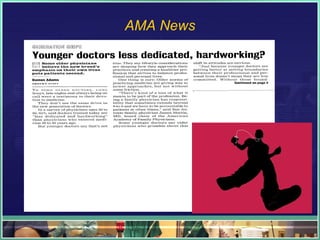
AMA News
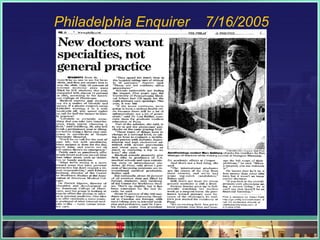
Philadelphia Enquirer  7/16/2005
USA Today - November 7, 2005
 
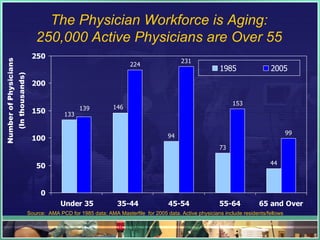
The Physician Workforce is Aging: 250,000 Active Physicians are Over 55 Source:  AMA PCD for 1985 data; AMA Masterfile  for 2005 data. Active physicians include residents/fellows
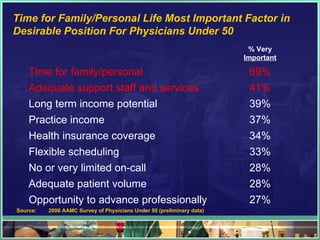
Time for Family/Personal Life Most Important Factor in Desirable Position For Physicians Under 50 Source:  2006 AAMC Survey of Physicians Under 50 (preliminary data) % Very  Important Time for family/personal 69% Adequate support staff and services 41% Long term income potential 39% Practice income 37% Health insurance coverage 34% Flexible scheduling 33% No or very limited on-call 28% Adequate patient volume 28% Opportunity to advance professionally 27%
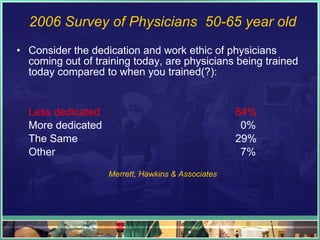
2006 Survey of Physicians  50-65 year old Consider the dedication and work ethic of physicians  coming out of training today, are physicians being trained today compared to when you trained(?): Less dedicated     64%  More dedicated    0% The Same   29% Other 7%   Merrett, Hawkins & Associates
Are Medical Students of Today Different?
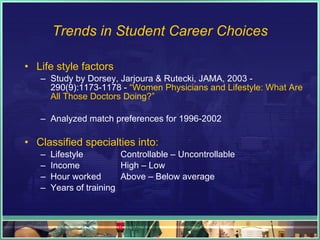
Trends in Student Career Choices Life style factors Study by Dorsey, Jarjoura & Rutecki, JAMA, 2003 - 290(9):1173-1178 -  “Women Physicians and Lifestyle: What Are All Those Doctors Doing?” Analyzed match preferences for 1996-2002 Classified specialties into: Lifestyle Controllable – Uncontrollable Income  High – Low Hour worked Above – Below average Years of training
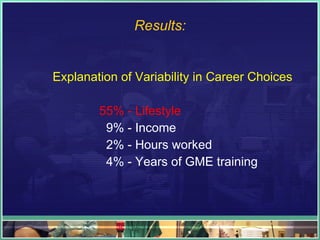
Results: Explanation of Variability in Career Choices 55% - Lifestyle     9% - Income     2% - Hours worked     4% - Years of GME training
 
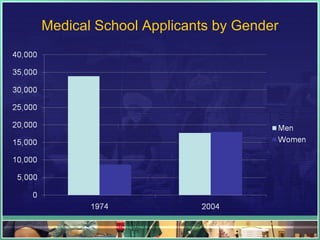
Medical School Applicants by Gender
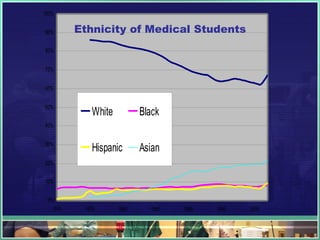
Ethnicity of Medical Students
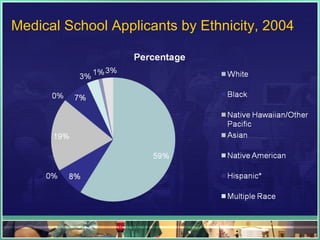
Medical School Applicants by Ethnicity, 2004
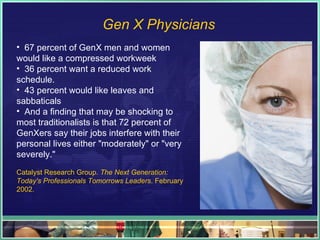
67 percent of GenX men and women would like a compressed workweek 36 percent want a reduced work schedule. 43 percent would like leaves and sabbaticals  And a finding that may be shocking to most traditionalists is that 72 percent of GenXers say their jobs interfere with their personal lives either "moderately" or "very severely."  Catalyst Research Group.  The Next Generation: Today's Professionals Tomorrows Leaders . February 2002. Gen X Physicians
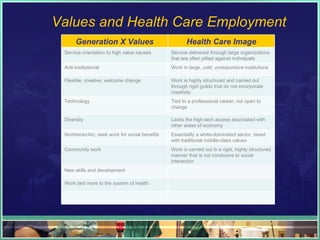
Values and Health Care Employment Generation X Values Health Care Image Service orientation to high value causes  Service delivered through large organizations that are often pitted against individuals  Anti-institutional  Work in large, cold, unresponsive institutions  Flexible, creative, welcome change  Work is highly structured and carried out through rigid guilds that do not incorporate creativity  Technology  Tied to a professional career, not open to change  Diversity  Lacks the high-tech access associated with other areas of economy  Nonhierarchic; seek work for social benefits  Essentially a white-dominated sector, beset with traditional middle-class values  Community work  Work is carried out in a rigid, highly structured manner that is not conducive to social interaction  New skills and development  Work tied more to the system of health
What about Generational Issues?
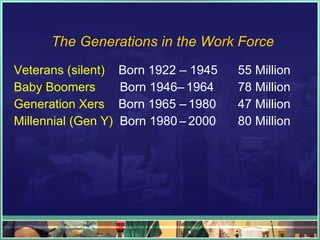
The Generations in the Work Force Veterans (silent)   Born 1922 – 1945  55 Million Baby Boomers   Born 1946–   1964 78 Million Generation Xers   Born 1965 –   1980 47 Million Millennial (Gen Y)  Born 1980   –   2000 80 Million
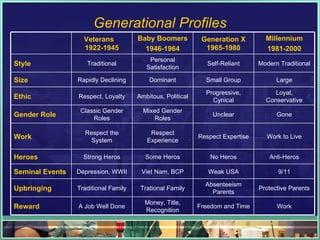
Generational Profiles Veterans  1922-1945 Baby Boomers 1946-1964 Generation X 1965-1980 Millennium 1981-2000 Style Traditional Personal Satisfaction Self-Reliant Modern Traditional Size Rapidly Declining Dominant Small Group Large Ethic Respect, Loyalty Ambitous, Political Progressive, Cynical Loyal, Conservative Gender Role Classic Gender Roles Mixed Gender Roles Unclear Gone Work Respect the System Respect Experience Respect Expertise Work to Live Heroes Strong Heros Some Heros No Heros Anti-Heros Seminal Events Depression, WWII Viet Nam, BCP Weak USA 9/11 Upbringing Traditional Family Trational Family Absenteeism Parents Protective Parents Reward A Job Well Done Money, Title, Recognition Freedom and Time Work
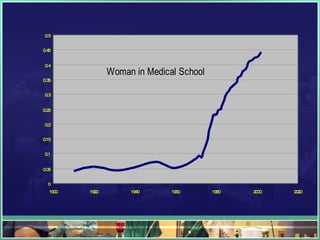
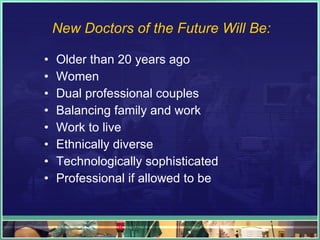
New Doctors of the Future Will Be: Older than 20 years ago Women Dual professional couples Balancing family and work Work to live Ethnically diverse Technologically sophisticated Professional if allowed to be
Essential Attributes of the “Physician” Embrace being a physician Caring and altruistic Honest, integrity Team player Strive for excellence Accept the duty for serving patients and society Courage, heroism
Attributes of the “Future Environment” Patient Focused Flexible Hours Prioritize physician well-bring and live balance Reward excellence, not endurance Promote seamless team care Expect excellence and total commitment doing work Foster joy of being a doctor
Teaching Gen X will need to: Respond to a generation not willing to “pay their dues.” Demand “just in time-just enough” learning Only give  earned  respect Are informal Have children/outside life and will need predictable hours If forced – will choose life style over specialty or income
Teaching Gen X will need to: Deal with “non-joiners” Include good computerized self learners Multi-taskers who learn in sound bites Allow learner centered learning Satisfy the need for relevance
Medical Practices will need: Flexible hours, flexible call schedules Child care Culture of quality, not quantity of work Reward excellence, not endurance Insist on working hard when you work Prevent burn-out Focus on the patient Work in teams Use IT to make practice work well Prioritize physician quality of life
New Doctors will need to : Define themselves as Physicians Take on the responsibilities of the role Have integrity in the workplace Offer proactive solutions for the practice community Be answerable to the patient’s needs Never compromise on quality of care
Being a Physician is: Who you are, all of the time How you relate to people Your role and identity in society How you see the world How you are judged Not ‘just a job’, maybe a “calling”
New Doctors will need to be . . . “ Unafraid of falling totally in love with being a doctor.” Team Players who expect nothing less than excellence in the workplace and accept – not shirk – the responsibility to serve patients and society. Future physicians will need to continue to be couragious healers and perhaps even heros.
Link Between Generational Identities  and Workplace Behavior Generational identities translate into distinct workplace behaviors as they relate to: Relationship with authority Relationship with organization Relationship with colleagues Work styles Management styles Learning styles
Summary Points Important generational differences exist in expectations and values for health care professionals These differences occur with attitudes about institutions, diversity, service, education, and commitment Institutional leaders should be mindful of these differences when designing new systems
Questions?
Appendix – Reference Materials
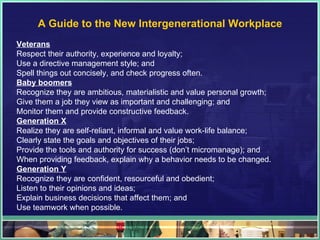
A Guide to the New Intergenerational Workplace Veterans Respect their authority, experience and loyalty;  Use a directive management style; and  Spell things out concisely, and check progress often.  Baby boomers Recognize they are ambitious, materialistic and value personal growth;  Give them a job they view as important and challenging; and  Monitor them and provide constructive feedback.  Generation X Realize they are self-reliant, informal and value work-life balance;  Clearly state the goals and objectives of their jobs;  Provide the tools and authority for success (don’t micromanage); and  When providing feedback, explain why a behavior needs to be changed.  Generation Y Recognize they are confident, resourceful and obedient;  Listen to their opinions and ideas;  Explain business decisions that affect them; and  Use teamwork when possible.
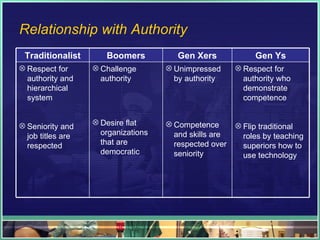
Relationship with Authority Traditionalist Boomers Gen Xers Gen Ys Respect for authority and hierarchical system Seniority and job titles are respected Challenge authority Desire flat organizations that are democratic  Unimpressed by authority  Competence and skills are respected over seniority Respect for authority who demonstrate competence  Flip traditional roles by teaching superiors how to use technology
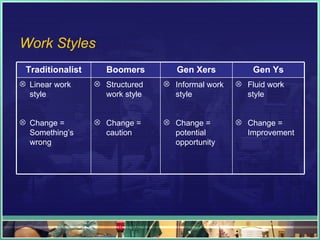
Work Styles  Traditionalist Boomers Gen Xers Gen Ys Linear work style Change = Something’s wrong Structured work style Change = caution  Informal work style Change = potential opportunity  Fluid work style Change = Improvement
But how shall we educate men of goodness, to a sense of one another, to a love of truth?  And more urgently, how shall we do this in a bad time? Daniel Berrigan
Thank You! Bill M. Wooten, Ph.D. [email_address]  713.745.6448 The University of Texas M.D. Anderson Cancer Center

Generational Differences Texas Medical Association 10 3 2008

  • 1.
    Generational Differences TexasMedical Association October 4, 2008 Bill M. Wooten, Ph.D. Executive Director, Organization Development The University of Texas M.D. Anderson Cancer Center
  • 2.
  • 3.
  • 4.
    USA Today -November 7, 2005
  • 5.
  • 6.
    The Physician Workforceis Aging: 250,000 Active Physicians are Over 55 Source: AMA PCD for 1985 data; AMA Masterfile for 2005 data. Active physicians include residents/fellows
  • 7.
    Time for Family/PersonalLife Most Important Factor in Desirable Position For Physicians Under 50 Source: 2006 AAMC Survey of Physicians Under 50 (preliminary data) % Very Important Time for family/personal 69% Adequate support staff and services 41% Long term income potential 39% Practice income 37% Health insurance coverage 34% Flexible scheduling 33% No or very limited on-call 28% Adequate patient volume 28% Opportunity to advance professionally 27%
  • 8.
    2006 Survey ofPhysicians 50-65 year old Consider the dedication and work ethic of physicians coming out of training today, are physicians being trained today compared to when you trained(?): Less dedicated 64% More dedicated 0% The Same 29% Other 7% Merrett, Hawkins & Associates
  • 9.
    Are Medical Studentsof Today Different?
  • 10.
    Trends in StudentCareer Choices Life style factors Study by Dorsey, Jarjoura & Rutecki, JAMA, 2003 - 290(9):1173-1178 - “Women Physicians and Lifestyle: What Are All Those Doctors Doing?” Analyzed match preferences for 1996-2002 Classified specialties into: Lifestyle Controllable – Uncontrollable Income High – Low Hour worked Above – Below average Years of training
  • 11.
    Results: Explanation ofVariability in Career Choices 55% - Lifestyle 9% - Income 2% - Hours worked 4% - Years of GME training
  • 12.
  • 13.
  • 14.
  • 15.
    Medical School Applicantsby Ethnicity, 2004
  • 16.
    67 percent ofGenX men and women would like a compressed workweek 36 percent want a reduced work schedule. 43 percent would like leaves and sabbaticals And a finding that may be shocking to most traditionalists is that 72 percent of GenXers say their jobs interfere with their personal lives either "moderately" or "very severely." Catalyst Research Group. The Next Generation: Today's Professionals Tomorrows Leaders . February 2002. Gen X Physicians
  • 17.
    Values and HealthCare Employment Generation X Values Health Care Image Service orientation to high value causes Service delivered through large organizations that are often pitted against individuals Anti-institutional Work in large, cold, unresponsive institutions Flexible, creative, welcome change Work is highly structured and carried out through rigid guilds that do not incorporate creativity Technology Tied to a professional career, not open to change Diversity Lacks the high-tech access associated with other areas of economy Nonhierarchic; seek work for social benefits Essentially a white-dominated sector, beset with traditional middle-class values Community work Work is carried out in a rigid, highly structured manner that is not conducive to social interaction New skills and development Work tied more to the system of health
  • 18.
  • 19.
    The Generations inthe Work Force Veterans (silent) Born 1922 – 1945 55 Million Baby Boomers Born 1946– 1964 78 Million Generation Xers Born 1965 – 1980 47 Million Millennial (Gen Y) Born 1980 – 2000 80 Million
  • 20.
    Generational Profiles Veterans 1922-1945 Baby Boomers 1946-1964 Generation X 1965-1980 Millennium 1981-2000 Style Traditional Personal Satisfaction Self-Reliant Modern Traditional Size Rapidly Declining Dominant Small Group Large Ethic Respect, Loyalty Ambitous, Political Progressive, Cynical Loyal, Conservative Gender Role Classic Gender Roles Mixed Gender Roles Unclear Gone Work Respect the System Respect Experience Respect Expertise Work to Live Heroes Strong Heros Some Heros No Heros Anti-Heros Seminal Events Depression, WWII Viet Nam, BCP Weak USA 9/11 Upbringing Traditional Family Trational Family Absenteeism Parents Protective Parents Reward A Job Well Done Money, Title, Recognition Freedom and Time Work
  • 21.
    New Doctors ofthe Future Will Be: Older than 20 years ago Women Dual professional couples Balancing family and work Work to live Ethnically diverse Technologically sophisticated Professional if allowed to be
  • 22.
    Essential Attributes ofthe “Physician” Embrace being a physician Caring and altruistic Honest, integrity Team player Strive for excellence Accept the duty for serving patients and society Courage, heroism
  • 23.
    Attributes of the“Future Environment” Patient Focused Flexible Hours Prioritize physician well-bring and live balance Reward excellence, not endurance Promote seamless team care Expect excellence and total commitment doing work Foster joy of being a doctor
  • 24.
    Teaching Gen Xwill need to: Respond to a generation not willing to “pay their dues.” Demand “just in time-just enough” learning Only give earned respect Are informal Have children/outside life and will need predictable hours If forced – will choose life style over specialty or income
  • 25.
    Teaching Gen Xwill need to: Deal with “non-joiners” Include good computerized self learners Multi-taskers who learn in sound bites Allow learner centered learning Satisfy the need for relevance
  • 26.
    Medical Practices willneed: Flexible hours, flexible call schedules Child care Culture of quality, not quantity of work Reward excellence, not endurance Insist on working hard when you work Prevent burn-out Focus on the patient Work in teams Use IT to make practice work well Prioritize physician quality of life
  • 27.
    New Doctors willneed to : Define themselves as Physicians Take on the responsibilities of the role Have integrity in the workplace Offer proactive solutions for the practice community Be answerable to the patient’s needs Never compromise on quality of care
  • 28.
    Being a Physicianis: Who you are, all of the time How you relate to people Your role and identity in society How you see the world How you are judged Not ‘just a job’, maybe a “calling”
  • 29.
    New Doctors willneed to be . . . “ Unafraid of falling totally in love with being a doctor.” Team Players who expect nothing less than excellence in the workplace and accept – not shirk – the responsibility to serve patients and society. Future physicians will need to continue to be couragious healers and perhaps even heros.
  • 30.
    Link Between GenerationalIdentities and Workplace Behavior Generational identities translate into distinct workplace behaviors as they relate to: Relationship with authority Relationship with organization Relationship with colleagues Work styles Management styles Learning styles
  • 31.
    Summary Points Importantgenerational differences exist in expectations and values for health care professionals These differences occur with attitudes about institutions, diversity, service, education, and commitment Institutional leaders should be mindful of these differences when designing new systems
  • 32.
  • 33.
  • 34.
    A Guide tothe New Intergenerational Workplace Veterans Respect their authority, experience and loyalty; Use a directive management style; and Spell things out concisely, and check progress often. Baby boomers Recognize they are ambitious, materialistic and value personal growth; Give them a job they view as important and challenging; and Monitor them and provide constructive feedback. Generation X Realize they are self-reliant, informal and value work-life balance; Clearly state the goals and objectives of their jobs; Provide the tools and authority for success (don’t micromanage); and When providing feedback, explain why a behavior needs to be changed. Generation Y Recognize they are confident, resourceful and obedient; Listen to their opinions and ideas; Explain business decisions that affect them; and Use teamwork when possible.
  • 35.
    Relationship with AuthorityTraditionalist Boomers Gen Xers Gen Ys Respect for authority and hierarchical system Seniority and job titles are respected Challenge authority Desire flat organizations that are democratic Unimpressed by authority Competence and skills are respected over seniority Respect for authority who demonstrate competence Flip traditional roles by teaching superiors how to use technology
  • 36.
    Work Styles Traditionalist Boomers Gen Xers Gen Ys Linear work style Change = Something’s wrong Structured work style Change = caution Informal work style Change = potential opportunity Fluid work style Change = Improvement
  • 37.
    But how shallwe educate men of goodness, to a sense of one another, to a love of truth? And more urgently, how shall we do this in a bad time? Daniel Berrigan
  • 38.
    Thank You! BillM. Wooten, Ph.D. [email_address] 713.745.6448 The University of Texas M.D. Anderson Cancer Center

Editor's Notes

  • #2 As we face another generation of workers entering into the changing world of the workplace, managers and supervisors are encouraged to deal with the generational differences that exist among workers. There are for the first time four generations represented in the workplace. Each generation brings its own view of the world with its experiences, perspectives, ethics, and values. And each generation forces society to look at life and work with a different focus, resulting in changes to workplace policies and procedures. It is not just coincidence that new programs addressing lifestyle changes, work/life balance, health and fitness — previously not considered key benefits — are now primary considerations of potential employees, and common practices among the most admired companies. This presentation visits the issues of generational differences and what they mean in the delivery of quality health care.