Workforce	
  Readiness:	


Should	
  the	
  Economy	
  Influence	
  
            our	
  Efforts?	


                            Presented	
  by:	
  
                     Kathryn	
  W.	
  Davanzo,	
  SPHR	
  
            Na5onal	
  Speaker,	
  Trainer	
  and	
  HR	
  Consultant	


                                    Represen?ng	
  
    CODA	
  Partners,	
  Inc.	
  	
  &	
  	
  	
  Pelorus	
  Leadership	
  Group,	
  Inc.	
  
Workforce	
  Readiness:	
  
      A	
  Broad	
  and	
  Complex	
  Issue	
  

As	
  HR	
  professionals	
  it	
  is	
  our	
  responsibility	
  is	
  	
  
to	
  ensure	
  our	
  organiza?ons	
  have	
  the	
  human	
  
                           capacity	
  	
  
                       (KSAs,	
  numbers)	
  	
  
             to	
  execute	
  our	
  strategy	
  and	
  	
  
      to	
  achieve	
  the	
  promise	
  of	
  our	
  vision.	
  
Workforce	
  Readiness:	
  
             A	
  Broad	
  and	
  Complex	
  Issue	
  

•  The	
  demographics	
  predicted…	
  
   –  Boomers	
  re?rements	
  will	
  lead	
  to	
  “brain	
  drain.”	
  
   –  Age,	
  ethnicity	
  and	
  other	
  demographic	
  shiRs	
  will	
  challenge	
  
      how	
  we	
  communicate	
  and	
  lead.	


•  Experience	
  was	
  teaching	
  us…	
  
   –  We	
  will	
  not	
  be	
  able	
  to	
  find	
  the	
  talent	
  we	
  need.	
  
   –  Worker	
  expecta?ons	
  will	
  shiR.	
  
Workforce	
  Readiness:	
  
            A	
  Broad	
  and	
  Complex	
  Issue	
  

•  Our	
  profession	
  and	
  public	
  media	
  preached…	
  

   –  We	
  must	
  prepare	
  for	
  pending	
  skills	
  shortages.	
  
   –  We	
  must	
  leverage	
  technology.	
  
   –  We	
  must	
  learn	
  to	
  operate	
  in	
  a	
  global	
  talent	
  market.	
  
Workforce	
  Readiness:	
  
             A	
  Broad	
  and	
  Complex	
  Issue	
  

 Then	
  the	
  economy	
  took	
  our	
  focus	
  off	
  the	
  future…	
  

                  Instead	
  of	
  building	
  we	
  were	
  razing.	
  
Instead	
  of	
  developing	
  talent	
  we	
  were	
  reducing	
  head	
  count.	
  
                    Instead	
  of	
  hiring	
  we	
  were	
  firing.	
  
Workforce	
  Readiness:	
  
             A	
  Broad	
  and	
  Complex	
  Issue	
  

                        Today’s	
  HR	
  Challenge…	
  

•  Recognize	
  our	
  current	
  reali?es	
  and	
  our	
  future	
  prospects.	
  

•  Address	
  our	
  short	
  and	
  long	
  term	
  workforce	
  requirements.	
  
Today…	
  

•  Trends	
  &	
  events	
  to	
  consider.	
  
•  Four	
  things	
  we	
  can	
  do	
  to	
  keep	
  things	
  balanced:	
  
    –  Find	
  and	
  face	
  the	
  new	
  reali?es	
  
    –  Look	
  back	
  first	
  
    –  Seek	
  the	
  next	
  prac?ce	
  not	
  just	
  the	
  best	
  prac?ce	
  
    –  Fund	
  the	
  future	
  first	
  
Trends	
  SHRM	
  Was	
  Watching	
  in	
  2009	
  
1.  The	
  impact	
  of	
  the	
  global	
  recession	
  on	
  business	
  strategy	
  and	
  
    employees.	


2.  The	
  influence	
  of	
  social	
  networking,	
  especially	
  as	
  it	
  relates	
  to	
  
    recrui?ng.	


3.  The	
  con?nuing	
  importance	
  of	
  work/life	
  balance	
  as	
  employees	
  deal	
  
    with	
  mul?ple	
  caring	
  responsibili?es	
  and,	
  in	
  some	
  cases,	
  mul?ple	
  paid	
  jobs.	


4.  The	
  need	
  for	
  measurement	
  of	
  results	
  and	
  the	
  development	
  and	
  
    standardiza?on	
  of	
  key	
  HR	
  metrics.	
  
Trends	
  SHRM	
  Was	
  Watching	
  in	
  2009	
  
5.  The	
  growing	
  need	
  for	
  organiza?ons	
  to	
  demonstrate	
  a	
  commitment	
  to	
  
    ethics,	
  sustainability	
  and	
  social	
  responsibility.	
  

6.  Safety	
  issues,	
  par?cularly	
  workplace	
  aggression	
  and	
  the	
  
    poten?al	
  impact	
  of	
  a	
  global	
  disease	
  pandemic.	


7.  The	
  importance	
  of	
  globaliza?on	
  and	
  integra?ng	
  
    markets.	
  	
  
What	
  SHRM	
  Was	
  Watching	
  in	
  2009	
  
8.  Con?nued	
  emphasis	
  on	
  performance	
  management.	


9.  The	
  ongoing	
  need	
  for	
  skilled	
  employees	
  and	
  concerns	
  about	
  the	
  ability	
  of	
  
    the	
  U.S.	
  educa?on	
  system	
  to	
  produce	
  the	
  needed	
  skilled	
  
    workers	
  of	
  the	
  future.	


10. 	
  Demographic	
  change	
  and	
  its	
  impact	
  on	
  diversity	
  and	
  labor	
  
    availability.	


11. The	
  implica?ons	
  of	
  government	
  legisla?on.	
  
Events	
  and	
  Trends	
  Impact	
  
                                                                                                 Economics	


1.        Who	
  is	
  working?	
                                    Technology	


2.        Where	
  are	
  we	
  working?	
  
                                                                                            Demographics	
  

3.        When	
  are	
  we	
  working?	
  
4.        What	
  work	
  do	
  we	
  need	
  to	
  do?	
                Globaliza?on	


5.  How	
  will	
  we	
  define	
  our	
                                                                Government	


  employment	
  rela?onship?	
  
Culng	
  Edge	
  Careers	


Changes	
  in	
  Work:	
                       1. Asian	
  Business	
  Development	
  Specialist	
  	
  
                                               2. Behavioral	
  Gene?cist	
  	
  
Some	
  of	
  the	
                            3. Computa?onal	
  Biologist	


fastest	
  growing	
                           4. Data	
  Miner	
  	
  
                                               5. Emergency	
  Planning	
  Manager	
  	
  
occupa?ons	
  today	
                          6. Green-­‐Collar	
  Consultant	
  	
  
                                               7. Health	
  Informa?cs	
  Specialist	
  	
  
did	
  not	
  even	
  exist	
                  8. Immigra?on	
  Specialist	


15	
  years	
  ago.	
                          9. Offshoring	
  Manager	
  	
  
                                               10. Pa?ent	
  Advocate	
  	
  
                                               11. Simula?on	
  Developer	
  	
  
US	
  News	
  and	
  World	
  Report	
  	
     12. Wellness	
  Coach	
  	
  
June	
  30,	
  2008	
  
Cri?cal	
  Healthcare	
  IT	
  Jobs	
  
Changes	
  in	
  Work:	
  
                             1. Prac?ce	
  Workflow	
  Specialist	
  

                             2. Informa?on	
  Management	
  Redesign	
  
E-­‐Healthcare	
                Specialist	
  
Systems	
                    3. Clinician-­‐Prac??oner	
  Consultant	
  

T&D	
  Magazine	
  	
        4. Implementa?on	
  Support	
  Specialist	
  
February,	
  2010	
  
                             5. Technical-­‐soRware	
  Support	
  Staff	
  

                             6. Trainers	
  
Changes	
  in	
  Who	
  Is	
  Working	
  on	
  What	
  

As	
  of	
  2005	
  there	
  was	
  a	
  shortage	
  of	
  
40,000	
  principals.	


                                         How	
  has/will	
  this	
  
                                         change	
  schools	
  
Harriet	
  Hankin	
                      and	
  educa?on?	
  
The	
  New	
  Workforce	
  
Changes	
  in	
  the	
  Workforce	
  
  2006	
  US	
  Census	
  Bureau	
  –	
  Labor	
  Force	
  Trends	


                   T	
          M	
                                     Millennials	
  
                                                                        Millenials	
  
                  20%	
        20%	
  
                                                                        Gen	
  Xers	
  
                                                                        Boomers	
  
                                    X	
                                 Tradi?onalists	
  
                 B	
  
                                   26%	
  
                34%	
  
Changes	
  in	
  the	
  Workforce	
  
  2012	
  US	
  Census	
  Bureau	
  –	
  Labor	
  Force	
  Trends	


                     T	
  
                    15%	
          M	
                                  Millennials	
  
                                                                        Millenials	
  
                                  33%	
                                 Gen	
  Xers	
  
                B	
                                                     Boomers	
  
               30%	
           X	
                                      Tradi?onalists	
  
                              22%	
  
Changes	
  in	
  the	
  Workforce	
  
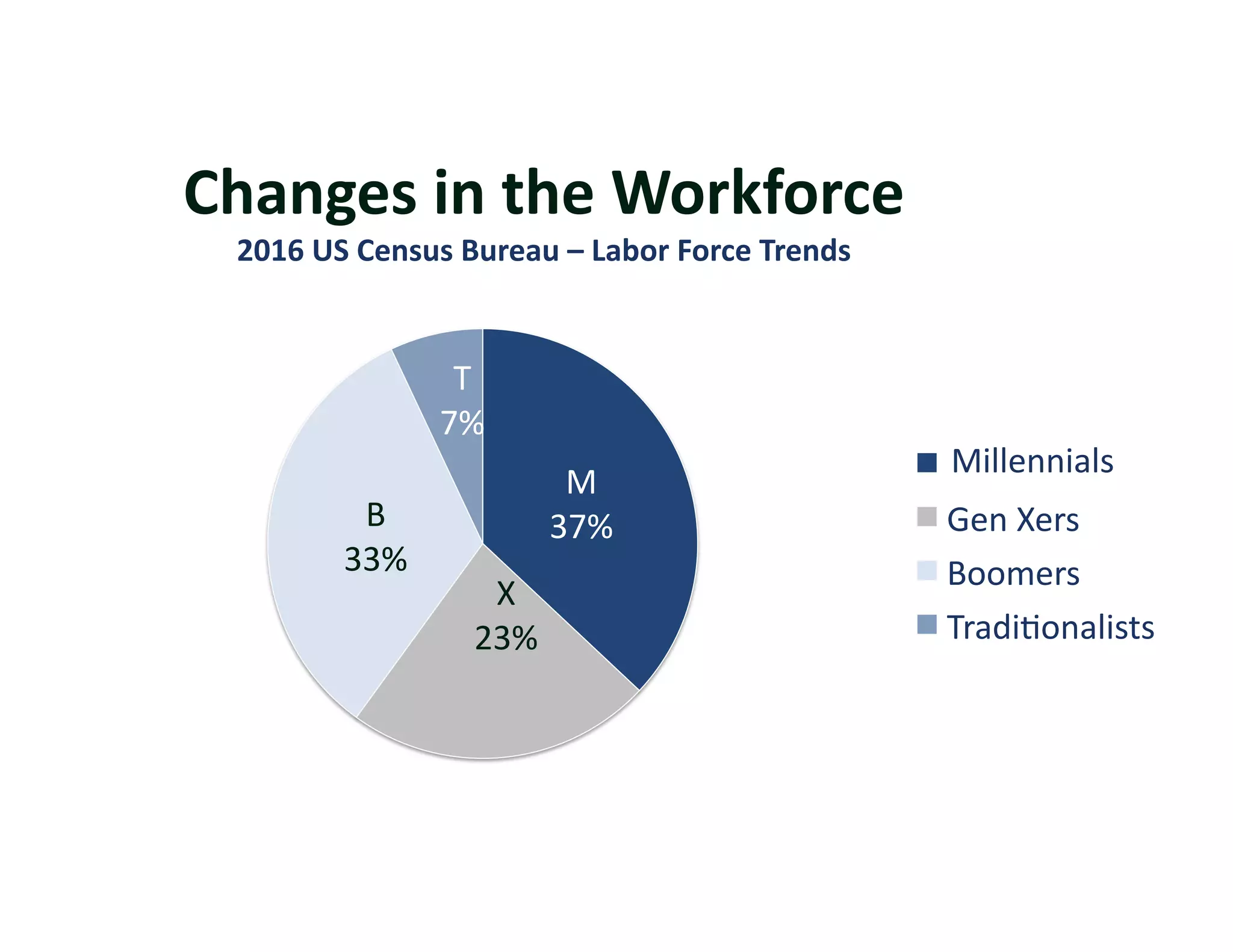
  2016	
  US	
  Census	
  Bureau	
  –	
  Labor	
  Force	
  Trends	


                        T	
  
                       7%	
  
                                                                        Millennials	
  
                                                                        Millenials	
  
                                      M	
  
              B	
                    37%	
                              Gen	
  Xers	
  
             33%	
                                                      Boomers	
  
                            X	
  
                           23%	
                                        Tradi?onalists	
  
Changes	
  in	
  the	
  Workforce:	
  Ethnicity	
  
 Hispanics	
  are	
  the	
  second	
  largest	
  
 segment	
  of	
  the	
  US	
  labor	
  force	


  2005 	


  Projected	
  for	
  2050	
  
   	
  Hispanics	
  represented	
   	
   	
  Hispanics	
  will	
  represent	
  
   	
  14%	
  of	
  the	
  popula?on	
   	
   	
  32%	
  of	
  the	
  popula?on	
  
   	
  22%	
  of	
  the	
  workforce	
   	
   	
  55%	
  of	
  the	
  workforce	
  
Changes	
  in	
  Where	
  We	
  Work	
  
At	
  the	
  company?	
  
Offshore?	
  
On	
  the	
  road?	
  
At	
  home?	
  
How	
  We	
  Work	
  –	
  Skill	
  ShiFs? 	


        •  Encyclopedias	
  
        •    Newspapers	
  –	
  	
  
        •    Musical	
  Ar?sts	
  
        •    Boat	
  Sales	
  –	
  	
  
        •    Temp	
  Agencies	
  –	
  	
  
        •    Your	
  Industry????	
  
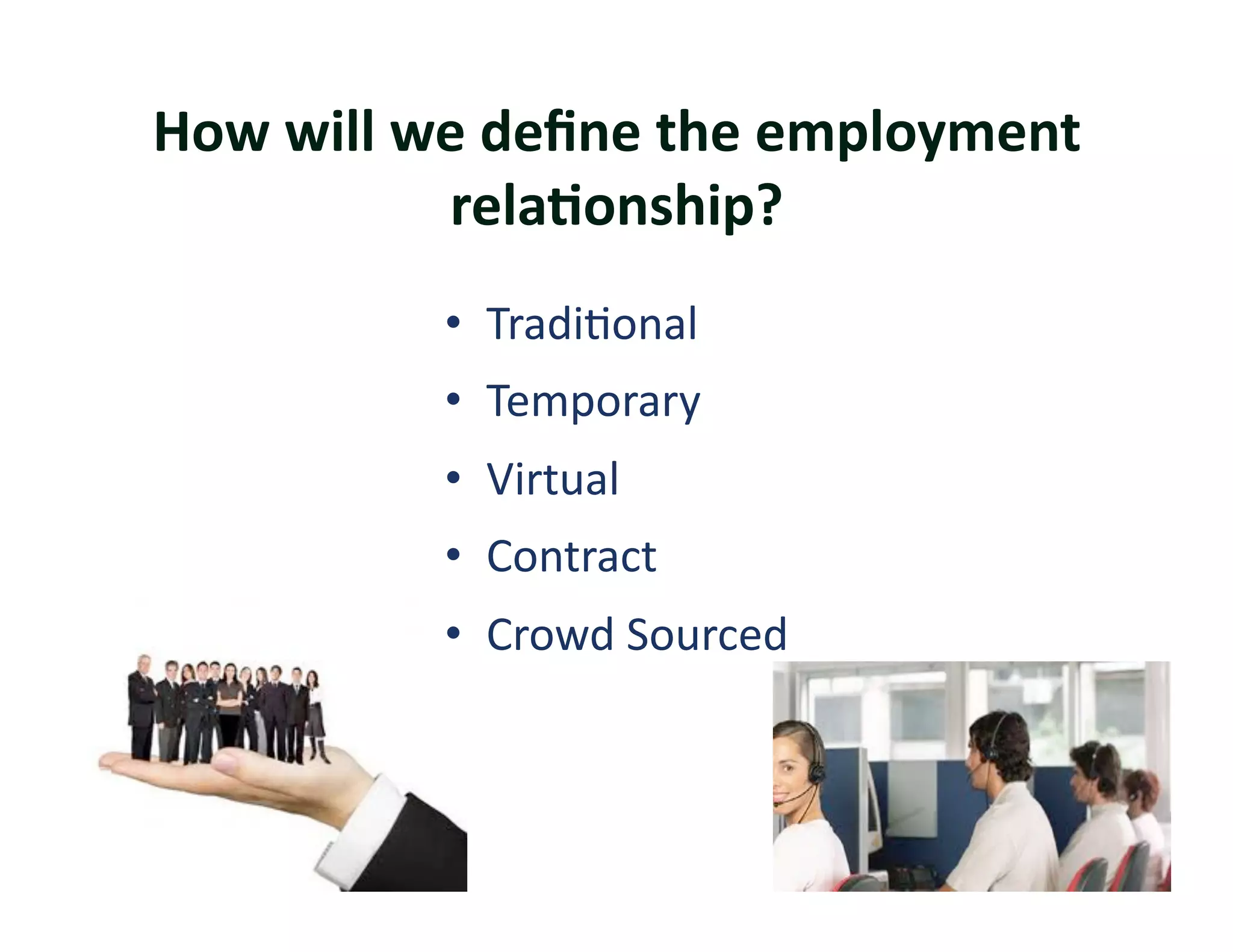
How	
  will	
  we	
  define	
  the	
  employment	
  
                relaKonship? 	
  	
  
               •  Tradi?onal	
  
               •  Temporary	
  
               •  Virtual	
  
               •  Contract	
  
               •  Crowd	
  Sourced	
  
What	
  Should	
  We	
  Do?	
  

•  Find	
  and	
  face	
  the	
  new	
  realiKes	
  

•  Look	
  back	
  first	
  

•  Seek	
  the	
  next	
  prac?ce	
  

•  Fund	
  the	
  future	
  first	
  
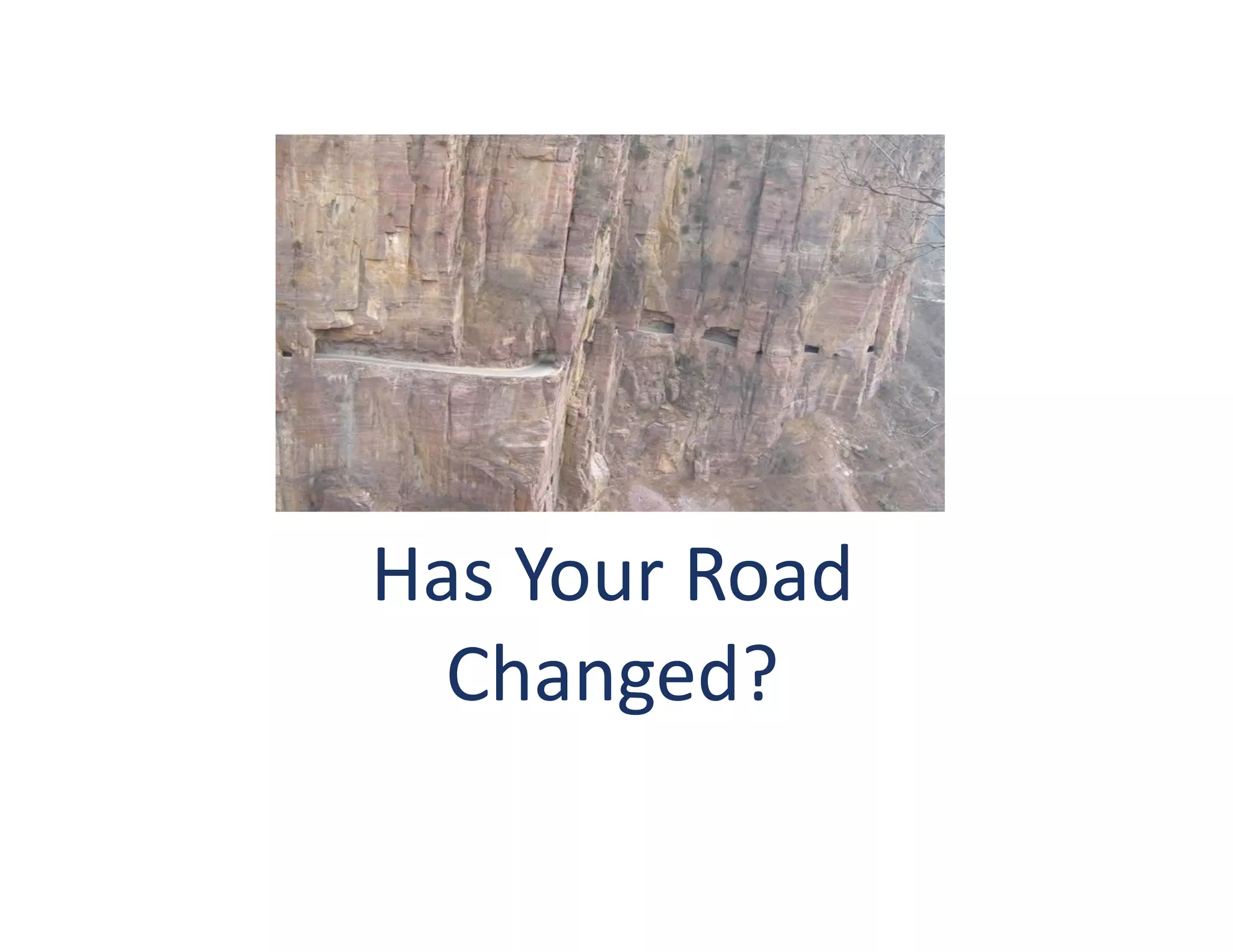
Has	
  Your	
  Road	
  
  Changed?	
  
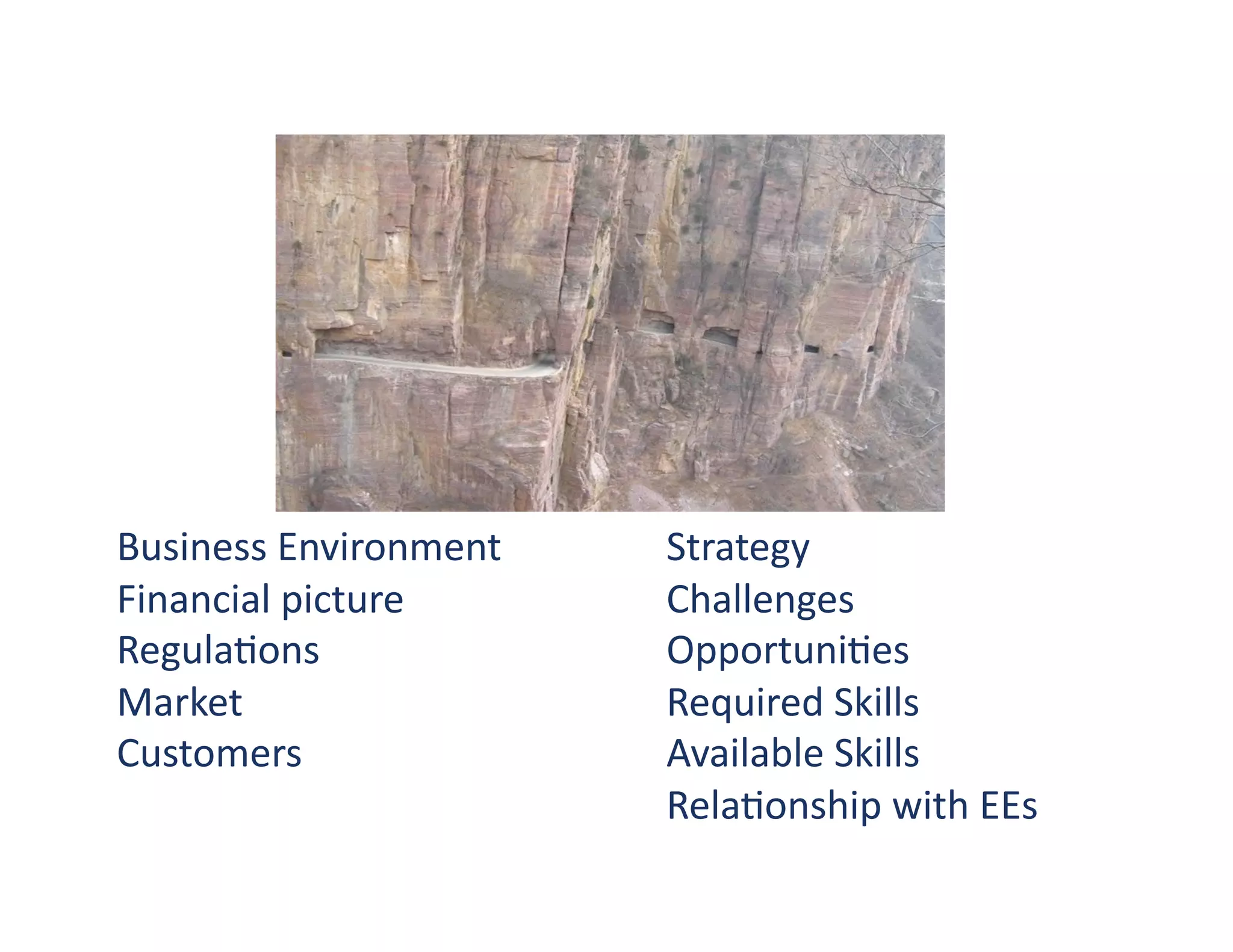
Business	
  Environment	
     Strategy	
  
Financial	
  picture	
        Challenges	
  
Regula?ons	
                  Opportuni?es	
  
Market	
                      Required	
  Skills	
  
Customers	
                   Available	
  Skills	
  
                              Rela?onship	
  with	
  EEs	
  
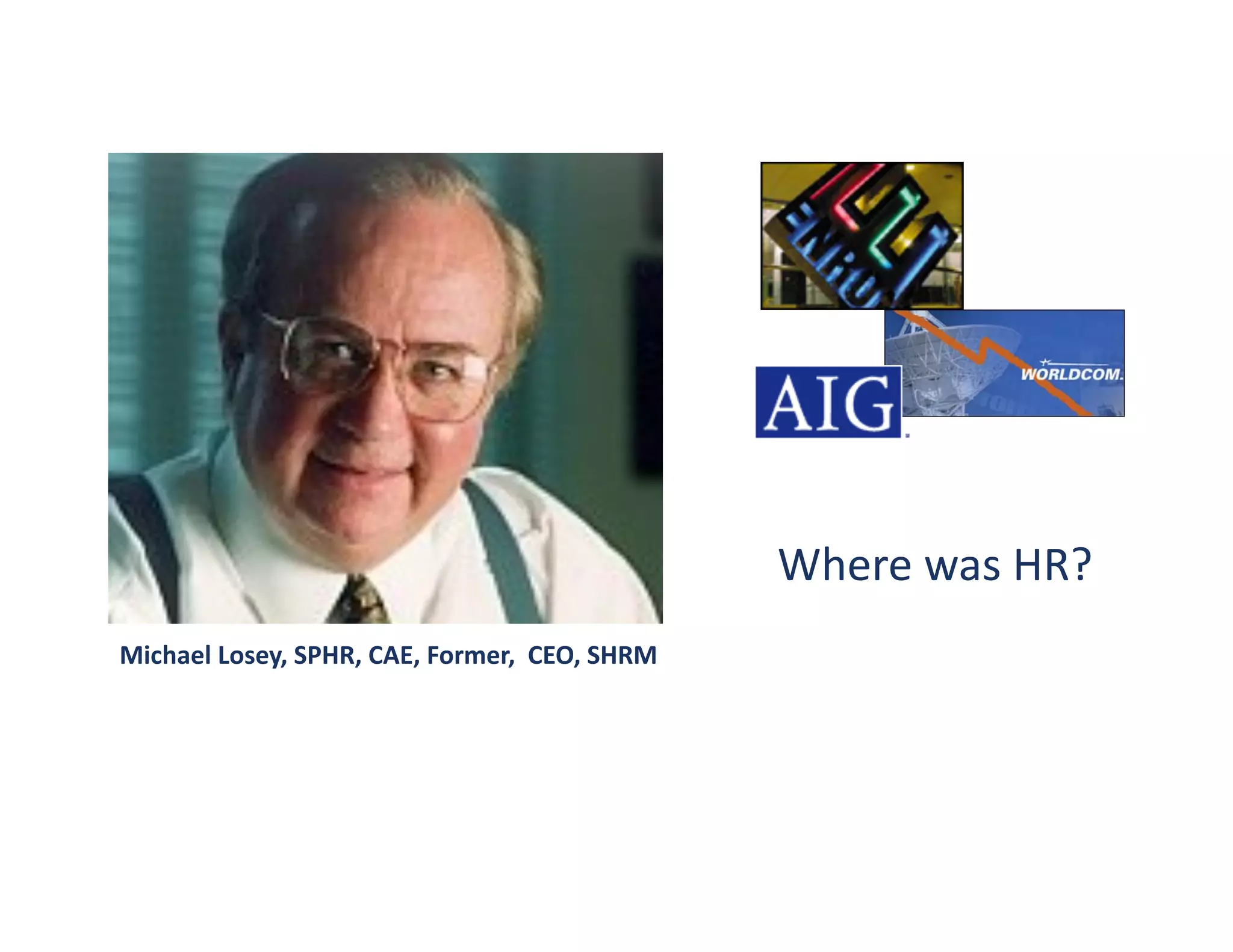
Where	
  was	
  HR?	
  
Michael	
  Losey,	
  SPHR,	
  CAE,	
  Former,	
  	
  CEO,	
  SHRM	
  
Find	
  the	
  Facts	


When	
  you	
  turn	
  over	
  rocks	
  and	
  look	
  at	
  all	
  the	
  
squiggly	
  things	
  underneath,	
  you	
  can	
  either	
  put	
  
the	
  rock	
  down,	
  or	
  you	
  can	
  say,	
  ‘My	
  job	
  is	
  to	
  
turn	
  over	
  rocks	
  and	
  look	
  at	
  the	
  squiggly	
  
things,’	
  even	
  if	
  they	
  scare	
  the	
  hell	
  out	
  of	
  you.”	
  
Fred	
  Purdue,	
  Pitney	
  Bowes	
  Execu?ve	
  quoted	
  in	
  Good	
  to	
  Great	
  
The	
  	
  Stockdale	
  Paradox	
  
                                            Retain	
  faith	
  that	
  you	
  will	
  
                                               prevail	
  in	
  the	
  end,	
  
                                            regardless	
  of	
  difficul?es	


                                              and	
  at	
  the	
  same	
  5me	
  
Admiral	
  James	
  Bond	
  Stockdale	


                                            confront	
  the	
  most	
  brutal	
  
                                              facts	
  of	
  your	
  current	
  
                                             reality,	
  whatever	
  they	
  
                                                       might	
  be.	
  
Some	
  of	
  today’s	
  facts	
  we	
  must	
  face	
  	
  
Economic	
  Downturn	
                                  Past	
  Recessions	


  This	
  is	
  not	
     • 
                                • 
                                     Recession	
  of	
  (1902	
  -­‐	
  1904)	
  	
  
                                     Panic	
  of	
  1907	
  (1907	
  –	
  1908)	
  
                                •    Post-­‐WWI	
  recession	
  	
  
        our	
  first	
           • 
                                • 
                                     Great	
  Depression	
  (1929	
  to	
  late	
  1930s)	
  
                                     Recession	
  of	
  (1945)	
  	
  
    recession!	
                • 
                                • 
                                     Recession	
  of	
  (1948	
  -­‐	
  1949)	
  	
  
                                     Post-­‐Korean	
  War	
  Recession	
  (1953	
  -­‐	
  1954)	
  	
  
                                •    Recession	
  of	
  (1957	
  -­‐	
  1958)	
  
                                •    Recession	
  of	
  (1960	
  -­‐	
  1961)	
  	
  
                                •    Bond	
  Inversion	
  of	
  (1965	
  -­‐	
  1967)	
  	
  
                                •    Recession	
  of	
  (1969	
  -­‐	
  1970)	
  	
  
                                •    1973	
  oil	
  crisis	
  (1973	
  -­‐	
  1975)	
  	
  
                                •    1979	
  energy	
  crisis	
  -­‐	
  1979	
  un?l	
  1980	
  
                                •    Early	
  1980s	
  recession	
  -­‐	
  1982	
  and	
  1983	
  
                                •    Late	
  1980s	
  recession	
  -­‐	
  1988	
  to	
  1992	
  
                                •    Early	
  2000s	
  recession	
  -­‐	
  2001	
  to	
  2003	
  
Remember	
  trends	
  are	
  not	
  certain?es	
  
            Categories	
  of	
  55+	
  Workers	
  
 •  Mature	
  Workers	
  –	
  with	
  financial	
  resources	
  
 •  Mature	
  Workers-­‐	
  without	
  financial	
  resources	
  
 •  Working	
  Re?red	
  
 •  Tradi?onal	
  Re?rees	
  

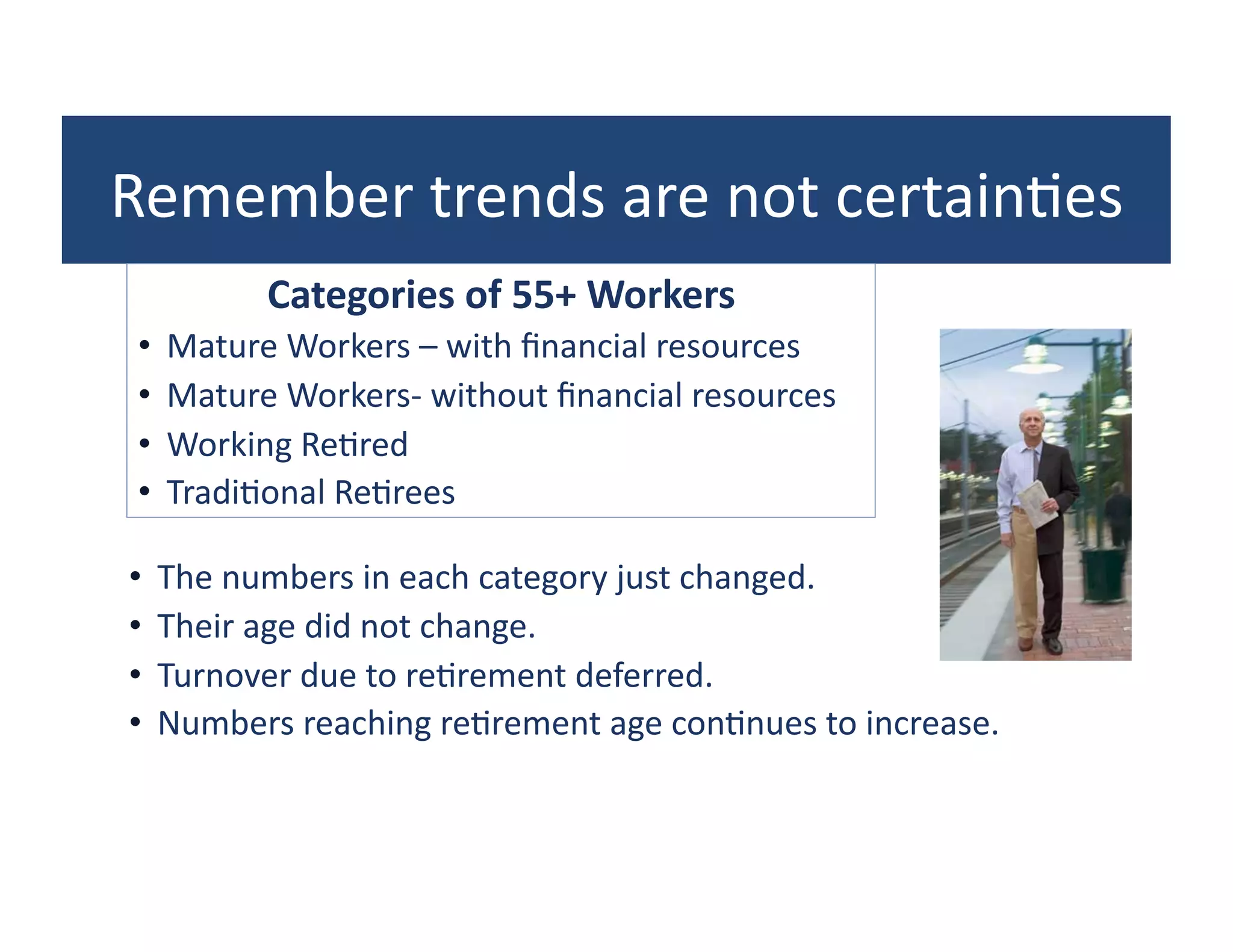
•  The	
  numbers	
  in	
  each	
  category	
  just	
  changed.	
  
•  Their	
  age	
  did	
  not	
  change.	
  
•  Turnover	
  due	
  to	
  re?rement	
  deferred.	
  
•  Numbers	
  reaching	
  re?rement	
  age	
  con?nues	
  to	
  increase.	
  
Have	
  You	
  Let	
  the	
  Current	
  Reality	
  	
  
                      Dictate	
  Your	
  Future?	
  
       Glaring	
  gap	
  exists	
  between	
  the	
  leadership	
  skills	
  
    organiza?ons	
  have	
  now	
  and	
  the	
  ones	
  they	
  will	
  need	
  five	
  
                              years	
  from	
  now.	


  Understanding	
  the	
  Leadership	
  Gap	


  Center	
  for	
  Crea?ve	
  Leadership,	
  2009	
  
                                       •  Leading	
  people	
  
        4	
  skills	
                  •  Planning	
  strategically	
  
        leaders	
  will	
              •  Inspiring	
  commitment	
  
        most	
  need	
                 •  Managing	
  change	
  
What	
  is	
  Your	
  Current	
  State	
  of	
  
           Preparedness?	
  
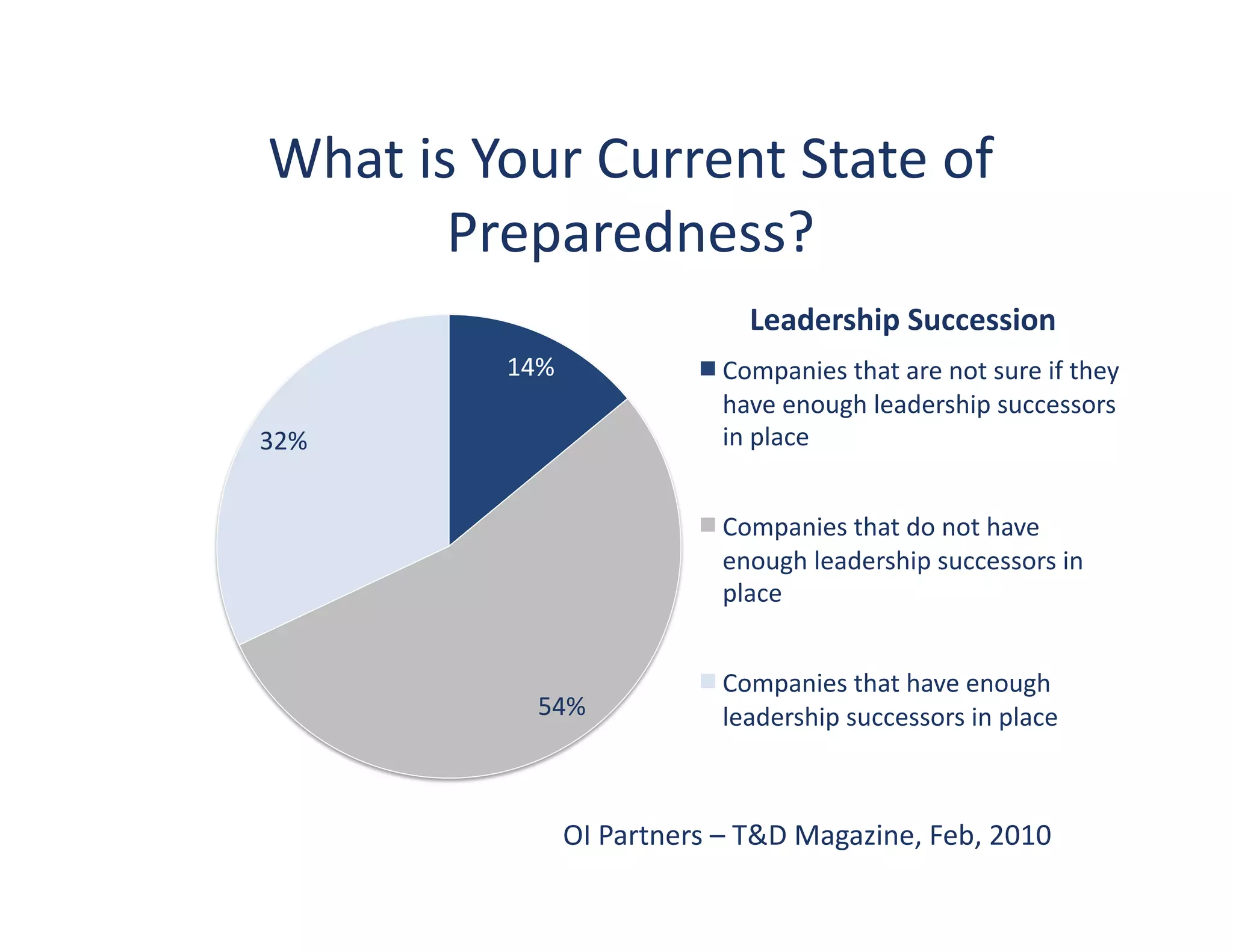
                                                Leadership	
  Succession	
  
                14%	
                        Companies	
  that	
  are	
  not	
  sure	
  if	
  they	
  
                                             have	
  enough	
  leadership	
  successors	
  
32%	
                                        in	
  place	


                                             Companies	
  that	
  do	
  not	
  have	
  
                                             enough	
  leadership	
  successors	
  in	
  
                                             place	


                                             Companies	
  that	
  have	
  enough	
  
                    54%	
                    leadership	
  successors	
  in	
  place	


                          OI	
  Partners	
  –	
  T&D	
  Magazine,	
  Feb,	
  2010	
  
What	
  Should	
  We	
  Do?	
  

•  Find	
  and	
  face	
  the	
  current	
  reali?es	
  

•  Look	
  back	
  first	
  

•  Seek	
  the	
  next	
  prac?ce	
  

•  Fund	
  the	
  future	
  first	
  
“We	
  make	
  sense	
  of	
  the	
  world	
  
retrospecKvely,	
  and	
  all	
  
understanding	
  originates	
  in	
  
reflecKon	
  and	
  looking	
  
backward….We	
  construct	
  the	
  future	
  
by	
  some	
  kind	
  of	
  extrapola?on,	
  in	
  
which	
  the	
  past	
  in	
  the	
  prologue,	
  and	
  
the	
  approach	
  to	
  the	
  future	
  is	
  
backward	
  looking.”	
  	
  
                      Hypothesis	
  of	
  the	
  One-­‐Way	
  Mirror	
  
                                    Omar	
  A.	
  El	
  Sawy	
  –	
  USC	
  
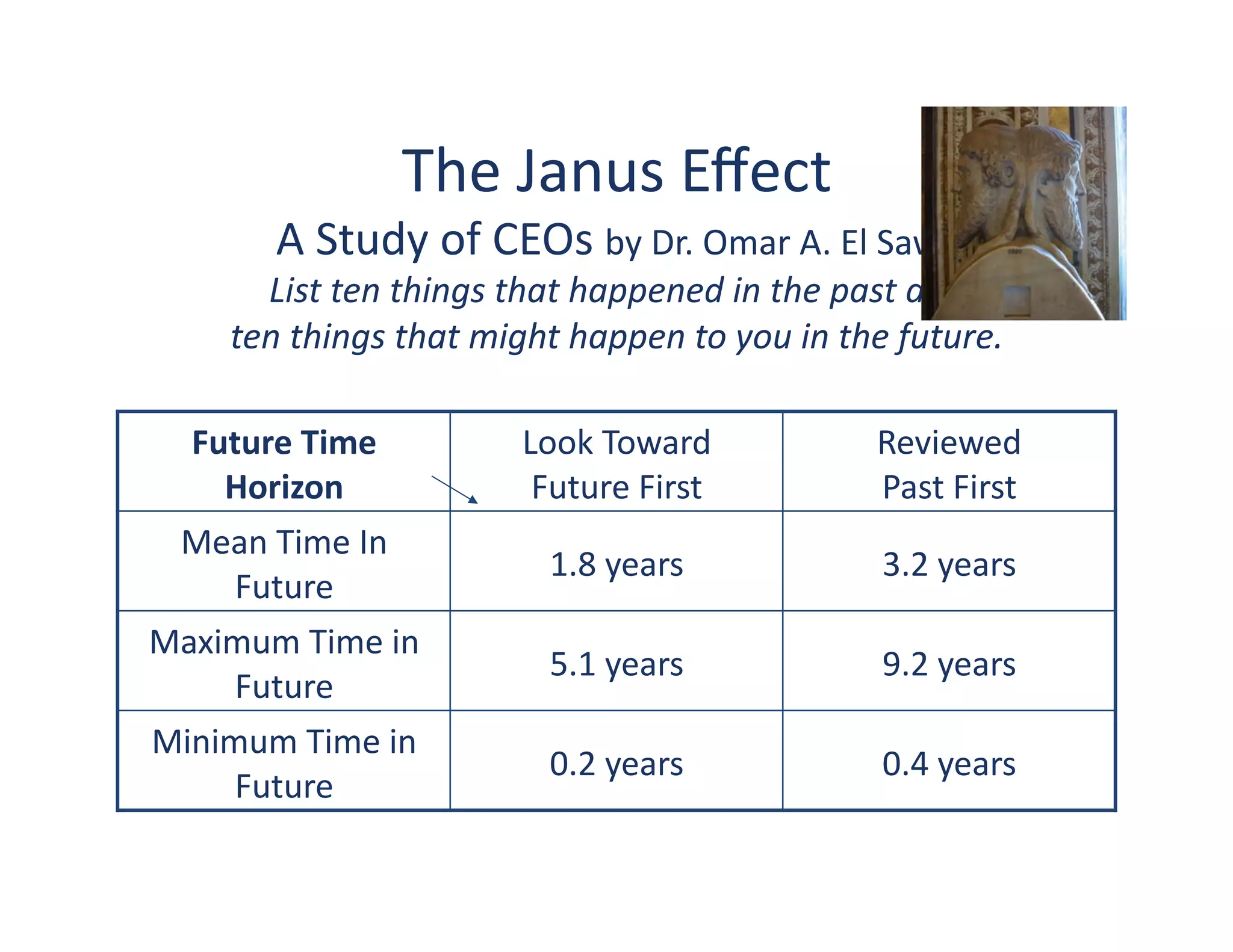
The	
  Janus	
  Effect	
  
           A	
  Study	
  of	
  CEOs	
  by	
  Dr.	
  Omar	
  A.	
  El	
  Sawy	
  
         List	
  ten	
  things	
  that	
  happened	
  in	
  the	
  past	
  and	
  	
  
       ten	
  things	
  that	
  might	
  happen	
  to	
  you	
  in	
  the	
  future.	
  

  Future	
  Time	
                   Look	
  Toward	
  	
                Reviewed	
  	
  
    Horizon	
                         Future	
  First	
                  Past	
  First	
  
 Mean	
  Time	
  In	
  
                                        1.8	
  years	
                    3.2	
  years	
  
     Future	
  
Maximum	
  Time	
  in	
  
                                        5.1	
  years	
                    9.2	
  years	
  
     Future	
  
Minimum	
  Time	
  in	
  
                                        0.2	
  years	
                    0.4	
  years	
  
     Future	
  
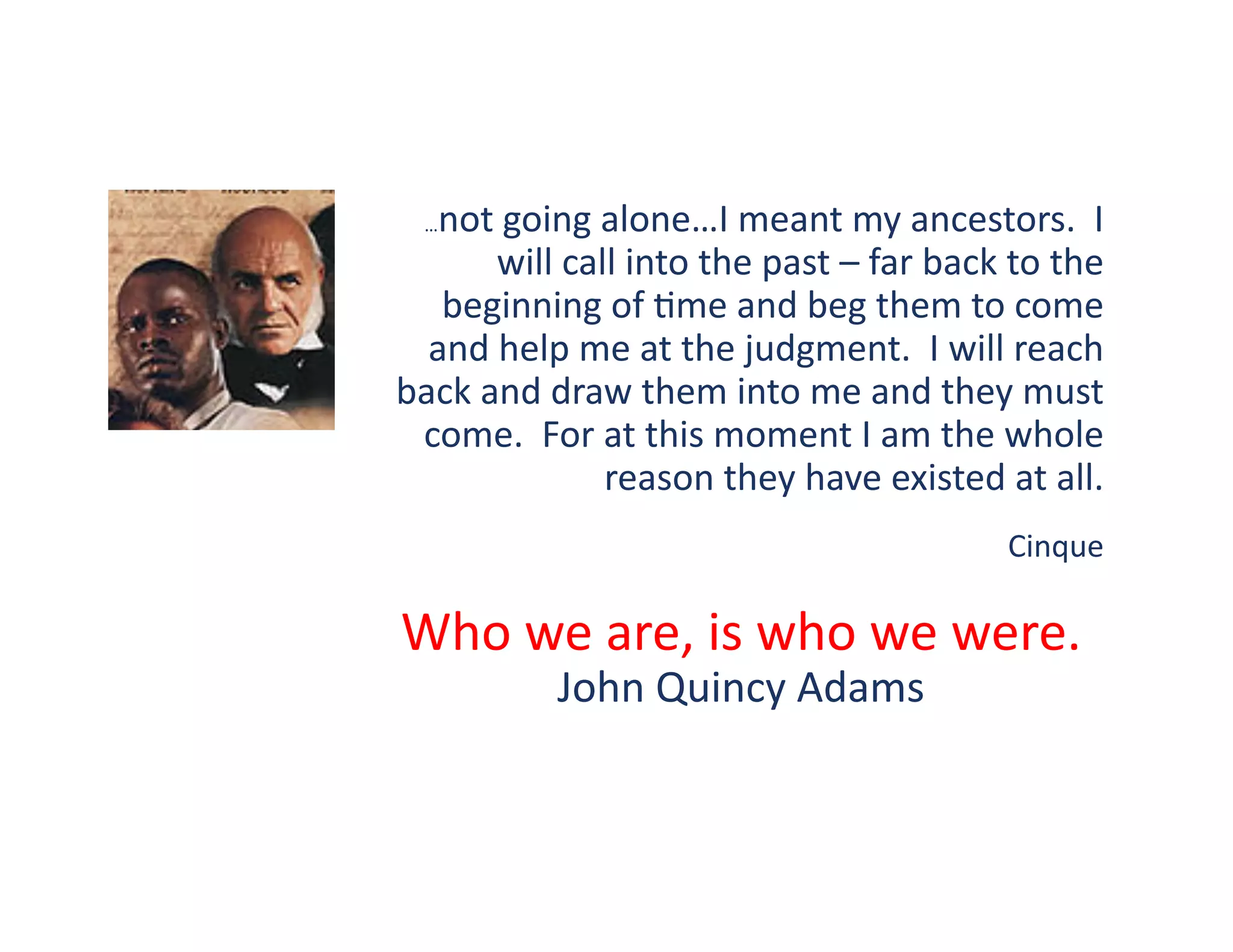
not	
  going	
  alone…I	
  meant	
  my	
  ancestors.	
  	
  I	
  
   …

         will	
  call	
  into	
  the	
  past	
  –	
  far	
  back	
  to	
  the	
  
   beginning	
  of	
  ?me	
  and	
  beg	
  them	
  to	
  come	
  
  and	
  help	
  me	
  at	
  the	
  judgment.	
  	
  I	
  will	
  reach	
  
back	
  and	
  draw	
  them	
  into	
  me	
  and	
  they	
  must	
  
 come.	
  	
  For	
  at	
  this	
  moment	
  I	
  am	
  the	
  whole	
  
                     reason	
  they	
  have	
  existed	
  at	
  all.	


                                                                     Cinque	
  

Who	
  we	
  are,	
  is	
  who	
  we	
  were.	
  	
  
                  John	
  Quincy	
  Adams	
  
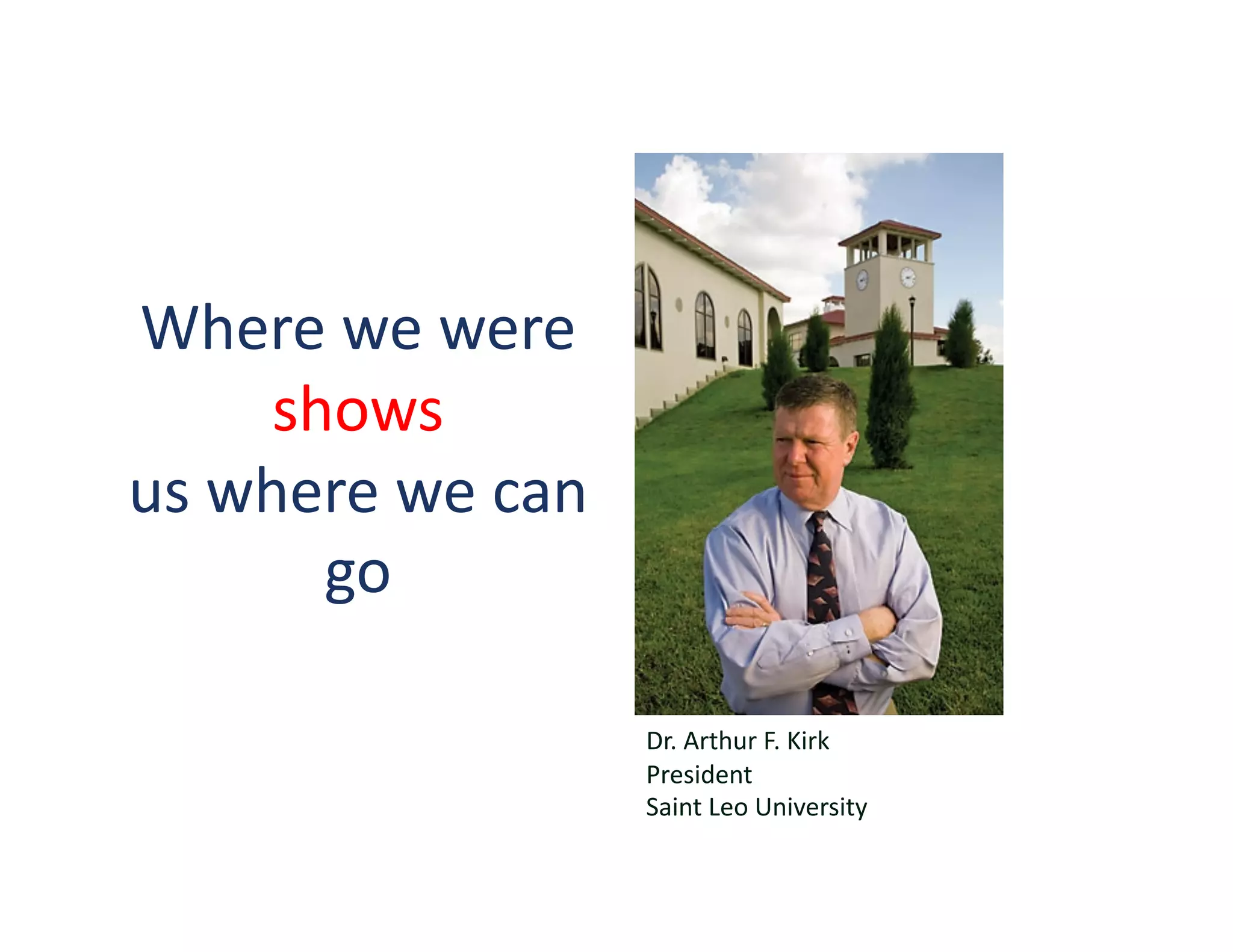
Where	
  we	
  were	
  
        shows	
  	
  
us	
  where	
  we	
  can	
  
          go	
  

                               Dr.	
  Arthur	
  F.	
  Kirk	
  	
  
                               President	
  
                               Saint	
  Leo	
  University	
  
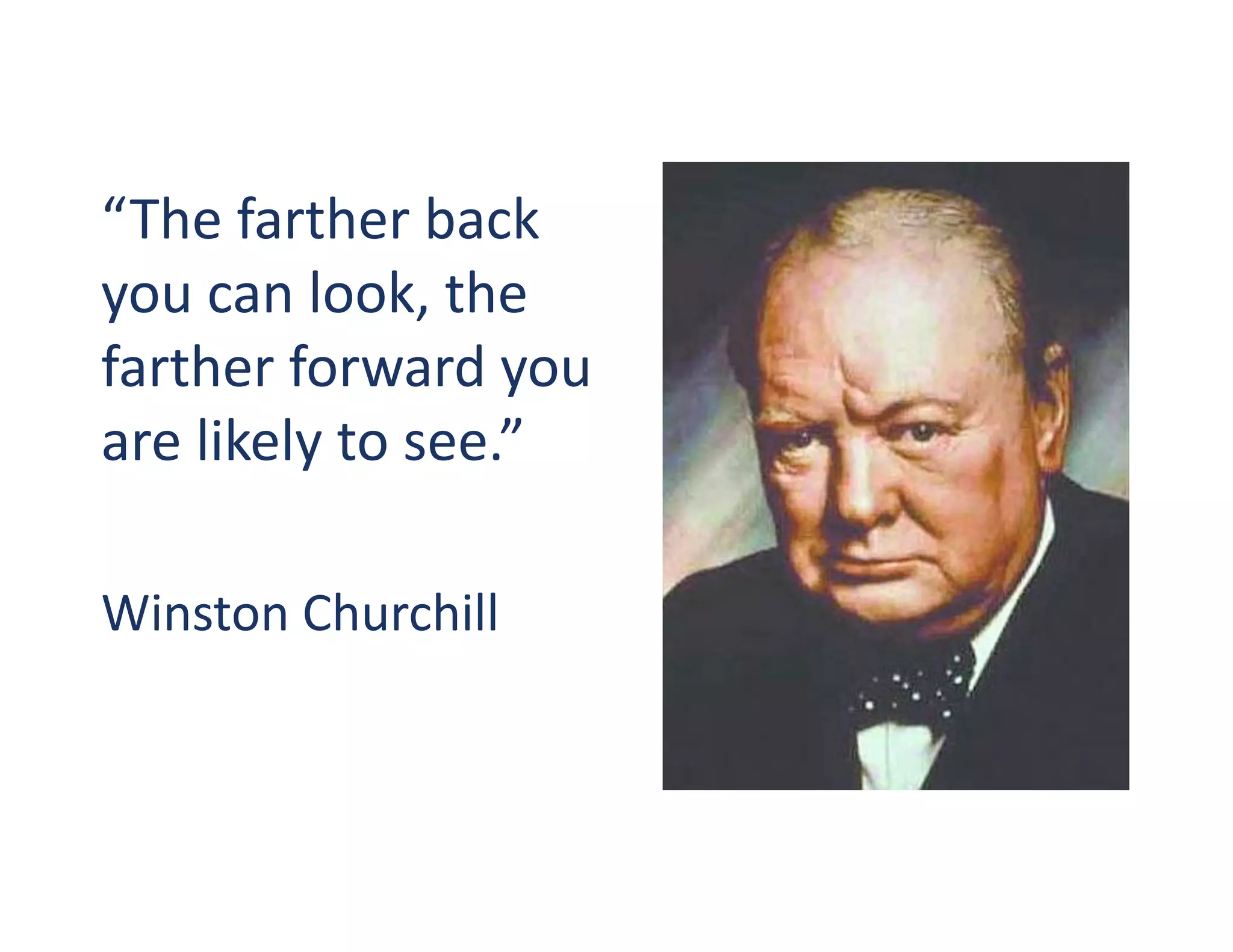
“The	
  farther	
  back	
  
you	
  can	
  look,	
  the	
  
farther	
  forward	
  you	
  
are	
  likely	
  to	
  see.”	


Winston	
  Churchill	
  
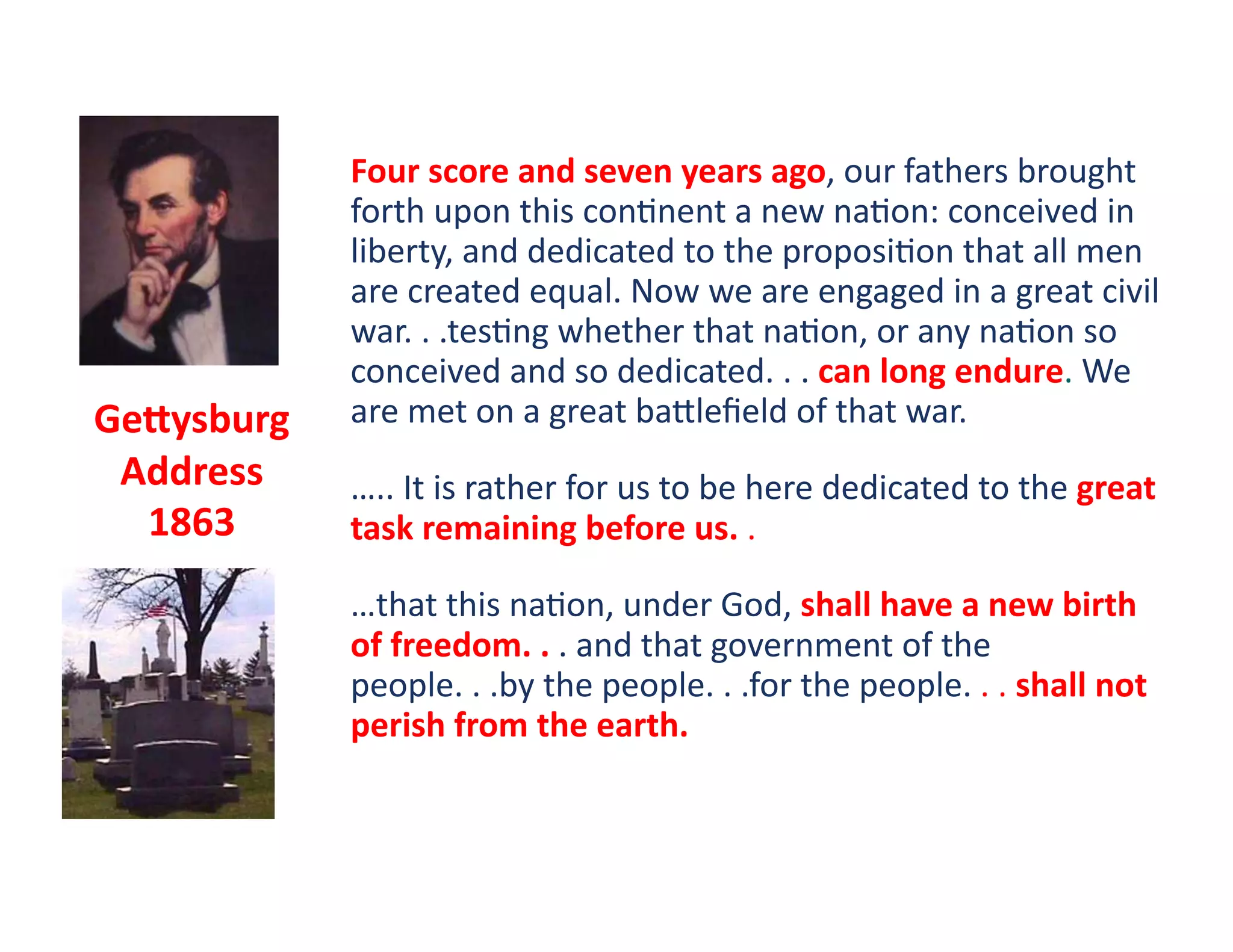
Four	
  score	
  and	
  seven	
  years	
  ago,	
  our	
  fathers	
  brought	
  
                forth	
  upon	
  this	
  con?nent	
  a	
  new	
  na?on:	
  conceived	
  in	
  
                liberty,	
  and	
  dedicated	
  to	
  the	
  proposi?on	
  that	
  all	
  men	
  
                are	
  created	
  equal.	
  Now	
  we	
  are	
  engaged	
  in	
  a	
  great	
  civil	
  
                war.	
  .	
  .tes?ng	
  whether	
  that	
  na?on,	
  or	
  any	
  na?on	
  so	
  
                conceived	
  and	
  so	
  dedicated.	
  .	
  .	
  can	
  long	
  endure.	
  We	
  
Ge`ysburg	
     are	
  met	
  on	
  a	
  great	
  bawlefield	
  of	
  that	
  war.	
  	
  
 Address	
      …..	
  It	
  is	
  rather	
  for	
  us	
  to	
  be	
  here	
  dedicated	
  to	
  the	
  great	
  
  1863	
        task	
  remaining	
  before	
  us.	
  .	
  

                …that	
  this	
  na?on,	
  under	
  God,	
  shall	
  have	
  a	
  new	
  birth	
  
                of	
  freedom.	
  .	
  .	
  and	
  that	
  government	
  of	
  the	
  
                people.	
  .	
  .by	
  the	
  people.	
  .	
  .for	
  the	
  people.	
  .	
  .	
  shall	
  not	
  
                perish	
  from	
  the	
  earth.	
  	
  
What	
  Should	
  We	
  Do?	
  

•  Find	
  and	
  face	
  the	
  current	
  reali?es	
  

•  Look	
  back	
  first	
  

•  Seek	
  the	
  next	
  pracKce	
  

•  Fund	
  the	
  future	
  first	


  Seek	
  the	
  Next	
  Prac?ce	
  Not	
  Just	
  the	
  Best	
  Prac?ce	


  Best	
  Prac?ce	
  vs.	
  Next	
  Prac?ce	


  What	
  works?	


  Could	
  work	
  bewer?	


  Current	
  Focus	


  Future	
  Focus	


  Adop?ve	


  Adap?ve	
  
What	
  Should	
  We	
  Do?	
  

•  Find	
  and	
  face	
  the	
  current	
  reali?es	
  

•  Look	
  back	
  first	
  

•  Seek	
  the	
  next	
  prac?ce	
  

•  Fund	
  the	
  future	
  first	
  
Fund	
  the	
  Future	
  First	
  –	
  Peter	
  Drucker	
  

OperaKng	
  Budget	
  	
                                           Future	
  Budget	
  
• To	
  maintain	
  current	
  business	
                          • To	
  posi?on	
  business	
  for	
  future.	
  

• 80%	
  to	
  90%	
  of	
  all	
  expenditures	
                  • 10%	
  to	
  20%	
  of	
  all	
  expenditures.	
  

• "What	
  is	
  the	
  minimum	
  we	
  need	
  to	
              • What	
  is	
  the	
  maximum	
  this	
  ac5vity	
  
  spend	
  to	
  keep	
  opera?ons	
  going?"	
  	
                  needs	
  to	
  produce	
  op5mal	
  results	
  

• And	
  in	
  bad	
  ?mes	
  it	
  should,	
  indeed,	
  be	
     • And	
  in	
  bad	
  ?mes	
  (not	
  catastrophic)	
  it	
  
  adjusted	
  downward.	
                                            should	
  be	
  maintained.	
  
.	
  	
  
Fund	
  the	
  Future	
  First	
  	
  -­‐	
  People	
  
Without	
  Leadership	
  Development….	
  

• Loss	
  or	
  decrease	
  of	
  ability	
  to	
  innovate	
  	
  43%	
  
• Employee	
  burnout	
  	
  57%	
  
• Unprepared	
  people	
  assuming	
  higher	
  level	
  of	
  posi?ons	
  due	
  to	
  
  lack	
  of	
  available	
  talent	
  72%	
  
• Loss	
  of	
  business/market	
  share/revenue	
  36%	
  
• Other	
  	
  3%	
  
  US	
  CPP,	
  Inc.	
  Survey	
  WORKPLACE	
  AND	
  SUCCESSION	
  MANAGEMENT	
  IN	
  A	
  CHANGING	
  WORLD,	
  Nov	
  2007	
  -­‐Jan	
  2008	
  
Fund	
  the	
  Future	
  First	
  -­‐	
  People	
  
•  Recession	
  of	
  2001	
  -­‐	
  Companies	
  cut	
  back	
  on	
  development	
  

•  Result	
  -­‐	
  a	
  mul?-­‐year	
  rebuilding	
  to	
  get	
  back	
  to	
  the	
  status	
  quo.	


•  Sacrificed	
  the	
  future	
  for	
  a	
  more	
  comfortable	
  present.	


•  Developing	
  employees	
  and	
  providing	
  career	
  opportuni?es	
  are	
  top	
  
   drivers	
  of	
  employee	
  engagement.	


•  Companies	
  with	
  higher	
  percentages	
  of	
  engaged	
  employees	
  perform	
  
   bewer	
  from	
  a	
  financial	
  perspec?ve	
  than	
  their	
  industry	
  peers.	
  	
  
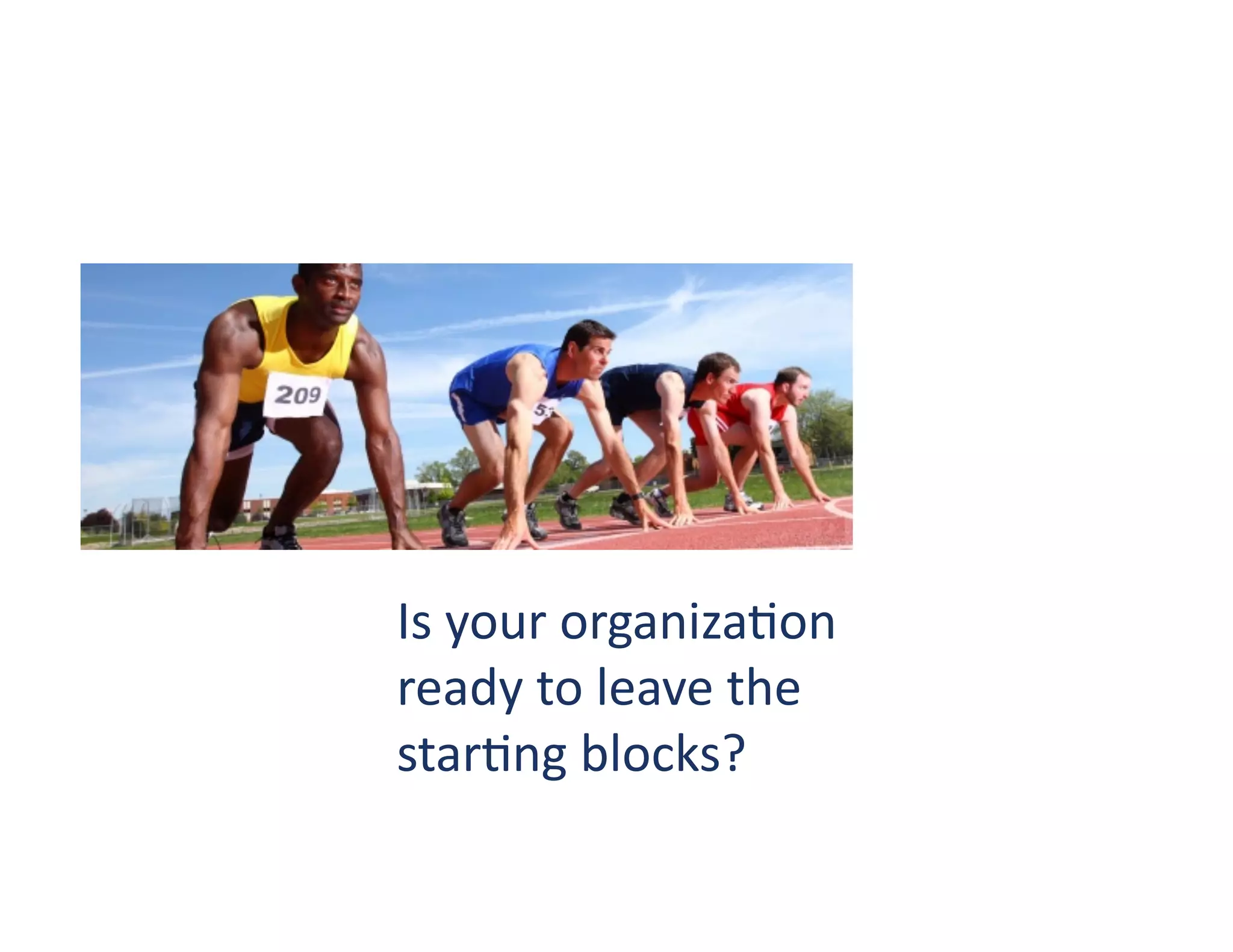
Is	
  your	
  organiza?on	
  
ready	
  to	
  leave	
  the	
  
star?ng	
  blocks?	
  
Today…and	
  Tomorrow!	
  

•  Trends	
  &	
  events	
  to	
  consider.	
  
•  Four	
  things	
  we	
  can	
  do	
  to	
  keep	
  things	
  balanced:	
  
    –  Find	
  and	
  face	
  the	
  new	
  reali?es	
  
    –  Look	
  back	
  first	
  
    –  Seek	
  the	
  next	
  prac?ce	
  not	
  just	
  the	
  best	
  prac?ce	
  
    –  Fund	
  the	
  future	
  first	
  
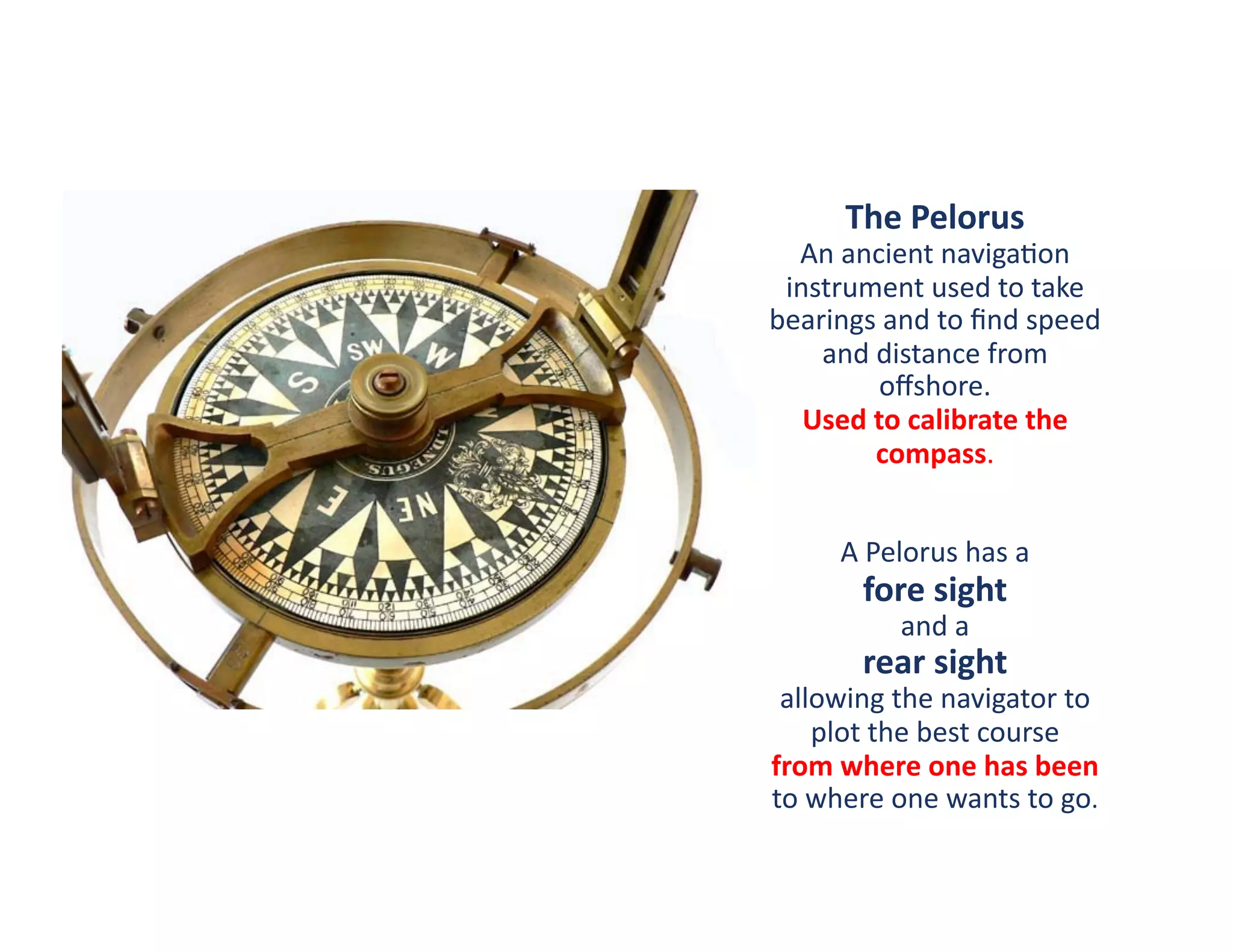
The	
  Pelorus	
  
  An	
  ancient	
  naviga?on	
  
 instrument	
  used	
  to	
  take	
  
bearings	
  and	
  to	
  find	
  speed	
  
    and	
  distance	
  from	
  
            offshore.	
  
   Used	
  to	
  calibrate	
  the	
  
           compass.	


        A	
  Pelorus	
  has	
  a	
  	
  
           fore	
  sight	
  	
  
                 and	
  a	
  	
  
           rear	
  sight	
  	
  
 allowing	
  the	
  navigator	
  to	
  
      plot	
  the	
  best	
  course	
  	
  
from	
  where	
  one	
  has	
  been	
  	
  
to	
  where	
  one	
  wants	
  to	
  go.	
  
Kathy	
  Davanzo,	
  SPHR	
  -­	
  National	
  Speaker,	
  Trainer,	
  	
  HR	
  Consultant	
  and	
  Facilitator	
  

Kathy	
  uses	
  her	
  easy	
  and	
  genuine	
  connection	
  to	
  her	
  audience	
  to	
  create	
  a	
  highly	
  interactive	
  learning	
  environment	
  	
  
incorporating	
  stories,	
  humor,	
  thoughtful	
  quotes	
  and	
  concepts,	
  her	
  experiences	
  and	
  the	
  experiences	
  of	
  her	
  	
  
audience	
  into	
  a	
  dynamic,	
  fast	
  paced	
  and	
  informative	
  event.	


Kathy	
  provides	
  keynotes,	
  workshops	
  and	
  break-­‐out	
  sessions	
  to	
  help	
  participants	
  clarify	
  and	
  articulate	
  their	
  personal	
  leadership	
  
point	
  of	
  view;	
  recognizing	
  that	
  a	
  leader	
  who	
  can	
  clearly	
  de@ine	
  and	
  communicate	
  his	
  or	
  her	
  strengths,	
  experiences,	
  and	
  vision	
  will	
  
experience	
  greater	
  and	
  sustained	
  leadership	
  effectiveness.	


Recently,	
  her	
  research,	
  writing	
  and	
  speaking	
  events	
  have	
  also	
  focused	
  on	
  the	
  way	
  generational	
  in@luences	
  are	
  impacting	
  the	
  way	
  we	
  
lead	
  and	
  the	
  way	
  work	
  gets	
  done.	
  

Kathy	
  holds	
  a	
  bachelor’s	
  degree	
  in	
  English	
  and	
  Communications	
  Education	
  from	
  Miami	
  University	
  and	
  a	
  master’s	
  degree	
  in	
  
Education	
  from	
  the	
  University	
  of	
  Miami.	


Kathy	
  is	
  a	
  certi@ied	
  administrator	
  of	
  the	
  Leadership	
  Spectrum	
  Pro@ile	
  and	
  the	
  Con@lict	
  Dynamics	
  Pro@ile.	
  	
  She	
  is	
  a	
  member	
  of	
  the	
  
Advisory	
  Council	
  for	
  the	
  Institute	
  for	
  Professional	
  Development	
  at	
  Saint	
  Leo	
  University.	
  

Kathy	
  is	
  a	
  Senior	
  Partner	
  with	
  CODA	
  Partners,	
  Inc.-­‐	
  provider	
  of	
  the	
  Leadership	
  POV™	
  programs	
  and	
  the	
  President	
  of	
  Pelorus	
  
Leadership	
  Group,	
  Inc.,	
  a	
  training	
  and	
  consulting	
  @irm.	
  

Kathy	
  is	
  an	
  avid	
  sailor,	
  and	
  when	
  not	
  sailing,	
  she	
  resides	
  in	
  Gulfport,	
  Florida	
  with	
  her	
  husband,	
  Charlie.	


  6860	
  Gulfport	
  Blvd.	
  S.	
  #343                                                                            	
  727-­‐302-­‐9170	
  
                              	
  St.	
  Petersburg,	
  FL	
  33707                                                                             	
  727-­‐743-­‐1430	


  www.codapartners.net                                                                                     	
  www.peloruslead.com	
  
                          	
  Kathy@codapartners.net	
  	
                                                                              	
  Kathy@peloruslead.com	
  

Davanzo - Workforce Readiness: Should the Economy Influence Our Efforts?

  • 1.
    Workforce  Readiness:       Should  the  Economy  Influence   our  Efforts?   Presented  by:   Kathryn  W.  Davanzo,  SPHR   Na5onal  Speaker,  Trainer  and  HR  Consultant     Represen?ng   CODA  Partners,  Inc.    &      Pelorus  Leadership  Group,  Inc.  
  • 2.
    Workforce  Readiness:   A  Broad  and  Complex  Issue   As  HR  professionals  it  is  our  responsibility  is     to  ensure  our  organiza?ons  have  the  human   capacity     (KSAs,  numbers)     to  execute  our  strategy  and     to  achieve  the  promise  of  our  vision.  
  • 3.
    Workforce  Readiness:   A  Broad  and  Complex  Issue   •  The  demographics  predicted…   –  Boomers  re?rements  will  lead  to  “brain  drain.”   –  Age,  ethnicity  and  other  demographic  shiRs  will  challenge   how  we  communicate  and  lead.   •  Experience  was  teaching  us…   –  We  will  not  be  able  to  find  the  talent  we  need.   –  Worker  expecta?ons  will  shiR.  
  • 4.
    Workforce  Readiness:   A  Broad  and  Complex  Issue   •  Our  profession  and  public  media  preached…   –  We  must  prepare  for  pending  skills  shortages.   –  We  must  leverage  technology.   –  We  must  learn  to  operate  in  a  global  talent  market.  
  • 5.
    Workforce  Readiness:   A  Broad  and  Complex  Issue   Then  the  economy  took  our  focus  off  the  future…   Instead  of  building  we  were  razing.   Instead  of  developing  talent  we  were  reducing  head  count.   Instead  of  hiring  we  were  firing.  
  • 6.
    Workforce  Readiness:   A  Broad  and  Complex  Issue   Today’s  HR  Challenge…   •  Recognize  our  current  reali?es  and  our  future  prospects.   •  Address  our  short  and  long  term  workforce  requirements.  
  • 7.
    Today…   •  Trends  &  events  to  consider.   •  Four  things  we  can  do  to  keep  things  balanced:   –  Find  and  face  the  new  reali?es   –  Look  back  first   –  Seek  the  next  prac?ce  not  just  the  best  prac?ce   –  Fund  the  future  first  
  • 8.
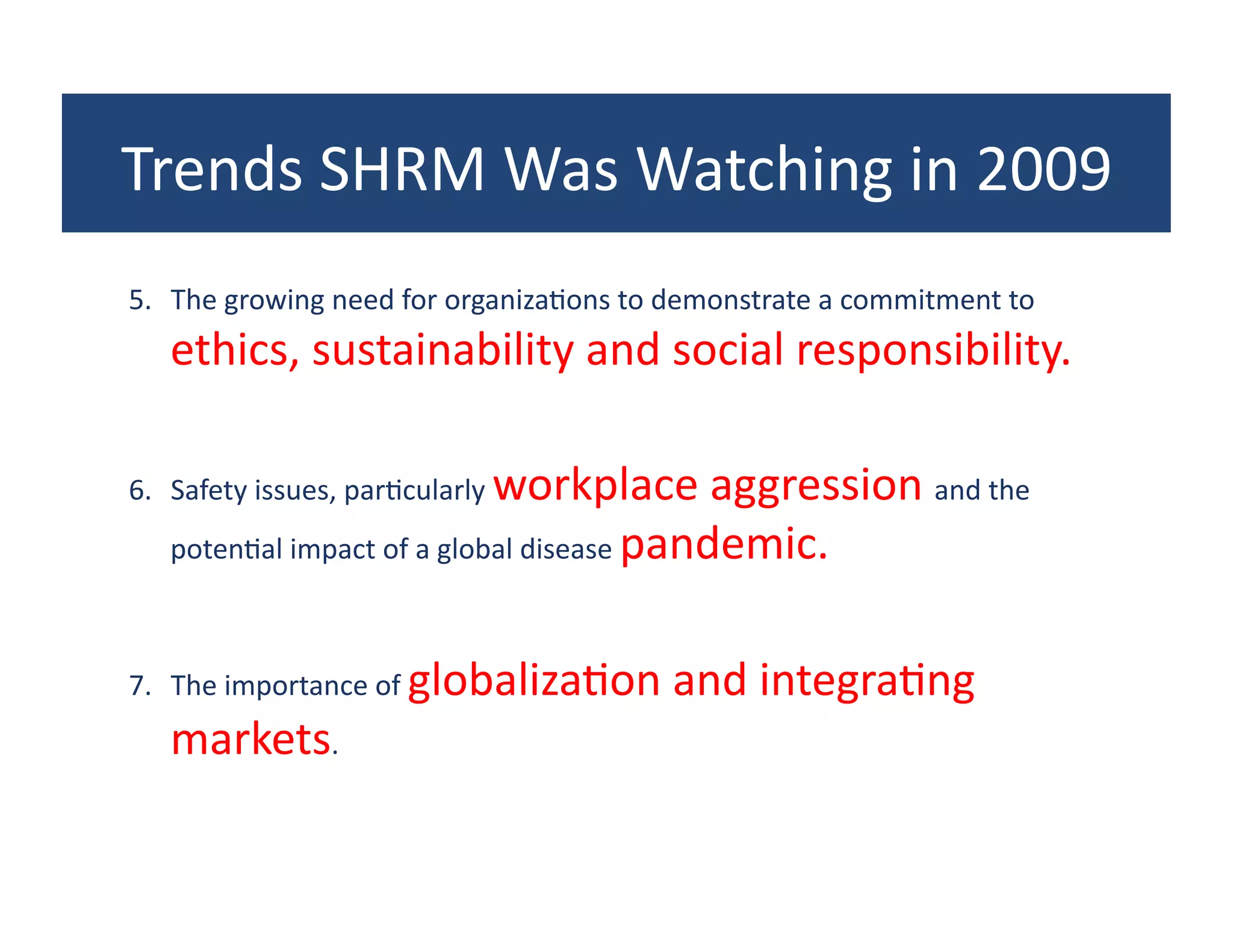
    Trends  SHRM  Was  Watching  in  2009   1.  The  impact  of  the  global  recession  on  business  strategy  and   employees.   2.  The  influence  of  social  networking,  especially  as  it  relates  to   recrui?ng.   3.  The  con?nuing  importance  of  work/life  balance  as  employees  deal   with  mul?ple  caring  responsibili?es  and,  in  some  cases,  mul?ple  paid  jobs.   4.  The  need  for  measurement  of  results  and  the  development  and   standardiza?on  of  key  HR  metrics.  
  • 9.
    Trends  SHRM  Was  Watching  in  2009   5.  The  growing  need  for  organiza?ons  to  demonstrate  a  commitment  to   ethics,  sustainability  and  social  responsibility.   6.  Safety  issues,  par?cularly  workplace  aggression  and  the   poten?al  impact  of  a  global  disease  pandemic.   7.  The  importance  of  globaliza?on  and  integra?ng   markets.    
  • 10.
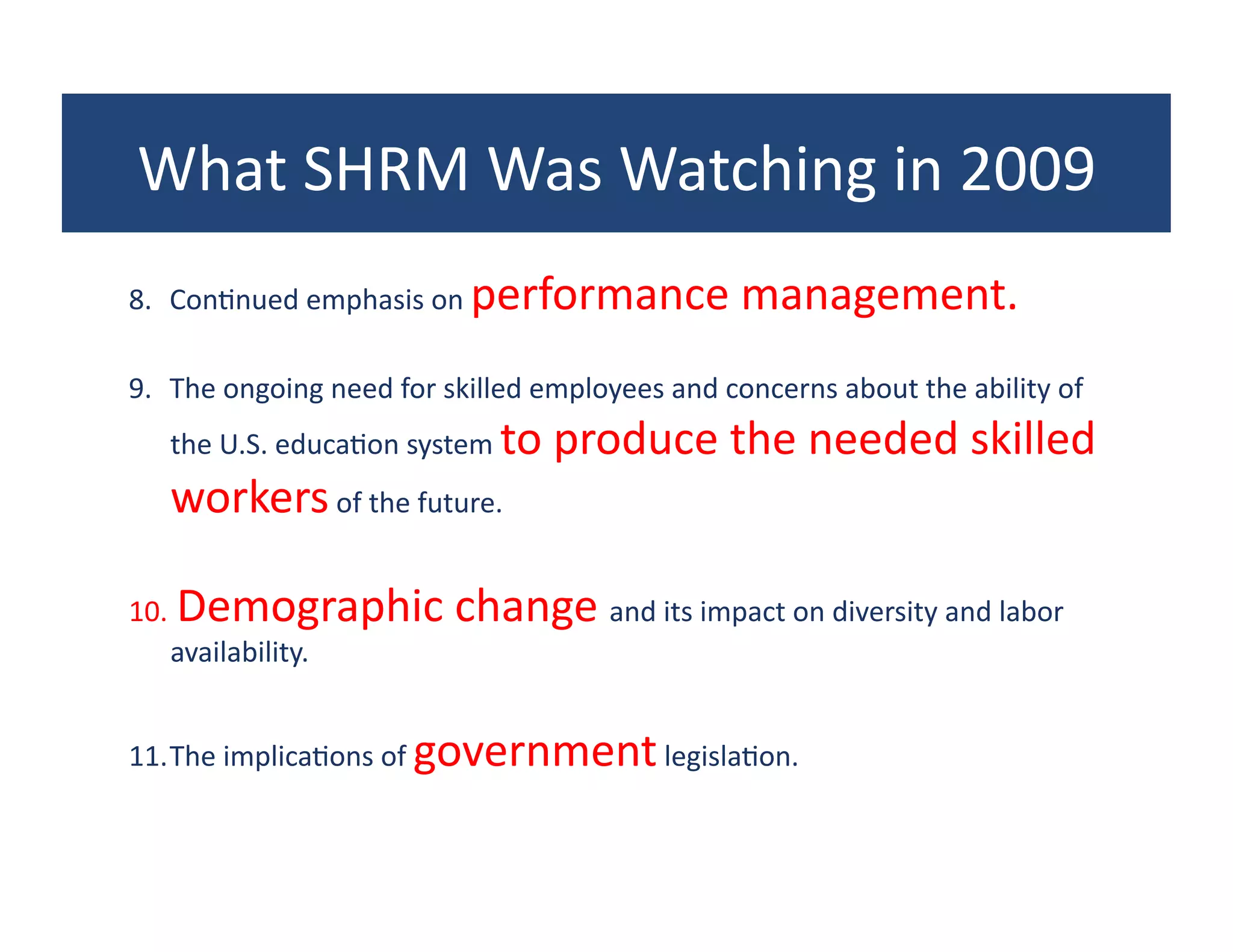
    What  SHRM  Was  Watching  in  2009   8.  Con?nued  emphasis  on  performance  management.     9.  The  ongoing  need  for  skilled  employees  and  concerns  about  the  ability  of   the  U.S.  educa?on  system  to  produce  the  needed  skilled   workers  of  the  future.     10.   Demographic  change  and  its  impact  on  diversity  and  labor   availability.     11. The  implica?ons  of  government  legisla?on.  
  • 11.
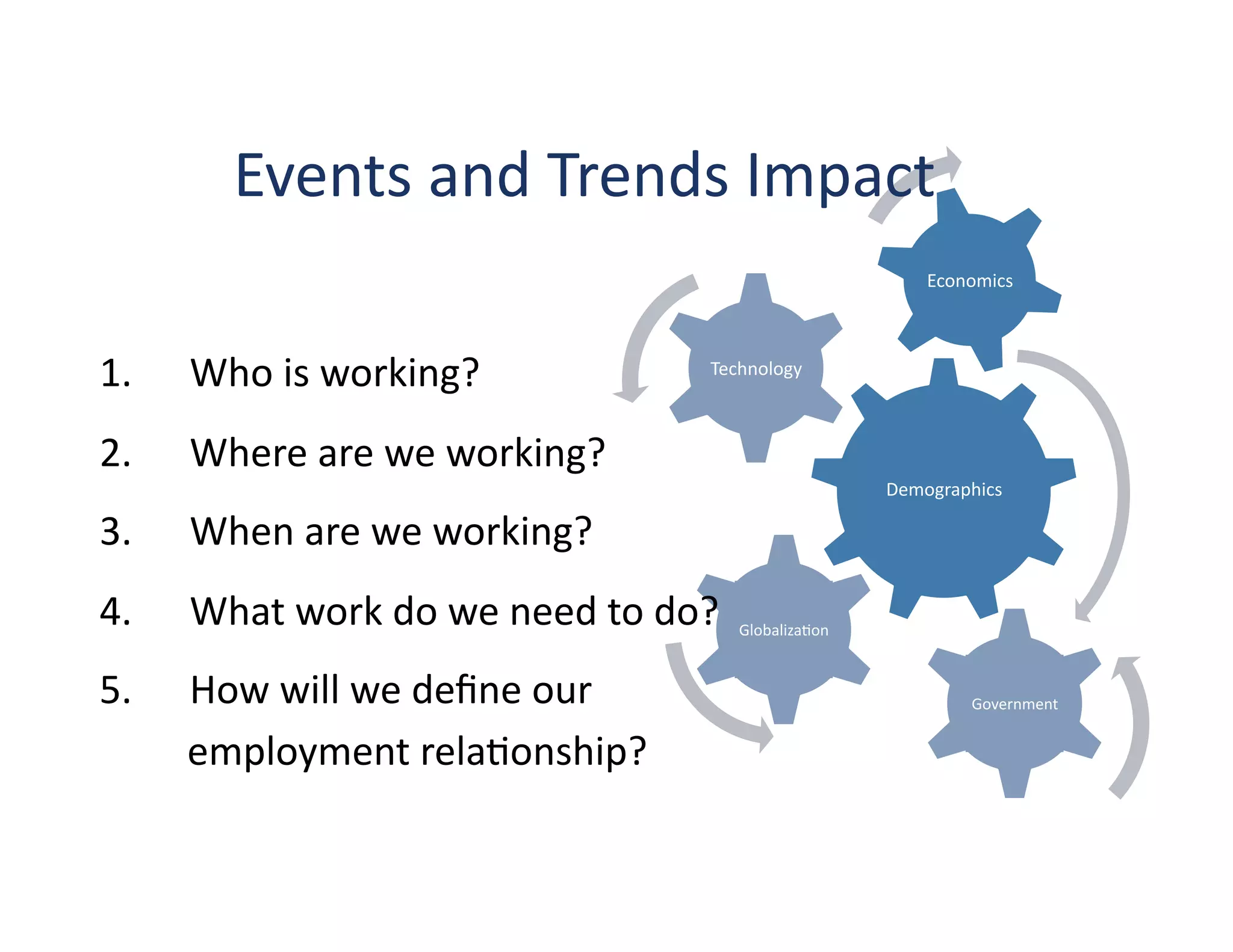
    Events  and  Trends  Impact   Economics   1.  Who  is  working?   Technology   2.  Where  are  we  working?   Demographics   3.  When  are  we  working?   4.  What  work  do  we  need  to  do?   Globaliza?on   5.  How  will  we  define  our   Government                    employment  rela?onship?  
  • 12.
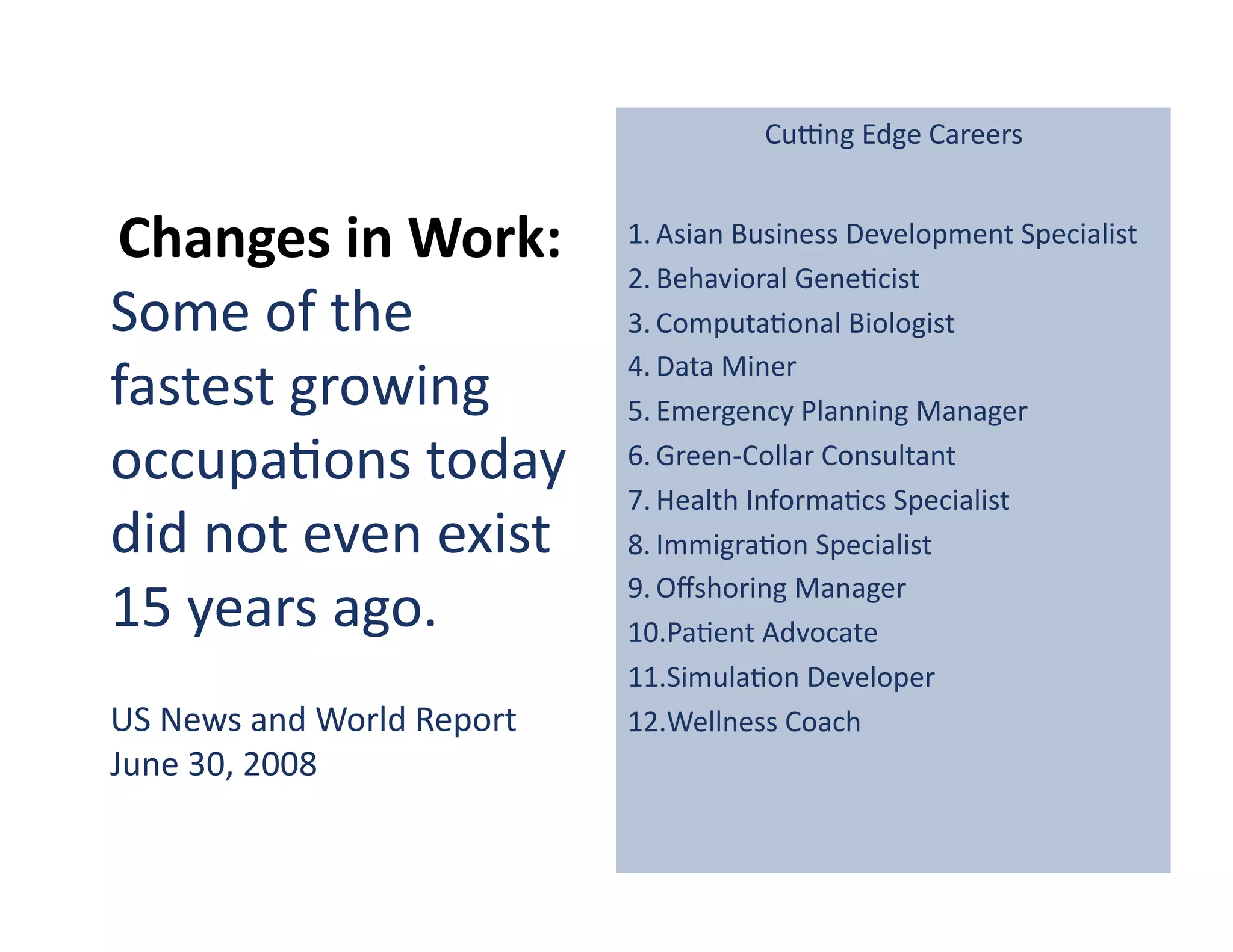
    Culng  Edge  Careers   Changes  in  Work:   1. Asian  Business  Development  Specialist     2. Behavioral  Gene?cist     Some  of  the   3. Computa?onal  Biologist     fastest  growing   4. Data  Miner     5. Emergency  Planning  Manager     occupa?ons  today   6. Green-­‐Collar  Consultant     7. Health  Informa?cs  Specialist     did  not  even  exist   8. Immigra?on  Specialist     15  years  ago.   9. Offshoring  Manager     10. Pa?ent  Advocate     11. Simula?on  Developer     US  News  and  World  Report     12. Wellness  Coach     June  30,  2008  
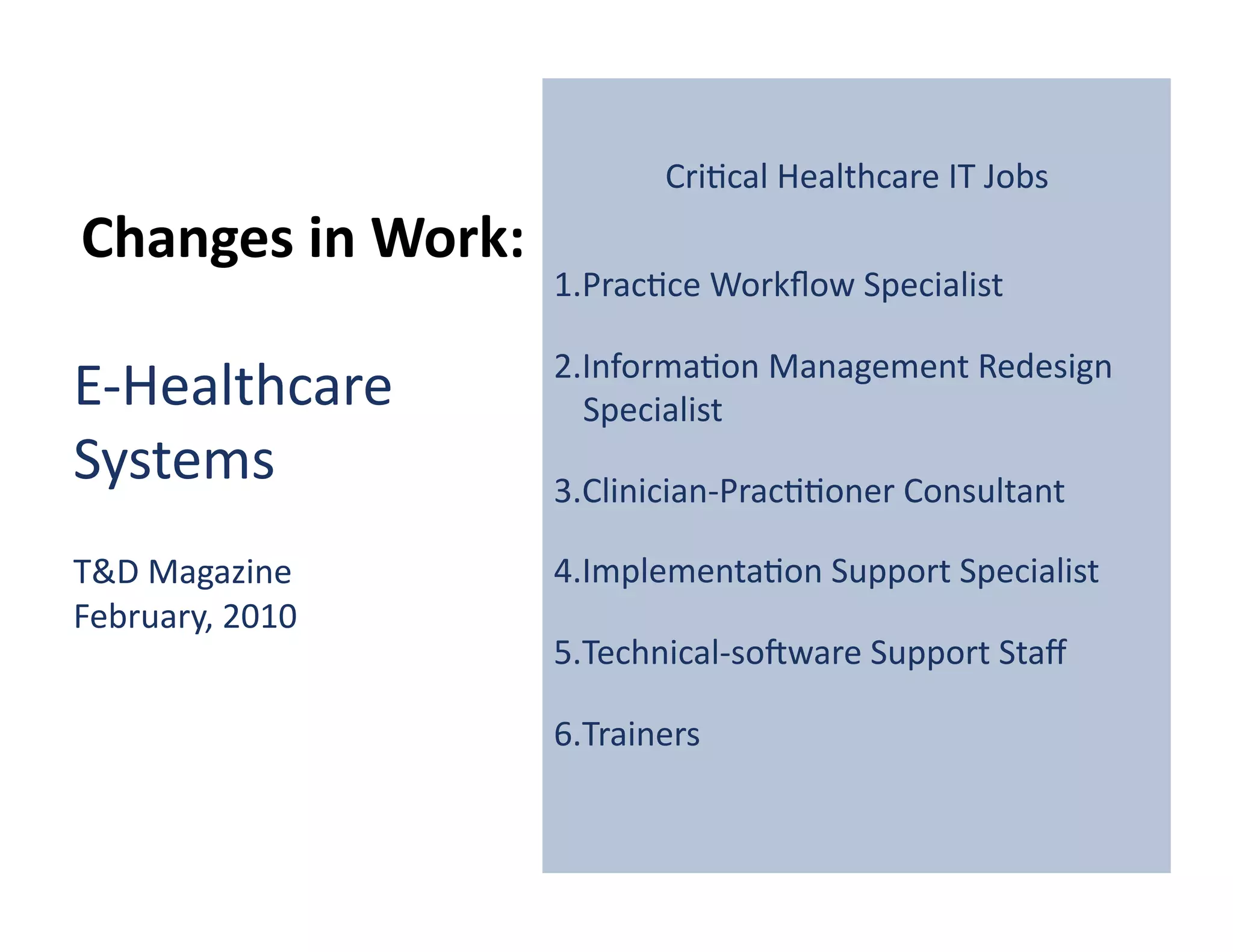
  • 13.
    Cri?cal  Healthcare  IT  Jobs   Changes  in  Work:   1. Prac?ce  Workflow  Specialist   2. Informa?on  Management  Redesign   E-­‐Healthcare   Specialist   Systems   3. Clinician-­‐Prac??oner  Consultant   T&D  Magazine     4. Implementa?on  Support  Specialist   February,  2010   5. Technical-­‐soRware  Support  Staff   6. Trainers  
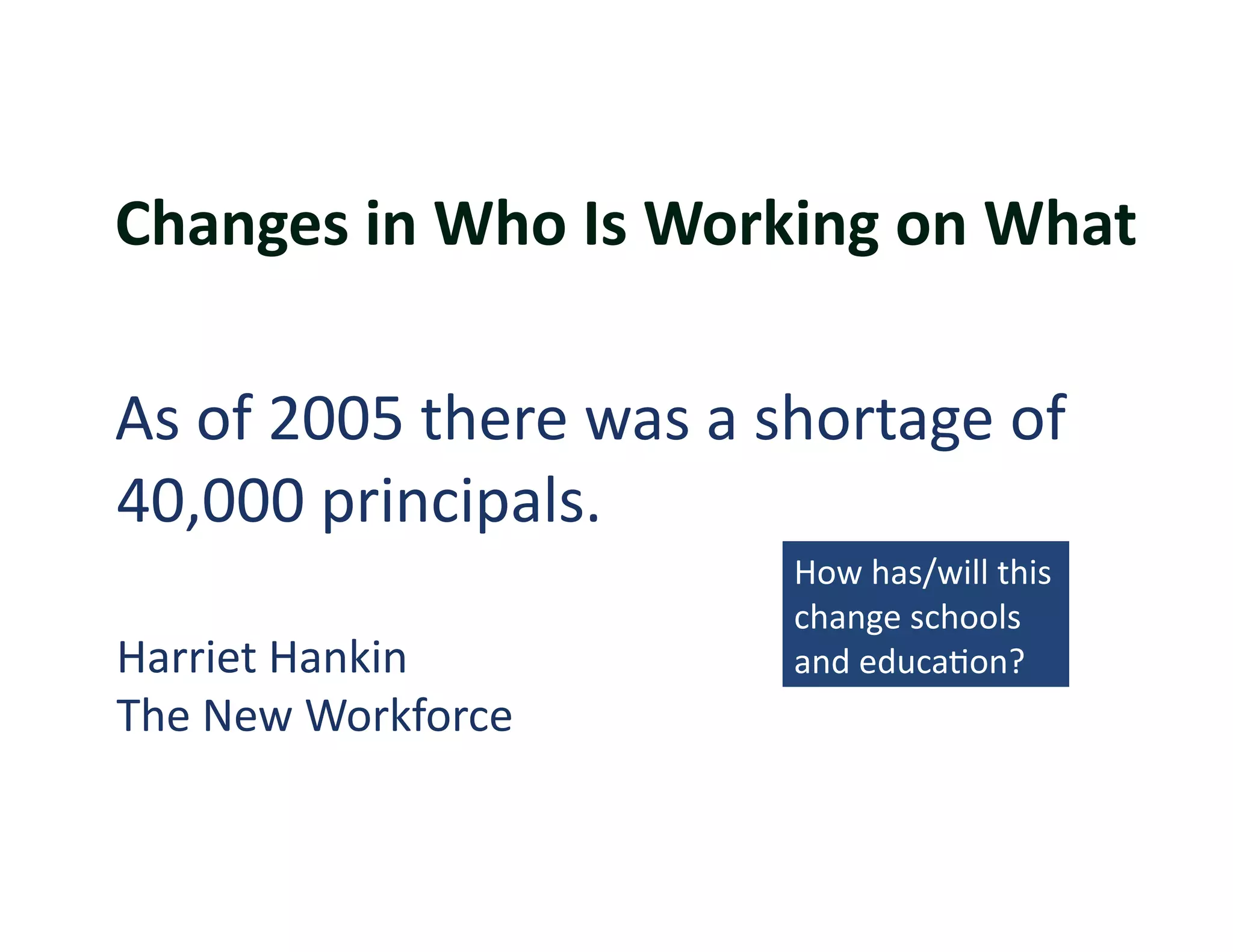
  • 14.
    Changes  in  Who  Is  Working  on  What   As  of  2005  there  was  a  shortage  of   40,000  principals.       How  has/will  this   change  schools   Harriet  Hankin   and  educa?on?   The  New  Workforce  
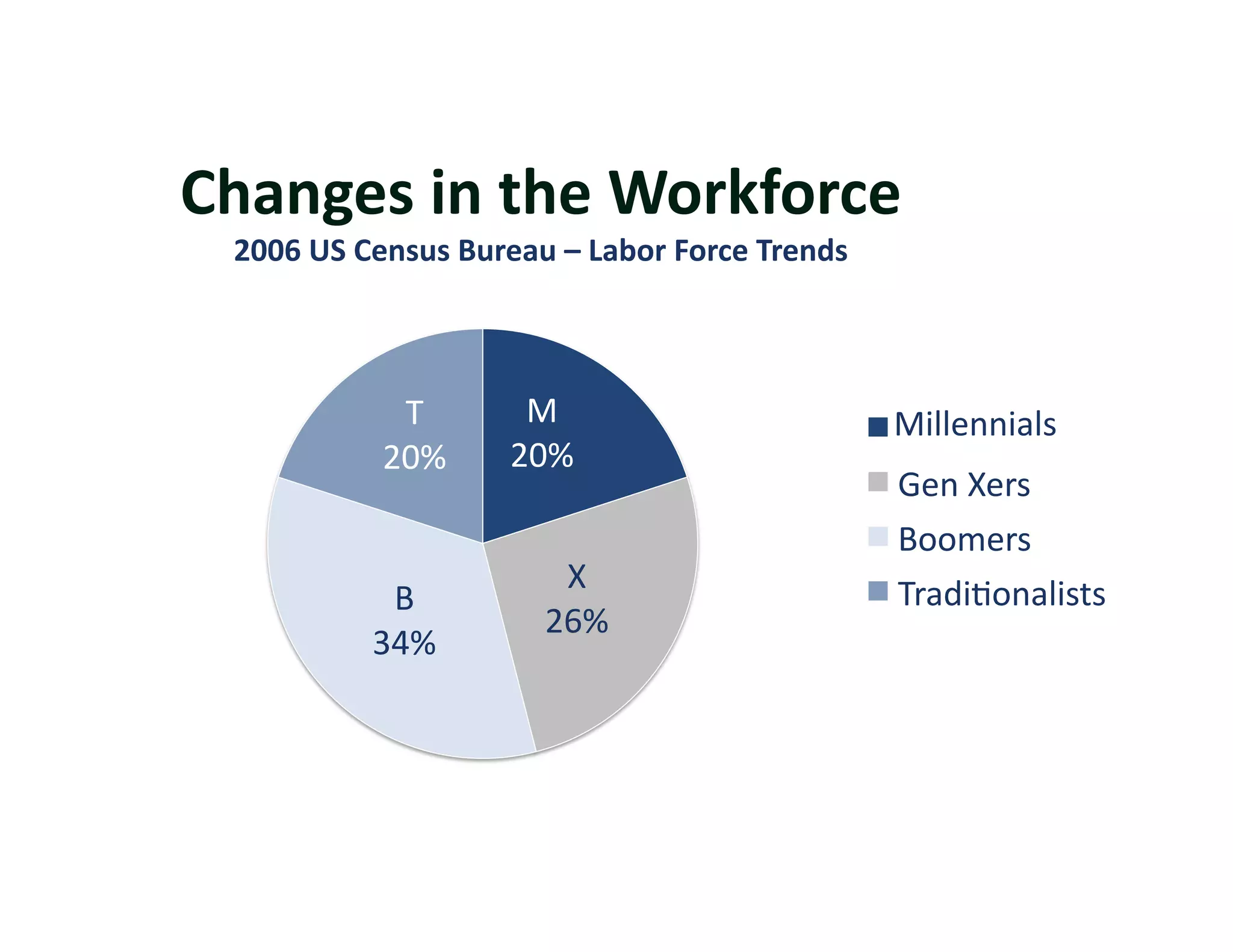
  • 15.
    Changes  in  the  Workforce   2006  US  Census  Bureau  –  Labor  Force  Trends   T   M   Millennials   Millenials   20%   20%   Gen  Xers   Boomers   X   Tradi?onalists   B   26%   34%  
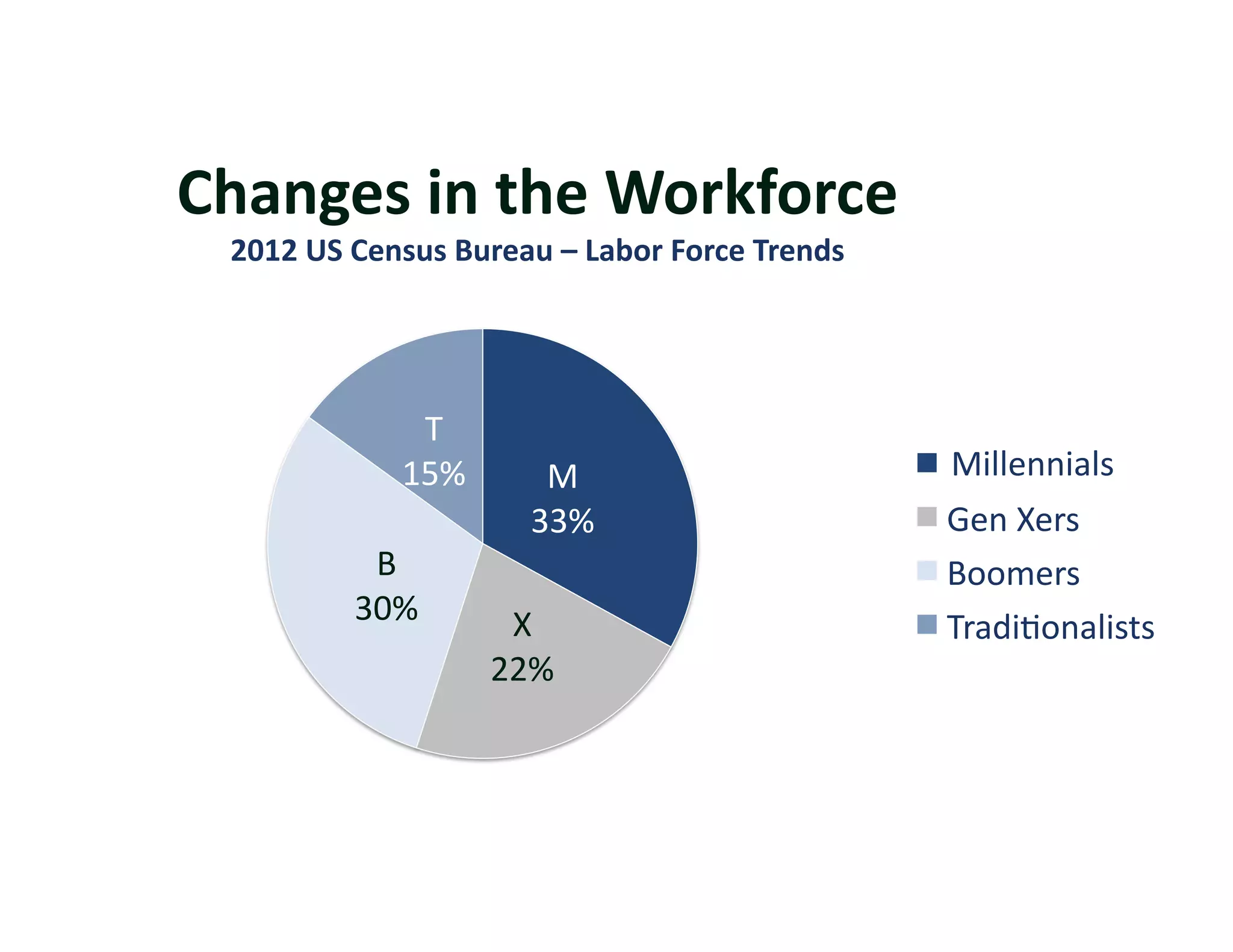
  • 16.
    Changes  in  the  Workforce   2012  US  Census  Bureau  –  Labor  Force  Trends   T   15%   M   Millennials   Millenials   33%   Gen  Xers   B   Boomers   30%   X   Tradi?onalists   22%  
  • 17.
    Changes  in  the  Workforce   2016  US  Census  Bureau  –  Labor  Force  Trends   T   7%   Millennials   Millenials   M   B   37%   Gen  Xers   33%   Boomers   X   23%   Tradi?onalists  
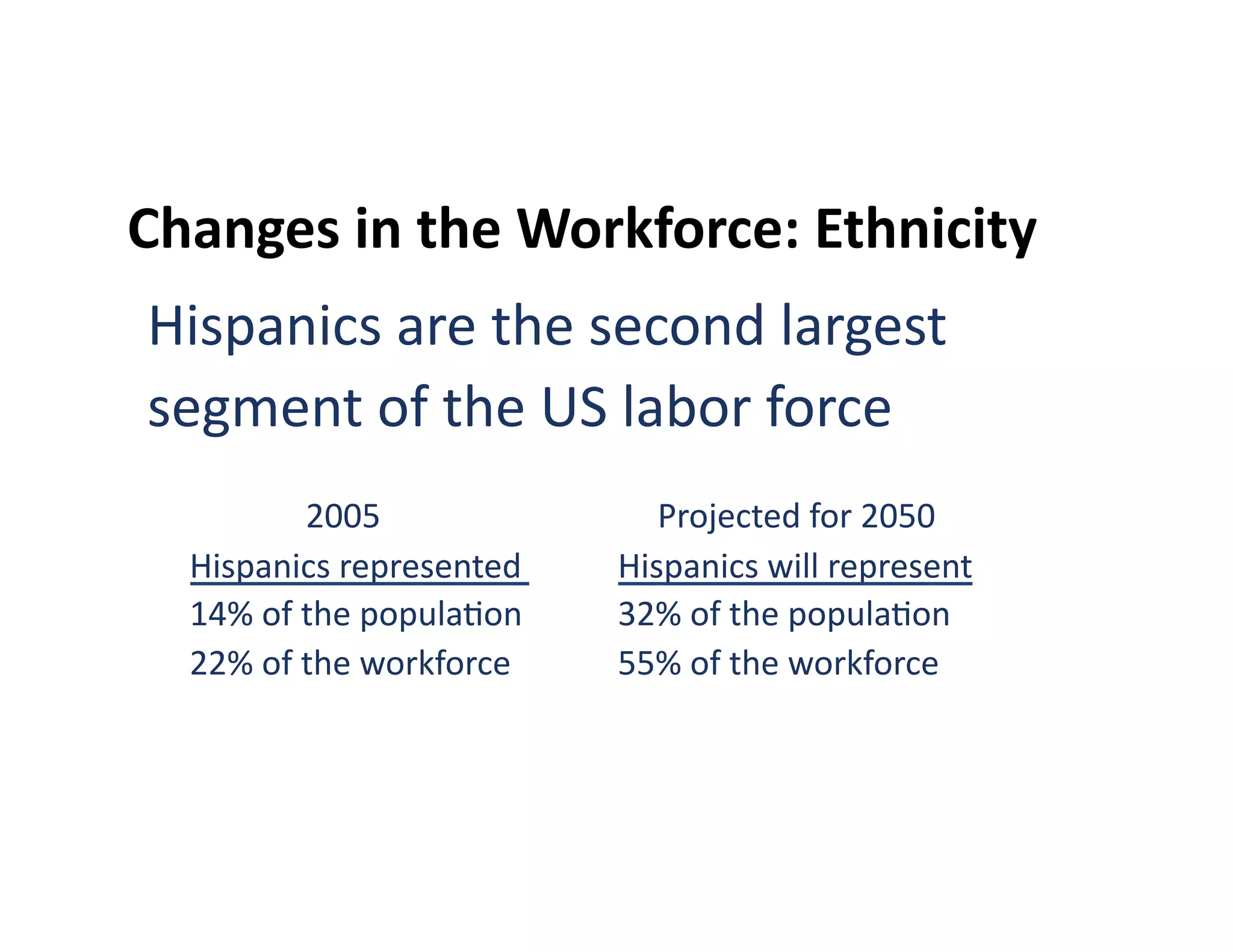
  • 18.
    Changes  in  the  Workforce:  Ethnicity   Hispanics  are  the  second  largest   segment  of  the  US  labor  force                          2005                                          Projected  for  2050    Hispanics  represented      Hispanics  will  represent    14%  of  the  popula?on      32%  of  the  popula?on    22%  of  the  workforce      55%  of  the  workforce  
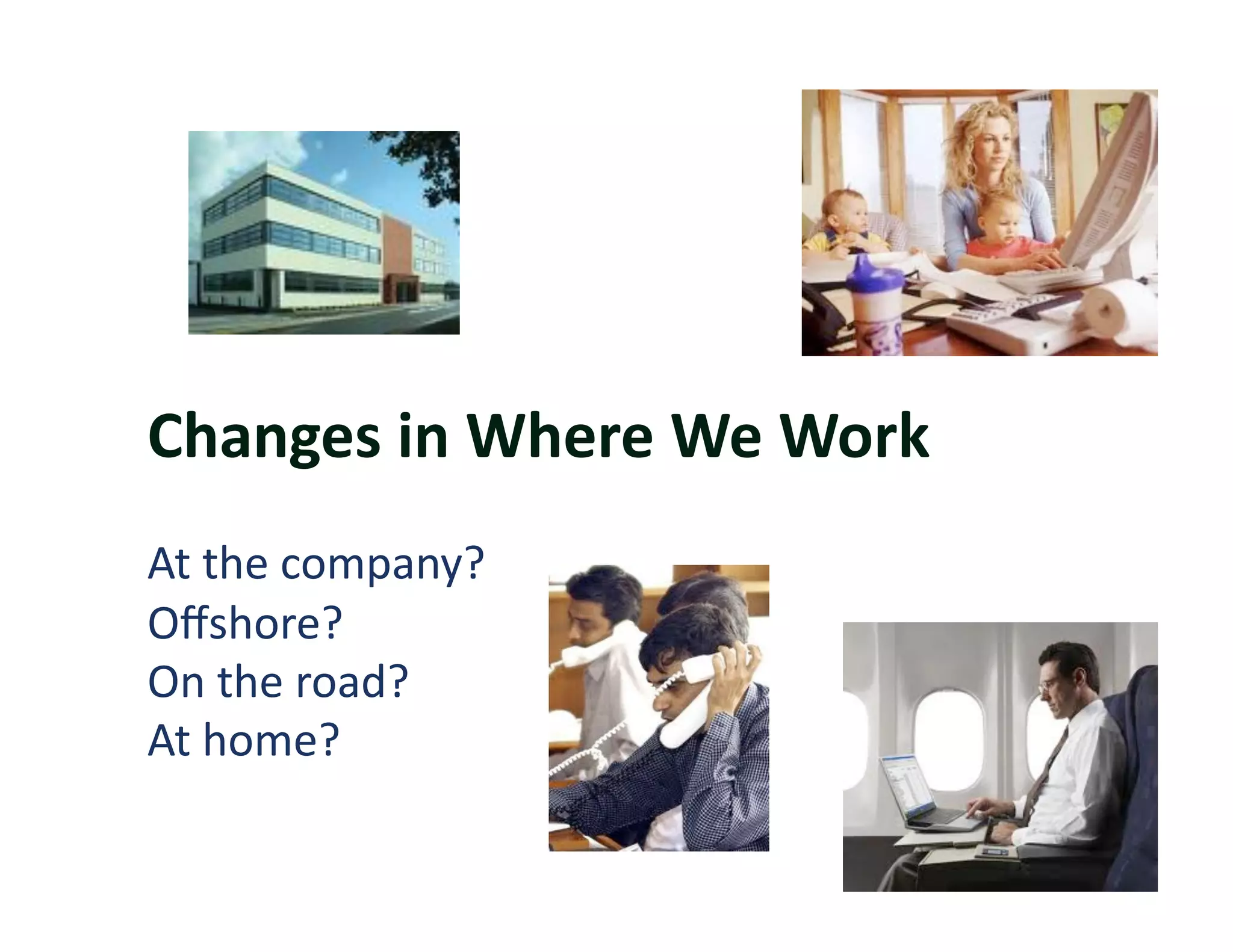
  • 19.
    Changes  in  Where  We  Work   At  the  company?   Offshore?   On  the  road?   At  home?  
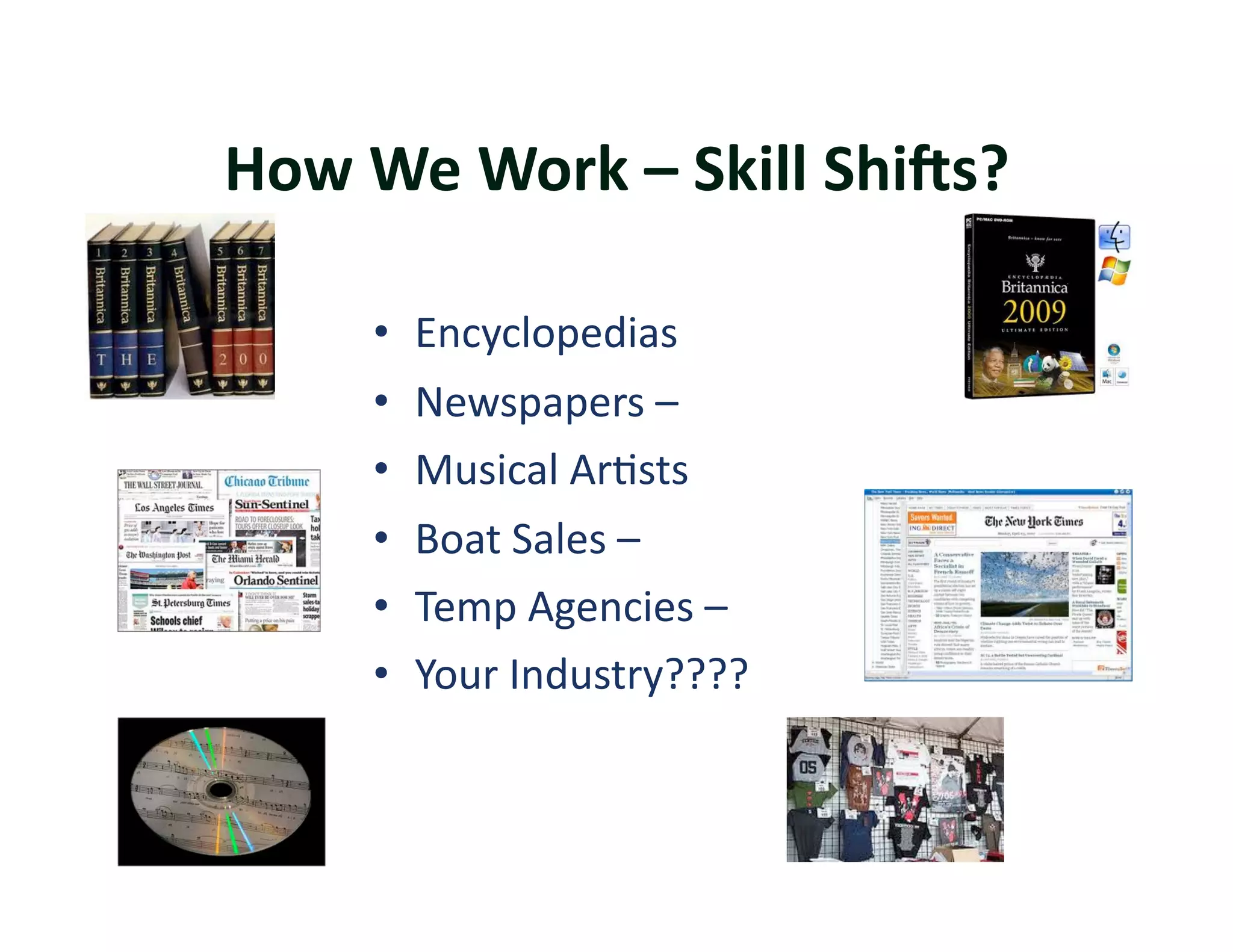
  • 20.
    How  We  Work  –  Skill  ShiFs?     •  Encyclopedias   •  Newspapers  –     •  Musical  Ar?sts   •  Boat  Sales  –     •  Temp  Agencies  –     •  Your  Industry????  
  • 21.
    How  will  we  define  the  employment   relaKonship?     •  Tradi?onal   •  Temporary   •  Virtual   •  Contract   •  Crowd  Sourced  
  • 22.
    What  Should  We  Do?   •  Find  and  face  the  new  realiKes   •  Look  back  first   •  Seek  the  next  prac?ce   •  Fund  the  future  first  
  • 23.
    Has  Your  Road   Changed?  
  • 24.
    Business  Environment   Strategy   Financial  picture   Challenges   Regula?ons   Opportuni?es   Market   Required  Skills   Customers   Available  Skills   Rela?onship  with  EEs  
  • 25.
    Where  was  HR?   Michael  Losey,  SPHR,  CAE,  Former,    CEO,  SHRM  
  • 26.
    Find  the  Facts     When  you  turn  over  rocks  and  look  at  all  the   squiggly  things  underneath,  you  can  either  put   the  rock  down,  or  you  can  say,  ‘My  job  is  to   turn  over  rocks  and  look  at  the  squiggly   things,’  even  if  they  scare  the  hell  out  of  you.”   Fred  Purdue,  Pitney  Bowes  Execu?ve  quoted  in  Good  to  Great  
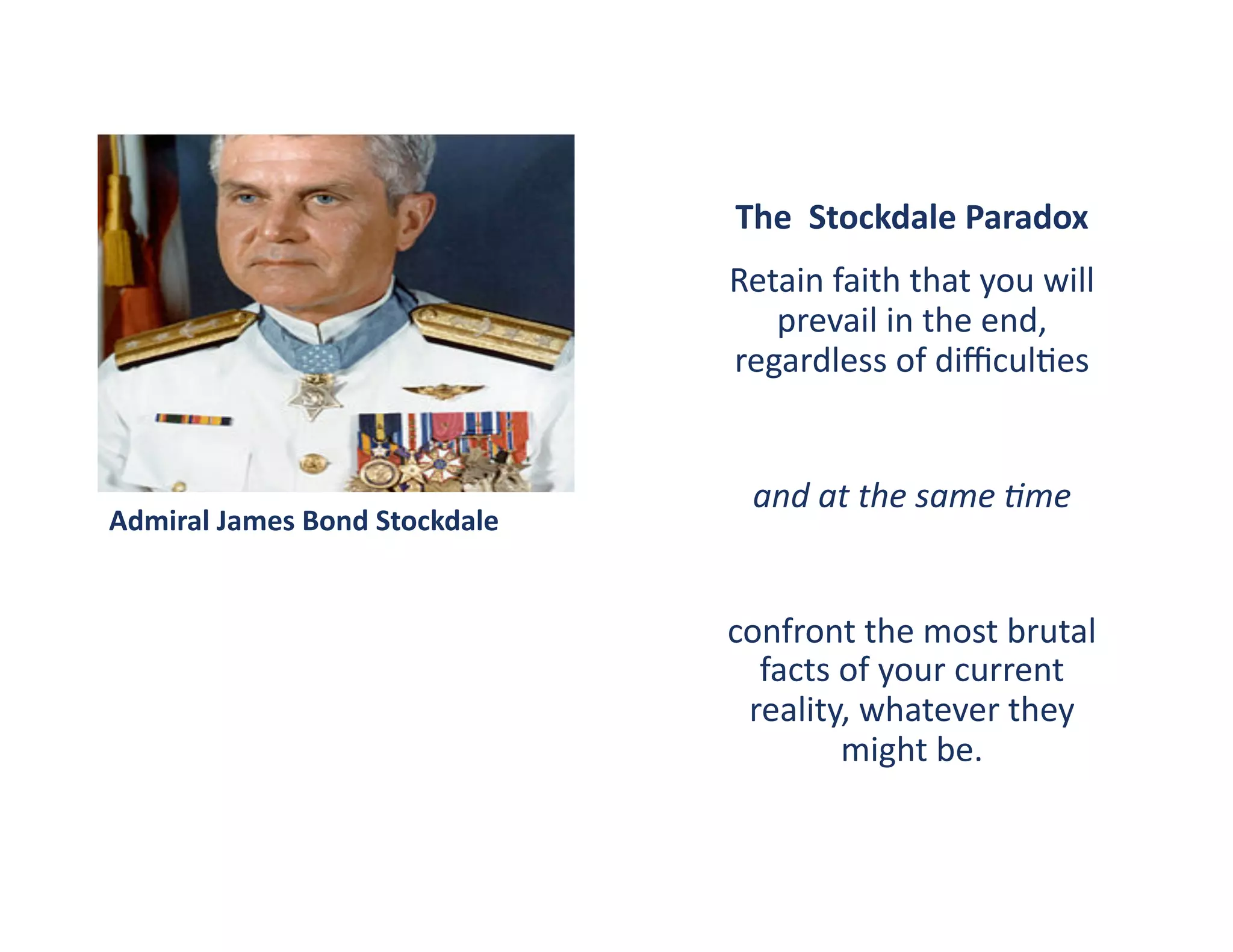
  • 27.
    The    Stockdale  Paradox   Retain  faith  that  you  will   prevail  in  the  end,   regardless  of  difficul?es     and  at  the  same  5me   Admiral  James  Bond  Stockdale   confront  the  most  brutal   facts  of  your  current   reality,  whatever  they   might  be.  
  • 28.
    Some  of  today’s  facts  we  must  face     Economic  Downturn   Past  Recessions      This  is  not   •  •  Recession  of  (1902  -­‐  1904)     Panic  of  1907  (1907  –  1908)   •  Post-­‐WWI  recession     our  first   •  •  Great  Depression  (1929  to  late  1930s)   Recession  of  (1945)     recession!   •  •  Recession  of  (1948  -­‐  1949)     Post-­‐Korean  War  Recession  (1953  -­‐  1954)     •  Recession  of  (1957  -­‐  1958)   •  Recession  of  (1960  -­‐  1961)     •  Bond  Inversion  of  (1965  -­‐  1967)     •  Recession  of  (1969  -­‐  1970)     •  1973  oil  crisis  (1973  -­‐  1975)     •  1979  energy  crisis  -­‐  1979  un?l  1980   •  Early  1980s  recession  -­‐  1982  and  1983   •  Late  1980s  recession  -­‐  1988  to  1992   •  Early  2000s  recession  -­‐  2001  to  2003  
  • 29.
    Remember  trends  are  not  certain?es   Categories  of  55+  Workers   •  Mature  Workers  –  with  financial  resources   •  Mature  Workers-­‐  without  financial  resources   •  Working  Re?red   •  Tradi?onal  Re?rees   •  The  numbers  in  each  category  just  changed.   •  Their  age  did  not  change.   •  Turnover  due  to  re?rement  deferred.   •  Numbers  reaching  re?rement  age  con?nues  to  increase.  
  • 30.
    Have  You  Let  the  Current  Reality     Dictate  Your  Future?   Glaring  gap  exists  between  the  leadership  skills   organiza?ons  have  now  and  the  ones  they  will  need  five   years  from  now.              Understanding  the  Leadership  Gap              Center  for  Crea?ve  Leadership,  2009   •  Leading  people   4  skills   •  Planning  strategically   leaders  will   •  Inspiring  commitment   most  need   •  Managing  change  
  • 31.
    What  is  Your  Current  State  of   Preparedness?   Leadership  Succession   14%   Companies  that  are  not  sure  if  they   have  enough  leadership  successors   32%   in  place   Companies  that  do  not  have   enough  leadership  successors  in   place   Companies  that  have  enough   54%   leadership  successors  in  place   OI  Partners  –  T&D  Magazine,  Feb,  2010  
  • 32.
    What  Should  We  Do?   •  Find  and  face  the  current  reali?es   •  Look  back  first   •  Seek  the  next  prac?ce   •  Fund  the  future  first  
  • 33.
    “We  make  sense  of  the  world   retrospecKvely,  and  all   understanding  originates  in   reflecKon  and  looking   backward….We  construct  the  future   by  some  kind  of  extrapola?on,  in   which  the  past  in  the  prologue,  and   the  approach  to  the  future  is   backward  looking.”     Hypothesis  of  the  One-­‐Way  Mirror   Omar  A.  El  Sawy  –  USC  
  • 34.
    The  Janus  Effect   A  Study  of  CEOs  by  Dr.  Omar  A.  El  Sawy   List  ten  things  that  happened  in  the  past  and     ten  things  that  might  happen  to  you  in  the  future.   Future  Time   Look  Toward     Reviewed     Horizon   Future  First   Past  First   Mean  Time  In   1.8  years   3.2  years   Future   Maximum  Time  in   5.1  years   9.2  years   Future   Minimum  Time  in   0.2  years   0.4  years   Future  
  • 35.
    not  going  alone…I  meant  my  ancestors.    I   … will  call  into  the  past  –  far  back  to  the   beginning  of  ?me  and  beg  them  to  come   and  help  me  at  the  judgment.    I  will  reach   back  and  draw  them  into  me  and  they  must   come.    For  at  this  moment  I  am  the  whole   reason  they  have  existed  at  all.         Cinque   Who  we  are,  is  who  we  were.     John  Quincy  Adams  
  • 36.
    Where  we  were   shows     us  where  we  can   go   Dr.  Arthur  F.  Kirk     President   Saint  Leo  University  
  • 37.
    “The  farther  back   you  can  look,  the   farther  forward  you   are  likely  to  see.”       Winston  Churchill  
  • 38.
    Four  score  and  seven  years  ago,  our  fathers  brought   forth  upon  this  con?nent  a  new  na?on:  conceived  in   liberty,  and  dedicated  to  the  proposi?on  that  all  men   are  created  equal.  Now  we  are  engaged  in  a  great  civil   war.  .  .tes?ng  whether  that  na?on,  or  any  na?on  so   conceived  and  so  dedicated.  .  .  can  long  endure.  We   Ge`ysburg   are  met  on  a  great  bawlefield  of  that  war.     Address   …..  It  is  rather  for  us  to  be  here  dedicated  to  the  great   1863   task  remaining  before  us.  .   …that  this  na?on,  under  God,  shall  have  a  new  birth   of  freedom.  .  .  and  that  government  of  the   people.  .  .by  the  people.  .  .for  the  people.  .  .  shall  not   perish  from  the  earth.    
  • 39.
    What  Should  We  Do?   •  Find  and  face  the  current  reali?es   •  Look  back  first   •  Seek  the  next  pracKce   •  Fund  the  future  first  
  • 40.
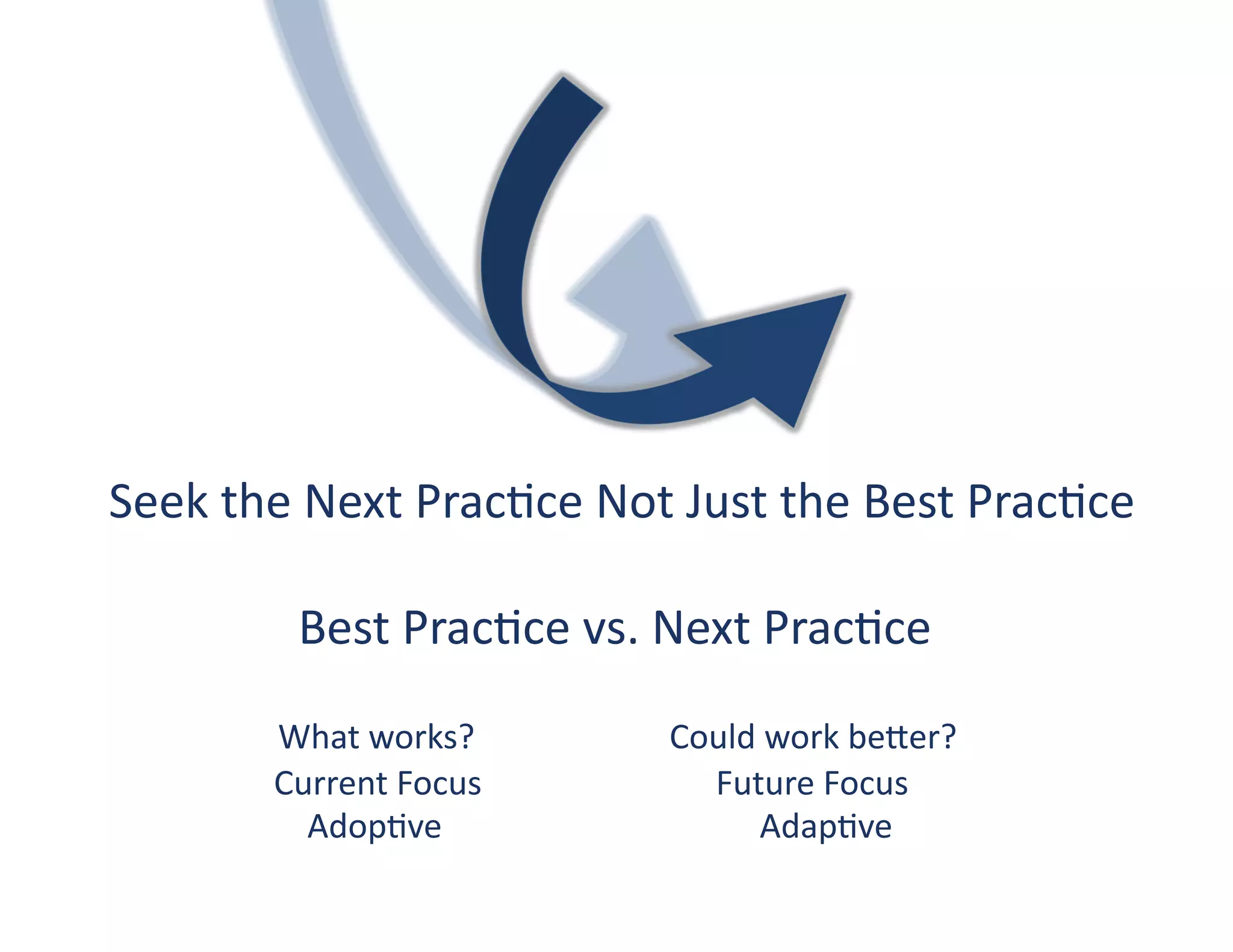
         Seek  the  Next  Prac?ce  Not  Just  the  Best  Prac?ce                                        Best  Prac?ce  vs.  Next  Prac?ce                                            What  works?                  Could  work  bewer?                                                  Current  Focus                                                        Future  Focus                                                          Adop?ve                                                                            Adap?ve  
  • 41.
    What  Should  We  Do?   •  Find  and  face  the  current  reali?es   •  Look  back  first   •  Seek  the  next  prac?ce   •  Fund  the  future  first  
  • 42.
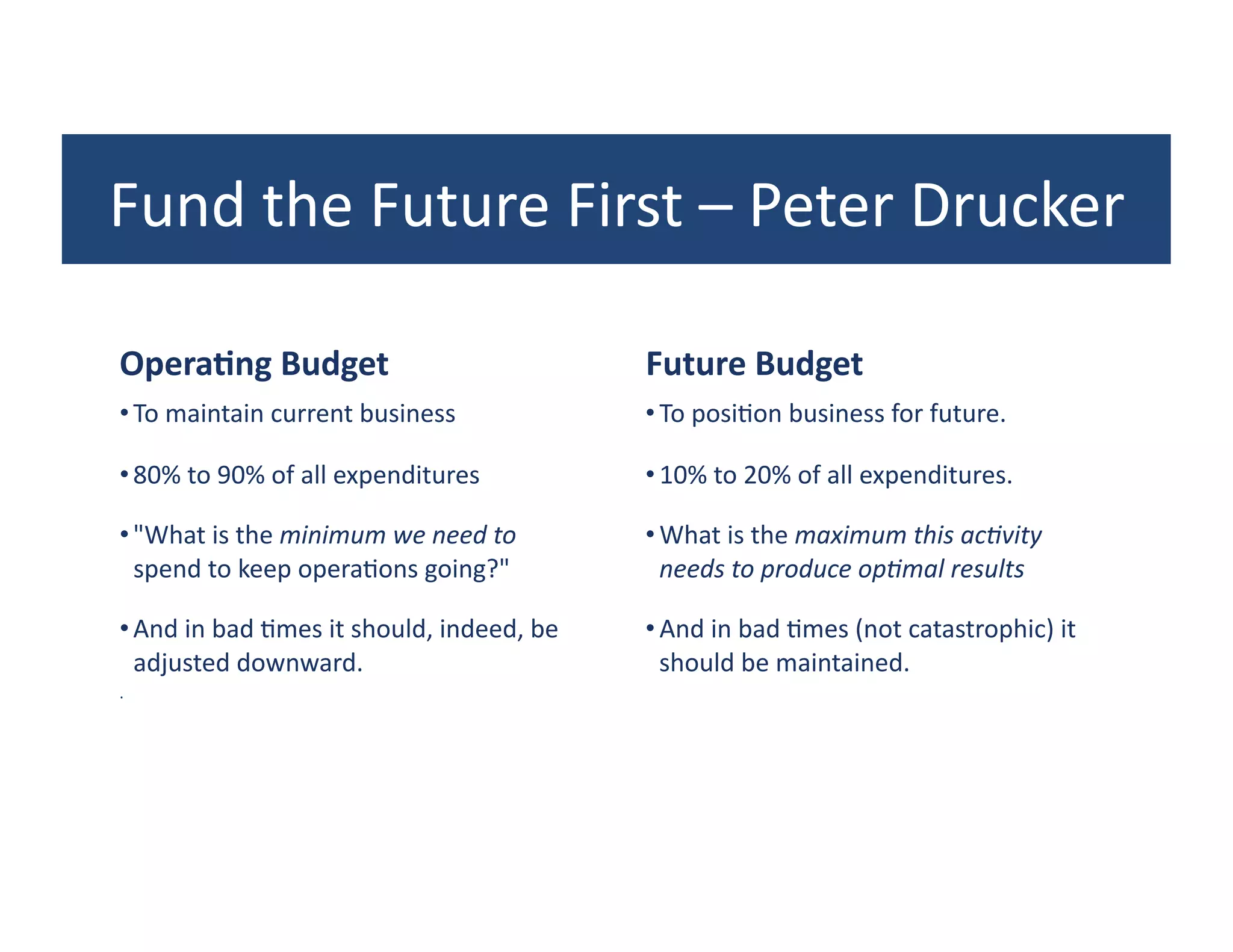
    Fund  the  Future  First  –  Peter  Drucker   OperaKng  Budget     Future  Budget   • To  maintain  current  business   • To  posi?on  business  for  future.   • 80%  to  90%  of  all  expenditures   • 10%  to  20%  of  all  expenditures.   • "What  is  the  minimum  we  need  to   • What  is  the  maximum  this  ac5vity   spend  to  keep  opera?ons  going?"     needs  to  produce  op5mal  results   • And  in  bad  ?mes  it  should,  indeed,  be   • And  in  bad  ?mes  (not  catastrophic)  it   adjusted  downward.   should  be  maintained.   .    
  • 43.
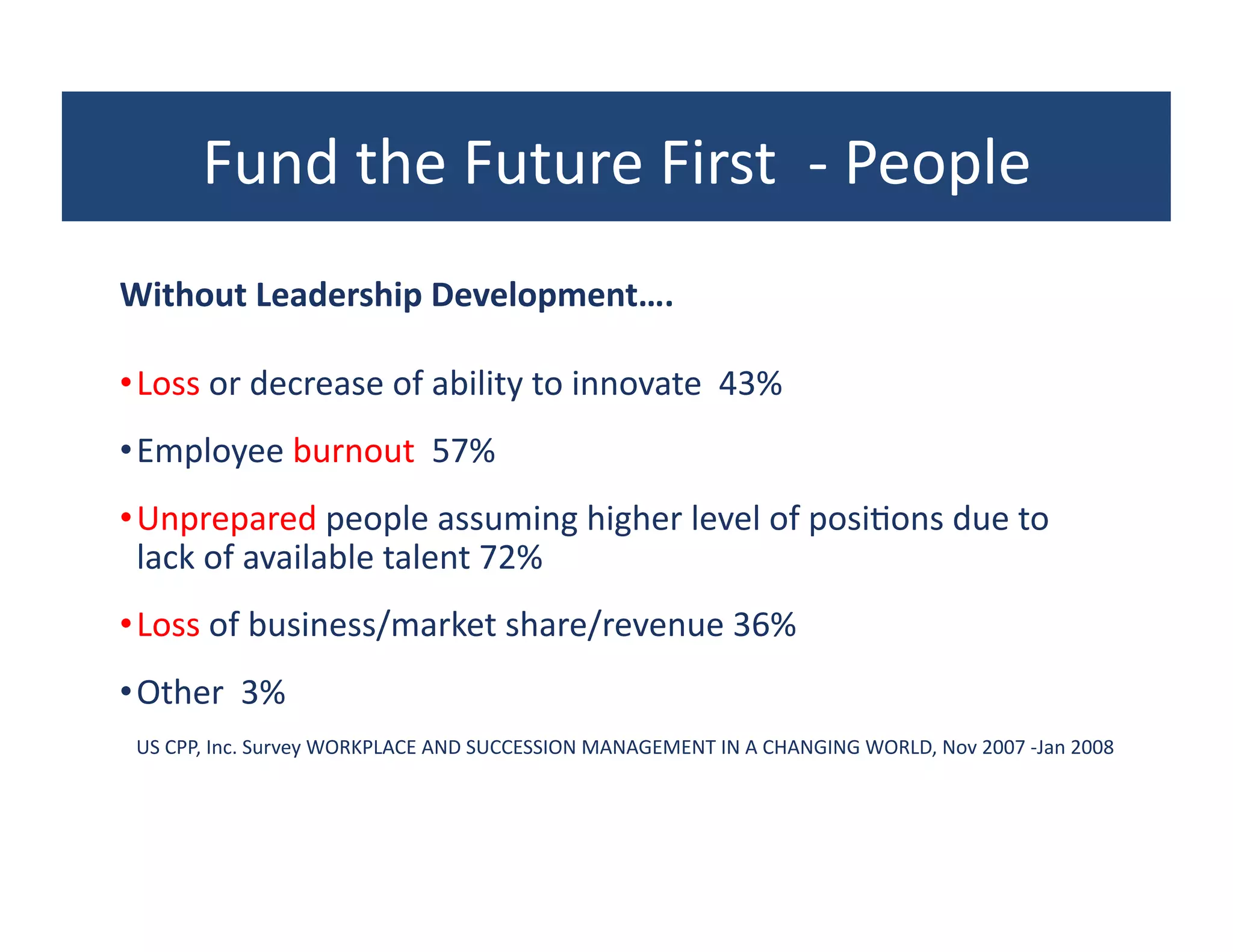
    Fund  the  Future  First    -­‐  People   Without  Leadership  Development….   • Loss  or  decrease  of  ability  to  innovate    43%   • Employee  burnout    57%   • Unprepared  people  assuming  higher  level  of  posi?ons  due  to   lack  of  available  talent  72%   • Loss  of  business/market  share/revenue  36%   • Other    3%   US  CPP,  Inc.  Survey  WORKPLACE  AND  SUCCESSION  MANAGEMENT  IN  A  CHANGING  WORLD,  Nov  2007  -­‐Jan  2008  
  • 44.
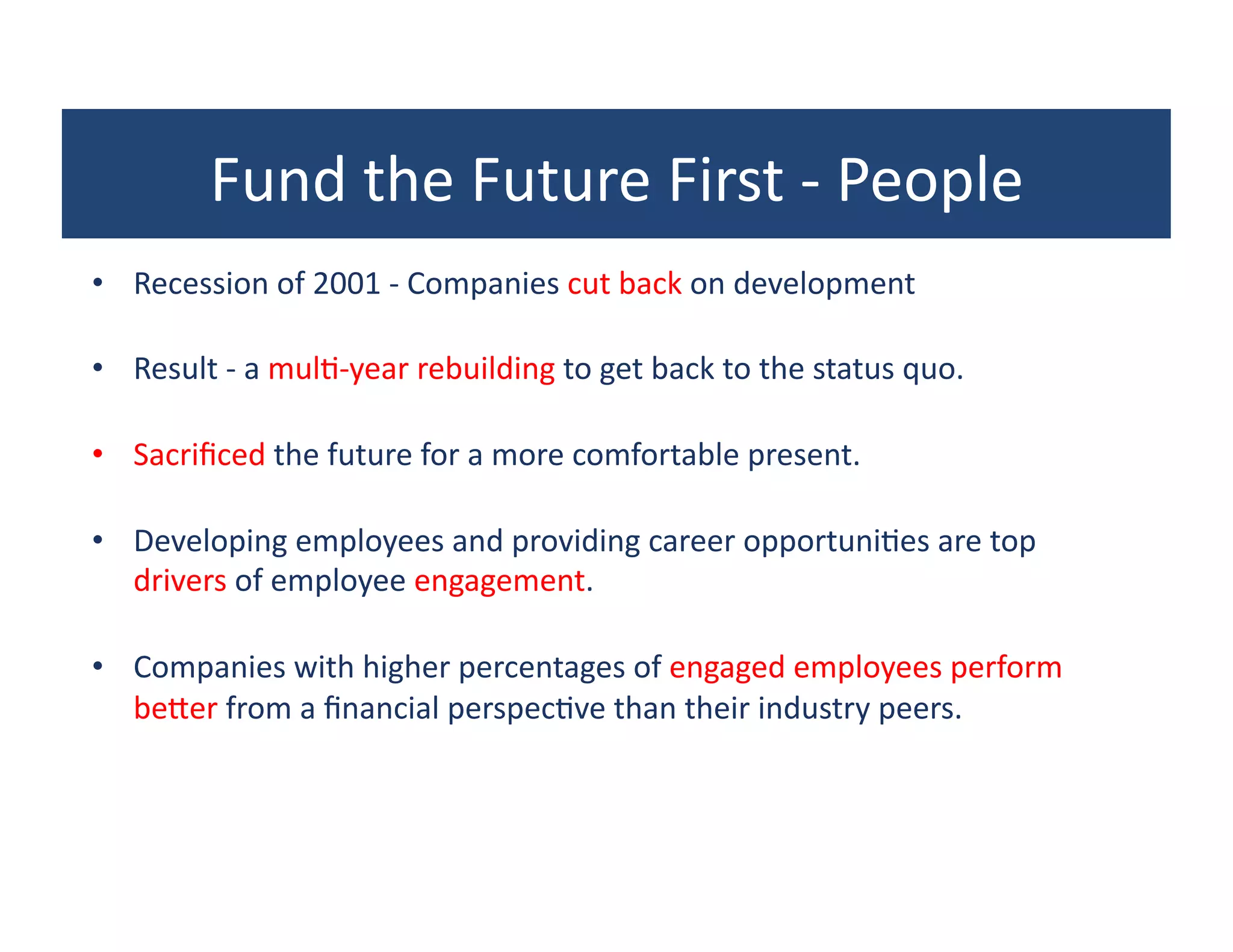
    Fund  the  Future  First  -­‐  People   •  Recession  of  2001  -­‐  Companies  cut  back  on  development   •  Result  -­‐  a  mul?-­‐year  rebuilding  to  get  back  to  the  status  quo.     •  Sacrificed  the  future  for  a  more  comfortable  present.     •  Developing  employees  and  providing  career  opportuni?es  are  top   drivers  of  employee  engagement.     •  Companies  with  higher  percentages  of  engaged  employees  perform   bewer  from  a  financial  perspec?ve  than  their  industry  peers.    
  • 45.
    Is  your  organiza?on   ready  to  leave  the   star?ng  blocks?  
  • 46.
    Today…and  Tomorrow!   • Trends  &  events  to  consider.   •  Four  things  we  can  do  to  keep  things  balanced:   –  Find  and  face  the  new  reali?es   –  Look  back  first   –  Seek  the  next  prac?ce  not  just  the  best  prac?ce   –  Fund  the  future  first  
  • 47.
    The  Pelorus   An  ancient  naviga?on   instrument  used  to  take   bearings  and  to  find  speed   and  distance  from   offshore.   Used  to  calibrate  the   compass.   A  Pelorus  has  a     fore  sight     and  a     rear  sight     allowing  the  navigator  to   plot  the  best  course     from  where  one  has  been     to  where  one  wants  to  go.  
  • 48.
    Kathy  Davanzo,  SPHR  -­  National  Speaker,  Trainer,    HR  Consultant  and  Facilitator   Kathy  uses  her  easy  and  genuine  connection  to  her  audience  to  create  a  highly  interactive  learning  environment     incorporating  stories,  humor,  thoughtful  quotes  and  concepts,  her  experiences  and  the  experiences  of  her     audience  into  a  dynamic,  fast  paced  and  informative  event.     Kathy  provides  keynotes,  workshops  and  break-­‐out  sessions  to  help  participants  clarify  and  articulate  their  personal  leadership   point  of  view;  recognizing  that  a  leader  who  can  clearly  de@ine  and  communicate  his  or  her  strengths,  experiences,  and  vision  will   experience  greater  and  sustained  leadership  effectiveness.     Recently,  her  research,  writing  and  speaking  events  have  also  focused  on  the  way  generational  in@luences  are  impacting  the  way  we   lead  and  the  way  work  gets  done.   Kathy  holds  a  bachelor’s  degree  in  English  and  Communications  Education  from  Miami  University  and  a  master’s  degree  in   Education  from  the  University  of  Miami.       Kathy  is  a  certi@ied  administrator  of  the  Leadership  Spectrum  Pro@ile  and  the  Con@lict  Dynamics  Pro@ile.    She  is  a  member  of  the   Advisory  Council  for  the  Institute  for  Professional  Development  at  Saint  Leo  University.   Kathy  is  a  Senior  Partner  with  CODA  Partners,  Inc.-­‐  provider  of  the  Leadership  POV™  programs  and  the  President  of  Pelorus   Leadership  Group,  Inc.,  a  training  and  consulting  @irm.   Kathy  is  an  avid  sailor,  and  when  not  sailing,  she  resides  in  Gulfport,  Florida  with  her  husband,  Charlie.    6860  Gulfport  Blvd.  S.  #343  727-­‐302-­‐9170    St.  Petersburg,  FL  33707  727-­‐743-­‐1430    www.codapartners.net  www.peloruslead.com    Kathy@codapartners.net      Kathy@peloruslead.com