Program Objectives Show the advantages of generational diversity in the workplace. Identify the impacts of generational differences. Learn the characteristics of different generations and how to adapt to and leverage them.
A Challenge Please Write  a One Sentence Definition of  “ Generation.”
Definition A body of individuals born in approximately the same time period who generally share similar behaviors and attitudes.
Benefits of Understanding Generational Differences More effective communication/less misunderstandings. Increased recruitment and employee retention. More effective motivational methods. Better-formed expectations. Increased productivity  and teamwork.
The Case of Understanding  There are now four (4) generations in the workplace with different expectations, motivations, attitudes, and behaviors. An understanding of these generational differences can equip one to handle workplace situations with  increased insight.
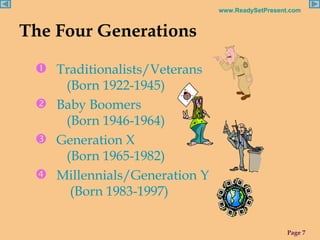
The Four Generations Traditionalists/Veterans    (Born 1922-1945) Baby Boomers    (Born 1946-1964) Generation X    (Born 1965-1982) Millennials/Generation Y    (Born 1983-1997)
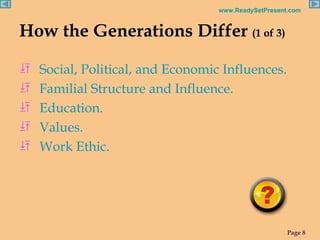
How the Generations Differ  (1 of 3) Social, Political, and Economic Influences. Familial Structure and Influence. Education. Values. Work Ethic.
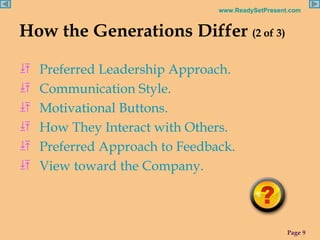
How the Generations Differ  (2 of 3) Preferred Leadership Approach. Communication Style. Motivational Buttons. How They Interact with Others. Preferred Approach to Feedback. View toward the Company.
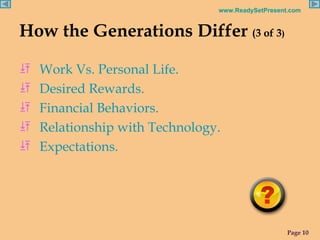
How the Generations Differ  (3 of 3 ) Work Vs. Personal Life. Desired Rewards. Financial Behaviors. Relationship with Technology. Expectations.
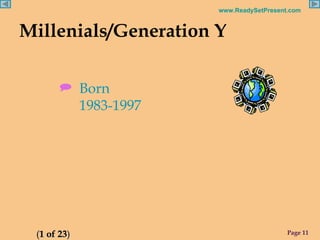
Millenials/Generation Y Born  1983-1997 ( 1 of 23 )
Also Known As  ( 1 of 2 ) Echo Boomers. named for many being the children of  Baby Boomers. Generation Me (not to be confused with Me Generation) named for being more confident but also more self-absorbed and demanding. ( 2 of 23 )
Also Known As  ( 2 of 2 ) iGeneration. named for the reasons of “Generation Me” in addition to acknowledging this generation’s tech savvy. Internet Generation. named for being the first generation  to grow up with widespread use of  the internet. ( 3 of 23 )
Influences :  Social, Political & Economic  ( 1 of 2 ) Rap and Hip Hop Music. Oklahoma City Bombing. Lewinsky Scandal. Columbine and Other  School Shootings. Dot Com Crash. ( 4 of 23 )
Influences:  Social, Political & Economic  ( 2 of 2 ) Enron and Corporate Scandals. War in Iraq. Proliferation of Communications and Mobile Technology. 9/11. ( 5 of 23 )
Familial Structure & Influence   (1 of 2) Millenials have grown up in non-traditional families with a record number of divorce rates. 1 in 4 lives in a single-parent household. For many Millenials, both mothers and fathers work and take part  in child-rearing. 3 in 4 have working mothers. ( 6 of 23 )
Familial Structure & Influence  (2 of 2) Millenials’ families are more child-centered, with parents involving themselves in their children’s activities and education. Millenials have a strong sense of their own self worth, are ambitious, and believe they can achieve anything. ( 7 of 23 )
Please Visit:  www.ReadySetPresent.com About This Product:  To download this entire “Generations At Work” PowerPoint presentation visit ReadySetPresent.com 100+ PowerPoint presentation content slides include topics such as: In the  first 92 slides  you will learn the advantages of generational diversity in the workplace, and identify the impacts of generational differences. This presentation details the 4 generations in our workplace today covering: Social, Political, and Economic Influences, Familial Structure and Influence, Education, Values, Work Ethic, Preferred Leadership Approach, Communication Style, Motivational Buttons, How They Interact with Others, Preferred Approach to Feedback, View toward the Company, Work Vs. Personal Life, Desired Rewards, Financial Behaviors, Relationship with Technology, and Expectations.  In addition you will receive 47 slides  covering: future trends and statistics for the four generations; implication for recruiting and supervising (Millennials). It also contrasts the pros and cons of each generation and 6 important tips to more effectively communicate with each generation plus much more.  Royalty Free – Use Them Over and Over Again.

GENERATIONS AT WORK POWERPOINT

  • 1.
  • 2.
    Program Objectives Showthe advantages of generational diversity in the workplace. Identify the impacts of generational differences. Learn the characteristics of different generations and how to adapt to and leverage them.
  • 3.
    A Challenge PleaseWrite a One Sentence Definition of “ Generation.”
  • 4.
    Definition A bodyof individuals born in approximately the same time period who generally share similar behaviors and attitudes.
  • 5.
    Benefits of UnderstandingGenerational Differences More effective communication/less misunderstandings. Increased recruitment and employee retention. More effective motivational methods. Better-formed expectations. Increased productivity and teamwork.
  • 6.
    The Case ofUnderstanding There are now four (4) generations in the workplace with different expectations, motivations, attitudes, and behaviors. An understanding of these generational differences can equip one to handle workplace situations with increased insight.
  • 7.
    The Four GenerationsTraditionalists/Veterans (Born 1922-1945) Baby Boomers (Born 1946-1964) Generation X (Born 1965-1982) Millennials/Generation Y (Born 1983-1997)
  • 8.
    How the GenerationsDiffer (1 of 3) Social, Political, and Economic Influences. Familial Structure and Influence. Education. Values. Work Ethic.
  • 9.
    How the GenerationsDiffer (2 of 3) Preferred Leadership Approach. Communication Style. Motivational Buttons. How They Interact with Others. Preferred Approach to Feedback. View toward the Company.
  • 10.
    How the GenerationsDiffer (3 of 3 ) Work Vs. Personal Life. Desired Rewards. Financial Behaviors. Relationship with Technology. Expectations.
  • 11.
    Millenials/Generation Y Born 1983-1997 ( 1 of 23 )
  • 12.
    Also Known As ( 1 of 2 ) Echo Boomers. named for many being the children of Baby Boomers. Generation Me (not to be confused with Me Generation) named for being more confident but also more self-absorbed and demanding. ( 2 of 23 )
  • 13.
    Also Known As ( 2 of 2 ) iGeneration. named for the reasons of “Generation Me” in addition to acknowledging this generation’s tech savvy. Internet Generation. named for being the first generation to grow up with widespread use of the internet. ( 3 of 23 )
  • 14.
    Influences : Social, Political & Economic ( 1 of 2 ) Rap and Hip Hop Music. Oklahoma City Bombing. Lewinsky Scandal. Columbine and Other School Shootings. Dot Com Crash. ( 4 of 23 )
  • 15.
    Influences: Social,Political & Economic ( 2 of 2 ) Enron and Corporate Scandals. War in Iraq. Proliferation of Communications and Mobile Technology. 9/11. ( 5 of 23 )
  • 16.
    Familial Structure &Influence (1 of 2) Millenials have grown up in non-traditional families with a record number of divorce rates. 1 in 4 lives in a single-parent household. For many Millenials, both mothers and fathers work and take part in child-rearing. 3 in 4 have working mothers. ( 6 of 23 )
  • 17.
    Familial Structure &Influence (2 of 2) Millenials’ families are more child-centered, with parents involving themselves in their children’s activities and education. Millenials have a strong sense of their own self worth, are ambitious, and believe they can achieve anything. ( 7 of 23 )
  • 18.
    Please Visit: www.ReadySetPresent.com About This Product: To download this entire “Generations At Work” PowerPoint presentation visit ReadySetPresent.com 100+ PowerPoint presentation content slides include topics such as: In the first 92 slides you will learn the advantages of generational diversity in the workplace, and identify the impacts of generational differences. This presentation details the 4 generations in our workplace today covering: Social, Political, and Economic Influences, Familial Structure and Influence, Education, Values, Work Ethic, Preferred Leadership Approach, Communication Style, Motivational Buttons, How They Interact with Others, Preferred Approach to Feedback, View toward the Company, Work Vs. Personal Life, Desired Rewards, Financial Behaviors, Relationship with Technology, and Expectations. In addition you will receive 47 slides covering: future trends and statistics for the four generations; implication for recruiting and supervising (Millennials). It also contrasts the pros and cons of each generation and 6 important tips to more effectively communicate with each generation plus much more. Royalty Free – Use Them Over and Over Again.