Take the Work-Life Quiz:  Know What You Need to Know to be Effective Judi C. Casey, Sloan Work & Family Research Network, Boston College Teresa Hopke, RSM McGladrey
Agenda Research data RSM McGladrey best practices Best practices sharing Questions Recommendations and action steps
“ Harder & Longer Philosophy” In order to increase productivity in this competitive global economy, employers of choice try to get the most out of employees by adopting the philosophy, “the harder and longer you can get them to work, the better.” True or False?
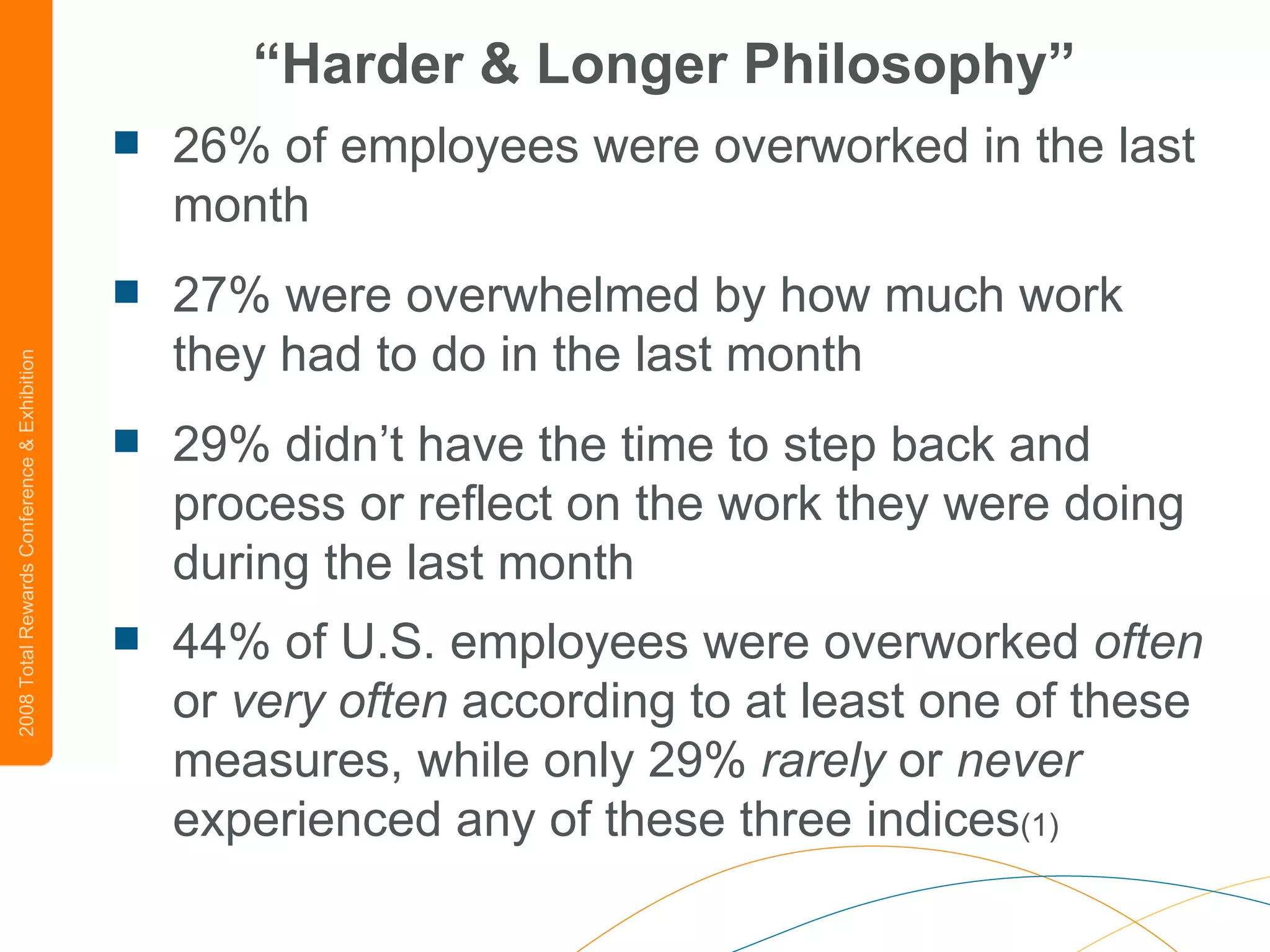
“ Harder & Longer Philosophy” 26% of employees were overworked in the last month 27% were overwhelmed by how much work they had to do in the last month 29% didn’t have the time to step back and process or reflect on the work they were doing during the last month 44% of U.S. employees were overworked  often  or  very often  according to at least one of these measures, while only 29%  rarely  or  never  experienced any of these three indices (1)
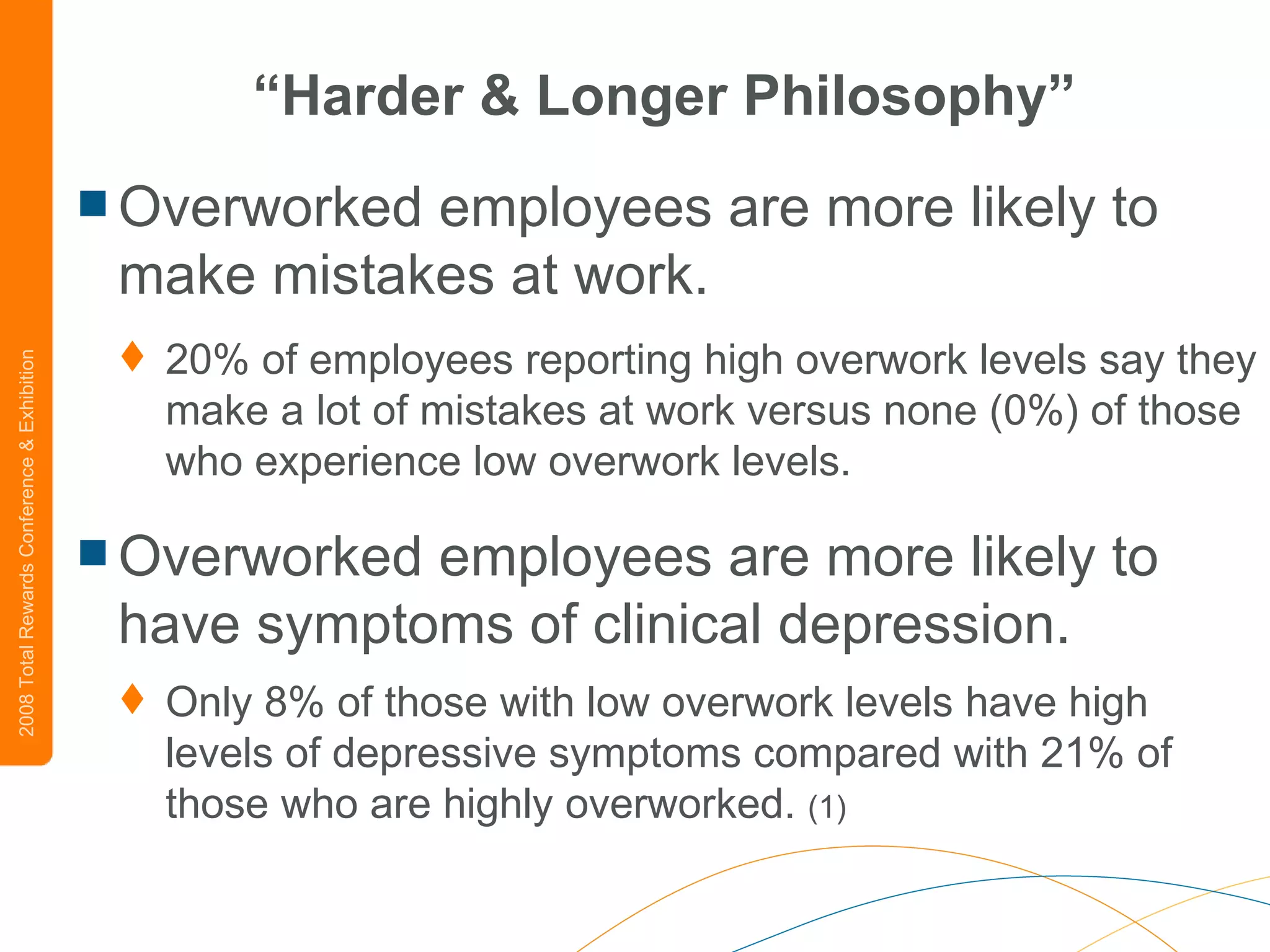
“ Harder & Longer Philosophy” Overworked employees are more likely to make mistakes at work.   20% of employees reporting high overwork levels say they make a lot of mistakes at work versus none (0%) of those who experience low overwork levels. Overworked employees are more likely to have symptoms of clinical depression.  Only 8% of those with low overwork levels have high levels of depressive symptoms compared with 21% of those who are highly overworked.  (1)
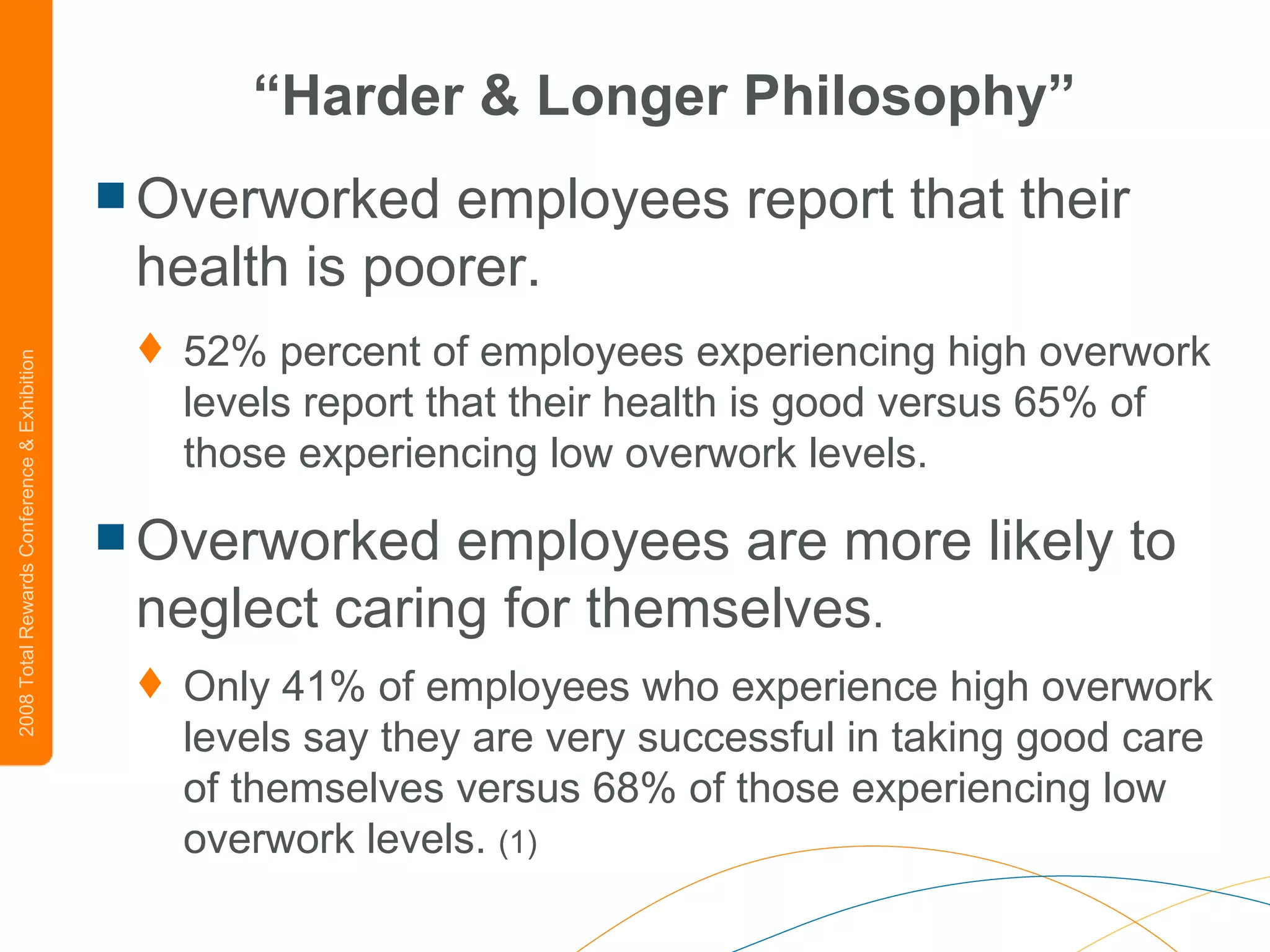
“ Harder & Longer Philosophy” Overworked employees report that their health is poorer.   52% percent of employees experiencing high overwork levels report that their health is good versus 65% of those experiencing low overwork levels. Overworked employees are more likely to neglect caring for themselves .  Only 41% of employees who experience high overwork levels say they are very successful in taking good care of themselves versus 68% of those experiencing low overwork levels.  (1)
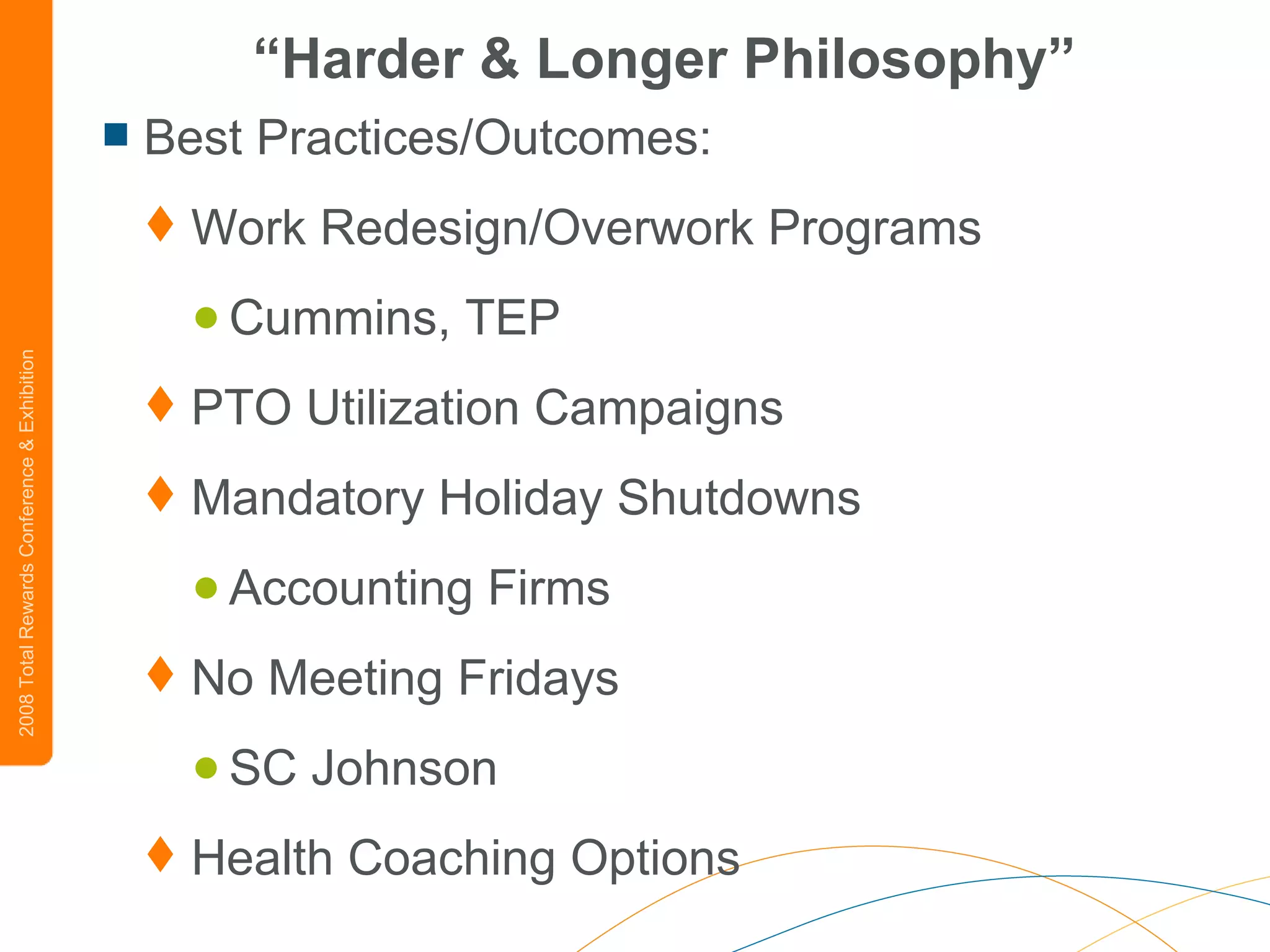
“ Harder & Longer Philosophy” Best Practices/Outcomes: Work Redesign/Overwork Programs Cummins, TEP PTO Utilization Campaigns Mandatory Holiday Shutdowns Accounting Firms No Meeting Fridays SC Johnson Health Coaching Options
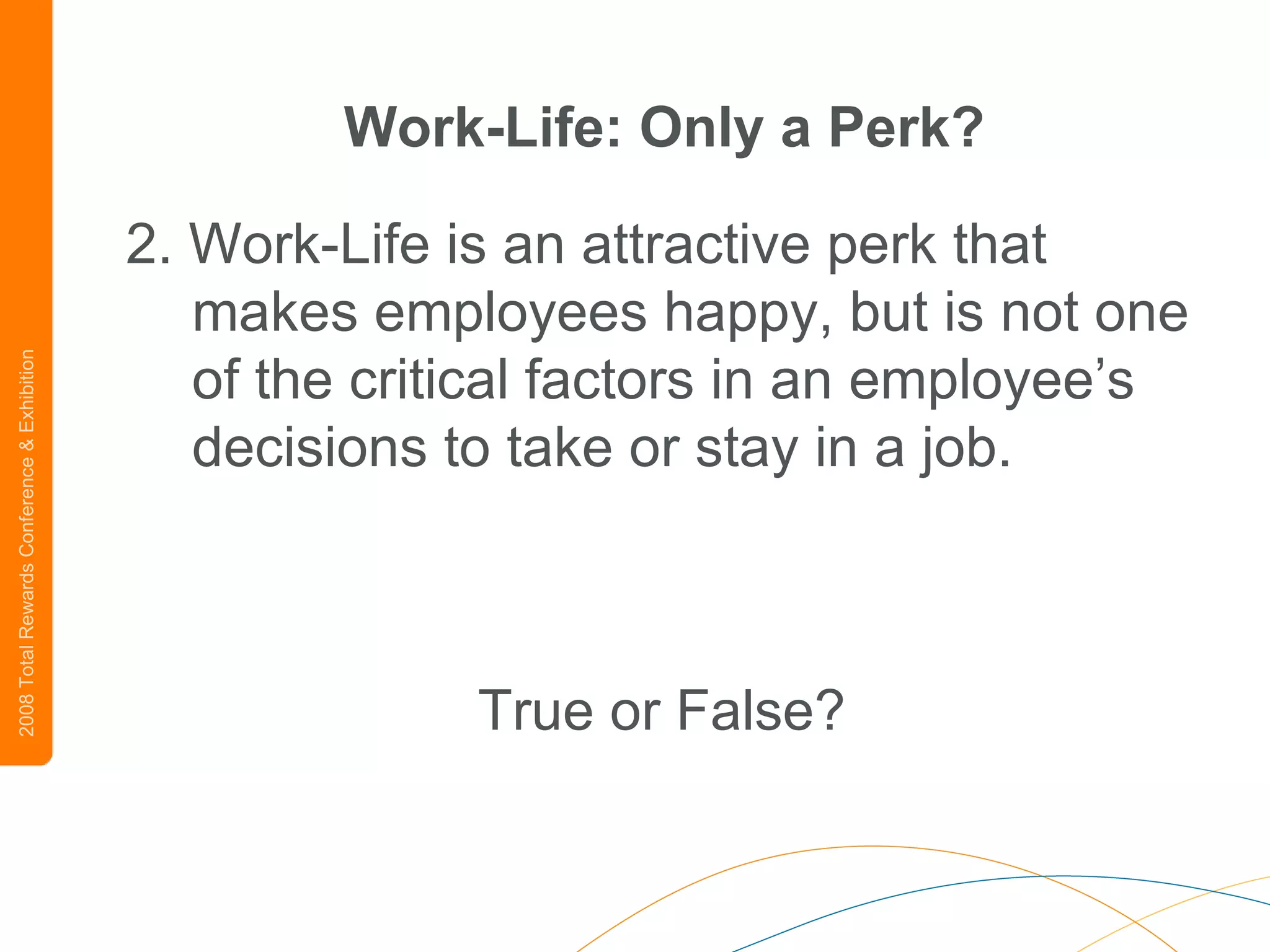
Work-Life: Only a Perk? 2. Work-Life is an attractive perk that makes employees happy, but is not one of the critical factors in an employee’s decisions to take or stay in a job.   True or False?
Work-Life: Only a Perk? When it comes to choosing a job, …three keys areas of focus emerged across countries and cultures:  ensuring adequate compensation and financial security;  achieving work/life balance ; and  having relevant learning and career opportunities.  (2)
Work-Life: Only a Perk? Graduating business students around the world report that attaining a balance between work and personal life is their  most important  career goal.  (3) 89% of employees polled believe work/life programs, such as flextime and telecommuting, are important when evaluating a new job, yet only about half of HR professionals polled consider work/life to be an important initiative for their companies.   (4)
Work-Life: Only a Perk? 29% of US workers now consider work-life balance and flexibility to be the most important factor in considering job offers.     Compensation still matters, but it finished second (23%) behind lifestyle when workers were asked to name the primary reason they accepted their current positions.  (5)
Work-Life: Only a Perk? Best Practices/Outcomes: One of top 3 reasons recruits join RSM Moved from #1 to #2 reason employees leave RSM One of key drivers of engagement on RSM survey Impacts employee health University presentations Gen Y willing to trade time for money
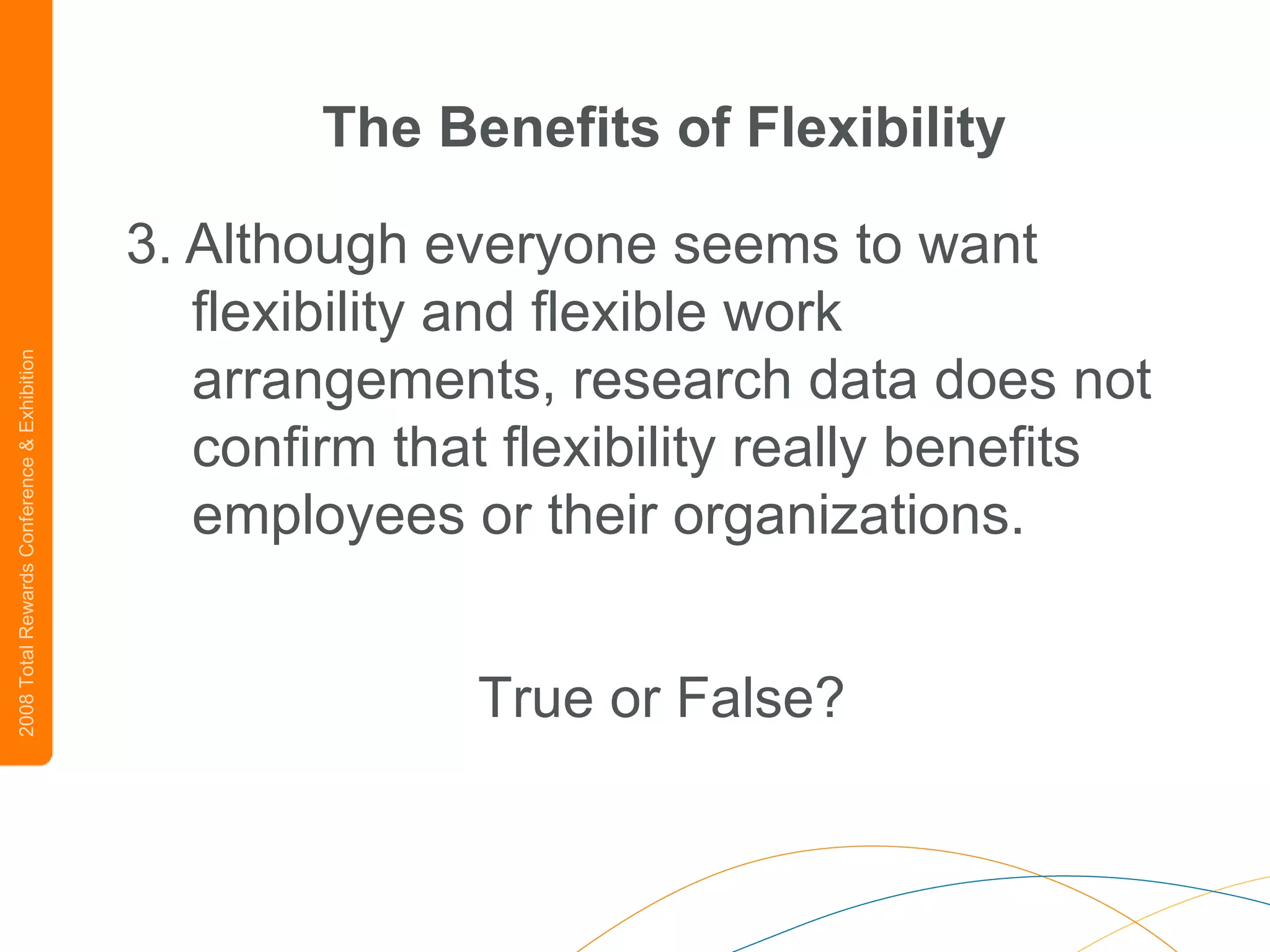
The Benefits of Flexibility 3.   Although everyone seems to want flexibility and flexible work arrangements, research data does not confirm that flexibility really benefits employees or their organizations.   True or False?
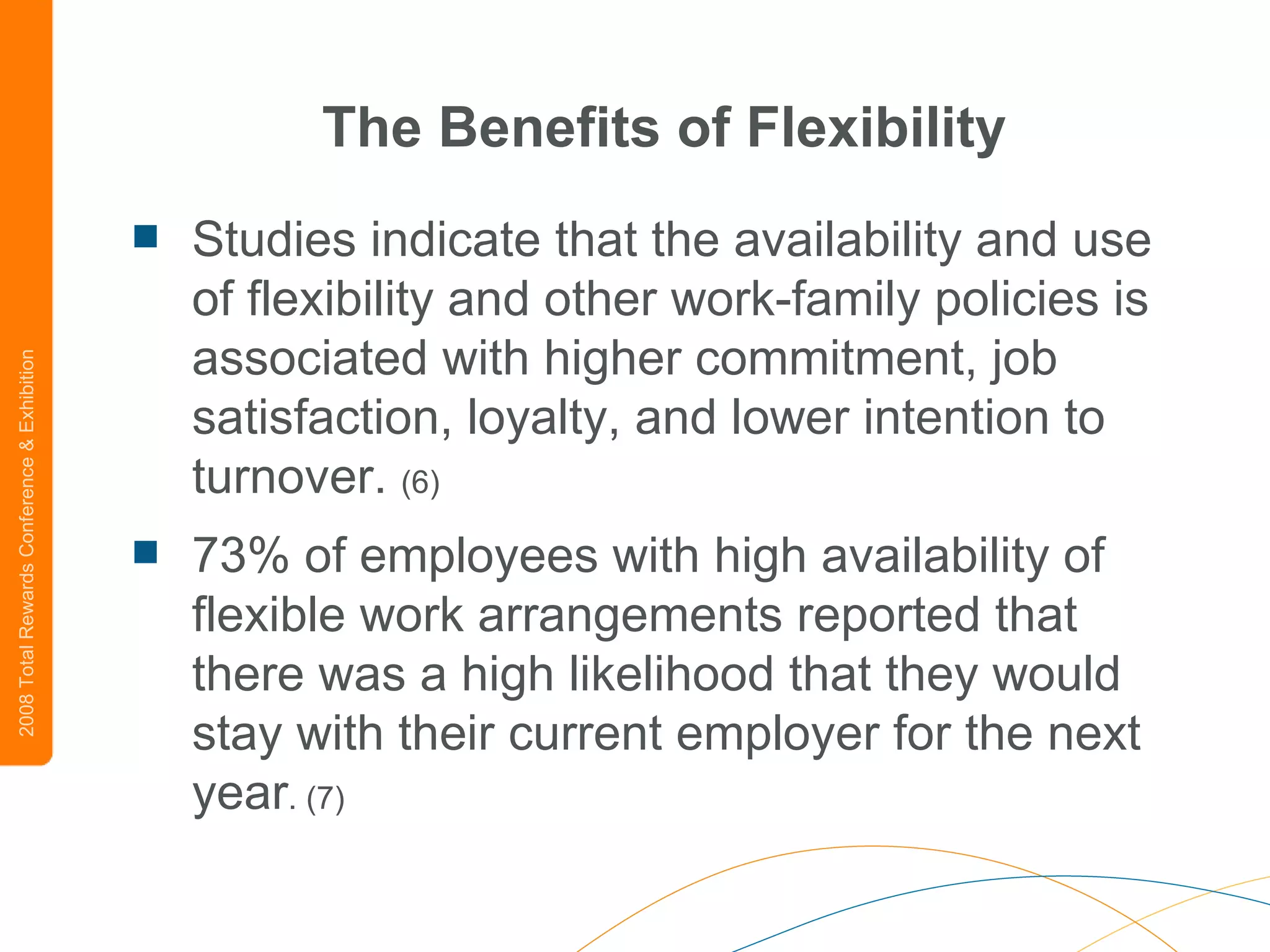
The Benefits of Flexibility Studies indicate that the availability and use of flexibility and other work-family policies is associated with higher commitment, job satisfaction, loyalty, and lower intention to turnover.  (6) 73% of employees with high availability of flexible work arrangements reported that there was a high likelihood that they would stay with their current employer for the next year . (7)
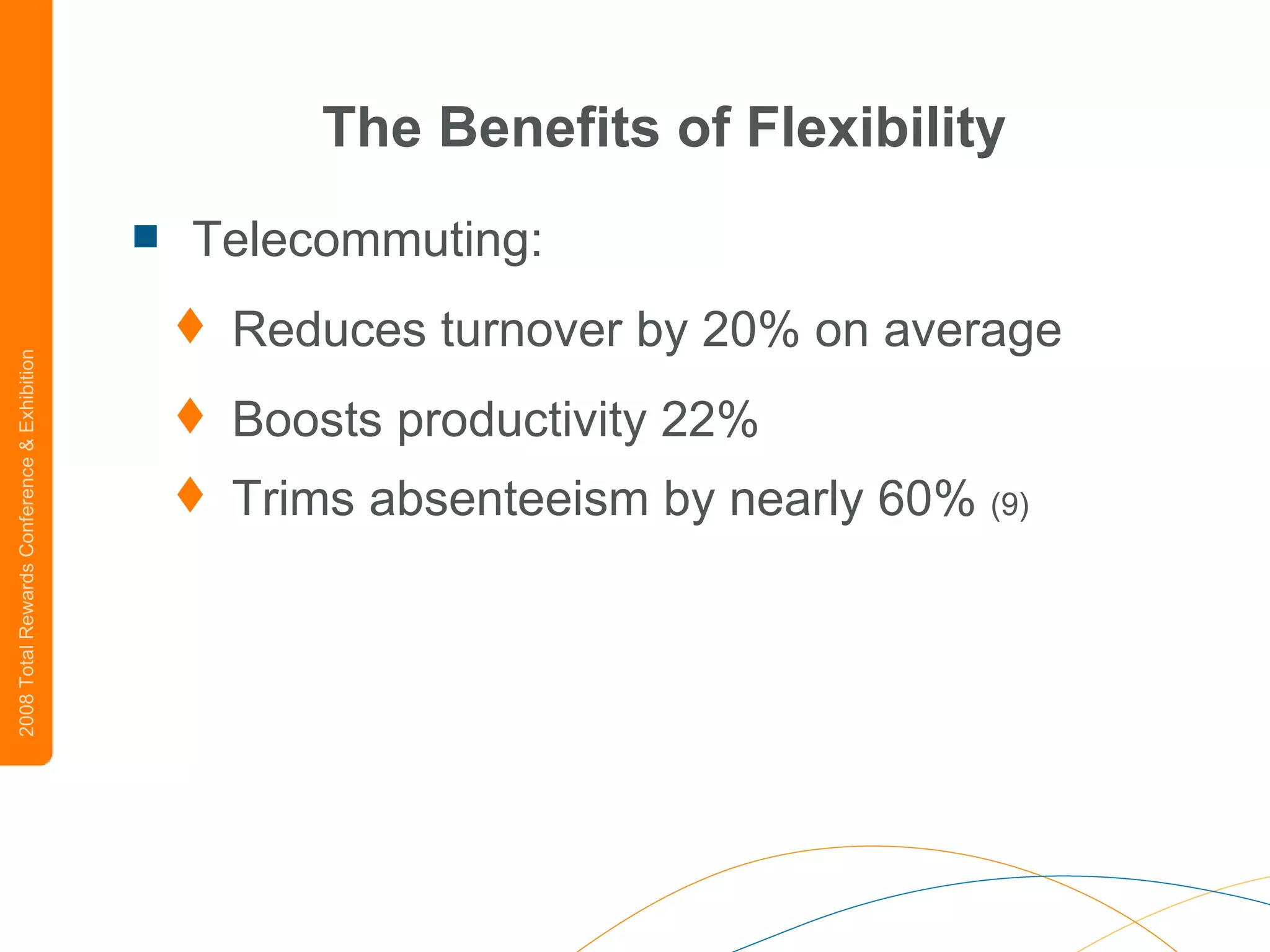
The Benefits of Flexibility Telecommuting: Reduces turnover by 20% on average  Boosts productivity 22%  Trims absenteeism by nearly 60%  (9)
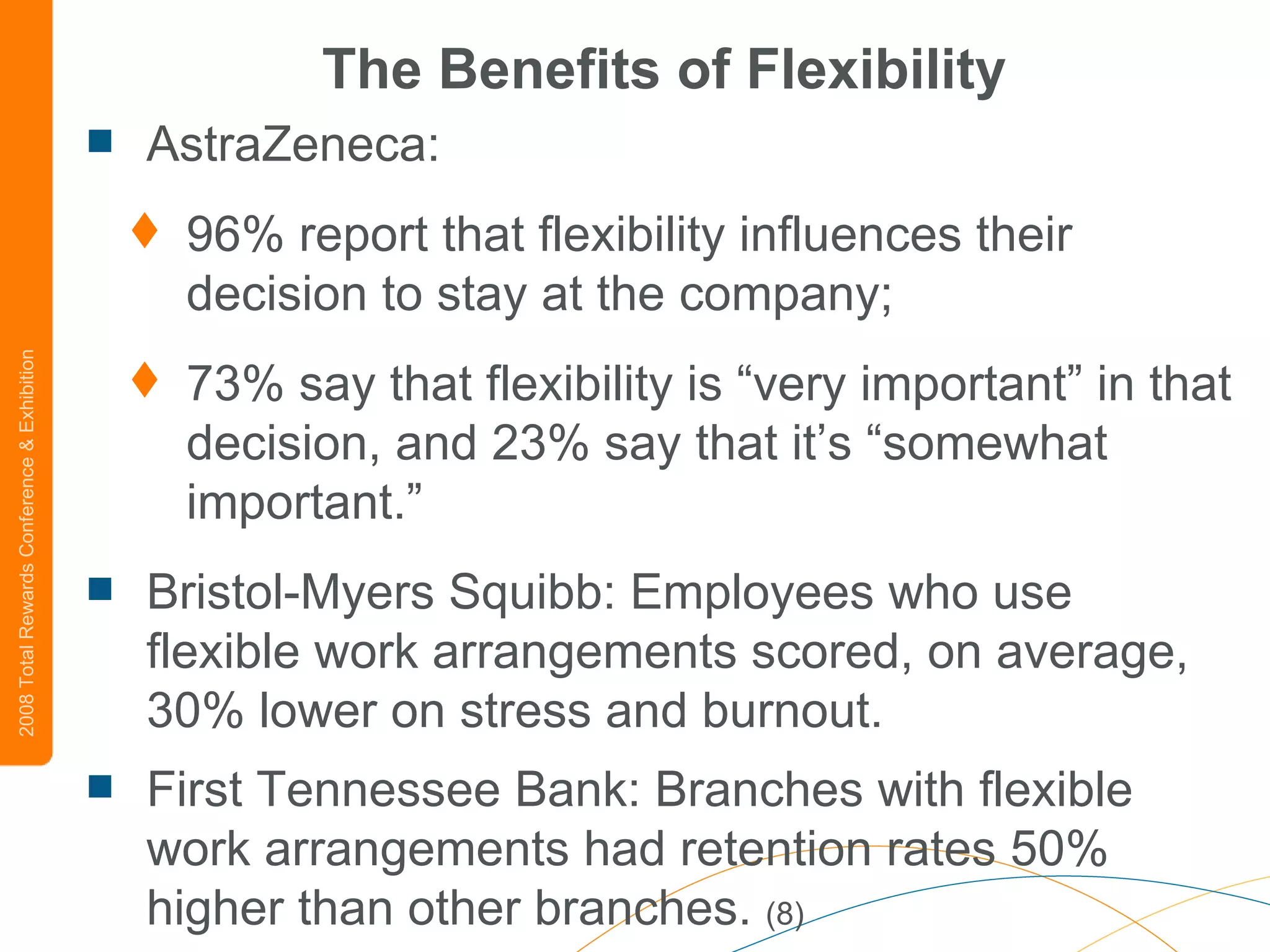
The Benefits of Flexibility AstraZeneca: 96% report that flexibility influences their decision to stay at the company;  73% say that flexibility is “very important” in that decision, and 23% say that it’s “somewhat important.” Bristol-Myers Squibb: Employees who use flexible work arrangements scored, on average, 30% lower on stress and burnout. First Tennessee Bank: Branches with flexible work arrangements had retention rates 50% higher than other branches.  (8)
The Benefits of Flexibility Best Practices/Outcomes: 89% of RSM employees said it was #1 WL benefit to offer Moved from accommodation to business based flex  All FWO requests approved based on business impact Opportunity to redesign job Comprehensive FWE rollout to all employees Flexyear = to help meet cyclical business needs FlexCareer = to help support career cycles
Multi-Generational Workforce 4.   There have always been differences about expectations and behaviors between workers of all ages at the workplace and the current situation is not that different. True or False?
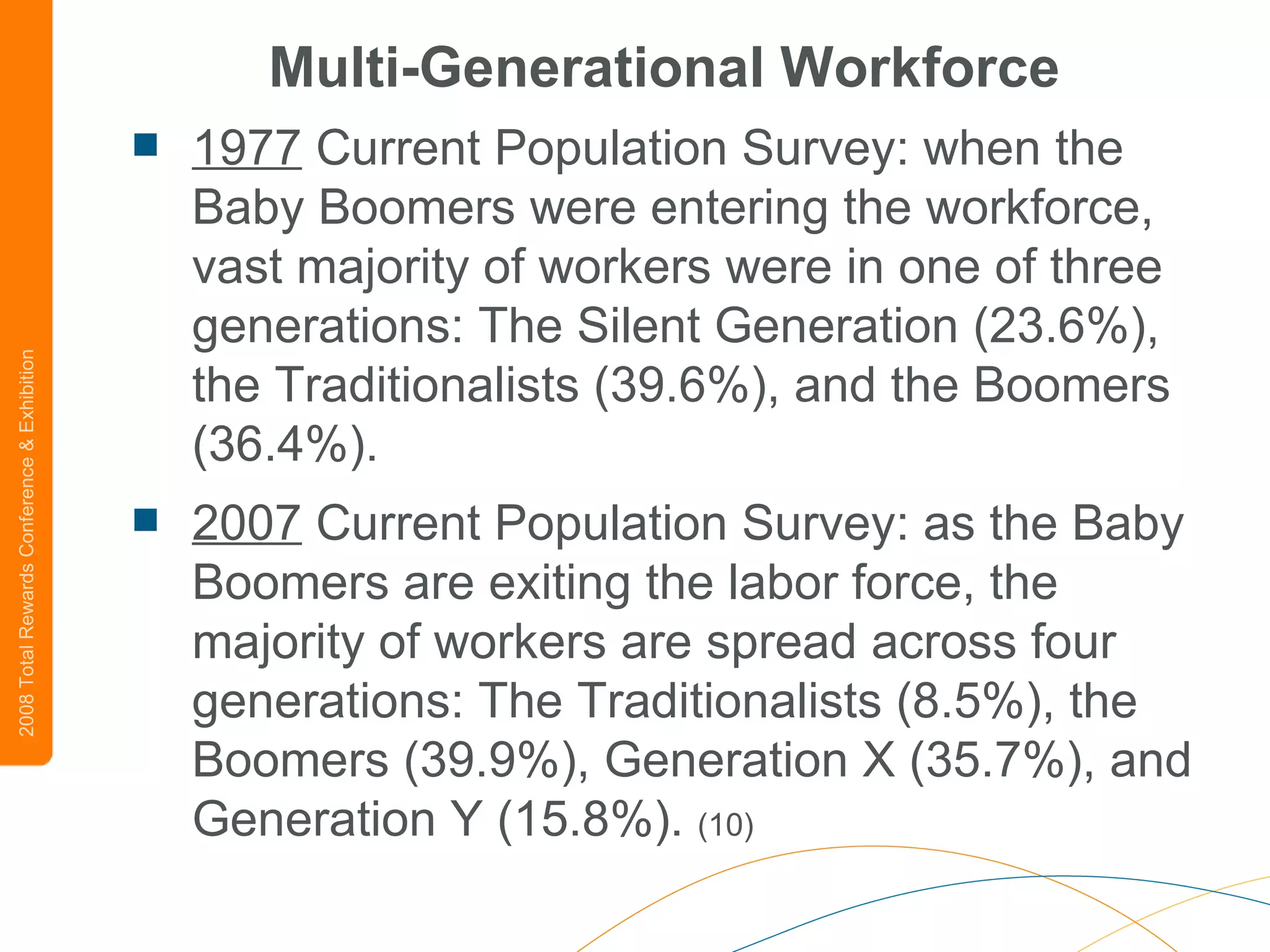
Multi-Generational Workforce 1977  Current Population Survey: when the Baby Boomers were entering the workforce, vast majority of workers were in one of three generations: The Silent Generation (23.6%), the Traditionalists (39.6%), and the Boomers (36.4%).  2007  Current Population Survey: as the Baby Boomers are exiting the labor force, the majority of workers are spread across four generations: The Traditionalists (8.5%), the Boomers (39.9%), Generation X (35.7%), and Generation Y (15.8%).  (10)
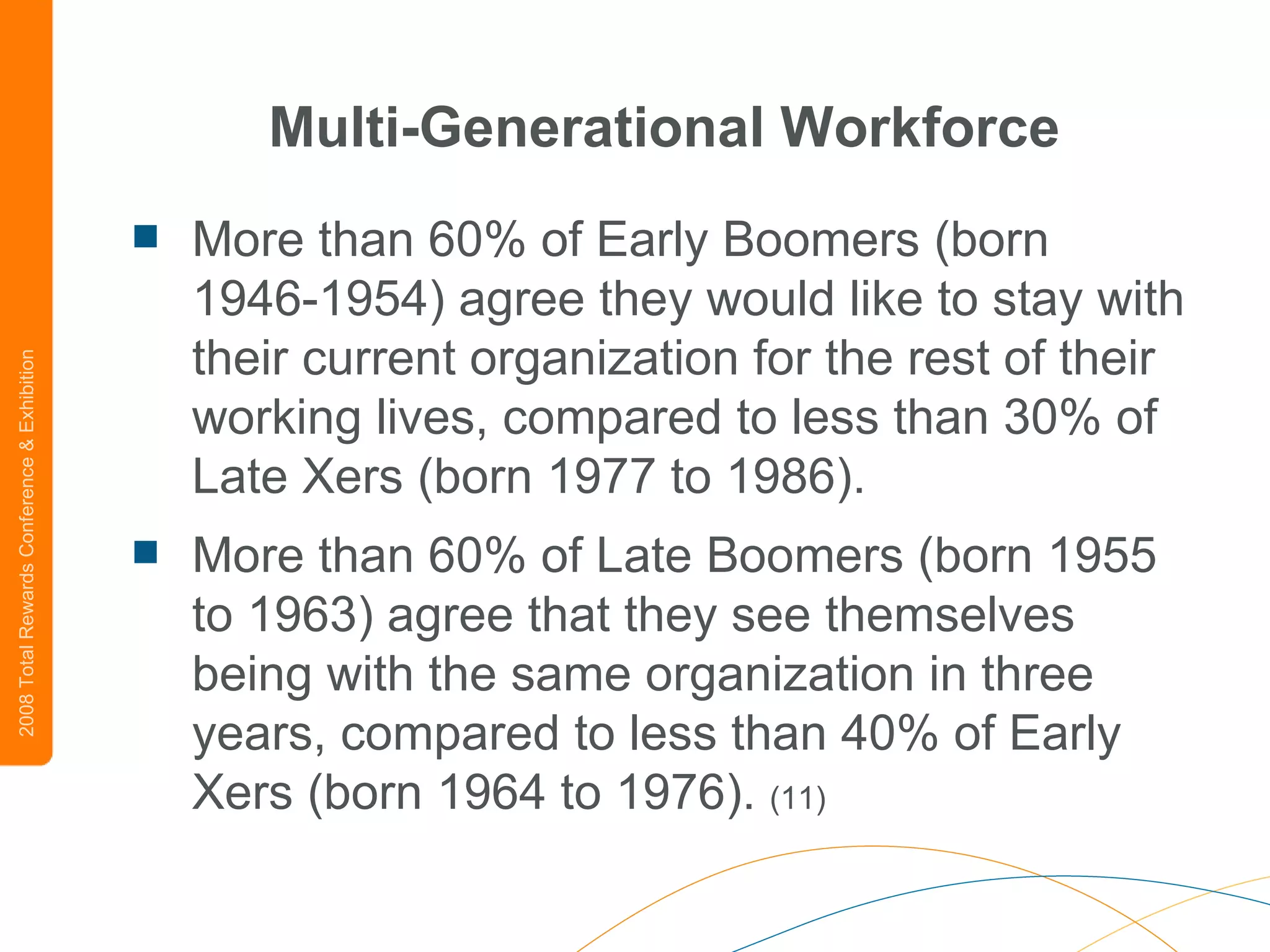
Multi-Generational Workforce More than 60% of Early Boomers (born 1946-1954) agree they would like to stay with their current organization for the rest of their working lives, compared to less than 30% of Late Xers (born 1977 to 1986). More than 60% of Late Boomers (born 1955 to 1963) agree that they see themselves being with the same organization in three years, compared to less than 40% of Early Xers (born 1964 to 1976).  (11)
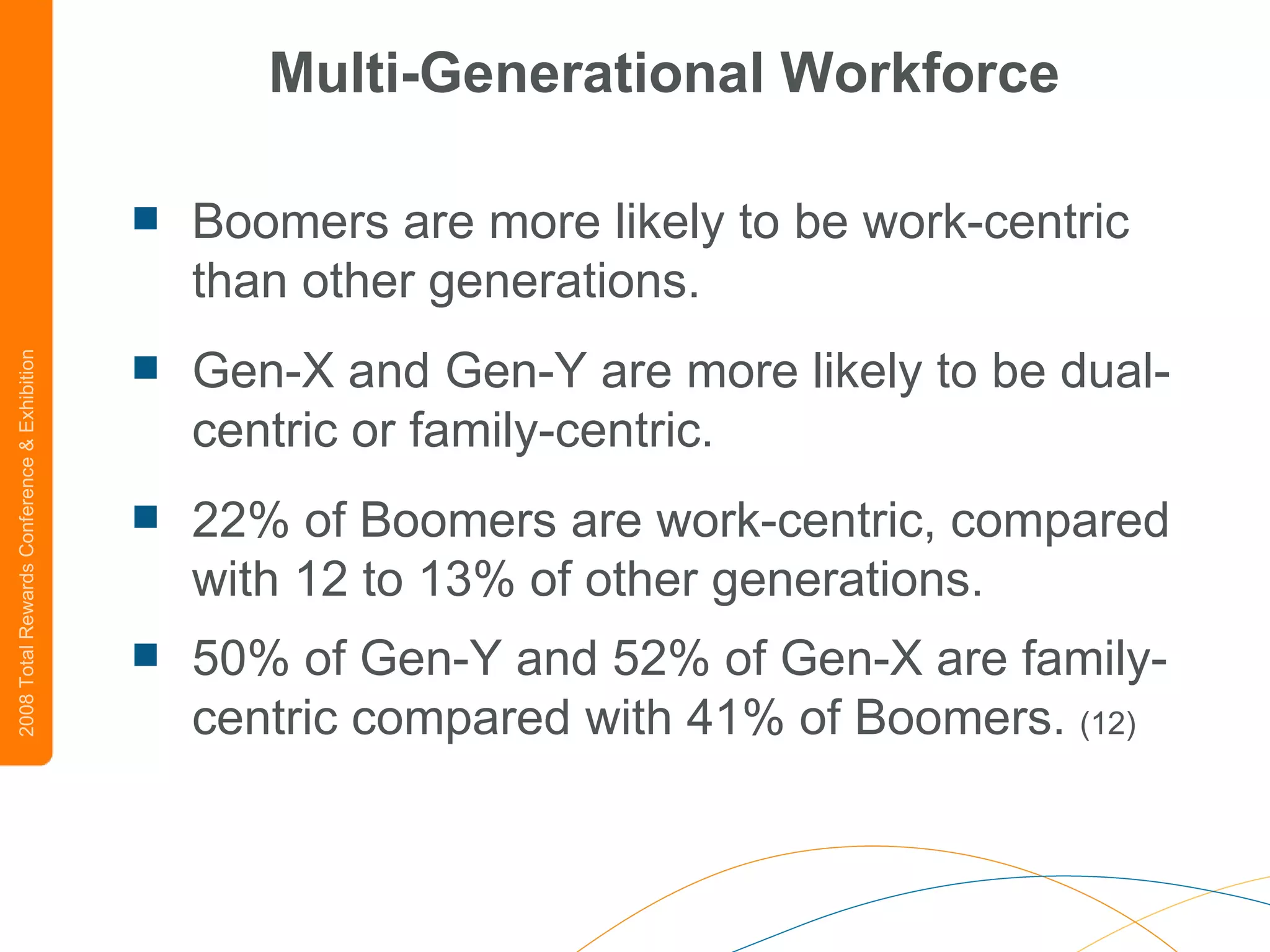
Multi-Generational Workforce Boomers are more likely to be work-centric than other generations.  Gen-X and Gen-Y are more likely to be dual-centric or family-centric.  22% of Boomers are work-centric, compared with 12 to 13% of other generations.  50% of Gen-Y and 52% of Gen-X are family-centric compared with 41% of Boomers.  (12)
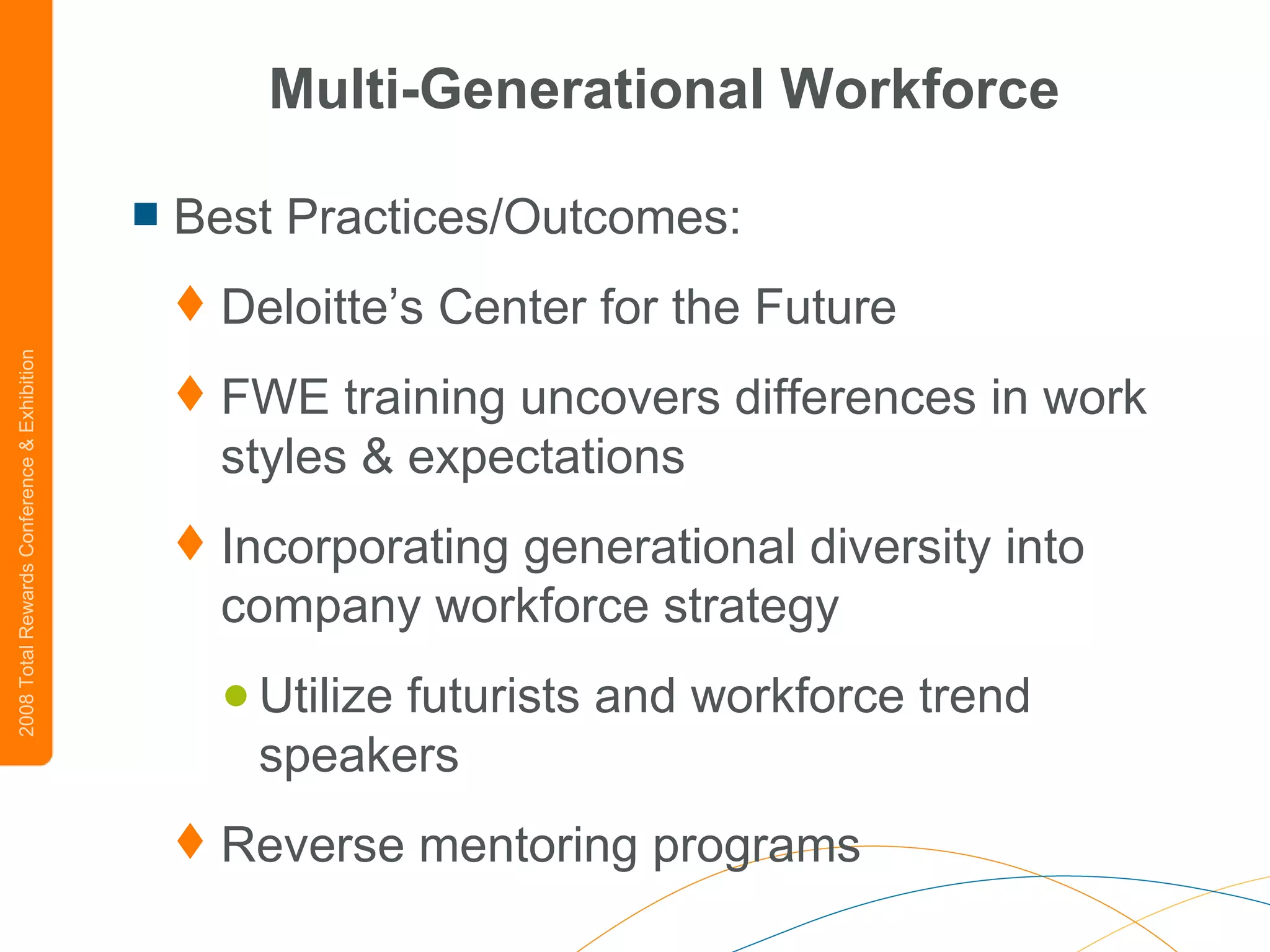
Multi-Generational Workforce Best Practices/Outcomes: Deloitte’s Center for the Future FWE training uncovers differences in work styles & expectations Incorporating generational diversity into company workforce strategy Utilize futurists and workforce trend speakers  Reverse mentoring programs
“ The Lists” 5. The best way to support employees with their work-life issues is to secure a spot on one of the prestigious “Best Companies Lists.” True or False?
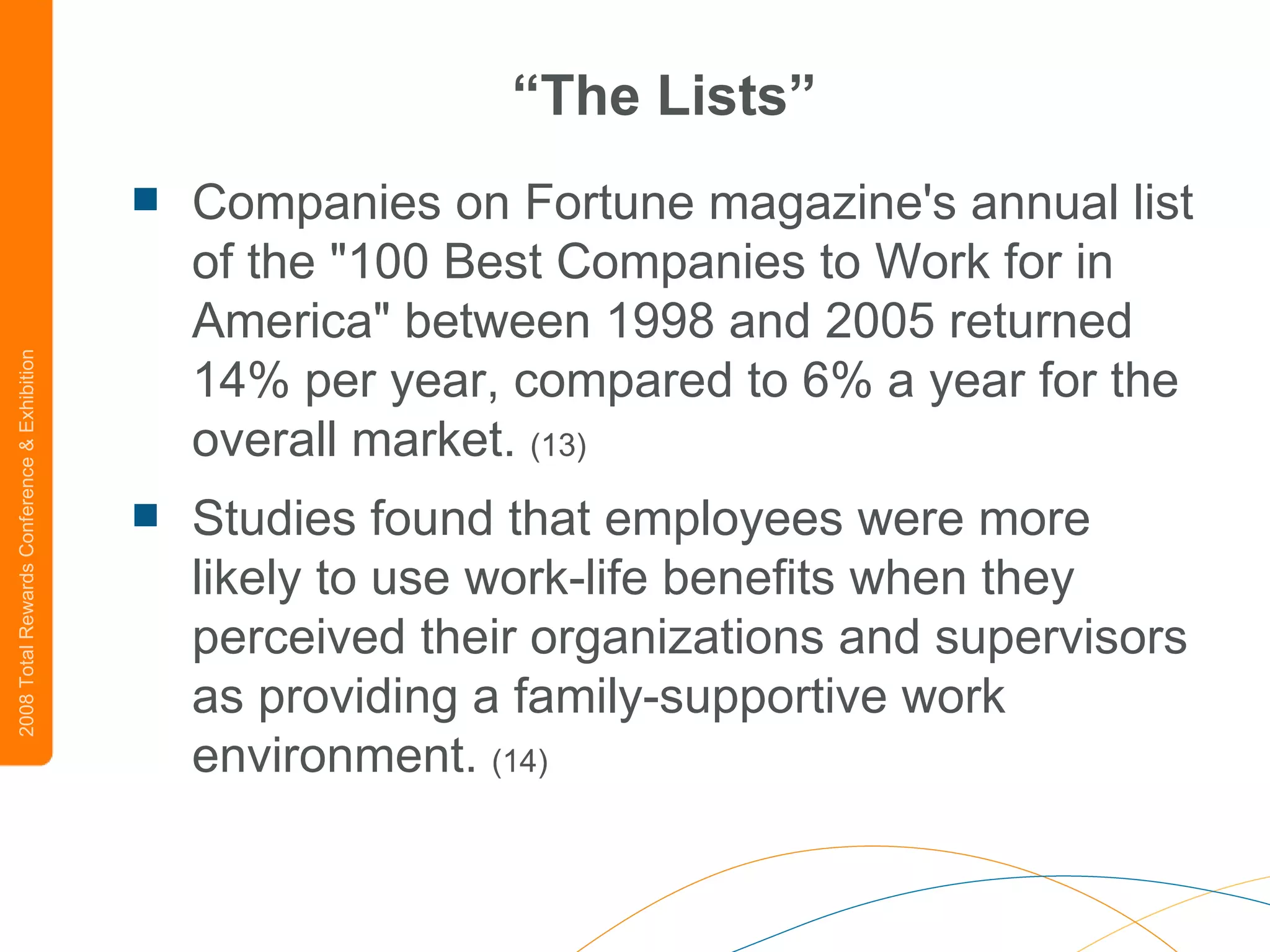
“ The Lists” Companies on Fortune magazine's annual list of the "100 Best Companies to Work for in America" between 1998 and 2005 returned 14% per year, compared to 6% a year for the overall market.  (13)   Studies found that employees were more likely to use work-life benefits when they perceived their organizations and supervisors as providing a family-supportive work environment.  (14)
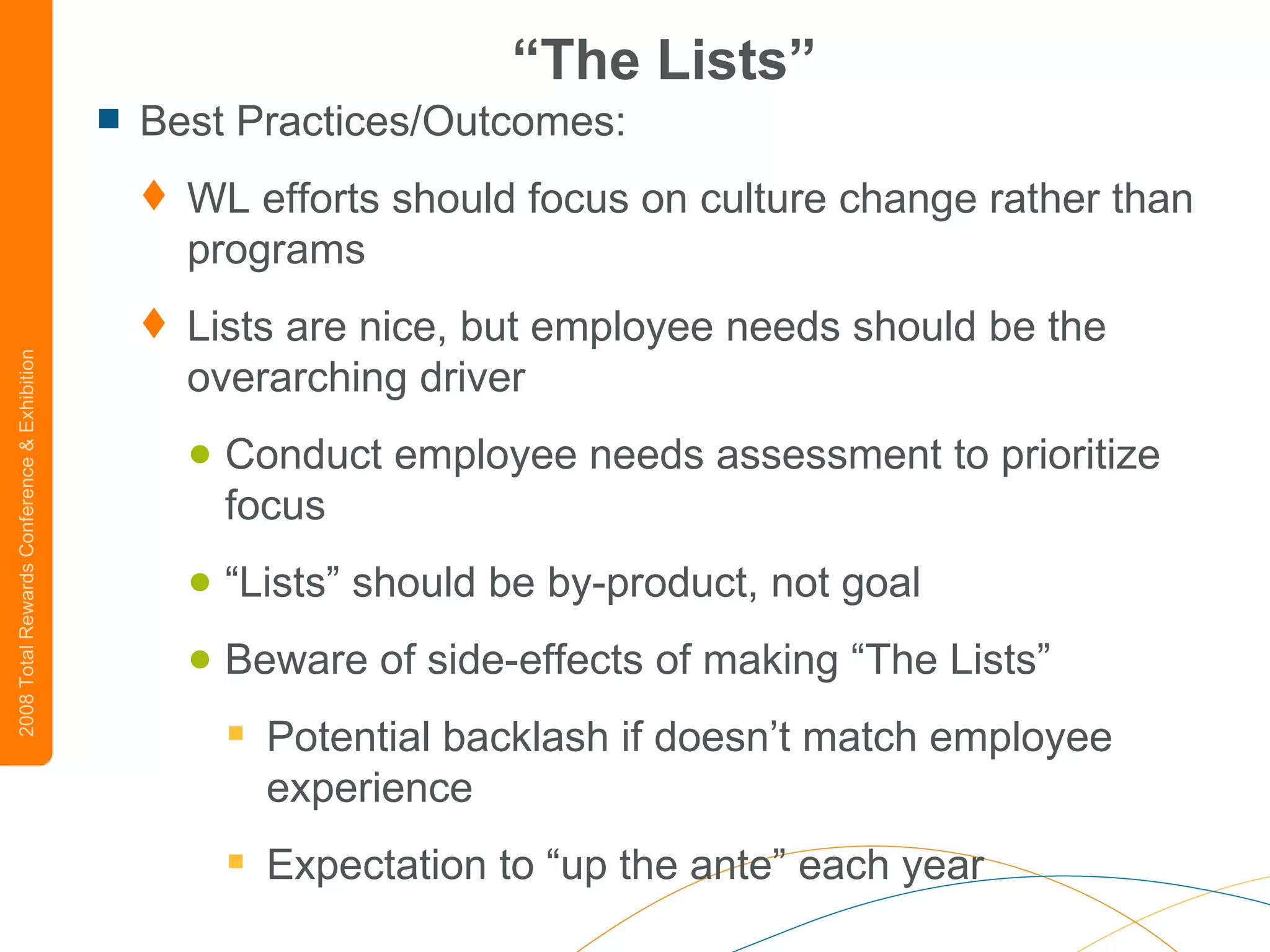
“ The Lists” Best Practices/Outcomes: WL efforts should focus on culture change rather than programs Lists are nice, but employee needs should be the overarching driver Conduct employee needs assessment to prioritize focus “ Lists” should be by-product, not goal Beware of side-effects of making “The Lists” Potential backlash if doesn’t match employee experience Expectation to “up the ante” each year
Work-Life is for Mothers 6. In most organizations, working mothers take advantage of work-life programs, but working dads typically don’t utilize or value them.   True or False?
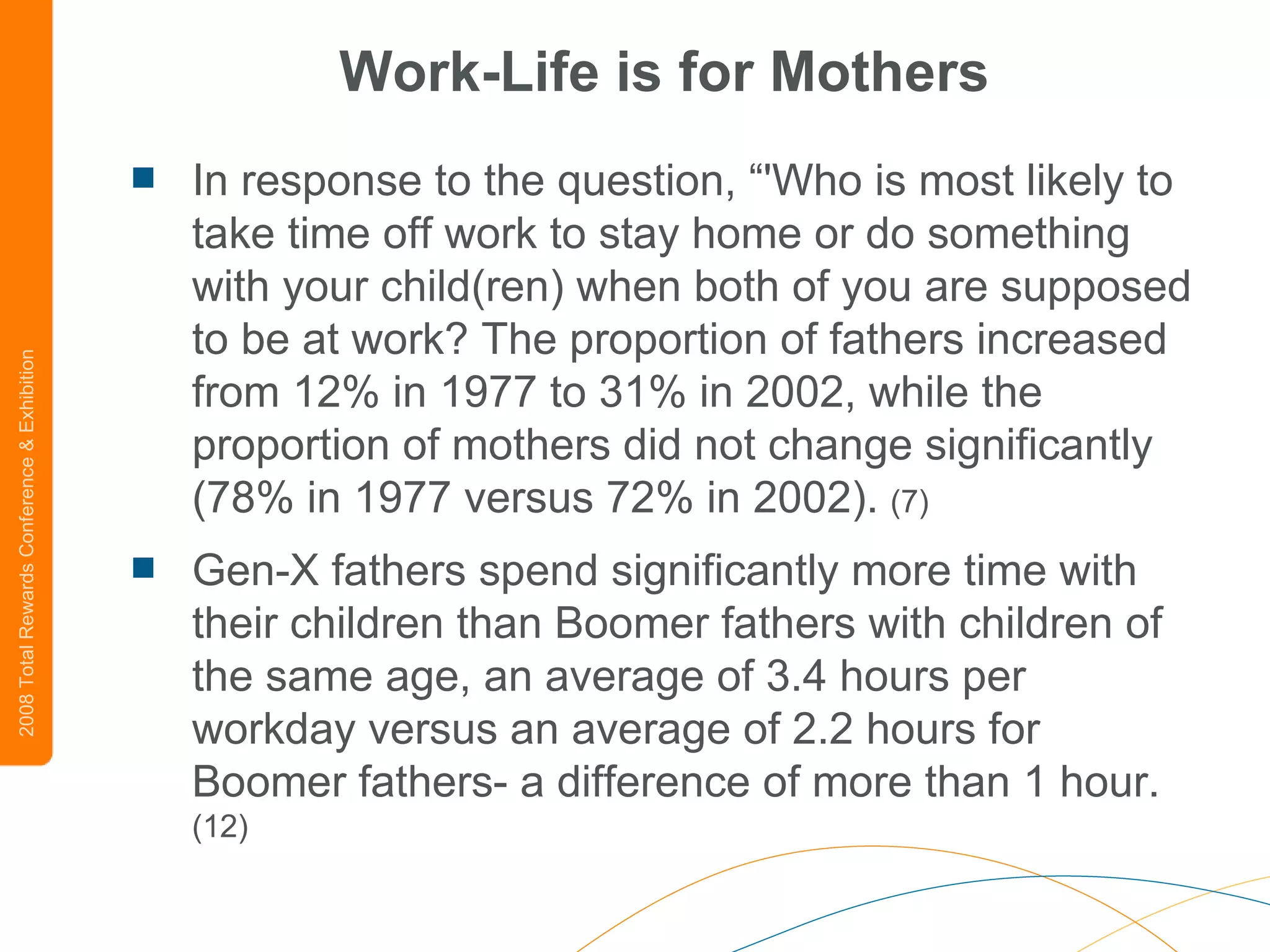
Work-Life is for Mothers In response to the question, “'Who is most likely to take time off work to stay home or do something with your child(ren) when both of you are supposed to be at work? The proportion of fathers increased from 12% in 1977 to 31% in 2002, while the proportion of mothers did not change significantly (78% in 1977 versus 72% in 2002).   (7) Gen-X fathers spend significantly more time with their children than Boomer fathers with children of the same age, an average of 3.4 hours per workday versus an average of 2.2 hours for Boomer fathers- a difference of more than 1 hour.  (12)
Work-Life is for Mothers In a sample of mothers and fathers with a child aged three to fifteen months, 20% of the fathers made changes in their work arrangements to spend time with their baby.   (15)  In 2002, 1 in 5 fathers were the primary caregiver for their preschooler [child under 5 years old], meaning their child spent more time in their care than in any other arrangement (20%).  (16)
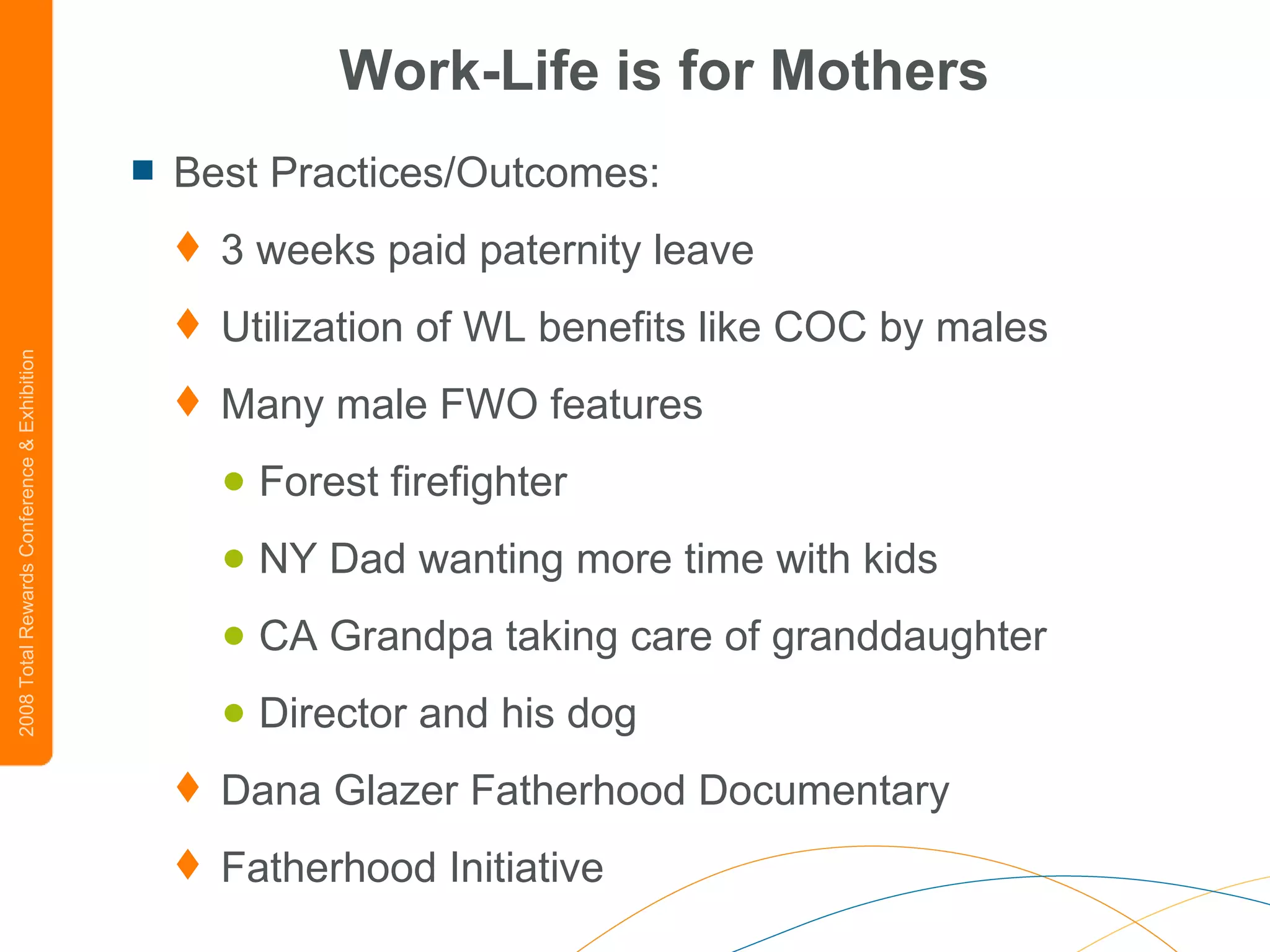
Work-Life is for Mothers Best Practices/Outcomes: 3 weeks paid paternity leave Utilization of WL benefits like COC by males Many male FWO features Forest firefighter NY Dad wanting more time with kids CA Grandpa taking care of granddaughter Director and his dog Dana Glazer Fatherhood Documentary Fatherhood Initiative
Questions and/or Additional Best Practices
Recommendations and Action Steps Assess the needs of your employees & consider all demographic groups individually Voluntary online survey option Take dualistic approach to strategy Align efforts to AWLP’s 7 categories Engage internal and external partners WL advisory team & senior champion/advocate Leaders who “get it” Line managers who do “hand-to-hand combat” Other departments (Operations, PM, OD, ER, Marketing) Corporate Voices, AWLP, Families & Work Institute, Sloan Network, local Think Tanks, Membership associations etc.
Recommendations and Action Steps Pilot & measure, pilot & measure, pilot & measure   Set up success measures from the start Understand that not all solutions are right for all organizations Figure out ways to get approval without getting approval FWE pilot helped re-direct intended rollout, COC changed drastically, Concierge created buy-in, etc. Position WL as a strategic business tool that can solve the issues that keep your leaders up at night Use WL as a business tool to enhance company brand and increase ability to recruit talent Use WL to drive workforce planning & strategy Have fun & be creative
Wrap-up What is the one step that you will take when you return to the office? What is the one thing that you can do? I will……..
References Source (1):  Galinksy, E., Bond, J.T., Kim, S.S., Backon, L., Brownfield, E., and Sakai, K.  (2005).   Overwork in America: When the way we work becomes too much.   New York: Families and Work Institute. Retrieved on March 20, 2008 from http://familiesandwork.org/site/research/summary/overwork2005summ.pdf Sample : Telephone interviews with a representative sample of 1,003 wage and salaried employees in the U.S. workforce. Source (2):  Towers Perrin. (2006).  Winning strategies for a global workforce: Attracting, retaining and engaging employees for a competitive advantage . Retrieved on March 20, 2008 from  http://www.towersperrin.com/tp/getwebcachedoc?webc=HRS/USA/2006/200602/GWS.pdf Sample:  86,000 respondents from 16 countries; 4 continents; 65% male
References Source (3):   PricewaterhouseCoopers. (June 1999).  Second international student survey  conducted by Universum International. Source (4):  2007 Monster Work/Life Balance Survey. Retrieved on March 18, 2008 from  http://hr.cch.com/news/hrm/120507a.asp Sample:  506 HR professionals and 830 workers  Source (5):  Hudson Survey 2008. Retrieved on March 18, 2008 from http://www.hudson-index.com/node.asp?SID=8532 Sample:  National poll of 1,634 U.S. workers who have been with their company for less than five years conducted January 26-27, 2008. Source (6):  Kossek, E., Lautsch, B., & Eaton, S. (2006). Telecommuting, control, and boundary management: Correlates of policy use and practice, job control, and work-family effectiveness.  Journal of Vocational Behavior.   68 (2), 347-367.
References Source (7):  Bond, J.T., Thompson, C., Galinsky, E. & Prottas,D. (2003).  Highlights of the 2002 national study of the changing workforce.  New York: Families and Work Institute.  Source (8):  Corporate Voices for Working Families with WFD Consulting. (2005, November).   Business impacts of flexibility: An imperative for expansion.  Washington, DC: Author.   Retrieved on March 18, 2008 from  http:// www.cvworkingfamilies.org/flex_report/flex_report.shtml Sample:  Draws on internal organizational research and information from 28 American firms.  Source (9):   International Telework Association & Council (2001, August).  Telecommuting is a flop, so fix it already.  Ziff Davis Smart Business. Washington, D.C: Author.
References Source (10):  McNamara, T. K. (2006). [Analysis of the March 1977 and 2007 Current Population Surveys]. Unpublished raw data.  Center on Aging and Work/Workplace Flexibility: Boston College. Source (11):  Deal, J. (2007).  Retiring the generation gap: How employees young and old can find common ground.  San Francisco, CA: Jossey-Bass/The Center for Creative Leadership.  Source (12):  Families and Work Institute (2004).  Generation & gender in the workplace.   Watertown, MA: American Business Collaboration. Retrieved on March 20, 2008 from  http://familiesandwork.org/publications/genandgender.html Source (13):  Edmans, A. (2008) How investing in intangibles -- like employee satisfaction – translates into financial returns. Knowledge@Wharton. Retrieved on March 20, 2008 from http://www.ftpress.com/articles/article.aspx?p=1167318
References Source (14):  Allen, T. D. (2001). Family-supportive work environments: The role of organizational perceptions.  Journal of Vocational   Behavior, 58 (3),414-435.  Source (14):  Thompson, C. A., Beauvais, L. L., & Lyness, K. S. (1999). When work-family benefits are not enough: The influence of work-family culture on benefit utilization, organizational attachment, and work-family conflict.  Journal of Vocational Behavior,   54 (3),392-415.  Source (15):  Smeaton, D. (2006).  Dads and their babies: A household analysis.  Manchester: Equal Opportunities Commission.    Sample:  “This study brings together the findings from two surveys commissioned by the Equal Opportunities Commission (EOC) investigating the use of leave by fathers from the perspective of both mothers and fathers… All the fathers were employees and in two-parent households with a child aged three to fifteen months”
References Source (16):  Johnson, J.O. (2005).  Who's minding the kids?: Child care arrangements: winter 2002 . Retrieved on March 20, 2008 from  http://ntis.library.gatech.edu/browse-title?top=123456789%2F5234 Sample: “The population represented (the population universe) in the 2001 Survey of Income and Program Participation (SIPP) is the civilian non-institutionalized population living in the United States. The SIPP is a longitudinal survey conducted at 4-month intervals. The data in this report were collected from February through May 2002 in the fourth wave (interview) of the 2001 SIPP.”
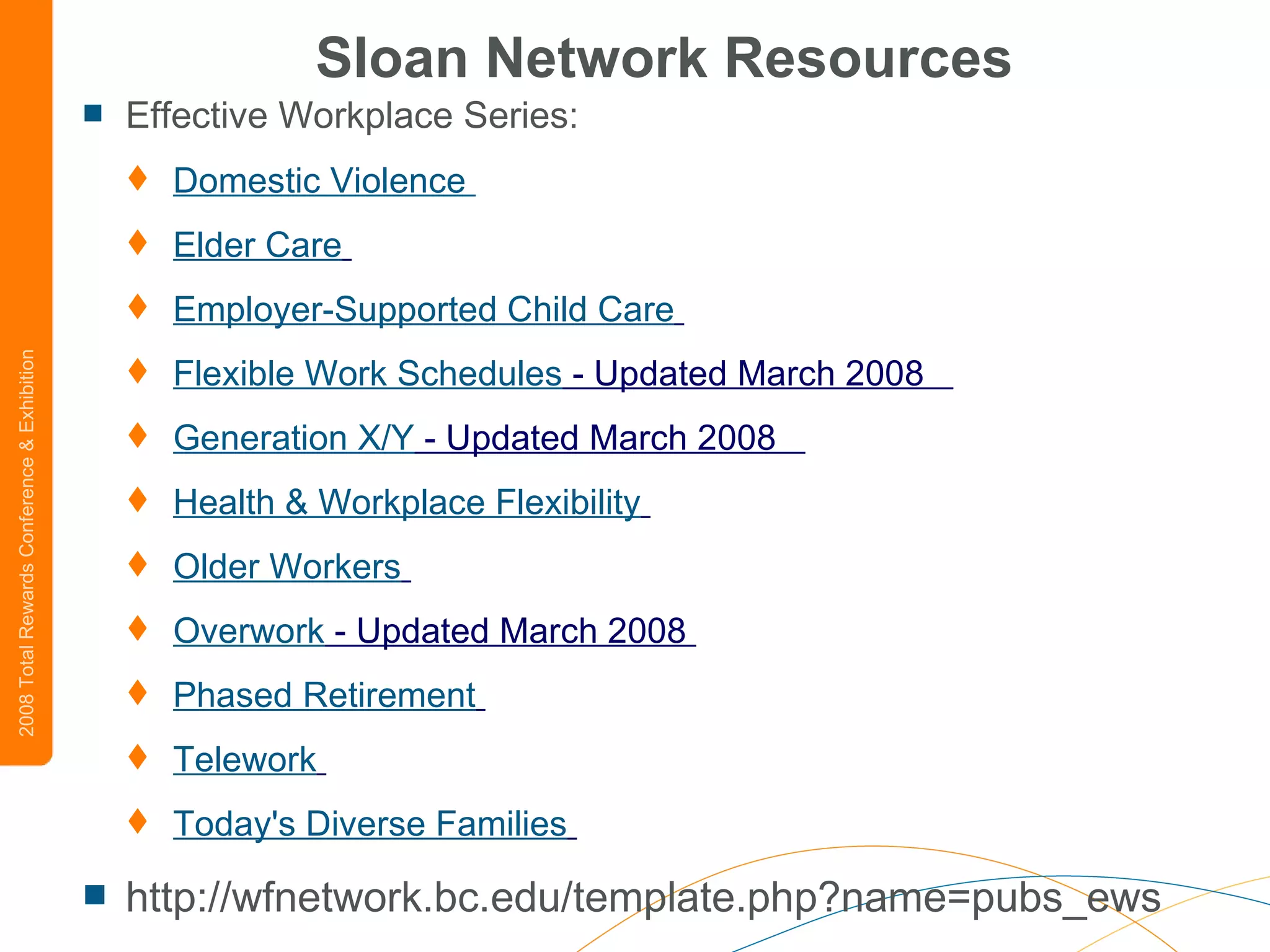
Sloan Network Resources Effective Workplace Series:  Domestic Violence  Elder Care   Employer-Supported Child Care   Flexible Work Schedules  - Updated March 2008    Generation X/Y  - Updated March 2008    Health & Workplace Flexibility   Older Workers   Overwork  - Updated March 2008  Phased Retirement   Telework   Today's Diverse Families   http://wfnetwork.bc.edu/template.php?name=pubs_ews
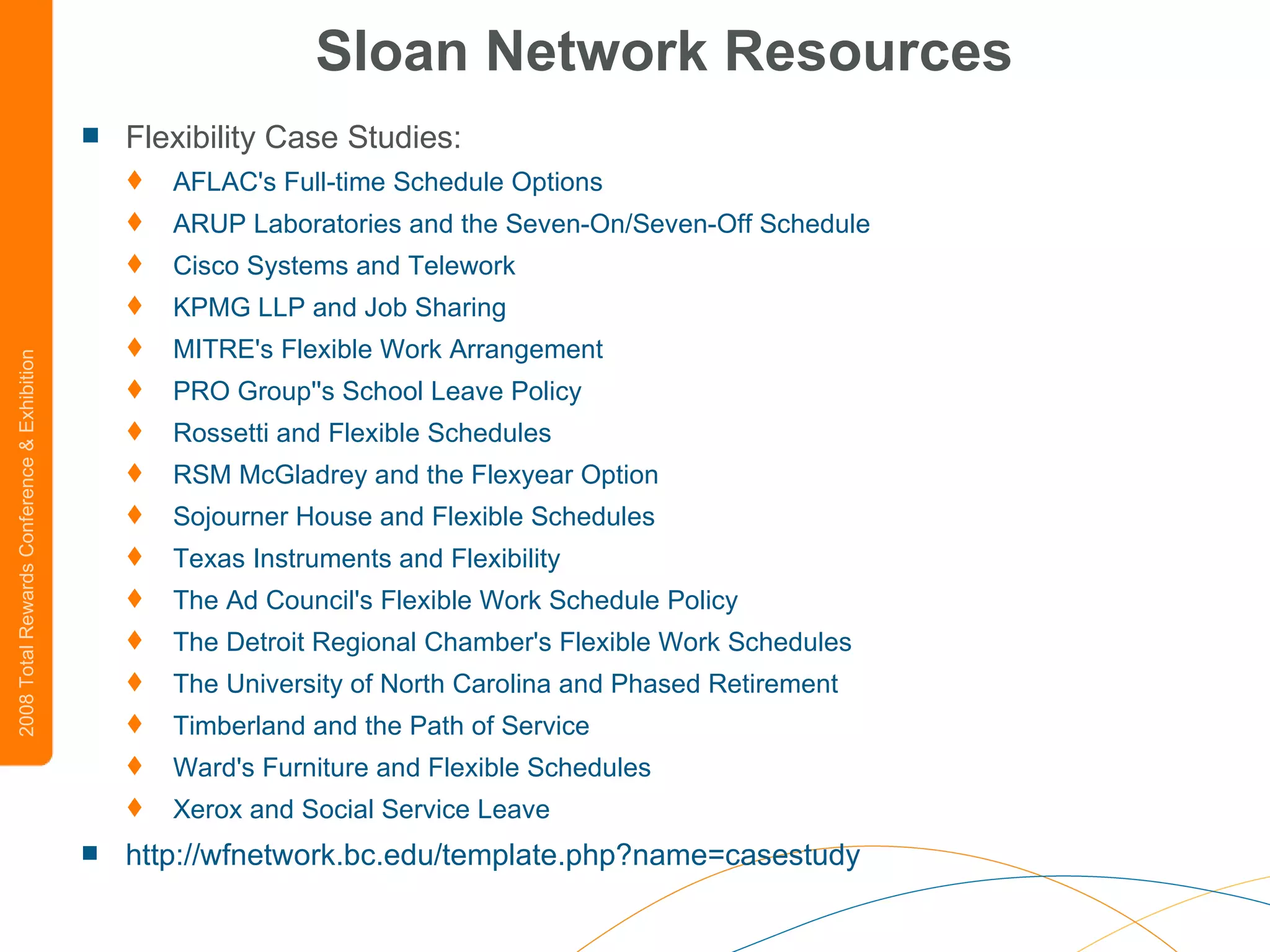
Sloan Network Resources Flexibility Case Studies: AFLAC's Full-time Schedule Options   ARUP Laboratories and the Seven-On/Seven-Off Schedule   Cisco Systems and  Telework   KPMG LLP and Job Sharing   MITRE's Flexible Work Arrangement   PRO  Group''s  School Leave Policy   Rossetti and Flexible Schedules   RSM  McGladrey  and the  Flexyear  Option   Sojourner House and Flexible Schedules   Texas Instruments and Flexibility   The Ad Council's Flexible Work Schedule Policy   The Detroit Regional Chamber's Flexible Work Schedules   The University of North Carolina and Phased Retirement   Timberland and the Path of Service   Ward's Furniture and Flexible Schedules   Xerox and Social Service Leave   http://wfnetwork.bc.edu/template.php?name=casestudy
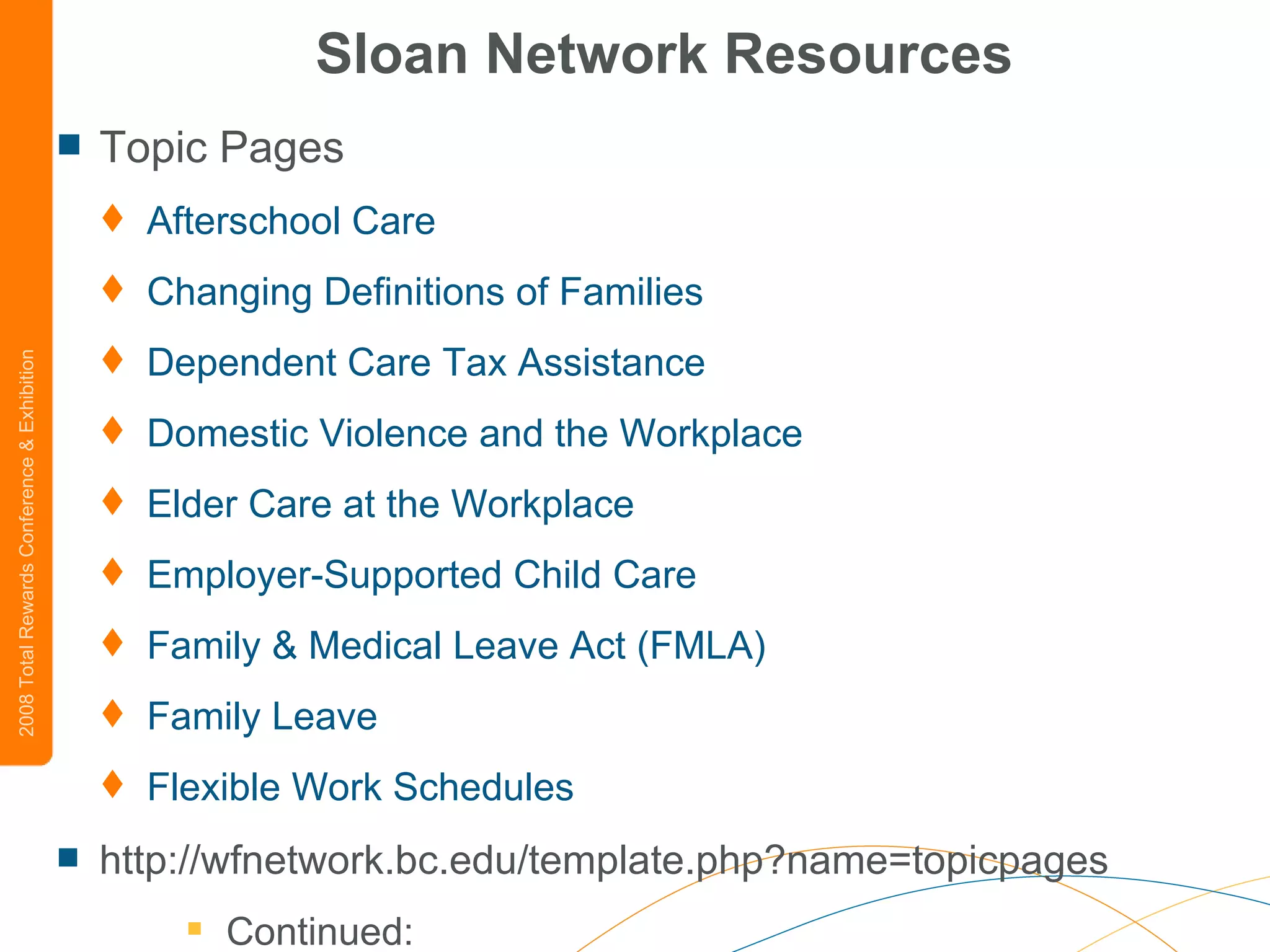
Sloan Network Resources Topic Pages Afterschool  Care   Changing Definitions of Families   Dependent Care Tax Assistance   Domestic Violence and the Workplace   Elder Care at the Workplace   Employer-Supported Child Care   Family & Medical Leave Act (FMLA)   Family Leave   Flexible Work Schedules   http://wfnetwork.bc.edu/template.php?name=topicpages Continued:
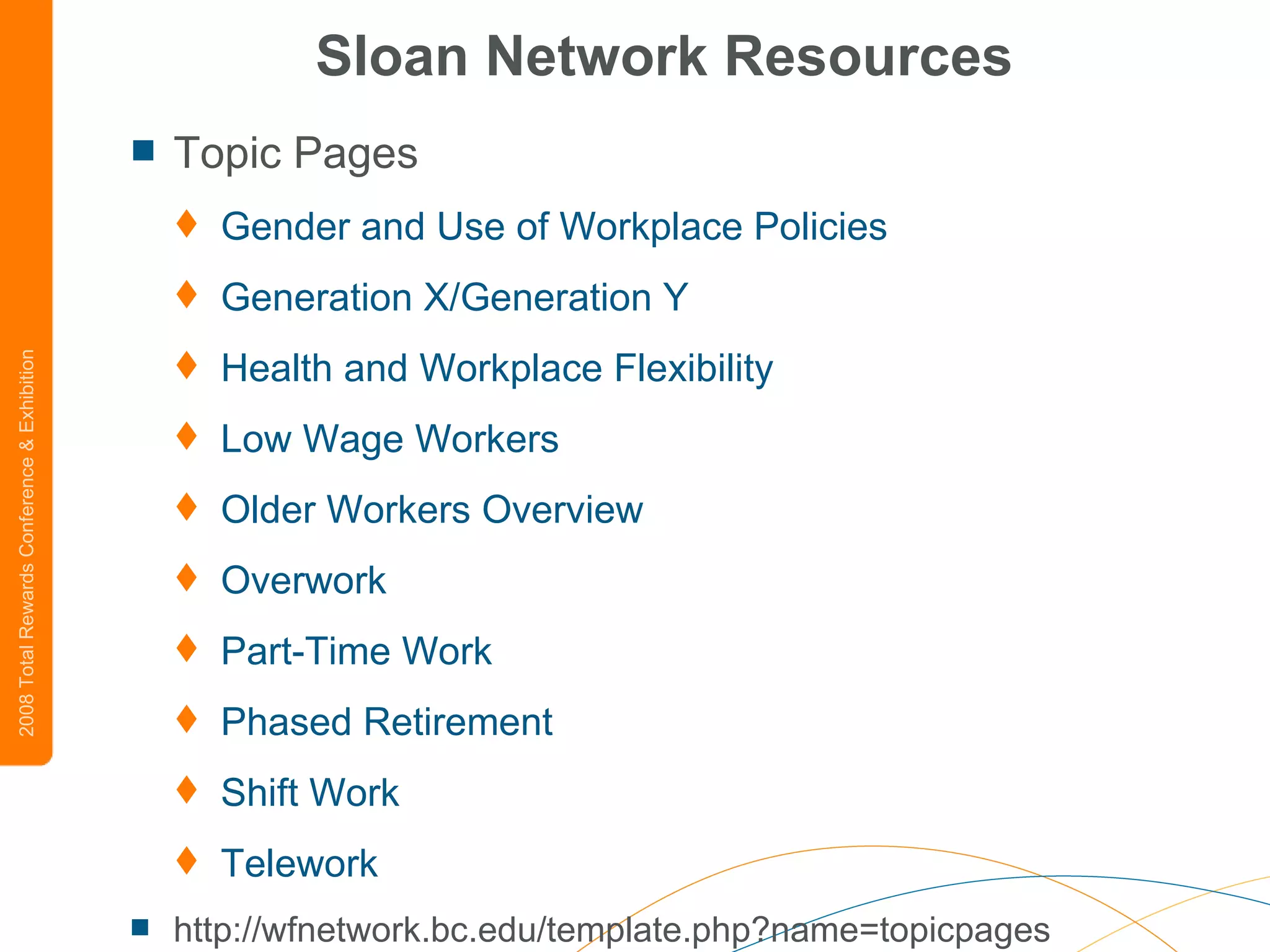
Sloan Network Resources Topic Pages Gender and Use of Workplace Policies   Generation X/Generation Y   Health and Workplace Flexibility   Low Wage Workers   Older Workers Overview   Overwork   Part-Time Work   Phased Retirement   Shift Work   Telework http://wfnetwork.bc.edu/template.php?name=topicpages
Sloan Network Resources Statistics and Fact Sheets: Afterschool  Care   Changing Definitions of Families   Child Care   Dependent Care: Tax Assistance   Elder Care   Employer-Supported Child Care   Family & Medical Leave Act (FMLA)   Family Leave   Flexible Work Schedules   http://wfnetwork.bc.edu/statistics.php Continued:
Sloan Network Resources Statistics and Fact Sheets:  Gender and Use of Workplace Policies   Generation X / Generation Y   Health and Workplace Flexibility   Low Wage Workers   Older Workers   Overwork   Part-Time Work   Phased Retirement   Self Care   Shift Work   Telework   Women in the Workforce   http://wfnetwork.bc.edu/statistics.php
Contact Us Judi C. Casey, Sloan Work and Family Research Network, Boston College [email_address] ; 617.552.2866 Teresa Hopke, RSM McGladrey [email_address] ; 952.921.7753
Take the WorkLife Quiz

Take the WorkLife Quiz

  • 1.
    Take the Work-LifeQuiz: Know What You Need to Know to be Effective Judi C. Casey, Sloan Work & Family Research Network, Boston College Teresa Hopke, RSM McGladrey
  • 2.
    Agenda Research dataRSM McGladrey best practices Best practices sharing Questions Recommendations and action steps
  • 3.
    “ Harder &Longer Philosophy” In order to increase productivity in this competitive global economy, employers of choice try to get the most out of employees by adopting the philosophy, “the harder and longer you can get them to work, the better.” True or False?
  • 4.
    “ Harder &Longer Philosophy” 26% of employees were overworked in the last month 27% were overwhelmed by how much work they had to do in the last month 29% didn’t have the time to step back and process or reflect on the work they were doing during the last month 44% of U.S. employees were overworked often or very often according to at least one of these measures, while only 29% rarely or never experienced any of these three indices (1)
  • 5.
    “ Harder &Longer Philosophy” Overworked employees are more likely to make mistakes at work. 20% of employees reporting high overwork levels say they make a lot of mistakes at work versus none (0%) of those who experience low overwork levels. Overworked employees are more likely to have symptoms of clinical depression. Only 8% of those with low overwork levels have high levels of depressive symptoms compared with 21% of those who are highly overworked. (1)
  • 6.
    “ Harder &Longer Philosophy” Overworked employees report that their health is poorer. 52% percent of employees experiencing high overwork levels report that their health is good versus 65% of those experiencing low overwork levels. Overworked employees are more likely to neglect caring for themselves . Only 41% of employees who experience high overwork levels say they are very successful in taking good care of themselves versus 68% of those experiencing low overwork levels. (1)
  • 7.
    “ Harder &Longer Philosophy” Best Practices/Outcomes: Work Redesign/Overwork Programs Cummins, TEP PTO Utilization Campaigns Mandatory Holiday Shutdowns Accounting Firms No Meeting Fridays SC Johnson Health Coaching Options
  • 8.
    Work-Life: Only aPerk? 2. Work-Life is an attractive perk that makes employees happy, but is not one of the critical factors in an employee’s decisions to take or stay in a job. True or False?
  • 9.
    Work-Life: Only aPerk? When it comes to choosing a job, …three keys areas of focus emerged across countries and cultures: ensuring adequate compensation and financial security; achieving work/life balance ; and having relevant learning and career opportunities. (2)
  • 10.
    Work-Life: Only aPerk? Graduating business students around the world report that attaining a balance between work and personal life is their most important career goal. (3) 89% of employees polled believe work/life programs, such as flextime and telecommuting, are important when evaluating a new job, yet only about half of HR professionals polled consider work/life to be an important initiative for their companies. (4)
  • 11.
    Work-Life: Only aPerk? 29% of US workers now consider work-life balance and flexibility to be the most important factor in considering job offers.   Compensation still matters, but it finished second (23%) behind lifestyle when workers were asked to name the primary reason they accepted their current positions. (5)
  • 12.
    Work-Life: Only aPerk? Best Practices/Outcomes: One of top 3 reasons recruits join RSM Moved from #1 to #2 reason employees leave RSM One of key drivers of engagement on RSM survey Impacts employee health University presentations Gen Y willing to trade time for money
  • 13.
    The Benefits ofFlexibility 3. Although everyone seems to want flexibility and flexible work arrangements, research data does not confirm that flexibility really benefits employees or their organizations. True or False?
  • 14.
    The Benefits ofFlexibility Studies indicate that the availability and use of flexibility and other work-family policies is associated with higher commitment, job satisfaction, loyalty, and lower intention to turnover. (6) 73% of employees with high availability of flexible work arrangements reported that there was a high likelihood that they would stay with their current employer for the next year . (7)
  • 15.
    The Benefits ofFlexibility Telecommuting: Reduces turnover by 20% on average Boosts productivity 22% Trims absenteeism by nearly 60% (9)
  • 16.
    The Benefits ofFlexibility AstraZeneca: 96% report that flexibility influences their decision to stay at the company; 73% say that flexibility is “very important” in that decision, and 23% say that it’s “somewhat important.” Bristol-Myers Squibb: Employees who use flexible work arrangements scored, on average, 30% lower on stress and burnout. First Tennessee Bank: Branches with flexible work arrangements had retention rates 50% higher than other branches. (8)
  • 17.
    The Benefits ofFlexibility Best Practices/Outcomes: 89% of RSM employees said it was #1 WL benefit to offer Moved from accommodation to business based flex All FWO requests approved based on business impact Opportunity to redesign job Comprehensive FWE rollout to all employees Flexyear = to help meet cyclical business needs FlexCareer = to help support career cycles
  • 18.
    Multi-Generational Workforce 4. There have always been differences about expectations and behaviors between workers of all ages at the workplace and the current situation is not that different. True or False?
  • 19.
    Multi-Generational Workforce 1977 Current Population Survey: when the Baby Boomers were entering the workforce, vast majority of workers were in one of three generations: The Silent Generation (23.6%), the Traditionalists (39.6%), and the Boomers (36.4%). 2007 Current Population Survey: as the Baby Boomers are exiting the labor force, the majority of workers are spread across four generations: The Traditionalists (8.5%), the Boomers (39.9%), Generation X (35.7%), and Generation Y (15.8%). (10)
  • 20.
    Multi-Generational Workforce Morethan 60% of Early Boomers (born 1946-1954) agree they would like to stay with their current organization for the rest of their working lives, compared to less than 30% of Late Xers (born 1977 to 1986). More than 60% of Late Boomers (born 1955 to 1963) agree that they see themselves being with the same organization in three years, compared to less than 40% of Early Xers (born 1964 to 1976). (11)
  • 21.
    Multi-Generational Workforce Boomersare more likely to be work-centric than other generations. Gen-X and Gen-Y are more likely to be dual-centric or family-centric. 22% of Boomers are work-centric, compared with 12 to 13% of other generations. 50% of Gen-Y and 52% of Gen-X are family-centric compared with 41% of Boomers. (12)
  • 22.
    Multi-Generational Workforce BestPractices/Outcomes: Deloitte’s Center for the Future FWE training uncovers differences in work styles & expectations Incorporating generational diversity into company workforce strategy Utilize futurists and workforce trend speakers Reverse mentoring programs
  • 23.
    “ The Lists”5. The best way to support employees with their work-life issues is to secure a spot on one of the prestigious “Best Companies Lists.” True or False?
  • 24.
    “ The Lists”Companies on Fortune magazine's annual list of the "100 Best Companies to Work for in America" between 1998 and 2005 returned 14% per year, compared to 6% a year for the overall market. (13) Studies found that employees were more likely to use work-life benefits when they perceived their organizations and supervisors as providing a family-supportive work environment. (14)
  • 25.
    “ The Lists”Best Practices/Outcomes: WL efforts should focus on culture change rather than programs Lists are nice, but employee needs should be the overarching driver Conduct employee needs assessment to prioritize focus “ Lists” should be by-product, not goal Beware of side-effects of making “The Lists” Potential backlash if doesn’t match employee experience Expectation to “up the ante” each year
  • 26.
    Work-Life is forMothers 6. In most organizations, working mothers take advantage of work-life programs, but working dads typically don’t utilize or value them. True or False?
  • 27.
    Work-Life is forMothers In response to the question, “'Who is most likely to take time off work to stay home or do something with your child(ren) when both of you are supposed to be at work? The proportion of fathers increased from 12% in 1977 to 31% in 2002, while the proportion of mothers did not change significantly (78% in 1977 versus 72% in 2002). (7) Gen-X fathers spend significantly more time with their children than Boomer fathers with children of the same age, an average of 3.4 hours per workday versus an average of 2.2 hours for Boomer fathers- a difference of more than 1 hour. (12)
  • 28.
    Work-Life is forMothers In a sample of mothers and fathers with a child aged three to fifteen months, 20% of the fathers made changes in their work arrangements to spend time with their baby. (15)  In 2002, 1 in 5 fathers were the primary caregiver for their preschooler [child under 5 years old], meaning their child spent more time in their care than in any other arrangement (20%). (16)
  • 29.
    Work-Life is forMothers Best Practices/Outcomes: 3 weeks paid paternity leave Utilization of WL benefits like COC by males Many male FWO features Forest firefighter NY Dad wanting more time with kids CA Grandpa taking care of granddaughter Director and his dog Dana Glazer Fatherhood Documentary Fatherhood Initiative
  • 30.
  • 31.
    Recommendations and ActionSteps Assess the needs of your employees & consider all demographic groups individually Voluntary online survey option Take dualistic approach to strategy Align efforts to AWLP’s 7 categories Engage internal and external partners WL advisory team & senior champion/advocate Leaders who “get it” Line managers who do “hand-to-hand combat” Other departments (Operations, PM, OD, ER, Marketing) Corporate Voices, AWLP, Families & Work Institute, Sloan Network, local Think Tanks, Membership associations etc.
  • 32.
    Recommendations and ActionSteps Pilot & measure, pilot & measure, pilot & measure Set up success measures from the start Understand that not all solutions are right for all organizations Figure out ways to get approval without getting approval FWE pilot helped re-direct intended rollout, COC changed drastically, Concierge created buy-in, etc. Position WL as a strategic business tool that can solve the issues that keep your leaders up at night Use WL as a business tool to enhance company brand and increase ability to recruit talent Use WL to drive workforce planning & strategy Have fun & be creative
  • 33.
    Wrap-up What isthe one step that you will take when you return to the office? What is the one thing that you can do? I will……..
  • 34.
    References Source (1): Galinksy, E., Bond, J.T., Kim, S.S., Backon, L., Brownfield, E., and Sakai, K.  (2005).  Overwork in America: When the way we work becomes too much.  New York: Families and Work Institute. Retrieved on March 20, 2008 from http://familiesandwork.org/site/research/summary/overwork2005summ.pdf Sample : Telephone interviews with a representative sample of 1,003 wage and salaried employees in the U.S. workforce. Source (2): Towers Perrin. (2006). Winning strategies for a global workforce: Attracting, retaining and engaging employees for a competitive advantage . Retrieved on March 20, 2008 from http://www.towersperrin.com/tp/getwebcachedoc?webc=HRS/USA/2006/200602/GWS.pdf Sample: 86,000 respondents from 16 countries; 4 continents; 65% male
  • 35.
    References Source (3): PricewaterhouseCoopers. (June 1999). Second international student survey conducted by Universum International. Source (4): 2007 Monster Work/Life Balance Survey. Retrieved on March 18, 2008 from http://hr.cch.com/news/hrm/120507a.asp Sample: 506 HR professionals and 830 workers Source (5): Hudson Survey 2008. Retrieved on March 18, 2008 from http://www.hudson-index.com/node.asp?SID=8532 Sample: National poll of 1,634 U.S. workers who have been with their company for less than five years conducted January 26-27, 2008. Source (6): Kossek, E., Lautsch, B., & Eaton, S. (2006). Telecommuting, control, and boundary management: Correlates of policy use and practice, job control, and work-family effectiveness. Journal of Vocational Behavior. 68 (2), 347-367.
  • 36.
    References Source (7): Bond, J.T., Thompson, C., Galinsky, E. & Prottas,D. (2003). Highlights of the 2002 national study of the changing workforce. New York: Families and Work Institute. Source (8): Corporate Voices for Working Families with WFD Consulting. (2005, November).  Business impacts of flexibility: An imperative for expansion.  Washington, DC: Author.  Retrieved on March 18, 2008 from http:// www.cvworkingfamilies.org/flex_report/flex_report.shtml Sample: Draws on internal organizational research and information from 28 American firms. Source (9): International Telework Association & Council (2001, August). Telecommuting is a flop, so fix it already. Ziff Davis Smart Business. Washington, D.C: Author.
  • 37.
    References Source (10): McNamara, T. K. (2006). [Analysis of the March 1977 and 2007 Current Population Surveys]. Unpublished raw data. Center on Aging and Work/Workplace Flexibility: Boston College. Source (11): Deal, J. (2007). Retiring the generation gap: How employees young and old can find common ground. San Francisco, CA: Jossey-Bass/The Center for Creative Leadership. Source (12): Families and Work Institute (2004). Generation & gender in the workplace.   Watertown, MA: American Business Collaboration. Retrieved on March 20, 2008 from http://familiesandwork.org/publications/genandgender.html Source (13): Edmans, A. (2008) How investing in intangibles -- like employee satisfaction – translates into financial returns. Knowledge@Wharton. Retrieved on March 20, 2008 from http://www.ftpress.com/articles/article.aspx?p=1167318
  • 38.
    References Source (14): Allen, T. D. (2001). Family-supportive work environments: The role of organizational perceptions. Journal of Vocational Behavior, 58 (3),414-435.  Source (14): Thompson, C. A., Beauvais, L. L., & Lyness, K. S. (1999). When work-family benefits are not enough: The influence of work-family culture on benefit utilization, organizational attachment, and work-family conflict. Journal of Vocational Behavior, 54 (3),392-415.  Source (15): Smeaton, D. (2006). Dads and their babies: A household analysis. Manchester: Equal Opportunities Commission.   Sample: “This study brings together the findings from two surveys commissioned by the Equal Opportunities Commission (EOC) investigating the use of leave by fathers from the perspective of both mothers and fathers… All the fathers were employees and in two-parent households with a child aged three to fifteen months”
  • 39.
    References Source (16): Johnson, J.O. (2005). Who's minding the kids?: Child care arrangements: winter 2002 . Retrieved on March 20, 2008 from http://ntis.library.gatech.edu/browse-title?top=123456789%2F5234 Sample: “The population represented (the population universe) in the 2001 Survey of Income and Program Participation (SIPP) is the civilian non-institutionalized population living in the United States. The SIPP is a longitudinal survey conducted at 4-month intervals. The data in this report were collected from February through May 2002 in the fourth wave (interview) of the 2001 SIPP.”
  • 40.
    Sloan Network ResourcesEffective Workplace Series: Domestic Violence Elder Care Employer-Supported Child Care Flexible Work Schedules - Updated March 2008   Generation X/Y  - Updated March 2008   Health & Workplace Flexibility Older Workers Overwork - Updated March 2008 Phased Retirement Telework Today's Diverse Families http://wfnetwork.bc.edu/template.php?name=pubs_ews
  • 41.
    Sloan Network ResourcesFlexibility Case Studies: AFLAC's Full-time Schedule Options ARUP Laboratories and the Seven-On/Seven-Off Schedule Cisco Systems and Telework KPMG LLP and Job Sharing MITRE's Flexible Work Arrangement PRO Group''s School Leave Policy Rossetti and Flexible Schedules RSM McGladrey and the Flexyear Option Sojourner House and Flexible Schedules Texas Instruments and Flexibility The Ad Council's Flexible Work Schedule Policy The Detroit Regional Chamber's Flexible Work Schedules The University of North Carolina and Phased Retirement Timberland and the Path of Service Ward's Furniture and Flexible Schedules Xerox and Social Service Leave http://wfnetwork.bc.edu/template.php?name=casestudy
  • 42.
    Sloan Network ResourcesTopic Pages Afterschool Care Changing Definitions of Families Dependent Care Tax Assistance Domestic Violence and the Workplace Elder Care at the Workplace Employer-Supported Child Care Family & Medical Leave Act (FMLA) Family Leave Flexible Work Schedules http://wfnetwork.bc.edu/template.php?name=topicpages Continued:
  • 43.
    Sloan Network ResourcesTopic Pages Gender and Use of Workplace Policies Generation X/Generation Y Health and Workplace Flexibility Low Wage Workers Older Workers Overview Overwork Part-Time Work Phased Retirement Shift Work Telework http://wfnetwork.bc.edu/template.php?name=topicpages
  • 44.
    Sloan Network ResourcesStatistics and Fact Sheets: Afterschool Care Changing Definitions of Families Child Care Dependent Care: Tax Assistance Elder Care Employer-Supported Child Care Family & Medical Leave Act (FMLA) Family Leave Flexible Work Schedules http://wfnetwork.bc.edu/statistics.php Continued:
  • 45.
    Sloan Network ResourcesStatistics and Fact Sheets: Gender and Use of Workplace Policies Generation X / Generation Y Health and Workplace Flexibility Low Wage Workers Older Workers Overwork Part-Time Work Phased Retirement Self Care Shift Work Telework Women in the Workforce http://wfnetwork.bc.edu/statistics.php
  • 46.
    Contact Us JudiC. Casey, Sloan Work and Family Research Network, Boston College [email_address] ; 617.552.2866 Teresa Hopke, RSM McGladrey [email_address] ; 952.921.7753

Editor's Notes

  • #2 Welcome Introductions Judi Sloan Network Created in 1997, we are the Premier online destination for work and family information Resources are free and we specifically target workplace practitioners as one of our user groups We provide evidence-based information on cutting-edge workforce issues, talent management, and the impact of work and family issues on business outcomes Brought Effective Workplace Series and brochures Teresa