GA P
GENERA TION
IN ORGANI ZATION
XXXXXX
XXXXXX
XXXXXX
TEAM!
Agenda
01
02
03
04
What are Different
Generations?
How does it affect
organization?
Case Study
What is Generation Gap?
Agenda
05
06
07
Tips For Organizations
Conclusion
Tips For Generations
1. What is
generation gap?
Why every CEO is concerned?
“The ‘Generation Gap’ refers to the differences
between the generations – in terms of character,
attributes and personal qualities”
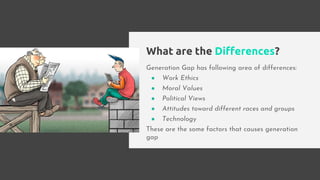
Generation Gap has following area of differences:
● Work Ethics
● Moral Values
● Political Views
● Attitudes toward different races and groups
● Technology
These are the some factors that causes generation
gap
What are the Differences?
For the first time in history, 5 generations is
working side by side.
But whether this multi-generational workplace
feels happy and productive or challenging and
stressful is, in large part, up to you: the boss.
Lets see what the experts say……
Why are CEOs Concerned?
—Peter Cappelli, professor of management at the Wharton School
“Organizational careers don’t look the way they
did before, It’s common to see someone
younger managing someone older. There is a
feeling of: why am I being bossed around by
someone without experience? On the other
hand, the young ones feels insecure and
wonders: how do I do this?”
—Jeanne C. Meister, a founding partner of Future Workplace
“It’s important to be aware of generational
tension - loosely defined as a lack of respect
for someone who’s of a different generation
from you - among colleagues, It’s your job to
help your employees recognize that they each
have distinct sets of skills and different things
they bring to the table”
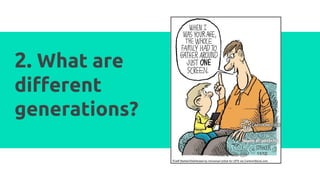
2. What are
different
generations?
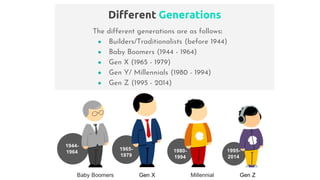
The different generations are as follows:
● Builders/Traditionalists (before 1944)
● Baby Boomers (1944 - 1964)
● Gen X (1965 - 1979)
● Gen Y/ Millennials (1980 - 1994)
● Gen Z (1995 - 2014)
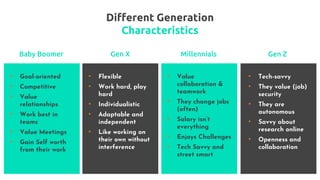
Different Generations
Different Generation
Characteristics
• Goal-oriented
• Competitive
• Value
relationships
• Work best in
teams
• Value Meetings
• Gain Self worth
from their work
Baby Boomer Gen X Millennials Gen Z
• Value
collaboration &
teamwork
• They change jobs
(often)
• Salary isn’t
everything
• Enjoys Challenges
• Tech Savvy and
street smart
• Flexible
• Work hard, play
hard
• Individualistic
• Adaptable and
independent
• Like working on
their own without
interference
• Tech-savvy
• They value (job)
security
• They are
autonomous
• Savvy about
research online
• Openness and
collaboration
3. How does it
affect
organization
• The intergenerational divide, if left unchecked,
could harm organizational harmony and wider
team-based success.
• Adjusting to change can affect individuals from
different backgrounds in different ways.
• Other problems caused by Gen gap are:
Why you should care?
• Boomers don’t know modern technology or Gen Y
are lazy.
• Unfortunately, Stereotypes like these are around.
• Negative Stereotypes causes lack of respect,
higher anxiety and lower productivity.
• They make workplace uncomfortable and
promote negative behavior like harassment.
1. Negative Stereotypes
• Boomers are used to long workdays at the office,
while Gen Y and Gen Z prefer flexible hours and
remote work.
• Mature workers are often happy with assignment
and project while young workers prefer group-
based work and daily feedback.
2. Different Work Styles
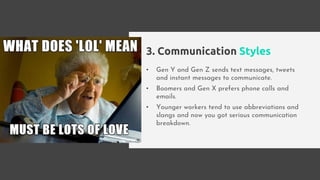
• Gen Y and Gen Z sends text messages, tweets
and instant messages to communicate.
• Boomers and Gen X prefers phone calls and
emails.
• Younger workers tend to use abbreviations and
slangs and now you got serious communication
breakdown.
3. Communication Styles
Age diversity in team can lead to
better decision
4. Case Study
• He Volunteered to take part in reciprocal mentoring program. The program partners
young employees with older colleagues to work on tech skills.
• Ron was assigned a coach, Rebecca Kaufman (24) and an avid social media user —
who taught him how to use Twitter and LinkedIn.
• Ron provides professional counsel and is also helping improve her communication
skills.
• Today hundreds of MasterCard employees take part in the program, which is
currently offered in five offices.
Ron Garrow (51), HR at MasterCard
5. Tips for
Generations
● The approach is to focus on similarities and not
the differences between the various
generations.
● Experts say core values are likely in alignment
regardless of age gape and focusing on these
can create open-mindedness and flexibility
within company culture.
Focus on similarities
● They’ll likely value the knowledge transfer—not
see it as a hindrance.
● While business conditions have changed
dramatically, people are still people. Trust is a
universal requirement for positive interactions.
● Social and technological changes have
reshaped the modern business environment,
creating a new business frontier.
Give value to seniors
● Seniors can understand the juniors
differences and skills method.
● Junior can respect the value and
attributes of seniors
Respect each other values
● The tendency to stereotype the
employees according to age is unfair.
● While there are common attributes and
skillsets within generations, this should
not take away the individual
differences.
● Avoid making assumptions.
Avoid Stereotypes
6. Tips for
Organizations
● While it may seem daunting to manage someone
much older than you, try taking an example
● U.S. Marine routinely puts 22-year-old lieutenants
in charge of 45-year-old sergeants,
● “The mindset is to make that person your partner
and involve them in everything you do. You’re still
the one making the decisions, but you should
hear them out.”
Build collaborative
● Leaders and employees can communicate with
their colleagues in the ways each person prefers.
● Bringing staff members of different generations
together for face-to-face team-building exercises
and ice breakers can help break down some of
the barriers that can occur with digital
communications
Adjust communication methods
● Reverse or reciprocal mentoring programs, which
pair younger workers with seasoned executives to
work on specific business objectives usually
involving technology, are increasingly prevalent
in many offices.
● The younger person — who grew up with the
internet — teaches the older person about the
power of social media to drive business results.
Create opportunities for cross-
generational mentoring
● Meanwhile, the more experienced employee
shares institutional knowledge with the younger
worker. Mixed-age work teams are another way
to promote cross-generational mentoring.
● Studies show that colleagues learn more from
each other than they do from formal training,
which is why it is so important to establish a
culture of coaching across age groups.
Create opportunities for cross-
generational mentoring
• Bother with generation-based
employee affinity groups — they
generally reinforce stereotypes
• Assume you already know how to
motivate employees who are older
or younger — ask them what they
want out of their professional lives
Principles to
remember
• Experiment with mixed-age teams
and reverse mentoring programs
that enable older, experienced
workers to interact with and learn
from younger hires
• Conduct regular human resources
surveys to get a pulse on your
employees’ demographics and needs
Do Don’t
7. Conclusion
Conclusion
• Contrasting views of the
different generations don’t
have to result in conflict and
disagreement.
• Fostering a work environment
where differences are valued
and respected instead of
punished or downplayed can
help to bridge the generation
gap.
Thanks!
Does anyone have any
questions?
● https://www.digitalhrtech.com/generational-differences-in-the-
workplace/
● https://www.shrm.org/resourcesandtools/hr-
topics/behavioral-competencies/global-and-cultural-
effectiveness/pages/4-ways-for-hr-to-overcome-aging-
workforce-issues.aspx
● https://ideas.bkconnection.com/bridging-the-
workplace-generation-gap-in-your-organization
References
● https://hbr.org/2014/09/managing-people-from-5-generations
● https://www.insperity.com/blog/generation-gap-in-the-
workplace/
● https://ideas.bkconnection.com/bridging-the-
workplace-generation-gap-in-your-organization
● https://www.deputy.com/blog/the-generation-gap-
how-to-bridge-the-gap-in-the-workplace
References

Generation Gap in Organization

  • 1.
    GA P GENERA TION INORGANI ZATION
  • 2.
  • 3.
    Agenda 01 02 03 04 What are Different Generations? Howdoes it affect organization? Case Study What is Generation Gap?
  • 4.
  • 5.
    1. What is generationgap? Why every CEO is concerned?
  • 6.
    “The ‘Generation Gap’refers to the differences between the generations – in terms of character, attributes and personal qualities”
  • 7.
    Generation Gap hasfollowing area of differences: ● Work Ethics ● Moral Values ● Political Views ● Attitudes toward different races and groups ● Technology These are the some factors that causes generation gap What are the Differences?
  • 8.
    For the firsttime in history, 5 generations is working side by side. But whether this multi-generational workplace feels happy and productive or challenging and stressful is, in large part, up to you: the boss. Lets see what the experts say…… Why are CEOs Concerned?
  • 9.
    —Peter Cappelli, professorof management at the Wharton School “Organizational careers don’t look the way they did before, It’s common to see someone younger managing someone older. There is a feeling of: why am I being bossed around by someone without experience? On the other hand, the young ones feels insecure and wonders: how do I do this?”
  • 10.
    —Jeanne C. Meister,a founding partner of Future Workplace “It’s important to be aware of generational tension - loosely defined as a lack of respect for someone who’s of a different generation from you - among colleagues, It’s your job to help your employees recognize that they each have distinct sets of skills and different things they bring to the table”
  • 11.
  • 12.
    The different generationsare as follows: ● Builders/Traditionalists (before 1944) ● Baby Boomers (1944 - 1964) ● Gen X (1965 - 1979) ● Gen Y/ Millennials (1980 - 1994) ● Gen Z (1995 - 2014) Different Generations
  • 13.
    Different Generation Characteristics • Goal-oriented •Competitive • Value relationships • Work best in teams • Value Meetings • Gain Self worth from their work Baby Boomer Gen X Millennials Gen Z • Value collaboration & teamwork • They change jobs (often) • Salary isn’t everything • Enjoys Challenges • Tech Savvy and street smart • Flexible • Work hard, play hard • Individualistic • Adaptable and independent • Like working on their own without interference • Tech-savvy • They value (job) security • They are autonomous • Savvy about research online • Openness and collaboration
  • 14.
    3. How doesit affect organization
  • 15.
    • The intergenerationaldivide, if left unchecked, could harm organizational harmony and wider team-based success. • Adjusting to change can affect individuals from different backgrounds in different ways. • Other problems caused by Gen gap are: Why you should care?
  • 16.
    • Boomers don’tknow modern technology or Gen Y are lazy. • Unfortunately, Stereotypes like these are around. • Negative Stereotypes causes lack of respect, higher anxiety and lower productivity. • They make workplace uncomfortable and promote negative behavior like harassment. 1. Negative Stereotypes
  • 17.
    • Boomers areused to long workdays at the office, while Gen Y and Gen Z prefer flexible hours and remote work. • Mature workers are often happy with assignment and project while young workers prefer group- based work and daily feedback. 2. Different Work Styles
  • 18.
    • Gen Yand Gen Z sends text messages, tweets and instant messages to communicate. • Boomers and Gen X prefers phone calls and emails. • Younger workers tend to use abbreviations and slangs and now you got serious communication breakdown. 3. Communication Styles
  • 19.
    Age diversity inteam can lead to better decision
  • 20.
  • 21.
    • He Volunteeredto take part in reciprocal mentoring program. The program partners young employees with older colleagues to work on tech skills. • Ron was assigned a coach, Rebecca Kaufman (24) and an avid social media user — who taught him how to use Twitter and LinkedIn. • Ron provides professional counsel and is also helping improve her communication skills. • Today hundreds of MasterCard employees take part in the program, which is currently offered in five offices. Ron Garrow (51), HR at MasterCard
  • 22.
  • 23.
    ● The approachis to focus on similarities and not the differences between the various generations. ● Experts say core values are likely in alignment regardless of age gape and focusing on these can create open-mindedness and flexibility within company culture. Focus on similarities
  • 24.
    ● They’ll likelyvalue the knowledge transfer—not see it as a hindrance. ● While business conditions have changed dramatically, people are still people. Trust is a universal requirement for positive interactions. ● Social and technological changes have reshaped the modern business environment, creating a new business frontier. Give value to seniors
  • 25.
    ● Seniors canunderstand the juniors differences and skills method. ● Junior can respect the value and attributes of seniors Respect each other values
  • 26.
    ● The tendencyto stereotype the employees according to age is unfair. ● While there are common attributes and skillsets within generations, this should not take away the individual differences. ● Avoid making assumptions. Avoid Stereotypes
  • 27.
  • 28.
    ● While itmay seem daunting to manage someone much older than you, try taking an example ● U.S. Marine routinely puts 22-year-old lieutenants in charge of 45-year-old sergeants, ● “The mindset is to make that person your partner and involve them in everything you do. You’re still the one making the decisions, but you should hear them out.” Build collaborative
  • 29.
    ● Leaders andemployees can communicate with their colleagues in the ways each person prefers. ● Bringing staff members of different generations together for face-to-face team-building exercises and ice breakers can help break down some of the barriers that can occur with digital communications Adjust communication methods
  • 30.
    ● Reverse orreciprocal mentoring programs, which pair younger workers with seasoned executives to work on specific business objectives usually involving technology, are increasingly prevalent in many offices. ● The younger person — who grew up with the internet — teaches the older person about the power of social media to drive business results. Create opportunities for cross- generational mentoring
  • 31.
    ● Meanwhile, themore experienced employee shares institutional knowledge with the younger worker. Mixed-age work teams are another way to promote cross-generational mentoring. ● Studies show that colleagues learn more from each other than they do from formal training, which is why it is so important to establish a culture of coaching across age groups. Create opportunities for cross- generational mentoring
  • 32.
    • Bother withgeneration-based employee affinity groups — they generally reinforce stereotypes • Assume you already know how to motivate employees who are older or younger — ask them what they want out of their professional lives Principles to remember • Experiment with mixed-age teams and reverse mentoring programs that enable older, experienced workers to interact with and learn from younger hires • Conduct regular human resources surveys to get a pulse on your employees’ demographics and needs Do Don’t
  • 33.
  • 34.
    Conclusion • Contrasting viewsof the different generations don’t have to result in conflict and disagreement. • Fostering a work environment where differences are valued and respected instead of punished or downplayed can help to bridge the generation gap.
  • 35.
  • 36.
  • 37.
    ● https://hbr.org/2014/09/managing-people-from-5-generations ● https://www.insperity.com/blog/generation-gap-in-the- workplace/ ●https://ideas.bkconnection.com/bridging-the- workplace-generation-gap-in-your-organization ● https://www.deputy.com/blog/the-generation-gap- how-to-bridge-the-gap-in-the-workplace References