Communication Across Generations
Jac Levesque, A.Ed.
Associate Dean for Graduate Medical Education and Faculty Affairs
COLLEGE OF MEDICINE
Disclosures
• The speaker has no financial or other conflicts of interest to
disclose.
COLLEGE OF MEDICINE
Objectives
• At the end of this session, participants will be able to:
– Define the meaning of “generations” in the United States, and why these
groups share a cultural identity;
– Identify the five (5.0) generations in today’s workforce/educational
environment;
– Recognize how generational differences can effect expectations,
communication and learning styles;
– Develop strategies to create a more inclusive learning environment;
– Utilize your personal generational attributes to guide your student’s
professional development.
COLLEGE OF MEDICINE
What is a generation?
• Viewed as the average familial time period for a child to grow
up, become an adult, and have children of their own.
– 30 years
• Groups which tend to believe/behave in a similar way because
they grew up experiencing the same “things” in the same
format.
– For cultural generations, we examine approximately 20 year spans
COLLEGE OF MEDICINE
Why the Difference?
• Think of cohorts – 20 year span leads to common life
experiences
• Five key variables which lead to generational differences:
– Family/Parenting
– Social Movements
– World Events
– Technology
– Economy
COLLEGE OF MEDICINE
Six Living Generations in America
• GI Generation (Born 1901 – 1926)
• Mature/Silents (Born 1927-1945)
• Baby Boomers (Born 1946 – 1964)
• Generation X (Born 1965 – 1980)
• Generation Y/Millennium (Born 1981 – 2000)
• Generation X/Boomlets (Born after 2001)
COLLEGE OF MEDICINE
Generations in America
• Five are generally in the workplace together.
• By 2021, the two youngest generations will make compose
nearly 70% of all global employees.
COLLEGE OF MEDICINE
GI Generation (The Greatest Generation 1901 – 1926)
• Children of WWI generation and fighters in WWII
• Young during Great Depression – strong models to overcome and
progress
• Excellent team players
• Community-minded
• Very loyal
• Strongly interested in personal morality; near-absolute standards of
right/wrong
• Avoid debt
• Grew up without a/c, tv, airplanes
COLLEGE OF MEDICINE
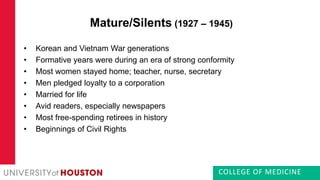
Mature/Silents (1927 – 1945)
• Korean and Vietnam War generations
• Formative years were during an era of strong conformity
• Most women stayed home; teacher, nurse, secretary
• Men pledged loyalty to a corporation
• Married for life
• Avid readers, especially newspapers
• Most free-spending retirees in history
• Beginnings of Civil Rights
COLLEGE OF MEDICINE
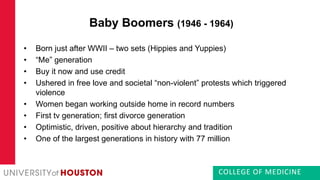
Baby Boomers (1946 - 1964)
• Born just after WWII – two sets (Hippies and Yuppies)
• “Me” generation
• Buy it now and use credit
• Ushered in free love and societal “non-violent” protests which triggered
violence
• Women began working outside home in record numbers
• First tv generation; first divorce generation
• Optimistic, driven, positive about hierarchy and tradition
• One of the largest generations in history with 77 million
COLLEGE OF MEDICINE
Generation X (1965 - 1980)
• “Latch-key kids”
• Entrepreneurial; very individualistic
• Government and big business mean little; cynical of many institutions
• Want to save their neighborhood, not the world
• Commit to self; average seven (7.0) lifetime career changes
• Raised in transition of written world to digital
• Late to marry and quick to divorce
• Into labels and brands; most deeply in credit card debt
• Self-absorbed and short on loyalty
• AIDS first disease which could not be quarantined
COLLEGE OF MEDICINE
Generation Y/Millennium (1981 - 2000)
• Nurtured by parents
• Learn early that the world is not a safe place
• Schedule everything; feel enormous academic pressure
• Most socialization from the internet
• Prefer digital literacy
• Want to work in teams
• Unlimited access to info; fast and immediate processing
• Expect the world to treat them as special
• Want hand holding and accolades
• If they can find the information they have a “right” to it
COLLEGE OF MEDICINE
Generation Z/Boomlets (after 2001)
• 2006 record number of US births; 49% of those born were Hispanic
• Most common name in US changed from Smith to Rodriguez
• Two subgroups:
– Tweens (8-12): $51B spent by them with an additional $170B by parents for them
– Toddler/Elementary: 4M have their own cell phones
• Never known world without computers and cell phones
• Eco-fatigue
• Over-saturated with brands; savvy consumers
• Leave toys behind at younger age
COLLEGE OF MEDICINE
Today’s Faculty
• Average age of practicing physician is 52
– 70% are 40 – 69 years old (Baby Boomers)
– 20% are 30 – 39 years old (Generation X)
– 10% are older than 69 (Silents)
COLLEGE OF MEDICINE
Today’s Residents
• Those entering residencies in 2019…
– Grown up with bottled water
– Never knew the Berlin Wall
– Pete Rose has never played baseball, and Nelson Mandela has always been free
– Women have always served as police chiefs in major US cities
– Eastern Airlines never existed; smoking on airlines has never been allowed
– Fox has always been a major news network
– MTV has never shown music videos
– Films have never been rated X, only NC-17
– Google has always been a verb
– Madden has always been a game, not a coach
COLLEGE OF MEDICINE
What am I dealing with?
• Don’t read; shorter attention span
• Seek multiple sources of info; poor judge of quality (Wikipedia)
• No need to memorize anything they can look up
• Want to participate in tasks they view as valuable; no value in “scutwork”
• Loss of connectivity is a natural disaster
• Beginning of “shift worker” mentality
• Medicine is more a job; less a profession
COLLEGE OF MEDICINE
What am I dealing with?
• Do not automatically respect experience; low social awareness
• Multi-taskers; little comprehension of time or place
• Why should I care??
• Constant feedback; constant EXPLICIT feedback
• Risky to try to “light a fire”
• Communication styles relate more to texting than the King’s English
COLLEGE OF MEDICINE
What does this mean for today’s medical
educators?
• Communication styles relate to texting
• Must have technology in their hand
– Losing aptitude to problem solve
• Lack the ability to “read the room”
• Expectations must be explicit
COLLEGE OF MEDICINE
What does this mean for today’s medical
educators?
• Global – want those experiences
• Mobile – hesitant to stay in one location
• Not afraid of risks
• Lifelong learners
• Adaptable
• Want their life to matter
COLLEGE OF MEDICINE
Teaching Strategies
• Replace long lectures with problem-solving experiences (hand-on)
• Variety of media for lectures (i.e podcasts)
• Discuss valid sources of info; train in methods of research
• Be prepared to explain the value of scutwork and memorization
– Be prepared to explain the value of EVERYTHING
COLLEGE OF MEDICINE
Teaching Strategies
• Set expectations and boundaries; dress codes, arrival times, putting up
cell phones, chain of command
• Provide regular feedback – but tell them first
• Expect to be questioned; teach how to learn from experience
• Teach them how to communicate
COLLEGE OF MEDICINE
References
• Deloit Mindset List - (themindsetlist.com).
• Longenecker, Beth A., DO, FACOEP, FACEP, CS. (2016). American Association of College of Osteopathic Medicine, Annual
Conference. Washington, DC.
• The Six Living Generations in America. (www.marketingteacher.com/the-six-living-generations-in-amercia).
• Pappas, Christopher. 8 Important Characteristics of Millennials eLearning Professionals Should Know. (elearningindustry.com/8-
important-characteristics-of-millennials-elearning-professionals-know). (2016).
• Pruitt, Shane. 10 Characteristics of Generation Z. (shanepruitt.com/10-characteristics-generation-z).
• CGK The Center for Generational Kinetics. Generational Breakdown: Info About All of the Generations. (genhq.com/FAQ-info-
about-generations/).
• Bennett, Mary R.Ph. (2017). A Breakdown of the Five Generations of Employees in the Workplace. (www.navexglobal.com).
• The Deloit Global Millennial Survey 2019. (https://www2.deloitte.com/content/dam/Deloitte/global/Documents/About-
Deloitte/deloitte-2019-millennial-survey.pdf).
COLLEGE OF MEDICINE
Contact Info
Jacqueline (Jac) Levesque, A.Ed.
Associate Dean for Graduate Medical Education and Faculty Affairs
713/743-9564
jelevesq@central.uh.edu

Communication Across Generations

  • 1.
    Communication Across Generations JacLevesque, A.Ed. Associate Dean for Graduate Medical Education and Faculty Affairs
  • 2.
    COLLEGE OF MEDICINE Disclosures •The speaker has no financial or other conflicts of interest to disclose.
  • 3.
    COLLEGE OF MEDICINE Objectives •At the end of this session, participants will be able to: – Define the meaning of “generations” in the United States, and why these groups share a cultural identity; – Identify the five (5.0) generations in today’s workforce/educational environment; – Recognize how generational differences can effect expectations, communication and learning styles; – Develop strategies to create a more inclusive learning environment; – Utilize your personal generational attributes to guide your student’s professional development.
  • 4.
    COLLEGE OF MEDICINE Whatis a generation? • Viewed as the average familial time period for a child to grow up, become an adult, and have children of their own. – 30 years • Groups which tend to believe/behave in a similar way because they grew up experiencing the same “things” in the same format. – For cultural generations, we examine approximately 20 year spans
  • 5.
    COLLEGE OF MEDICINE Whythe Difference? • Think of cohorts – 20 year span leads to common life experiences • Five key variables which lead to generational differences: – Family/Parenting – Social Movements – World Events – Technology – Economy
  • 6.
    COLLEGE OF MEDICINE SixLiving Generations in America • GI Generation (Born 1901 – 1926) • Mature/Silents (Born 1927-1945) • Baby Boomers (Born 1946 – 1964) • Generation X (Born 1965 – 1980) • Generation Y/Millennium (Born 1981 – 2000) • Generation X/Boomlets (Born after 2001)
  • 7.
    COLLEGE OF MEDICINE Generationsin America • Five are generally in the workplace together. • By 2021, the two youngest generations will make compose nearly 70% of all global employees.
  • 8.
    COLLEGE OF MEDICINE GIGeneration (The Greatest Generation 1901 – 1926) • Children of WWI generation and fighters in WWII • Young during Great Depression – strong models to overcome and progress • Excellent team players • Community-minded • Very loyal • Strongly interested in personal morality; near-absolute standards of right/wrong • Avoid debt • Grew up without a/c, tv, airplanes
  • 9.
    COLLEGE OF MEDICINE Mature/Silents(1927 – 1945) • Korean and Vietnam War generations • Formative years were during an era of strong conformity • Most women stayed home; teacher, nurse, secretary • Men pledged loyalty to a corporation • Married for life • Avid readers, especially newspapers • Most free-spending retirees in history • Beginnings of Civil Rights
  • 10.
    COLLEGE OF MEDICINE BabyBoomers (1946 - 1964) • Born just after WWII – two sets (Hippies and Yuppies) • “Me” generation • Buy it now and use credit • Ushered in free love and societal “non-violent” protests which triggered violence • Women began working outside home in record numbers • First tv generation; first divorce generation • Optimistic, driven, positive about hierarchy and tradition • One of the largest generations in history with 77 million
  • 11.
    COLLEGE OF MEDICINE GenerationX (1965 - 1980) • “Latch-key kids” • Entrepreneurial; very individualistic • Government and big business mean little; cynical of many institutions • Want to save their neighborhood, not the world • Commit to self; average seven (7.0) lifetime career changes • Raised in transition of written world to digital • Late to marry and quick to divorce • Into labels and brands; most deeply in credit card debt • Self-absorbed and short on loyalty • AIDS first disease which could not be quarantined
  • 12.
    COLLEGE OF MEDICINE GenerationY/Millennium (1981 - 2000) • Nurtured by parents • Learn early that the world is not a safe place • Schedule everything; feel enormous academic pressure • Most socialization from the internet • Prefer digital literacy • Want to work in teams • Unlimited access to info; fast and immediate processing • Expect the world to treat them as special • Want hand holding and accolades • If they can find the information they have a “right” to it
  • 13.
    COLLEGE OF MEDICINE GenerationZ/Boomlets (after 2001) • 2006 record number of US births; 49% of those born were Hispanic • Most common name in US changed from Smith to Rodriguez • Two subgroups: – Tweens (8-12): $51B spent by them with an additional $170B by parents for them – Toddler/Elementary: 4M have their own cell phones • Never known world without computers and cell phones • Eco-fatigue • Over-saturated with brands; savvy consumers • Leave toys behind at younger age
  • 14.
    COLLEGE OF MEDICINE Today’sFaculty • Average age of practicing physician is 52 – 70% are 40 – 69 years old (Baby Boomers) – 20% are 30 – 39 years old (Generation X) – 10% are older than 69 (Silents)
  • 15.
    COLLEGE OF MEDICINE Today’sResidents • Those entering residencies in 2019… – Grown up with bottled water – Never knew the Berlin Wall – Pete Rose has never played baseball, and Nelson Mandela has always been free – Women have always served as police chiefs in major US cities – Eastern Airlines never existed; smoking on airlines has never been allowed – Fox has always been a major news network – MTV has never shown music videos – Films have never been rated X, only NC-17 – Google has always been a verb – Madden has always been a game, not a coach
  • 16.
    COLLEGE OF MEDICINE Whatam I dealing with? • Don’t read; shorter attention span • Seek multiple sources of info; poor judge of quality (Wikipedia) • No need to memorize anything they can look up • Want to participate in tasks they view as valuable; no value in “scutwork” • Loss of connectivity is a natural disaster • Beginning of “shift worker” mentality • Medicine is more a job; less a profession
  • 17.
    COLLEGE OF MEDICINE Whatam I dealing with? • Do not automatically respect experience; low social awareness • Multi-taskers; little comprehension of time or place • Why should I care?? • Constant feedback; constant EXPLICIT feedback • Risky to try to “light a fire” • Communication styles relate more to texting than the King’s English
  • 18.
    COLLEGE OF MEDICINE Whatdoes this mean for today’s medical educators? • Communication styles relate to texting • Must have technology in their hand – Losing aptitude to problem solve • Lack the ability to “read the room” • Expectations must be explicit
  • 19.
    COLLEGE OF MEDICINE Whatdoes this mean for today’s medical educators? • Global – want those experiences • Mobile – hesitant to stay in one location • Not afraid of risks • Lifelong learners • Adaptable • Want their life to matter
  • 20.
    COLLEGE OF MEDICINE TeachingStrategies • Replace long lectures with problem-solving experiences (hand-on) • Variety of media for lectures (i.e podcasts) • Discuss valid sources of info; train in methods of research • Be prepared to explain the value of scutwork and memorization – Be prepared to explain the value of EVERYTHING
  • 21.
    COLLEGE OF MEDICINE TeachingStrategies • Set expectations and boundaries; dress codes, arrival times, putting up cell phones, chain of command • Provide regular feedback – but tell them first • Expect to be questioned; teach how to learn from experience • Teach them how to communicate
  • 22.
    COLLEGE OF MEDICINE References •Deloit Mindset List - (themindsetlist.com). • Longenecker, Beth A., DO, FACOEP, FACEP, CS. (2016). American Association of College of Osteopathic Medicine, Annual Conference. Washington, DC. • The Six Living Generations in America. (www.marketingteacher.com/the-six-living-generations-in-amercia). • Pappas, Christopher. 8 Important Characteristics of Millennials eLearning Professionals Should Know. (elearningindustry.com/8- important-characteristics-of-millennials-elearning-professionals-know). (2016). • Pruitt, Shane. 10 Characteristics of Generation Z. (shanepruitt.com/10-characteristics-generation-z). • CGK The Center for Generational Kinetics. Generational Breakdown: Info About All of the Generations. (genhq.com/FAQ-info- about-generations/). • Bennett, Mary R.Ph. (2017). A Breakdown of the Five Generations of Employees in the Workplace. (www.navexglobal.com). • The Deloit Global Millennial Survey 2019. (https://www2.deloitte.com/content/dam/Deloitte/global/Documents/About- Deloitte/deloitte-2019-millennial-survey.pdf).
  • 23.
    COLLEGE OF MEDICINE ContactInfo Jacqueline (Jac) Levesque, A.Ed. Associate Dean for Graduate Medical Education and Faculty Affairs 713/743-9564 jelevesq@central.uh.edu

Editor's Notes

  • #7 Cite marketingteacher.com
  • #8 Cite Mary Bennett
  • #15 Cite Longenecker’s Presentation
  • #16 Cite Deloit Mindset List – used to be Oberlin
  • #17 Again cite Longenecker Presentation
  • #21 Again cite Longenecker