Explore generational differences Implications for leadership & management  Managing the Generation Jumble in Today's Workforce ICE Conference November 7, 2007 This presentation is presented with my compliments; please feel free to use; but kindly be mindful of copyright issues.
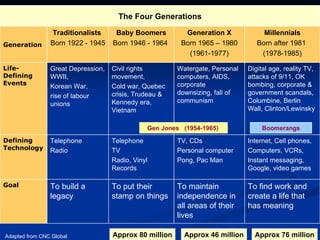
Boomerangs Gen Jones  (1954-1965)   Approx 80 million Approx 46 million Approx 76 million Adapted from CNC Global Internet, Cell phones, Computers, VCRs,  Instant messaging, Google, video games  TV, CDs Personal computer Pong, Pac Man Telephone TV Radio, Vinyl Records Telephone Radio  Defining Technology To find work and create a life that has meaning   To maintain independence in all areas of their lives   To put their stamp on things   To build a legacy   Goal   Digital age, reality TV, attacks of 9/11, OK bombing, corporate & government scandals, Columbine , Berlin Wall, Clinton/Lewinsky Watergate, Personal computers, AIDS, corporate downsizing, fall of communism Civil rights movement,  Cold war, Quebec crisis, Trudeau & Kennedy  era, Vietnam  Great Depression, WWII,  Korean War,  rise of labour unions   Life-Defining Events   Millennials Born after 1981   (1978-1985) Generation X Born 1965 – 1980 (1961-1977) Baby Boomers Born 1946 - 1964   Traditionalists  Born 1922 - 1945   Generation   The Four Generations
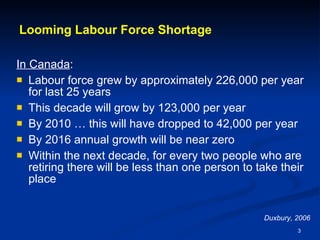
Looming Labour Force Shortage  In Canada : Labour force grew by approximately 226,000 per year for last 25 years This decade will grow by 123,000 per year By 2010 … this will have dropped to 42,000 per year By 2016 annual growth will be near zero Within the next decade, for every two people who are retiring there will be less than one person to take their place  Duxbury, 2006
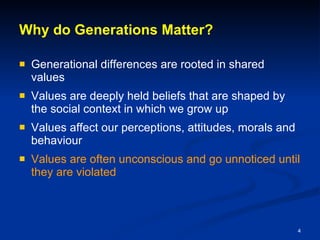
Why do Generations Matter? Generational differences are rooted in shared values Values are deeply held beliefs that are shaped by the social context in which we grow up Values affect our perceptions, attitudes, morals and behaviour Values are often unconscious and go unnoticed until they are violated
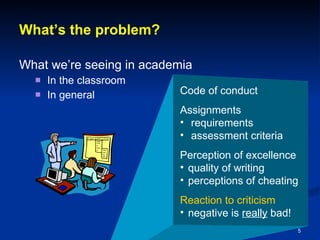
What’s the problem? What we’re seeing in academia In the classroom In general Code of conduct Assignments requirements assessment criteria Perception of excellence quality of writing  perceptions of cheating Reaction to criticism negative is  really  bad!
What’s the problem? What we’re hearing from business people There is a problem… There isn’t a problem… “ To keep up with the twenty-somethings, I’ve had to learn to talk fast and listen fast.” …  a 53-year old manager
What’s been said… Generation profiles & Work Values Webber’s study of new employees
A Recent Study: An Empirical Assessment of Generational Differences in Work Related Values Sean Lyons – St. Francis Xavier University Linda Duxbury – Carleton University Chris Higgins – University of Western Ontario
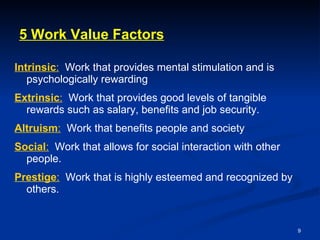
5 Work Value Factors Intrinsic :   Work that provides mental stimulation and is psychologically rewarding Extrinsic :   Work that provides good levels of tangible rewards such as salary, benefits and job security.  Altruism :   Work that benefits people and society Social :   Work that allows for social interaction with other people. Prestige :   Work that is highly esteemed and recognized by others.
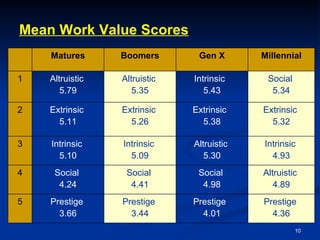
Mean Work Value Scores 5 4 3 2 1 Prestige  4.36 Altruistic  4.89 Intrinsic  4.93 Extrinsic  5.32 Social  5.34 Millennial Prestige  3.44 Social  4.41 Intrinsic  5.09 Extrinsic  5.26 Altruistic  5.35 Boomers Prestige  3.66 Social  4.24 Intrinsic  5.10 Extrinsic  5.11 Altruistic  5.79 Matures Prestige  4.01 Social  4.98 Altruistic  5.30 Extrinsic  5.38 Intrinsic  5.43 Gen X
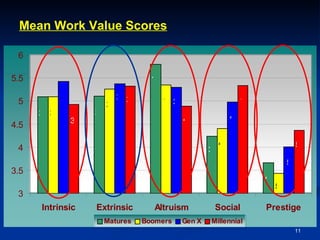
Mean Work Value Scores 2 3 3 1 2 2 2 2 1 1 3 4 4 3 4 1 4 5 5 5
More on generational differences…
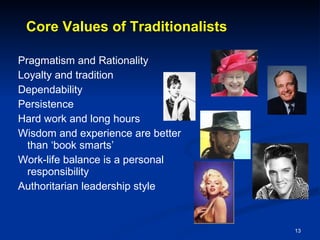
Core Values of Traditionalists Pragmatism and Rationality Loyalty and tradition Dependability Persistence Hard work and long hours Wisdom and experience are better than ‘book smarts’ Work-life balance is a personal responsibility Authoritarian leadership style
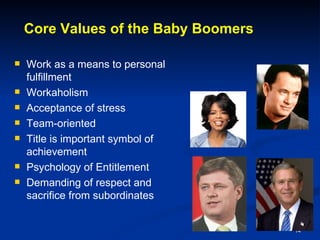
Core Values of the Baby Boomers Work as a means to personal fulfillment Workaholism Acceptance of stress Team-oriented Title is important symbol of achievement Psychology of Entitlement  Demanding of respect and  sacrifice from subordinates
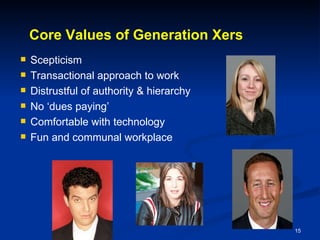
Core Values of Generation Xers Scepticism Transactional approach to work Distrustful of authority & hierarchy No ‘dues paying’ Comfortable with technology Fun and communal workplace
Generation X Individualistic , assertive,  independent.   Hate  to be stereotyped.   Ambitious – want to advance & make good salary, but follow their hearts and quality of life concerns.  Enjoy work, but consider work/life balance important Take responsibility for developing  their skills and employability;  shaping their own work environment View each job as chance to learn;  willing to change jobs,  be entrepreneurs – “free agent” Even when act like Boomers,  their motivations are usually different… How to manage: Provide challenging, interesting work Set goals, give requirements, and deadline    leave alone, don’t nag!
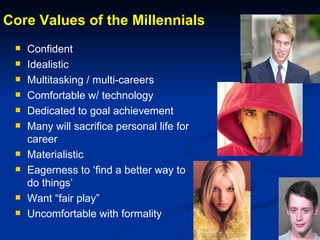
Core Values of the Millennials Confident Idealistic Multitasking / multi-careers Comfortable w/ technology  Dedicated to goal achievement Many will sacrifice personal life for career Materialistic Eagerness to ‘find a better way to do things’ Want “fair play” Uncomfortable with formality
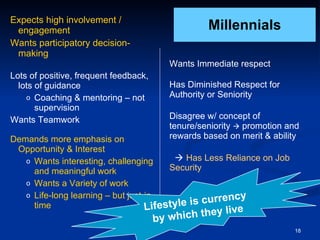
Wants Immediate respect  Has Diminished Respect for Authority or Seniority  Disagree w/ concept of tenure/seniority    promotion and rewards based on merit & ability    Has Less Reliance on Job  Security Millennials Expects high involvement / engagement  Wants participatory decision-making Lots of positive, frequent feedback,  lots of guidance Coaching & mentoring – not supervision  Wants Teamwork  Demands more emphasis on Opportunity & Interest  Wants interesting, challenging and meaningful work Wants a Variety of work Life-long learning – but just-in-time  Lifestyle is currency  by which they live
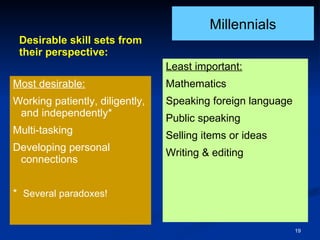
Desirable skill sets from their perspective: Most desirable: Working patiently, diligently, and independently* Multi-tasking Developing personal connections *  Several paradoxes! Least important: Mathematics Speaking foreign language Public speaking Selling items or ideas Writing & editing Millennials
Millennials Will put in extra time for worthy and necessary cause as an exception – not as a rule. “ I will work hard for something that will reward me financially or with personal satisfaction, but I will not tolerate being bullied into doing extra for someone else’s benefit.” Impatient with anything that doesn’t lead to learning and advancement “ Nothing infuriates us more than busywork [grunt work]…  I don’t have time to be intimidated.  … It’s not that I’m disrespectful, it’s just a waste of energy to be fearful.”
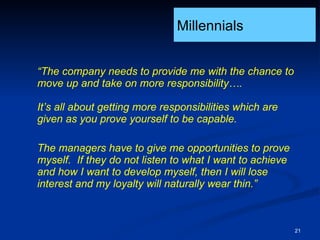
“ The company needs to provide me with the chance to move up and take on more responsibility….  It’s all about getting more responsibilities which are given as you prove yourself to be capable. The managers have to give me opportunities to prove myself.  If they do not listen to what I want to achieve and how I want to develop myself, then I will lose interest and my loyalty will naturally wear thin.” Millennials
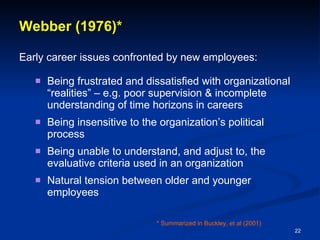
Webber (1976)* Early career issues confronted by new employees: Being frustrated and dissatisfied with organizational “realities” – e.g. poor supervision & incomplete understanding of time horizons in careers Being insensitive to the organization’s political process Being unable to understand, and adjust to, the evaluative criteria used in an organization Natural tension between older and younger employees * Summarized in Buckley, et al (2001)
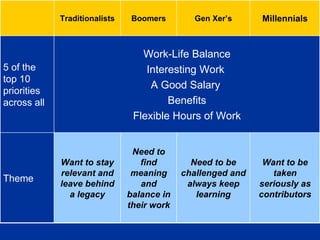
Want to be taken seriously as contributors Need to be challenged and always keep learning Need to find meaning and balance in their work Want to stay relevant and leave behind a legacy Theme Work-Life Balance Interesting Work  A Good Salary  Benefits Flexible Hours of Work 5 of the top 10 priorities across all Millennials Gen Xer’s Boomers Traditionalists
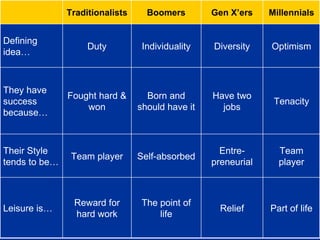
Part of life Relief The point of life Reward for hard work Leisure is… Team player Entre-preneurial Self-absorbed Team player Their Style tends to be… Tenacity Have two jobs Born and should have it Fought hard & won They have success because… Optimism Diversity Individuality Duty Defining idea… Millennials Gen X’ers Boomers Traditionalists
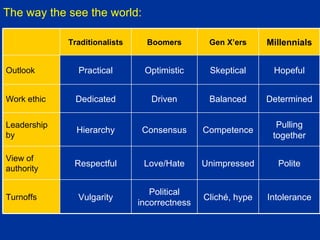
The way the see the world: Pulling together Competence Consensus Hierarchy Leadership by Intolerance Cliché, hype Political incorrectness Vulgarity Turnoffs Polite Unimpressed Love/Hate Respectful View of authority Determined Balanced Driven Dedicated Work ethic Hopeful Skeptical Optimistic Practical Outlook Millennials Gen X’ers Boomers Traditionalists
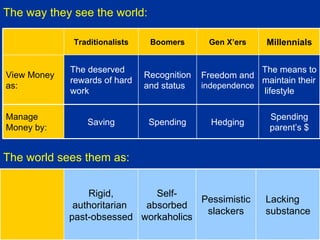
The way they see the world: The world sees them as: The means to maintain their  lifestyle Freedom and  independence Recognition and status The deserved rewards of hard work View Money as: Spending parent’s $ Hedging Spending Saving Manage Money by: Millennials Gen X’ers Boomers Traditionalists Lacking substance Pessimistic slackers Self-absorbed workaholics Rigid, authoritarian  past-obsessed
What do they think about IT?
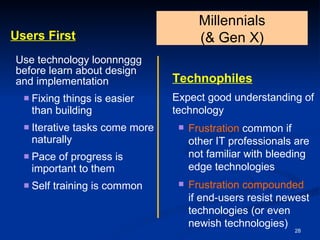
Users First Use technology loonnnggg before learn about design and implementation Fixing things is easier than building  Iterative tasks come more naturally Pace of progress is important to them Self training is common Millennials  (& Gen X) Technophiles   Expect good understanding of technology Frustration  common if other IT professionals are not familiar with bleeding edge technologies Frustration compounded   if end-users resist newest technologies (or even newish technologies)
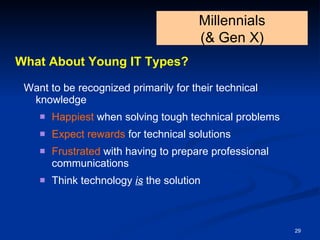
Want to be recognized primarily for their technical knowledge Happiest  when solving tough technical problems Expect rewards  for technical solutions Frustrated   with having to prepare professional communications Think technology  is  the solution What About Young IT Types? Millennials  (& Gen X)
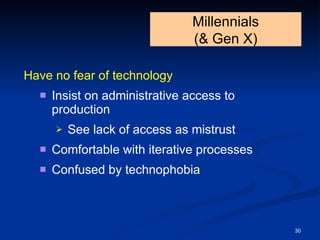
Have no fear of technology Insist on administrative access to production See lack of access as mistrust Comfortable with iterative processes Confused by technophobia Generation Y + X Millennials  (& Gen X)
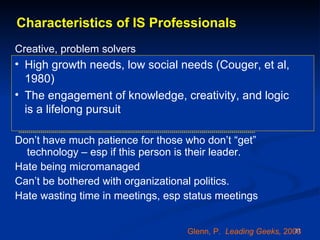
Characteristics of IS Professionals Creative, problem solvers Get absorbed in work / projects – like to be left alone when working Put extraordinary effort into the creative solution of a technical or business problem - take it personally if that solution is criticized.  Don’t have much patience for those who don’t “get” technology – esp if this person is their leader.  Hate being micromanaged Can’t be bothered with organizational politics. Hate wasting time in meetings, esp status meetings Glenn, P.  Leading Geeks,  2003 High growth needs, low social needs (Couger, et al, 1980)  The engagement of knowledge, creativity, and logic  is a lifelong pursuit
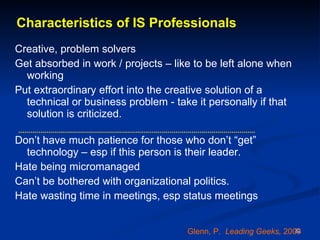
Characteristics of IS Professionals Creative, problem solvers Get absorbed in work / projects – like to be left alone when working Put extraordinary effort into the creative solution of a technical or business problem - take it personally if that solution is criticized.  Don’t have much patience for those who don’t “get” technology – esp if this person is their leader.  Hate being micromanaged Can’t be bothered with organizational politics. Hate wasting time in meetings, esp status meetings Glenn, P.  Leading Geeks,  2003
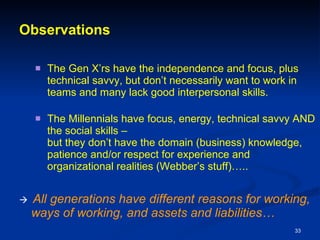
Observations The Gen X’rs have the independence and focus, plus technical savvy, but don’t necessarily want to work in teams and many lack good interpersonal skills. The Millennials have focus, energy, technical savvy AND the social skills –  but they don’t have the domain (business) knowledge, patience and/or respect for experience and organizational realities (Webber’s stuff)…..    All generations have different reasons for working, ways of working, and assets and liabilities…
Other cross-generational issues present  critical challenges… Employees evolving into  “consumers of work experience”  and developing more transactional attitude towards work     challenge for recruitment and retention Fewer college-educated employees – of both genders and across all three generations – want to move into management    challenge for succession planning, Business Continuity Planning Noticeable gap between skills students believe they will need and those employers think are necessary to succeed… Decreased enrollments in key fields; decreased interest (and competency) in key knowledge areas    Challenge for knowledge development & transfer, business continuity Values / attitudes of Gen X in relation to Gen Y    challenge for mgt Culture of entitlement – Now!    challenge for rewards & motivation
Consumers of work From Tulgan: In order to remain viable, employers moving away from long-term employment relationships, and adopt flexible & efficiency staffing practices…  In turn, employees have less confidence in long-term rewards and have adjusted by being more aggressive/assertive in their attitudes, expectations, & behaviors. Employer-employee relationships less hierarchical, more transactional. Instead of defining “success” in relation to rank or seniority, employees define it in highly personal terms. “ Free agency” attitude (job hopping) has intensified and spread across all generations.
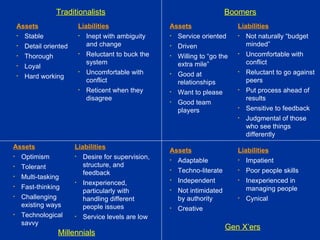
Assets Stable Detail oriented Thorough Loyal Hard working Liabilities Inept with ambiguity and change Reluctant to buck the system Uncomfortable with conflict Reticent when they disagree Traditionalists Assets Service oriented Driven Willing to “go the extra mile” Good at relationships Want to please Good team players Liabilities Not naturally “budget minded” Uncomfortable with conflict Reluctant to go against peers Put process ahead of results Sensitive to feedback Judgmental of those who see things differently Boomers Assets Adaptable Techno-literate Independent Not intimidated by authority Creative Liabilities Impatient Poor people skills Inexperienced in managing people  Cynical Gen X’ers Millennials Assets Optimism Tolerant Multi-tasking Fast-thinking Challenging existing ways Technological savvy Liabilities Desire for supervision, structure, and feedback Inexperienced, particularly with handling different people issues Service levels are low
Our challenge – Part 1: How do we motivate Gen X to improve their social skills to become better managers? What social skill development do they need? How / when do we teach it? How do we keep them? How do we attract and keep Gen Y’s in our organization? How do we keep them challenged and interested? How do we address their impatience in fairness to older employees? How do we keep them? How do we lure them into management?
Our challenge – Part 2: How do we: Lead & Manage Retain Communicate Across generations?
Implications for Leading & Managing: Feed workers’ passionate pursuits    challenge and truly engage them Organizational structures and procedures will need to adapt to demands of workers Leadership styles & management practices will have to adapt
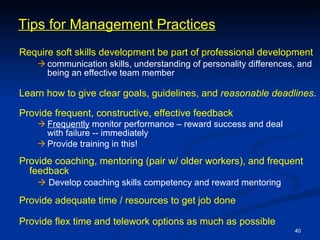
Require soft skills development be part of professional development communication skills, understanding of personality differences, and being an effective team member Learn how to give clear goals, guidelines, and  reasonable   deadlines . Provide frequent, constructive, effective feedback   Frequently  monitor performance – reward success and deal  with failure -- immediately   Provide training in this!   Provide coaching, mentoring (pair w/ older workers), and frequent feedback      Develop coaching skills competency and reward mentoring Provide adequate time / resources to get job done  Provide flex time and telework options as much as possible Tips for Management Practices
Behaviours that result in disloyalty: Being rigid in expectations Treating all staff the same Communication is 1-way, and mainly in the form of instructions Creating culture of physical presence Encouraging culture of excessive hours & work as the primary focus of life “ Use and abuse” employees – implicitly or explicitly Dictatorial and unilateral behaviour, or false consultation with lip-service to staff input Adapted from Kerslake,  Management , June 2005
Good article with list of “best practices”: Tulgan, B. “The Under-Management Epidemic,” Rainmaker Thinking, June 2004 www.rainmakerthinking.com/undermgm.doc
When Generations Fail To Communicate May impact turnover rates May impact tangible costs (i.e. recruitment, hiring, training, retention) May impact intangible costs (i.e. morale) May impact grievances and complaints May impact perceptions of fairness & equity
Generational Implications for Communication: The differences in values and perspectives, make it harder for various generations to communicate Craft different communications to convey the same message Use different communication mediums effectively.
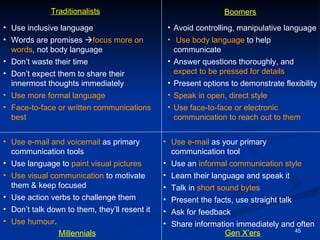
Traditionalists Boomers Gen X’ers Millennials Use inclusive language Words are promises   focus more on words , not body language Don’t waste their time Don’t expect them to share their innermost thoughts immediately Use more formal language Face-to-face or written communications best Avoid controlling, manipulative language Use body language  to help communicate Answer questions thoroughly, and  expect to be pressed for details Present options to demonstrate flexibility Speak in open, direct style Use face-to-face or electronic communication to reach out to them Use e-mail  as your primary communication tool Use an  informal communication style Learn their language and speak it Talk in  short sound bytes Present the facts, use straight talk Ask for feedback Share information immediately and often Use e-mail and voicemail  as primary communication tools Use language to  paint visual pictures Use visual communication  to motivate them & keep focused  Use action verbs to challenge them Don’t talk down to them, they’ll resent it Use humour .
The nature of work has changed… The nature of organizations has changed… The nature of workers has changed…    The nature of  management  has to change We need to become   better managers of PEOPLE …   not just managers of processes, projects,  costs and bottom-lines. Summary:
Find   the time  (and the resources) to  manage individuals;    Get to truly know and understand each individual    Actively manage the relationship  (frequently communicate about all sorts of things) with each individual. You can’t afford to ignore these issues hoping  they will go away… Get your people discussing these issues.       Develop an action plan for moving forward… BUT…
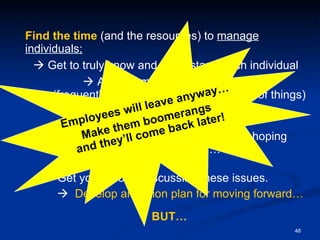
Find   the time  (and the resources) to  manage individuals;    Get to truly know and understand each individual    Actively manage the relationship  (frequently communicate about all sorts of things) with each individual. You can’t afford to ignore these issues hoping  they will go away… Get your people discussing these issues.       Develop an action plan for moving forward… BUT… Employees will leave anyway… Make them boomerangs  and they’ll come back later!
Pro-actively, enthusiastically  promote IS as a  vibrant, dynamic,  people-oriented career  for young people!!!
Q&A For more information, please contact: Mimi Hurt [email_address] (403) 932-1672
References Anonymous, How HR Can Build a Cohesive Workforce Out of ‘Squares,’ ‘Hippies,’ and ‘Slackers,’”  Human Resource Department Management Report , ioma,  www.ioma.com , March 2005. Buckley, Beu, Novicevic, Sigerstad, “Managing Generation NeXt: Individual and Organizational Perspectives,”  Review of Business , Vol 22, Issue 1/2, Spring/Summer 2001.  Celtron and Davies, “Trends Now Shaping the Future:  Technological, Workplace, Management and Institutional Trends,”  The Futurist , May-June, 2005. Center for Generational Studies, http://www.gentrends.com/index.html Duke University, Office of Institutional Equity, “Cross Generational Communication:  Implications in the Work Environment,” http//: www.duke.edu/web/equity.html , accessed on 06/11/2007. Chester, E., Generation Why?,,  http://www.generationwhy.com/index.php Glen, P.,  Leading Geeks: How to Manage and Lead People who Deliver Technology , Josey – Bass, 2003. Grossman, L., “Grow up?  Not so Fast,”  Time Magazine , Vol. 165, No. 4,  January 24,  2005. Hamilton, C. and J. Norrie,  The A to Z Guide to Soul-Inspiring Leadership,  Essence Publishing (Canada), 2003 .   Kerslake, P.  “Words from the Y’s:  Leading the demanding dot-coms,”  Management , www.management.co.nz, May 2005. Kerslake, P. “The Death of Loyalty and 10 steps for Winning it Back,”  Management , www.management.co.nz, June 2005, pgs 35-37. Kersten, D., “Today’s Generations Face New Communication Gaps,” USAToday.com, 2002-11-15, accessed on O6/11/2007. Lyons, S., L.  Duxbury, and C.  Higgins, “A n Empirical Assessment of Generational Differences in Work Related Values,”  Proceedings of Administrative Sciences Association of Canada Annual Conference,  2005. Sacks, Danielle, “Scenes from the Culture Clash,”  Fast Company , Jan/Feb 2006, Issue 102, pgs 72-77. Stencel, B. & H. Hanson, “Communications Across the Generations,” Univ of Wisconsin-Extension Dept of Community Resource Development, accessed on 06/11/07 Tulgan, B. “Generational Shift: What we Saw at the Workplace Revolution,” Rainmaker Thinking, Sep 2003 Tulgan, B. “The Under-Management Epidemic,” Rainmaker Thinking, June 2004 Zust, K. “Baby Boomer Leaders Face Challenges Communicating Across Generations,” HAR Management Central, www.mcentral.har.com, 2002, accessed on 06/11/2007.

Managing The New Generation Of IS Workers

  • 1.
    Explore generational differencesImplications for leadership & management Managing the Generation Jumble in Today's Workforce ICE Conference November 7, 2007 This presentation is presented with my compliments; please feel free to use; but kindly be mindful of copyright issues.
  • 2.
    Boomerangs Gen Jones (1954-1965) Approx 80 million Approx 46 million Approx 76 million Adapted from CNC Global Internet, Cell phones, Computers, VCRs, Instant messaging, Google, video games TV, CDs Personal computer Pong, Pac Man Telephone TV Radio, Vinyl Records Telephone Radio Defining Technology To find work and create a life that has meaning To maintain independence in all areas of their lives To put their stamp on things To build a legacy Goal Digital age, reality TV, attacks of 9/11, OK bombing, corporate & government scandals, Columbine , Berlin Wall, Clinton/Lewinsky Watergate, Personal computers, AIDS, corporate downsizing, fall of communism Civil rights movement, Cold war, Quebec crisis, Trudeau & Kennedy era, Vietnam Great Depression, WWII, Korean War, rise of labour unions Life-Defining Events Millennials Born after 1981 (1978-1985) Generation X Born 1965 – 1980 (1961-1977) Baby Boomers Born 1946 - 1964 Traditionalists Born 1922 - 1945 Generation The Four Generations
  • 3.
    Looming Labour ForceShortage In Canada : Labour force grew by approximately 226,000 per year for last 25 years This decade will grow by 123,000 per year By 2010 … this will have dropped to 42,000 per year By 2016 annual growth will be near zero Within the next decade, for every two people who are retiring there will be less than one person to take their place Duxbury, 2006
  • 4.
    Why do GenerationsMatter? Generational differences are rooted in shared values Values are deeply held beliefs that are shaped by the social context in which we grow up Values affect our perceptions, attitudes, morals and behaviour Values are often unconscious and go unnoticed until they are violated
  • 5.
    What’s the problem?What we’re seeing in academia In the classroom In general Code of conduct Assignments requirements assessment criteria Perception of excellence quality of writing perceptions of cheating Reaction to criticism negative is really bad!
  • 6.
    What’s the problem?What we’re hearing from business people There is a problem… There isn’t a problem… “ To keep up with the twenty-somethings, I’ve had to learn to talk fast and listen fast.” … a 53-year old manager
  • 7.
    What’s been said…Generation profiles & Work Values Webber’s study of new employees
  • 8.
    A Recent Study:An Empirical Assessment of Generational Differences in Work Related Values Sean Lyons – St. Francis Xavier University Linda Duxbury – Carleton University Chris Higgins – University of Western Ontario
  • 9.
    5 Work ValueFactors Intrinsic : Work that provides mental stimulation and is psychologically rewarding Extrinsic : Work that provides good levels of tangible rewards such as salary, benefits and job security. Altruism : Work that benefits people and society Social : Work that allows for social interaction with other people. Prestige : Work that is highly esteemed and recognized by others.
  • 10.
    Mean Work ValueScores 5 4 3 2 1 Prestige 4.36 Altruistic 4.89 Intrinsic 4.93 Extrinsic 5.32 Social 5.34 Millennial Prestige 3.44 Social 4.41 Intrinsic 5.09 Extrinsic 5.26 Altruistic 5.35 Boomers Prestige 3.66 Social 4.24 Intrinsic 5.10 Extrinsic 5.11 Altruistic 5.79 Matures Prestige 4.01 Social 4.98 Altruistic 5.30 Extrinsic 5.38 Intrinsic 5.43 Gen X
  • 11.
    Mean Work ValueScores 2 3 3 1 2 2 2 2 1 1 3 4 4 3 4 1 4 5 5 5
  • 12.
    More on generationaldifferences…
  • 13.
    Core Values ofTraditionalists Pragmatism and Rationality Loyalty and tradition Dependability Persistence Hard work and long hours Wisdom and experience are better than ‘book smarts’ Work-life balance is a personal responsibility Authoritarian leadership style
  • 14.
    Core Values ofthe Baby Boomers Work as a means to personal fulfillment Workaholism Acceptance of stress Team-oriented Title is important symbol of achievement Psychology of Entitlement Demanding of respect and sacrifice from subordinates
  • 15.
    Core Values ofGeneration Xers Scepticism Transactional approach to work Distrustful of authority & hierarchy No ‘dues paying’ Comfortable with technology Fun and communal workplace
  • 16.
    Generation X Individualistic, assertive, independent. Hate to be stereotyped. Ambitious – want to advance & make good salary, but follow their hearts and quality of life concerns. Enjoy work, but consider work/life balance important Take responsibility for developing their skills and employability; shaping their own work environment View each job as chance to learn; willing to change jobs, be entrepreneurs – “free agent” Even when act like Boomers, their motivations are usually different… How to manage: Provide challenging, interesting work Set goals, give requirements, and deadline  leave alone, don’t nag!
  • 17.
    Core Values ofthe Millennials Confident Idealistic Multitasking / multi-careers Comfortable w/ technology Dedicated to goal achievement Many will sacrifice personal life for career Materialistic Eagerness to ‘find a better way to do things’ Want “fair play” Uncomfortable with formality
  • 18.
    Wants Immediate respect Has Diminished Respect for Authority or Seniority Disagree w/ concept of tenure/seniority  promotion and rewards based on merit & ability  Has Less Reliance on Job Security Millennials Expects high involvement / engagement Wants participatory decision-making Lots of positive, frequent feedback, lots of guidance Coaching & mentoring – not supervision Wants Teamwork Demands more emphasis on Opportunity & Interest Wants interesting, challenging and meaningful work Wants a Variety of work Life-long learning – but just-in-time Lifestyle is currency by which they live
  • 19.
    Desirable skill setsfrom their perspective: Most desirable: Working patiently, diligently, and independently* Multi-tasking Developing personal connections * Several paradoxes! Least important: Mathematics Speaking foreign language Public speaking Selling items or ideas Writing & editing Millennials
  • 20.
    Millennials Will putin extra time for worthy and necessary cause as an exception – not as a rule. “ I will work hard for something that will reward me financially or with personal satisfaction, but I will not tolerate being bullied into doing extra for someone else’s benefit.” Impatient with anything that doesn’t lead to learning and advancement “ Nothing infuriates us more than busywork [grunt work]… I don’t have time to be intimidated. … It’s not that I’m disrespectful, it’s just a waste of energy to be fearful.”
  • 21.
    “ The companyneeds to provide me with the chance to move up and take on more responsibility…. It’s all about getting more responsibilities which are given as you prove yourself to be capable. The managers have to give me opportunities to prove myself. If they do not listen to what I want to achieve and how I want to develop myself, then I will lose interest and my loyalty will naturally wear thin.” Millennials
  • 22.
    Webber (1976)* Earlycareer issues confronted by new employees: Being frustrated and dissatisfied with organizational “realities” – e.g. poor supervision & incomplete understanding of time horizons in careers Being insensitive to the organization’s political process Being unable to understand, and adjust to, the evaluative criteria used in an organization Natural tension between older and younger employees * Summarized in Buckley, et al (2001)
  • 23.
    Want to betaken seriously as contributors Need to be challenged and always keep learning Need to find meaning and balance in their work Want to stay relevant and leave behind a legacy Theme Work-Life Balance Interesting Work A Good Salary Benefits Flexible Hours of Work 5 of the top 10 priorities across all Millennials Gen Xer’s Boomers Traditionalists
  • 24.
    Part of lifeRelief The point of life Reward for hard work Leisure is… Team player Entre-preneurial Self-absorbed Team player Their Style tends to be… Tenacity Have two jobs Born and should have it Fought hard & won They have success because… Optimism Diversity Individuality Duty Defining idea… Millennials Gen X’ers Boomers Traditionalists
  • 25.
    The way thesee the world: Pulling together Competence Consensus Hierarchy Leadership by Intolerance Cliché, hype Political incorrectness Vulgarity Turnoffs Polite Unimpressed Love/Hate Respectful View of authority Determined Balanced Driven Dedicated Work ethic Hopeful Skeptical Optimistic Practical Outlook Millennials Gen X’ers Boomers Traditionalists
  • 26.
    The way theysee the world: The world sees them as: The means to maintain their lifestyle Freedom and independence Recognition and status The deserved rewards of hard work View Money as: Spending parent’s $ Hedging Spending Saving Manage Money by: Millennials Gen X’ers Boomers Traditionalists Lacking substance Pessimistic slackers Self-absorbed workaholics Rigid, authoritarian past-obsessed
  • 27.
    What do theythink about IT?
  • 28.
    Users First Usetechnology loonnnggg before learn about design and implementation Fixing things is easier than building Iterative tasks come more naturally Pace of progress is important to them Self training is common Millennials (& Gen X) Technophiles Expect good understanding of technology Frustration common if other IT professionals are not familiar with bleeding edge technologies Frustration compounded if end-users resist newest technologies (or even newish technologies)
  • 29.
    Want to berecognized primarily for their technical knowledge Happiest when solving tough technical problems Expect rewards for technical solutions Frustrated with having to prepare professional communications Think technology is the solution What About Young IT Types? Millennials (& Gen X)
  • 30.
    Have no fearof technology Insist on administrative access to production See lack of access as mistrust Comfortable with iterative processes Confused by technophobia Generation Y + X Millennials (& Gen X)
  • 31.
    Characteristics of ISProfessionals Creative, problem solvers Get absorbed in work / projects – like to be left alone when working Put extraordinary effort into the creative solution of a technical or business problem - take it personally if that solution is criticized. Don’t have much patience for those who don’t “get” technology – esp if this person is their leader. Hate being micromanaged Can’t be bothered with organizational politics. Hate wasting time in meetings, esp status meetings Glenn, P. Leading Geeks, 2003 High growth needs, low social needs (Couger, et al, 1980) The engagement of knowledge, creativity, and logic is a lifelong pursuit
  • 32.
    Characteristics of ISProfessionals Creative, problem solvers Get absorbed in work / projects – like to be left alone when working Put extraordinary effort into the creative solution of a technical or business problem - take it personally if that solution is criticized. Don’t have much patience for those who don’t “get” technology – esp if this person is their leader. Hate being micromanaged Can’t be bothered with organizational politics. Hate wasting time in meetings, esp status meetings Glenn, P. Leading Geeks, 2003
  • 33.
    Observations The GenX’rs have the independence and focus, plus technical savvy, but don’t necessarily want to work in teams and many lack good interpersonal skills. The Millennials have focus, energy, technical savvy AND the social skills – but they don’t have the domain (business) knowledge, patience and/or respect for experience and organizational realities (Webber’s stuff)…..  All generations have different reasons for working, ways of working, and assets and liabilities…
  • 34.
    Other cross-generational issuespresent critical challenges… Employees evolving into “consumers of work experience” and developing more transactional attitude towards work  challenge for recruitment and retention Fewer college-educated employees – of both genders and across all three generations – want to move into management  challenge for succession planning, Business Continuity Planning Noticeable gap between skills students believe they will need and those employers think are necessary to succeed… Decreased enrollments in key fields; decreased interest (and competency) in key knowledge areas  Challenge for knowledge development & transfer, business continuity Values / attitudes of Gen X in relation to Gen Y  challenge for mgt Culture of entitlement – Now!  challenge for rewards & motivation
  • 35.
    Consumers of workFrom Tulgan: In order to remain viable, employers moving away from long-term employment relationships, and adopt flexible & efficiency staffing practices… In turn, employees have less confidence in long-term rewards and have adjusted by being more aggressive/assertive in their attitudes, expectations, & behaviors. Employer-employee relationships less hierarchical, more transactional. Instead of defining “success” in relation to rank or seniority, employees define it in highly personal terms. “ Free agency” attitude (job hopping) has intensified and spread across all generations.
  • 36.
    Assets Stable Detailoriented Thorough Loyal Hard working Liabilities Inept with ambiguity and change Reluctant to buck the system Uncomfortable with conflict Reticent when they disagree Traditionalists Assets Service oriented Driven Willing to “go the extra mile” Good at relationships Want to please Good team players Liabilities Not naturally “budget minded” Uncomfortable with conflict Reluctant to go against peers Put process ahead of results Sensitive to feedback Judgmental of those who see things differently Boomers Assets Adaptable Techno-literate Independent Not intimidated by authority Creative Liabilities Impatient Poor people skills Inexperienced in managing people Cynical Gen X’ers Millennials Assets Optimism Tolerant Multi-tasking Fast-thinking Challenging existing ways Technological savvy Liabilities Desire for supervision, structure, and feedback Inexperienced, particularly with handling different people issues Service levels are low
  • 37.
    Our challenge –Part 1: How do we motivate Gen X to improve their social skills to become better managers? What social skill development do they need? How / when do we teach it? How do we keep them? How do we attract and keep Gen Y’s in our organization? How do we keep them challenged and interested? How do we address their impatience in fairness to older employees? How do we keep them? How do we lure them into management?
  • 38.
    Our challenge –Part 2: How do we: Lead & Manage Retain Communicate Across generations?
  • 39.
    Implications for Leading& Managing: Feed workers’ passionate pursuits  challenge and truly engage them Organizational structures and procedures will need to adapt to demands of workers Leadership styles & management practices will have to adapt
  • 40.
    Require soft skillsdevelopment be part of professional development communication skills, understanding of personality differences, and being an effective team member Learn how to give clear goals, guidelines, and reasonable deadlines . Provide frequent, constructive, effective feedback Frequently monitor performance – reward success and deal with failure -- immediately Provide training in this! Provide coaching, mentoring (pair w/ older workers), and frequent feedback  Develop coaching skills competency and reward mentoring Provide adequate time / resources to get job done Provide flex time and telework options as much as possible Tips for Management Practices
  • 41.
    Behaviours that resultin disloyalty: Being rigid in expectations Treating all staff the same Communication is 1-way, and mainly in the form of instructions Creating culture of physical presence Encouraging culture of excessive hours & work as the primary focus of life “ Use and abuse” employees – implicitly or explicitly Dictatorial and unilateral behaviour, or false consultation with lip-service to staff input Adapted from Kerslake, Management , June 2005
  • 42.
    Good article withlist of “best practices”: Tulgan, B. “The Under-Management Epidemic,” Rainmaker Thinking, June 2004 www.rainmakerthinking.com/undermgm.doc
  • 43.
    When Generations FailTo Communicate May impact turnover rates May impact tangible costs (i.e. recruitment, hiring, training, retention) May impact intangible costs (i.e. morale) May impact grievances and complaints May impact perceptions of fairness & equity
  • 44.
    Generational Implications forCommunication: The differences in values and perspectives, make it harder for various generations to communicate Craft different communications to convey the same message Use different communication mediums effectively.
  • 45.
    Traditionalists Boomers GenX’ers Millennials Use inclusive language Words are promises  focus more on words , not body language Don’t waste their time Don’t expect them to share their innermost thoughts immediately Use more formal language Face-to-face or written communications best Avoid controlling, manipulative language Use body language to help communicate Answer questions thoroughly, and expect to be pressed for details Present options to demonstrate flexibility Speak in open, direct style Use face-to-face or electronic communication to reach out to them Use e-mail as your primary communication tool Use an informal communication style Learn their language and speak it Talk in short sound bytes Present the facts, use straight talk Ask for feedback Share information immediately and often Use e-mail and voicemail as primary communication tools Use language to paint visual pictures Use visual communication to motivate them & keep focused Use action verbs to challenge them Don’t talk down to them, they’ll resent it Use humour .
  • 46.
    The nature ofwork has changed… The nature of organizations has changed… The nature of workers has changed…  The nature of management has to change We need to become better managers of PEOPLE … not just managers of processes, projects, costs and bottom-lines. Summary:
  • 47.
    Find the time (and the resources) to manage individuals;  Get to truly know and understand each individual  Actively manage the relationship (frequently communicate about all sorts of things) with each individual. You can’t afford to ignore these issues hoping they will go away… Get your people discussing these issues.  Develop an action plan for moving forward… BUT…
  • 48.
    Find the time (and the resources) to manage individuals;  Get to truly know and understand each individual  Actively manage the relationship (frequently communicate about all sorts of things) with each individual. You can’t afford to ignore these issues hoping they will go away… Get your people discussing these issues.  Develop an action plan for moving forward… BUT… Employees will leave anyway… Make them boomerangs and they’ll come back later!
  • 49.
    Pro-actively, enthusiastically promote IS as a vibrant, dynamic, people-oriented career for young people!!!
  • 50.
    Q&A For moreinformation, please contact: Mimi Hurt [email_address] (403) 932-1672
  • 51.
    References Anonymous, HowHR Can Build a Cohesive Workforce Out of ‘Squares,’ ‘Hippies,’ and ‘Slackers,’” Human Resource Department Management Report , ioma, www.ioma.com , March 2005. Buckley, Beu, Novicevic, Sigerstad, “Managing Generation NeXt: Individual and Organizational Perspectives,” Review of Business , Vol 22, Issue 1/2, Spring/Summer 2001. Celtron and Davies, “Trends Now Shaping the Future: Technological, Workplace, Management and Institutional Trends,” The Futurist , May-June, 2005. Center for Generational Studies, http://www.gentrends.com/index.html Duke University, Office of Institutional Equity, “Cross Generational Communication: Implications in the Work Environment,” http//: www.duke.edu/web/equity.html , accessed on 06/11/2007. Chester, E., Generation Why?,, http://www.generationwhy.com/index.php Glen, P., Leading Geeks: How to Manage and Lead People who Deliver Technology , Josey – Bass, 2003. Grossman, L., “Grow up? Not so Fast,” Time Magazine , Vol. 165, No. 4, January 24, 2005. Hamilton, C. and J. Norrie, The A to Z Guide to Soul-Inspiring Leadership, Essence Publishing (Canada), 2003 . Kerslake, P. “Words from the Y’s: Leading the demanding dot-coms,” Management , www.management.co.nz, May 2005. Kerslake, P. “The Death of Loyalty and 10 steps for Winning it Back,” Management , www.management.co.nz, June 2005, pgs 35-37. Kersten, D., “Today’s Generations Face New Communication Gaps,” USAToday.com, 2002-11-15, accessed on O6/11/2007. Lyons, S., L. Duxbury, and C. Higgins, “A n Empirical Assessment of Generational Differences in Work Related Values,” Proceedings of Administrative Sciences Association of Canada Annual Conference, 2005. Sacks, Danielle, “Scenes from the Culture Clash,” Fast Company , Jan/Feb 2006, Issue 102, pgs 72-77. Stencel, B. & H. Hanson, “Communications Across the Generations,” Univ of Wisconsin-Extension Dept of Community Resource Development, accessed on 06/11/07 Tulgan, B. “Generational Shift: What we Saw at the Workplace Revolution,” Rainmaker Thinking, Sep 2003 Tulgan, B. “The Under-Management Epidemic,” Rainmaker Thinking, June 2004 Zust, K. “Baby Boomer Leaders Face Challenges Communicating Across Generations,” HAR Management Central, www.mcentral.har.com, 2002, accessed on 06/11/2007.

Editor's Notes

  • #2 Road map for talk…
  • #3 09/18/09 00:44 Why is this topic important? sheer #’s of workers retiring; large number coming in; few in between. Boomers = approx 80 million, Gen X = 46 million, Gen Y = 76 million. Fewer people to enter management (and who want to); to take over and carry on with great successes and companies that Veterans, Boomers have invested so much time, effort, and personal energy (and sacrifice) in building. Recruitment and retention of Gen X & Gen Y is critical…  need time for knowledge transfer!
  • #6 09/18/09 00:44 Assignments – Having to give more and more detailed assignment requirements…. Moving to “fill-in the blank” templates? Having to give more detailed description of assessment criteria  Having to clearly specify all expectations  Consequences : Where is true learning, exploration, creativity, “a-ha” moments? Grade averages have gone up bkuz expectations met more often Other issues: Code of Conduct issues - rudeness (?)  lack of respect in classroom (using cellphone, reading newspaper, etc), Not same recognition of time and place issues, boundaries blurred for “always on” generation? Also, they’re more comfortable with multi-tasking (text msg, video game, chat room, watching TV – all while doing homework – therefore think its “no big deal”… Perception of cheating – what’s cheating these days versus knowing how to use resources (cheat codes in games) Quality Perception of quality – frequently think their work is good. When pointed out how could be improved, shrug “it’s good enough”. When take off points because it’s only “good,” but not excellent… “If you told me that’s what you wanted / thought was excellent, I would have done it.” Reaction to criticism – Really frustrating! B+ = not good enough, grounds for real crisis. Can I have a “do-over”? Dramatic fall off in enrollment in certain fields…
  • #7 09/18/09 00:44 E-mail boss, 5 mins later – leave voice msg… 5 mins later – pop into ofc to discuss “ I’m still thinking about it!” CEO forum in Aus 75% experienced workers > 55 say get along fine with younger workers. 77% report they don’t solicit advice / guidance Why? 80% of younger folks say older people have nothing new to bring to the table
  • #8 09/18/09 00:44 What we’re clearly seeing is a fundamental difference in attitudes towards work. Boomers – driven by financial success – brag about latest toy Gen x – driven by need for independence & practicality – brag about how much saved What drives Gen Y? Want careers / interactions that are intensely personal
  • #9 Linda Duxbury – name you might recognize… always quoted on these type topics. Guru. 2 Samples: 1,068 knowledge workers in large (500+) organizations in the public, private and not-for profit sectors 123 Undergraduate students from 2 universities in compulsory 2 nd and 3 rd year business courses – got flack about this sample – business students “different” from other same aged kids – greedy, biased, etc 64% female, 36% male Generational Breakdown: Matures: 4% Baby Boomers: 31% Generation Xers: 53% Millennials: 11%
  • #10 Work values affects attitudes, work behaviors, work preferences…
  • #11 These are the averages for each cohort on a scale from 1-7, where 6 = Very important, and 7 = of supreme importance. 3 = Important Note the rankings and ranges Matures – 5.79 – 3.66, definite distinctions Boomers – 5.35 – 3.44 Gen X – 5.43 - 4.01 Gen Y – 5.34 – 4.36 … very small differences between factors
  • #12 Intrinsic work values : Generation Xers > Boomers and Millennials Extrinsic work values : No sig. differences Altruistic work values : Matures > Gen Xers and Millennials; Boomers > Millennials Social work values : Millennials > Gen Xers > Baby Boomers and Matures Prestige : Millennials > Gen Xers > Boomers and Matures
  • #17 09/18/09 00:44 Gen X – hate to be stereotyped, view categorization as lack of respect for their individualism, opportunity for criticism . Likely to seek new career opportunities & ventures as grow older  Managers have to work hard to keep Xers engaged…
  • #19 09/18/09 00:44 Left side = SOCIAL & INTRINSIC needs Will show respect only after treated with respect. Will learn only from a “respect figure”. Will question and refuse to accept “this is the way we’ve always done it.” An employer must walk the talk…  Gen Y see companies as shells containing groups of people. If people are bad, especially supervisor, they will leave. Need empathetic and consultative leaders. Want managers who can have fun, be sociable, and professional when required Autocratic leaders, command and control type  most likely will blow a gasket… Don’t want to achieve, want to be seen to achieve -- “look at me” generation For many, prestige/glamour/ peer cool factor is important. They want to work for glamorous industries, large corporations are also appealing. “Gold Dusting” their CV. Lifestyle is currency by which live – Demand more time-off /leaves/schedule flexibility  from beginning of career …. Gen X  quantity time as well as quality time with kids Will turn down job which requires extra travel, extra work Single most empowering question to ask younger person: “what do you think?”
  • #20 09/18/09 00:44 Believe networking is important for personal success… The least important skills are those that are increasingly important in global business… definite reduction in basic skills (math & writing) From a Deloitte & Touche survey, quoted in “How HR Can Build a Cohesive Workforce Out of ‘Squares,’ ‘Hippies,’ and ‘Slackers,’” Human Resource Department Management Report, ioma, March 2005.
  • #21 09/18/09 00:44 First quote from Kerslake, 2005, 2 nd quote from Sacks, 2006 Gen Y is transactional… showing loyalty and dedication as long as they are achieving their goals; then flitting off for their next challenge. Their impatience is palpable; they believe 3 mos on the job is sufficient to learn it. They believe they are capable far before their managers believe them to be… but they really haven’t had enough time to see or understand exceptions, one-off situations and know how to handle these.
  • #22 09/18/09 00:44
  • #23 09/18/09 00:44 Buckley, Beu, Novicevic, Sigerstad, “Managing Generation NeXt: Individual and Organizational Perspectives,” Review of Business , Spring/Summer 2001, Vol 22, Issue 1/2
  • #26 09/18/09 00:44 Adapted from Beyond Generation X , Raines, Claire
  • #27 09/18/09 00:44 Adapted from Beyond Generation X , Raines, Claire
  • #32 09/18/09 00:44 Build title – briefly discuss nature of IS work traditionally is… Ambiguity rules… figuring out what going to do often more difficult than doing it Design/Development  Creative, thought driven work – requires deep concentration, long uninterrupted blocks of time Estimation of how long will take always difficult
  • #33 09/18/09 00:44 Build title – briefly discuss nature of IS work traditionally is… Ambiguity rules… figuring out what going to do often more difficult than doing it Design/Development  Creative, thought driven work – requires deep concentration, long uninterrupted blocks of time Estimation of how long will take always difficult
  • #35 09/18/09 00:44 Here are some more issues that we are grappling with in the work force… Consumers of work: see next slide Why don’t want responsibility – i.e. management Among college-educated men of all 3 gens, 52% want to move into positions of > responsib – down from 68% in 1992. Among college-educated women of all 3 gens, 36% want to move up vs 57% in 1992  This in time of great loss in management due to retirement, smaller size cohort moving up, etc. Younger workers consider jobs with greater responsibility less desirable bkuz have seen parents / grandparents move up ladder only to be downsized / outsourced --- BUT I think they are making a distinction between responsibility and management – they want more responsibility – e.g. P&L, and they want to work in teams, but they don’t necessarily want to be in “management” Quite aware of amount of conflict, stress at upper levels of management Don’t like what they see of those in higher management Taken from: ”How HR Can Build a Cohesive Workforce Out of ‘Squares,’ ‘Hippies,’ and ‘Slackers,’” Human Resource Department Management Report, ioma, www.ioma.com, March 2005.
  • #40 09/18/09 00:44 Feed workers’ passionate pursuits Challenging, variety of work Provide life-long learning support Organization structures have to adapt Seniority / tenure will need to give way to performance and ability There will need to be fewer tenured entitlements Flexibility in work schedule , & time off Job rotations? Short term, not necessarily long term More project-oriented type work instead of permanent “forever” type functions/jobs Need to have adaptable organization structures/policies Leadership style & management practices Highly situational leadership practices will be needed Remember transactional orientation of employees, esp younger ones High need to communicate rationales Respect abilities , reward accomplishment / merit Effective coaching / encouraging behaviors to motivate individuals to change, try something new  Coach as in coach a sports team Coaching competency is key
  • #41 09/18/09 00:44 Adapted from Kerslake, Management , June 2005
  • #42 Behaviours that result in loyalty Understanding the needs of employees as individuals, and flex to meet those individual needs Actively communicating (2-way) with staff to understand their changing needs and expectations Collegial, consultative and inclusive management style
  • #45 09/18/09 00:44
  • #47 09/18/09 00:44 Understand and accept the new reality that managing people has become day to day negotiation. (Tulgan, 2004) The managers who said there were no problems with the young workforce… were already innate people managers… .
  • #48 09/18/09 00:44 One type of management style doesn’t fit everyone … Be aware of cultural and generational issues, and manage accordingly.
  • #49 09/18/09 00:44 One final note: Gen Y employees are going to leave anyway… goal is to make them into boomerang employees:  They’ll come back in later years because they remember how good it was to “live” under your company’s roof. You need to nurture them.
  • #50 09/18/09 00:44 Understand and accept the new reality that managing people has become day to day negotiation. (Tulgan, 2004) The managers who said there were no problems with the young workforce… were already innate people managers… One type of management style doesn’t fit everyone … Be aware of cultural and generational issues, and manage accordingly. One final note: Gen Y employees are going to leave anyway… goal is to make them into boomerang employees:  They’ll come back in later years because they remember how good it was to “live” under your company’s roof. You need to nurture them.
  • #51 09/18/09 00:44
  • #52 09/18/09 00:44