A SEMINAR ON
GENERATION OF ELECTRICITY
USING ROAD TRANSPORT PRESSURE
BY
KADTARE GOURI SATEJ
SHARAD INSTITUTE OF TECHNOLOGY COLLEGE OF
ENGINEERING , YADRAV.
Contents
1. Introduction
2. Load Considerations
3. Components of System
4. Specifications of Speed Breaker
5. Working Process
6. Calculation of Input Energy and Output Energy
7. Advantages
8. Disadvantages
9. Conclusion
10.Reference
8/11/2019 2
INTRODUCTION
 Need of renewable energy-
Conventional energy resources are limited i.e. fossil fuels,
Nuclear energy etc.
 Wastage of kinetic energy of vehicles passing over a speed
breaker-
Energy of vehicle is wasted as heat in it.
8/11/2019 3
Continue
 Using wasted kinetic energy in producing electricity –
Extraction of such kinetic energy can be used to produce and
store electricity.
 Speed breaker generator for extraction of energy
Principle of working- Simply energy conversion from
mechanical to electrical.
8/11/2019 4
Load Considerations
 The Roads are different at different locations, when we design
something related to roads, it is must to consider all type of loads. [1]
1) Bus= 10200 kg at back axle
2) Multi-Axle Volvo= 14500 kg at back axle
3) 3 axles rigid lorry= 26000 kg
4) 5 axle vehicle with draw bar trailer = 36000 kg
5) 6 axle draw bar heavy duty lorry = 41000 kg
6) 6 axles artic heavy duty vehicle = 44000 kg
8/11/2019 5
Components
The system consists of following Electro- Mechanical elements:
1. Plate
2. Fixture and constrains
3. Sprocket and chain
4. Unidirectional ball bearing
5. Flywheel
6. Generator
7. Storage battery
8/11/2019 6
Fig. No.1 components of speed breaker generator
(Reference- IJEST Volume 2, Issue 3, May 2013.)8/11/2019 7
 The material used for construction of speed breakers is steel.
 Height of Speed Breakers is 10 to 12cm.
 Fixture used - L shaped clamp or an inverted T clamp.
Specifications of Speed Breakers
8/11/2019 8
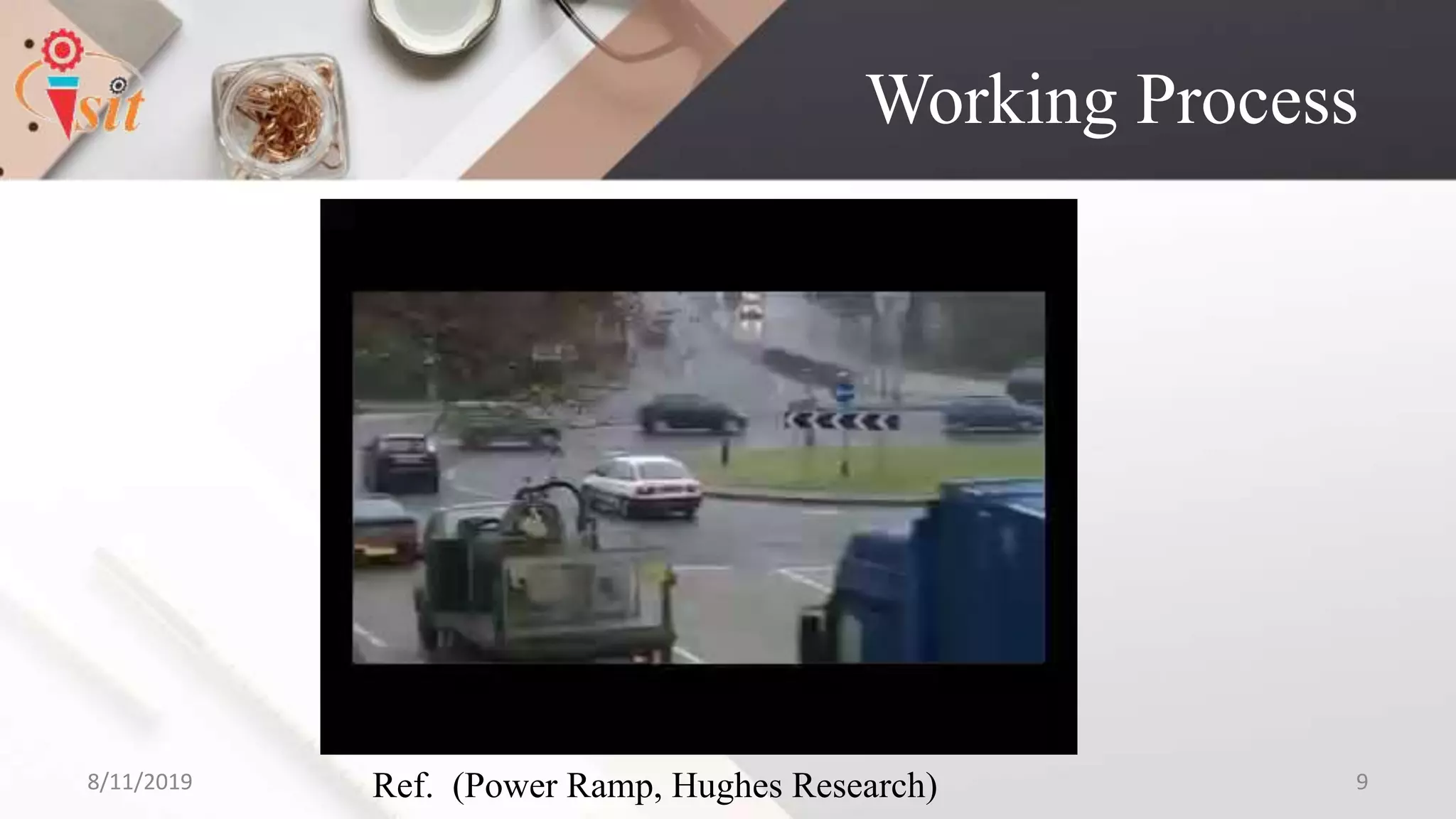
Working Process
Ref. (Power Ramp, Hughes Research)8/11/2019 9
Considering 7 kg load (m) on the pressure lever, the lever travels a distance of 0.152 meter (S) and
the total time taken to travel this distance is 0.717 seconds(t). RPM for one Stroke is 1014. [1]
• Input power-
Work done = W= F*S
= mg*S
= 7*9.81*0.152
= 10.43 Joule
Input Power = Total Work done / Total time
taken to do the work
= 10.43/0.717
= 14.55 Watt
• Output Power = Voltage * Current
= 4 * 0.5
= 2 Watt
Efficiency = (Output Power /
Input Power)*100 %
= (2/14.55)*100 %
= 13.75%
Calculations of Input Power
and Output Power
8/11/2019 10
Advantages
 It can eliminate the transmission system (electric towers) in rural areas.
 Simple construction.
 Offers renewable energy having very less environmental impact.
8/11/2019 11
Disadvantages
 It may not work with light weight vehicle.
 Require more suitable and compact mechanisms to enhance efficiency.
 Checking of mechanism from time to time in short span of period.
 Because of Rain water it may get damaged.
8/11/2019 12
Conclusion
• In coming days, it will prove a great boon to the world, since it will save a
lot of electricity of power plants that gets wasted in illuminating the street
lights.
• Vehicular traffic can be utilized for proper generation by means of a new
technique called “power hump”. It has advantages that it does not utilize
any external source.
8/11/2019 13
Reference
1. Saiful Islam, Syed Khalid Rahman, ‘Generation of Electricity using Load Transport
Pressure’, International Journal of Engineering Science and Innovative Technology
(IJESIT) Volume 2, Issue 3, May 2013.
2. Shakun Srivastava, Ankit Asthana, “Produce Electricity by the use of Speed Breakers,”
Journal of Engineering Research and Studies, Vol.2, No.1 April-Jun 2011.
3. ‘Anusandhana’ Journal of Science Engineering and Management, Vol- 3, Issue-1, June
2014, published by- NITTE Meenakshi Institute Of Technology, Karnataka, India.
8/11/2019 14
THANK YOU !
8/11/2019 15

Generation of electricity using road trasport pressure

  • 1.
    A SEMINAR ON GENERATIONOF ELECTRICITY USING ROAD TRANSPORT PRESSURE BY KADTARE GOURI SATEJ SHARAD INSTITUTE OF TECHNOLOGY COLLEGE OF ENGINEERING , YADRAV.
  • 2.
    Contents 1. Introduction 2. LoadConsiderations 3. Components of System 4. Specifications of Speed Breaker 5. Working Process 6. Calculation of Input Energy and Output Energy 7. Advantages 8. Disadvantages 9. Conclusion 10.Reference 8/11/2019 2
  • 3.
    INTRODUCTION  Need ofrenewable energy- Conventional energy resources are limited i.e. fossil fuels, Nuclear energy etc.  Wastage of kinetic energy of vehicles passing over a speed breaker- Energy of vehicle is wasted as heat in it. 8/11/2019 3
  • 4.
    Continue  Using wastedkinetic energy in producing electricity – Extraction of such kinetic energy can be used to produce and store electricity.  Speed breaker generator for extraction of energy Principle of working- Simply energy conversion from mechanical to electrical. 8/11/2019 4
  • 5.
    Load Considerations  TheRoads are different at different locations, when we design something related to roads, it is must to consider all type of loads. [1] 1) Bus= 10200 kg at back axle 2) Multi-Axle Volvo= 14500 kg at back axle 3) 3 axles rigid lorry= 26000 kg 4) 5 axle vehicle with draw bar trailer = 36000 kg 5) 6 axle draw bar heavy duty lorry = 41000 kg 6) 6 axles artic heavy duty vehicle = 44000 kg 8/11/2019 5
  • 6.
    Components The system consistsof following Electro- Mechanical elements: 1. Plate 2. Fixture and constrains 3. Sprocket and chain 4. Unidirectional ball bearing 5. Flywheel 6. Generator 7. Storage battery 8/11/2019 6
  • 7.
    Fig. No.1 componentsof speed breaker generator (Reference- IJEST Volume 2, Issue 3, May 2013.)8/11/2019 7
  • 8.
     The materialused for construction of speed breakers is steel.  Height of Speed Breakers is 10 to 12cm.  Fixture used - L shaped clamp or an inverted T clamp. Specifications of Speed Breakers 8/11/2019 8
  • 9.
    Working Process Ref. (PowerRamp, Hughes Research)8/11/2019 9
  • 10.
    Considering 7 kgload (m) on the pressure lever, the lever travels a distance of 0.152 meter (S) and the total time taken to travel this distance is 0.717 seconds(t). RPM for one Stroke is 1014. [1] • Input power- Work done = W= F*S = mg*S = 7*9.81*0.152 = 10.43 Joule Input Power = Total Work done / Total time taken to do the work = 10.43/0.717 = 14.55 Watt • Output Power = Voltage * Current = 4 * 0.5 = 2 Watt Efficiency = (Output Power / Input Power)*100 % = (2/14.55)*100 % = 13.75% Calculations of Input Power and Output Power 8/11/2019 10
  • 11.
    Advantages  It caneliminate the transmission system (electric towers) in rural areas.  Simple construction.  Offers renewable energy having very less environmental impact. 8/11/2019 11
  • 12.
    Disadvantages  It maynot work with light weight vehicle.  Require more suitable and compact mechanisms to enhance efficiency.  Checking of mechanism from time to time in short span of period.  Because of Rain water it may get damaged. 8/11/2019 12
  • 13.
    Conclusion • In comingdays, it will prove a great boon to the world, since it will save a lot of electricity of power plants that gets wasted in illuminating the street lights. • Vehicular traffic can be utilized for proper generation by means of a new technique called “power hump”. It has advantages that it does not utilize any external source. 8/11/2019 13
  • 14.
    Reference 1. Saiful Islam,Syed Khalid Rahman, ‘Generation of Electricity using Load Transport Pressure’, International Journal of Engineering Science and Innovative Technology (IJESIT) Volume 2, Issue 3, May 2013. 2. Shakun Srivastava, Ankit Asthana, “Produce Electricity by the use of Speed Breakers,” Journal of Engineering Research and Studies, Vol.2, No.1 April-Jun 2011. 3. ‘Anusandhana’ Journal of Science Engineering and Management, Vol- 3, Issue-1, June 2014, published by- NITTE Meenakshi Institute Of Technology, Karnataka, India. 8/11/2019 14
  • 15.