Drawing
Conclusions
and
Making
Generalizations
Essential Question
How does a reader make
generalizations or draw
conclusions?
Key Terms
conclude
generalization
draw
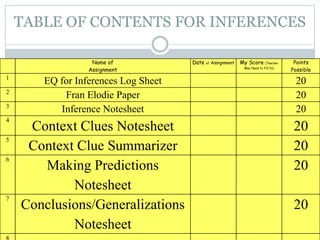
TABLE OF CONTENTS FOR INFERENCES
Name of
Assignment
Date of Assignment My Score (Teacher
May Need to Fill In)
Points
Possible
1
EQ for Inferences Log Sheet 20
2
Fran Elodie Paper 20
3
Inference Notesheet 20
4
Context Clues Notesheet 20
5
Context Clue Summarizer 20
6
Making Predictions
Notesheet
20
7
Conclusions/Generalizations
Notesheet
20
8
Activator
Imagine you are walking down the street
and you come across a house with
overgrown grass that reaches waist-height,
no lights in the windows, and the paint that
is peeling off the siding.
What might you think about this house?
Activator
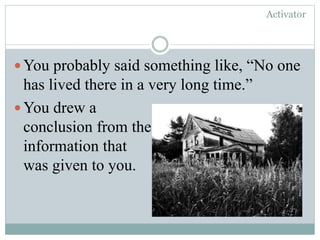
You probably said something like, “No one
has lived there in a very long time.”
You drew a
conclusion from the
information that
was given to you.
Drawing Conclusions
When you draw conclusions, you use two
things:
What you know in your head
AND
What you’ve read in the story.
A conclusion is what you come to when
you put these two together.
Drawing Conclusions
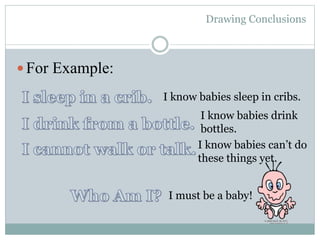
For Example:
I know babies sleep in cribs.
I know babies drink
bottles.
I know babies can’t do
these things yet.
I must be a baby!
Drawing Conclusions
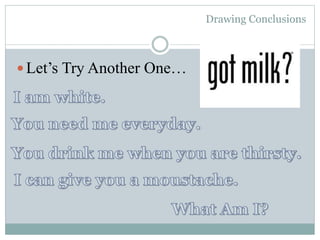
Let’s Try Another One…
Drawing Conclusions
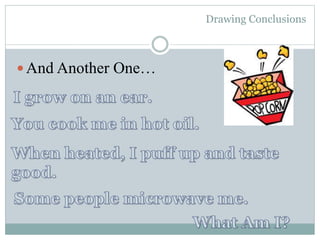
And Another One…
Drawing Conclusions
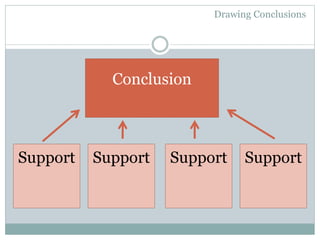
Using a graphic organizer on the next slide
may help you come to logical conclusions.
Notice how the “conclusion” is supported.
Drawing Conclusions
Conclusion
Support Support Support Support
Making Generalizations
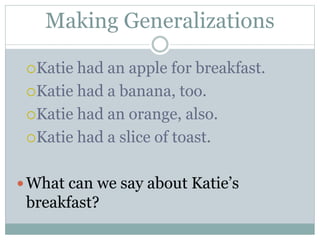
Katie had an apple for breakfast.
Katie had a banana, too.
Katie had an orange, also.
Katie had a slice of toast.
What can we say about Katie’s
breakfast?
Making Generalizations
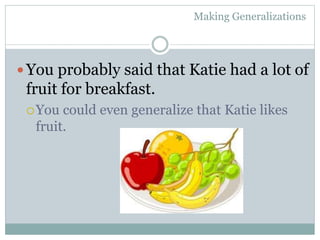
You probably said that Katie had a lot of
fruit for breakfast.
You could even generalize that Katie likes
fruit.
Making Generalizations
A generalization is a broad statement
about a group of people or things.
It states something they have in
common.
Making Generalizations
Be careful!
Make sure your generalization is valid.
Valid means true.
It is supported by facts
It agrees with what you already
know about the topic
It uses logic and reasoning
It is proven with several examples
Making Generalizations
Be careful!
Make sure your generalization is not
faulty.
 Faulty means false.
It is not supported by facts
Watch for the key words: none,
all, always, never, everyone,
nobody
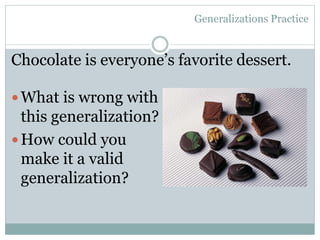
Generalizations Practice
What is wrong with
this generalization?
How could you
make it a valid
generalization?
Chocolate is everyone’s favorite dessert.
Generalizations Practice
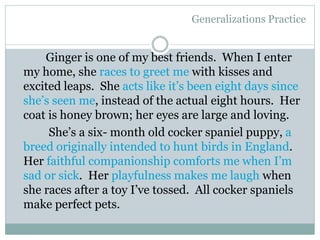
Ginger is one of my best friends.
When I enter my home, she races to
greet me with kisses and excited leaps.
She acts like it’s been eight days since
she’s seen me, instead of the actual
eight hours. Her coat is honey brown;
her eyes are large and loving.
Read the following passage.
She’s a six- month old cocker spaniel
puppy, a breed originally intended to
hunt birds in England. Her faithful
companionship comforts me when I’m
sad or sick. Her playfulness makes me
laugh when she races after a toy I’ve
tossed. All cocker spaniels make
perfect pets.
Generalizations Practice
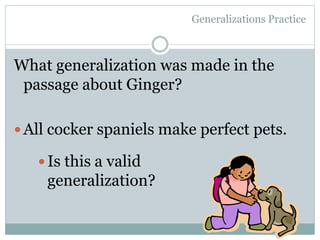
All cocker spaniels make perfect pets.
Generalizations Practice
What generalization was made in the
passage about Ginger?
Is this a valid
generalization?
Let’s Think About This…
Does the author:
Use facts to support the idea?
Share past experiences to support the
idea?
Provide several examples?
Use logical thinking?
Generalizations Practice
Ginger is one of my best friends. When I enter
my home, she races to greet me with kisses and
excited leaps. She acts like it’s been eight days since
she’s seen me, instead of the actual eight hours. Her
coat is honey brown; her eyes are large and loving.
She’s a six- month old cocker spaniel puppy, a
breed originally intended to hunt birds in England.
Her faithful companionship comforts me when I’m
sad or sick. Her playfulness makes me laugh when
she races after a toy I’ve tossed. All cocker spaniels
make perfect pets.
Generalizations Practice
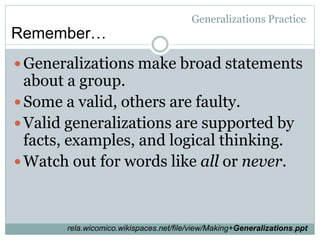
Generalizations make broad statements
about a group.
Some a valid, others are faulty.
Valid generalizations are supported by
facts, examples, and logical thinking.
Watch out for words like all or never.
rela.wicomico.wikispaces.net/file/view/Making+Generalizations.ppt
Generalizations Practice
Remember…
Activity
I am going to be reading “When
Monsters Meet” by John Koster to you
all.
Please pay attention as I do so.
Now, you need to open your book to page
619.
We will be reading “Out There” and
answering some questions– making
conclusions and generalizations.
Summarizer
Pretend you are a writing for a
newspaper.
You need to come up with two
headlines.
These headlines need to sum up:
Drawing Conclusions
Making Generalizations
Trackers Out, Please!
Workbook Page 222
Check the HW Board to see if there is
anything else!

Drawing_Conclusions_and_Making_Generalizations_PP.ppt

  • 1.
  • 2.
    Essential Question How doesa reader make generalizations or draw conclusions?
  • 3.
  • 4.
    TABLE OF CONTENTSFOR INFERENCES Name of Assignment Date of Assignment My Score (Teacher May Need to Fill In) Points Possible 1 EQ for Inferences Log Sheet 20 2 Fran Elodie Paper 20 3 Inference Notesheet 20 4 Context Clues Notesheet 20 5 Context Clue Summarizer 20 6 Making Predictions Notesheet 20 7 Conclusions/Generalizations Notesheet 20 8
  • 5.
    Activator Imagine you arewalking down the street and you come across a house with overgrown grass that reaches waist-height, no lights in the windows, and the paint that is peeling off the siding. What might you think about this house?
  • 6.
    Activator You probably saidsomething like, “No one has lived there in a very long time.” You drew a conclusion from the information that was given to you.
  • 7.
    Drawing Conclusions When youdraw conclusions, you use two things: What you know in your head AND What you’ve read in the story. A conclusion is what you come to when you put these two together.
  • 8.
    Drawing Conclusions For Example: Iknow babies sleep in cribs. I know babies drink bottles. I know babies can’t do these things yet. I must be a baby!
  • 9.
  • 10.
  • 11.
    Drawing Conclusions Using agraphic organizer on the next slide may help you come to logical conclusions. Notice how the “conclusion” is supported.
  • 12.
  • 13.
    Making Generalizations Katie hadan apple for breakfast. Katie had a banana, too. Katie had an orange, also. Katie had a slice of toast. What can we say about Katie’s breakfast?
  • 14.
    Making Generalizations You probablysaid that Katie had a lot of fruit for breakfast. You could even generalize that Katie likes fruit.
  • 15.
    Making Generalizations A generalizationis a broad statement about a group of people or things. It states something they have in common.
  • 16.
    Making Generalizations Be careful! Makesure your generalization is valid. Valid means true. It is supported by facts It agrees with what you already know about the topic It uses logic and reasoning It is proven with several examples
  • 17.
    Making Generalizations Be careful! Makesure your generalization is not faulty.  Faulty means false. It is not supported by facts Watch for the key words: none, all, always, never, everyone, nobody
  • 18.
    Generalizations Practice What iswrong with this generalization? How could you make it a valid generalization? Chocolate is everyone’s favorite dessert.
  • 19.
    Generalizations Practice Ginger isone of my best friends. When I enter my home, she races to greet me with kisses and excited leaps. She acts like it’s been eight days since she’s seen me, instead of the actual eight hours. Her coat is honey brown; her eyes are large and loving. Read the following passage.
  • 20.
    She’s a six-month old cocker spaniel puppy, a breed originally intended to hunt birds in England. Her faithful companionship comforts me when I’m sad or sick. Her playfulness makes me laugh when she races after a toy I’ve tossed. All cocker spaniels make perfect pets. Generalizations Practice
  • 21.
    All cocker spanielsmake perfect pets. Generalizations Practice What generalization was made in the passage about Ginger? Is this a valid generalization?
  • 22.
    Let’s Think AboutThis… Does the author: Use facts to support the idea? Share past experiences to support the idea? Provide several examples? Use logical thinking? Generalizations Practice
  • 23.
    Ginger is oneof my best friends. When I enter my home, she races to greet me with kisses and excited leaps. She acts like it’s been eight days since she’s seen me, instead of the actual eight hours. Her coat is honey brown; her eyes are large and loving. She’s a six- month old cocker spaniel puppy, a breed originally intended to hunt birds in England. Her faithful companionship comforts me when I’m sad or sick. Her playfulness makes me laugh when she races after a toy I’ve tossed. All cocker spaniels make perfect pets. Generalizations Practice
  • 24.
    Generalizations make broadstatements about a group. Some a valid, others are faulty. Valid generalizations are supported by facts, examples, and logical thinking. Watch out for words like all or never. rela.wicomico.wikispaces.net/file/view/Making+Generalizations.ppt Generalizations Practice Remember…
  • 25.
    Activity I am goingto be reading “When Monsters Meet” by John Koster to you all. Please pay attention as I do so. Now, you need to open your book to page 619. We will be reading “Out There” and answering some questions– making conclusions and generalizations.
  • 26.
    Summarizer Pretend you area writing for a newspaper. You need to come up with two headlines. These headlines need to sum up: Drawing Conclusions Making Generalizations
  • 27.
    Trackers Out, Please! WorkbookPage 222 Check the HW Board to see if there is anything else!