The SuperResolution
Technology
Welcome to our Webconference:
16.11.2012 Dr. Martin Stratmann/Stefan Wenz/Jennifer Just
SuperResolution with
Deconvolution in Detail
What is the Problem?
How can we solve it?
3/24Testo AG, SuperResolution - Webconference (1.0), 1000len-juj, 15.11.2012, Confidentiality 2
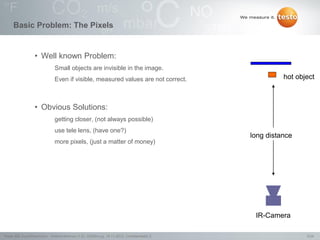
Basic Problem: The Pixels
• Well known Problem:
Small objects are invisible in the image.
Even if visible, measured values are not correct.
• Obvious Solutions:
getting closer, (not always possible)
use tele lens, (have one?)
more pixels, (just a matter of money)
hot object
IR-Camera
long distance
4/24Testo AG, SuperResolution - Webconference (1.0), 1000len-juj, 15.11.2012, Confidentiality 2
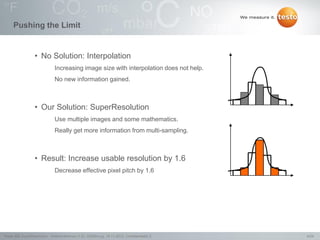
Pushing the Limit
• No Solution: Interpolation
Increasing image size with interpolation does not help.
No new information gained.
• Our Solution: SuperResolution
Use multiple images and some mathematics.
Really get more information from multi-sampling.
• Result: Increase usable resolution by 1.6
Decrease effective pixel pitch by 1.6
5/24Testo AG, SuperResolution - Webconference (1.0), 1000len-juj, 15.11.2012, Confidentiality 2
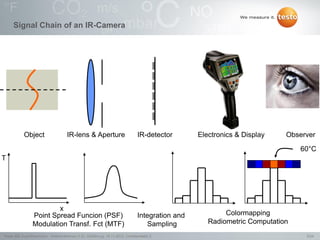
Signal Chain of an IR-Camera
IR-lens & Aperture
T
x
60°C
Point Spread Funcion (PSF)
Modulation Transf. Fct (MTF)
Integration and
Sampling
Object IR-detector Electronics & Display Observer
Colormapping
Radiometric Computation
6/24Testo AG, SuperResolution - Webconference (1.0), 1000len-juj, 15.11.2012, Confidentiality 2
Sensitivity
x
Limitations of Detectors and Basic Superresolution
Area of one Bolometer (pixel pitch ²)
Typical pixel pitch: 25µm
cut-off frequency: 20 [lp/mm] (Nyquist)
Super-Sampling: Take two images, slightly shifted, and combine them
x
Sensitivity
Sensitive Area (only ~75%)
7/24Testo AG, SuperResolution - Webconference (1.0), 1000len-juj, 15.11.2012, Confidentiality 2
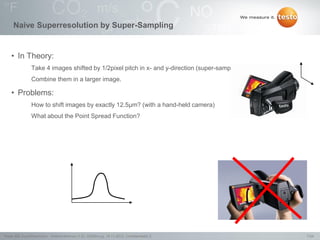
Naive Superresolution by Super-Sampling
• In Theory:
Take 4 images shifted by 1/2pixel pitch in x- and y-direction (super-sampling)
Combine them in a larger image.
• Problems:
How to shift images by exactly 12.5µm? (with a hand-held camera)
What about the Point Spread Function?
8/24Testo AG, SuperResolution - Webconference (1.0), 1000len-juj, 15.11.2012, Confidentiality 2
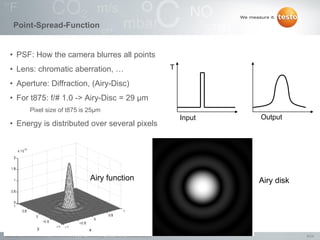
Point-Spread-Function
• PSF: How the camera blurres all points
• Lens: chromatic aberration, …
• Aperture: Diffraction, (Airy-Disc)
• For t875: f/# 1.0 -> Airy-Disc = 29 µm
Pixel size of t875 is 25µm
• Energy is distributed over several pixels
T
Airy function Airy disk
Input Output
9/24Testo AG, SuperResolution - Webconference (1.0), 1000len-juj, 15.11.2012, Confidentiality 2
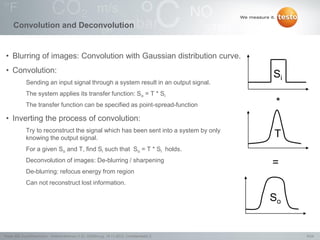
Convolution and Deconvolution
• Blurring of images: Convolution with Gaussian distribution curve.
• Convolution:
Sending an input signal through a system result in an output signal.
The system applies its transfer function: So = T * Si
The transfer function can be specified as point-spread-function
• Inverting the process of convolution:
Try to reconstruct the signal which has been sent into a system by only
knowing the output signal.
For a given So and T, find Si such that So = T * Si holds.
Deconvolution of images: De-blurring / sharpening
De-blurring: refocus energy from region
Can not reconstruct lost information.
*
T
Si
So
=
10/24Testo AG, SuperResolution - Webconference (1.0), 1000len-juj, 15.11.2012, Confidentiality 2
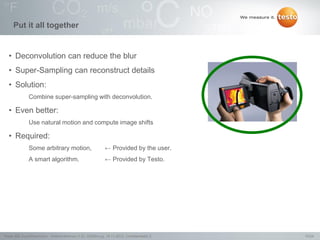
Put it all together
• Deconvolution can reduce the blur
• Super-Sampling can reconstruct details
• Solution:
Combine super-sampling with deconvolution.
• Even better:
Use natural motion and compute image shifts
• Required:
Some arbitrary motion, ← Provided by the user.
A smart algorithm. ← Provided by Testo.
11/24Testo AG, SuperResolution - Webconference (1.0), 1000len-juj, 15.11.2012, Confidentiality 2
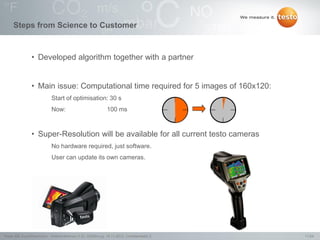
Steps from Science to Customer
• Developed algorithm together with a partner
• Main issue: Computational time required for 5 images of 160x120:
Start of optimisation: 30 s
Now: 100 ms
• Super-Resolution will be available for all current testo cameras
No hardware required, just software.
User can update its own cameras.
Results
-
Is it really better then
Interpolation?
13/24Testo AG, SuperResolution - Webconference (1.0), 1000len-juj, 15.11.2012, Confidentiality 2
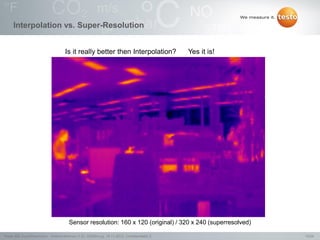
Interpolation vs. Super-Resolution
Sensor resolution: 160 x 120 (original) / 320 x 240 (superresolved)
Is it really better then Interpolation? Yes it is!
14/24Testo AG, SuperResolution - Webconference (1.0), 1000len-juj, 15.11.2012, Confidentiality 2
Experimental Evidence
• MTF: Standard way to specify quality of optical systems
Measured in [line pairs / millimeter]
ISO 12233: slanted edge (problematic for processed images)
Here: Variable Frequency Target
• IFOVmeas: That is what really matters for thermal imaging
Setup with black body at reference temp
Vary aperture in front
Observe maximum
Similiar to CNPP Test
15/24Testo AG, SuperResolution - Webconference (1.0), 1000len-juj, 15.11.2012, Confidentiality 2
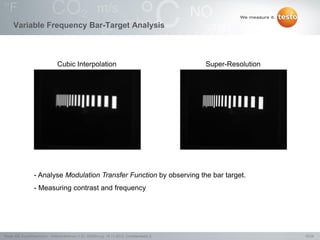
Variable Frequency Bar-Target Analysis
Cubic Interpolation Super-Resolution
- Analyse Modulation Transfer Function by observing the bar target.
- Measuring contrast and frequency
16/24Testo AG, SuperResolution - Webconference (1.0), 1000len-juj, 15.11.2012, Confidentiality 2
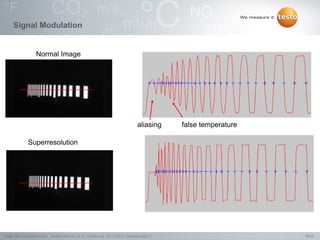
Signal Modulation
Normal Image
false temperature
Superresolution
aliasing
17/24Testo AG, SuperResolution - Webconference (1.0), 1000len-juj, 15.11.2012, Confidentiality 2
Detectable Spatial Frequencies
Cubic Interpolation
0
5
10
15
20
25
30
0 5 10 15 20 25 30 35
Frequency from bar target [lp/mm]
Frequencyfromimage[lp/mm]
Superresolution
0
5
10
15
20
25
30
0 5 10 15 20 25 30 35
Frequency from bar target [lp/mm]
Frequencyfromimage[lp/mm]
no frequencies above detector cut-off
detectable
frequencies approx. 50% above detector cut-off
detectable
18/24Testo AG, SuperResolution - Webconference (1.0), 1000len-juj, 15.11.2012, Confidentiality 2
Modulation Transfer Function
0,00%
20,00%
40,00%
60,00%
80,00%
100,00%
0 5 10 15 20 25
Spatial Resolution [lp/mm]
Super-Resolution
Normal
Diffraction Limit
Testo 881, 160x120, pixel pitch 25µm, F0,84
x1.6
19/24Testo AG, SuperResolution - Webconference (1.0), 1000len-juj, 15.11.2012, Confidentiality 2
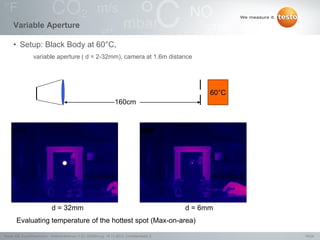
Variable Aperture
• Setup: Black Body at 60°C,
variable aperture ( d = 2-32mm), camera at 1.6m distance
60°C
160cm
d = 32mm d = 6mm
Evaluating temperature of the hottest spot (Max-on-area)
20/24Testo AG, SuperResolution - Webconference (1.0), 1000len-juj, 15.11.2012, Confidentiality 2
Temperature Measurement of Variable Aperture
59,4 58,8
57,5
56,1
52,7
40,8
60,9
59,9
61,9
60,7
62,5
43,2
30
35
40
45
50
55
60
65
32 16 8 6 4 2
aperture diameter [mm]
T[°C]
Normal
Superresolution
320x240 pixel, 25µm pixel pitch, 32°-Lens, Distance = 160cm
False Positive
IFOVmeas/1.6 = 4.8mmIFOVmeas =7.8mm
False Negative
21/24Testo AG, SuperResolution - Webconference (1.0), 1000len-juj, 15.11.2012, Confidentiality 2
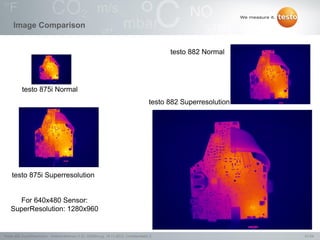
Image Comparison
testo 875i Normal
testo 875i Superresolution
testo 882 Normal
testo 882 Superresolution
For 640x480 Sensor:
SuperResolution: 1280x960
22/24Testo AG, SuperResolution - Webconference (1.0), 1000len-juj, 15.11.2012, Confidentiality 2
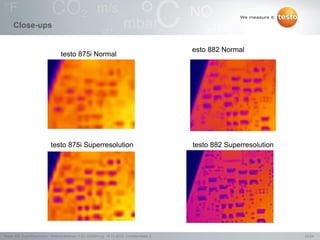
Close-ups
testo 875i Normal
testo 875i Superresolution
esto 882 Normal
testo 882 Superresolution
23/24Testo AG, SuperResolution - Webconference (1.0), 1000len-juj, 15.11.2012, Confidentiality 2
Conclusions
• Superresolution + Deconvolution:
Combine several images
Reduce blurring
Use natural motion
• Result:
Increase spatial resolution by 1.6
Decrease effective pixel pitch by 1.6
• Available as software-update for all
current Testo-IR-Cameras
Even for already sold cameras.
Testo SuperResolution:
Get the most out of Your Pixels.
Thank you for your attention!
Any questions?

The super resolution technology 2016

  • 1.
    The SuperResolution Technology Welcome toour Webconference: 16.11.2012 Dr. Martin Stratmann/Stefan Wenz/Jennifer Just
  • 2.
    SuperResolution with Deconvolution inDetail What is the Problem? How can we solve it?
  • 3.
    3/24Testo AG, SuperResolution- Webconference (1.0), 1000len-juj, 15.11.2012, Confidentiality 2 Basic Problem: The Pixels • Well known Problem: Small objects are invisible in the image. Even if visible, measured values are not correct. • Obvious Solutions: getting closer, (not always possible) use tele lens, (have one?) more pixels, (just a matter of money) hot object IR-Camera long distance
  • 4.
    4/24Testo AG, SuperResolution- Webconference (1.0), 1000len-juj, 15.11.2012, Confidentiality 2 Pushing the Limit • No Solution: Interpolation Increasing image size with interpolation does not help. No new information gained. • Our Solution: SuperResolution Use multiple images and some mathematics. Really get more information from multi-sampling. • Result: Increase usable resolution by 1.6 Decrease effective pixel pitch by 1.6
  • 5.
    5/24Testo AG, SuperResolution- Webconference (1.0), 1000len-juj, 15.11.2012, Confidentiality 2 Signal Chain of an IR-Camera IR-lens & Aperture T x 60°C Point Spread Funcion (PSF) Modulation Transf. Fct (MTF) Integration and Sampling Object IR-detector Electronics & Display Observer Colormapping Radiometric Computation
  • 6.
    6/24Testo AG, SuperResolution- Webconference (1.0), 1000len-juj, 15.11.2012, Confidentiality 2 Sensitivity x Limitations of Detectors and Basic Superresolution Area of one Bolometer (pixel pitch ²) Typical pixel pitch: 25µm cut-off frequency: 20 [lp/mm] (Nyquist) Super-Sampling: Take two images, slightly shifted, and combine them x Sensitivity Sensitive Area (only ~75%)
  • 7.
    7/24Testo AG, SuperResolution- Webconference (1.0), 1000len-juj, 15.11.2012, Confidentiality 2 Naive Superresolution by Super-Sampling • In Theory: Take 4 images shifted by 1/2pixel pitch in x- and y-direction (super-sampling) Combine them in a larger image. • Problems: How to shift images by exactly 12.5µm? (with a hand-held camera) What about the Point Spread Function?
  • 8.
    8/24Testo AG, SuperResolution- Webconference (1.0), 1000len-juj, 15.11.2012, Confidentiality 2 Point-Spread-Function • PSF: How the camera blurres all points • Lens: chromatic aberration, … • Aperture: Diffraction, (Airy-Disc) • For t875: f/# 1.0 -> Airy-Disc = 29 µm Pixel size of t875 is 25µm • Energy is distributed over several pixels T Airy function Airy disk Input Output
  • 9.
    9/24Testo AG, SuperResolution- Webconference (1.0), 1000len-juj, 15.11.2012, Confidentiality 2 Convolution and Deconvolution • Blurring of images: Convolution with Gaussian distribution curve. • Convolution: Sending an input signal through a system result in an output signal. The system applies its transfer function: So = T * Si The transfer function can be specified as point-spread-function • Inverting the process of convolution: Try to reconstruct the signal which has been sent into a system by only knowing the output signal. For a given So and T, find Si such that So = T * Si holds. Deconvolution of images: De-blurring / sharpening De-blurring: refocus energy from region Can not reconstruct lost information. * T Si So =
  • 10.
    10/24Testo AG, SuperResolution- Webconference (1.0), 1000len-juj, 15.11.2012, Confidentiality 2 Put it all together • Deconvolution can reduce the blur • Super-Sampling can reconstruct details • Solution: Combine super-sampling with deconvolution. • Even better: Use natural motion and compute image shifts • Required: Some arbitrary motion, ← Provided by the user. A smart algorithm. ← Provided by Testo.
  • 11.
    11/24Testo AG, SuperResolution- Webconference (1.0), 1000len-juj, 15.11.2012, Confidentiality 2 Steps from Science to Customer • Developed algorithm together with a partner • Main issue: Computational time required for 5 images of 160x120: Start of optimisation: 30 s Now: 100 ms • Super-Resolution will be available for all current testo cameras No hardware required, just software. User can update its own cameras.
  • 12.
    Results - Is it reallybetter then Interpolation?
  • 13.
    13/24Testo AG, SuperResolution- Webconference (1.0), 1000len-juj, 15.11.2012, Confidentiality 2 Interpolation vs. Super-Resolution Sensor resolution: 160 x 120 (original) / 320 x 240 (superresolved) Is it really better then Interpolation? Yes it is!
  • 14.
    14/24Testo AG, SuperResolution- Webconference (1.0), 1000len-juj, 15.11.2012, Confidentiality 2 Experimental Evidence • MTF: Standard way to specify quality of optical systems Measured in [line pairs / millimeter] ISO 12233: slanted edge (problematic for processed images) Here: Variable Frequency Target • IFOVmeas: That is what really matters for thermal imaging Setup with black body at reference temp Vary aperture in front Observe maximum Similiar to CNPP Test
  • 15.
    15/24Testo AG, SuperResolution- Webconference (1.0), 1000len-juj, 15.11.2012, Confidentiality 2 Variable Frequency Bar-Target Analysis Cubic Interpolation Super-Resolution - Analyse Modulation Transfer Function by observing the bar target. - Measuring contrast and frequency
  • 16.
    16/24Testo AG, SuperResolution- Webconference (1.0), 1000len-juj, 15.11.2012, Confidentiality 2 Signal Modulation Normal Image false temperature Superresolution aliasing
  • 17.
    17/24Testo AG, SuperResolution- Webconference (1.0), 1000len-juj, 15.11.2012, Confidentiality 2 Detectable Spatial Frequencies Cubic Interpolation 0 5 10 15 20 25 30 0 5 10 15 20 25 30 35 Frequency from bar target [lp/mm] Frequencyfromimage[lp/mm] Superresolution 0 5 10 15 20 25 30 0 5 10 15 20 25 30 35 Frequency from bar target [lp/mm] Frequencyfromimage[lp/mm] no frequencies above detector cut-off detectable frequencies approx. 50% above detector cut-off detectable
  • 18.
    18/24Testo AG, SuperResolution- Webconference (1.0), 1000len-juj, 15.11.2012, Confidentiality 2 Modulation Transfer Function 0,00% 20,00% 40,00% 60,00% 80,00% 100,00% 0 5 10 15 20 25 Spatial Resolution [lp/mm] Super-Resolution Normal Diffraction Limit Testo 881, 160x120, pixel pitch 25µm, F0,84 x1.6
  • 19.
    19/24Testo AG, SuperResolution- Webconference (1.0), 1000len-juj, 15.11.2012, Confidentiality 2 Variable Aperture • Setup: Black Body at 60°C, variable aperture ( d = 2-32mm), camera at 1.6m distance 60°C 160cm d = 32mm d = 6mm Evaluating temperature of the hottest spot (Max-on-area)
  • 20.
    20/24Testo AG, SuperResolution- Webconference (1.0), 1000len-juj, 15.11.2012, Confidentiality 2 Temperature Measurement of Variable Aperture 59,4 58,8 57,5 56,1 52,7 40,8 60,9 59,9 61,9 60,7 62,5 43,2 30 35 40 45 50 55 60 65 32 16 8 6 4 2 aperture diameter [mm] T[°C] Normal Superresolution 320x240 pixel, 25µm pixel pitch, 32°-Lens, Distance = 160cm False Positive IFOVmeas/1.6 = 4.8mmIFOVmeas =7.8mm False Negative
  • 21.
    21/24Testo AG, SuperResolution- Webconference (1.0), 1000len-juj, 15.11.2012, Confidentiality 2 Image Comparison testo 875i Normal testo 875i Superresolution testo 882 Normal testo 882 Superresolution For 640x480 Sensor: SuperResolution: 1280x960
  • 22.
    22/24Testo AG, SuperResolution- Webconference (1.0), 1000len-juj, 15.11.2012, Confidentiality 2 Close-ups testo 875i Normal testo 875i Superresolution esto 882 Normal testo 882 Superresolution
  • 23.
    23/24Testo AG, SuperResolution- Webconference (1.0), 1000len-juj, 15.11.2012, Confidentiality 2 Conclusions • Superresolution + Deconvolution: Combine several images Reduce blurring Use natural motion • Result: Increase spatial resolution by 1.6 Decrease effective pixel pitch by 1.6 • Available as software-update for all current Testo-IR-Cameras Even for already sold cameras.
  • 24.
    Testo SuperResolution: Get themost out of Your Pixels. Thank you for your attention! Any questions?