


GENERAL MOTORS
RESTRUCTURIZATION
LEAN OPERATIONS AND ORGANIZATION STRUCTURE
SYNDICATE 5 1
PROBLEMS
Huge losses in subsequent years
 $ 2 Billion in 1990
 $4.5 Billion in 1991
2
CAUSES
• Inefficient work force and managerial problems
• Low capacity utilization
• Too many divisions and models
• High-cost suppliers
3
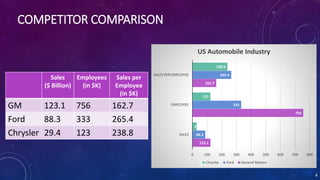
COMPETITOR COMPARISON
Sales
($ Billion)
Employees
(in $K)
Sales per
Employee
(in $K)
GM 123.1 756 162.7
Ford 88.3 333 265.4
Chrysler 29.4 123 238.8
123.1
756
162.7
88.3
333
265.4
29.4
123
238.8
0 100 200 300 400 500 600 700 800
SALES
EMPLOYEE
SALES PER EMPLOYEE
US Automobile Industry
Chrysler Ford General Motors
4
RETURNS TO SCALE
Constant Returns to Scale Increasing Returns to Scale Decreasing Returns to Scale
5
THE FIRST RESTRUCTURIZATION (LATE 1991)
Actions Taken
• Closed 21 plants
• Fired around 74.000 workers (white and blue collars combined)
Results
• New capacity declined into 5 – 5.5 million production/year (reduced around 2
million/year)
• Market share just reduced around 2%
• Before restructurization, market share was 35% - in 1991
• After restructurization, market share was 33%
6
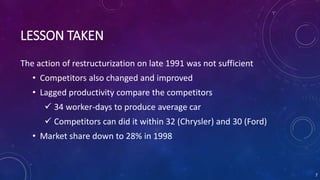
LESSON TAKEN
The action of restructurization on late 1991 was not sufficient
• Competitors also changed and improved
• Lagged productivity compare the competitors
 34 worker-days to produce average car
 Competitors can did it within 32 (Chrysler) and 30 (Ford)
• Market share down to 28% in 1998
7
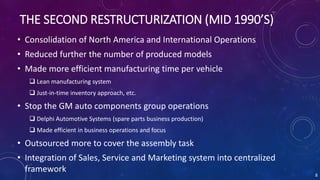
THE SECOND RESTRUCTURIZATION (MID 1990’S)
• Consolidation of North America and International Operations
• Reduced further the number of produced models
• Made more efficient manufacturing time per vehicle
 Lean manufacturing system
 Just-in-time inventory approach, etc.
• Stop the GM auto components group operations
 Delphi Automotive Systems (spare parts business production)
 Made efficient in business operations and focus
• Outsourced more to cover the assembly task
• Integration of Sales, Service and Marketing system into centralized
framework
8
RESULTS
Surpassed Ford in 2002
• Vehicle productivity
• Quality ratings
• Profitability
9
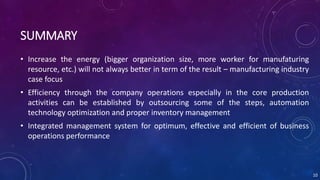
SUMMARY
• Increase the energy (bigger organization size, more worker for manufaturing
resource, etc.) will not always better in term of the result – manufacturing industry
case focus
• Efficiency through the company operations especially in the core production
activities can be established by outsourcing some of the steps, automation
technology optimization and proper inventory management
• Integrated management system for optimum, effective and efficient of business
operations performance
10

General motors case study

  • 1.
    GENERAL MOTORS RESTRUCTURIZATION LEAN OPERATIONSAND ORGANIZATION STRUCTURE SYNDICATE 5 1
  • 2.
    PROBLEMS Huge losses insubsequent years  $ 2 Billion in 1990  $4.5 Billion in 1991 2
  • 3.
    CAUSES • Inefficient workforce and managerial problems • Low capacity utilization • Too many divisions and models • High-cost suppliers 3
  • 4.
    COMPETITOR COMPARISON Sales ($ Billion) Employees (in$K) Sales per Employee (in $K) GM 123.1 756 162.7 Ford 88.3 333 265.4 Chrysler 29.4 123 238.8 123.1 756 162.7 88.3 333 265.4 29.4 123 238.8 0 100 200 300 400 500 600 700 800 SALES EMPLOYEE SALES PER EMPLOYEE US Automobile Industry Chrysler Ford General Motors 4
  • 5.
    RETURNS TO SCALE ConstantReturns to Scale Increasing Returns to Scale Decreasing Returns to Scale 5
  • 6.
    THE FIRST RESTRUCTURIZATION(LATE 1991) Actions Taken • Closed 21 plants • Fired around 74.000 workers (white and blue collars combined) Results • New capacity declined into 5 – 5.5 million production/year (reduced around 2 million/year) • Market share just reduced around 2% • Before restructurization, market share was 35% - in 1991 • After restructurization, market share was 33% 6
  • 7.
    LESSON TAKEN The actionof restructurization on late 1991 was not sufficient • Competitors also changed and improved • Lagged productivity compare the competitors  34 worker-days to produce average car  Competitors can did it within 32 (Chrysler) and 30 (Ford) • Market share down to 28% in 1998 7
  • 8.
    THE SECOND RESTRUCTURIZATION(MID 1990’S) • Consolidation of North America and International Operations • Reduced further the number of produced models • Made more efficient manufacturing time per vehicle  Lean manufacturing system  Just-in-time inventory approach, etc. • Stop the GM auto components group operations  Delphi Automotive Systems (spare parts business production)  Made efficient in business operations and focus • Outsourced more to cover the assembly task • Integration of Sales, Service and Marketing system into centralized framework 8
  • 9.
    RESULTS Surpassed Ford in2002 • Vehicle productivity • Quality ratings • Profitability 9
  • 10.
    SUMMARY • Increase theenergy (bigger organization size, more worker for manufaturing resource, etc.) will not always better in term of the result – manufacturing industry case focus • Efficiency through the company operations especially in the core production activities can be established by outsourcing some of the steps, automation technology optimization and proper inventory management • Integrated management system for optimum, effective and efficient of business operations performance 10