Volkswagen Do Brasil
Driving Strategy with the Balance
Scorecard
Shubham Pandey 20EMP1-17
Sneha Jha 20EMP1-18
Sumit Jha 20EMP1-19
Vikram Rohilla 20EMP1-20
Vipul Mahajan 20EMP1-21
Table of Contents
1. Brazil Brief
a) Automotive landscape
b) Competition scenario
2. About the Company
a) Volkswagen Do Brasil vision and mission
b) Brand Portfolio; Timeline
c) Team Structure
3. What challenges does Thomas Schmall face upon becoming CEO of
Volkswagen do Brasil (VWB)?
4. Describe VWB’s new strategy
5. How does the strategy map and balance scorecard help Schmall
and Senn implements the new strategy?
6. How can Schmall and his team use the scorecard to deal with the
challenges faced by the company in January 2009?
7. What are the strength and weakness of the scores and its
implementation.
8. Conclusion
Brazil Brief
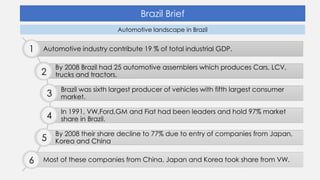
Automotive industry contribute 19 % of total industrial GDP.
By 2008 Brazil had 25 automotive assemblers which produces Cars, LCV,
trucks and tractors.
Brazil was sixth largest producer of vehicles with fifth largest consumer
market.
In 1991, VW,Ford,GM and Fiat had been leaders and hold 97% market
share in Brazil.
By 2008 their share decline to 77% due to entry of companies from Japan,
Korea and China
Most of these companies from China, Japan and Korea took share from VW.
1
2
3
4
5
6
Automotive landscape in Brazil
Volkswagen do Brasil is a
subsidiary arm
of Volkswagen Group,
established in 1953
• By 2008, Volkswagen Group (VWAG) had a market
share of 10.3%, making it the third-largest automotive
company globally.
• Currently, running with 4 operational plants
• Revenue – EUR 7.04B
• Employees – 22,000
• Focus: Small & Midsize Vehicles
Vision – To sell 6.6 million Volkswagen
vehicles by 2018, with over 21% return
on investment
Mission – Top employer with highest
customer satisfaction rating
Volkswagen’s Brand Portfolio
Volkswagen Do Brasil : Timeline
1953 VWAG opened its firs production plant outside Germany
1956
Volkswagen Do Brasil introduced a van with 50% of the parts and
components produced in Brazil
1961 Volkswagen Do Brasil earned 61% car production
1970
• Launch of medium sized cars
• Created first ethanol-fueled cars
1986 Volatile industry; 20% decline in the domestic automotive market
1993;1997
• Recorded highest sales - 1.6 million
• More than 1.1 million vehicles production
1999;2003
• Back to 1.1 million units in 1991
• Recorded peak sales in 2003
2003;2006
• Sales dropped from 580000 to 280000 in 2003
• Eight consecutive loss in 2006
THE TEAM
VP HR: JOSEPH-FIDELIS SENN
● Restructure contract with labor union
● Balance scorecard
● Implement VWB transformation
● Adoption on new strategy and culture
● Financial. Customer. Internal process. Potential and
growth.
Strategy/BSC
Committee
CFO: Carsteen Isensee
● Reeducate VWB management team
CEO: THOMAS SCMALL
• Build a high-performance team
• Drive VWB to S. American industry
leader
• Quality, innovation, sale, profitability
• Rebranding
What challenges does Thomas Schmall face upon becoming
CEO of Volkswagen do Brasil (VWB)?
➢Decreasing market share (compared to Japanese and
French manufacturer).
➢Struggling to minimize production due to appreciation of
Brazilian currency.
➢Cut-throat competition from other leading players (such as
Ford, Fiat); due to which prices couldn’t be increased.
➢Inefficient process in the company
➢Employee dedication
Strategy Map and Balance Scorecard
•Created tool that could change the mind set of the company
•Communicate message down to the factory floor
•Strategy map based on four challenges: Finance, Customer, internal process, potential and growth
Communicating the Balanced Scorecard
•Established office of strategy management
•Leaders assigned for strategy analysis and formulation and BSC management.
•Co-ordination from each group of VWB of BSC management to the employees
•Events, discussions,trainings and competitions for extensive communication
• Mascot (Giga) that could symbolize and communicate strategy
Compensation and Recognition for motivation
•Executive bonus plan tied with individual’s performance
•Annual result sharing plans with the floor employees (Non-Executive)
•Encouragement for process improvements
•Annual awards and employee recognition
Engaging suppliers and Dealers
•VWB had 550 suppliers producing 15800 components for VW vehicles
•Encouraged supplier for innovation and reduce development cycles
•VWB had 600 independent dealers ( Largest dealer network in Brazil)
•Trainings and Recognition programs for partners
•Supplier day event with supply award
•Established Dealer's academy for trainings
Describe VWB’s new strategy
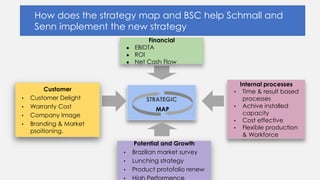
STRATEGIC
MAP
Internal processes
• Time & result based
processes
• Achive installed
capacity
• Cost effective
• Flexible production
& Workforce
Customer
• Customer Delight
• Warranty Cost
• Company Image
• Branding & Market
psoitioning.
Potential and Growth
• Brazilian market survey
• Lunching strategy
• Product protofolio renew
Financial
● EBIDTA
● ROI
● Net Cash Flow
How does the strategy map and BSC help Schmall and
Senn implement the new strategy
BSC Management
team
Communication
programs
GIGA, Board games, Role-
Playing games
Learning map exercises
Compensation and recognition
Engaging suppliers and dealers
Balanced Score card
How can Schmall and his team use the scorecard to deal
with the challenges faced by the company in January 2009?
➢Set the objectives
➢Communicated through all levels of management
➢Transparency was attained
➢Every employee was clear with their own responsibilities
➢What all steps should be taken to overcome the challenges
Compensation & Recognition
• Multiple command training messages by linking
compensation systems
• Projects can be presented by anyone
• Best employee should be rewarded
• High performing individuals – Job promotions, rotations
and training
What are the strength and weakness of the scores and its
implementation.
STRENGTHS
• Tool for cultural change.
• Visual picture of strategy.
• MBO guidelines.
• Makes communication
easier.
• Connects the individual
worker to organizational
goals.
WEAKNESSES
• Won’t work without
cultural shift. Effort is
communicating and
bringing about the
change
• Must be tailored to the
organization
• Can get complicated
Conclusion
➢ After Implementation of new strategy market positioning of VW increased in
two years.
➢ Accountability of employees defined and tracked with the help of
Balanced score card.
➢ Supplier & Dealer Score increased.
➢ Due to Global financial crisis there is some negative impact on sales can be
seen.
➢ The lag in sales, Less market shares & all the impacts due to global financial
crisis captured in BSC & decision are taken accordingly.
➢ Due to success of Balanced score card company is able to cope up with
the sudden global financial crisis.
➢ Due to BSC indication companies went for further cost cutting.
➢ BSC indicated the sales hence production is controlled to control Inventory.
➢ Balance score card indicated not to invest immediately better to wait for
the favorable time.
➢ Hence it can be concluded the BSC implementation was a successful and
helped VWB to track the activities and take decisions accordingly.

Volkswagen do brasil

  • 1.
    Volkswagen Do Brasil DrivingStrategy with the Balance Scorecard Shubham Pandey 20EMP1-17 Sneha Jha 20EMP1-18 Sumit Jha 20EMP1-19 Vikram Rohilla 20EMP1-20 Vipul Mahajan 20EMP1-21
  • 2.
    Table of Contents 1.Brazil Brief a) Automotive landscape b) Competition scenario 2. About the Company a) Volkswagen Do Brasil vision and mission b) Brand Portfolio; Timeline c) Team Structure 3. What challenges does Thomas Schmall face upon becoming CEO of Volkswagen do Brasil (VWB)? 4. Describe VWB’s new strategy 5. How does the strategy map and balance scorecard help Schmall and Senn implements the new strategy? 6. How can Schmall and his team use the scorecard to deal with the challenges faced by the company in January 2009? 7. What are the strength and weakness of the scores and its implementation. 8. Conclusion
  • 3.
    Brazil Brief Automotive industrycontribute 19 % of total industrial GDP. By 2008 Brazil had 25 automotive assemblers which produces Cars, LCV, trucks and tractors. Brazil was sixth largest producer of vehicles with fifth largest consumer market. In 1991, VW,Ford,GM and Fiat had been leaders and hold 97% market share in Brazil. By 2008 their share decline to 77% due to entry of companies from Japan, Korea and China Most of these companies from China, Japan and Korea took share from VW. 1 2 3 4 5 6 Automotive landscape in Brazil
  • 4.
    Volkswagen do Brasilis a subsidiary arm of Volkswagen Group, established in 1953 • By 2008, Volkswagen Group (VWAG) had a market share of 10.3%, making it the third-largest automotive company globally. • Currently, running with 4 operational plants • Revenue – EUR 7.04B • Employees – 22,000 • Focus: Small & Midsize Vehicles Vision – To sell 6.6 million Volkswagen vehicles by 2018, with over 21% return on investment Mission – Top employer with highest customer satisfaction rating
  • 5.
  • 6.
    Volkswagen Do Brasil: Timeline 1953 VWAG opened its firs production plant outside Germany 1956 Volkswagen Do Brasil introduced a van with 50% of the parts and components produced in Brazil 1961 Volkswagen Do Brasil earned 61% car production 1970 • Launch of medium sized cars • Created first ethanol-fueled cars 1986 Volatile industry; 20% decline in the domestic automotive market 1993;1997 • Recorded highest sales - 1.6 million • More than 1.1 million vehicles production 1999;2003 • Back to 1.1 million units in 1991 • Recorded peak sales in 2003 2003;2006 • Sales dropped from 580000 to 280000 in 2003 • Eight consecutive loss in 2006
  • 7.
    THE TEAM VP HR:JOSEPH-FIDELIS SENN ● Restructure contract with labor union ● Balance scorecard ● Implement VWB transformation ● Adoption on new strategy and culture ● Financial. Customer. Internal process. Potential and growth. Strategy/BSC Committee CFO: Carsteen Isensee ● Reeducate VWB management team CEO: THOMAS SCMALL • Build a high-performance team • Drive VWB to S. American industry leader • Quality, innovation, sale, profitability • Rebranding
  • 8.
    What challenges doesThomas Schmall face upon becoming CEO of Volkswagen do Brasil (VWB)? ➢Decreasing market share (compared to Japanese and French manufacturer). ➢Struggling to minimize production due to appreciation of Brazilian currency. ➢Cut-throat competition from other leading players (such as Ford, Fiat); due to which prices couldn’t be increased. ➢Inefficient process in the company ➢Employee dedication
  • 9.
    Strategy Map andBalance Scorecard •Created tool that could change the mind set of the company •Communicate message down to the factory floor •Strategy map based on four challenges: Finance, Customer, internal process, potential and growth Communicating the Balanced Scorecard •Established office of strategy management •Leaders assigned for strategy analysis and formulation and BSC management. •Co-ordination from each group of VWB of BSC management to the employees •Events, discussions,trainings and competitions for extensive communication • Mascot (Giga) that could symbolize and communicate strategy Compensation and Recognition for motivation •Executive bonus plan tied with individual’s performance •Annual result sharing plans with the floor employees (Non-Executive) •Encouragement for process improvements •Annual awards and employee recognition Engaging suppliers and Dealers •VWB had 550 suppliers producing 15800 components for VW vehicles •Encouraged supplier for innovation and reduce development cycles •VWB had 600 independent dealers ( Largest dealer network in Brazil) •Trainings and Recognition programs for partners •Supplier day event with supply award •Established Dealer's academy for trainings Describe VWB’s new strategy
  • 10.
    STRATEGIC MAP Internal processes • Time& result based processes • Achive installed capacity • Cost effective • Flexible production & Workforce Customer • Customer Delight • Warranty Cost • Company Image • Branding & Market psoitioning. Potential and Growth • Brazilian market survey • Lunching strategy • Product protofolio renew Financial ● EBIDTA ● ROI ● Net Cash Flow How does the strategy map and BSC help Schmall and Senn implement the new strategy
  • 11.
    BSC Management team Communication programs GIGA, Boardgames, Role- Playing games Learning map exercises Compensation and recognition Engaging suppliers and dealers Balanced Score card
  • 12.
    How can Schmalland his team use the scorecard to deal with the challenges faced by the company in January 2009? ➢Set the objectives ➢Communicated through all levels of management ➢Transparency was attained ➢Every employee was clear with their own responsibilities ➢What all steps should be taken to overcome the challenges Compensation & Recognition • Multiple command training messages by linking compensation systems • Projects can be presented by anyone • Best employee should be rewarded • High performing individuals – Job promotions, rotations and training
  • 13.
    What are thestrength and weakness of the scores and its implementation. STRENGTHS • Tool for cultural change. • Visual picture of strategy. • MBO guidelines. • Makes communication easier. • Connects the individual worker to organizational goals. WEAKNESSES • Won’t work without cultural shift. Effort is communicating and bringing about the change • Must be tailored to the organization • Can get complicated
  • 14.
    Conclusion ➢ After Implementationof new strategy market positioning of VW increased in two years. ➢ Accountability of employees defined and tracked with the help of Balanced score card. ➢ Supplier & Dealer Score increased. ➢ Due to Global financial crisis there is some negative impact on sales can be seen. ➢ The lag in sales, Less market shares & all the impacts due to global financial crisis captured in BSC & decision are taken accordingly. ➢ Due to success of Balanced score card company is able to cope up with the sudden global financial crisis. ➢ Due to BSC indication companies went for further cost cutting. ➢ BSC indicated the sales hence production is controlled to control Inventory. ➢ Balance score card indicated not to invest immediately better to wait for the favorable time. ➢ Hence it can be concluded the BSC implementation was a successful and helped VWB to track the activities and take decisions accordingly.