SYNOPSIS OF THE CASE 1.  HENRY FORD STRATEGY A.  LOW - COST B.  MASS PRODUCTION C.  DEVELOPED MASS MARKET -  ONE MODEL “T” D.  LIMITED PRODUCT DIFFERENTATION E.  MFG.  DISTINCTIVE COMPETENCE -    STANDARDIZATION OF QUALITY COMPONENT  PARTS FOR EASY AND CHEAP ASSEMBLY
BROAD DIFFERENTIATION OF PRODUCT DECENTRALIZATION - PROFIT CENTERS FIVE DIVISIONS - FIVE MARKET SEGMENTS CUSTOMER COULD UPGRADE WITHIN G.M. CHEVROLET, PONTIAC, OLDSMOBILE, BUICK, AND CADILLAC MASS PRODUCTION 2. ALFRED P. SLOAN STRATEGY
VERTICAL INTEGRATION CARRIED TOO FAR - 60%  TRANSFER PRICING PROBLEMS - CORPORATE CONTROL HIGH COST - POOR QUALITY PRODUCT DIFFERENTIATION BETWEEN DIVISIONS BECAME EXCESSIVE - DISTRUCTIVE COMPETITION ROI DECLINED TOO MANY MODELS AND PLATFORMS 3.  DEVELOPING PROBLEMS AT G.M.
SMALL CARS - G.M. LITTLE EXPERIENCE LEAN PRODUCTION - LOW COST HIGH QUALITY G.M. EUROPEAN DIVISION HAD THESE SKILLS BUT COULD NOT TRANSFER THEM TO U.S. 4.  OIL CRISIS AND JAPANESE COMPETITION
Leadership, Vision, And Mission:  Focus Technology Vs. People Profit Vs. Market Share Financial Considerations Competition:  Quality, Cost, And Product Differentiation Vertical Integration Vs. Outsourcing Strategy - Structure Link EDS And Hughes Aircraft The Oldsmobile division
THE G.M. VISION GM’s vision is to be the world leader in transportation products and  related services.  We will earn our customers’ enthusiasm through  continuous improvement driven by  the integrity, teamwork, and innovation  of GM people.
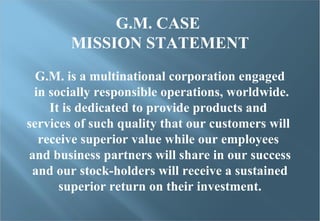
G.M. CASE  MISSION STATEMENT G.M. is a multinational corporation engaged in socially responsible operations, worldwide. It is dedicated to provide products and  services of such quality that our customers will  receive superior value while our employees  and business partners will share in our success and our stock-holders will receive a sustained  superior return on their investment.
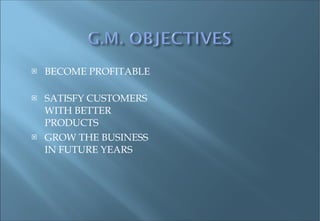
BECOME PROFITABLE SATISFY CUSTOMERS WITH BETTER PRODUCTS GROW THE BUSINESS IN FUTURE YEARS
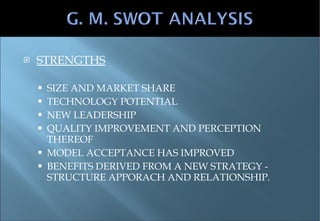
STRENGTHS SIZE AND MARKET SHARE TECHNOLOGY POTENTIAL NEW LEADERSHIP QUALITY IMPROVEMENT AND PERCEPTION THEREOF MODEL ACCEPTANCE HAS IMPROVED BENEFITS DERIVED FROM A NEW STRATEGY - STRUCTURE APPORACH AND RELATIONSHIP.
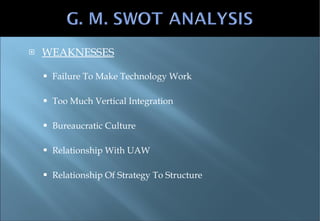
WEAKNESSES Failure To Make Technology Work Too Much Vertical Integration Bureaucratic Culture Relationship With UAW Relationship Of Strategy To Structure
WEAKNESSES cont. Product Design Problems - Public Acceptance And Reduction Of Cycle Time Market Share And Profitability Negative Effects Of Downsizing Still Much To Learn About Lean Production - High Cost Producer Hughes Aircraft Situation
OPPORTUNITIES USE OF KNOWLEDGE GAINED FROM SATURN EXPERINCE AND TOYOTA (NUMMI) JOINT VENTURE. EXPANSION OF THEIR GLOBAL PRESENCE - THEIR OWN EUROPEAN MODEL OPERATON AS AN EXAMPLE. CONTINUE TO BUILD ON THE NEWFOUND CUSTOMER CONFIDENCE. CHANGING CONSUMER DEMAND FOR NEW MODEL TYPES AND STYLES - EXPANSION AND LEADERSHIP.
THREATS DOMESTIC AND FOREIGN COMPETITION U.S. FEDERAL LEGISLATION AND REGULATION CONSUMER LAWSUITS FOREIGN LEGISLATION AND REGULATION DECLINING QUALITY OF THE INFASTRUCTURE IN THIS COUNTRY DECLINING VALUE OF JAPANESE YEN
INDUSTRY ANALYSIS MATURE PRODUCT SEGMENTATION BY PRICE AND FUNCTION TECHNOLOGY CHANGING IN MFG. PROCESS AND PRODUCT DESIGN OVERCAPACITY WORLDWIDE
INDUSTRY ANALYSIS MEGADEALERS AND AUTO SUPERMARKETS WORLDWIDE DEMAND - STAGNATION - DECLINE MUST BE WORLD CLASS IN EVERY RESPECT - PRODUCT, MFG. OPERATIONS, FINANCING,  AND DISTRIBUTION
Cost -  G.M. too high Quality - G.M. marginal, competition continues to improve Styling - G.M. must watch Product line and segmentation - price and function - G.M. OK Suppliers - G.M. too vertically integrated Buyers - sport utility and pick-ups New entrants - not likely a threat
G.M. has been through some difficult times the past 10 years or so and appears to have learned some hard lessons.  Based on these lessons G.M. has begun to adopt a strategy of restoring profitability to its North American operations, by aggressive marketing, redesigned products, decentralized MGT style, and a profit rather than a market share goal.
Dropping Unsuccessful Product Lines Trimming Its Product Line Reduce the Number of Basic Platforms Standardizing Component Parts Across Models Reducing the Number of Parts Needed to Produce a Car CUT COSTS BY:
Streamlining Operations by Consolidations Within the Corporation Decentralizing Decision Making Integration of It Design & MFG Activities Better Managing Its Supplier Relationships CUT COSTS BY: con’t
Focus resources on core products, cars, & trucks . Realignment of organizational structure to support core products and meet costs & quality goals.  Example:  self managed creative work teams to figure out how to speed-up product development & improve product development.  Implement common systems & processes where possible. Balance needs of employees and unions with needs of the company.
Pelfrey, W. (2006).  Billy, alfred, and general motors: the story of two unique men, a legendary company, and a remarkable time in american history . Amacom Books. Maynard, M. (2004).  The end of detroit: how the big three lost their grip on the american car market . Broadway Business. Taylor, A, & Jackson, M. (2010).  Sixty to zero: an inside look at the collapse of general motors--and the detroit auto industry . Yale Univ Pr.
J., W. (2009).  Why gm matters: inside the race to transform an american icon . Walker & Company. Ingrassia, P, & B., J. (1995).  Comeback: the fall and rise of the american automobile industry . Simon and Schuster.

Gmcase

  • 1.
  • 2.
    SYNOPSIS OF THECASE 1. HENRY FORD STRATEGY A. LOW - COST B. MASS PRODUCTION C. DEVELOPED MASS MARKET - ONE MODEL “T” D. LIMITED PRODUCT DIFFERENTATION E. MFG. DISTINCTIVE COMPETENCE - STANDARDIZATION OF QUALITY COMPONENT PARTS FOR EASY AND CHEAP ASSEMBLY
  • 3.
    BROAD DIFFERENTIATION OFPRODUCT DECENTRALIZATION - PROFIT CENTERS FIVE DIVISIONS - FIVE MARKET SEGMENTS CUSTOMER COULD UPGRADE WITHIN G.M. CHEVROLET, PONTIAC, OLDSMOBILE, BUICK, AND CADILLAC MASS PRODUCTION 2. ALFRED P. SLOAN STRATEGY
  • 4.
    VERTICAL INTEGRATION CARRIEDTOO FAR - 60% TRANSFER PRICING PROBLEMS - CORPORATE CONTROL HIGH COST - POOR QUALITY PRODUCT DIFFERENTIATION BETWEEN DIVISIONS BECAME EXCESSIVE - DISTRUCTIVE COMPETITION ROI DECLINED TOO MANY MODELS AND PLATFORMS 3. DEVELOPING PROBLEMS AT G.M.
  • 5.
    SMALL CARS -G.M. LITTLE EXPERIENCE LEAN PRODUCTION - LOW COST HIGH QUALITY G.M. EUROPEAN DIVISION HAD THESE SKILLS BUT COULD NOT TRANSFER THEM TO U.S. 4. OIL CRISIS AND JAPANESE COMPETITION
  • 6.
    Leadership, Vision, AndMission: Focus Technology Vs. People Profit Vs. Market Share Financial Considerations Competition: Quality, Cost, And Product Differentiation Vertical Integration Vs. Outsourcing Strategy - Structure Link EDS And Hughes Aircraft The Oldsmobile division
  • 7.
    THE G.M. VISIONGM’s vision is to be the world leader in transportation products and related services. We will earn our customers’ enthusiasm through continuous improvement driven by the integrity, teamwork, and innovation of GM people.
  • 8.
    G.M. CASE MISSION STATEMENT G.M. is a multinational corporation engaged in socially responsible operations, worldwide. It is dedicated to provide products and services of such quality that our customers will receive superior value while our employees and business partners will share in our success and our stock-holders will receive a sustained superior return on their investment.
  • 9.
    BECOME PROFITABLE SATISFYCUSTOMERS WITH BETTER PRODUCTS GROW THE BUSINESS IN FUTURE YEARS
  • 10.
    STRENGTHS SIZE ANDMARKET SHARE TECHNOLOGY POTENTIAL NEW LEADERSHIP QUALITY IMPROVEMENT AND PERCEPTION THEREOF MODEL ACCEPTANCE HAS IMPROVED BENEFITS DERIVED FROM A NEW STRATEGY - STRUCTURE APPORACH AND RELATIONSHIP.
  • 11.
    WEAKNESSES Failure ToMake Technology Work Too Much Vertical Integration Bureaucratic Culture Relationship With UAW Relationship Of Strategy To Structure
  • 12.
    WEAKNESSES cont. ProductDesign Problems - Public Acceptance And Reduction Of Cycle Time Market Share And Profitability Negative Effects Of Downsizing Still Much To Learn About Lean Production - High Cost Producer Hughes Aircraft Situation
  • 13.
    OPPORTUNITIES USE OFKNOWLEDGE GAINED FROM SATURN EXPERINCE AND TOYOTA (NUMMI) JOINT VENTURE. EXPANSION OF THEIR GLOBAL PRESENCE - THEIR OWN EUROPEAN MODEL OPERATON AS AN EXAMPLE. CONTINUE TO BUILD ON THE NEWFOUND CUSTOMER CONFIDENCE. CHANGING CONSUMER DEMAND FOR NEW MODEL TYPES AND STYLES - EXPANSION AND LEADERSHIP.
  • 14.
    THREATS DOMESTIC ANDFOREIGN COMPETITION U.S. FEDERAL LEGISLATION AND REGULATION CONSUMER LAWSUITS FOREIGN LEGISLATION AND REGULATION DECLINING QUALITY OF THE INFASTRUCTURE IN THIS COUNTRY DECLINING VALUE OF JAPANESE YEN
  • 15.
    INDUSTRY ANALYSIS MATUREPRODUCT SEGMENTATION BY PRICE AND FUNCTION TECHNOLOGY CHANGING IN MFG. PROCESS AND PRODUCT DESIGN OVERCAPACITY WORLDWIDE
  • 16.
    INDUSTRY ANALYSIS MEGADEALERSAND AUTO SUPERMARKETS WORLDWIDE DEMAND - STAGNATION - DECLINE MUST BE WORLD CLASS IN EVERY RESPECT - PRODUCT, MFG. OPERATIONS, FINANCING, AND DISTRIBUTION
  • 17.
    Cost - G.M. too high Quality - G.M. marginal, competition continues to improve Styling - G.M. must watch Product line and segmentation - price and function - G.M. OK Suppliers - G.M. too vertically integrated Buyers - sport utility and pick-ups New entrants - not likely a threat
  • 18.
    G.M. has beenthrough some difficult times the past 10 years or so and appears to have learned some hard lessons. Based on these lessons G.M. has begun to adopt a strategy of restoring profitability to its North American operations, by aggressive marketing, redesigned products, decentralized MGT style, and a profit rather than a market share goal.
  • 19.
    Dropping Unsuccessful ProductLines Trimming Its Product Line Reduce the Number of Basic Platforms Standardizing Component Parts Across Models Reducing the Number of Parts Needed to Produce a Car CUT COSTS BY:
  • 20.
    Streamlining Operations byConsolidations Within the Corporation Decentralizing Decision Making Integration of It Design & MFG Activities Better Managing Its Supplier Relationships CUT COSTS BY: con’t
  • 21.
    Focus resources oncore products, cars, & trucks . Realignment of organizational structure to support core products and meet costs & quality goals. Example: self managed creative work teams to figure out how to speed-up product development & improve product development. Implement common systems & processes where possible. Balance needs of employees and unions with needs of the company.
  • 22.
    Pelfrey, W. (2006). Billy, alfred, and general motors: the story of two unique men, a legendary company, and a remarkable time in american history . Amacom Books. Maynard, M. (2004). The end of detroit: how the big three lost their grip on the american car market . Broadway Business. Taylor, A, & Jackson, M. (2010). Sixty to zero: an inside look at the collapse of general motors--and the detroit auto industry . Yale Univ Pr.
  • 23.
    J., W. (2009). Why gm matters: inside the race to transform an american icon . Walker & Company. Ingrassia, P, & B., J. (1995). Comeback: the fall and rise of the american automobile industry . Simon and Schuster.