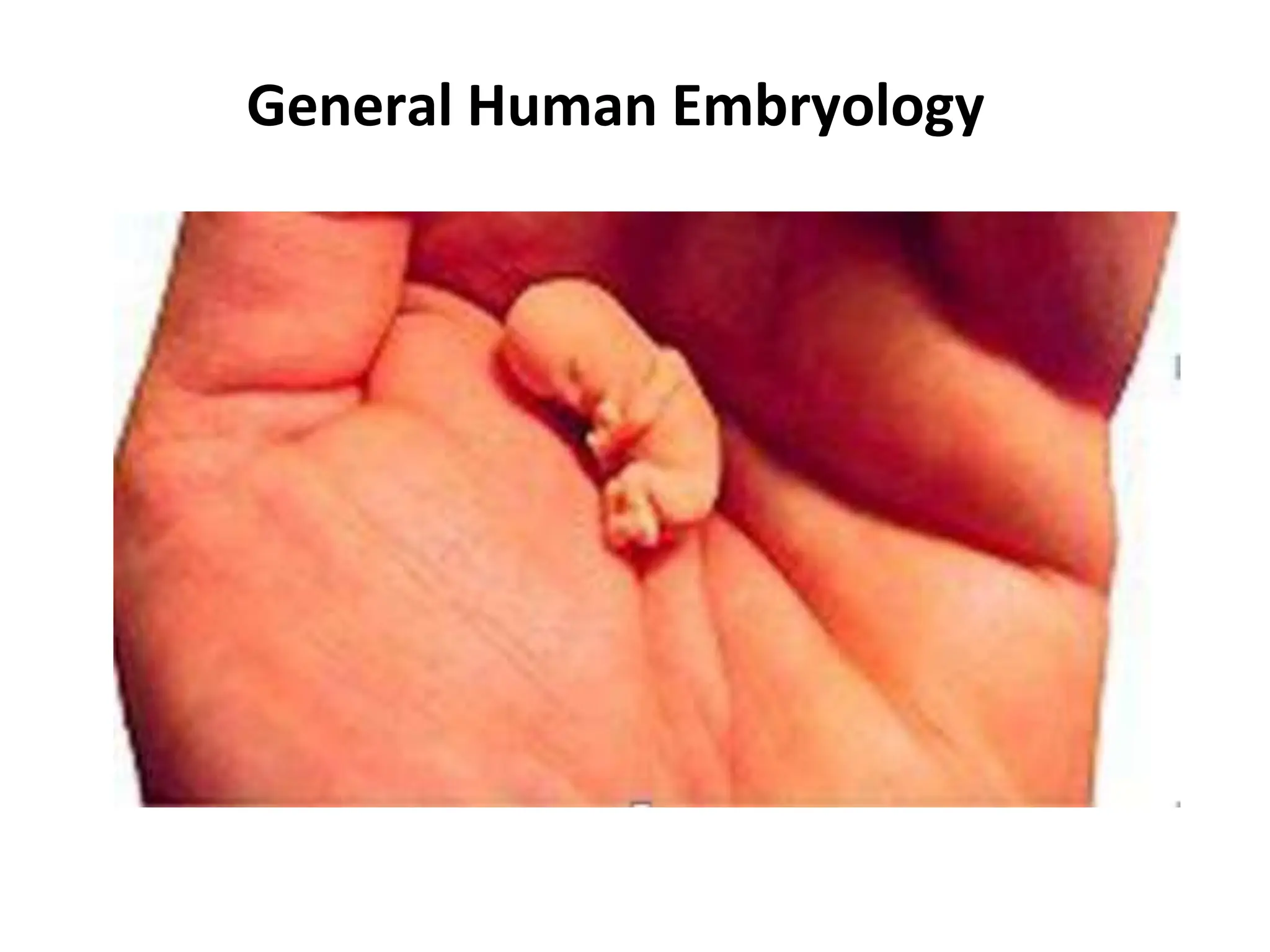
General Human Embryology
EMBRYOLOGY
 Literally, embryology means the study of embryos; however, the
term generally refers to prenatal development of embryos and
fetuses
– a branch of developmental anatomy that studies the changes
that cells, tissues, organs, and the body as a whole undergo from
a germ cell of each parent to the resulting adult.
– is a science that studies the normal prenatal development as well
as birth defects of a human being in the maternal uterus.
2
Significance of embryology
• Bridges the gap between prenatal development and obstetrics,
perinatal medicine, pediatrics, and clinical anatomy.
• Develops knowledge concerning the beginnings of human life
and the changes occurring during prenatal development.
• Is of practical value in helping to understand the causes of
variations in human structure.
• Illuminates gross anatomy and explains how normal and
abnormal relations develop.
Developmental periods
– Human development is a continuous process that begins when
an oocyte (ovum) is fertilized by a sperm (spermatozoon).
– divided into
1. Prenatal/Antenatal development (before birth)
– a developmental process that represents an amazing
integration of increasingly complexity that occurs
from fertilization to birth.
– is more rapid than postnatal development and results
in more striking changes
2. Postnatal (after birth) periods
4
Pre-natal development
• Prenatal development:
– lasts 38 weeks from fertilization to parturition, &
– divided into three developmental periods and three
trimesters (three months each).
 Pre-embryonic period (Germinal Period) (0–2 weeks)
 An Embryonic period (3rd – 8th weeks)
 Fetal period (9th week -birth)
1. Pre-embryonic (Germinal) Period (0 – 2 weeks)
– the first two weeks of development
– the events of pre-embryonic period include:
– Fertilization
– Transportation of zygote down the uterine tube
– Repeated mitotic divisions/ cleavage or segmentation
– Implantation
– The formation of bilaminar embryonic disc
– Development of the amnion and chorion
2. An Embryonic period (3rd – 8th weeks):
– lasts from the beginning of the 3rd Week (day 15) to the end of the
8th week (day56).
– during which the primordia of all major organ-systems develop from
the 3 germ layers, hence most important period in life.
7
3. Fetal period:
– Lasts from 9th week to birth (38 weeks, or 40 weeks fromLNMP)
– Period of organ systems growth and differentiation
– Culminates with parturition and birth of the fetus
8
.. - - ...
►
;·►
0
►
Fertilization
1-week conceptus
2-week conceptus
3-week embryo
4-week embryo
8-week embryo
9-week fetus
12-week fetus
5-weekembry;
/ '
7-week embryo
FIG URE 28.1 Diagram s showing the size of a human conceptus
from fertilization to the early fetal stag e. The embryonic stage
begins in week 3 after fertilization; the fetal stage begins in week 9.
PRECONDITIONS FOR THE BEGINNING OF EARLY
DEVELOPMENT OF HUMAN EMBRYO
Gametogenesis: Conversion of Diploid Germ Cells into
Haploid Male and Female Gametes
– a process of formation and maturation of the gametes
(sperm and ovum)
– involves mitosis, meiosis, and cytodifferentiation.
The Purpose of Gametogenesis
– Production of gametes
– Reduction of the number of chromosomes by half.
–Alteration of the shape of germ cells for fertilization
Two types of gametogenesis:
– Spermatogenesis
– Oogenesis
Primordial Germ Cells
• Gametes are derived from
primordial germ cells (PGCs)
that are formed in the epiblast
during the second week and
that move to the wall of the
yolk sac.
• They are originated from the
wall of the yolk sac at the end
of 3rd week of embryonic
development.
Cont..
 These cells migrate by amoeboid movement from the yolk
sac toward the developing gonads (primitive sex glands),
where they arrive at the end of 4th week and invading the
genital ridges in 6th week ofdevelopment.
 Hence, the primordial germ cells have an inductive influence
on development of the gonadal ridge into ovary or testis.
Primordial germ cells
Yolk sac
The first human germ cells (primordial germ cells) appear
in the wall of the yolk sac (3rd week)
The germ cells, through amoeboid movement, move
towards the gonads where they arrive at about 5th week
Primordial cells later differentiate into mature gametes
i.e. spermatogonia (male) or oogonia (female)
Primordialgermcells
Yolksac
Spermatogenesis (male gametogenesis)
– is the sequence of events by which spermatogonia are
transformed into mature sperms
– Takes place in the male gonads ,approximately 300 million
sperm cells are produced daily.
 At puberty, the testes begin to secrete greatly increased
amounts of testosterone.
 This triggers maturation of the seminiferous tubules, and the
commencement of spermatogenesis.
 Primordial germ cells resume development and divide several
times by mitosis, producing spermatogonia.
Cont…
• The newly formed cells can
follow one of two paths: they
can continue dividing as stem
cells, also called type A
spermatogonia,
or
• They can differentiate during
progressive mitotic cycles to
become type B
spermatogonia.
Cont….
• Type B spermatogonia are
progenitor cells that will
differentiate into primary
spermatocytes
• The primary spermatocyte
has 46 (44 + XY)
chromosomes.
Cont….
– primary spermatocytes-the largest germ cells in the
seminiferous tubules.
– Each primary spermatocyte subsequently undergoes a
reduction division-the first meiotic division-to form two
haploid secondary spermatocytes.
– secondary spermatocytes are approximately half the size of
primary spermatocytes.
– the secondary spermatocytes undergo second meiotic
division to form four haploid small round cells called
spermatids.
– The spermatids are gradually transformed into mature
flagellated sperms by a process known as spermiogenesis.
– When spermiogenesis is complete, the sperms enter the
lumina of the seminiferous tubules.
First meiotic division
Spermiogenesis
– is the final stage in sperm production involving no cell division
– the process by which spermatids transform into spermatozoa,
cells that are highly specialized to deliver male DNA to the ovum.
– the spermatids can be distinguished by their small size (7–8 µm in
diameter), haploid round nuclei with highly condensed chromatin,
and position near the lumen of the seminiferous tubules.
– includes formation of the acrosome, condensation and
elongation of the nucleus, development of the flagellum, and
the loss of much of the cytoplasm.
– The cellular events and changes between the final mitoses of
spermatogonia and the formation and release of mature
spermatids take about 2 ½ months.
Phases of spermiogenesis
• It can be divided into three phases.
1. The Golgi Phase
2. The Acrosomal Phase
3. The Maturation Phase
Phases of spermiogenesis
• Golgi phase: Prominent Golgi complex near the nucleus,
mitochondria, a pair of centrioles
• The Acrosomal Phase
– The acrosomal vesicle spreads to cover the anterior half of the
condensing nucleus and is then known as the acrosome
– The acrosome contains several hydrolytic enzymes
;hyaluronidase, neuraminidase, acid phosphatase, and a
protease
– Dissociate cells of the corona radiata and digest the zona
pellucida
Phases of spermiogenesis cont.…
– One of the centrioles grows concomitantly, forming the
flagellum.
– Mitochondria aggregate around the proximal part of the
flagellum, forming a thickened region known as the middle
piece.
• The Maturation Phase:
– Residual cytoplasm is shed and phagocytosed by Sertoli cells
– The spermatozoa are released into the lumen of the tubule
– During its development, through the rotation of the nucleus
and acrosomal vesicle, the flagellum primordium comes to lie
on the opposite side of the acrosome.
The mature sperm
• It is a free-swimming actively motile cell, consisting of a head,
neck and a tail.
• The head, composed mostly of haploid nucleus.
• is about 60 µm long
• The nucleus is partly covered by a caplike acrosome, an
organelle containing enzymes to help sperm in penetrating
corona radiata & zona pellucida of secondary oocyte during
fertilization.
• The tail of sperm consists of 3 segments : middle,
principal & end pieces. it provides motility of sperm to the
site of fertilization.
• The middle piece of the tail contains mitochondria, providing
adenosine triphosphate (ATP) necessary for activity.
The mature sperm
Oogenesis
– is the sequence of events by which oogonia are transformed
into mature oocytes (ova).
– This maturation process begins before birth and is completed
after puberty, during child bearing age.
– There are less than two million primary oocytes in the ovaries
of a new born female, ranging from 1.2 to 1.6 million.
– by adolescence no more than 40,000 remain
– Of these, not more than 500 become secondary oocytes and
are expelled at ovulation during the reproductive period.
Prenatal Maturation of Oocytes.
– Once PGCs have arrived in the gonad of a genetic female,
they differentiate into oogonia.
– These cells undergo a number of mitotic divisions, and by the
end of the third month, they are arranged in clusters
surrounded by a layer of flat epithelial cells.
– Whereas all of the oogonia in one cluster are probably
derived from a single cell, the flat epithelial cells, known as
follicular cells, originate from surface epithelium covering the
ovary.
– The majority of oogonia continue to divide by mitosis, but
some of them arrest their cell division in prophase of meiosis
I and form primary oocytes.
Cont….
– During the next few months, oogonia increase rapidly in number,
and by the fifth month of prenatal development, the total
number of germ cells in the ovary reaches its maximum,
estimated at 7 million.
– At this time, cell death begins, and many oogonia as well as
primary oocytes degenerate and become atretic.
– By the seventh month, the majority of oogonia have
degenerated except for a few near the surface.
– All surviving primary oocytes have entered prophase of meiosis I,
and most of them are individually surrounded by a layer of flat
follicular epithelial cells.
33
Prenatal Maturation of Oocytes
Maturation of Oocytes at Puberty
– Primary oocytes remain arrested in prophase and do not finish
their first meiotic division before puberty is reached.
– This arrested State is due to oocyte maturation
inhibitor (OMI), a small peptide secreted by follicular cells.
 As a follicle matures, the primary oocyte increases in size and,
shortly before ovulation, completes the first meiotic division to
give rise to a secondary oocyte and the first polar body
 The secondary oocyte receives almost all the cytoplasm , and the
first polar body receives very little.
 The polar body is a small, nonfunctional cell that soon
degenerates.
Cont…
 At ovulation, the nucleus of the secondary oocyte begins the
second meiotic division, but progresses only to metaphase,
when division is arrested.
• If the secondary oocyte is fertilized by a sperm, the second
meiotic division is completed otherwise it degenerates 24
hours after ovulation.
• Most of the cytoplasm is retained by the Mature Oocyte
(Fertilized Oocyte).
• The rest is in the 2nd Polar Body which soondegenerats.
Comparison of Gametes
Sperm
It is highly motile.
It contains little cytoplasm.
It is not surrounded by Z.P
& C.R.
It has 2 kinds of sex
chromosomes : 23,x and
23,y / so the difference in sex
chromosome complement of
sperms forms the basis of
primary sex determination.
Secondary oocyte
It is immotile.
It has an abundance of
cytoplasm.
It is surrounded by Z.P and
a layer of follicular cells-the
C.R.
It has only one kind of sex
chromosome : 23,x
Comparison of Gametes
Abnormal Gametes
• The ideal maternal age for reproduction is generally
considered to be from 18 to 35 years.
• The likelihood of chromosomal abnormalities in the embryo
increases after the mother is 35.
• During gametogenesis, homologous chromosomes sometimes
fail to separate. As a result of this error of meiotic cell
division-nondisjunction-some gametes have 24 chromosomes
and others only 22
Abnormal Gametes cont….
 If a gamete with 24 chromosomes unites with a normal one
with 23 chromosomes during fertilization, a zygote with 47
chromosomes forms .
 This condition is called trisomy because of the presence of
three representatives of a particular chromosome instead of
the usual two.
• If a gamete with only 22 chromosomes unites with a normal
one, a zygote with 45 chromosomes forms.
• This condition is known as monosomy
Normal maturation divisions. Nondisjunction in the
first meiotic division.
Nondisjunction in the
second meiotic division.
Abnormal Gametes
Fertilization
• It is a complex process.
• It begins with a contact
between sperm & ovum.
• Ends up with intermingling
of the maternal and paternal
chromosomes.
• Time: 12 - 24 hours after
ovulation
Fertilization
– Site: ampulla of
uterine tube
The Laborious Journey of the Sperm
• An average ejaculate discharges 40-150 million sperm which
eagerly swim upstream toward the fallopian tubes on their
mission to fertilize an egg.
• Only 1% of sperm deposited in the vagina enter the cervix,
where they may survive for many hours.
• Movement of sperm from the cervix to the uterine tube occurs
by muscular contractions of the uterus and uterine tube and
very little by their own propulsion.
Cont…
• Fast-swimming sperm can reach the egg in a half an hour, while
other may take days (30 minutes or 6 day).
• After reaching the isthmus, sperm become less motile and cease
their migration.
• At ovulation, sperm again become motile, perhaps because of
chemo attractants produced by cumulus cells surrounding the
egg, and swim to the ampulla, where fertilization usually occurs.
Cont…
• Only a few hundred will even come close to the egg, due to
the many natural barriers and hurdles that exist in the female
reproductive tract.
Cont….
 If a sperm cell meets and penetrates an egg, it will fertilize the
egg.
 The process takes about 24 hours.
Important events in Fertilization
Before:
 Capacitation
–Acrosomal reaction
During:
 Penetration of corona radiata, zona pellucida and oocyte cell
membrane
 Recognition: a zona protein ZP3 is responsible for species-
specific fertilization
After entry:
 Cortical reaction: release of cortical granules by the oocyte.
 Zona reaction: zona becomes impenetrable to other sperms
(monospermy), through enzyme release from cortical granules
of oocyte to change structure and composition of the zona.
Cont…
• Spermatozoa are not able to fertilize the oocyte immediately
upon arrival in the female genital tract but must undergo
(1) Capacitation
(2) The acrosome reaction to acquire this capability.
Capacitation
• Is a period of conditioning in the female reproductive tract
that lasts approximately 7 hours.
• Much of it occurs in the uterine tube and involves epithelial
interactions between the sperm and the mucosal surface of
the tube.
• Destabilize acrosomal sperm head membrane .
• During this time, a glycoprotein coat and seminal plasma
proteins are removed from the plasma membrane that
overlies the acrosomal region of the spermatozoa.
• Only capacitated sperm can pass through the corona cells
and undergo the acrosome reaction.
Acrosome reaction
• Occurs after binding to the zona pellucida
• Is induced by zona proteins.
• This reaction culminates in the release of enzymes needed to
penetrate the zona pellucida,
•1.Acrosin
2.Hyaluronidase
3.Trypsin
4. Colagenase
5.B- galactocidase
6.Esterases
7. Neuraminidase
8. aryl sulphate
9. aryl aminidase
10. phospholipase c
Cont…
During fertilization, the
spermatozoon must
penetrate
The corona radiata
The zona pellucida
The oocyte cell
membrane.
Phases of Fertilization
 Fertilization is a sequence of coordinated events
1 Passage of the sperm through the cells of the corona
radiata by the effect of:
a) Hyaluronidase enzyme secreted from the sperms.
b) By movement of its tail.
2 Penetration of the zona pellucida by acrosine (a substance
secreted from acrosomal cap).
3 Fusion of the plasma membranes of the oocyte and the
sperm.
4 Completion of the second meiotic division of the oocyte &
formation of the female pronucleus.
5 Formation of the male pronucleus.
6. As the pronuclei fuse into a single diploid aggregation of
chromosomes, the ootid becomes a zygote
53
Phases of Fertilization
The oocyte responds in three ways:
1.Cortical & zona reactions
2.Resumption of 2nd meiotic division of oocyte
3.Metabolic activation of oocyte
1.Cortical & zona reactions
• Once a receptor has been activated, a
series of reactions to prevent polyspermy
(the entrance of more than one sperm)
will be initiated.
– First, the cell surface will be
depolarized.
– Then, cortical granules (lysosomes)
released into the perivitelline space
will hydrolyze the other receptors.
– The oocyte membrane becomes
impenetrable to other spermatozoa
Cont…
2. Completion of the second meiotic division of oocyte and
formation of female pronucleus.
• Penetration of the oocyte by a sperm activates the oocyte
into completing the second meiotic division and forming a
mature oocyte and a second polar body.
• Following decondensation of the maternal chromosomes, the
nucleus of the mature oocyte becomes the female
pronucleus.
3.Metabolic activation of oocyte
• Activating factor is carried by spermatozoon
• Formation of male pronucleus
• Tail detaches and degenerates
• At this stage, the male and female pronuclei are
indistinguishable.
• The two pronuclei fuse eventually, loose nuclear envelops .
• During growth of male and female pronuclei (both haploid)
each replicates its DNA and then undergo first mitotic division.
Results of fertilization
 Restoration of the diploid number of chromosomes, half
from the father and half from the mother.
 Results in variation of human species as maternal and
paternal chromosomes intermingle.
 Determination of the sex of the new individual.
An X-carrying sperm produces a female (XX) embryo, and
a Y-carrying sperm produces a male (XY) embryo.
 Initiation of cleavage.
 Without fertilization, the oocyte usually degenerates 24 hours
after ovulation.
Cleavage
• A series of mitotic cell divisions,
increasing the numbers of cells
but not size.
• These cells, which become
smaller with each cleavage
division, are known as
blastomeres.
• Until the eight-cell stage,they
form a loosely arranged clump.
• After the third cleavage,
however, blastomeres maximize
their contact with each other,
forming a compact ball of cells
held together by tight junctions.
Cleavage of zygote cont…
• It begins about 30 hours
after fertilization.
• Zygote divides into 2, then 4,
then 8, then 16 cells.
• Zygote lies within the thick
zona pellucida during
cleavage.
• It migrates in the uterine
tube during cleavage from
lateral to medial.
• Zona pellucida is translucent
under the light microscope.
Morula
• When there are 16-32 blastomeres
the developing human is called
morula.
• The Morula reaches the uterine cavity
at this stage.
• Spherical Morula is formed about 3
days after fertilization.
• It resembles mulberry or blackberry.
Blastocyst
 About the time the morula enters
the uterine cavity, fluid begins to
penetrate through the zona
pellucida into the intercellular
spaces of the inner cell mass.
 A cavity appears within the morula
dividing its cells into 2 groups:
1. Outer cell layer called trophoblast.
2. Inner cell layer (mass) attached to
one of the poles of the blastocyst.
 The cavity is called blastocystic cavity
or blastocele.
• It is the process by which the Blastocyst penetrates the superficial
(Compact) layer of the endometrium of the uterus.
• The normal site of implantation is the posterior wall of the uterus
near the fundus.
• It begins about the 6th day afterfertilization.
• It is completed by the 11th or 12th day.
Implantation
Implantation cont…
• The Morula reaches the uterine cavity by the 4th day after
fertilization, & remains free for one or two days.
• Fluid passes from uterine cavity to the Morula.
• Now the Morula is called Blastocyst, its cavity is called
blastocystic cavity, its cells divided into Embryoblast &
Trophoblast.
• By the 5th day the Zona pellucida degenerates to allow the
blastocyst to increase in size and penetrates the
endometrium
Why implantation is needed ?
 The implantation of the blastocyst provides nutrition to the
growing embryo from the maternal blood initially by diffusion.
 Later through the development of the placenta.
 Then after the development of placenta and umbilical cord
the embryo comes out in to the uterine cavity
Requirements for Implantation
1. Zona pellucida disappears in time.
2. Normal development and transport of the zygote
3. Endometrium in secretory phase.
4. Normal endocrine regulation
Cont….
• Blastocyst begins implantation by the 6th day.
• Trophoblast cells penetrate the epithelium of the
endometrium.
• Penetration results from endometrial cells undergo apoptosis
(programmed cell death), which facilitates the invasion of the
maternal endometrium during implantation.
• Proteolytic enzymes produced by the syncytiotrophoblast, as
well as COX-2 derived prostacyclin present at the implantation
site, are involved in this process.
• Syncytiotrophoblast engulf these degenerated cells for
nutrition of the embryo.
Day 6th Trophoblast attached to endometrial
epithelium superficially
Cont…
• By 7th day, Trophoblastdifferentiated
into 2 layers:
• Cytotrophoblast, a mononucleated
layer of cells that is mitotically active
and forms new cells that migrate
into the increasing mass of
syncytiotrophoblast, where they
fuse and lose their cell membranes.
• Syncytiotrophoblast, a rapidly
expanding, multinucleated mass in
which no cell boundaries are
discernible.
Cont…
• By 8th day the blastocyst is
superficially embedded in the
compact layer of the
endometrium
Cont…
• Early pregnancy factor, an immunosuppressant protein,
• is secreted by the trophoblastic cells and appears in the
maternal serum within 24 to 48 hours after fertilization.
• Forms the basis of a pregnancy test during the first 10 days of
development
Ectopic pregnancy:
– Implantation outside the uterus: the uterine tube, abdominal cavity,
or ovary, cervix.
– Abortion and severe hemorrhage during the 2nd month of gestation
75
76
Cont….
 Placenta previa:
 Implantation near the internal os.
 The placenta over bridges the os and causes severe
bleeding during later pregnancy and delivery.
 Ovary- Ovarian pregnancy is rare & probably is a factor of
ovarian teratomas.
 Abdominal cavity - Implantation of blastocyst in the
abdominal cavity is rare & may take place in peritoneal lining
of the pouch of douglas.
 Uterine tube- Tubal pregnancy is followed by the rupture of
uterine tube, which may produce alarming haemorrhage
endangering the life of the mother.
95 to 97% of ectopic pregnancies occurs in the uterine tube.
Most are in the ampulla & isthmus
Second week of development
Completion of implantation and continuation of
embryonic development
Events occur in the second week of development
• Completion of implantation
• Formation of the amniotic cavity, embryonic disc, and
umbilical vesicle
• Development of the chorionic sac and primary chronic villi
The 2nd week
Day 8
• At this stage the embryo is partly implant in the
endometrium.
• The implantation process initiates the decidual reaction or
decidualization in the uterine stroma, the cells of which
contribute the maternal component of the placenta.
• The trophoblast begins to differentiate: its inner part becomes a
single layer of cells, hence its name the cytotrophoblast
• The outer layer is more extensive and is the invasive layer is known as
the syncytiotrophoblast.
– It is a syncytium, and at this stage, although it has invaded the
endometrium, it has not invaded endometrial blood vessels.
FORMATION OF THE AMNIOTIC CAVITY, EMBRYONIC DISC, AND
UMBILICAL VESICLE
 The inner cell mass of the blastocyst has differentiated into
two layers: the upper epiblast and the lower hypoblast.
– These two layers are in contact and form a bilaminar
embryonic disc.
– Epiblast, the thicker layer, consisting of high columnar cells
related to the amniotic cavity
– Hypoblast, consisting of small cuboidal cells adjacent to the
exocoelomic cavity
• Within the epiblast a cavity develops, the amniotic cavity,
which fills with amniotic fluid.
• Some epiblast cells become specialized as amnioblasts, and
they secrete the amniotic fluid.
• The exocoelomic membrane is derived from the hypoblast and
lines the cavity that appears beneath the hypoblast forming the
primary yolk sac
– The fluid contained in this sac is the source of nutrition for the
embryo before the placenta is fully formed and functional.
Cont….
• By 12th day of development the blastocyst is
completely embedded in the endometrial stroma.
• The site of the penetration is closed at first by a fibrin
plug which later replaced by the epithelial lining of
the uterus.
• The blastocyst lies in the endometrium& bulges
gradually in the uterine cavity as the development
advances.
• By 12 days there has been significant change particularly in the
trophoblast.
• Small clefts appear in the syncytiotrophoblast called lacunae
which communicate with the maternal endometrial sinusoids,
thereby deriving nutritional support for the developing embryo
 Now blood of maternal capillaries reaches the lacunae
so primordial uteroplacental circulation is established
by 11th or 12th day.
• Concurrently, extraembryonic mesoderm is formed between
the exocoelomic membrane and the cytotrophoblast
• Small clefts appear within the extraembryonic mesoderm
splitting in to two layer
• These cavity merge to form large extra-embryonic coelom
that almost completely surround the embryo and is known
as the chorionic cavity
Cont…
• The extraembryonic coelom splits the extraembryonic
mesoderm into two layers
– Extraembryonic somatic mesoderm, lining the
trophoblast and covering the amnion
– Extraembryonic splanchnic mesoderm, surrounding the
umbilical vesicle
• The extraembryonic somatic mesoderm and the two layers of
trophoblast form the chorion
• The chorion forms the wall of the chorionic sac, within which
the embryo and its amniotic sac and umbilical vesicle are
suspended by the connecting stalk.
• The two cavities continue to enlarge, with the amniotic
cavity above the epiblast and the yolk sac below the
hypoblast, now known as the secondary yolk sac because
of the presence of the chorionic cavity
Development of the chorionic sac
• The end of the second week is characterized by the
appearance of primary chorionic villi
• Proliferation of cytotrophoblastic cells produces cellular
extensions that grow into the syncytiotrophoblast. The growth
of these extensions is thought to be induced by the
underlying extraembryonic somatic mesoderm.
• The cellular projections form primary chorionic villi, the first
stage in the development of the chorionic villi of the placenta
• By day 13 the lacunae have enlarged substantially.
• The cytotrophoblast has begun to form primary
chorionic villi, which are finger-like protrusions into the
lacunae.
• The embryo is connected to the cytotropoblast by a
connecting stalk of extra-embryonic mesoderm
• This stalk is the forerunner of the umbilical cord.
A 13-day-old implantation site showing primary villi of the trophoblastic
shell just beginning to be invaded by mesoderm from the chorionic
plate. 100
Cont…
• By the the 2nd week the syncytiotrophoblast produces the
hormone human chorionic gonadotrophin (HCG) ,which
maintains the corpus luteum in the ovary, which in turn
sustains the thickness of the endometrium.
• The hormone is secreted in the urine and thus its presence is
an early indicator of pregnancy.
• This is the basis upon which pregnancy test kits work.
Formation o f Germ
Layers and E a r l y
Tissue and Organ
Differentiation: Third
Week
INTRODUCTION
The rapid development of the embryo
from the embryonic disc during the
third week is characterized by:
1. appearance of primitive streak
2. development of notochord
3. differentiation of three germ layers
Gastrulation
 Gastrulation is the formative process by which the three germ
layers and axial orientation are established in embryos.
 It is the beginning of morphogenesis (development of body
form) and is the significant event occurring during the third week
 Gastrulation begins with formation of the primitive streak on
the surface of the epiblast
Primitive Streak
 The first sign of Gastrulation is the appearance of
“primitive streak” By (15-16day).
 It is groove-like midline depression in the caudal end of
the bilaminar embryonic disc.
 At the cephalic end of the streak the primitive node
develops as a small nodular enlargement consists of a
slightly elevated area surrounding the small primitive
pit.
Primitive Streak cont…
• Cells of the epiblast migrate toward the primitive streak.
• Upon arrival in the region of the streak, they become flask-
shaped, detach from the epiblast, and slip beneath it.
• This inward movement is known as invagination
• Once the cells have invaginated, some displace the hypoblast,
creating the embryonic Endoderm, and others come to lie
between the epiblast and newly created endoderm to form
Mesoderm.
• Cells remaining in the epiblast then form Ectoderm.
• Thus, the epiblast, through the process of gastrulation, is the
source of all of the germ layers, and cells in these layers will
give rise to all of the tissues and organs in the embryo.
 Cells remaining in the epiblast form ectoderm
 Some displace the hypoblast to form embryonic
endoderm
 Cells that lie between the epiblast and newly created
endoderm form mesoderm
• The mesoderm germ layer
spreads out in all directions
to lie between the ectoderm
and the endoderm, except in
two locations, where the
original two germs layers
remain in contact:
1. the prechordal plate, at
the cephalic end of the
disc, and
2.The cloacal plate at the
caudal end of the disc
Prechordal plate
A small circular area of
columnar endodermal cells where
the ectoderm and endoderm are
in contact.
It is the primordium of the
oropharyngeal membrane, located
at the future site of the oral cavity
and may also have a role as a
signaling center for controlling
development of cranial structures
Cont…
• The cloacal plate is replaced by
the cloacal membrane.
• In week 4 this membrane breaks
down to establish communication
between the gut tube and the
amniotic cavity.
Germ layers
Each of the three germ layers (ectoderm, mesoderm, and endoderm)
gives rise to specific tissues and organs.
Embryonic ectoderm gives rise to
• The surface ectoderm.
• The neuroectoderm central & peripheral nervous systems.
The embryonic mesoderm gives rise to :
•Paraaxial Mesoderm
Axial Skeleton , Straited muscle , dermis.
•Intermadiate Mesoderm
Urogenital sustem.
•Lateral Mesoderm
Connective tissue & smooth muscle of viscera.
.
Cont…
•The embryonic endoderm is the source of the
epithelial linings of the respiratory passages &
gastrointestinal (GI) tract, including the glands opening
into the GI tract & glandular cells of associated organs
such as the liver and pancreas.
Fate of Primitive Streak
 Primitive streak actively forms mesoderm until the fourth
week, then it diminishes in size and becomes an insignificant
structure in the sacrococcygeal region of the embryo.
 Normally the primitive streak undergoes degeneration and
disappears by the end of the fourth week.
SACROCOCCYGEAL TERATOMA
 It is developed from remnants of primitive streak.
 It is a benign tumor which contains elements of incomplete
differentiated (3) germ layers.
 It is the most common tumor in newborn, infant mostly
female.
 It is usually diagnosed by ultrasonography.
 It is removable by surgery and its prognosis is good.
Notochord
• Some mesenchymal
cells from the
primitive node and pit
migrate cranially
between the
ectoderm and
endoderm until it
reaches the
prechordal plate,
forming a median
cellular cord, the
notochordal process.
Cont…
• This process soon acquires a lumen, the notochordal
canal.
• Openings develop in the floor
of the notochordal canal and
soon coalesce, leaving a
notochordal plate.
• This plate infolds to form the
notochord
Function of notochord
 It forms the basis of the axial skeleton (bones of the
head and vertebral column).
 It induces the overlying ectoderm to thicken and form
the neural plate; the primordium of the central
nervous system.
2/10/2022 124
Cont…
• The notochord
degenerates and
disappears as the
bodies of the vertebra
(nucleus pulposus )
Cont…
• Some mesenchymal cells from
the primitive streak migrate
cranially on each side of the
notochordal process and around
the prechordal plate.
• Here they meet cranially to form
cardiogenic mesoderm in the
cardiogenic area where the
heart primordium begins to
develop at the end of the third
week.
Allantois
• The allantois appears on about
day 16 as a small, sausage-
shaped diverticulum
(outpouching) from the caudal
wall of the yolk sac that extends
into the connecting stalk.
Cont…
• In embryos of reptiles,
birds, and most
mammals, this
endodermal sac has a
respiratory function
and/or acts as a reservoir
for urine during
embryonic life.
• In humans, the allantoic
sac remains very small,
but allantoic mesoderm
expands beneath the
chorion and forms blood
vessels that will serve the
placenta
• The proximal part of the original allantoic diverticulum
persists throughout much of development as a stalk
called the urachus, which extends from the bladder to
the umbilical region.
• Remnant of it called median umbilical ligament
Median umbilical ligament
Neurulation: Formation of Neural Tube
• The processes involved in the formation of the neural plate
and neural folds and closure of the folds to form the neural
tube constitute neurulation.
• These processes are completed by the end of the fourth week,
when closure of the caudal neuropore occurs.
• During neurulation, the embryo may be referred to as a
neurula.
Neural Plate and Neural Tube
 As the notochord develops,
the embryonic ectoderm
over it thickens to form an
elongated, slipperlike plate
of thickened epithelial cells,
the neural plate.
• Neural plate formation is
induced by the notochord.
 The ectoderm of the neural
plate (neuroectoderm) gives
rise to the CNS — the brain
and spinal cord.
 On about the 18th day, the neural
plate invaginates along its central
axis to form a longitudinal median
neural groove, which has neural
folds on each side.
 The neural folds become
particularly prominent at the
cranial end of the embryo and
are the first signs of brain
development.
 By the end of the third week,
the neural folds have begun to
move together and fuse,
converting the neural plate into
a neural tube, the primordium
of the CNS.
• The neural tube soon separates from the surface ectoderm
and the free edges of the surface ectoderm fuse so that this
layer becomes continuous over the neural tube and the back
of the embryo.
• Subsequently, the surface ectoderm differentiates into the
epidermis.
• Neurulation is completed during the fourth week.
Neural Crest Formation
• Some neuroectodermal cells lying along the crest of each neural fold
lose their epithelial affinities and attachments to neighboring cells.
• As the neural tube separates from the surface ectoderm, neural
crest cells migrate dorsolaterally on each side of the neural tube.
• They soon form a flattened irregular mass, the neural crest,.
 The neural crest soon
separates into right and left
parts that migrate to the
dorsolateral aspects of the
neural tube.
 Neural crest cells migrate in
various directions and disperse
within the mesenchyme.
Neurulation
Derivatives of neural crest
 Connective tissue and bones of the face and skull
 Cranial nerve ganglia
 C cells of the thyroid gland
 Conotruncal septum in the heart
 Odontoblasts
 Dermis in face and neck
 Spinal (dorsal root) ganglia
 Sympathetic chain and preaortic ganglia
 Parasympathetic ganglia of the gastrointestinal tract
 Adrenal medulla
 Schwann cells
 Glial cells
 Arachnoid and pia mater (leptomeninges)
 Melanocytes
Further development of the mesoderm
• As the numbers of cells increase each side of the notochord,
by day 17 the layer is thickest closest to the midline, and is
known as the paraxial mesoderm.
• The parts further out are known as the intermediate and
lateral plate mesoderm
• The mesoderm of the lateral plate is continuous with the
extra-embryonic mesoderm covering the amniotic sac and the
yolk sac.
Further development of the mesoderm
Paraxial mesoderm
• As the notochord and neural tube form, the intraembryonic
mesoderm lateral to these structures thickens to form two
longitudinal columns of paraxial mesoderm .
• Toward the end of the third week, the paraxial mesoderm
differentiates, condenses, and begins to divide into paired
cuboidal blocks on each side of the developing neural tube ,
the somites, which form in a craniocaudal sequence.
• Somites are so prominent during the 4th and 5th weeks, they
are used as one of several criteria for determining an
embryo's age.
Cont…
• Each smite differentiates into two parts
– The ventromedial part is the sclerotome; its cells form the
vertebrae and ribs.
– The dorsolateral part is the dermomyotome; cells from its
myotome region form myoblasts (primordial muscle cells),
and those from its dermatome region form the dermis
(fibroblasts).
Cont….
• The first pair of somites arises in the occipital region of the
embryo at approximately the 20th day of development.
• From here, new somites appear in craniocaudal sequence at a
rate of approximately three pairs per day until, at the end of
the fifth week, 42 to 44 pairs are present.
• There are four occipital, eight cervical,12 thoracic, five lumbar,
five sacral, and eight to 10 coccygeal pairs.
• The first occipital and the last five to seven coccygeal somites
later disappear, while the remaining somites form the axial
skeleton
Intermediate mesoderm
• Intermediate mesoderm, which temporarily connects paraxial
mesoderm with the lateral plate , differentiates into
urogenital structures.
• In cervical and upper thoracic regions, it forms segmental cell
clusters (future nephrotomes), whereas more caudally, it
forms an unsegmented mass of tissue, the nephrogenic cord.
• Excretory units of the urinary system and the gonads develop
from this partly segmented, partly unsegmented intermediate
mesoderm.
Lateral plate mesoderm
• The primordium of the intraembryonic coelom appears as
isolated coelomic spaces in the lateral mesoderm and
cardiogenic (heart-forming) mesoderm.
• These spaces soon coalesce to form a single horseshoe-shaped
cavity, the intraembryonic coelom, which divides the lateral
mesoderm into two layers:
– A somatic or parietal layer of lateral mesoderm located
beneath the ectodermal epithelium and continuous with
the extraembryonic mesoderm covering the amnion
– A splanchnic or visceral layer of lateral mesoderm located
adjacent to the endoderm and continuous with the
extraembryonic mesoderm covering the umbilical vesicle
 The somatic mesoderm and overlying embryonic ectoderm
form the embryonic body wall or somatopleure, whereas the
splanchnic mesoderm and underlying embryonic endoderm
form the embryonic gut or splanchnopleure.
Development of chorionic villi
• Shortly after primary chorionic villi appear at the end of the
second week, they begin to branch.
Early in the third week, mesenchyme grows into these primary
villi, forming a core of mesenchymal tissue.
The villi at this stage-secondary chorionic villi-cover the entire
surface of the chorionic sac.
 Some mesenchymal cells in the villi soon differentiate into
capillaries and blood cells.
 They are called tertiary chorionic villi when blood vessels are
visible in them.
 The capillaries in the chorionic villi fuse to form arteriocapillary
networks.
Development of a villus.
A. Transverse section of a primary villus showing a core of cytotrophoblastic cells
covered by a layer of syncytium.
B. Transverse section of a secondary villus with a core of mesoderm covered by a
single layer of cytotrophoblastic cells, which in turn is covered by syncytium.
C. Mesoderm of the villus showing a number of capillaries and venules.
• By the end of the third week, embryonic blood begins to flow
slowly through the capillaries in the chorionic villi
• Oxygen and nutrients in the maternal blood in the intervillous
space diffuse through the walls of the villi and enter the
embryo's blood.
2/10/2022 160
Concurrently, cytotrophoblastic cells of the chorionic villi
proliferate and extend through the syncytiotrophoblast to
form a cytotrophoblastic shell, which gradually surrounds the
chorionic sac and attaches it to the endometrium
Function of the villi
 Villi that attach to the maternal tissues through the
cytotrophoblastic shell (anchoring villi).
 The villi that grow from the sides of the stem villi are branch
chorionic villi (terminal villi).
 Main exchange of material between the blood of the mother
and the embryo takes place.
 The branch villi are bathed in continually changing maternal
blood in the intervillous space.
162
Function of the villi
Abnormal Growth of Trophoblast
 Sometimes the embryo dies and the chorionic villi do not
complete their development; that is, they do not become
vascularized to form tertiary villi.
 These degenerating villi form cystic swellings- hydatidiform
moles which resemble a bunch of grapes.
 The moles exhibit variable degrees of trophoblastic proliferation
and produce excessive amounts of human chorionic
gonadotropin.
.
Cont….
• 3 to 5% of moles develop into malignant trophoblastic lesions
choriocarcinomas.
• Some moles develop after spontaneous abortions, and others
occur after normal deliveries.
• Choriocarcinomas invariably metastasize (spread) through the
bloodstream to various sites, such as the lungs, vagina, liver,
bone, intestine, and brain
Complete hydatidiform moles
• Complete hydatidiform moles are of paternal origin
• Complete moles appear to arise from an ovum that has been
fertilized by a haploid sperm, which then duplicates its own
chromosomes, and the ovum nucleus may be either absent or
inactivated.
• Most complete hydatidiform moles are monospermic.
Gross
we see a mass of
vesicles, vary in size,
grape-like with stems,
blood and clot filling the
inter-vesicle space
Partial hydatidiform mole
 Partial moles usually have a triploid karyotype (69
chromosomes ), with the extra haploid set of chromosomes
derived from the father.
 When a fetus is present in conjunction with a partial mole, it
usually exhibits the stigmata of triploidy, including growth
retardation and multiple congenital malformations.
 A partial (dispermic) hydatidiform mole usually results from
fertilization of an oocyte by two sperms (dispermy).
Gross
we see a mass of
vesicles, vary in
size, grape-like
and identifiable
embryonic or fetal
tissues.
Fourth to Eighth Weeks
Organogenetic period(4th to 8th weeks)
2/10/2022 170
Introduction
• All major external and internal structures are established
during the fourth to eighth weeks.
• By the end of this period, the main organ systems have begun
to develop; however, the function of most of them is minimal
except for the cardiovascular system.
• As the tissues and organs form, the shape of the embryo
changes, and by the eighth week, it has a distinctly human
appearance.
• Because the tissues and organs are differentiating rapidly
during the fourth to eighth weeks, exposure of embryos to
teratogens during this period may cause major congenital
anomalies.
• Teratogens are agents such as drugs and viruses that produce
or increase the incidence of congenital anomalies.
Phases of embryonic development
Human development may be divided into three phases
1. Growth,- involves cell division and the elaboration of cell
products.
 It is achieved by mitosis together with the production of
extracellular matrices.
2.Morphogenesis -development of shape, size, or other features
of a particular organ
3.Differentiation (maturation of physiologic processes).
 Completion of differentiation results in the formation of
tissues and organs that are capable of performing
specialized functions.
Any interference or barrier to these processes results in birth
defects
2/10/2022 172
Folding of Embryo
 Flat trilaminar disc folds into a somewhat cylindrical embryo.
 Folding occurs in both median & horizontal planes
 Results from rapid growth of the embryo
 Long axis increases rapidly than the sides
 Occurs simultaneously on both axis.
 Constriction at the junction of embryo & yolk sac.
Cont…
• Folding occurs in
– Median plane
–Head folding
–Tail folding
– Horizontal plane
Folding in Median Plane
• Occurs in the cranial and caudal ends.
• Causing head and tail folds.
• Moving ventrally as the embryo elongates cranially
and caudally.
Head Fold
• At the beginning of the 4th week neural folds inthe
cranial region thickened to form primordium of the brain.
• Initially the developing brain projects dorsally into the
amniotic cavity.
• Later grows cranially beyond the oropharyngeal
membrane.
• Overhangs the developing heart
Head Fold cont…
• Septum transversum,
primordial heart, pericardial
coelom & oropharyngeal
membrane move onto the
ventral surface.
• Endoderm of the yolk sac is
incorporated into the
embryo as a foregut.
• The foregut lies between
the brain & heart
• Oropharyngeal membrane
separates the foregut from
the stomodeum.
Head Fold cont…
 Septum transversum lies caudal to heart after the folding and
develops into central tendon of diaphragm.
 Head fold also affects the arrangement of the primordium of
body cavity which consists of a flattened horseshoe shaped
cavity before folding.
Tail Fold
• Results primarily from
growth of the distal part of
the neural tube.
• This is primordium of the
spinal cord.
• As embryo grows, the
caudal eminence projects
over the cloacal
membrane.
• During folding, part of
endoderm is incorporated
into the embryo as a
hindgut.
Tail Fold
• Terminal part of the hindgut
soon dilates to form the
cloaca.
• Cloaca is the primordium of
urinary bladder and
anorectal canal
• Before folding primitive
streak lies cranial to the
cloacal membrane
• After folding it lies caudal to
it
After Tail Fold
• The connecting stalk
(primordium of umbilical
cord) is attached to the
ventral surface of the
embryo.
• Allantois (a diverticulum of
yolk sac) is partially
incorporated into the
embryo.
Folding in Horizontal Plane
• Folding of the sides of the embryo produces right and left
lateral folds (the primordia of the ventrolateral wall)
• Lateral folding is produced by the rapidly growing somites.
• Lateral folding or rolling the edges of the embryonic disc
ventrally toward the median plane and forming a roughly
cylindrical embryo
Folding in Horizontal Plane
• As the abdominal walls
form, part of endoderm is
incorporated into the
embryo as the midgut
• Initially there is a wide
connection between midgut
& yolk sac
• After folding the connection
is reduced to yolk
stalk(omphaloenteric duct)
(vitelline duct)
By the fifth week, the yolk sac duct, allantois, and umbilical
vessels are restricted to the region of the umbilical ring
The distal portion of the allantois remains in the connecting
stalk.
Control of embryonic development
 Most developmental processes depend on a precisely
coordinated interaction of genetic and environmental factors.
 Several control mechanisms guide differentiation and ensure
synchronized development, such as
Tissue interactions,
Regulated migration of cells and cell colonies
 Controlled proliferation
Programmed cell death.
 Each system of the body has its own developmental pattern.
2/10/2022 187
2/10/2022 188
At the beginning of the fourth week
 The embryo is almost straight
 Has 4 to 12 somites.
 The neural tube is widely open at the rostral and caudal
neuropores .
Highlights of the fourth to eighth weeks
Cont…
• By 24 days
• The first two pharyngeal
arches are visible.
• The first (mandibular arch)
and the second (hyoid
arch) are distinct.
• The heart produces a large
ventral prominence and
pumps blood.
2/10/2022 189
By 26 to 27 days
Three pairs of pharyngeal arches are visible
 The rostral neuropore is closed
The forebrain produces a prominent elevation of the head
Upper limb buds are recognizable
The otic pits (Primordial of internal ear)
Ectodermal thickenings (lens placodes)
Anencephaly
Is a congenital anomaly characterized by the total or
partial absence of the cranial vault , the covering
skin, and the brain missing or reduced to small mass
By the end of the fourth week
2/10/2022 192
 Embryo has C-shaped curve
 Rudiments of many of the organ systems(CVS)
 The fourth pair of pharyngeal arches are visible
 The lower limb buds are visible
 Long tail-like caudal eminence is present
 The caudal neuropore is usually closed
Spina bifida
• Spina bifida is a family of
congenital anomalies defects
in the closure of the spinal
column characterized by
herniation or exposure of
the spinal cord and/or
meninges through an
incompletely closed spine.
Fifth Week
• Enlargement of the head is caused mainly by the rapid
development of the brain and facial prominences.
• The face soon contacts the heart prominence.
• The rapidly growing second pharyngeal arch overgrows the
third and fourth arches, forming a lateral ectodermal
depression on each side-the cervical sinus.
• Changes in body form are minor during the fifth week
compared with those that occurred during the fourth week, but
growth of the head exceeds that of other regions.
2/10/2022 194
Cervical sinus
Fifth Week
196
Upper limbs begin to show regional differentiation as the elbows
and large handplates develop .
Digital rays, begin to develop in the handplates
Auricular hillocks-develop largely
Retinal pigment has formed
The intestines enter the extraembryonic coelom in the proximal
part of the umbilical cord.
Sixth Week
2/10/2022 197
The limbs undergo considerable change
Notches appear between the digital rays in the handplates
Communication between the primordial gut and umbilical
vesicle is now reduced to a relatively slender duct, the
omphaloenteric duct.
Ossification of the bones of the upper limbs has begun.
Seventh Week
The digits of the hand are separated but noticeably webbed.
Notches are now clearly visible between the digital rays of the feet.
The caudal eminence is still present but stubby.
The scalp vascular plexus has appeared and forms a characteristic
band around the head.
Eighth week
By the end of Eighth week
 All regions of the limbs are apparent, the digits have lengthened
and are completely separated.
 Purposeful limb movements first occur during this week.
 Ossification begins in the femur.
 All evidence of the caudal eminence has disappeared by the end
of the eighth week.
 Both hands and feet approach each other ventrally.
2/10/2022 199
Cont…
• The embryo has distinct human characteristics
• However, the head is still disproportionately large,
constituting almost half of the embryo.
• The neck region is established, and the eyelids are more
obvious.
• The eyelids are closing, and they begin to unite by
epithelial fusion.
2/10/2022 200
Cont…
• The intestines are still in the proximal portion of the umbilical
cord.
• The auricles of the external ears begin to assume their final shape.
• Although there are sex differences in the appearance of the
external genitalia, they are not distinctive enough to permit
accurate sexual identification.
2/10/2022 201
Day 52
Fetal period( Ninth week to Birth)
Fetal period
• Period from the beginning of the ninth week to birth.
Characterized by
Maturation of tissues and organs
Rapid growth of the body
Estimation of fetal age
 The date of birth is calculated as 266 days after the
estimated day of fertilizaton or 280 days after the
onset of the last normal menstrual period (LNMP).
 From fertilization to the end of the embryonic period
(8 weeks), age is best expressed in days; thereafter,
age is often given in weeks.
Cont…
• Clinically, the gestational period is divided into three
trimesters, each lasting 3 months.
• At the end of the first trimester, all major systems
are developed.
• In the second trimester, the fetus grows sufficiently
in size so that good anatomic detail can be visualized
during ultrasonography.
• By the beginning of the third trimester, the fetus
may survive if born prematurely.
Measurements and Characteristics of Fetuses
Various measurements and external characteristics are
useful for estimating fetal age.
CRL is the method of choice for estimating fetal age until
the end of the first trimester because there is very little
variability in fetal size during this period.
In the second and third trimesters, several structures can
be identified and measured ultrasonographically.
The basic measurements are
Biparietal diameter (diameter of the head between the two
parietal eminences)
Head circumference
Abdominal circumference
Femur length
Foot length
• Ultrasound measurements of the crown-rump length
(CRL) are taken to determine the size and probable age
of the fetus and to provide a prediction of the expected
date of delivery.
Cont…
 Weight is often a useful criterion for estimating age, but
there may be a discrepancy between the age and the
weight.
 In these cases, weight often exceeds values considered
normal for CRL.
 Growth in Length and Weight During the Fetal Period
Age (Weeks) CRL (cm) Weight (g)
9–12 5–8 10–45
13–16 9–14 60–200
17–20 15–19 250–450
21–24 20–23 500–820
25–28 24–27 900–1300
29–32 28–30 1400–2100
33–36 31–34 2200–2900
37–38 35–36 3000–3400
9-12 weeks
 At the beginning of 9th week
Head ½ of crown-ramp length of the fetus
Short legs and small thighs
The liver is the major site of erythropoiesis.
 At 9 weeks the face is broad, the eyes are widely separated, the
ears are low set, and the eyelids are fused.
 Urine formation begins between the 9th and 12th weeks.
½ of the CRL 1/3 of the CRL ¼ of the CRL
Cont…
 The sex can be differentiated by external genitalia by 12
weeks
 By the 11th week, the intestines have returned to the
abdomen
 By the end of week 12
limbs reach their relative length in comparison with the
rest of the body.
Primary ossification centers appear in the skeleton
(cranium (skull) and long bones)
By the end of 12 weeks the spleen will begin
erythropoiesis.
A 9 week fetus the arrow shows that still the intestine is
found in the proximal part of the umbilical cord
An 11-week fetus :Note its relatively large head and that the
intestines are no longer in the umbilical cord
Omphalocele
13 to 16 Weeks
 Growth is rapid during this period
 Ossification of the fetal skeleton is active during this
period, and the bones are clearly visible on ultrasound
images by the beginning of the 16th week.
The lower limbs have lengthened.
Limb movements are visible during ultrasound
examinations.
13 to 16 Weeks
Scalp hair patterning is also determined during this period.
By 16 weeks, the eyes face anteriorly rather than
anterolaterally.
The external ears are close to their definitive position on the
sides of the head.
13 to 16 Weeks
17 to 18 Weeks
• Growth slows down during this period, but the fetus still
increases its CRL by approximately 50 mm.
• Fetal movements-quickening-are commonly felt by the mother.
• The skin is now covered with a greasy, cheeselike material-
vernix caseosa.
• The vernix caseosa protects the fetal skin from abrasions,
chapping, and hardening that result from exposure to the
amniotic fluid with urine.
• Eyebrows and head hair are visible at 20 weeks.
• Brown fat forms during this period and is the site of heat
production, particularly in the newborn infant
The fetuses are usually completely covered with fine downy hair-
lanugo-that helps to hold the vernix caseosa on the skin
Cont…
• By 18 weeks, the uterus is formed and canalization of
the vagina has begun.
• By this time, many primordial ovarian follicles
containing oogonia are visible.
• By 20 weeks, the testes have begun to descend.
17-week fetus. As there is little subcutaneous tissue and the skin is thin,
the blood vessels of the scalp are visible. Fetuses at this age are unable to
survive if born prematurely, mainly because their respiratory systems are
immature.
21-25 weeks
 There is a substantial weight gain
By 24 week, types II pneumocytes in the interalveolar
walls of the lung have begun to secrete surfactant
At 21 weeks, rapid eye movements begin and blink-
startle responses have been reported at 22 to 23 weeks.
Fingernails are present by 24 weeks.
Although a 22- to 25-week fetus born prematurely may survive if
given intensive care it may die because its respiratory system is still
immature.
26-29 weeks
A fetus may survive if born prematurely and given
intensive care because lungs are capable of breathing
air
Eyes open at the beginning of this period.
The central nervous system has matured to the stage
where it can direct rhythmic breathing movements and
control body temperature.
White fat increases approximately 3.5% of body weight.
By 28 weeks bone marrow become the major site of
erythroposis.
Toenails become visible
Considerable subcutaneous fat
30-34 weeks
Pupillary light reflex can be elicited
Upper and lower limbs have a chubby appearance
Fat in the body is about 8% of the body weight
If a normal-weight fetus is born during this
period, it is premature by date as opposed to
being premature by weight.
35-38 weeks
 At 35 weeks fetus will have a firm grasp & exhibit a spontaneous
orientation to light.
 Secondary ossification centers appear in the epiphyses
 Amount of fat changes to 16% of body weight
 The nervous system is sufficiently mature to carry out some
integrative functions.
 By 36 weeks, the circumferences of the head and abdomen are
approximately equal.
 After this, the circumference of the abdomen may be greater
than that of the head.
 There is a slowing of growth as the time of birth approach.
Cont…
At the time of birth
Weight of a normal fetus is 3000 to 3400 g
CRL is about 36 cm
CHL is about 50 cm
Sexual characteristics are pronounced, and the testes
should be in the scrotum.
Cont…
• Preterm:<37 weeks
• Term: 37 to 41 weeks
• Post term:>42 weeks
A, At 34 weeks (36-week gestational
age).
At 38 weeks (40-week gestational
age).
Postmaturity Syndrome
Prolongation of pregnancy for 3 or more
weeks beyond the expected date of delivery
occurs in 5% to 6% of women.
These fetuses have
 Dry, parchment-like skin,
 Overweight,
 Have no lanugo,
 Decreased or absent vernix caseosa,
 Long nails, and
 Increased alertness.
Factors influencing fetal growth
• Many factors may affect prenatal growth.
• IUGR (Intrauterine growth retardation) refers to a
process that causes a reduction in the expected
pattern of fetal growth as well as fetal growth
potential.
• SGA (Small for gestational age) refers to an infant
whose birth weight is lower than a predetermined
cutoff value for a particular gestational age.
Cont…
 Cigarette Smoking
 Multiple Pregnancy
 Alcohol and Illicit Drugs
 Impaired Uteroplacental and Fetoplacental Blood
Flow
 Genetic Factors and Growth Retardation
Estimation of Gestational and Embryonic Age
• By convention, obstetricians date pregnancy from the first day of
the LNMP (Gestational age)
• Embryonic age begins at fertilization, approximately 2 weeks after
the LNMP.
• Fertilization age is used in patients who have undergone in vitro
fertilization or artificial insemination.
• Age should indicate the reference point used, that is, days after
the LNMP or after the estimated time of fertilization.
Methods of embryo age estimation
• The day of onset of the LNMP
• The estimated time of fertilization
• Ultrasound measurements of the embryo
• Examination of external characteristics of the embryo
• Methods of measurements
• Greater length (GL)- when straight
• Sitting height or crown-rump length (CRL)
• Standing height or crown- heel length (CHL)
31
Estimation of fetal age by CRL
First trimester
- Crown rump length-
length between head to
Caudal tail/ buttock
46
Cont….
• Estimation of gestational age from the menstrual history
alone may be unreliable.
– Error may occur in a women who become pregnant after cessation of
oral contraception.
– Slight uterine bleeding ("spotting"), which sometimes occurs during
implantation of the blastocyst, may be incorrectly regarded by a
woman as light menstruation.
– Oligomenorrhea (scanty menstruation), pregnancy in the postpartum
period (i.e., several weeks after childbirth), and use of in trauterine
devices.
Cont…
 Size and length of the embryo
– Because embryos of the third and
early fourth weeks are straight
measurements indicate the greatest
length
Cont…
Crown-rump length (CRL) (sitting
height)
 Is the measurement of the length of
human embryos and fetuses from
the top of the head (crown) to the
bottom of the buttocks (rump).
 It is most frequently used for older
embryos.
Cont….
Crown-heel length(CHL)
(Standing height)
– Length of an outstretched
embryo or of a fetus from
cranium vertex to heel (standing
length).
– Is sometimes measured for 8-
week embryos.
Illustrations of methods used to measure the length of embryos.
A, Greatest length (GL). B and C, Crown (C)-rump (R) length. D,
Crown (C)-heel (H) length.
Cont….
• Size alone may be an unreliable criterion because some
embryos undergo a progressively slower rate of growth before
death.
• The sequence of appearance of the various structures in the
development of the embryo remains always the same.
• Carnegie stages are a system used by embryologists to
describe the apparent maturity of embryos.
– An embryo is assigned a Carnegie stage (numbered from 1 to 23)
based on its external features.
Cont…
 Its use enables comparisons to be made between the findings
of one person and those of another.
 Embryos that might have different ages or sizes can be assigned
the same Carnegie stage based on their external appearance
because of the natural variation which occurs between
individuals.
Placenta and fetal membrane
The Placenta and Fetal Membranes
• The chorion, amnion, umbilical vesicle, and allantois
constitute the fetal membranes
• Fetal membranes separate the fetus from the
endometrium and provides protection.
THE PLACENTA
 The placenta is the primary site of nutrient and gas
exchange between the mother and fetus.
 Nutrients and oxygen pass from the maternal blood
through the placenta to the fetal blood.
 Shortly after birth, the placenta and fetal membranes
are expelled from the uterus as the afterbirth
The Decidua
• Decidua refers to the gravid endometrium, the
functional layer of the endometrium in a pregnant
woman that separates from the remainder of the
uterus after parturition (childbirth).
• The three regions of the decidua are named
according to their relation to the implantation site:
254
Cont…
– The decidua basalis is the part of the decidua
deep to the conceptus that forms the maternal
part of the placenta.
– The decidua capsularis is the superficial part of
the decidua overlying the conceptus.
– The decidua parietalis is all the remaining parts of
the decidua
255
Decidua
Three regions of the decidua :
 Decidua basalis
Decidua capsularis
Decidua parietalis
Development of the Placenta
• Early placental development is characterized by the
rapid proliferation of the trophoblast and development
of the chorionic sac and chorionic villi.
• Chorionic villi cover the entire chorionic sac until the
beginning of the eighth week.
• As pregnancy advances, villi on the embryonic pole
continue to grow and expand, giving rise to the chorion
frondosum (bushy chorion)
258
Chorion
frondosum
 Villi associated with the
decidua capsularis are
compressed, reducing the
blood supply to them.
• By the 3 rd month (smooth
chorion (chorion laeve)
260
• By 22 to 24 weeks, the reduced blood supply to the decidua
capsularis causes it to degenerate and disappear.
• The smooth part of the chorionic sac fuses with the decidua
parietalis, thereby slowly obliterating the uterine cavity.
261
262
 The only portion of the chorion participating in the exchange
process is the chorion frondosum, which, together with the
decidua basalis, makes up the placenta.
 Fusion of the amnion and chorion to form the
amniochorionic membrane obliterates the chorionic cavity.
264
 It is the amniochorionic membrane that ruptures during
labor (the expulsion of the fetus and placenta from the
uterus).
 Preterm rupture of this membrane is the most common
event leading to premature labor.
Cont…
• Growth in the size and thickness of the placenta
continues rapidly until the fetus is approximately 18
weeks old (20 weeks' gestation).
• The fully developed placenta
 Covers 15% to 30% of the decidua and
 Weighs approximately one sixth that of the fetus.
Cont…
• The chorionic villi attach firmly to the decidua basalis
through the cytotrophoblastic shell and anchor the
chorionic sac to the decidua basalis.
• Endometrial arteries and veins pass freely through
gaps in the cytotrophoblastic shell and open into the
intervillous space.
266
7
26
 The fetal part of the placenta (villous chorion) is attached to the
maternal part of the placenta (decidua basalis) by the
cytotrophoblastic shell
268
As the chorionic villi invade the decidua basalis, decidual tissue
is eroded to enlarge the intervillous space.
This erosion produces several wedge-shaped areas of decidua,
placental septa, that project toward the chorionic plate, the
part of the chorionic wall related to the placenta
269
The placental septa divide the fetal part of the placenta
into irregular convex areas cotyledons
270
Each cotyledon consists of two or more stem villi and their many
branch villi .
By the end of the fourth month, the decidua basalis is almost
entirely replaced by the cotyledons
271
A number of large arteries and veins, the chorionic
vessels, converge toward the umbilical cord
Full-term placenta
• Is discoid with
22 cm in length
 approximately 3 cm thick
 weighs about 500 to 600 g
• Fetal side
– Smooth, shiny and covered by amnion
– Umbilical vessels radiate from the umbilical cord
– They branch on the fetal surface to form chorionic vessels.
• Maternal side
– 15 to 20 slightly bulging areas, the cotyledons, covered by a
thin layer of decidua basalis, are clearly recognizable.
3
27
Fetal side
Maternal side
Cont…
• N.B. After birth, the placenta is always inspected for
missing cotyledon.
• Cotyledons remaining attached to the uterine wall
after birth may cause severe bleeding.
274
Circulation of the placenta
• Placental circulation consists of independent
circulation of blood in two systems:
 Utero-placental circulation
– A mature placenta has a volume of about 500ml of blood
,350ml being occupied in the villi system and 150 ml lying
in the intervillous space.
– The blood of the intervillous spaces is replenished about 3
or 4 times per minute.
275
Chorionic plate
Endometrial
veins
Endometrial
arteries
Decidua
plate
277
Feto-placental circulation
Placental membrane
• It is a composite of extra fetal tissues which separates
the fetal and maternal bloods.
• Up to (20) weeks, it is composed of four layers
 Endothelial lining of fetal vessels
The connective tissue in the villous core
Cytotrophoblastic layer
Syncytium
• From the fourth month on, however, the placental
membrane thins.
279
280
Cont…
• Cytotrophoblastic cells disappear over large areas of
the villi, leaving only thin patches of
syncytiotrophoblast.
• As a result, the placental membrane consists of three
layers in most places
• In some areas, the placental membrane becomes
markedly thinned and attenuated.
• At these sites, the syncytiotrophoblast comes in
direct contact with the endothelium of the fetal
capillaries to form a vasculo syncytial placental
membrane.
281
Cont…
• The placenta is not a true barrier since many substance
pass through it.
• It acts as a barrier only when the molecule is of a
certain size, configuration, and charge such as heparin
and bacteria.
• Some metabolites, toxins, and hormones, although
present in the maternal circulation, do not pass
through the placental membrane in sufficient
concentrations to affect the embryo/fetus.
• Most drugs and other substances in the maternal
plasma pass through the placental membrane and
enter the fetal plasma.
282
283
Functions of the placenta
• Exchange of Gases
• Exchange of Nutrients and Electrolytes
– amino acids, free fatty acids, carbohydrates, and vitamins
• Transmission of Maternal Antibodies
– maternal immunoglobulin G (IgG)
 Endocrine Synthesis and Secretion
HCG
The steroid hormones synthesized by the placenta are
progesterone and estrogens
The ovaries of a pregnant woman can be removed after the
first trimester without causing an abortion because the
placenta takes over the production of progesterone from
the corpus luteum.
6
Abnormalities of the Placenta
• Its abnormalities could be regarding to different factors,
these are:
• Abnormal shape
•Placenta bilobata: consists of two equal lobes
connected by placental tissue
•Placenta bipartita: consists of two equal parts connected by
membrane
•Placenta Succenturiata: consists of a large lobe and a smaller
one connecting together by membrane
•Placenta Cirrcumvallata: when the peripheral edge of the
placenta is covered by a circular fold of decidua
•Placenta Fenestrata: a gap seen in the placenta covered by
membranes giving the appearance of a window.
• Abnormal position: placenta prevea- in internal os of the uterus
• Abnormal adhesion:
- Placenta accreta-the chorionic villi penetrates deeply in to
the uterine wall to reach the myometrium
- Placenta percreta – the chorionic villi reaches the
peritoneal coat
69
287
Umbilical Cord
• It is a soft tortuous cord
measuring (30- 90) cm in length
(average 55) ,(1-2) cm in
diameter.
• It is a pathway between the
ventral aspect of the embryo and
the placenta (chorion)
It has a smooth surface because it
is covered by the amnion
• Attachment to the placenta
usually near the center of the
fetal surface
288
Structure of Umbilical Cord
1-Connecting stalk:
Allantois & Umbilical vessels
Wharton’s jelly (extra
embryonic mesoderm)
2-Yolk stalk (Vitello-intestinal
duct):
– A narrow, elongated duct
which connects gut to yolk sac
– It contains Vitelline Vessels
– (Later on , it is obliterated and
the vitelline vessels disappear
289
290
Normal Attachment of UmbilicalCord
• It is attached to a point
near the centre of the
fetal surface of the
placenta
Anomalies of Umbilical Cord
292
Battledore placenta :
 The UC is attached to the
margin of the placenta (it is
not dangerous).
Velamentous insertion of the
cord :
 UC is attached to the amnion
away from placenta, (It is
dangerous to the fetus due to
liability of rupture of its
blood vessels during labor)
Abnormalities in Length
• Very Long Cord
• It is dangerous , it may
prolapse or coil around the
fetus.
• Prolapsed cord is
compressed during labor
causing fetal hypoxia or
anoxia.
• If the deficiency of oxygen
persists for more than five
minutes , the baby’ brain
may be damaged producing
mental retardation.
293
Very Short Cord
 It is dangerous because it may cause premature separation of
placenta, or the cord itself may rupture
294
knots of umbilical cord
• a-False knots:
• Normally the UC looks tortuous due to twisting of
umbilical vessels (umbilical vessels are longer than the
cord), these knots are normal and do not cause any harm
to the fetus
• b-True knots:
• Are rare (1%) of pregnancy, but very dangerous because
they may cause obstruction to blood flow in umbilical
vessels, leading to fetal death resulting from fetal
anoxia.
295
296
Amnion
 It is a thin, transparent & tough fluid-filled, membranous sac
surrounding the embryo.
 At First : It is seen as a small cavity lying Dorsal to the
embryonic plate.
 At Stage of Chorionic Vesicle: The amnion becomes separated
from the chorion by Chorionic Cavity (extra embryonic
coelom).
297
cont,….
 After Folding: the amnion expands greatly and is becomes on
the ventral surface of the embryo.
 As a result of expansion of the amnion, the extra embryonic
coelom is gradually obliterated and amnion forms the
epithelial covering of umbilical cord.
298
299
Amniotic Fluid
• It is a watery fluid inside the amniotic cavity (sac).
• It has a major role in fetal growth & development
• It increases slowly, to become (700-1000) ml by full term (37)
weeks.
• Composition
– 99% of amniotic fluid is water
– It contains un-dissolved material of desquamated
fetal epithelial cells + organic & inorganic salts
• As pregnancy advances, composition of amniotic fluid
changes as fetal excreta (meconium = fetal feces/& urine) are
added
300
Functions of amniotic fluid
 Provides symmetrical external growth of the embryo
 Acts as a barrier to infection (it is an aseptic medium)
 Permits normal fetal lung development
 Prevents adherence of embryo to amnion
 Protects embryo against external injuries
 Keeps the fetal body temperature constant
 Allows the embryo to move freely, aiding muscular
development in the limbs
 Maintain homeostasis of fluids & electrolytes
 Permits studies on fetal enzymes, hormones and diagnosis of
fetal sex and chromosomal abnormalities
301
Anomalies of Volume of AmnioticFluid
Oligohydramnios
• A decreased amount of amniotic fluid (less than 400 ml)
• Causes :
• Placental insufficiency with low placental blood flow
• Preterm rupture of amnio-chorionic membrane occurs in
10% of pregnancies
• Renal Agenesis (failure of kidney development)
• Obstructive Uropathy (urinary tract obstruction) lead to
absence of fetal urine (the main source)
• Complications :
• Fetal abnormalities (pulmonary hypoplasia, facial & limb
defects)
302
Polyhydramnios (Hydramnios)
• An excess amount of amniotic fluid (1500–2000
ml).
• Causes
– Fetal ( 1-20% ) : Esophagealatresia.
– Maternal (2-20%) : Defects inmaternal
circulation.
–Idiopathic (3-60%)
• It may be associated with severe anomalies of
the CNS
303
304
Amniotic band syndrome
• This is a set of congenital malformations attributed to amniotic
bands.
• Occasionally, tears in the amnion result in amniotic bands that
may encircle part of the fetus, particularly the limbs and digits.
• Origin of the bands is probably from infection or toxic insults that
involve either the fetus, fetal membranes, or both.
• Bands then form from the amnion, like scar tissue, constricting
fetal structures
• Amputations,ring constrictions,and other abnormalities, including
craniofacial deformations, may result.
305
2/10/2022
Yolk sac development
• It is large at 32 days.
• It atrophies as pregnancy advances and detaches
itself from the midgut by the end of the 6th week.
• By 10 weeks age it has shrunk to a pear-shaped
remnant about 5 mm in diameter and remains
connected with the midgut by a narrow yolk
stalk.
• By 20 weeks age is barely visible.
The Umbilical Vesicle (Yolk Sac)
• Fate of yolk sack
•By sixth week yolk stalk which was connecting yolk sac to mid gut
loop usually get detached
•By 9th wk the yolk sack shrink
•By 20th wk usually notvisible
• 2-4% of adults, the proximal intra-abdominal part may persists
as an ileal diverticulum (Meckel diverticulum)
Dr. L. Tchakarov 308
YOLK SAC FORMATION
3 weeks 4 weeks
20 weeks 10 weeks
Significance of the Umbilical Vesicle
• Supplies nutrients to the embryo during the second and
third weeks.
• Source of blood cell from the third through six week.
• Primordial germ cells appear in the endodermal lining of
the wall of the umbilical vesicle in the third week .
The endoderm will give the mucus membrane
which lines the gut and the respiratory tract.
It gives the vitelline arteries and vitelline veins
Allantois
• A sausage-like diverticulum from the caudal part of
the yolk sac(endoderm origin)
• During the second month, the extraembryonic part of
the allantois degenerates
• Although the allantois is not functional in human
embryos, it is important for:
 Blood formation occurs in its wall during the third
to fifth weeks.
Its blood vessels persist as the umbilical vein and
arteries.
2/10/2022
DEVELOPMENT OF THE ALLANTOIS
3 weeks 9 weeks
3 months adult
• At age 3 weeks it appears
as sausagelike
diverticulum of the caudal
wall of the of the yolk sac.
• It extends in the
connecting stalk.
• During the 2nd month the
extraembryonic part of the
allantois degenerates.
The intraembryonic part of the allantois runs from the
umbilicus to the urinary bladder,
Form urachus
The median umbilical ligament.
Multiple pregnancies
– When more than one fetus simultaneously develops in the
uterus then it is called multiple pregnancy.
– Simultaneous development of two fetuses (twins) is the
commonest
– Three fetuses (triplets), four fetuses (quadruplets), five fetuses
(quintuplets or six fetuses (sextuplets) may also occur.
Cont…
Trizygotic triplets may develop by individual fertilization of
3 simultaneously expelled ova.
Similarly, quadruplets may be monozygotic, paired
dizygotic, or quadrizygotic (ie, they may arise from 1–4
ova).
Factors that Influence Twinning
 Race
 Heredity: Family history in mother.
 Maternal Age and Parity
 Nutritional Factors: Taller, heavier women—twinning rate 25 to
30 % greater.
 Pituitary Gonadotropin
 Infertility therapy
 Assisted Reproductive Technology
Twins pregnancy
Twins that originate from two zygotes are dizygotic (DZ) twins
(fraternal twins).
Twins that originate from one zygote are monozygotic (MZ)
twins (identical twins).
2/3 of twins are DZ.
The frequency of DZ twinning shows marked racial
differences, but the incidence of MZ twinning is
approximately the same in all populations.
In addition, the rate of MZ twinning shows little variation
with the mother's age, whereas the rate of DZ twinning
increases with maternal age.
Dizygotic Twins
 They may be of the same sex or different sexes.
 They are no more alike genetically
 The only thing they have in common is that they were in their
mother's uterus at the same time (i.e., "womb mates").
 DZ twins always have two amnions and two chorions, but the
chorions and placentas may be fused.
Dizygotic (DZ) twins
Dizygotic (DZ)
twins
Monozygotic Twins
MZ twins are of the same sex, genetically identical, and very
similar in physical appearance.
Physical differences between MZ twins are environmentally
induced, e.g., because of anastomosis of placental vessels.
MZ twinning usually begins in the blastocyst stage,
approximately at the end of the first week, and results from
division of the embryoblast into two embryonic primordia.
Types of Monozygotic Twins
Monochorionic-diamniotic twin
 Division after differentiation of the trophoblast but before
formation of the amnion (days 4–8)
Dichorionic-diamniotic twin
– Uncommonly, early separation of embryonic blastomeres
(e.g., during the two- to eight-cell stages) results in MZ
twins with two amnions, two chorions, and two placentas
that may or may not be fused.
– In such cases, it is impossible to determine from the
membranes alone whether the twins are MZ or DZ.
– Monochorionic-monoamniotic twin
– Division after differentiation of the amnion (days 8–13)
– These MZ twins are rarely delivered alive because the
umbilical cords are frequently so entangled that circulation
of blood through their vessels ceases and one or both
fetuses die
Cont…
• Sometimes in multiple births combination of dizygotic &
monozygotic individuals are possible in order to differentiate
them two terms are used.
• Superfecundation is the fertilization of 2 or more ova,
released at approximately the same time, by sperm released
at separate acts of sexual intercourse.
• Superfetation is the fertilization of ova released in different
menstrual cycles.
• This is virtually impossible in humans because the initial
corpus luteum of pregnancy would have to be suppressed to
allow for a second ovulation approximately 1 month later.
MZ twins may be discordant
• In addition to environmental differences and chance variation,
the following have been implicated:
Mechanisms of embryologic development, such as
vascular abnormalities, that can lead to discordance for
anomalies
Postzygotic changes, such as somatic mutation leading to
discordance for cancer, or somatic rearrangement of
immunoglobulin or T cell-receptor genes
Chromosome aberrations originating in one blastocyst
after the twinning event
Uneven X chromosome inactivation between female MZ
twins, with the result that one twin preferentially
expresses the paternal X and the other the maternal X.
Conjoined Twins (Siamese twins)
• If the embryonic disc does not divide completely, or adjacent
embryonic discs fuse, various types of conjoined (attached)
MZ twins may form.
According to the site & degree of fusion the conjoined twins
may be classified as,
 Craniopagus
 Thoracopagus
 Pygopagus
 Cephalo-thoracopagus
 Dicephalus
united by head
fusion at thoracic region
fusion at sacral region
extensive fusion of head & thorax
Single trunk and two heads
 Omphalopagus Joined at abdomen
Twin-Twin Transfusion Syndrome
15% of monochorionic twins have domensturable anastomosis.
The presence of unbalanced anastomosis in the placenta (typically
arterial-venous connections) leads to a syndrome in which one
twin’s circulation perfuses the other twin.
Cont…
• Receptor twin becomes larger with
polyctthemic, hypertensive and
hydramnios
• Donor twin which become smaller
with anemic, hypotensive and
hypovolemic
Parasitic twins
 One partner of the conjoined twins
may be rudimentary due to
diminished blood supply.
 They grow like a parasite from the
body of the well developed co-twin.
 The independent twin is called
the autosite.
 Sometimes the parasitic twin maybe
completely enclosed within the body
of the co – twin this phenomenon is
known as the foetus in foetu.
Vanishing twin
• Is a fetus in a multi-gestation
pregnancy which dies in
utero and is then partially or
completely reabsorbed by the
twin.
Cont…
• Occasionally, rather than being
completely reabsorbed, the
dead fetus will be compressed
by its growing twin to a
flattened, parchment-like state
known as fetus papyraceus.
Assisted Reproduction Technology ART
• ART refers to all techniques involving direct retrieval of oocytes
from the ovary.
• ART procedures include IVF, GIFT and ICSI.
In vitro fertilization of human gametes and
Embryo transfer
• External fertilization of human ova has been accomplished
successfully in a number of selected cases
• When the female partner with normal ovarian function is unable to
reproduce due to bilateral blockage or atresia of the uterine tubes
• Such females are pretreated in the pre ovulatory half of menstrual
cycle by the drug clomiphene which stimulates maturation of multiple
ovarian follicles in a single cycle.
• Just proir to ovulation the oocytes are collected from the ovarian
follicles under laparoscopy with an aspirator.
 The collected oocytes are then placed in a sterile container with
culture medium under standardized pH & temperature.
 Within 12hrs after the collection of oocytes, the sperms from the
husband are added to the same culture medium.
 The husband’s ejaculated semen should be fresh & collected in a
condom or may be stored in a freeze and thawed before use.
 The fertilization of the oocytes can be assessed through the
stereoscopic microscope by the appearance of atleast two polar
bodies in the perivitelline space of oocyte.
 The fertilized ova are allowed to undergo cleavage division up to 8
celled stage.
 This process of external fertilization is sometimes expressed in test
tube babies.
• The female partner is pretreated with hormone of
progesterone compound to increase receptivity of the
endometrium by enhancing the secretory phase with decidual
reaction.
• There after number of fertilized ova at 8 celled stage are
reimplanted in the uterine cavity through cervical canal.
• With the expectation that some of the fertilized eggs will be
embedded by natural process.
• This type of phenomenon is known as Embroyo transfer.
• A disadvantage of IVF is its low success rate; only 20% of
fertilized ova implant and develop to term
• Therefore, to increase chances of a successful pregnancy, four
or five ova are collected, fertilized, and placed in the uterus.
• This approach sometimes leads to multiple births.
EMBRYO TRANSFER
Gamete intrafallopian transfer(GIFT )
• It involves superovulation (similar to that used for in vitro
fertilization), oocyte retrieval, sperm collection, and
laparoscopic placement of several oocytes and sperms into the
uterine tubes.
• Using this technique, fertilization occurs in the ampulla, its
usual location.
Intracytoplasmic Sperm Injection(ICSI)
• A sperm can be injected directly into the cytoplasm of a
mature oocyte.
• This technique has been successfully used for the treatment
of couples for whom in vitro fertilization failed or in cases
where there are too few sperms available for in vitro
insemination
Surrogacy
• A Surrogate is a process of
arrangement for women to carry and
give birth to a child who will be
raised by others.
Types of surrogacy
 Traditional surrogacy
– It involves artificially inseminating a surrogate mother with
the intended fathers sperm’s via IVF the child is genetically
related to its father and the surrogate mother.
Gestational surrogacy
– When the intended mother is not able to carry a baby her
egg and intended father sperm are used to create an
embryo via IVF.
– The child is genetically related to its parents and not related
to the surrogate mother.
Development of intraembryonic coelom,
mesentery and diaphram
The embryonic body cavity
• The intraembryonic coelom is the primordium of the embryonic
body cavities and begins to develop near the end of week 3
• By the beginning of week 4, it is a horseshoe-shaped cavity in
the cardiogenic and lateral mesoderm.
– A pericardial cavity
– Two pericardioperitoneal canals
– A peritoneal cavity
• The curve of the horseshoe represents the future pericardial
cavity and its lateral limbs represent the future pleural and
peritoneal cavities
 The distal part of each limb of the intraembryonic coelom is
continuous with the extraembryonic coelom at the lateral
edges of the embryonic disc .
 Lined by mesothelium (pariteal & visceral)
During folding of the embryonic disc in week 4, the lateral
parts of the intraembryonic coelom are brought together
on the ventral aspect of the embryo.
Cont…
• The peritoneal cavity (the major part of intraembryonic
coelom) is connected with the extraembryonic coelom at the
umbilicus.
• The peritoneal cavity loses its connection with the
extraembryonic coelom during the 10th week as the
intestines return to the abdomen from the umbilical cord.
During formation of the head fold, the heart and pericardial
cavity are relocated ventrocaudally, anterior to the foregut.
Until week 7, the embryonic pericardial cavity communicates with
the peritoneal cavity through paired pericadioperitoneal canals
 The growth of the bronchial buds (primordia of bronchi
and lungs) into the pericardioperitoneal canals , a pair of
membranous ridges is produced in the lateral wall of each
canal.
• The pleuropericardial membranes project into the cranial
ends of the pericardioperitoneal canals.
By the seventh week, it fuse with the mesenchyme ventral to the
esophagus, separating the pericardial cavity from the pleural
cavities.
Development of the diaphragm
• The diaphragm is a dome-shaped, musculotendinous partition
that separates the thoracic and abdominal cavities.
• It is a composite structure that develops from four embryonic
components.
 Septum transversum
Pleuroperitoneal membranes
Dorsal mesentery of esophagus
Muscular ingrowth from lateral body walls
Septum transversum
• Composed of mesodermal tissue, is the primordium of the
central tendon of the diaphragm.
• The septum transversum is first identifiable at the end of the
third week as a mass of mesodermal tissue cranial to the
pericardial cavity.
 After the head folds ventrally during the fourth week, the
septum transversum forms a thick incomplete partition
between the pericardial and abdominal cavities.
 During its early development, a large part of the liver is
embedded in the septum transversum.
Cont…
• There are large openings, the
pericardioperitoneal canals, along
the sides of the esophagus
• The septum transversum expands
and fuses with the dorsal
mesentery of the esophagus and
the pleuroperitoneal membranes.
Pleuroperitoneal Membranes
• These membranes fuse with the dorsal mesentery of the
esophagus and the septum transversum
• This completes the partition between the thoracic and
abdominal cavities and forms the primordial diaphragm.
• Although the pleuroperitoneal membranes form large portions
of the early fetal diaphragm, they represent relatively small
portions of the newborn's diaphragm.
Dorsal Mesentery of the Esophagus
• The septum transversum and pleuroperitoneal membranes
fuse with the dorsal mesentery of the esophagus
(mesoesophagus).
• This mesentery constitutes the median portion of the
diaphragm.
The crura of the diaphragm, a leglike pair of diverging
muscle bundles that cross in the median plane anterior
to the aorta , develop from myoblasts that grow into
the dorsal mesentery of the esophagus.
Muscular Ingrowth from Lateral Body Walls
• During the 9th to 12th weeks, the lungs and pleural cavities
enlarge, "burrowing" into the lateral body walls .
• During this process, the body-wall tissue is split into two
layers:
• An external layer that becomes part of the definitive
abdominal wall
• An internal layer that contributes to peripheral parts of the
diaphragm, external to the parts derived from the
pleuroperitoneal membranes
Cont….
Cont…
• Further extension of the developing pleural cavities into the
lateral body walls forms the right and left costodiaphragmatic
recesses , establishing the characteristic dome-shaped
configuration of the diaphragm.
• After birth, the costodiaphragmatic recesses become
alternately smaller and larger as the lungs move in and out of
them during inspiration and expiration
Development of diaphragm
Congenital diaphragmatic
hernia
• A diaphragmatic hernia is a
birth defect in which there is
an abnormal opening in the
diaphragm
• CDH, usually unilateral, results
from defective formation
and/or fusion of the
pleuroperitoneal membrane
(Posterolateral defects of
diaphragm) with the other
three parts of the diaphragm.
Cont…
 The opening allows part of
the organs from the belly
(stomach, spleen, liver, and
intestines) to go up into the
chest cavity near the lungs
Mesenteries
A mesentery is a double layer of
peritoneum that begins as an
extension of the visceral
peritoneum covering an organ.
The mesentery connects the
organ to the body wall and
conveys vessels and nerves to it.
Transiently, the dorsal and
ventral mesenteries divide the
peritoneal cavity into right and
left halves .
• The ventral mesentery soon disappears, except where it
is attached to the caudal part of the foregut (primordium
of stomach and proximal part of duodenum).
• The peritoneal cavity then becomes a continuous space
Birth Defects and
Prenatal
Diagnosis
Human Birth Defects
• Birth defect is used to describe structural, functional, behavioral,
and metabolic disorders present at birth.
• Teratology is the branch of science that studies the causes,
mechanisms, and patterns of abnormal development.
• Dysmorphology is an area of clinical genetics that is concerned
with the diagnosis and interpretation of patterns of structural
defects.
Types of Abnormalities
• Malformations occur during formation of structures, for example,
during organogénesis.
– They may result in complete or partial absence of a structure or in
alterations o f its normal configuration
• Disruptions result in morphological alterations of already formed
structures and are caused by destructive processes.
– Vascular accidents leading to transverse limb defects and defects produced
by amniotic bands are examples of destructive factors that produce
disruptions.
• Deformations result from mechanical forces that mold a part of
the fetus over a prolonged period. Clubfeet, for example, are
caused by compression in the amniotic cavity
– Deformations often involve the musculoskeletal system and may be
reversible postnatally
Deformations
 Abnormal positioning of the lower
limbs and clubfeet as examples of deformations.
 These defects are probably caused by oligohydramnios (too littie
amniotic fluid].
Disruptions
Cont…
Dysplasia is caused by an abnormal organization of the cells in
the organ / tissue.
A syndrome
• is a group of anomalies occurring together that have a specific
common cause.
• This term indicates that a diagnosis has been made and that
the risk of recurrence is known.
Principles of Teratology
 Factors determining the capacity of an agent to produce birth
defects have been defined and set forth as the principles of
teratology
 Susceptibility to teratogenesis depends on the genotype of the
conceptus and the manner in which this genetic composition
interacts with the environment.
 Susceptibility to teratogens varies with the developmental stage
at the time of exposure.
 Manifestations of abnormal development depend on dose and
duration of exposure to a teratogen.
Cont…
 Teratogens act in specific ways (mechanisms) on developing
cells and tissues to initiate abnormal embryogenesis
(pathogenesis).
Mechanisms may involve inhibition of a specific
biochemical or molecular process; pathogenesis may
involve cell death, decreased cell proliferation, or other
cellular phenomena.
 Manifestations of abnormal development are death,
malformation, growth retardation, and functional disorders.
Causes of congenital anomalies
1 Genetic factors such as chromosomal abnormalities and
mutant genes.
2 Environmental factors e.g.: the mother had German measles
in early pregnancy will cause abnormality in the embryo.
3 Combined genetic and environmental factors (mutlifactorials
factors).
Incidence of Major Anomalies in Human Organs at
Birth
•
ORGAN INCIDENCE
Brain 10:1000
Heart 8:1000
Kidneys 4:1000
Limbs 2:1000
All other 6:1000
Total 30:1000
A. Child with unilateral amelia
B. Patient
with a form of meromelia called phocomelia.
Anomalies caused by genetic factors
• Two kinds of change occur in chromosome complements:
numerical and structural.
• Genetic factors initiate anomalies by biochemical or other
means at the subcellular, cellular, or tissue level.
Numerical Chromosomal Abnormalities
 Numerical aberrations of chromosomes usually result from
nondisjunction, a failure of a chromosomal pair or two
chromatids of a chromosome to disjoin during mitosis or meiosis.
 Nondisjunction may occur during maternal or paternal
gametogenesis.
 It leads to the formation of daughter cells with unequal
chromosome numbers – one with three copies of a chromosome
(trisomy), the other with only one (monosomy). In general,
monosomy is lethal.
Aneuploidy and Polyploidy
 The normal diploid number of chromosomes is called
‘euploid’ (eu = good)
 Aneuploidy is any deviation from the human diploid number
of 46 chromosomes. ; it is usually applied when an extra
chromosome is present (trisomy] or when one is missing
(monosomy).
• A polyploid is an individual who has a chromosome number
that is a multiple of the haploid number of 23 other than the
diploid number.
Normal maturation divisions. Nondisjunction in the
first meiotic division.
Nondisjunction in the
second meiotic division.
• Occasionally nondisjunction occurs during mitosis (mitotic
nondisjunction) in an embryonic cell during the earliest cell
divisions.
• Such conditions produce mosaicism, with some cells having
an abnormal chromosome number and others being normal.
• Affected individuals may exhibit few or many of the
characteristics of a particular syndrome, depending on the
number of cells involved and their distribution.
Polyploidy
• The most common type of polyploidy is triploidy.
• Triploidy could result from the second polar body failing to
separate from the oocyte during the second meiotic division ;
but more likely triploidy results when an oocyte is fertilized by
two sperms (dispermy) almost simultaneously.
• Tetraploidy
Doubling the diploid chromosome number to 92 (tetraploidy
• Probably occurs during the first cleavage division.
• Tetraploid embryos abort very early.
Trisomy of Autosomes
• The presence of three chromosome copies in a given
chromosome pair is called trisomy.
• The usual cause of this numerical error is meiotic nondisjunction
of chromosomes, resulting in a gamete with 24 instead of 23
chromosomes and subsequently in a zygote with 47
chromosomes.
• Three main syndromes:
– Trisomy 21 or Down syndrome 47, XX, +21 ,47,XY, +21)
– Trisomy 18 or Edwards syndrome 47, XX+18, 47,XY+18
– Trisomy 13 or Patau syndrome 47, XX+13, 47, XY +13
• Infants with trisomy 13 and trisomy 18 are severely
malformed and mentally retarded and usually die early in
infancy.
Trisomy 21 or Down syndrome
• Features of children with Down syndrome include:
• Growth retardation
• varying degrees of mental retardation
• craniofacial abnormalities,including upward slanting eyes,
epicanthal folds , flat faces, single transverse palmar crease,
furrowed lips, small ears and cardiac defect.
• The incidence of Down syndrome is approximately 1 in 2000
conceptuses for women under age 25.
• This risk increases with maternal age to 1 in 300 at age 35 and 1
in 100 at age 40.
Trisomy 18 or Edwards syndrome
• Feature of edward sydrome shows
• Mental retardation, congenital heart defects, low-set ears, and
flexion of fingers and hands
• In addition, patients frequently show micrognathia, renal
anomalies, syndactyly, and malformations of the skeletal system.
• The incidence of this condition is approximately 1 in 5000
newborns
 Eighty-five percent are lost between 10 weeks of gestation and
term, whereas those born alive usually die by 2 months of age.
• Child with trisomy 18. Note the low-
set ears, small mouth, deficient
mandible (micrognathia), flexion of
the hands, and absent and/or
hypoplasia of the radius and ulna.
Trisomy 13 syndrome
• The main abnormallaities of trisom y 13 are intellectual
dísability, holoprosencephaly, congenital heart defects,
deafness, cleft lip and palate, and eye defects, such as
microphthalmia. anophthalmia, and coloboma
• The incidence of this abnormality is approximately 1 in 20,000
live births, and over 90% of the infants die in the first month
after birth.
Child with trisomy 13. Note the bilateral
cleft lip, the sloping forehead, and anophthalmia.
klinefelter syndrome
• The clinical features of Klinefelter syndrome, found only in
males and usually detected at puberty, are, testicular atrophy,
hyalinization of the seminiferous tubules, sterility and usually
gynecomastia.
• The cells have 47 chromosomes with a sex chromosomal
complement of the XXY type
• The incidence is approximately 1 in 500 males
Turner syndrome
• Turner syndrome, with a 45,X karyotype, is the only monosomy
compatible with life.
• The phenotype is female.
• Secondary sexual characteristics do not develop in 90% of
affected girls.
• Include translocations, structural abnormalities of the X
chromosome and mosaic monosomy X.
• Are characterized by the absence of ovaries (gonadal
dysgenesis) and short stature.
• Other common associated abnormalities are webbed neck,
lymphedema of the extremities, and a broad chest
Turner syndrome
Structural Chromosomal Anomalies
• Structural abnormalities do not affect the total chromosome
number, but do have serious consequences.
• Translocation is an anomaly where a part of a chromosome
breaks off and is attached to another. The two chromosomes may
even ‘exchange’ equal or unequal segments.
• ‘deletion’ a segment of a chromosome is lost.
• Microdeletion- a segment of gene is lost
• Inversion is an anomaly where a segment of a chromosome is
detached and reattached in an inverted manner.
• Though this does not involve loss of genes, the disturbance of
their sequence along the chromosome may be significant.
Translocation
• This is the transfer of a piece of one
chromosome to a nonhomologous
chromosome.
• If two nonhomologous chromosomes
exchange pieces, it is a reciprocal
translocation.
• Translocation does not necessarily cause
abnormal development.
Duplications
• Duplications are less
harmful because there is
no loss of genetic
material.
• However, there is often a
resulting clinical effect on
the phenotype leading to
either mental impairment
or birth defects.
Inversion
• A segment of a chromosome is
reversed.
Cri-du-chat syndrome
• A well-known syndrome, caused
by partial deletion of the short
arm of chromosome 5, is the cri-
du-chat syndrome.
• Such children have a catlike cry,
microcephaly, mental
retardation, and congenital
heart disease.
Angelman syndrome
• Results from inheriting the
microdeletion on the long
arm of maternal chromosome
15
• The children are mentally
retarded, cannot speak,
exhibit poor motor
development, and are prone
to unprovoked and prolonged
periods of laughter
Prader-Willi syndrome
 Produced if the microdeletion is
inherited on the long arm of paternal
chromosome 15
 Affected individuals are characterized
by hypotonia, obesity, mental
retardation, hypogonadism, and
cryptorchidism
Prenatal Diagnosis
• The perinatologist has several approaches for assessing
growth and development of the fetus in utero, including
ultrasound, amniocentesis, chorionic villus sampling, and
maternal serum screening.
• In combination, these techniques are designed to detect
malformations, genetic abnormalities, overall fetal growth,
and complications of pregnancy, such as placental or uterine
abnormalities.
• Their use and development of in utero therapies have
heralded a new concept in which the fetus is now a patient.
Ultrasonography
• Ultrasonography is a relatively noninvasive technique that uses
high-frequency sound waves reflected from tissues to create
images.
• The approach may be transabdominal or transvaginal, with the
latter producing images with higher resolution.
– Important parameters revealed by ultrasound include: Characteristics of
fetal age and growth
– Presence or absence of congenital anomalies
– Status of the uterine environment, including the amount of amniotic
fluid , placental position and umbilical blood flow; and whether multiple
gestations are present
Cont…
• Congenital malformations that can be determined by
ultrasound include:
– The neural tube defects such as anencephaly and spina
bifida
– Abdominal wall defects, such as omphalocele
– Heart and facial defects, including cleft lip and palate
A. Ultrasound image showing position of the fetal skull and placement of
the needle into the amniotic cavity (arrow) during amniocentesis. B. Twins.
Ultrasound
showing the presence of two gestational sacs (S).
Maternal serum screening
• A search for biochemical markers of fetal status led to
development of maternal serum screening tests. One of the
first of these tests assessed serum alpha fetoprotein (AFP)
concentrations.
• AFP is produced normally by the fetal liver, peeks at
approximately 14 weeks, and “leaks” into the maternal
circulation via the placenta.
• Thus, AFP concentrations increase in maternal serum during
the second trimester and then begin a steady decline after 30
weeks of gestation.
• In cases of neural tube defects and several other
abnormalities, including omphalocele, gastroschisis, bladder
exstrophy, amniotic band syndrome, sacrococcygeal teratoma,
and intestinal atresia, AFP levels increase in amniotic fluid and
maternal serum.
• In other instances, AFP concentrations decrease as, for
example, in Down syndrome, Edward syndrome, sex
chromosome abnormalities, and triploidy.
Amniocentesis
• During amniocentesis, a needle is inserted transabdominally
into the amniotic cavity (identified by ultrasound; and
approximately 20 to 30 ml of fluid are withdrawn.
• Because of the amount of fluid required, the procedure is not
usually performed before 14 weeks gestation, when sufficient
quantities are available without endangering the fetus.
• The risk of fetal loss as a result of the procedure is 1%, but it is
less in centers skilled in the technique.
• The fluid itself is analyzed for biochemical factors, such as AFP
and acetylcholinesterase.
• In addition, fetal cells, sloughed into the amniotic fluid, can be
recovered and used for metaphase karyotyping and other
genetic analyses.
Amniocentesis
Indication of amniocentesis
• For detecting genetic disorders ((e.g., Down syndrome).
• Advanced maternal age (38 years or older)
• Previous birth of a trisomic child (e.g., Down syndrome)
• Chromosome abnormality in either parent (e.g., a chromosome
translocation
• Women who are carriers of X-linked recessive disorders (e.g.,
hemophilia)
• History of neural tube defects in the family
Chorionic Villus Sampling
• Biopsies of trophoblastic tissue (5-20 mg) may be obtained by
inserting a needle, guided by ultrasonography, through the
mother's abdominal and uterine walls (transabdominal) into the
uterine cavity.
• Chorionic villus sampling (CVS) is also performed
transcervically.
Cont…
• Biopsies of chorionic villi are
used for detecting
chromosomal abnormalities.
• CVS can be performed
between 10 and 12 weeks of
gestation
Thank you

General embryology for PGMW 2014.hgfffypptx

  • 1.
  • 2.
    EMBRYOLOGY  Literally, embryologymeans the study of embryos; however, the term generally refers to prenatal development of embryos and fetuses – a branch of developmental anatomy that studies the changes that cells, tissues, organs, and the body as a whole undergo from a germ cell of each parent to the resulting adult. – is a science that studies the normal prenatal development as well as birth defects of a human being in the maternal uterus. 2
  • 3.
    Significance of embryology •Bridges the gap between prenatal development and obstetrics, perinatal medicine, pediatrics, and clinical anatomy. • Develops knowledge concerning the beginnings of human life and the changes occurring during prenatal development. • Is of practical value in helping to understand the causes of variations in human structure. • Illuminates gross anatomy and explains how normal and abnormal relations develop.
  • 4.
    Developmental periods – Humandevelopment is a continuous process that begins when an oocyte (ovum) is fertilized by a sperm (spermatozoon). – divided into 1. Prenatal/Antenatal development (before birth) – a developmental process that represents an amazing integration of increasingly complexity that occurs from fertilization to birth. – is more rapid than postnatal development and results in more striking changes 2. Postnatal (after birth) periods 4
  • 5.
    Pre-natal development • Prenataldevelopment: – lasts 38 weeks from fertilization to parturition, & – divided into three developmental periods and three trimesters (three months each).  Pre-embryonic period (Germinal Period) (0–2 weeks)  An Embryonic period (3rd – 8th weeks)  Fetal period (9th week -birth)
  • 6.
    1. Pre-embryonic (Germinal)Period (0 – 2 weeks) – the first two weeks of development – the events of pre-embryonic period include: – Fertilization – Transportation of zygote down the uterine tube – Repeated mitotic divisions/ cleavage or segmentation – Implantation – The formation of bilaminar embryonic disc – Development of the amnion and chorion
  • 7.
    2. An Embryonicperiod (3rd – 8th weeks): – lasts from the beginning of the 3rd Week (day 15) to the end of the 8th week (day56). – during which the primordia of all major organ-systems develop from the 3 germ layers, hence most important period in life. 7
  • 8.
    3. Fetal period: –Lasts from 9th week to birth (38 weeks, or 40 weeks fromLNMP) – Period of organ systems growth and differentiation – Culminates with parturition and birth of the fetus 8
  • 9.
    .. - -... ► ;·► 0 ► Fertilization 1-week conceptus 2-week conceptus 3-week embryo 4-week embryo 8-week embryo 9-week fetus 12-week fetus 5-weekembry; / ' 7-week embryo FIG URE 28.1 Diagram s showing the size of a human conceptus from fertilization to the early fetal stag e. The embryonic stage begins in week 3 after fertilization; the fetal stage begins in week 9.
  • 10.
    PRECONDITIONS FOR THEBEGINNING OF EARLY DEVELOPMENT OF HUMAN EMBRYO Gametogenesis: Conversion of Diploid Germ Cells into Haploid Male and Female Gametes – a process of formation and maturation of the gametes (sperm and ovum) – involves mitosis, meiosis, and cytodifferentiation. The Purpose of Gametogenesis – Production of gametes – Reduction of the number of chromosomes by half. –Alteration of the shape of germ cells for fertilization Two types of gametogenesis: – Spermatogenesis – Oogenesis
  • 11.
    Primordial Germ Cells •Gametes are derived from primordial germ cells (PGCs) that are formed in the epiblast during the second week and that move to the wall of the yolk sac. • They are originated from the wall of the yolk sac at the end of 3rd week of embryonic development.
  • 12.
    Cont..  These cellsmigrate by amoeboid movement from the yolk sac toward the developing gonads (primitive sex glands), where they arrive at the end of 4th week and invading the genital ridges in 6th week ofdevelopment.  Hence, the primordial germ cells have an inductive influence on development of the gonadal ridge into ovary or testis.
  • 13.
    Primordial germ cells Yolksac The first human germ cells (primordial germ cells) appear in the wall of the yolk sac (3rd week)
  • 14.
    The germ cells,through amoeboid movement, move towards the gonads where they arrive at about 5th week Primordial cells later differentiate into mature gametes i.e. spermatogonia (male) or oogonia (female) Primordialgermcells Yolksac
  • 15.
    Spermatogenesis (male gametogenesis) –is the sequence of events by which spermatogonia are transformed into mature sperms – Takes place in the male gonads ,approximately 300 million sperm cells are produced daily.  At puberty, the testes begin to secrete greatly increased amounts of testosterone.  This triggers maturation of the seminiferous tubules, and the commencement of spermatogenesis.  Primordial germ cells resume development and divide several times by mitosis, producing spermatogonia.
  • 17.
    Cont… • The newlyformed cells can follow one of two paths: they can continue dividing as stem cells, also called type A spermatogonia, or • They can differentiate during progressive mitotic cycles to become type B spermatogonia.
  • 18.
    Cont…. • Type Bspermatogonia are progenitor cells that will differentiate into primary spermatocytes • The primary spermatocyte has 46 (44 + XY) chromosomes.
  • 19.
    Cont…. – primary spermatocytes-thelargest germ cells in the seminiferous tubules. – Each primary spermatocyte subsequently undergoes a reduction division-the first meiotic division-to form two haploid secondary spermatocytes. – secondary spermatocytes are approximately half the size of primary spermatocytes. – the secondary spermatocytes undergo second meiotic division to form four haploid small round cells called spermatids. – The spermatids are gradually transformed into mature flagellated sperms by a process known as spermiogenesis. – When spermiogenesis is complete, the sperms enter the lumina of the seminiferous tubules.
  • 20.
  • 21.
    Spermiogenesis – is thefinal stage in sperm production involving no cell division – the process by which spermatids transform into spermatozoa, cells that are highly specialized to deliver male DNA to the ovum. – the spermatids can be distinguished by their small size (7–8 µm in diameter), haploid round nuclei with highly condensed chromatin, and position near the lumen of the seminiferous tubules. – includes formation of the acrosome, condensation and elongation of the nucleus, development of the flagellum, and the loss of much of the cytoplasm. – The cellular events and changes between the final mitoses of spermatogonia and the formation and release of mature spermatids take about 2 ½ months.
  • 22.
    Phases of spermiogenesis •It can be divided into three phases. 1. The Golgi Phase 2. The Acrosomal Phase 3. The Maturation Phase
  • 23.
  • 24.
    Phases of spermiogenesis •Golgi phase: Prominent Golgi complex near the nucleus, mitochondria, a pair of centrioles • The Acrosomal Phase – The acrosomal vesicle spreads to cover the anterior half of the condensing nucleus and is then known as the acrosome – The acrosome contains several hydrolytic enzymes ;hyaluronidase, neuraminidase, acid phosphatase, and a protease – Dissociate cells of the corona radiata and digest the zona pellucida
  • 25.
    Phases of spermiogenesiscont.… – One of the centrioles grows concomitantly, forming the flagellum. – Mitochondria aggregate around the proximal part of the flagellum, forming a thickened region known as the middle piece. • The Maturation Phase: – Residual cytoplasm is shed and phagocytosed by Sertoli cells – The spermatozoa are released into the lumen of the tubule – During its development, through the rotation of the nucleus and acrosomal vesicle, the flagellum primordium comes to lie on the opposite side of the acrosome.
  • 27.
    The mature sperm •It is a free-swimming actively motile cell, consisting of a head, neck and a tail. • The head, composed mostly of haploid nucleus. • is about 60 µm long • The nucleus is partly covered by a caplike acrosome, an organelle containing enzymes to help sperm in penetrating corona radiata & zona pellucida of secondary oocyte during fertilization. • The tail of sperm consists of 3 segments : middle, principal & end pieces. it provides motility of sperm to the site of fertilization. • The middle piece of the tail contains mitochondria, providing adenosine triphosphate (ATP) necessary for activity.
  • 28.
  • 29.
    Oogenesis – is thesequence of events by which oogonia are transformed into mature oocytes (ova). – This maturation process begins before birth and is completed after puberty, during child bearing age. – There are less than two million primary oocytes in the ovaries of a new born female, ranging from 1.2 to 1.6 million. – by adolescence no more than 40,000 remain – Of these, not more than 500 become secondary oocytes and are expelled at ovulation during the reproductive period.
  • 31.
    Prenatal Maturation ofOocytes. – Once PGCs have arrived in the gonad of a genetic female, they differentiate into oogonia. – These cells undergo a number of mitotic divisions, and by the end of the third month, they are arranged in clusters surrounded by a layer of flat epithelial cells. – Whereas all of the oogonia in one cluster are probably derived from a single cell, the flat epithelial cells, known as follicular cells, originate from surface epithelium covering the ovary. – The majority of oogonia continue to divide by mitosis, but some of them arrest their cell division in prophase of meiosis I and form primary oocytes.
  • 32.
    Cont…. – During thenext few months, oogonia increase rapidly in number, and by the fifth month of prenatal development, the total number of germ cells in the ovary reaches its maximum, estimated at 7 million. – At this time, cell death begins, and many oogonia as well as primary oocytes degenerate and become atretic. – By the seventh month, the majority of oogonia have degenerated except for a few near the surface. – All surviving primary oocytes have entered prophase of meiosis I, and most of them are individually surrounded by a layer of flat follicular epithelial cells.
  • 33.
  • 34.
    Maturation of Oocytesat Puberty – Primary oocytes remain arrested in prophase and do not finish their first meiotic division before puberty is reached. – This arrested State is due to oocyte maturation inhibitor (OMI), a small peptide secreted by follicular cells.  As a follicle matures, the primary oocyte increases in size and, shortly before ovulation, completes the first meiotic division to give rise to a secondary oocyte and the first polar body  The secondary oocyte receives almost all the cytoplasm , and the first polar body receives very little.  The polar body is a small, nonfunctional cell that soon degenerates.
  • 35.
    Cont…  At ovulation,the nucleus of the secondary oocyte begins the second meiotic division, but progresses only to metaphase, when division is arrested. • If the secondary oocyte is fertilized by a sperm, the second meiotic division is completed otherwise it degenerates 24 hours after ovulation. • Most of the cytoplasm is retained by the Mature Oocyte (Fertilized Oocyte). • The rest is in the 2nd Polar Body which soondegenerats.
  • 36.
    Comparison of Gametes Sperm Itis highly motile. It contains little cytoplasm. It is not surrounded by Z.P & C.R. It has 2 kinds of sex chromosomes : 23,x and 23,y / so the difference in sex chromosome complement of sperms forms the basis of primary sex determination. Secondary oocyte It is immotile. It has an abundance of cytoplasm. It is surrounded by Z.P and a layer of follicular cells-the C.R. It has only one kind of sex chromosome : 23,x
  • 37.
  • 38.
    Abnormal Gametes • Theideal maternal age for reproduction is generally considered to be from 18 to 35 years. • The likelihood of chromosomal abnormalities in the embryo increases after the mother is 35. • During gametogenesis, homologous chromosomes sometimes fail to separate. As a result of this error of meiotic cell division-nondisjunction-some gametes have 24 chromosomes and others only 22
  • 39.
    Abnormal Gametes cont…. If a gamete with 24 chromosomes unites with a normal one with 23 chromosomes during fertilization, a zygote with 47 chromosomes forms .  This condition is called trisomy because of the presence of three representatives of a particular chromosome instead of the usual two. • If a gamete with only 22 chromosomes unites with a normal one, a zygote with 45 chromosomes forms. • This condition is known as monosomy
  • 40.
    Normal maturation divisions.Nondisjunction in the first meiotic division. Nondisjunction in the second meiotic division. Abnormal Gametes
  • 41.
    Fertilization • It isa complex process. • It begins with a contact between sperm & ovum. • Ends up with intermingling of the maternal and paternal chromosomes. • Time: 12 - 24 hours after ovulation
  • 42.
  • 43.
    The Laborious Journeyof the Sperm • An average ejaculate discharges 40-150 million sperm which eagerly swim upstream toward the fallopian tubes on their mission to fertilize an egg. • Only 1% of sperm deposited in the vagina enter the cervix, where they may survive for many hours. • Movement of sperm from the cervix to the uterine tube occurs by muscular contractions of the uterus and uterine tube and very little by their own propulsion.
  • 44.
    Cont… • Fast-swimming spermcan reach the egg in a half an hour, while other may take days (30 minutes or 6 day). • After reaching the isthmus, sperm become less motile and cease their migration. • At ovulation, sperm again become motile, perhaps because of chemo attractants produced by cumulus cells surrounding the egg, and swim to the ampulla, where fertilization usually occurs.
  • 45.
    Cont… • Only afew hundred will even come close to the egg, due to the many natural barriers and hurdles that exist in the female reproductive tract.
  • 46.
    Cont….  If asperm cell meets and penetrates an egg, it will fertilize the egg.  The process takes about 24 hours.
  • 47.
    Important events inFertilization Before:  Capacitation –Acrosomal reaction During:  Penetration of corona radiata, zona pellucida and oocyte cell membrane  Recognition: a zona protein ZP3 is responsible for species- specific fertilization After entry:  Cortical reaction: release of cortical granules by the oocyte.  Zona reaction: zona becomes impenetrable to other sperms (monospermy), through enzyme release from cortical granules of oocyte to change structure and composition of the zona.
  • 48.
    Cont… • Spermatozoa arenot able to fertilize the oocyte immediately upon arrival in the female genital tract but must undergo (1) Capacitation (2) The acrosome reaction to acquire this capability.
  • 49.
    Capacitation • Is aperiod of conditioning in the female reproductive tract that lasts approximately 7 hours. • Much of it occurs in the uterine tube and involves epithelial interactions between the sperm and the mucosal surface of the tube. • Destabilize acrosomal sperm head membrane . • During this time, a glycoprotein coat and seminal plasma proteins are removed from the plasma membrane that overlies the acrosomal region of the spermatozoa. • Only capacitated sperm can pass through the corona cells and undergo the acrosome reaction.
  • 50.
    Acrosome reaction • Occursafter binding to the zona pellucida • Is induced by zona proteins. • This reaction culminates in the release of enzymes needed to penetrate the zona pellucida, •1.Acrosin 2.Hyaluronidase 3.Trypsin 4. Colagenase 5.B- galactocidase 6.Esterases 7. Neuraminidase 8. aryl sulphate 9. aryl aminidase 10. phospholipase c
  • 51.
    Cont… During fertilization, the spermatozoonmust penetrate The corona radiata The zona pellucida The oocyte cell membrane.
  • 52.
    Phases of Fertilization Fertilization is a sequence of coordinated events 1 Passage of the sperm through the cells of the corona radiata by the effect of: a) Hyaluronidase enzyme secreted from the sperms. b) By movement of its tail. 2 Penetration of the zona pellucida by acrosine (a substance secreted from acrosomal cap). 3 Fusion of the plasma membranes of the oocyte and the sperm. 4 Completion of the second meiotic division of the oocyte & formation of the female pronucleus. 5 Formation of the male pronucleus. 6. As the pronuclei fuse into a single diploid aggregation of chromosomes, the ootid becomes a zygote
  • 53.
  • 54.
  • 55.
    The oocyte respondsin three ways: 1.Cortical & zona reactions 2.Resumption of 2nd meiotic division of oocyte 3.Metabolic activation of oocyte
  • 56.
    1.Cortical & zonareactions • Once a receptor has been activated, a series of reactions to prevent polyspermy (the entrance of more than one sperm) will be initiated. – First, the cell surface will be depolarized. – Then, cortical granules (lysosomes) released into the perivitelline space will hydrolyze the other receptors. – The oocyte membrane becomes impenetrable to other spermatozoa
  • 57.
    Cont… 2. Completion ofthe second meiotic division of oocyte and formation of female pronucleus. • Penetration of the oocyte by a sperm activates the oocyte into completing the second meiotic division and forming a mature oocyte and a second polar body. • Following decondensation of the maternal chromosomes, the nucleus of the mature oocyte becomes the female pronucleus.
  • 58.
    3.Metabolic activation ofoocyte • Activating factor is carried by spermatozoon • Formation of male pronucleus • Tail detaches and degenerates • At this stage, the male and female pronuclei are indistinguishable. • The two pronuclei fuse eventually, loose nuclear envelops . • During growth of male and female pronuclei (both haploid) each replicates its DNA and then undergo first mitotic division.
  • 59.
    Results of fertilization Restoration of the diploid number of chromosomes, half from the father and half from the mother.  Results in variation of human species as maternal and paternal chromosomes intermingle.  Determination of the sex of the new individual. An X-carrying sperm produces a female (XX) embryo, and a Y-carrying sperm produces a male (XY) embryo.  Initiation of cleavage.  Without fertilization, the oocyte usually degenerates 24 hours after ovulation.
  • 60.
    Cleavage • A seriesof mitotic cell divisions, increasing the numbers of cells but not size. • These cells, which become smaller with each cleavage division, are known as blastomeres. • Until the eight-cell stage,they form a loosely arranged clump. • After the third cleavage, however, blastomeres maximize their contact with each other, forming a compact ball of cells held together by tight junctions.
  • 61.
    Cleavage of zygotecont… • It begins about 30 hours after fertilization. • Zygote divides into 2, then 4, then 8, then 16 cells. • Zygote lies within the thick zona pellucida during cleavage. • It migrates in the uterine tube during cleavage from lateral to medial. • Zona pellucida is translucent under the light microscope.
  • 63.
    Morula • When thereare 16-32 blastomeres the developing human is called morula. • The Morula reaches the uterine cavity at this stage. • Spherical Morula is formed about 3 days after fertilization. • It resembles mulberry or blackberry.
  • 64.
    Blastocyst  About thetime the morula enters the uterine cavity, fluid begins to penetrate through the zona pellucida into the intercellular spaces of the inner cell mass.  A cavity appears within the morula dividing its cells into 2 groups: 1. Outer cell layer called trophoblast. 2. Inner cell layer (mass) attached to one of the poles of the blastocyst.  The cavity is called blastocystic cavity or blastocele.
  • 65.
    • It isthe process by which the Blastocyst penetrates the superficial (Compact) layer of the endometrium of the uterus. • The normal site of implantation is the posterior wall of the uterus near the fundus. • It begins about the 6th day afterfertilization. • It is completed by the 11th or 12th day. Implantation
  • 66.
    Implantation cont… • TheMorula reaches the uterine cavity by the 4th day after fertilization, & remains free for one or two days. • Fluid passes from uterine cavity to the Morula. • Now the Morula is called Blastocyst, its cavity is called blastocystic cavity, its cells divided into Embryoblast & Trophoblast. • By the 5th day the Zona pellucida degenerates to allow the blastocyst to increase in size and penetrates the endometrium
  • 67.
    Why implantation isneeded ?  The implantation of the blastocyst provides nutrition to the growing embryo from the maternal blood initially by diffusion.  Later through the development of the placenta.  Then after the development of placenta and umbilical cord the embryo comes out in to the uterine cavity
  • 68.
    Requirements for Implantation 1.Zona pellucida disappears in time. 2. Normal development and transport of the zygote 3. Endometrium in secretory phase. 4. Normal endocrine regulation
  • 70.
    Cont…. • Blastocyst beginsimplantation by the 6th day. • Trophoblast cells penetrate the epithelium of the endometrium. • Penetration results from endometrial cells undergo apoptosis (programmed cell death), which facilitates the invasion of the maternal endometrium during implantation. • Proteolytic enzymes produced by the syncytiotrophoblast, as well as COX-2 derived prostacyclin present at the implantation site, are involved in this process. • Syncytiotrophoblast engulf these degenerated cells for nutrition of the embryo.
  • 71.
    Day 6th Trophoblastattached to endometrial epithelium superficially
  • 72.
    Cont… • By 7thday, Trophoblastdifferentiated into 2 layers: • Cytotrophoblast, a mononucleated layer of cells that is mitotically active and forms new cells that migrate into the increasing mass of syncytiotrophoblast, where they fuse and lose their cell membranes. • Syncytiotrophoblast, a rapidly expanding, multinucleated mass in which no cell boundaries are discernible.
  • 73.
    Cont… • By 8thday the blastocyst is superficially embedded in the compact layer of the endometrium
  • 74.
    Cont… • Early pregnancyfactor, an immunosuppressant protein, • is secreted by the trophoblastic cells and appears in the maternal serum within 24 to 48 hours after fertilization. • Forms the basis of a pregnancy test during the first 10 days of development
  • 75.
    Ectopic pregnancy: – Implantationoutside the uterus: the uterine tube, abdominal cavity, or ovary, cervix. – Abortion and severe hemorrhage during the 2nd month of gestation 75
  • 76.
  • 77.
    Cont….  Placenta previa: Implantation near the internal os.  The placenta over bridges the os and causes severe bleeding during later pregnancy and delivery.  Ovary- Ovarian pregnancy is rare & probably is a factor of ovarian teratomas.  Abdominal cavity - Implantation of blastocyst in the abdominal cavity is rare & may take place in peritoneal lining of the pouch of douglas.  Uterine tube- Tubal pregnancy is followed by the rupture of uterine tube, which may produce alarming haemorrhage endangering the life of the mother. 95 to 97% of ectopic pregnancies occurs in the uterine tube. Most are in the ampulla & isthmus
  • 79.
    Second week ofdevelopment Completion of implantation and continuation of embryonic development
  • 80.
    Events occur inthe second week of development • Completion of implantation • Formation of the amniotic cavity, embryonic disc, and umbilical vesicle • Development of the chorionic sac and primary chronic villi
  • 81.
    The 2nd week Day8 • At this stage the embryo is partly implant in the endometrium. • The implantation process initiates the decidual reaction or decidualization in the uterine stroma, the cells of which contribute the maternal component of the placenta.
  • 82.
    • The trophoblastbegins to differentiate: its inner part becomes a single layer of cells, hence its name the cytotrophoblast • The outer layer is more extensive and is the invasive layer is known as the syncytiotrophoblast. – It is a syncytium, and at this stage, although it has invaded the endometrium, it has not invaded endometrial blood vessels.
  • 83.
    FORMATION OF THEAMNIOTIC CAVITY, EMBRYONIC DISC, AND UMBILICAL VESICLE  The inner cell mass of the blastocyst has differentiated into two layers: the upper epiblast and the lower hypoblast. – These two layers are in contact and form a bilaminar embryonic disc. – Epiblast, the thicker layer, consisting of high columnar cells related to the amniotic cavity – Hypoblast, consisting of small cuboidal cells adjacent to the exocoelomic cavity
  • 85.
    • Within theepiblast a cavity develops, the amniotic cavity, which fills with amniotic fluid. • Some epiblast cells become specialized as amnioblasts, and they secrete the amniotic fluid.
  • 86.
    • The exocoelomicmembrane is derived from the hypoblast and lines the cavity that appears beneath the hypoblast forming the primary yolk sac – The fluid contained in this sac is the source of nutrition for the embryo before the placenta is fully formed and functional.
  • 87.
    Cont…. • By 12thday of development the blastocyst is completely embedded in the endometrial stroma. • The site of the penetration is closed at first by a fibrin plug which later replaced by the epithelial lining of the uterus. • The blastocyst lies in the endometrium& bulges gradually in the uterine cavity as the development advances.
  • 89.
    • By 12days there has been significant change particularly in the trophoblast. • Small clefts appear in the syncytiotrophoblast called lacunae which communicate with the maternal endometrial sinusoids, thereby deriving nutritional support for the developing embryo
  • 91.
     Now bloodof maternal capillaries reaches the lacunae so primordial uteroplacental circulation is established by 11th or 12th day.
  • 92.
    • Concurrently, extraembryonicmesoderm is formed between the exocoelomic membrane and the cytotrophoblast
  • 93.
    • Small cleftsappear within the extraembryonic mesoderm splitting in to two layer • These cavity merge to form large extra-embryonic coelom that almost completely surround the embryo and is known as the chorionic cavity
  • 94.
    Cont… • The extraembryoniccoelom splits the extraembryonic mesoderm into two layers – Extraembryonic somatic mesoderm, lining the trophoblast and covering the amnion – Extraembryonic splanchnic mesoderm, surrounding the umbilical vesicle • The extraembryonic somatic mesoderm and the two layers of trophoblast form the chorion • The chorion forms the wall of the chorionic sac, within which the embryo and its amniotic sac and umbilical vesicle are suspended by the connecting stalk.
  • 96.
    • The twocavities continue to enlarge, with the amniotic cavity above the epiblast and the yolk sac below the hypoblast, now known as the secondary yolk sac because of the presence of the chorionic cavity
  • 98.
    Development of thechorionic sac • The end of the second week is characterized by the appearance of primary chorionic villi • Proliferation of cytotrophoblastic cells produces cellular extensions that grow into the syncytiotrophoblast. The growth of these extensions is thought to be induced by the underlying extraembryonic somatic mesoderm. • The cellular projections form primary chorionic villi, the first stage in the development of the chorionic villi of the placenta
  • 99.
    • By day13 the lacunae have enlarged substantially. • The cytotrophoblast has begun to form primary chorionic villi, which are finger-like protrusions into the lacunae. • The embryo is connected to the cytotropoblast by a connecting stalk of extra-embryonic mesoderm • This stalk is the forerunner of the umbilical cord.
  • 100.
    A 13-day-old implantationsite showing primary villi of the trophoblastic shell just beginning to be invaded by mesoderm from the chorionic plate. 100
  • 101.
    Cont… • By thethe 2nd week the syncytiotrophoblast produces the hormone human chorionic gonadotrophin (HCG) ,which maintains the corpus luteum in the ovary, which in turn sustains the thickness of the endometrium. • The hormone is secreted in the urine and thus its presence is an early indicator of pregnancy. • This is the basis upon which pregnancy test kits work.
  • 103.
    Formation o fGerm Layers and E a r l y Tissue and Organ Differentiation: Third Week
  • 104.
    INTRODUCTION The rapid developmentof the embryo from the embryonic disc during the third week is characterized by: 1. appearance of primitive streak 2. development of notochord 3. differentiation of three germ layers
  • 105.
    Gastrulation  Gastrulation isthe formative process by which the three germ layers and axial orientation are established in embryos.  It is the beginning of morphogenesis (development of body form) and is the significant event occurring during the third week  Gastrulation begins with formation of the primitive streak on the surface of the epiblast
  • 107.
    Primitive Streak  Thefirst sign of Gastrulation is the appearance of “primitive streak” By (15-16day).  It is groove-like midline depression in the caudal end of the bilaminar embryonic disc.  At the cephalic end of the streak the primitive node develops as a small nodular enlargement consists of a slightly elevated area surrounding the small primitive pit.
  • 110.
    Primitive Streak cont… •Cells of the epiblast migrate toward the primitive streak. • Upon arrival in the region of the streak, they become flask- shaped, detach from the epiblast, and slip beneath it. • This inward movement is known as invagination • Once the cells have invaginated, some displace the hypoblast, creating the embryonic Endoderm, and others come to lie between the epiblast and newly created endoderm to form Mesoderm. • Cells remaining in the epiblast then form Ectoderm. • Thus, the epiblast, through the process of gastrulation, is the source of all of the germ layers, and cells in these layers will give rise to all of the tissues and organs in the embryo.
  • 112.
     Cells remainingin the epiblast form ectoderm  Some displace the hypoblast to form embryonic endoderm  Cells that lie between the epiblast and newly created endoderm form mesoderm
  • 113.
    • The mesodermgerm layer spreads out in all directions to lie between the ectoderm and the endoderm, except in two locations, where the original two germs layers remain in contact: 1. the prechordal plate, at the cephalic end of the disc, and 2.The cloacal plate at the caudal end of the disc
  • 114.
    Prechordal plate A smallcircular area of columnar endodermal cells where the ectoderm and endoderm are in contact. It is the primordium of the oropharyngeal membrane, located at the future site of the oral cavity and may also have a role as a signaling center for controlling development of cranial structures
  • 115.
    Cont… • The cloacalplate is replaced by the cloacal membrane. • In week 4 this membrane breaks down to establish communication between the gut tube and the amniotic cavity.
  • 116.
    Germ layers Each ofthe three germ layers (ectoderm, mesoderm, and endoderm) gives rise to specific tissues and organs. Embryonic ectoderm gives rise to • The surface ectoderm. • The neuroectoderm central & peripheral nervous systems. The embryonic mesoderm gives rise to : •Paraaxial Mesoderm Axial Skeleton , Straited muscle , dermis. •Intermadiate Mesoderm Urogenital sustem. •Lateral Mesoderm Connective tissue & smooth muscle of viscera. .
  • 117.
    Cont… •The embryonic endodermis the source of the epithelial linings of the respiratory passages & gastrointestinal (GI) tract, including the glands opening into the GI tract & glandular cells of associated organs such as the liver and pancreas.
  • 119.
    Fate of PrimitiveStreak  Primitive streak actively forms mesoderm until the fourth week, then it diminishes in size and becomes an insignificant structure in the sacrococcygeal region of the embryo.  Normally the primitive streak undergoes degeneration and disappears by the end of the fourth week.
  • 120.
    SACROCOCCYGEAL TERATOMA  Itis developed from remnants of primitive streak.  It is a benign tumor which contains elements of incomplete differentiated (3) germ layers.  It is the most common tumor in newborn, infant mostly female.  It is usually diagnosed by ultrasonography.  It is removable by surgery and its prognosis is good.
  • 121.
    Notochord • Some mesenchymal cellsfrom the primitive node and pit migrate cranially between the ectoderm and endoderm until it reaches the prechordal plate, forming a median cellular cord, the notochordal process.
  • 122.
    Cont… • This processsoon acquires a lumen, the notochordal canal.
  • 123.
    • Openings developin the floor of the notochordal canal and soon coalesce, leaving a notochordal plate. • This plate infolds to form the notochord
  • 124.
    Function of notochord It forms the basis of the axial skeleton (bones of the head and vertebral column).  It induces the overlying ectoderm to thicken and form the neural plate; the primordium of the central nervous system. 2/10/2022 124
  • 125.
    Cont… • The notochord degeneratesand disappears as the bodies of the vertebra (nucleus pulposus )
  • 126.
    Cont… • Some mesenchymalcells from the primitive streak migrate cranially on each side of the notochordal process and around the prechordal plate. • Here they meet cranially to form cardiogenic mesoderm in the cardiogenic area where the heart primordium begins to develop at the end of the third week.
  • 127.
    Allantois • The allantoisappears on about day 16 as a small, sausage- shaped diverticulum (outpouching) from the caudal wall of the yolk sac that extends into the connecting stalk.
  • 128.
    Cont… • In embryosof reptiles, birds, and most mammals, this endodermal sac has a respiratory function and/or acts as a reservoir for urine during embryonic life. • In humans, the allantoic sac remains very small, but allantoic mesoderm expands beneath the chorion and forms blood vessels that will serve the placenta
  • 129.
    • The proximalpart of the original allantoic diverticulum persists throughout much of development as a stalk called the urachus, which extends from the bladder to the umbilical region. • Remnant of it called median umbilical ligament
  • 130.
  • 131.
    Neurulation: Formation ofNeural Tube • The processes involved in the formation of the neural plate and neural folds and closure of the folds to form the neural tube constitute neurulation. • These processes are completed by the end of the fourth week, when closure of the caudal neuropore occurs. • During neurulation, the embryo may be referred to as a neurula.
  • 132.
    Neural Plate andNeural Tube  As the notochord develops, the embryonic ectoderm over it thickens to form an elongated, slipperlike plate of thickened epithelial cells, the neural plate. • Neural plate formation is induced by the notochord.  The ectoderm of the neural plate (neuroectoderm) gives rise to the CNS — the brain and spinal cord.
  • 134.
     On aboutthe 18th day, the neural plate invaginates along its central axis to form a longitudinal median neural groove, which has neural folds on each side.  The neural folds become particularly prominent at the cranial end of the embryo and are the first signs of brain development.  By the end of the third week, the neural folds have begun to move together and fuse, converting the neural plate into a neural tube, the primordium of the CNS.
  • 135.
    • The neuraltube soon separates from the surface ectoderm and the free edges of the surface ectoderm fuse so that this layer becomes continuous over the neural tube and the back of the embryo. • Subsequently, the surface ectoderm differentiates into the epidermis. • Neurulation is completed during the fourth week.
  • 136.
    Neural Crest Formation •Some neuroectodermal cells lying along the crest of each neural fold lose their epithelial affinities and attachments to neighboring cells. • As the neural tube separates from the surface ectoderm, neural crest cells migrate dorsolaterally on each side of the neural tube. • They soon form a flattened irregular mass, the neural crest,.
  • 137.
     The neuralcrest soon separates into right and left parts that migrate to the dorsolateral aspects of the neural tube.  Neural crest cells migrate in various directions and disperse within the mesenchyme.
  • 138.
  • 139.
    Derivatives of neuralcrest  Connective tissue and bones of the face and skull  Cranial nerve ganglia  C cells of the thyroid gland  Conotruncal septum in the heart  Odontoblasts  Dermis in face and neck  Spinal (dorsal root) ganglia  Sympathetic chain and preaortic ganglia  Parasympathetic ganglia of the gastrointestinal tract  Adrenal medulla  Schwann cells  Glial cells  Arachnoid and pia mater (leptomeninges)  Melanocytes
  • 140.
    Further development ofthe mesoderm • As the numbers of cells increase each side of the notochord, by day 17 the layer is thickest closest to the midline, and is known as the paraxial mesoderm. • The parts further out are known as the intermediate and lateral plate mesoderm • The mesoderm of the lateral plate is continuous with the extra-embryonic mesoderm covering the amniotic sac and the yolk sac.
  • 141.
  • 142.
    Paraxial mesoderm • Asthe notochord and neural tube form, the intraembryonic mesoderm lateral to these structures thickens to form two longitudinal columns of paraxial mesoderm . • Toward the end of the third week, the paraxial mesoderm differentiates, condenses, and begins to divide into paired cuboidal blocks on each side of the developing neural tube , the somites, which form in a craniocaudal sequence. • Somites are so prominent during the 4th and 5th weeks, they are used as one of several criteria for determining an embryo's age.
  • 144.
    Cont… • Each smitedifferentiates into two parts – The ventromedial part is the sclerotome; its cells form the vertebrae and ribs. – The dorsolateral part is the dermomyotome; cells from its myotome region form myoblasts (primordial muscle cells), and those from its dermatome region form the dermis (fibroblasts).
  • 146.
    Cont…. • The firstpair of somites arises in the occipital region of the embryo at approximately the 20th day of development. • From here, new somites appear in craniocaudal sequence at a rate of approximately three pairs per day until, at the end of the fifth week, 42 to 44 pairs are present. • There are four occipital, eight cervical,12 thoracic, five lumbar, five sacral, and eight to 10 coccygeal pairs. • The first occipital and the last five to seven coccygeal somites later disappear, while the remaining somites form the axial skeleton
  • 149.
    Intermediate mesoderm • Intermediatemesoderm, which temporarily connects paraxial mesoderm with the lateral plate , differentiates into urogenital structures. • In cervical and upper thoracic regions, it forms segmental cell clusters (future nephrotomes), whereas more caudally, it forms an unsegmented mass of tissue, the nephrogenic cord. • Excretory units of the urinary system and the gonads develop from this partly segmented, partly unsegmented intermediate mesoderm.
  • 150.
    Lateral plate mesoderm •The primordium of the intraembryonic coelom appears as isolated coelomic spaces in the lateral mesoderm and cardiogenic (heart-forming) mesoderm. • These spaces soon coalesce to form a single horseshoe-shaped cavity, the intraembryonic coelom, which divides the lateral mesoderm into two layers: – A somatic or parietal layer of lateral mesoderm located beneath the ectodermal epithelium and continuous with the extraembryonic mesoderm covering the amnion – A splanchnic or visceral layer of lateral mesoderm located adjacent to the endoderm and continuous with the extraembryonic mesoderm covering the umbilical vesicle
  • 153.
     The somaticmesoderm and overlying embryonic ectoderm form the embryonic body wall or somatopleure, whereas the splanchnic mesoderm and underlying embryonic endoderm form the embryonic gut or splanchnopleure.
  • 154.
    Development of chorionicvilli • Shortly after primary chorionic villi appear at the end of the second week, they begin to branch.
  • 155.
    Early in thethird week, mesenchyme grows into these primary villi, forming a core of mesenchymal tissue. The villi at this stage-secondary chorionic villi-cover the entire surface of the chorionic sac.
  • 156.
     Some mesenchymalcells in the villi soon differentiate into capillaries and blood cells.  They are called tertiary chorionic villi when blood vessels are visible in them.  The capillaries in the chorionic villi fuse to form arteriocapillary networks.
  • 157.
    Development of avillus. A. Transverse section of a primary villus showing a core of cytotrophoblastic cells covered by a layer of syncytium. B. Transverse section of a secondary villus with a core of mesoderm covered by a single layer of cytotrophoblastic cells, which in turn is covered by syncytium. C. Mesoderm of the villus showing a number of capillaries and venules.
  • 159.
    • By theend of the third week, embryonic blood begins to flow slowly through the capillaries in the chorionic villi • Oxygen and nutrients in the maternal blood in the intervillous space diffuse through the walls of the villi and enter the embryo's blood.
  • 160.
    2/10/2022 160 Concurrently, cytotrophoblasticcells of the chorionic villi proliferate and extend through the syncytiotrophoblast to form a cytotrophoblastic shell, which gradually surrounds the chorionic sac and attaches it to the endometrium
  • 162.
    Function of thevilli  Villi that attach to the maternal tissues through the cytotrophoblastic shell (anchoring villi).  The villi that grow from the sides of the stem villi are branch chorionic villi (terminal villi).  Main exchange of material between the blood of the mother and the embryo takes place.  The branch villi are bathed in continually changing maternal blood in the intervillous space. 162
  • 163.
  • 164.
    Abnormal Growth ofTrophoblast  Sometimes the embryo dies and the chorionic villi do not complete their development; that is, they do not become vascularized to form tertiary villi.  These degenerating villi form cystic swellings- hydatidiform moles which resemble a bunch of grapes.  The moles exhibit variable degrees of trophoblastic proliferation and produce excessive amounts of human chorionic gonadotropin. .
  • 165.
    Cont…. • 3 to5% of moles develop into malignant trophoblastic lesions choriocarcinomas. • Some moles develop after spontaneous abortions, and others occur after normal deliveries. • Choriocarcinomas invariably metastasize (spread) through the bloodstream to various sites, such as the lungs, vagina, liver, bone, intestine, and brain
  • 166.
    Complete hydatidiform moles •Complete hydatidiform moles are of paternal origin • Complete moles appear to arise from an ovum that has been fertilized by a haploid sperm, which then duplicates its own chromosomes, and the ovum nucleus may be either absent or inactivated. • Most complete hydatidiform moles are monospermic.
  • 167.
    Gross we see amass of vesicles, vary in size, grape-like with stems, blood and clot filling the inter-vesicle space
  • 168.
    Partial hydatidiform mole Partial moles usually have a triploid karyotype (69 chromosomes ), with the extra haploid set of chromosomes derived from the father.  When a fetus is present in conjunction with a partial mole, it usually exhibits the stigmata of triploidy, including growth retardation and multiple congenital malformations.  A partial (dispermic) hydatidiform mole usually results from fertilization of an oocyte by two sperms (dispermy).
  • 169.
    Gross we see amass of vesicles, vary in size, grape-like and identifiable embryonic or fetal tissues.
  • 170.
    Fourth to EighthWeeks Organogenetic period(4th to 8th weeks) 2/10/2022 170
  • 171.
    Introduction • All majorexternal and internal structures are established during the fourth to eighth weeks. • By the end of this period, the main organ systems have begun to develop; however, the function of most of them is minimal except for the cardiovascular system. • As the tissues and organs form, the shape of the embryo changes, and by the eighth week, it has a distinctly human appearance. • Because the tissues and organs are differentiating rapidly during the fourth to eighth weeks, exposure of embryos to teratogens during this period may cause major congenital anomalies. • Teratogens are agents such as drugs and viruses that produce or increase the incidence of congenital anomalies.
  • 172.
    Phases of embryonicdevelopment Human development may be divided into three phases 1. Growth,- involves cell division and the elaboration of cell products.  It is achieved by mitosis together with the production of extracellular matrices. 2.Morphogenesis -development of shape, size, or other features of a particular organ 3.Differentiation (maturation of physiologic processes).  Completion of differentiation results in the formation of tissues and organs that are capable of performing specialized functions. Any interference or barrier to these processes results in birth defects 2/10/2022 172
  • 173.
    Folding of Embryo Flat trilaminar disc folds into a somewhat cylindrical embryo.  Folding occurs in both median & horizontal planes  Results from rapid growth of the embryo  Long axis increases rapidly than the sides  Occurs simultaneously on both axis.  Constriction at the junction of embryo & yolk sac.
  • 174.
    Cont… • Folding occursin – Median plane –Head folding –Tail folding – Horizontal plane
  • 175.
    Folding in MedianPlane • Occurs in the cranial and caudal ends. • Causing head and tail folds. • Moving ventrally as the embryo elongates cranially and caudally.
  • 176.
    Head Fold • Atthe beginning of the 4th week neural folds inthe cranial region thickened to form primordium of the brain. • Initially the developing brain projects dorsally into the amniotic cavity. • Later grows cranially beyond the oropharyngeal membrane. • Overhangs the developing heart
  • 177.
    Head Fold cont… •Septum transversum, primordial heart, pericardial coelom & oropharyngeal membrane move onto the ventral surface. • Endoderm of the yolk sac is incorporated into the embryo as a foregut. • The foregut lies between the brain & heart • Oropharyngeal membrane separates the foregut from the stomodeum.
  • 178.
    Head Fold cont… Septum transversum lies caudal to heart after the folding and develops into central tendon of diaphragm.  Head fold also affects the arrangement of the primordium of body cavity which consists of a flattened horseshoe shaped cavity before folding.
  • 179.
    Tail Fold • Resultsprimarily from growth of the distal part of the neural tube. • This is primordium of the spinal cord. • As embryo grows, the caudal eminence projects over the cloacal membrane. • During folding, part of endoderm is incorporated into the embryo as a hindgut.
  • 180.
    Tail Fold • Terminalpart of the hindgut soon dilates to form the cloaca. • Cloaca is the primordium of urinary bladder and anorectal canal • Before folding primitive streak lies cranial to the cloacal membrane • After folding it lies caudal to it
  • 181.
    After Tail Fold •The connecting stalk (primordium of umbilical cord) is attached to the ventral surface of the embryo. • Allantois (a diverticulum of yolk sac) is partially incorporated into the embryo.
  • 183.
    Folding in HorizontalPlane • Folding of the sides of the embryo produces right and left lateral folds (the primordia of the ventrolateral wall) • Lateral folding is produced by the rapidly growing somites. • Lateral folding or rolling the edges of the embryonic disc ventrally toward the median plane and forming a roughly cylindrical embryo
  • 184.
    Folding in HorizontalPlane • As the abdominal walls form, part of endoderm is incorporated into the embryo as the midgut • Initially there is a wide connection between midgut & yolk sac • After folding the connection is reduced to yolk stalk(omphaloenteric duct) (vitelline duct)
  • 186.
    By the fifthweek, the yolk sac duct, allantois, and umbilical vessels are restricted to the region of the umbilical ring The distal portion of the allantois remains in the connecting stalk.
  • 187.
    Control of embryonicdevelopment  Most developmental processes depend on a precisely coordinated interaction of genetic and environmental factors.  Several control mechanisms guide differentiation and ensure synchronized development, such as Tissue interactions, Regulated migration of cells and cell colonies  Controlled proliferation Programmed cell death.  Each system of the body has its own developmental pattern. 2/10/2022 187
  • 188.
    2/10/2022 188 At thebeginning of the fourth week  The embryo is almost straight  Has 4 to 12 somites.  The neural tube is widely open at the rostral and caudal neuropores . Highlights of the fourth to eighth weeks
  • 189.
    Cont… • By 24days • The first two pharyngeal arches are visible. • The first (mandibular arch) and the second (hyoid arch) are distinct. • The heart produces a large ventral prominence and pumps blood. 2/10/2022 189
  • 190.
    By 26 to27 days Three pairs of pharyngeal arches are visible  The rostral neuropore is closed The forebrain produces a prominent elevation of the head Upper limb buds are recognizable The otic pits (Primordial of internal ear) Ectodermal thickenings (lens placodes)
  • 191.
    Anencephaly Is a congenitalanomaly characterized by the total or partial absence of the cranial vault , the covering skin, and the brain missing or reduced to small mass
  • 192.
    By the endof the fourth week 2/10/2022 192  Embryo has C-shaped curve  Rudiments of many of the organ systems(CVS)  The fourth pair of pharyngeal arches are visible  The lower limb buds are visible  Long tail-like caudal eminence is present  The caudal neuropore is usually closed
  • 193.
    Spina bifida • Spinabifida is a family of congenital anomalies defects in the closure of the spinal column characterized by herniation or exposure of the spinal cord and/or meninges through an incompletely closed spine.
  • 194.
    Fifth Week • Enlargementof the head is caused mainly by the rapid development of the brain and facial prominences. • The face soon contacts the heart prominence. • The rapidly growing second pharyngeal arch overgrows the third and fourth arches, forming a lateral ectodermal depression on each side-the cervical sinus. • Changes in body form are minor during the fifth week compared with those that occurred during the fourth week, but growth of the head exceeds that of other regions. 2/10/2022 194
  • 195.
  • 196.
    196 Upper limbs beginto show regional differentiation as the elbows and large handplates develop . Digital rays, begin to develop in the handplates Auricular hillocks-develop largely Retinal pigment has formed The intestines enter the extraembryonic coelom in the proximal part of the umbilical cord. Sixth Week
  • 197.
    2/10/2022 197 The limbsundergo considerable change Notches appear between the digital rays in the handplates Communication between the primordial gut and umbilical vesicle is now reduced to a relatively slender duct, the omphaloenteric duct. Ossification of the bones of the upper limbs has begun. Seventh Week
  • 198.
    The digits ofthe hand are separated but noticeably webbed. Notches are now clearly visible between the digital rays of the feet. The caudal eminence is still present but stubby. The scalp vascular plexus has appeared and forms a characteristic band around the head. Eighth week
  • 199.
    By the endof Eighth week  All regions of the limbs are apparent, the digits have lengthened and are completely separated.  Purposeful limb movements first occur during this week.  Ossification begins in the femur.  All evidence of the caudal eminence has disappeared by the end of the eighth week.  Both hands and feet approach each other ventrally. 2/10/2022 199
  • 200.
    Cont… • The embryohas distinct human characteristics • However, the head is still disproportionately large, constituting almost half of the embryo. • The neck region is established, and the eyelids are more obvious. • The eyelids are closing, and they begin to unite by epithelial fusion. 2/10/2022 200
  • 201.
    Cont… • The intestinesare still in the proximal portion of the umbilical cord. • The auricles of the external ears begin to assume their final shape. • Although there are sex differences in the appearance of the external genitalia, they are not distinctive enough to permit accurate sexual identification. 2/10/2022 201
  • 202.
  • 203.
    Fetal period( Ninthweek to Birth)
  • 204.
    Fetal period • Periodfrom the beginning of the ninth week to birth. Characterized by Maturation of tissues and organs Rapid growth of the body
  • 205.
    Estimation of fetalage  The date of birth is calculated as 266 days after the estimated day of fertilizaton or 280 days after the onset of the last normal menstrual period (LNMP).  From fertilization to the end of the embryonic period (8 weeks), age is best expressed in days; thereafter, age is often given in weeks.
  • 206.
    Cont… • Clinically, thegestational period is divided into three trimesters, each lasting 3 months. • At the end of the first trimester, all major systems are developed. • In the second trimester, the fetus grows sufficiently in size so that good anatomic detail can be visualized during ultrasonography. • By the beginning of the third trimester, the fetus may survive if born prematurely.
  • 207.
    Measurements and Characteristicsof Fetuses Various measurements and external characteristics are useful for estimating fetal age. CRL is the method of choice for estimating fetal age until the end of the first trimester because there is very little variability in fetal size during this period. In the second and third trimesters, several structures can be identified and measured ultrasonographically. The basic measurements are Biparietal diameter (diameter of the head between the two parietal eminences) Head circumference Abdominal circumference Femur length Foot length
  • 208.
    • Ultrasound measurementsof the crown-rump length (CRL) are taken to determine the size and probable age of the fetus and to provide a prediction of the expected date of delivery.
  • 210.
    Cont…  Weight isoften a useful criterion for estimating age, but there may be a discrepancy between the age and the weight.  In these cases, weight often exceeds values considered normal for CRL.
  • 211.
     Growth inLength and Weight During the Fetal Period Age (Weeks) CRL (cm) Weight (g) 9–12 5–8 10–45 13–16 9–14 60–200 17–20 15–19 250–450 21–24 20–23 500–820 25–28 24–27 900–1300 29–32 28–30 1400–2100 33–36 31–34 2200–2900 37–38 35–36 3000–3400
  • 212.
    9-12 weeks  Atthe beginning of 9th week Head ½ of crown-ramp length of the fetus Short legs and small thighs The liver is the major site of erythropoiesis.  At 9 weeks the face is broad, the eyes are widely separated, the ears are low set, and the eyelids are fused.  Urine formation begins between the 9th and 12th weeks.
  • 213.
    ½ of theCRL 1/3 of the CRL ¼ of the CRL
  • 214.
    Cont…  The sexcan be differentiated by external genitalia by 12 weeks  By the 11th week, the intestines have returned to the abdomen  By the end of week 12 limbs reach their relative length in comparison with the rest of the body. Primary ossification centers appear in the skeleton (cranium (skull) and long bones) By the end of 12 weeks the spleen will begin erythropoiesis.
  • 215.
    A 9 weekfetus the arrow shows that still the intestine is found in the proximal part of the umbilical cord
  • 216.
    An 11-week fetus:Note its relatively large head and that the intestines are no longer in the umbilical cord
  • 217.
  • 218.
    13 to 16Weeks  Growth is rapid during this period  Ossification of the fetal skeleton is active during this period, and the bones are clearly visible on ultrasound images by the beginning of the 16th week.
  • 219.
    The lower limbshave lengthened. Limb movements are visible during ultrasound examinations. 13 to 16 Weeks
  • 220.
    Scalp hair patterningis also determined during this period. By 16 weeks, the eyes face anteriorly rather than anterolaterally. The external ears are close to their definitive position on the sides of the head. 13 to 16 Weeks
  • 221.
    17 to 18Weeks • Growth slows down during this period, but the fetus still increases its CRL by approximately 50 mm. • Fetal movements-quickening-are commonly felt by the mother. • The skin is now covered with a greasy, cheeselike material- vernix caseosa. • The vernix caseosa protects the fetal skin from abrasions, chapping, and hardening that result from exposure to the amniotic fluid with urine. • Eyebrows and head hair are visible at 20 weeks. • Brown fat forms during this period and is the site of heat production, particularly in the newborn infant
  • 222.
    The fetuses areusually completely covered with fine downy hair- lanugo-that helps to hold the vernix caseosa on the skin
  • 223.
    Cont… • By 18weeks, the uterus is formed and canalization of the vagina has begun. • By this time, many primordial ovarian follicles containing oogonia are visible. • By 20 weeks, the testes have begun to descend.
  • 224.
    17-week fetus. Asthere is little subcutaneous tissue and the skin is thin, the blood vessels of the scalp are visible. Fetuses at this age are unable to survive if born prematurely, mainly because their respiratory systems are immature.
  • 225.
    21-25 weeks  Thereis a substantial weight gain By 24 week, types II pneumocytes in the interalveolar walls of the lung have begun to secrete surfactant At 21 weeks, rapid eye movements begin and blink- startle responses have been reported at 22 to 23 weeks.
  • 226.
  • 227.
    Although a 22-to 25-week fetus born prematurely may survive if given intensive care it may die because its respiratory system is still immature.
  • 228.
    26-29 weeks A fetusmay survive if born prematurely and given intensive care because lungs are capable of breathing air Eyes open at the beginning of this period. The central nervous system has matured to the stage where it can direct rhythmic breathing movements and control body temperature. White fat increases approximately 3.5% of body weight. By 28 weeks bone marrow become the major site of erythroposis.
  • 229.
  • 230.
    30-34 weeks Pupillary lightreflex can be elicited Upper and lower limbs have a chubby appearance Fat in the body is about 8% of the body weight If a normal-weight fetus is born during this period, it is premature by date as opposed to being premature by weight.
  • 232.
    35-38 weeks  At35 weeks fetus will have a firm grasp & exhibit a spontaneous orientation to light.  Secondary ossification centers appear in the epiphyses  Amount of fat changes to 16% of body weight  The nervous system is sufficiently mature to carry out some integrative functions.  By 36 weeks, the circumferences of the head and abdomen are approximately equal.  After this, the circumference of the abdomen may be greater than that of the head.  There is a slowing of growth as the time of birth approach.
  • 233.
    Cont… At the timeof birth Weight of a normal fetus is 3000 to 3400 g CRL is about 36 cm CHL is about 50 cm Sexual characteristics are pronounced, and the testes should be in the scrotum.
  • 235.
    Cont… • Preterm:<37 weeks •Term: 37 to 41 weeks • Post term:>42 weeks
  • 236.
    A, At 34weeks (36-week gestational age). At 38 weeks (40-week gestational age).
  • 237.
    Postmaturity Syndrome Prolongation ofpregnancy for 3 or more weeks beyond the expected date of delivery occurs in 5% to 6% of women. These fetuses have  Dry, parchment-like skin,  Overweight,  Have no lanugo,  Decreased or absent vernix caseosa,  Long nails, and  Increased alertness.
  • 239.
    Factors influencing fetalgrowth • Many factors may affect prenatal growth. • IUGR (Intrauterine growth retardation) refers to a process that causes a reduction in the expected pattern of fetal growth as well as fetal growth potential. • SGA (Small for gestational age) refers to an infant whose birth weight is lower than a predetermined cutoff value for a particular gestational age.
  • 240.
    Cont…  Cigarette Smoking Multiple Pregnancy  Alcohol and Illicit Drugs  Impaired Uteroplacental and Fetoplacental Blood Flow  Genetic Factors and Growth Retardation
  • 241.
    Estimation of Gestationaland Embryonic Age • By convention, obstetricians date pregnancy from the first day of the LNMP (Gestational age) • Embryonic age begins at fertilization, approximately 2 weeks after the LNMP. • Fertilization age is used in patients who have undergone in vitro fertilization or artificial insemination. • Age should indicate the reference point used, that is, days after the LNMP or after the estimated time of fertilization.
  • 242.
    Methods of embryoage estimation • The day of onset of the LNMP • The estimated time of fertilization • Ultrasound measurements of the embryo • Examination of external characteristics of the embryo • Methods of measurements • Greater length (GL)- when straight • Sitting height or crown-rump length (CRL) • Standing height or crown- heel length (CHL) 31
  • 243.
    Estimation of fetalage by CRL First trimester - Crown rump length- length between head to Caudal tail/ buttock 46
  • 244.
    Cont…. • Estimation ofgestational age from the menstrual history alone may be unreliable. – Error may occur in a women who become pregnant after cessation of oral contraception. – Slight uterine bleeding ("spotting"), which sometimes occurs during implantation of the blastocyst, may be incorrectly regarded by a woman as light menstruation. – Oligomenorrhea (scanty menstruation), pregnancy in the postpartum period (i.e., several weeks after childbirth), and use of in trauterine devices.
  • 245.
    Cont…  Size andlength of the embryo – Because embryos of the third and early fourth weeks are straight measurements indicate the greatest length
  • 246.
    Cont… Crown-rump length (CRL)(sitting height)  Is the measurement of the length of human embryos and fetuses from the top of the head (crown) to the bottom of the buttocks (rump).  It is most frequently used for older embryos.
  • 247.
    Cont…. Crown-heel length(CHL) (Standing height) –Length of an outstretched embryo or of a fetus from cranium vertex to heel (standing length). – Is sometimes measured for 8- week embryos.
  • 248.
    Illustrations of methodsused to measure the length of embryos. A, Greatest length (GL). B and C, Crown (C)-rump (R) length. D, Crown (C)-heel (H) length.
  • 249.
    Cont…. • Size alonemay be an unreliable criterion because some embryos undergo a progressively slower rate of growth before death. • The sequence of appearance of the various structures in the development of the embryo remains always the same. • Carnegie stages are a system used by embryologists to describe the apparent maturity of embryos. – An embryo is assigned a Carnegie stage (numbered from 1 to 23) based on its external features.
  • 250.
    Cont…  Its useenables comparisons to be made between the findings of one person and those of another.  Embryos that might have different ages or sizes can be assigned the same Carnegie stage based on their external appearance because of the natural variation which occurs between individuals.
  • 251.
  • 252.
    The Placenta andFetal Membranes • The chorion, amnion, umbilical vesicle, and allantois constitute the fetal membranes • Fetal membranes separate the fetus from the endometrium and provides protection.
  • 253.
    THE PLACENTA  Theplacenta is the primary site of nutrient and gas exchange between the mother and fetus.  Nutrients and oxygen pass from the maternal blood through the placenta to the fetal blood.  Shortly after birth, the placenta and fetal membranes are expelled from the uterus as the afterbirth
  • 254.
    The Decidua • Deciduarefers to the gravid endometrium, the functional layer of the endometrium in a pregnant woman that separates from the remainder of the uterus after parturition (childbirth). • The three regions of the decidua are named according to their relation to the implantation site: 254
  • 255.
    Cont… – The deciduabasalis is the part of the decidua deep to the conceptus that forms the maternal part of the placenta. – The decidua capsularis is the superficial part of the decidua overlying the conceptus. – The decidua parietalis is all the remaining parts of the decidua 255
  • 256.
    Decidua Three regions ofthe decidua :  Decidua basalis Decidua capsularis Decidua parietalis
  • 257.
    Development of thePlacenta • Early placental development is characterized by the rapid proliferation of the trophoblast and development of the chorionic sac and chorionic villi. • Chorionic villi cover the entire chorionic sac until the beginning of the eighth week. • As pregnancy advances, villi on the embryonic pole continue to grow and expand, giving rise to the chorion frondosum (bushy chorion)
  • 258.
  • 259.
  • 260.
     Villi associatedwith the decidua capsularis are compressed, reducing the blood supply to them. • By the 3 rd month (smooth chorion (chorion laeve) 260
  • 261.
    • By 22to 24 weeks, the reduced blood supply to the decidua capsularis causes it to degenerate and disappear. • The smooth part of the chorionic sac fuses with the decidua parietalis, thereby slowly obliterating the uterine cavity. 261
  • 262.
  • 263.
     The onlyportion of the chorion participating in the exchange process is the chorion frondosum, which, together with the decidua basalis, makes up the placenta.  Fusion of the amnion and chorion to form the amniochorionic membrane obliterates the chorionic cavity.
  • 264.
    264  It isthe amniochorionic membrane that ruptures during labor (the expulsion of the fetus and placenta from the uterus).  Preterm rupture of this membrane is the most common event leading to premature labor.
  • 265.
    Cont… • Growth inthe size and thickness of the placenta continues rapidly until the fetus is approximately 18 weeks old (20 weeks' gestation). • The fully developed placenta  Covers 15% to 30% of the decidua and  Weighs approximately one sixth that of the fetus.
  • 266.
    Cont… • The chorionicvilli attach firmly to the decidua basalis through the cytotrophoblastic shell and anchor the chorionic sac to the decidua basalis. • Endometrial arteries and veins pass freely through gaps in the cytotrophoblastic shell and open into the intervillous space. 266
  • 267.
    7 26  The fetalpart of the placenta (villous chorion) is attached to the maternal part of the placenta (decidua basalis) by the cytotrophoblastic shell
  • 268.
    268 As the chorionicvilli invade the decidua basalis, decidual tissue is eroded to enlarge the intervillous space. This erosion produces several wedge-shaped areas of decidua, placental septa, that project toward the chorionic plate, the part of the chorionic wall related to the placenta
  • 269.
    269 The placental septadivide the fetal part of the placenta into irregular convex areas cotyledons
  • 270.
    270 Each cotyledon consistsof two or more stem villi and their many branch villi . By the end of the fourth month, the decidua basalis is almost entirely replaced by the cotyledons
  • 271.
    271 A number oflarge arteries and veins, the chorionic vessels, converge toward the umbilical cord
  • 272.
    Full-term placenta • Isdiscoid with 22 cm in length  approximately 3 cm thick  weighs about 500 to 600 g • Fetal side – Smooth, shiny and covered by amnion – Umbilical vessels radiate from the umbilical cord – They branch on the fetal surface to form chorionic vessels. • Maternal side – 15 to 20 slightly bulging areas, the cotyledons, covered by a thin layer of decidua basalis, are clearly recognizable.
  • 273.
  • 274.
    Cont… • N.B. Afterbirth, the placenta is always inspected for missing cotyledon. • Cotyledons remaining attached to the uterine wall after birth may cause severe bleeding. 274
  • 275.
    Circulation of theplacenta • Placental circulation consists of independent circulation of blood in two systems:  Utero-placental circulation – A mature placenta has a volume of about 500ml of blood ,350ml being occupied in the villi system and 150 ml lying in the intervillous space. – The blood of the intervillous spaces is replenished about 3 or 4 times per minute. 275
  • 276.
  • 277.
  • 278.
    Placental membrane • Itis a composite of extra fetal tissues which separates the fetal and maternal bloods. • Up to (20) weeks, it is composed of four layers  Endothelial lining of fetal vessels The connective tissue in the villous core Cytotrophoblastic layer Syncytium • From the fourth month on, however, the placental membrane thins.
  • 279.
  • 280.
  • 281.
    Cont… • Cytotrophoblastic cellsdisappear over large areas of the villi, leaving only thin patches of syncytiotrophoblast. • As a result, the placental membrane consists of three layers in most places • In some areas, the placental membrane becomes markedly thinned and attenuated. • At these sites, the syncytiotrophoblast comes in direct contact with the endothelium of the fetal capillaries to form a vasculo syncytial placental membrane. 281
  • 282.
    Cont… • The placentais not a true barrier since many substance pass through it. • It acts as a barrier only when the molecule is of a certain size, configuration, and charge such as heparin and bacteria. • Some metabolites, toxins, and hormones, although present in the maternal circulation, do not pass through the placental membrane in sufficient concentrations to affect the embryo/fetus. • Most drugs and other substances in the maternal plasma pass through the placental membrane and enter the fetal plasma. 282
  • 283.
  • 284.
    Functions of theplacenta • Exchange of Gases • Exchange of Nutrients and Electrolytes – amino acids, free fatty acids, carbohydrates, and vitamins • Transmission of Maternal Antibodies – maternal immunoglobulin G (IgG)  Endocrine Synthesis and Secretion HCG The steroid hormones synthesized by the placenta are progesterone and estrogens The ovaries of a pregnant woman can be removed after the first trimester without causing an abortion because the placenta takes over the production of progesterone from the corpus luteum.
  • 285.
  • 286.
    Abnormalities of thePlacenta • Its abnormalities could be regarding to different factors, these are: • Abnormal shape •Placenta bilobata: consists of two equal lobes connected by placental tissue •Placenta bipartita: consists of two equal parts connected by membrane •Placenta Succenturiata: consists of a large lobe and a smaller one connecting together by membrane •Placenta Cirrcumvallata: when the peripheral edge of the placenta is covered by a circular fold of decidua •Placenta Fenestrata: a gap seen in the placenta covered by membranes giving the appearance of a window. • Abnormal position: placenta prevea- in internal os of the uterus • Abnormal adhesion: - Placenta accreta-the chorionic villi penetrates deeply in to the uterine wall to reach the myometrium - Placenta percreta – the chorionic villi reaches the peritoneal coat 69
  • 287.
  • 288.
    Umbilical Cord • Itis a soft tortuous cord measuring (30- 90) cm in length (average 55) ,(1-2) cm in diameter. • It is a pathway between the ventral aspect of the embryo and the placenta (chorion) It has a smooth surface because it is covered by the amnion • Attachment to the placenta usually near the center of the fetal surface 288
  • 289.
    Structure of UmbilicalCord 1-Connecting stalk: Allantois & Umbilical vessels Wharton’s jelly (extra embryonic mesoderm) 2-Yolk stalk (Vitello-intestinal duct): – A narrow, elongated duct which connects gut to yolk sac – It contains Vitelline Vessels – (Later on , it is obliterated and the vitelline vessels disappear 289
  • 290.
  • 291.
    Normal Attachment ofUmbilicalCord • It is attached to a point near the centre of the fetal surface of the placenta
  • 292.
    Anomalies of UmbilicalCord 292 Battledore placenta :  The UC is attached to the margin of the placenta (it is not dangerous). Velamentous insertion of the cord :  UC is attached to the amnion away from placenta, (It is dangerous to the fetus due to liability of rupture of its blood vessels during labor)
  • 293.
    Abnormalities in Length •Very Long Cord • It is dangerous , it may prolapse or coil around the fetus. • Prolapsed cord is compressed during labor causing fetal hypoxia or anoxia. • If the deficiency of oxygen persists for more than five minutes , the baby’ brain may be damaged producing mental retardation. 293
  • 294.
    Very Short Cord It is dangerous because it may cause premature separation of placenta, or the cord itself may rupture 294
  • 295.
    knots of umbilicalcord • a-False knots: • Normally the UC looks tortuous due to twisting of umbilical vessels (umbilical vessels are longer than the cord), these knots are normal and do not cause any harm to the fetus • b-True knots: • Are rare (1%) of pregnancy, but very dangerous because they may cause obstruction to blood flow in umbilical vessels, leading to fetal death resulting from fetal anoxia. 295
  • 296.
  • 297.
    Amnion  It isa thin, transparent & tough fluid-filled, membranous sac surrounding the embryo.  At First : It is seen as a small cavity lying Dorsal to the embryonic plate.  At Stage of Chorionic Vesicle: The amnion becomes separated from the chorion by Chorionic Cavity (extra embryonic coelom). 297
  • 298.
    cont,….  After Folding:the amnion expands greatly and is becomes on the ventral surface of the embryo.  As a result of expansion of the amnion, the extra embryonic coelom is gradually obliterated and amnion forms the epithelial covering of umbilical cord. 298
  • 299.
  • 300.
    Amniotic Fluid • Itis a watery fluid inside the amniotic cavity (sac). • It has a major role in fetal growth & development • It increases slowly, to become (700-1000) ml by full term (37) weeks. • Composition – 99% of amniotic fluid is water – It contains un-dissolved material of desquamated fetal epithelial cells + organic & inorganic salts • As pregnancy advances, composition of amniotic fluid changes as fetal excreta (meconium = fetal feces/& urine) are added 300
  • 301.
    Functions of amnioticfluid  Provides symmetrical external growth of the embryo  Acts as a barrier to infection (it is an aseptic medium)  Permits normal fetal lung development  Prevents adherence of embryo to amnion  Protects embryo against external injuries  Keeps the fetal body temperature constant  Allows the embryo to move freely, aiding muscular development in the limbs  Maintain homeostasis of fluids & electrolytes  Permits studies on fetal enzymes, hormones and diagnosis of fetal sex and chromosomal abnormalities 301
  • 302.
    Anomalies of Volumeof AmnioticFluid Oligohydramnios • A decreased amount of amniotic fluid (less than 400 ml) • Causes : • Placental insufficiency with low placental blood flow • Preterm rupture of amnio-chorionic membrane occurs in 10% of pregnancies • Renal Agenesis (failure of kidney development) • Obstructive Uropathy (urinary tract obstruction) lead to absence of fetal urine (the main source) • Complications : • Fetal abnormalities (pulmonary hypoplasia, facial & limb defects) 302
  • 303.
    Polyhydramnios (Hydramnios) • Anexcess amount of amniotic fluid (1500–2000 ml). • Causes – Fetal ( 1-20% ) : Esophagealatresia. – Maternal (2-20%) : Defects inmaternal circulation. –Idiopathic (3-60%) • It may be associated with severe anomalies of the CNS 303
  • 304.
    304 Amniotic band syndrome •This is a set of congenital malformations attributed to amniotic bands. • Occasionally, tears in the amnion result in amniotic bands that may encircle part of the fetus, particularly the limbs and digits. • Origin of the bands is probably from infection or toxic insults that involve either the fetus, fetal membranes, or both. • Bands then form from the amnion, like scar tissue, constricting fetal structures • Amputations,ring constrictions,and other abnormalities, including craniofacial deformations, may result.
  • 305.
  • 306.
    2/10/2022 Yolk sac development •It is large at 32 days. • It atrophies as pregnancy advances and detaches itself from the midgut by the end of the 6th week. • By 10 weeks age it has shrunk to a pear-shaped remnant about 5 mm in diameter and remains connected with the midgut by a narrow yolk stalk. • By 20 weeks age is barely visible.
  • 307.
    The Umbilical Vesicle(Yolk Sac) • Fate of yolk sack •By sixth week yolk stalk which was connecting yolk sac to mid gut loop usually get detached •By 9th wk the yolk sack shrink •By 20th wk usually notvisible • 2-4% of adults, the proximal intra-abdominal part may persists as an ileal diverticulum (Meckel diverticulum)
  • 308.
    Dr. L. Tchakarov308 YOLK SAC FORMATION 3 weeks 4 weeks 20 weeks 10 weeks
  • 309.
    Significance of theUmbilical Vesicle • Supplies nutrients to the embryo during the second and third weeks. • Source of blood cell from the third through six week. • Primordial germ cells appear in the endodermal lining of the wall of the umbilical vesicle in the third week . The endoderm will give the mucus membrane which lines the gut and the respiratory tract. It gives the vitelline arteries and vitelline veins
  • 310.
    Allantois • A sausage-likediverticulum from the caudal part of the yolk sac(endoderm origin) • During the second month, the extraembryonic part of the allantois degenerates • Although the allantois is not functional in human embryos, it is important for:  Blood formation occurs in its wall during the third to fifth weeks. Its blood vessels persist as the umbilical vein and arteries.
  • 311.
    2/10/2022 DEVELOPMENT OF THEALLANTOIS 3 weeks 9 weeks 3 months adult • At age 3 weeks it appears as sausagelike diverticulum of the caudal wall of the of the yolk sac. • It extends in the connecting stalk. • During the 2nd month the extraembryonic part of the allantois degenerates.
  • 312.
    The intraembryonic partof the allantois runs from the umbilicus to the urinary bladder, Form urachus The median umbilical ligament.
  • 313.
  • 314.
    Multiple pregnancies – Whenmore than one fetus simultaneously develops in the uterus then it is called multiple pregnancy. – Simultaneous development of two fetuses (twins) is the commonest – Three fetuses (triplets), four fetuses (quadruplets), five fetuses (quintuplets or six fetuses (sextuplets) may also occur.
  • 315.
    Cont… Trizygotic triplets maydevelop by individual fertilization of 3 simultaneously expelled ova. Similarly, quadruplets may be monozygotic, paired dizygotic, or quadrizygotic (ie, they may arise from 1–4 ova).
  • 316.
    Factors that InfluenceTwinning  Race  Heredity: Family history in mother.  Maternal Age and Parity  Nutritional Factors: Taller, heavier women—twinning rate 25 to 30 % greater.  Pituitary Gonadotropin  Infertility therapy  Assisted Reproductive Technology
  • 317.
    Twins pregnancy Twins thatoriginate from two zygotes are dizygotic (DZ) twins (fraternal twins). Twins that originate from one zygote are monozygotic (MZ) twins (identical twins). 2/3 of twins are DZ. The frequency of DZ twinning shows marked racial differences, but the incidence of MZ twinning is approximately the same in all populations. In addition, the rate of MZ twinning shows little variation with the mother's age, whereas the rate of DZ twinning increases with maternal age.
  • 319.
    Dizygotic Twins  Theymay be of the same sex or different sexes.  They are no more alike genetically  The only thing they have in common is that they were in their mother's uterus at the same time (i.e., "womb mates").  DZ twins always have two amnions and two chorions, but the chorions and placentas may be fused.
  • 320.
  • 321.
  • 322.
    Monozygotic Twins MZ twinsare of the same sex, genetically identical, and very similar in physical appearance. Physical differences between MZ twins are environmentally induced, e.g., because of anastomosis of placental vessels. MZ twinning usually begins in the blastocyst stage, approximately at the end of the first week, and results from division of the embryoblast into two embryonic primordia.
  • 324.
    Types of MonozygoticTwins Monochorionic-diamniotic twin  Division after differentiation of the trophoblast but before formation of the amnion (days 4–8)
  • 325.
    Dichorionic-diamniotic twin – Uncommonly,early separation of embryonic blastomeres (e.g., during the two- to eight-cell stages) results in MZ twins with two amnions, two chorions, and two placentas that may or may not be fused. – In such cases, it is impossible to determine from the membranes alone whether the twins are MZ or DZ.
  • 326.
    – Monochorionic-monoamniotic twin –Division after differentiation of the amnion (days 8–13) – These MZ twins are rarely delivered alive because the umbilical cords are frequently so entangled that circulation of blood through their vessels ceases and one or both fetuses die
  • 328.
    Cont… • Sometimes inmultiple births combination of dizygotic & monozygotic individuals are possible in order to differentiate them two terms are used. • Superfecundation is the fertilization of 2 or more ova, released at approximately the same time, by sperm released at separate acts of sexual intercourse. • Superfetation is the fertilization of ova released in different menstrual cycles. • This is virtually impossible in humans because the initial corpus luteum of pregnancy would have to be suppressed to allow for a second ovulation approximately 1 month later.
  • 329.
    MZ twins maybe discordant • In addition to environmental differences and chance variation, the following have been implicated: Mechanisms of embryologic development, such as vascular abnormalities, that can lead to discordance for anomalies Postzygotic changes, such as somatic mutation leading to discordance for cancer, or somatic rearrangement of immunoglobulin or T cell-receptor genes Chromosome aberrations originating in one blastocyst after the twinning event Uneven X chromosome inactivation between female MZ twins, with the result that one twin preferentially expresses the paternal X and the other the maternal X.
  • 331.
    Conjoined Twins (Siamesetwins) • If the embryonic disc does not divide completely, or adjacent embryonic discs fuse, various types of conjoined (attached) MZ twins may form. According to the site & degree of fusion the conjoined twins may be classified as,  Craniopagus  Thoracopagus  Pygopagus  Cephalo-thoracopagus  Dicephalus united by head fusion at thoracic region fusion at sacral region extensive fusion of head & thorax Single trunk and two heads  Omphalopagus Joined at abdomen
  • 334.
    Twin-Twin Transfusion Syndrome 15%of monochorionic twins have domensturable anastomosis. The presence of unbalanced anastomosis in the placenta (typically arterial-venous connections) leads to a syndrome in which one twin’s circulation perfuses the other twin.
  • 335.
    Cont… • Receptor twinbecomes larger with polyctthemic, hypertensive and hydramnios • Donor twin which become smaller with anemic, hypotensive and hypovolemic
  • 336.
    Parasitic twins  Onepartner of the conjoined twins may be rudimentary due to diminished blood supply.  They grow like a parasite from the body of the well developed co-twin.  The independent twin is called the autosite.  Sometimes the parasitic twin maybe completely enclosed within the body of the co – twin this phenomenon is known as the foetus in foetu.
  • 337.
    Vanishing twin • Isa fetus in a multi-gestation pregnancy which dies in utero and is then partially or completely reabsorbed by the twin.
  • 338.
    Cont… • Occasionally, ratherthan being completely reabsorbed, the dead fetus will be compressed by its growing twin to a flattened, parchment-like state known as fetus papyraceus.
  • 339.
    Assisted Reproduction TechnologyART • ART refers to all techniques involving direct retrieval of oocytes from the ovary. • ART procedures include IVF, GIFT and ICSI.
  • 340.
    In vitro fertilizationof human gametes and Embryo transfer • External fertilization of human ova has been accomplished successfully in a number of selected cases • When the female partner with normal ovarian function is unable to reproduce due to bilateral blockage or atresia of the uterine tubes • Such females are pretreated in the pre ovulatory half of menstrual cycle by the drug clomiphene which stimulates maturation of multiple ovarian follicles in a single cycle. • Just proir to ovulation the oocytes are collected from the ovarian follicles under laparoscopy with an aspirator.
  • 341.
     The collectedoocytes are then placed in a sterile container with culture medium under standardized pH & temperature.  Within 12hrs after the collection of oocytes, the sperms from the husband are added to the same culture medium.  The husband’s ejaculated semen should be fresh & collected in a condom or may be stored in a freeze and thawed before use.  The fertilization of the oocytes can be assessed through the stereoscopic microscope by the appearance of atleast two polar bodies in the perivitelline space of oocyte.  The fertilized ova are allowed to undergo cleavage division up to 8 celled stage.  This process of external fertilization is sometimes expressed in test tube babies.
  • 342.
    • The femalepartner is pretreated with hormone of progesterone compound to increase receptivity of the endometrium by enhancing the secretory phase with decidual reaction. • There after number of fertilized ova at 8 celled stage are reimplanted in the uterine cavity through cervical canal. • With the expectation that some of the fertilized eggs will be embedded by natural process. • This type of phenomenon is known as Embroyo transfer. • A disadvantage of IVF is its low success rate; only 20% of fertilized ova implant and develop to term • Therefore, to increase chances of a successful pregnancy, four or five ova are collected, fertilized, and placed in the uterus. • This approach sometimes leads to multiple births.
  • 343.
  • 344.
    Gamete intrafallopian transfer(GIFT) • It involves superovulation (similar to that used for in vitro fertilization), oocyte retrieval, sperm collection, and laparoscopic placement of several oocytes and sperms into the uterine tubes. • Using this technique, fertilization occurs in the ampulla, its usual location.
  • 345.
    Intracytoplasmic Sperm Injection(ICSI) •A sperm can be injected directly into the cytoplasm of a mature oocyte. • This technique has been successfully used for the treatment of couples for whom in vitro fertilization failed or in cases where there are too few sperms available for in vitro insemination
  • 346.
    Surrogacy • A Surrogateis a process of arrangement for women to carry and give birth to a child who will be raised by others.
  • 347.
    Types of surrogacy Traditional surrogacy – It involves artificially inseminating a surrogate mother with the intended fathers sperm’s via IVF the child is genetically related to its father and the surrogate mother. Gestational surrogacy – When the intended mother is not able to carry a baby her egg and intended father sperm are used to create an embryo via IVF. – The child is genetically related to its parents and not related to the surrogate mother.
  • 348.
    Development of intraembryoniccoelom, mesentery and diaphram
  • 349.
    The embryonic bodycavity • The intraembryonic coelom is the primordium of the embryonic body cavities and begins to develop near the end of week 3 • By the beginning of week 4, it is a horseshoe-shaped cavity in the cardiogenic and lateral mesoderm. – A pericardial cavity – Two pericardioperitoneal canals – A peritoneal cavity
  • 351.
    • The curveof the horseshoe represents the future pericardial cavity and its lateral limbs represent the future pleural and peritoneal cavities
  • 352.
     The distalpart of each limb of the intraembryonic coelom is continuous with the extraembryonic coelom at the lateral edges of the embryonic disc .  Lined by mesothelium (pariteal & visceral)
  • 353.
    During folding ofthe embryonic disc in week 4, the lateral parts of the intraembryonic coelom are brought together on the ventral aspect of the embryo.
  • 354.
    Cont… • The peritonealcavity (the major part of intraembryonic coelom) is connected with the extraembryonic coelom at the umbilicus. • The peritoneal cavity loses its connection with the extraembryonic coelom during the 10th week as the intestines return to the abdomen from the umbilical cord.
  • 355.
    During formation ofthe head fold, the heart and pericardial cavity are relocated ventrocaudally, anterior to the foregut. Until week 7, the embryonic pericardial cavity communicates with the peritoneal cavity through paired pericadioperitoneal canals
  • 356.
     The growthof the bronchial buds (primordia of bronchi and lungs) into the pericardioperitoneal canals , a pair of membranous ridges is produced in the lateral wall of each canal.
  • 357.
    • The pleuropericardialmembranes project into the cranial ends of the pericardioperitoneal canals.
  • 358.
    By the seventhweek, it fuse with the mesenchyme ventral to the esophagus, separating the pericardial cavity from the pleural cavities.
  • 359.
    Development of thediaphragm • The diaphragm is a dome-shaped, musculotendinous partition that separates the thoracic and abdominal cavities. • It is a composite structure that develops from four embryonic components.  Septum transversum Pleuroperitoneal membranes Dorsal mesentery of esophagus Muscular ingrowth from lateral body walls
  • 361.
    Septum transversum • Composedof mesodermal tissue, is the primordium of the central tendon of the diaphragm. • The septum transversum is first identifiable at the end of the third week as a mass of mesodermal tissue cranial to the pericardial cavity.
  • 362.
     After thehead folds ventrally during the fourth week, the septum transversum forms a thick incomplete partition between the pericardial and abdominal cavities.  During its early development, a large part of the liver is embedded in the septum transversum.
  • 363.
    Cont… • There arelarge openings, the pericardioperitoneal canals, along the sides of the esophagus • The septum transversum expands and fuses with the dorsal mesentery of the esophagus and the pleuroperitoneal membranes.
  • 364.
    Pleuroperitoneal Membranes • Thesemembranes fuse with the dorsal mesentery of the esophagus and the septum transversum • This completes the partition between the thoracic and abdominal cavities and forms the primordial diaphragm. • Although the pleuroperitoneal membranes form large portions of the early fetal diaphragm, they represent relatively small portions of the newborn's diaphragm.
  • 366.
    Dorsal Mesentery ofthe Esophagus • The septum transversum and pleuroperitoneal membranes fuse with the dorsal mesentery of the esophagus (mesoesophagus). • This mesentery constitutes the median portion of the diaphragm.
  • 368.
    The crura ofthe diaphragm, a leglike pair of diverging muscle bundles that cross in the median plane anterior to the aorta , develop from myoblasts that grow into the dorsal mesentery of the esophagus.
  • 369.
    Muscular Ingrowth fromLateral Body Walls • During the 9th to 12th weeks, the lungs and pleural cavities enlarge, "burrowing" into the lateral body walls . • During this process, the body-wall tissue is split into two layers: • An external layer that becomes part of the definitive abdominal wall • An internal layer that contributes to peripheral parts of the diaphragm, external to the parts derived from the pleuroperitoneal membranes
  • 370.
  • 371.
    Cont… • Further extensionof the developing pleural cavities into the lateral body walls forms the right and left costodiaphragmatic recesses , establishing the characteristic dome-shaped configuration of the diaphragm. • After birth, the costodiaphragmatic recesses become alternately smaller and larger as the lungs move in and out of them during inspiration and expiration
  • 373.
  • 374.
    Congenital diaphragmatic hernia • Adiaphragmatic hernia is a birth defect in which there is an abnormal opening in the diaphragm • CDH, usually unilateral, results from defective formation and/or fusion of the pleuroperitoneal membrane (Posterolateral defects of diaphragm) with the other three parts of the diaphragm.
  • 375.
    Cont…  The openingallows part of the organs from the belly (stomach, spleen, liver, and intestines) to go up into the chest cavity near the lungs
  • 376.
    Mesenteries A mesentery isa double layer of peritoneum that begins as an extension of the visceral peritoneum covering an organ. The mesentery connects the organ to the body wall and conveys vessels and nerves to it. Transiently, the dorsal and ventral mesenteries divide the peritoneal cavity into right and left halves .
  • 377.
    • The ventralmesentery soon disappears, except where it is attached to the caudal part of the foregut (primordium of stomach and proximal part of duodenum). • The peritoneal cavity then becomes a continuous space
  • 378.
  • 379.
    Human Birth Defects •Birth defect is used to describe structural, functional, behavioral, and metabolic disorders present at birth. • Teratology is the branch of science that studies the causes, mechanisms, and patterns of abnormal development. • Dysmorphology is an area of clinical genetics that is concerned with the diagnosis and interpretation of patterns of structural defects.
  • 380.
    Types of Abnormalities •Malformations occur during formation of structures, for example, during organogénesis. – They may result in complete or partial absence of a structure or in alterations o f its normal configuration • Disruptions result in morphological alterations of already formed structures and are caused by destructive processes. – Vascular accidents leading to transverse limb defects and defects produced by amniotic bands are examples of destructive factors that produce disruptions. • Deformations result from mechanical forces that mold a part of the fetus over a prolonged period. Clubfeet, for example, are caused by compression in the amniotic cavity – Deformations often involve the musculoskeletal system and may be reversible postnatally
  • 381.
    Deformations  Abnormal positioningof the lower limbs and clubfeet as examples of deformations.  These defects are probably caused by oligohydramnios (too littie amniotic fluid].
  • 382.
  • 383.
    Cont… Dysplasia is causedby an abnormal organization of the cells in the organ / tissue. A syndrome • is a group of anomalies occurring together that have a specific common cause. • This term indicates that a diagnosis has been made and that the risk of recurrence is known.
  • 384.
    Principles of Teratology Factors determining the capacity of an agent to produce birth defects have been defined and set forth as the principles of teratology  Susceptibility to teratogenesis depends on the genotype of the conceptus and the manner in which this genetic composition interacts with the environment.  Susceptibility to teratogens varies with the developmental stage at the time of exposure.  Manifestations of abnormal development depend on dose and duration of exposure to a teratogen.
  • 385.
    Cont…  Teratogens actin specific ways (mechanisms) on developing cells and tissues to initiate abnormal embryogenesis (pathogenesis). Mechanisms may involve inhibition of a specific biochemical or molecular process; pathogenesis may involve cell death, decreased cell proliferation, or other cellular phenomena.  Manifestations of abnormal development are death, malformation, growth retardation, and functional disorders.
  • 387.
    Causes of congenitalanomalies 1 Genetic factors such as chromosomal abnormalities and mutant genes. 2 Environmental factors e.g.: the mother had German measles in early pregnancy will cause abnormality in the embryo. 3 Combined genetic and environmental factors (mutlifactorials factors).
  • 389.
    Incidence of MajorAnomalies in Human Organs at Birth • ORGAN INCIDENCE Brain 10:1000 Heart 8:1000 Kidneys 4:1000 Limbs 2:1000 All other 6:1000 Total 30:1000
  • 391.
    A. Child withunilateral amelia B. Patient with a form of meromelia called phocomelia.
  • 392.
    Anomalies caused bygenetic factors • Two kinds of change occur in chromosome complements: numerical and structural. • Genetic factors initiate anomalies by biochemical or other means at the subcellular, cellular, or tissue level.
  • 393.
    Numerical Chromosomal Abnormalities Numerical aberrations of chromosomes usually result from nondisjunction, a failure of a chromosomal pair or two chromatids of a chromosome to disjoin during mitosis or meiosis.  Nondisjunction may occur during maternal or paternal gametogenesis.  It leads to the formation of daughter cells with unequal chromosome numbers – one with three copies of a chromosome (trisomy), the other with only one (monosomy). In general, monosomy is lethal.
  • 394.
    Aneuploidy and Polyploidy The normal diploid number of chromosomes is called ‘euploid’ (eu = good)  Aneuploidy is any deviation from the human diploid number of 46 chromosomes. ; it is usually applied when an extra chromosome is present (trisomy] or when one is missing (monosomy). • A polyploid is an individual who has a chromosome number that is a multiple of the haploid number of 23 other than the diploid number.
  • 395.
    Normal maturation divisions.Nondisjunction in the first meiotic division. Nondisjunction in the second meiotic division.
  • 397.
    • Occasionally nondisjunctionoccurs during mitosis (mitotic nondisjunction) in an embryonic cell during the earliest cell divisions. • Such conditions produce mosaicism, with some cells having an abnormal chromosome number and others being normal. • Affected individuals may exhibit few or many of the characteristics of a particular syndrome, depending on the number of cells involved and their distribution.
  • 399.
    Polyploidy • The mostcommon type of polyploidy is triploidy. • Triploidy could result from the second polar body failing to separate from the oocyte during the second meiotic division ; but more likely triploidy results when an oocyte is fertilized by two sperms (dispermy) almost simultaneously. • Tetraploidy Doubling the diploid chromosome number to 92 (tetraploidy • Probably occurs during the first cleavage division. • Tetraploid embryos abort very early.
  • 401.
    Trisomy of Autosomes •The presence of three chromosome copies in a given chromosome pair is called trisomy. • The usual cause of this numerical error is meiotic nondisjunction of chromosomes, resulting in a gamete with 24 instead of 23 chromosomes and subsequently in a zygote with 47 chromosomes. • Three main syndromes: – Trisomy 21 or Down syndrome 47, XX, +21 ,47,XY, +21) – Trisomy 18 or Edwards syndrome 47, XX+18, 47,XY+18 – Trisomy 13 or Patau syndrome 47, XX+13, 47, XY +13 • Infants with trisomy 13 and trisomy 18 are severely malformed and mentally retarded and usually die early in infancy.
  • 402.
    Trisomy 21 orDown syndrome • Features of children with Down syndrome include: • Growth retardation • varying degrees of mental retardation • craniofacial abnormalities,including upward slanting eyes, epicanthal folds , flat faces, single transverse palmar crease, furrowed lips, small ears and cardiac defect. • The incidence of Down syndrome is approximately 1 in 2000 conceptuses for women under age 25. • This risk increases with maternal age to 1 in 300 at age 35 and 1 in 100 at age 40.
  • 405.
    Trisomy 18 orEdwards syndrome • Feature of edward sydrome shows • Mental retardation, congenital heart defects, low-set ears, and flexion of fingers and hands • In addition, patients frequently show micrognathia, renal anomalies, syndactyly, and malformations of the skeletal system. • The incidence of this condition is approximately 1 in 5000 newborns  Eighty-five percent are lost between 10 weeks of gestation and term, whereas those born alive usually die by 2 months of age.
  • 407.
    • Child withtrisomy 18. Note the low- set ears, small mouth, deficient mandible (micrognathia), flexion of the hands, and absent and/or hypoplasia of the radius and ulna.
  • 408.
    Trisomy 13 syndrome •The main abnormallaities of trisom y 13 are intellectual dísability, holoprosencephaly, congenital heart defects, deafness, cleft lip and palate, and eye defects, such as microphthalmia. anophthalmia, and coloboma • The incidence of this abnormality is approximately 1 in 20,000 live births, and over 90% of the infants die in the first month after birth.
  • 409.
    Child with trisomy13. Note the bilateral cleft lip, the sloping forehead, and anophthalmia.
  • 411.
    klinefelter syndrome • Theclinical features of Klinefelter syndrome, found only in males and usually detected at puberty, are, testicular atrophy, hyalinization of the seminiferous tubules, sterility and usually gynecomastia. • The cells have 47 chromosomes with a sex chromosomal complement of the XXY type • The incidence is approximately 1 in 500 males
  • 413.
    Turner syndrome • Turnersyndrome, with a 45,X karyotype, is the only monosomy compatible with life. • The phenotype is female. • Secondary sexual characteristics do not develop in 90% of affected girls. • Include translocations, structural abnormalities of the X chromosome and mosaic monosomy X. • Are characterized by the absence of ovaries (gonadal dysgenesis) and short stature. • Other common associated abnormalities are webbed neck, lymphedema of the extremities, and a broad chest
  • 414.
  • 416.
    Structural Chromosomal Anomalies •Structural abnormalities do not affect the total chromosome number, but do have serious consequences. • Translocation is an anomaly where a part of a chromosome breaks off and is attached to another. The two chromosomes may even ‘exchange’ equal or unequal segments. • ‘deletion’ a segment of a chromosome is lost. • Microdeletion- a segment of gene is lost • Inversion is an anomaly where a segment of a chromosome is detached and reattached in an inverted manner. • Though this does not involve loss of genes, the disturbance of their sequence along the chromosome may be significant.
  • 417.
    Translocation • This isthe transfer of a piece of one chromosome to a nonhomologous chromosome. • If two nonhomologous chromosomes exchange pieces, it is a reciprocal translocation. • Translocation does not necessarily cause abnormal development.
  • 419.
    Duplications • Duplications areless harmful because there is no loss of genetic material. • However, there is often a resulting clinical effect on the phenotype leading to either mental impairment or birth defects.
  • 420.
    Inversion • A segmentof a chromosome is reversed.
  • 421.
    Cri-du-chat syndrome • Awell-known syndrome, caused by partial deletion of the short arm of chromosome 5, is the cri- du-chat syndrome. • Such children have a catlike cry, microcephaly, mental retardation, and congenital heart disease.
  • 423.
    Angelman syndrome • Resultsfrom inheriting the microdeletion on the long arm of maternal chromosome 15 • The children are mentally retarded, cannot speak, exhibit poor motor development, and are prone to unprovoked and prolonged periods of laughter
  • 424.
    Prader-Willi syndrome  Producedif the microdeletion is inherited on the long arm of paternal chromosome 15  Affected individuals are characterized by hypotonia, obesity, mental retardation, hypogonadism, and cryptorchidism
  • 425.
    Prenatal Diagnosis • Theperinatologist has several approaches for assessing growth and development of the fetus in utero, including ultrasound, amniocentesis, chorionic villus sampling, and maternal serum screening. • In combination, these techniques are designed to detect malformations, genetic abnormalities, overall fetal growth, and complications of pregnancy, such as placental or uterine abnormalities. • Their use and development of in utero therapies have heralded a new concept in which the fetus is now a patient.
  • 426.
    Ultrasonography • Ultrasonography isa relatively noninvasive technique that uses high-frequency sound waves reflected from tissues to create images. • The approach may be transabdominal or transvaginal, with the latter producing images with higher resolution. – Important parameters revealed by ultrasound include: Characteristics of fetal age and growth – Presence or absence of congenital anomalies – Status of the uterine environment, including the amount of amniotic fluid , placental position and umbilical blood flow; and whether multiple gestations are present
  • 428.
    Cont… • Congenital malformationsthat can be determined by ultrasound include: – The neural tube defects such as anencephaly and spina bifida – Abdominal wall defects, such as omphalocele – Heart and facial defects, including cleft lip and palate
  • 429.
    A. Ultrasound imageshowing position of the fetal skull and placement of the needle into the amniotic cavity (arrow) during amniocentesis. B. Twins. Ultrasound showing the presence of two gestational sacs (S).
  • 430.
    Maternal serum screening •A search for biochemical markers of fetal status led to development of maternal serum screening tests. One of the first of these tests assessed serum alpha fetoprotein (AFP) concentrations. • AFP is produced normally by the fetal liver, peeks at approximately 14 weeks, and “leaks” into the maternal circulation via the placenta. • Thus, AFP concentrations increase in maternal serum during the second trimester and then begin a steady decline after 30 weeks of gestation.
  • 431.
    • In casesof neural tube defects and several other abnormalities, including omphalocele, gastroschisis, bladder exstrophy, amniotic band syndrome, sacrococcygeal teratoma, and intestinal atresia, AFP levels increase in amniotic fluid and maternal serum. • In other instances, AFP concentrations decrease as, for example, in Down syndrome, Edward syndrome, sex chromosome abnormalities, and triploidy.
  • 432.
    Amniocentesis • During amniocentesis,a needle is inserted transabdominally into the amniotic cavity (identified by ultrasound; and approximately 20 to 30 ml of fluid are withdrawn. • Because of the amount of fluid required, the procedure is not usually performed before 14 weeks gestation, when sufficient quantities are available without endangering the fetus. • The risk of fetal loss as a result of the procedure is 1%, but it is less in centers skilled in the technique.
  • 433.
    • The fluiditself is analyzed for biochemical factors, such as AFP and acetylcholinesterase. • In addition, fetal cells, sloughed into the amniotic fluid, can be recovered and used for metaphase karyotyping and other genetic analyses.
  • 434.
  • 435.
    Indication of amniocentesis •For detecting genetic disorders ((e.g., Down syndrome). • Advanced maternal age (38 years or older) • Previous birth of a trisomic child (e.g., Down syndrome) • Chromosome abnormality in either parent (e.g., a chromosome translocation • Women who are carriers of X-linked recessive disorders (e.g., hemophilia) • History of neural tube defects in the family
  • 436.
    Chorionic Villus Sampling •Biopsies of trophoblastic tissue (5-20 mg) may be obtained by inserting a needle, guided by ultrasonography, through the mother's abdominal and uterine walls (transabdominal) into the uterine cavity. • Chorionic villus sampling (CVS) is also performed transcervically.
  • 437.
    Cont… • Biopsies ofchorionic villi are used for detecting chromosomal abnormalities. • CVS can be performed between 10 and 12 weeks of gestation
  • 438.