Gender Role Oscar Maxson Mardhiah Vivian Ruhaizah Zuliany Oon
Introduction Gender role as a set of behavioral norms related especially with males or females, in a given social group or system. WordNet, it is the overt expression of attitudes that indicate to others the degree of an individual maleness or femaleness. 02/08/12   02:38
Traditional gender    masculinity as having power and being in control in emotional situations, in the workplace, and in sexual relationships    femininity as being nurturing, supportive, and assigning high priority to one's relationships. Talcott Parsons (1955), he believed that male and female has different role. In his view, feminine role was an expressive, whereas masculine role was instrumental.  02/08/12   02:38
Past…… 19 th  Century, economy shifted from agricultural to industrialization… Middle to Upper class family–man will be the bread-winner for the family and women will stayed at home as family caretakers. Lower class, single mother, working class family & immigrant women–find paid employment as survival. ‘ Women’s work’–Nurse, Teacher, Clerk, Secretary ‘ Men’s Work’–Lawyer, Engineer and higher paid position Gendered Division of Labour  02/08/12   02:38
Present…. Late 20 th  Century, due to globalization, industrialization and urbanization… New job opportunities – especially those with college qualification Roles of women – shifted as they work in professional area.   Roles of gender was quite equal as more women was seen doing ‘men’s job’– Doctors, CEOs  and men’s participate in ‘women’s work’– Teachers, Nurses . Even if women work for wages outside the home, they are still expected to take primary responsibility for the care of their home and children (Shelton, 1992). Gendered Division of Labour  02/08/12   02:38
Occupation Segregation Exists in two different levels: Segregation by Occupation Women’s work and Men’s work Within any occupations of women and men their roles are not distributed equally across the occupational hierarchy. There is occupation with women clustered at the lower levels and men at the upper ones-even in occupations which predominantly women. E.g. teachers–male were dominant to be headmaster..  To simplify, men were more dominant as leaders while women will work under them.  02/08/12   02:38
Gender Equity Considered as a state of fairness and justness Requires that the specific needs of particular groups are considered separately and acted upon accordingly.  e.g : All Malaysians are meant to be equal in regards to their rights and treatment by government and social institutions, their needs, interests and values will differ.  Equity leads to equality. 02/08/12   02:38
Gender Equalization Defined as the nonexistence of discrimination. Based on a person’s sex, in opportunities and the part of resources or benefits or in access to services.  Concerned with treating everyone the same. Acknowledge and addressing different needs, interests and values, can help to overcome inequalities and arrive at equitable outcomes. 02/08/12   02:38
Theory of Gender Equity Adams’ Equity Theory calls for a fair balance to be struck between an employee’s inputs and an employee’s outputs. Find fair balance to ensure a strong and productive relationship which can result contented and motivated employees. An employee will consider that he or she is treated fairly if he or she perceives the ratio of his or her inputs to his or her outcomes to be equivalent to those around him or her.  02/08/12   02:38
Approaches to Gender Equalization Three broad approaches of gender equality by Rees, 1998: 1) Equal treatment ensuring men and women are treated the same. 2) Positive action special actions to redress disadvantage. 3) Mainstreaming equality integrate gender equality into systems, structures, institutions, programs, policies and practices.  02/08/12   02:38
Gender Stereotyping Definition -  sets of beliefs about groups. Stereotypes may sometimes be accurate in the sense of an average group difference but the challenging aspect of stereotypes is to believe that every member of a group has all the features of the average group member. Example : In an individual career stereotyping still happen when society categorize certain group in particular features like work as labor in contraction just for man and it impossible to women take place this job. 02/08/12   02:38
Gender Discrimination Definition -  D iscrimination against a person or group on the grounds of sex, sexual orientation, or gender identity. Gender discrimination in the workplace happens when an employee is treated differently because of his or her gender.   - Hiring  - Job Task - Promotion - Salaries - Empowerment 02/08/12   02:38
Effects to HR  Low performance Low motivation Productivity will decrease Vision and Mission of the organization will be difficult to achieve 02/08/12   02:38
HR Manager Roles in Handling Gender Role Issues Workplace Policy Leadership Skill Individualising Aware of men’s role and women’s role 02/08/12   02:38
Conclusion gender role issue is much interrelated to the stereotyping and discrimination. The equality and equity that is not equilibrium in the division of labor causes the discrimination in gender dynamic changes in the society and culture will result a dynamic gender role issues or conflict in return   02/08/12   02:38
Conclusion discrimination in gender role should be minimized or even better eliminated together with the stereotyping Distribution of work is no longer looking at what gender you are, but the big question is what are you able to do. 02/08/12   02:38
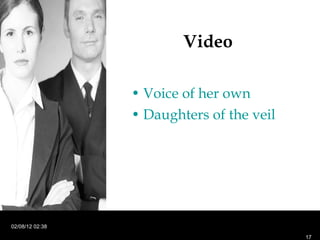
Video Voice of her own Daughters of the veil 02/08/12   02:38
Reference : Advameg Inc. (2007).  Gender issues in mental health  [On-line]. Retrieved March 6, 2007 from the World Wide Web:  http://www.minddisorders.com/Flu-Inv/Gender-issues-in-mental-health.html Answers Corporation. (November 2006).  Gender role  [On-line]. Retrieved March 6, 2007 from the World Wide Web:  http://www.answers.com/topic/gender-role-2 02/08/12   02:38

Gender role

  • 1.
    Gender Role OscarMaxson Mardhiah Vivian Ruhaizah Zuliany Oon
  • 2.
    Introduction Gender roleas a set of behavioral norms related especially with males or females, in a given social group or system. WordNet, it is the overt expression of attitudes that indicate to others the degree of an individual maleness or femaleness. 02/08/12 02:38
  • 3.
    Traditional gender  masculinity as having power and being in control in emotional situations, in the workplace, and in sexual relationships  femininity as being nurturing, supportive, and assigning high priority to one's relationships. Talcott Parsons (1955), he believed that male and female has different role. In his view, feminine role was an expressive, whereas masculine role was instrumental. 02/08/12 02:38
  • 4.
    Past…… 19 th Century, economy shifted from agricultural to industrialization… Middle to Upper class family–man will be the bread-winner for the family and women will stayed at home as family caretakers. Lower class, single mother, working class family & immigrant women–find paid employment as survival. ‘ Women’s work’–Nurse, Teacher, Clerk, Secretary ‘ Men’s Work’–Lawyer, Engineer and higher paid position Gendered Division of Labour 02/08/12 02:38
  • 5.
    Present…. Late 20th Century, due to globalization, industrialization and urbanization… New job opportunities – especially those with college qualification Roles of women – shifted as they work in professional area. Roles of gender was quite equal as more women was seen doing ‘men’s job’– Doctors, CEOs and men’s participate in ‘women’s work’– Teachers, Nurses . Even if women work for wages outside the home, they are still expected to take primary responsibility for the care of their home and children (Shelton, 1992). Gendered Division of Labour 02/08/12 02:38
  • 6.
    Occupation Segregation Existsin two different levels: Segregation by Occupation Women’s work and Men’s work Within any occupations of women and men their roles are not distributed equally across the occupational hierarchy. There is occupation with women clustered at the lower levels and men at the upper ones-even in occupations which predominantly women. E.g. teachers–male were dominant to be headmaster.. To simplify, men were more dominant as leaders while women will work under them. 02/08/12 02:38
  • 7.
    Gender Equity Consideredas a state of fairness and justness Requires that the specific needs of particular groups are considered separately and acted upon accordingly. e.g : All Malaysians are meant to be equal in regards to their rights and treatment by government and social institutions, their needs, interests and values will differ. Equity leads to equality. 02/08/12 02:38
  • 8.
    Gender Equalization Definedas the nonexistence of discrimination. Based on a person’s sex, in opportunities and the part of resources or benefits or in access to services. Concerned with treating everyone the same. Acknowledge and addressing different needs, interests and values, can help to overcome inequalities and arrive at equitable outcomes. 02/08/12 02:38
  • 9.
    Theory of GenderEquity Adams’ Equity Theory calls for a fair balance to be struck between an employee’s inputs and an employee’s outputs. Find fair balance to ensure a strong and productive relationship which can result contented and motivated employees. An employee will consider that he or she is treated fairly if he or she perceives the ratio of his or her inputs to his or her outcomes to be equivalent to those around him or her. 02/08/12 02:38
  • 10.
    Approaches to GenderEqualization Three broad approaches of gender equality by Rees, 1998: 1) Equal treatment ensuring men and women are treated the same. 2) Positive action special actions to redress disadvantage. 3) Mainstreaming equality integrate gender equality into systems, structures, institutions, programs, policies and practices. 02/08/12 02:38
  • 11.
    Gender Stereotyping Definition- sets of beliefs about groups. Stereotypes may sometimes be accurate in the sense of an average group difference but the challenging aspect of stereotypes is to believe that every member of a group has all the features of the average group member. Example : In an individual career stereotyping still happen when society categorize certain group in particular features like work as labor in contraction just for man and it impossible to women take place this job. 02/08/12 02:38
  • 12.
    Gender Discrimination Definition- D iscrimination against a person or group on the grounds of sex, sexual orientation, or gender identity. Gender discrimination in the workplace happens when an employee is treated differently because of his or her gender. - Hiring - Job Task - Promotion - Salaries - Empowerment 02/08/12 02:38
  • 13.
    Effects to HR Low performance Low motivation Productivity will decrease Vision and Mission of the organization will be difficult to achieve 02/08/12 02:38
  • 14.
    HR Manager Rolesin Handling Gender Role Issues Workplace Policy Leadership Skill Individualising Aware of men’s role and women’s role 02/08/12 02:38
  • 15.
    Conclusion gender roleissue is much interrelated to the stereotyping and discrimination. The equality and equity that is not equilibrium in the division of labor causes the discrimination in gender dynamic changes in the society and culture will result a dynamic gender role issues or conflict in return 02/08/12 02:38
  • 16.
    Conclusion discrimination ingender role should be minimized or even better eliminated together with the stereotyping Distribution of work is no longer looking at what gender you are, but the big question is what are you able to do. 02/08/12 02:38
  • 17.
    Video Voice ofher own Daughters of the veil 02/08/12 02:38
  • 18.
    Reference : AdvamegInc. (2007). Gender issues in mental health [On-line]. Retrieved March 6, 2007 from the World Wide Web: http://www.minddisorders.com/Flu-Inv/Gender-issues-in-mental-health.html Answers Corporation. (November 2006). Gender role [On-line]. Retrieved March 6, 2007 from the World Wide Web: http://www.answers.com/topic/gender-role-2 02/08/12 02:38