Think back to Grade 7.
  Picture the most disengaged
student in your class. What is
  this person doing/not doing?

            Why?
Used with permission, Clive School


                       Boys Education:
                                                                          WinWin Program, 2002


                        Think WinWin
                                  Working INteractively,
                                  Winning INdependently

                                   Brent Galloway,
                                   Middle Years Program Coordinator, Red Deer College
                                   Brent.galloway@rdc.ab.ca
Used with permission, Clive School MiddleYearsGuy@Twitter.com
WinWin Program, 2002               gallowayteacherconventionsessions.blogspot.com
Boys Education:
       The Galloway Vault
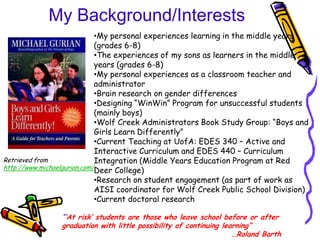
Dr. Michael Gurian, author of Boys and
Girls Learn Differently, believes “that
many poor learners can be turned around
if we just acknowledge the differences
between boys and girls and re-educate
ourselves on how to help them thrive.”


       Used with permission, Clive School, WinWin Program, 2002
My Background/Interests
                             •My personal experiences learning in the middle years
                             (grades 6-8)
                             •The experiences of my sons as learners in the middle
                             years (grades 6-8)
                             •My personal experiences as a classroom teacher and
                             administrator
                             •Brain research on gender differences
                             •Designing “WinWin” Program for unsuccessful students
                             (mainly boys)
                             •Wolf Creek Administrators Book Study Group: “Boys and
                             Girls Learn Differently”
                             •Current Teaching at UofA: EDES 340 – Active and
                             Interactive Curriculum and EDES 440 – Curriculum
Retrieved from               Integration (Middle Years Education Program at Red
http://www.michaelgurian.com/Deer College)
                             •Research on student engagement (as part of work as
                             AISI coordinator for Wolf Creek Public School Division)
                             •Current doctoral research

                “‟At risk‟ students are those who leave school before or after
                graduation with little possibility of continuing learning”
                                                                    …Roland Barth
Just the Facts about Boys:
                   True or False
          The male brain is 10-15% larger
Boys develop and mature later than girls, both physically ,
   emotionally, and cognitively
      Many boys are kinesthetic learners – they learn best by moving their
      bodies and doing things rather than sitting passively and listening
  Boys tend to be deductive thinkers vs. inductive thinkers (girls)
          Boys favour abstract or concrete reasoning (e.g. moral debates.
          arguments, problems)
The male brain secretes less serotonin than the female, making males
more impulsive in general as well as fidgety
       Boys get bored more easily than girls; this often requires
       more and varying stimulants to keep them attentive
    Boys tend to use more space when they learn
                 Boys need to move more when they are learning; this helps
                 them to stimulate their brains, and to manage and relieve
                 impulsive behaviour
            Boys tend use less sensory data than girls (smell, taste, hear);
            their visual sense is typically the best (e.g. tv and video games
            suit a male brain)
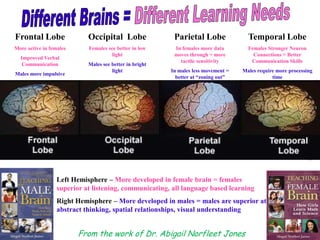
Frontal Lobe                Occipital Lobe                Parietal Lobe               Temporal Lobe
More active in females      Females see better in low     In females more data        Females Stronger Neuron
                                      light               moves through = more          Connections = Better
  Improved Verbal
                                                            tactile sensitivity        Communication Skills
   Communication            Males see better in bright
                                      light              In males less movement =   Males require more processing
Males more impulsive
                                                           better at “zoning out”               time


                  Left Hemisphere – More developed in female brain = females
                  superior at listening, communicating, all language based learning
                  Right Hemisphere – More developed in males = males are superior at
                  abstract thinking, spatial relationships, visual understanding


                         From the work of Dr. Abigail Norfleet Jones
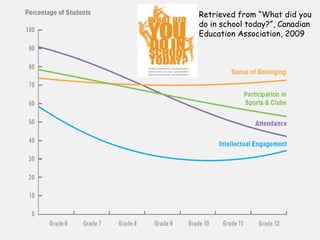
Retrieved from “What did you
do in school today?”, Canadian
Education Association, 2009
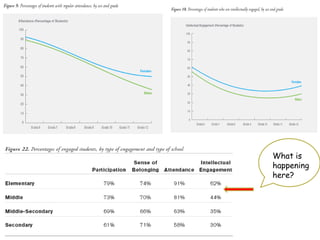
What is
happening
here?
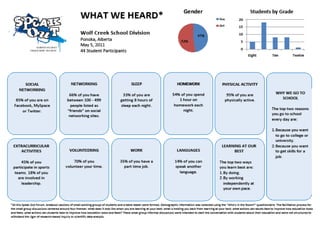
Used with permission, Speak Out,
Wolf Creek Public School Division, 2010
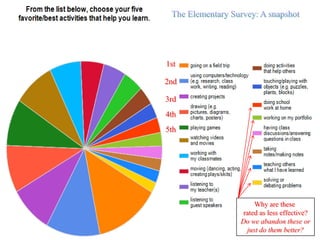
1st

2nd

3rd
4th
5th


           Why are these
       rated as less effective?
      Do we abandon these or
        just do them better?
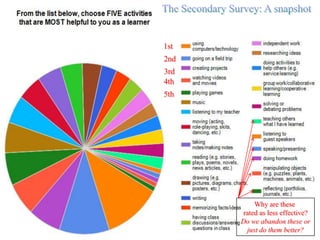
1st
2nd
3rd
4th
5th


           Why are these
       rated as less effective?
      Do we abandon these or
        just do them better?
Inquiring Minds Want to Know

• The Candidates: Joe               Student and Elijah Green
• The Big Question:
    How do boys experience learning in grade 7?
•   Open Ended Questions:
•   Additional Questions:
•   The Pre-interview Activity
•   Compare and Contrast
              “The average boy is quite different than the average girl,
               and that‟s due to nature, not nurture.”
                   – Gabrielle Bauer, “Boys Must be Boys” Canadian Living
Open Ended Questions
•   What is the best thing about being in grade 7?
•   What is the hardest thing about being in grade 7?
•   What are the challenges you find being a boy in grade 7?
•   How do you think learning is different for girls in your classroom?
•   If you had one idea to make your school better, what would you do?
•   What do you look forward to the most when going to school?
•   If you could choose the topics to learn in school, what would you
    choose?
•    How would you describe the optimal learning environment
    (classroom/school) for yourself?
•    Describe a recent successful learning experience. What made the
    experience successful for you?
•    Besides school, describe other places where you learn about topics of
    interest?
               “Schools …… have begun to focus on academics at too early an
               age, leaving boys hating education from their earliest days.
               Programs that focus more on fun and less on academics up to
               age seven or eight would reap educational dividends.”
                                                     Leonard Sax, Boys Adrift
Additional Questions
•   Describe you favorite teacher. How did this teacher teach you?
•   Who have been your favorite teachers through the years and what do
    they have in common?
•   How would you change your classroom if you could?
•   If you were principal for a day, what would you do to make your school
    a better place for you as a learner?
•   What topics in school have you enjoyed learning about?
•   What additional topics in school would you like to learn more about?
•   If you were an architect designing the future classroom of the 21st
    century, what would it look like?
•   If you went to school for only three days a week, what would you do to
    fill your free time?
•   What would you like less of in school, and of what would you like more?
•   Describe something that you have done in which you were very proud?
               “Schools …… have begun to focus on academics at too early an
               age, leaving boys hating education from their earliest days.
               Programs that focus more on fun and less on academics up to
               age seven or eight would reap educational dividends.”
                                                     Leonard Sax, Boys Adrift
Pre-interview Activity
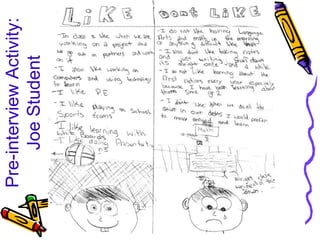
•   Make a two column chart with words/drawings/diagrams showing school/class
    activities that you like and another column of those that you don‟t like as a
    student in grade 7

•   Make a schedule of a typical school week in your life. Use colors (to color code
    – e.g. one color could be for school, one could be for routines, one could be for
    “out-of-school” activities, etc. ) and a legend if you like (e.g.  for things you
    like,  for things you don‟t like)

•   Create a timeline of this current year (January to December) outlining three
    to five events that were most exciting to you (or that you are looking forward
    to). Your timeline could include words and/or pictures.

•   Make 2 drawings: one of yourself in a classroom learning activity you enjoyed;
    and one in a classroom learning activity that you did not enjoy. Use little
    drawings/stick men to show me what is going on and/or use thought
    bubbles/words to tell your story.

                 “Educators often lack understanding of „typical boy‟ traits
                 such as physical aggression, verbal and emotional
                 reticence, and interest in objects moving through space”.
                        Michael Gurian , Boys and Girls Learn Differently,
Pre-interview Activity:
     Joe Student
Pre-interview
   Activity:
Elijah Green
The Top Hat: The Results


   “The way North American schools teach boys puts them at
 risk of underachieving”
  – Michael Gurian, author of Boys and Girls Learn Differently
Summary/Analysis of Data:Reflections
    …..These two grade 7 boys
• like school as long as they are engaged
• like to be active in schools and get bored easily from passive activities
  like taking notes and reading
• like technology
• prefer learning later in the day
• like to play and work with their hands (e.g. projects)
• like teachers who “accept” them as male learners; most often these are
  “male” teachers
• like working collaboratively and like to have choice
• perceive that the students who do not like learning and who get “in
  trouble” are boys
• like learning and want to be involved in school
• have limited opportunities to express themselves artistically
  (music/art/drama)
            “If we want to have engaged brains in the classroom, we have to
            have an interactive environment”         …
                               Spencer Kagan, Cooperative Learning Structures
My Interpretive Account:
 Expectations, Findings, Reframing
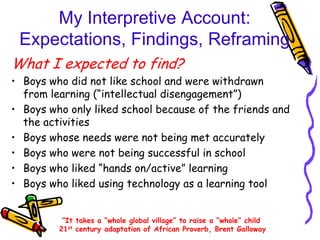
What I expected to find?
• Boys who did not like school and were withdrawn
  from learning (“intellectual disengagement”)
• Boys who only liked school because of the friends and
  the activities
• Boys whose needs were not being met accurately
• Boys who were not being successful in school
• Boys who liked “hands on/active” learning
• Boys who liked using technology as a learning tool


          “It takes a “whole global village” to raise a “whole” child
         21st century adaptation of African Proverb, Brent Galloway
My Interpretive Account:
 Expectations, Findings, Reframing
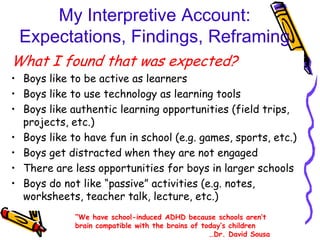
What I found that was expected?
• Boys like to be active as learners
• Boys like to use technology as learning tools
• Boys like authentic learning opportunities (field trips,
  projects, etc.)
• Boys like to have fun in school (e.g. games, sports, etc.)
• Boys get distracted when they are not engaged
• There are less opportunities for boys in larger schools
• Boys do not like “passive” activities (e.g. notes,
  worksheets, teacher talk, lecture, etc.)
             “We have school-induced ADHD because schools aren‟t
             brain compatible with the brains of today‟s children
                                                   …Dr. David Sousa
My Interpretive Account:
 Expectations, Findings, Reframing
What I found that was surprising?
 These boys really enjoy school and like talking about it
 These boys like learning but did not care for the “topics”
  that were being studied (e.g. First Nations)
 These boys did not have opportunities to express
  themselves artistically (e.g. music, art, drama, etc.)
 These boys like to express themselves physically/
  socially through sports
 These boys were eager to be involved in their school
 Boys do not “get lost” in larger schools
 Teachers still engage in many “traditional” practices
 There was almost no evidence of curriculum integration
           “Assessment is about being fair, not equal”, Rick Wormeli
Boys Education:
                                    Think WinWin
                Reframing my question

    How can we, as educators, use integrated and
interactive curricular approaches to better meet the
needs of male adolescent learners in our middle years
            classroom of the 21st century?


    “Fairness is everyone getting what they need in school”
          …Martha Kaufeldt,”Begin with the Brain in Mind”
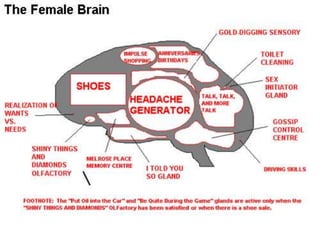
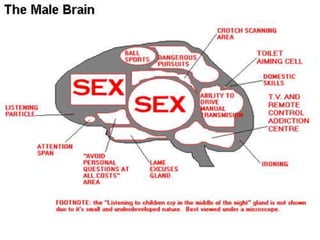
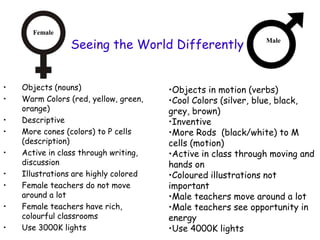
Female

                Seeing the World Differently                  Male


•   Objects (nouns)                    •Objects in motion (verbs)
•   Warm Colors (red, yellow, green,   •Cool Colors (silver, blue, black,
    orange)                            grey, brown)
•   Descriptive                        •Inventive
•   More cones (colors) to P cells     •More Rods (black/white) to M
    (description)                      cells (motion)
•   Active in class through writing,   •Active in class through moving and
    discussion                         hands on
•   Illustrations are highly colored   •Coloured illustrations not
•   Female teachers do not move        important
    around a lot                       •Male teachers move around a lot
•   Female teachers have rich,         •Male teachers see opportunity in
    colourful classrooms               energy
•   Use 3000K lights                   •Use 4000K lights
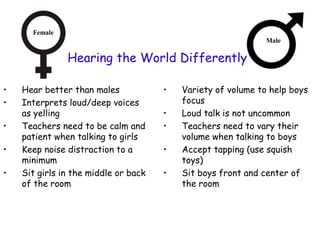
Female
                                                              Male

               Hearing the World Differently

•   Hear better than males            •   Variety of volume to help boys
•   Interprets loud/deep voices           focus
    as yelling                        •   Loud talk is not uncommon
•   Teachers need to be calm and      •   Teachers need to vary their
    patient when talking to girls         volume when talking to boys
•   Keep noise distraction to a       •   Accept tapping (use squish
    minimum                               toys)
•   Sit girls in the middle or back   •   Sit boys front and center of
    of the room                           the room
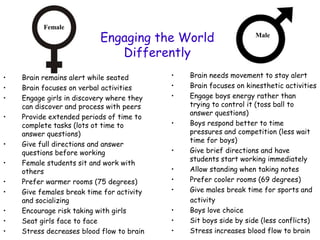
Female
                           Engaging the World                      Male

                              Differently
•   Brain remains alert while seated       •   Brain needs movement to stay alert
•   Brain focuses on verbal activities     •   Brain focuses on kinesthetic activities
•   Engage girls in discovery where they   •   Engage boys energy rather than
    can discover and process with peers        trying to control it (toss ball to
                                               answer questions)
•   Provide extended periods of time to
    complete tasks (lots ot time to        •   Boys respond better to time
    answer questions)                          pressures and competition (less wait
                                               time for boys)
•   Give full directions and answer
    questions before working               •   Give brief directions and have
                                               students start working immediately
•   Female students sit and work with
    others                                 •   Allow standing when taking notes
•   Prefer warmer rooms (75 degrees)       •   Prefer cooler rooms (69 degrees)
•   Give females break time for activity   •   Give males break time for sports and
    and socializing                            activity
•   Encourage risk taking with girls       •   Boys love choice
•   Seat girls face to face                •   Sit boys side by side (less conflicts)
•   Stress decreases blood flow to brain   •   Stress increases blood flow to brain
Good Ole Boys
– Advantages for Boys in Schools
   The majority of sports funding and
    community support goes to male athletes
    e.g. 73% of high school athletes are boys
   Boys tend to be louder, more physically
    aggressive and more prone to attention
    getting devices in the classroom, thus
    more attention from the teacher
   Boys are approximately 2 to 4 points
    ahead of girls in math and science scores
   Boys score slightly higher on SAT and
    college entrance exams
   Boys have less psychological disorders
    than girls (e.g. bulimia, suicide,
    depression)
   Some school networks and work settings
    still have the “good ole boys” network
    leading to more privileges for boys
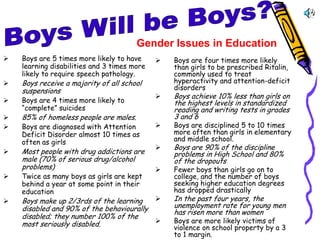
Gender Issues in Education
   Boys are 5 times more likely to have        Boys are four times more likely
    learning disabilities and 3 times more       than girls to be prescribed Ritalin,
    likely to require speech pathology.          commonly used to treat
   Boys receive a majority of all school        hyperactivity and attention-deficit
    suspensions                                  disorders
                                                Boys achieve 10% less than girls on
   Boys are 4 times more likely to              the highest levels in standardized
    “complete” suicides                          reading and writing tests in grades
   85% of homeless people are males.            3 and 6
   Boys are diagnosed with Attention           Boys are disciplined 5 to 10 times
    Deficit Disorder almost 10 times as          more often than girls in elementary
    often as girls                               and middle school.
                                                Boys are 90% of the discipline
   Most people with drug addictions are         problems in High School and 80%
    male (70% of serious drug/alcohol            of the dropouts
    problems)                                   Fewer boys than girls go on to
   Twice as many boys as girls are kept         college, and the number of boys
    behind a year at some point in their         seeking higher education degrees
    education                                    has dropped drastically
   Boys make up 2/3rds of the learning         In the past four years, the
    disabled and 90% of the behaviourally        unemployment rate for young men
                                                 has risen more than women
    disabled; they number 100% of the
    most seriously disabled.                    Boys are more likely victims of
                                                 violence on school property by a 3
                                                 to 1 margin.
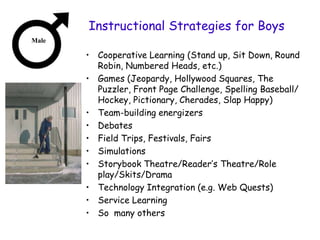
Instructional Strategies for Boys
Male

       • Cooperative Learning (Stand up, Sit Down, Round
         Robin, Numbered Heads, etc.)
       • Games (Jeopardy, Hollywood Squares, The
         Puzzler, Front Page Challenge, Spelling Baseball/
         Hockey, Pictionary, Cherades, Slap Happy)
       • Team-building energizers
       • Debates
       • Field Trips, Festivals, Fairs
       • Simulations
       • Storybook Theatre/Reader‟s Theatre/Role
         play/Skits/Drama
       • Technology Integration (e.g. Web Quests)
       • Service Learning
       • So many others
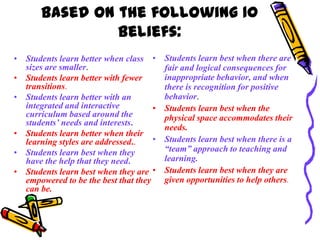
based on the following 10
                Beliefs:
• Students learn better when class •     Students learn best when there are
  sizes are smaller.                     fair and logical consequences for
• Students learn better with fewer       inappropriate behavior, and when
  transitions.                           there is recognition for positive
• Students learn better with an          behavior.
  integrated and interactive         •   Students learn best when the
  curriculum based around the            physical space accommodates their
  students’ needs and interests.
                                         needs.
• Students learn better when their
  learning styles are addressed..    •   Students learn best when there is a
• Students learn best when they          “team” approach to teaching and
  have the help that they need.          learning.
• Students learn best when they are •    Students learn best when they are
  empowered to be the best that they     given opportunities to help others.

  can be.
The Results
      Year 1                     Year 2
    (Grade 9):                (Grade 7/8):
• Best Practices          •   Report Card Results
• Mission Statements      •   Parent Survey Results
• Report Card Results
                          •   Student
• Parent Survey Results       Survey/Interview
• Student Survey              Results
  Results
                          •   Reading Results (CTBS)
• Discipline Referrals
                          •   School wide Satisfaction
                              Survey Results
Boys Education:
                            Think WinWin
What “WinWin” idea will you take with you today to
help better meet the needs of your male learners?
Wise Words
   “The way North American schools
 teach boys puts them at risk of               “We have school-induced ADHD because
 underachieving”                               schools aren‟t brain compatible with the
                                               brains of today‟s children”
 – Michael Gurian, author of Boys and                                  …Dr. David Sousa
 Girls Learn Differently
          “Fairness is everyone getting what      “Educators often lack understanding of
          they need in school”                    „typical boy‟ traits such as physical
                        …Martha Kaufeldt          aggression, verbal and emotional reticence,
                                                  and interest in objects moving through
“All kids in our society are at risk              space”. – Michael Gurian
           …Dr. Richard Brokenleg
                                            “If we want to have engaged brains in the
     “The average boy is quite different    classroom, we have to have an interactive
      than the average girl, and that‟s due environment”              … Spencer Kagan
      to nature, not nurture.”
      – Gabrielle Bauer, “Boys Must be            “‟At risk‟ students are those who leave
      Boys” Canadian Living                       school before or after graduation with
                                                  little possibility of continuing learning”
    There are no „bad‟ kids, just
                                                                            …Roland Barth
    kids with „bad‟ problems”
                …Harold Brathwaite      “Are we training kids to write tests for life,
                                        or are we training kids for the tests of life”
                                                                      ….Art Costa

Boys Education: Think Win Win - CATCA

  • 1.
    Think back toGrade 7. Picture the most disengaged student in your class. What is this person doing/not doing? Why?
  • 2.
    Used with permission,Clive School Boys Education: WinWin Program, 2002 Think WinWin Working INteractively, Winning INdependently Brent Galloway, Middle Years Program Coordinator, Red Deer College Brent.galloway@rdc.ab.ca Used with permission, Clive School MiddleYearsGuy@Twitter.com WinWin Program, 2002 gallowayteacherconventionsessions.blogspot.com
  • 3.
    Boys Education: The Galloway Vault Dr. Michael Gurian, author of Boys and Girls Learn Differently, believes “that many poor learners can be turned around if we just acknowledge the differences between boys and girls and re-educate ourselves on how to help them thrive.” Used with permission, Clive School, WinWin Program, 2002
  • 4.
    My Background/Interests •My personal experiences learning in the middle years (grades 6-8) •The experiences of my sons as learners in the middle years (grades 6-8) •My personal experiences as a classroom teacher and administrator •Brain research on gender differences •Designing “WinWin” Program for unsuccessful students (mainly boys) •Wolf Creek Administrators Book Study Group: “Boys and Girls Learn Differently” •Current Teaching at UofA: EDES 340 – Active and Interactive Curriculum and EDES 440 – Curriculum Retrieved from Integration (Middle Years Education Program at Red http://www.michaelgurian.com/Deer College) •Research on student engagement (as part of work as AISI coordinator for Wolf Creek Public School Division) •Current doctoral research “‟At risk‟ students are those who leave school before or after graduation with little possibility of continuing learning” …Roland Barth
  • 5.
    Just the Factsabout Boys: True or False The male brain is 10-15% larger Boys develop and mature later than girls, both physically , emotionally, and cognitively Many boys are kinesthetic learners – they learn best by moving their bodies and doing things rather than sitting passively and listening Boys tend to be deductive thinkers vs. inductive thinkers (girls) Boys favour abstract or concrete reasoning (e.g. moral debates. arguments, problems) The male brain secretes less serotonin than the female, making males more impulsive in general as well as fidgety Boys get bored more easily than girls; this often requires more and varying stimulants to keep them attentive Boys tend to use more space when they learn Boys need to move more when they are learning; this helps them to stimulate their brains, and to manage and relieve impulsive behaviour Boys tend use less sensory data than girls (smell, taste, hear); their visual sense is typically the best (e.g. tv and video games suit a male brain)
  • 8.
    Frontal Lobe Occipital Lobe Parietal Lobe Temporal Lobe More active in females Females see better in low In females more data Females Stronger Neuron light moves through = more Connections = Better Improved Verbal tactile sensitivity Communication Skills Communication Males see better in bright light In males less movement = Males require more processing Males more impulsive better at “zoning out” time Left Hemisphere – More developed in female brain = females superior at listening, communicating, all language based learning Right Hemisphere – More developed in males = males are superior at abstract thinking, spatial relationships, visual understanding From the work of Dr. Abigail Norfleet Jones
  • 9.
    Retrieved from “Whatdid you do in school today?”, Canadian Education Association, 2009
  • 10.
  • 11.
    Used with permission,Speak Out, Wolf Creek Public School Division, 2010
  • 14.
    1st 2nd 3rd 4th 5th Why are these rated as less effective? Do we abandon these or just do them better?
  • 15.
    1st 2nd 3rd 4th 5th Why are these rated as less effective? Do we abandon these or just do them better?
  • 16.
    Inquiring Minds Wantto Know • The Candidates: Joe Student and Elijah Green • The Big Question: How do boys experience learning in grade 7? • Open Ended Questions: • Additional Questions: • The Pre-interview Activity • Compare and Contrast “The average boy is quite different than the average girl, and that‟s due to nature, not nurture.” – Gabrielle Bauer, “Boys Must be Boys” Canadian Living
  • 17.
    Open Ended Questions • What is the best thing about being in grade 7? • What is the hardest thing about being in grade 7? • What are the challenges you find being a boy in grade 7? • How do you think learning is different for girls in your classroom? • If you had one idea to make your school better, what would you do? • What do you look forward to the most when going to school? • If you could choose the topics to learn in school, what would you choose? • How would you describe the optimal learning environment (classroom/school) for yourself? • Describe a recent successful learning experience. What made the experience successful for you? • Besides school, describe other places where you learn about topics of interest? “Schools …… have begun to focus on academics at too early an age, leaving boys hating education from their earliest days. Programs that focus more on fun and less on academics up to age seven or eight would reap educational dividends.” Leonard Sax, Boys Adrift
  • 18.
    Additional Questions • Describe you favorite teacher. How did this teacher teach you? • Who have been your favorite teachers through the years and what do they have in common? • How would you change your classroom if you could? • If you were principal for a day, what would you do to make your school a better place for you as a learner? • What topics in school have you enjoyed learning about? • What additional topics in school would you like to learn more about? • If you were an architect designing the future classroom of the 21st century, what would it look like? • If you went to school for only three days a week, what would you do to fill your free time? • What would you like less of in school, and of what would you like more? • Describe something that you have done in which you were very proud? “Schools …… have begun to focus on academics at too early an age, leaving boys hating education from their earliest days. Programs that focus more on fun and less on academics up to age seven or eight would reap educational dividends.” Leonard Sax, Boys Adrift
  • 19.
    Pre-interview Activity • Make a two column chart with words/drawings/diagrams showing school/class activities that you like and another column of those that you don‟t like as a student in grade 7 • Make a schedule of a typical school week in your life. Use colors (to color code – e.g. one color could be for school, one could be for routines, one could be for “out-of-school” activities, etc. ) and a legend if you like (e.g.  for things you like,  for things you don‟t like) • Create a timeline of this current year (January to December) outlining three to five events that were most exciting to you (or that you are looking forward to). Your timeline could include words and/or pictures. • Make 2 drawings: one of yourself in a classroom learning activity you enjoyed; and one in a classroom learning activity that you did not enjoy. Use little drawings/stick men to show me what is going on and/or use thought bubbles/words to tell your story. “Educators often lack understanding of „typical boy‟ traits such as physical aggression, verbal and emotional reticence, and interest in objects moving through space”. Michael Gurian , Boys and Girls Learn Differently,
  • 20.
  • 21.
    Pre-interview Activity: Elijah Green
  • 22.
    The Top Hat:The Results “The way North American schools teach boys puts them at risk of underachieving” – Michael Gurian, author of Boys and Girls Learn Differently
  • 23.
    Summary/Analysis of Data:Reflections …..These two grade 7 boys • like school as long as they are engaged • like to be active in schools and get bored easily from passive activities like taking notes and reading • like technology • prefer learning later in the day • like to play and work with their hands (e.g. projects) • like teachers who “accept” them as male learners; most often these are “male” teachers • like working collaboratively and like to have choice • perceive that the students who do not like learning and who get “in trouble” are boys • like learning and want to be involved in school • have limited opportunities to express themselves artistically (music/art/drama) “If we want to have engaged brains in the classroom, we have to have an interactive environment” … Spencer Kagan, Cooperative Learning Structures
  • 24.
    My Interpretive Account: Expectations, Findings, Reframing What I expected to find? • Boys who did not like school and were withdrawn from learning (“intellectual disengagement”) • Boys who only liked school because of the friends and the activities • Boys whose needs were not being met accurately • Boys who were not being successful in school • Boys who liked “hands on/active” learning • Boys who liked using technology as a learning tool “It takes a “whole global village” to raise a “whole” child 21st century adaptation of African Proverb, Brent Galloway
  • 25.
    My Interpretive Account: Expectations, Findings, Reframing What I found that was expected? • Boys like to be active as learners • Boys like to use technology as learning tools • Boys like authentic learning opportunities (field trips, projects, etc.) • Boys like to have fun in school (e.g. games, sports, etc.) • Boys get distracted when they are not engaged • There are less opportunities for boys in larger schools • Boys do not like “passive” activities (e.g. notes, worksheets, teacher talk, lecture, etc.) “We have school-induced ADHD because schools aren‟t brain compatible with the brains of today‟s children …Dr. David Sousa
  • 26.
    My Interpretive Account: Expectations, Findings, Reframing What I found that was surprising?  These boys really enjoy school and like talking about it  These boys like learning but did not care for the “topics” that were being studied (e.g. First Nations)  These boys did not have opportunities to express themselves artistically (e.g. music, art, drama, etc.)  These boys like to express themselves physically/ socially through sports  These boys were eager to be involved in their school  Boys do not “get lost” in larger schools  Teachers still engage in many “traditional” practices  There was almost no evidence of curriculum integration “Assessment is about being fair, not equal”, Rick Wormeli
  • 27.
    Boys Education: Think WinWin Reframing my question How can we, as educators, use integrated and interactive curricular approaches to better meet the needs of male adolescent learners in our middle years classroom of the 21st century? “Fairness is everyone getting what they need in school” …Martha Kaufeldt,”Begin with the Brain in Mind”
  • 28.
    Female Seeing the World Differently Male • Objects (nouns) •Objects in motion (verbs) • Warm Colors (red, yellow, green, •Cool Colors (silver, blue, black, orange) grey, brown) • Descriptive •Inventive • More cones (colors) to P cells •More Rods (black/white) to M (description) cells (motion) • Active in class through writing, •Active in class through moving and discussion hands on • Illustrations are highly colored •Coloured illustrations not • Female teachers do not move important around a lot •Male teachers move around a lot • Female teachers have rich, •Male teachers see opportunity in colourful classrooms energy • Use 3000K lights •Use 4000K lights
  • 29.
    Female Male Hearing the World Differently • Hear better than males • Variety of volume to help boys • Interprets loud/deep voices focus as yelling • Loud talk is not uncommon • Teachers need to be calm and • Teachers need to vary their patient when talking to girls volume when talking to boys • Keep noise distraction to a • Accept tapping (use squish minimum toys) • Sit girls in the middle or back • Sit boys front and center of of the room the room
  • 30.
    Female Engaging the World Male Differently • Brain remains alert while seated • Brain needs movement to stay alert • Brain focuses on verbal activities • Brain focuses on kinesthetic activities • Engage girls in discovery where they • Engage boys energy rather than can discover and process with peers trying to control it (toss ball to answer questions) • Provide extended periods of time to complete tasks (lots ot time to • Boys respond better to time answer questions) pressures and competition (less wait time for boys) • Give full directions and answer questions before working • Give brief directions and have students start working immediately • Female students sit and work with others • Allow standing when taking notes • Prefer warmer rooms (75 degrees) • Prefer cooler rooms (69 degrees) • Give females break time for activity • Give males break time for sports and and socializing activity • Encourage risk taking with girls • Boys love choice • Seat girls face to face • Sit boys side by side (less conflicts) • Stress decreases blood flow to brain • Stress increases blood flow to brain
  • 31.
    Good Ole Boys –Advantages for Boys in Schools  The majority of sports funding and community support goes to male athletes e.g. 73% of high school athletes are boys  Boys tend to be louder, more physically aggressive and more prone to attention getting devices in the classroom, thus more attention from the teacher  Boys are approximately 2 to 4 points ahead of girls in math and science scores  Boys score slightly higher on SAT and college entrance exams  Boys have less psychological disorders than girls (e.g. bulimia, suicide, depression)  Some school networks and work settings still have the “good ole boys” network leading to more privileges for boys
  • 32.
    Gender Issues inEducation  Boys are 5 times more likely to have  Boys are four times more likely learning disabilities and 3 times more than girls to be prescribed Ritalin, likely to require speech pathology. commonly used to treat  Boys receive a majority of all school hyperactivity and attention-deficit suspensions disorders  Boys achieve 10% less than girls on  Boys are 4 times more likely to the highest levels in standardized “complete” suicides reading and writing tests in grades  85% of homeless people are males. 3 and 6  Boys are diagnosed with Attention  Boys are disciplined 5 to 10 times Deficit Disorder almost 10 times as more often than girls in elementary often as girls and middle school.  Boys are 90% of the discipline  Most people with drug addictions are problems in High School and 80% male (70% of serious drug/alcohol of the dropouts problems)  Fewer boys than girls go on to  Twice as many boys as girls are kept college, and the number of boys behind a year at some point in their seeking higher education degrees education has dropped drastically  Boys make up 2/3rds of the learning  In the past four years, the disabled and 90% of the behaviourally unemployment rate for young men has risen more than women disabled; they number 100% of the most seriously disabled.  Boys are more likely victims of violence on school property by a 3 to 1 margin.
  • 33.
    Instructional Strategies forBoys Male • Cooperative Learning (Stand up, Sit Down, Round Robin, Numbered Heads, etc.) • Games (Jeopardy, Hollywood Squares, The Puzzler, Front Page Challenge, Spelling Baseball/ Hockey, Pictionary, Cherades, Slap Happy) • Team-building energizers • Debates • Field Trips, Festivals, Fairs • Simulations • Storybook Theatre/Reader‟s Theatre/Role play/Skits/Drama • Technology Integration (e.g. Web Quests) • Service Learning • So many others
  • 34.
    based on thefollowing 10 Beliefs: • Students learn better when class • Students learn best when there are sizes are smaller. fair and logical consequences for • Students learn better with fewer inappropriate behavior, and when transitions. there is recognition for positive • Students learn better with an behavior. integrated and interactive • Students learn best when the curriculum based around the physical space accommodates their students’ needs and interests. needs. • Students learn better when their learning styles are addressed.. • Students learn best when there is a • Students learn best when they “team” approach to teaching and have the help that they need. learning. • Students learn best when they are • Students learn best when they are empowered to be the best that they given opportunities to help others. can be.
  • 35.
    The Results Year 1 Year 2 (Grade 9): (Grade 7/8): • Best Practices • Report Card Results • Mission Statements • Parent Survey Results • Report Card Results • Student • Parent Survey Results Survey/Interview • Student Survey Results Results • Reading Results (CTBS) • Discipline Referrals • School wide Satisfaction Survey Results
  • 36.
    Boys Education: Think WinWin What “WinWin” idea will you take with you today to help better meet the needs of your male learners?
  • 37.
    Wise Words “The way North American schools teach boys puts them at risk of “We have school-induced ADHD because underachieving” schools aren‟t brain compatible with the brains of today‟s children” – Michael Gurian, author of Boys and …Dr. David Sousa Girls Learn Differently “Fairness is everyone getting what “Educators often lack understanding of they need in school” „typical boy‟ traits such as physical …Martha Kaufeldt aggression, verbal and emotional reticence, and interest in objects moving through “All kids in our society are at risk space”. – Michael Gurian …Dr. Richard Brokenleg “If we want to have engaged brains in the “The average boy is quite different classroom, we have to have an interactive than the average girl, and that‟s due environment” … Spencer Kagan to nature, not nurture.” – Gabrielle Bauer, “Boys Must be “‟At risk‟ students are those who leave Boys” Canadian Living school before or after graduation with little possibility of continuing learning” There are no „bad‟ kids, just …Roland Barth kids with „bad‟ problems” …Harold Brathwaite “Are we training kids to write tests for life, or are we training kids for the tests of life” ….Art Costa