Technology and Innovation
http://DSign4Methods.com
Innovation
February 23 2017
Introduction
Introduction
©2016 L. SCHLENKER
Agenda
Introduction
Context
Five Generations
Open Innovation
Innovation
3
Date Subject
23 February Introduction
23 February Innovation
10 March Technology
10 March Management Decision Making
11 March Social Business
How does information technology
contribute to business innovation in
the digital economy?
©2016 LHST sarl
Introduction
Giffgaff - gaelic for mutual giving
reflected in their manifesto
Social CRM : member gets member,
eVouchers, goodybags
Customer service is member driven
Giffgaff labs – crowdsourcing product
testing
Payback for miles, cash or charities
Introduction
©2016 LHST sarl
Introduction
I. Unexpected Occurrences
II. Incongruities
III. Process Needs
IV. Industry and Market Changes
V. Demographic Changes
VI. Changes in Perception
VII. New Knowledge
Innovative ideas come from methodically analyzing seven areas of
opportunity….
Within a company/industry
Social and Intellectual
Environment
The Discipline of Innovation
Peter F. Drucker
Economic development consists of three
distinguishable stages of invention, innovation and
imitation
An ’invention’ is an idea, a sketch or model for a
new or improved device, product, process or
system.
An ’innovation’ is accomplished with the
commercial transactions of the product, process,
system or device.
Joseph Schumpeter
Introduction
©2016 L. SCHLENKER
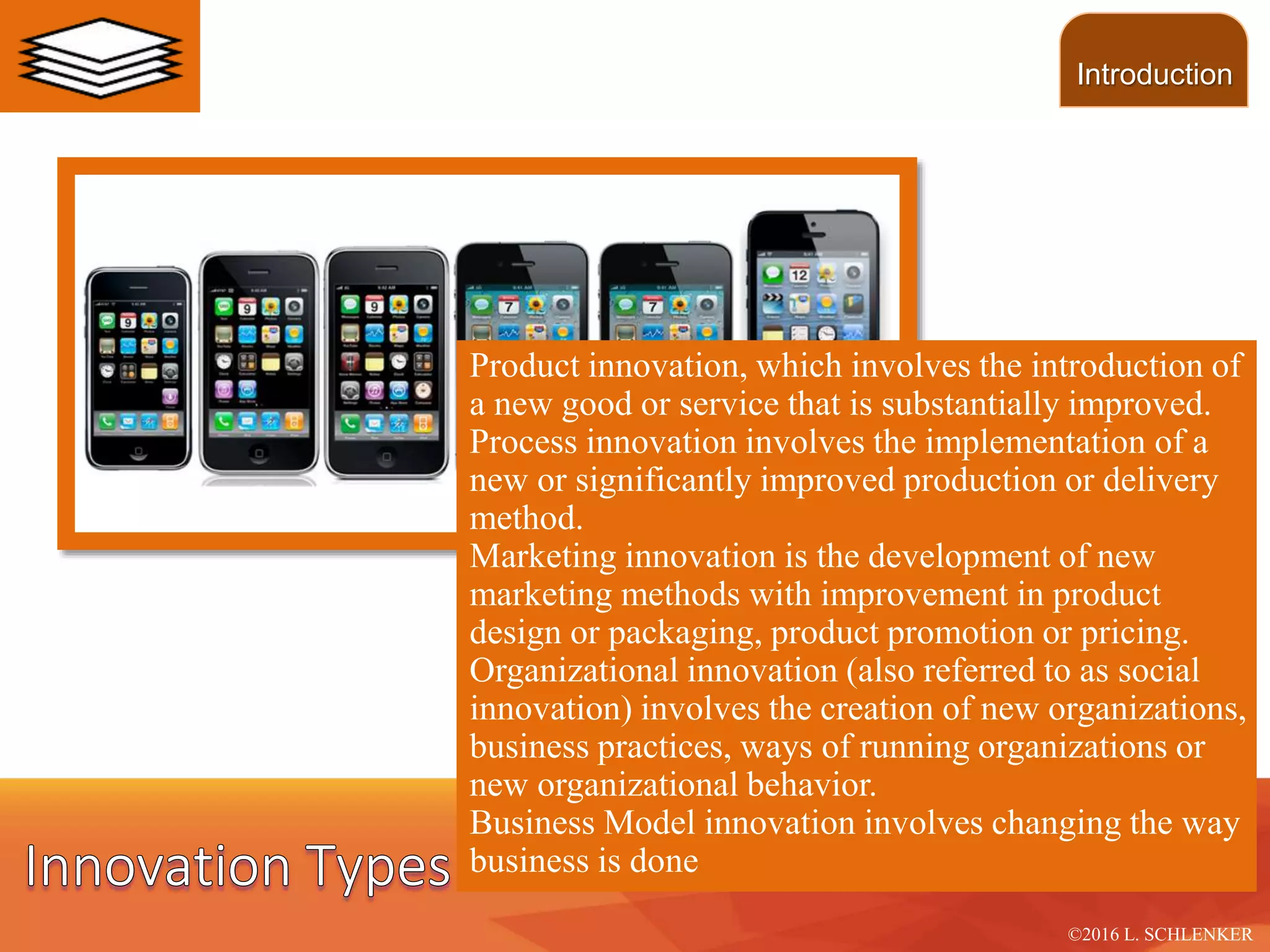
Product innovation, which involves the introduction of
a new good or service that is substantially improved.
Process innovation involves the implementation of a
new or significantly improved production or delivery
method.
Marketing innovation is the development of new
marketing methods with improvement in product
design or packaging, product promotion or pricing.
Organizational innovation (also referred to as social
innovation) involves the creation of new organizations,
business practices, ways of running organizations or
new organizational behavior.
Business Model innovation involves changing the way
business is done
Introduction
Julien Birkinshaw
Introduction
0
5,000
10,000
15,000
20,000
25,000
30,000
35,000
40,000
45,000
Technological Product Business / business
model
Strategy / strategic Organizational /
organisational
Administrative Management
Numberofhits
Bessant and Tidd (2007)
◦ Product innovation: changes in the things which an
organization offers
◦ Process innovation: changes in the ways in which they
are created an delivered
◦ Position innovation: changes in the context in which the
product or services are introduced
◦ Paradigm innovation: changes in the underlying mental
modes of what an organization does
©2016 L. SCHLENKER
Introduction
https://padlet.com/leeschlenker/Laas
Introduction
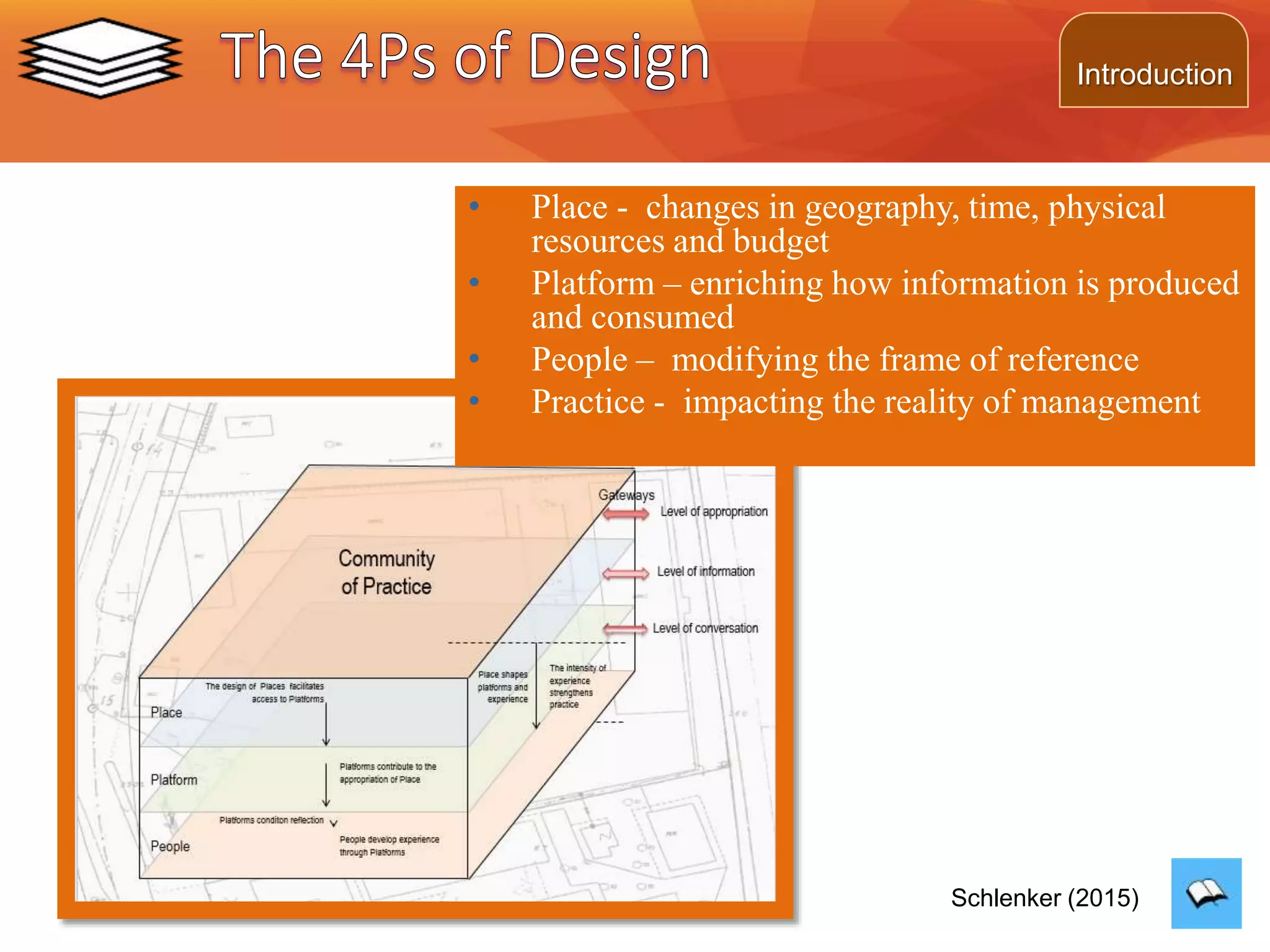
• Place - changes in geography, time, physical
resources and budget
• Platform – enriching how information is produced
and consumed
• People – modifying the frame of reference
• Practice - impacting the reality of management
Schlenker (2015)
Tidd et al. (2005)
©2016 L. SCHLENKER
Introduction
From 1950 to the mid-1960’s, fast
economic growth allowed for a strong
‘technology push’
Companies focused predominantly on
scientific breakthroughs
Innovation is a simple linear process
with emphasis on R&D
Market information (customer demands)
are integrated very late in the process
Roy Rothwell
Laser Technologies
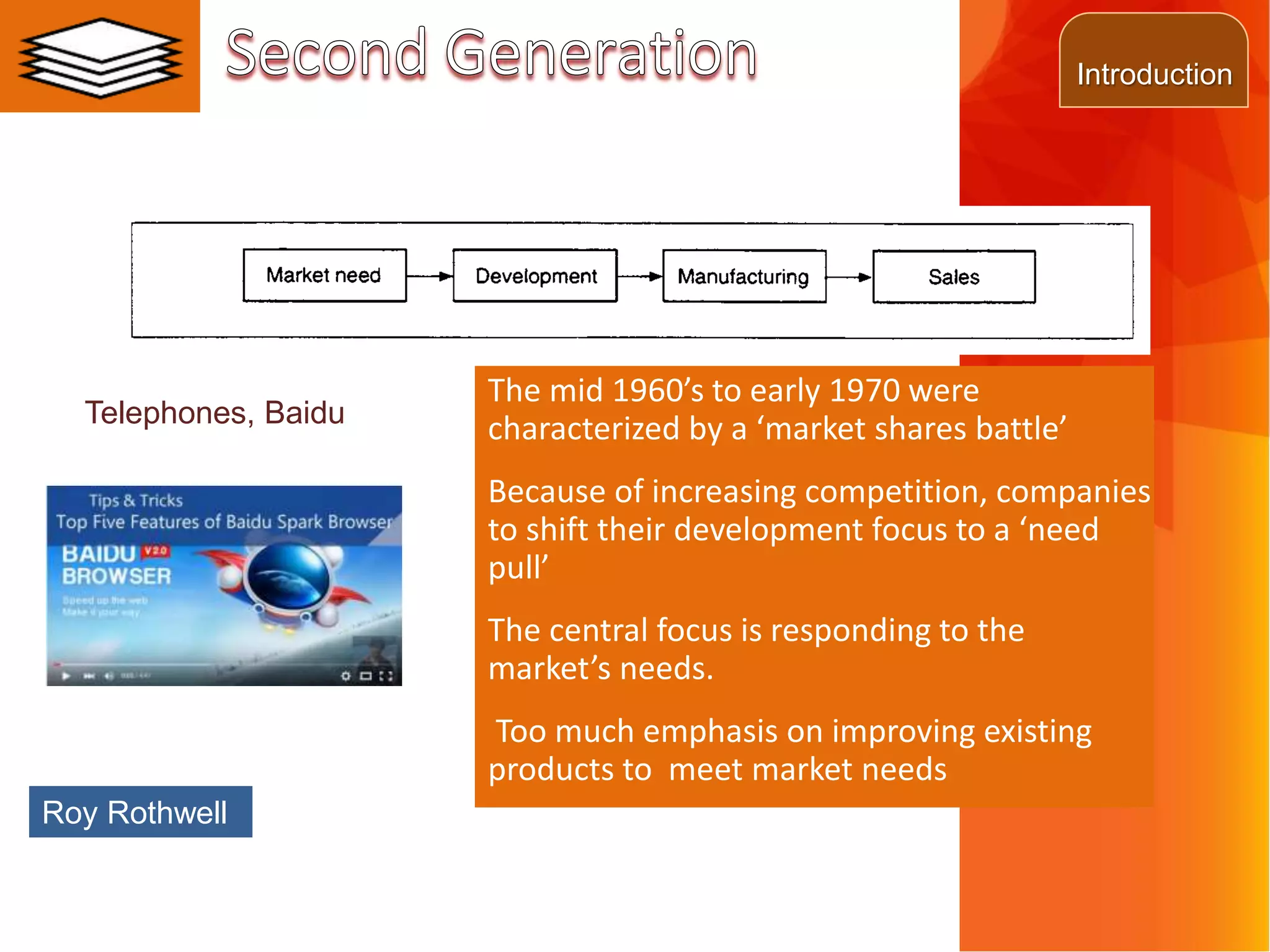
The mid 1960’s to early 1970 were
characterized by a ‘market shares battle’
Because of increasing competition, companies
to shift their development focus to a ‘need
pull’
The central focus is responding to the
market’s needs.
Too much emphasis on improving existing
products to meet market needs
Roy Rothwell
Telephones, Baidu
Introduction
Introduction
From the mid 1970’s to the mid-
1980’s are marked by inflation and
stagflation
Strategic focus was on corporate
consolidation and product
portfolios’
R&D and marketing play a
balanced role in cost reductions
The focus is on technological
opportunities rather than societal
needs
Research
Knowledge
Potential
market
Invent and/or
produce
analytic
design
Detailed
design and
test
Redesign
and
product
Distribute
and
market
D I S
D: Direct link to and from researchfrom problems ininvention and design
I: Support ofscientific research by instruments, machines, tools
S: Support of researchinsciences underlying the product areas
K K K
Roy Rothwell
ATMs
©2016 L. SCHLENKER
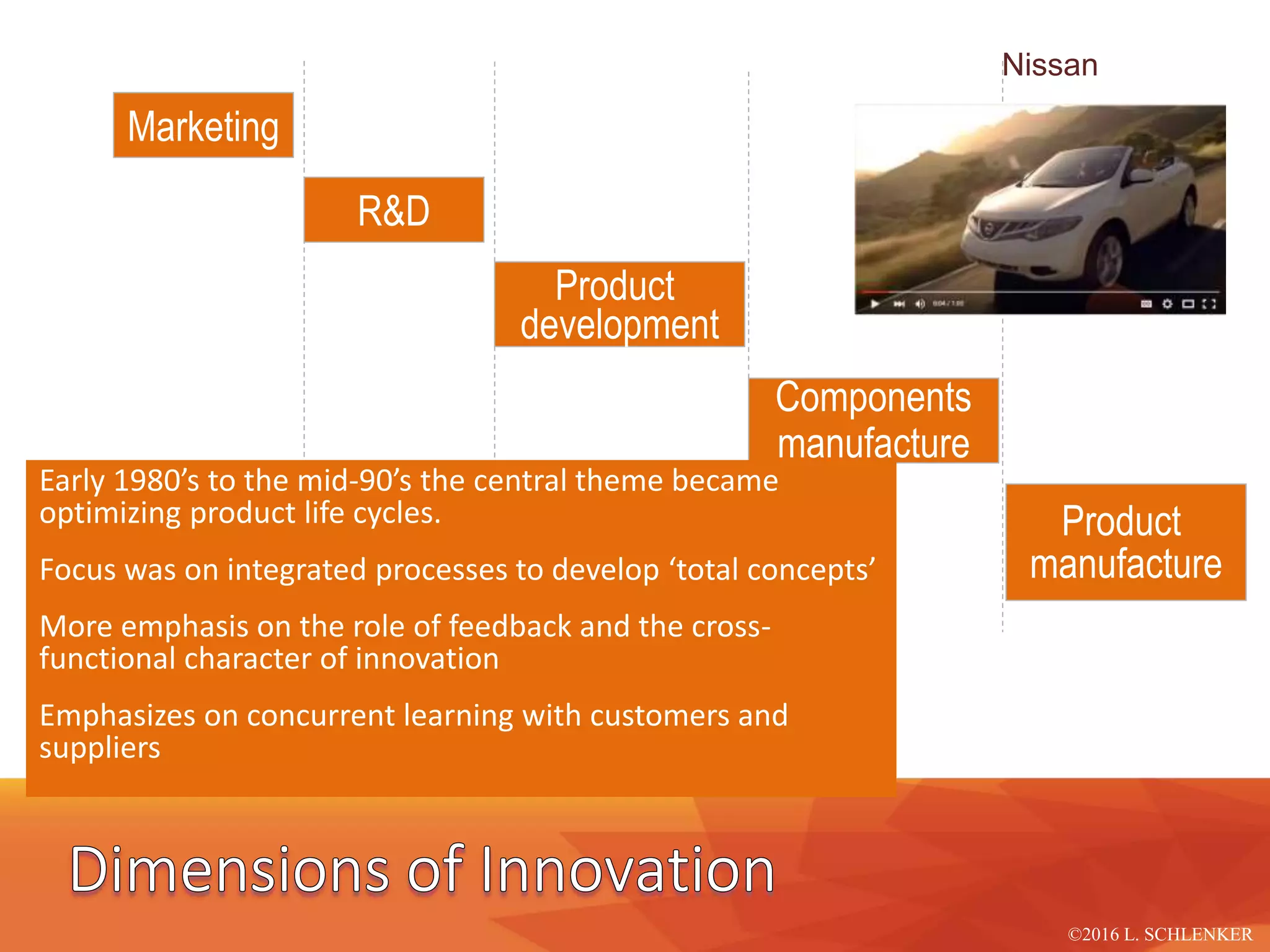
Marketing
R&D
Product
development
Components
manufacture
Product
manufacture
Early 1980’s to the mid-90’s the central theme became
optimizing product life cycles.
Focus was on integrated processes to develop ‘total concepts’
More emphasis on the role of feedback and the cross-
functional character of innovation
Emphasizes on concurrent learning with customers and
suppliers
Nissan
EXTERNAL INPUTS:
societal needs;
competitors;
supplier partnerships;
distributors;
customers;
strategic alliances.
EXTERNAL INPUTS:
scientific and technological
development;
competitors;
suppliers;
customers;
university departments.
Organisation and
business strategy
EXTERNAL INPUTS:
macro factors
ROI
costs;
competition.
Organisation’s
knowledge base
accumulates
knowledge
over
time
New products
Source: Trott, 2005
Spotify and the
music industry
Introduction
The use of purposive inflows and outflows of
knowledge to accelerate internal innovation, and
expand the markets for external use of
innovation, respectively.
Introduction
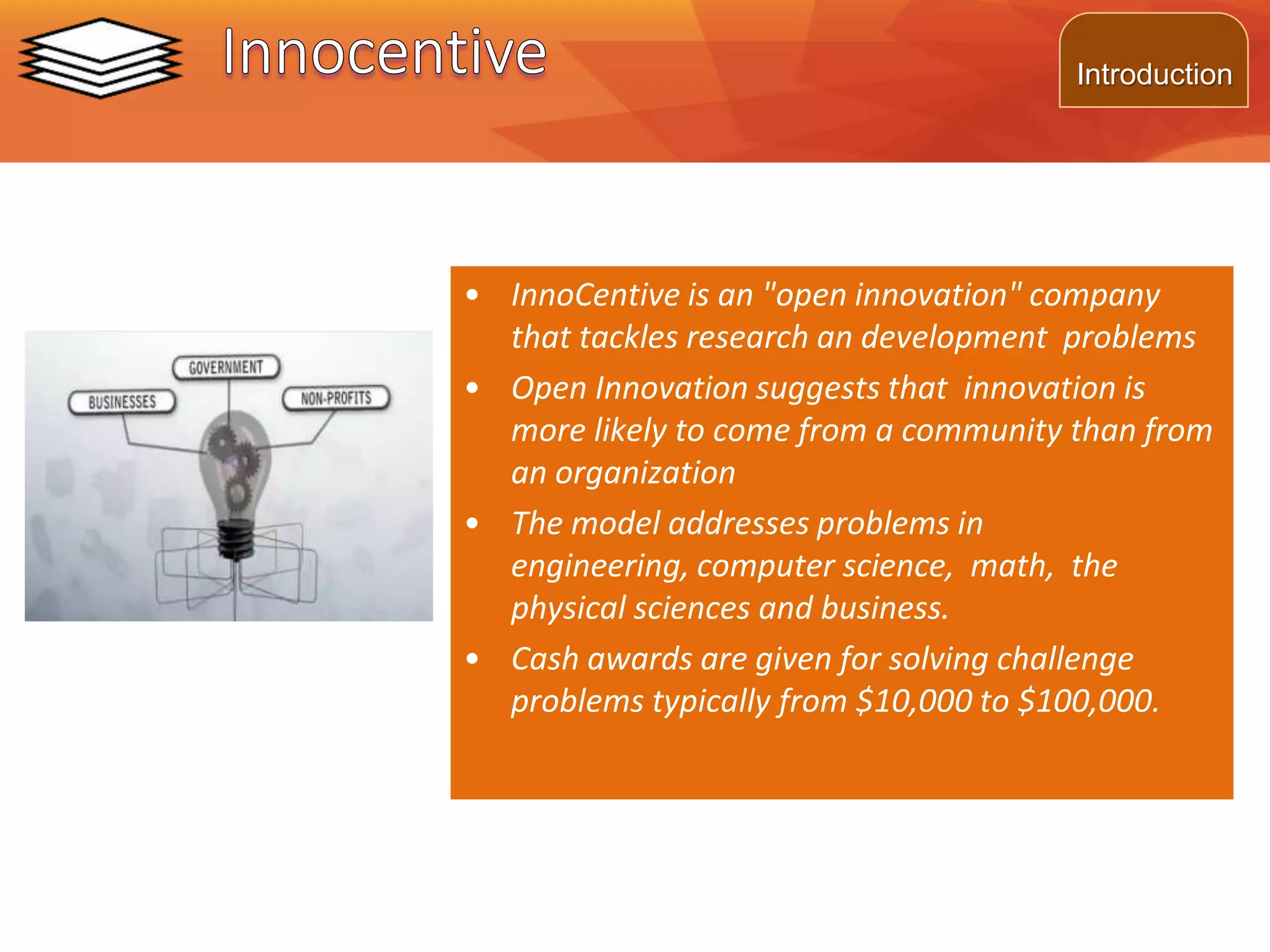
• InnoCentive is an "open innovation" company
that tackles research an development problems
• Open Innovation suggests that innovation is
more likely to come from a community than from
an organization
• The model addresses problems in
engineering, computer science, math, the
physical sciences and business.
• Cash awards are given for solving challenge
problems typically from $10,000 to $100,000.
Introduction
©2016 L. SCHLENKER
Closed innovation Open innovation
All the best people are working for us Not all the best people are working for us . We
must work with clever people within and
outside our company.
R&D creates profit only when we invent,
develop and market everything ourselves.
External R&D can create remarkable value; to
employ it, we need absorption capacity, often
as internal R&D.
If we develop the product ourselves, we will be
the first on the market.
R&D can create profit even if we do not
initialize and perform it ourselves.
Winner is who gets the innovation to the
market first.
To develop better business model is more
important than to be the first in the market.
We will win if we develop most of the ideas (an
the best of them).
We will win if we make best use of internal
and external ideas.
We must have our intellectual property under
control so that our competitors can make
advantage of it.
We must be able to profit from others using
our intellectual property and we must license
the intellectual property if it supports our
business model.
• What if the devices “completely go away
to be absorbed into the fabric of our lives?”
• Smart pills are an example of ambient
technologies that integrate into our
environments
• These Invisibles will create a world in
which we don’t see technology or sensors
• Can technology become human –
reacting to what makes each one of us
unique?
http://youtu.be/-hhOtjdkU34
©2014 L. SCHLENKER
Introduction
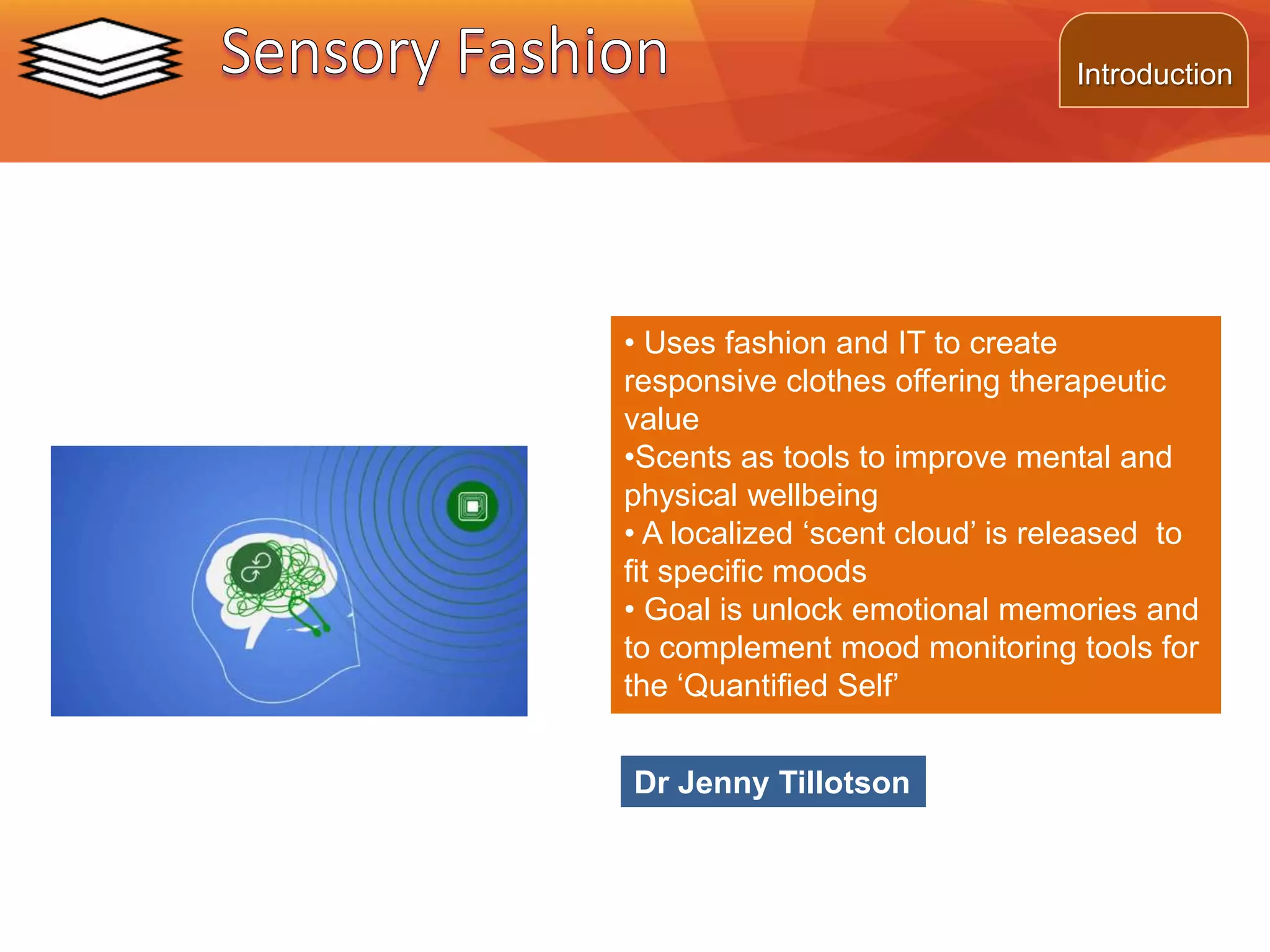
• Uses fashion and IT to create
responsive clothes offering therapeutic
value
•Scents as tools to improve mental and
physical wellbeing
• A localized ‘scent cloud’ is released to
fit specific moods
• Goal is unlock emotional memories and
to complement mood monitoring tools for
the ‘Quantified Self’
Dr Jenny Tillotson
©2014 L. SCHLENKER
Introduction

Gem innovation

  • 1.
  • 2.
  • 3.
    3 Date Subject 23 FebruaryIntroduction 23 February Innovation 10 March Technology 10 March Management Decision Making 11 March Social Business How does information technology contribute to business innovation in the digital economy? ©2016 LHST sarl Introduction
  • 4.
    Giffgaff - gaelicfor mutual giving reflected in their manifesto Social CRM : member gets member, eVouchers, goodybags Customer service is member driven Giffgaff labs – crowdsourcing product testing Payback for miles, cash or charities Introduction
  • 5.
    ©2016 LHST sarl Introduction I.Unexpected Occurrences II. Incongruities III. Process Needs IV. Industry and Market Changes V. Demographic Changes VI. Changes in Perception VII. New Knowledge Innovative ideas come from methodically analyzing seven areas of opportunity…. Within a company/industry Social and Intellectual Environment The Discipline of Innovation Peter F. Drucker
  • 6.
    Economic development consistsof three distinguishable stages of invention, innovation and imitation An ’invention’ is an idea, a sketch or model for a new or improved device, product, process or system. An ’innovation’ is accomplished with the commercial transactions of the product, process, system or device. Joseph Schumpeter Introduction
  • 7.
    ©2016 L. SCHLENKER Productinnovation, which involves the introduction of a new good or service that is substantially improved. Process innovation involves the implementation of a new or significantly improved production or delivery method. Marketing innovation is the development of new marketing methods with improvement in product design or packaging, product promotion or pricing. Organizational innovation (also referred to as social innovation) involves the creation of new organizations, business practices, ways of running organizations or new organizational behavior. Business Model innovation involves changing the way business is done Introduction
  • 8.
    Julien Birkinshaw Introduction 0 5,000 10,000 15,000 20,000 25,000 30,000 35,000 40,000 45,000 Technological ProductBusiness / business model Strategy / strategic Organizational / organisational Administrative Management Numberofhits
  • 9.
    Bessant and Tidd(2007) ◦ Product innovation: changes in the things which an organization offers ◦ Process innovation: changes in the ways in which they are created an delivered ◦ Position innovation: changes in the context in which the product or services are introduced ◦ Paradigm innovation: changes in the underlying mental modes of what an organization does ©2016 L. SCHLENKER Introduction https://padlet.com/leeschlenker/Laas
  • 10.
    Introduction • Place -changes in geography, time, physical resources and budget • Platform – enriching how information is produced and consumed • People – modifying the frame of reference • Practice - impacting the reality of management Schlenker (2015)
  • 11.
    Tidd et al.(2005) ©2016 L. SCHLENKER
  • 12.
    Introduction From 1950 tothe mid-1960’s, fast economic growth allowed for a strong ‘technology push’ Companies focused predominantly on scientific breakthroughs Innovation is a simple linear process with emphasis on R&D Market information (customer demands) are integrated very late in the process Roy Rothwell Laser Technologies
  • 13.
    The mid 1960’sto early 1970 were characterized by a ‘market shares battle’ Because of increasing competition, companies to shift their development focus to a ‘need pull’ The central focus is responding to the market’s needs. Too much emphasis on improving existing products to meet market needs Roy Rothwell Telephones, Baidu Introduction
  • 14.
    Introduction From the mid1970’s to the mid- 1980’s are marked by inflation and stagflation Strategic focus was on corporate consolidation and product portfolios’ R&D and marketing play a balanced role in cost reductions The focus is on technological opportunities rather than societal needs Research Knowledge Potential market Invent and/or produce analytic design Detailed design and test Redesign and product Distribute and market D I S D: Direct link to and from researchfrom problems ininvention and design I: Support ofscientific research by instruments, machines, tools S: Support of researchinsciences underlying the product areas K K K Roy Rothwell ATMs
  • 15.
    ©2016 L. SCHLENKER Marketing R&D Product development Components manufacture Product manufacture Early1980’s to the mid-90’s the central theme became optimizing product life cycles. Focus was on integrated processes to develop ‘total concepts’ More emphasis on the role of feedback and the cross- functional character of innovation Emphasizes on concurrent learning with customers and suppliers Nissan
  • 16.
    EXTERNAL INPUTS: societal needs; competitors; supplierpartnerships; distributors; customers; strategic alliances. EXTERNAL INPUTS: scientific and technological development; competitors; suppliers; customers; university departments. Organisation and business strategy EXTERNAL INPUTS: macro factors ROI costs; competition. Organisation’s knowledge base accumulates knowledge over time New products Source: Trott, 2005 Spotify and the music industry Introduction
  • 17.
    The use ofpurposive inflows and outflows of knowledge to accelerate internal innovation, and expand the markets for external use of innovation, respectively. Introduction
  • 18.
    • InnoCentive isan "open innovation" company that tackles research an development problems • Open Innovation suggests that innovation is more likely to come from a community than from an organization • The model addresses problems in engineering, computer science, math, the physical sciences and business. • Cash awards are given for solving challenge problems typically from $10,000 to $100,000. Introduction
  • 19.
    ©2016 L. SCHLENKER Closedinnovation Open innovation All the best people are working for us Not all the best people are working for us . We must work with clever people within and outside our company. R&D creates profit only when we invent, develop and market everything ourselves. External R&D can create remarkable value; to employ it, we need absorption capacity, often as internal R&D. If we develop the product ourselves, we will be the first on the market. R&D can create profit even if we do not initialize and perform it ourselves. Winner is who gets the innovation to the market first. To develop better business model is more important than to be the first in the market. We will win if we develop most of the ideas (an the best of them). We will win if we make best use of internal and external ideas. We must have our intellectual property under control so that our competitors can make advantage of it. We must be able to profit from others using our intellectual property and we must license the intellectual property if it supports our business model.
  • 20.
    • What ifthe devices “completely go away to be absorbed into the fabric of our lives?” • Smart pills are an example of ambient technologies that integrate into our environments • These Invisibles will create a world in which we don’t see technology or sensors • Can technology become human – reacting to what makes each one of us unique? http://youtu.be/-hhOtjdkU34 ©2014 L. SCHLENKER Introduction
  • 21.
    • Uses fashionand IT to create responsive clothes offering therapeutic value •Scents as tools to improve mental and physical wellbeing • A localized ‘scent cloud’ is released to fit specific moods • Goal is unlock emotional memories and to complement mood monitoring tools for the ‘Quantified Self’ Dr Jenny Tillotson ©2014 L. SCHLENKER Introduction