EMULSION
Presented By;
Sibtain Shoukat
Mubashir Rehmat
Maryam Qadeer
Maryam Khalid
Noor Fatima
Ammara Habib
Presented By;
Ma’m Maria Malook
Emulsion
Definition;
An emulsion is thermodynamically unstable system
containing at least two immiscible liquid phases,one of which is dispersed
as globules in the other liquid phase, stabilize by the presence of an
emulsifying agent.
Phases;
1-Internal phase
2-External phase
.
Internal phase;
In emulsion the component which is present in the
form of small droplet.
External phase;
In emulsion the other component present as liquid.
Particle diameter;
The particle diameter as small as 0.01 micrometre and
as large as 100 micrometer are not uncommon in some preparation.
Composition of Emulsion
Emulsion usually consist of three components;
1- Aqueous phase
2-Oily phase
3-Emulsifying Agent
Aqueous phase;
The aqueous phase of an emulsion consists of purified or deionized
water which contains water soluble drug preservative,coloring and flavoring
agents.If tap water or hard water is used in the formulation it has adverse effect
on the stability of emulsion.
Oily phase;
The oily phase of an emulsion consists of fixed, volatile, or mineral oil,
which contains oil-soluble vitamins and antiseptics. The oil used in the formation
of an emulsion should be prevented from auto-oxidation as well as from microbes.
Emulsifying agents;
It is the component of the emulsion that binds the two
immiscible liquids by forming a film around the dispersed globules and makes the
emulsion stable. So, it prevents the two liquids (water and oil) from separating as
two distinct layers. The emulsifying agents are of great importance in any type of
emulsion, i.e., o/w, w/o, multiple, or micro emulsions.
Types of emulsion:
1-Oil in water emulsion (o/w)
2-Water in oil emulsion (w/o)
3-Multiple emulsions
4-Micro emulsion
1-Oil in water emulsion (o/w);
The emulsion in which the external phase is water and the
internal phase is surrounded by an emulsifying agent is called an oil in water
emulsion (o/w).
Example;
Milk is a natural emulsion of the o/w type. Most emulsions designed for
oral administration are of o/w type. Emulsified creams and lotions are either of w/o
or o/w type depending on their use.
2-Water in oil emulsion (w/o);
The emulsion in which the external phase is oil and
the internal phase is surrounded by an emulsifying agent is called a water in oil
emulsion.
Example;
Solid creams and butter are w/o types of emulsions.
3-Multiple Emulsions:
Emulsions in which o/w or w/o emulsions are dispersed in
another liquid medium are called multiple emulsions.
Example;
When very small droplets of oil are dispersed in the water
globules of w/o emulsions, it is called o/w/o emulsions. And when very small
droplets of water are dispersed in oily globules of o/w emulsions, it is called w/o/w
emulsions.
4-Micro emulsions:
Clear dispersion of oil in water or water in oil is designated as
micro emulsions. They are also known as a solubilized system.
Micro emulsions can be prepared with an emulsifying agent, giving a negative
interfacial tension. They are also free from some of the stability problems of
emulsions.
Difference between micro and coarse emulsion
Following are the differences between micro emulsions and coarse emulsions:
❋Micro emulsions contain particles at least an order of
magnitude smaller than those in coarse emulsions.
❋Micro emulsions are clear, while coarse emulsions are
cloudy.
❋Micro emulsions can be formed spontaneously, while
others require vigorous shaking.
Micro emulsions are used in;
• Floor waxes, shaving lotions
• Beverage concentrates
• Pesticide preparations
• Cold creams
Classification of emulsifying agents
Emulsifying agents are classified as follows.
1) Synthetic emulsifying agents.
2) Finally divided emulsifying agents.
3) Natural emulsifying agents.
4) Auxiliary emulsifying agents.
1) SYNTHETIC EMULSIFYING AGENTS
Surfactants are used as synthetic emulsifying agents.
I. Anionic/anion active surfactants:
They ionize in aqueous solutions into a large anion which is responsible for their
emulsifying ability
Examples are soaps of mono-valent and divalent metals. sulphated compounds like sodium laury!
sulphate. Sodium cetyl sulphate, sulphonated compounds like dioctyl sodium sulfosuccinate,
efc.
II. Cationics/cation active surfactants:
They ionize in aqueous solutions into large cations, responsible for their
emulsifying ability.
Examples are benzylkonium chloride, cetyl trimethyl ammonium bromide, etc.
III. Non-ionic surfactants:
They do not ionize in aqueous solutions.
Examples are glyceryl monostearate, spans and tweens. This is the most widely used classes of
surfactants in pharmaceutical industries because they offer a wide range of physical properties and
are stable over a wide ranige of pH.
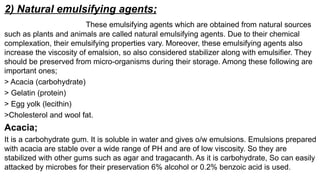
2) Natural emulsifying agents;
These emulsifying agents which are obtained from natural sources
such as plants and animals are called natural emulsifying agents. Due to their chemical
complexation, their emulsifying properties vary. Moreover, these emulsifying agents also
increase the viscosity of emalsion, so also considered stabilizer along with emulsifier. They
should be preserved from micro-organisms during their storage. Among these following are
important ones;
> Acacia (carbohydrate)
> Gelatin (protein)
> Egg yolk (lecithin)
>Cholesterol and wool fat.
Acacia;
It is a carbohydrate gum. It is soluble in water and gives o/w emulsions. Emulsions prepared
with acacia are stable over a wide range of PH and are of low viscosity. So they are
stabilized with other gums such as agar and tragacanth. As it is carbohydrate, So can easily
attacked by microbes for their preservation 6% alcohol or 0.2% benzoic acid is used.
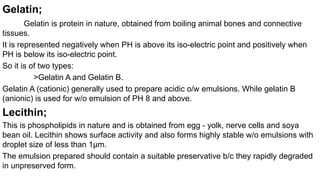
Gelatin;
Gelatin is protein in nature, obtained from boiling animal bones and connective
tissues.
It is represented negatively when PH is above its iso-electric point and positively when
PH is below its iso-electric point.
So it is of two types:
>Gelatin A and Gelatin B.
Gelatin A (cationic) generally used to prepare acidic o/w emulsions. While gelatin B
(anionic) is used for w/o emulsion of PH 8 and above.
Lecithin;
This is phospholipids in nature and is obtained from egg - yolk, nerve cells and soya
bean oil. Lecithin shows surface activity and also forms highly stable w/o emulsions with
droplet size of less than 1µm.
The emulsion prepared should contain a suitable preservative b/c they rapidly degraded
in unpreserved form.
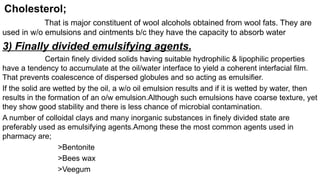
Cholesterol;
That is major constituent of wool alcohols obtained from wool fats. They are
used in w/o emulsions and ointments b/c they have the capacity to absorb water
3) Finally divided emulsifying agents.
Certain finely divided solids having suitable hydrophilic & lipophilic properties
have a tendency to accumulate at the oil/water interface to yield a coherent interfacial film.
That prevents coalescence of dispersed globules and so acting as emulsifier.
If the solid are wetted by the oil, a w/o oil emulsion results and if it is wetted by water, then
results in the formation of an o/w emulsion.Although such emulsions have coarse texture, yet
they show good stability and there is less chance of microbial contamination.
A number of colloidal clays and many inorganic substances in finely divided state are
preferably used as emulsifying agents.Among these the most common agents used in
pharmacy are;
>Bentonite
>Bees wax
>Veegum
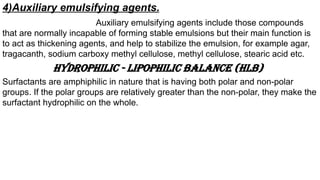
4)Auxiliary emulsifying agents.
Auxiliary emulsifying agents include those compounds
that are normally incapable of forming stable emulsions but their main function is
to act as thickening agents, and help to stabilize the emulsion, for example agar,
tragacanth, sodium carboxy methyl cellulose, methyl cellulose, stearic acid etc.
HYDROPHILIC - LIPOPHILIC BALANCE (HLB)
Surfactants are amphiphilic in nature that is having both polar and non-polar
groups. If the polar groups are relatively greater than the non-polar, they make the
surfactant hydrophilic on the whole.

Emulsion in pharmaceutics with it's application and uses

  • 1.
    EMULSION Presented By; Sibtain Shoukat MubashirRehmat Maryam Qadeer Maryam Khalid Noor Fatima Ammara Habib Presented By; Ma’m Maria Malook
  • 2.
    Emulsion Definition; An emulsion isthermodynamically unstable system containing at least two immiscible liquid phases,one of which is dispersed as globules in the other liquid phase, stabilize by the presence of an emulsifying agent. Phases; 1-Internal phase 2-External phase
  • 3.
    . Internal phase; In emulsionthe component which is present in the form of small droplet. External phase; In emulsion the other component present as liquid. Particle diameter; The particle diameter as small as 0.01 micrometre and as large as 100 micrometer are not uncommon in some preparation. Composition of Emulsion Emulsion usually consist of three components; 1- Aqueous phase 2-Oily phase 3-Emulsifying Agent
  • 4.
    Aqueous phase; The aqueousphase of an emulsion consists of purified or deionized water which contains water soluble drug preservative,coloring and flavoring agents.If tap water or hard water is used in the formulation it has adverse effect on the stability of emulsion. Oily phase; The oily phase of an emulsion consists of fixed, volatile, or mineral oil, which contains oil-soluble vitamins and antiseptics. The oil used in the formation of an emulsion should be prevented from auto-oxidation as well as from microbes. Emulsifying agents; It is the component of the emulsion that binds the two immiscible liquids by forming a film around the dispersed globules and makes the emulsion stable. So, it prevents the two liquids (water and oil) from separating as two distinct layers. The emulsifying agents are of great importance in any type of emulsion, i.e., o/w, w/o, multiple, or micro emulsions.
  • 5.
    Types of emulsion: 1-Oilin water emulsion (o/w) 2-Water in oil emulsion (w/o) 3-Multiple emulsions 4-Micro emulsion 1-Oil in water emulsion (o/w); The emulsion in which the external phase is water and the internal phase is surrounded by an emulsifying agent is called an oil in water emulsion (o/w). Example; Milk is a natural emulsion of the o/w type. Most emulsions designed for oral administration are of o/w type. Emulsified creams and lotions are either of w/o or o/w type depending on their use.
  • 6.
    2-Water in oilemulsion (w/o); The emulsion in which the external phase is oil and the internal phase is surrounded by an emulsifying agent is called a water in oil emulsion. Example; Solid creams and butter are w/o types of emulsions. 3-Multiple Emulsions: Emulsions in which o/w or w/o emulsions are dispersed in another liquid medium are called multiple emulsions. Example; When very small droplets of oil are dispersed in the water globules of w/o emulsions, it is called o/w/o emulsions. And when very small droplets of water are dispersed in oily globules of o/w emulsions, it is called w/o/w emulsions.
  • 7.
    4-Micro emulsions: Clear dispersionof oil in water or water in oil is designated as micro emulsions. They are also known as a solubilized system. Micro emulsions can be prepared with an emulsifying agent, giving a negative interfacial tension. They are also free from some of the stability problems of emulsions. Difference between micro and coarse emulsion Following are the differences between micro emulsions and coarse emulsions: ❋Micro emulsions contain particles at least an order of magnitude smaller than those in coarse emulsions. ❋Micro emulsions are clear, while coarse emulsions are cloudy. ❋Micro emulsions can be formed spontaneously, while others require vigorous shaking.
  • 8.
    Micro emulsions areused in; • Floor waxes, shaving lotions • Beverage concentrates • Pesticide preparations • Cold creams Classification of emulsifying agents Emulsifying agents are classified as follows. 1) Synthetic emulsifying agents. 2) Finally divided emulsifying agents. 3) Natural emulsifying agents. 4) Auxiliary emulsifying agents.
  • 9.
    1) SYNTHETIC EMULSIFYINGAGENTS Surfactants are used as synthetic emulsifying agents. I. Anionic/anion active surfactants: They ionize in aqueous solutions into a large anion which is responsible for their emulsifying ability Examples are soaps of mono-valent and divalent metals. sulphated compounds like sodium laury! sulphate. Sodium cetyl sulphate, sulphonated compounds like dioctyl sodium sulfosuccinate, efc. II. Cationics/cation active surfactants: They ionize in aqueous solutions into large cations, responsible for their emulsifying ability. Examples are benzylkonium chloride, cetyl trimethyl ammonium bromide, etc. III. Non-ionic surfactants: They do not ionize in aqueous solutions. Examples are glyceryl monostearate, spans and tweens. This is the most widely used classes of surfactants in pharmaceutical industries because they offer a wide range of physical properties and are stable over a wide ranige of pH.
  • 10.
    2) Natural emulsifyingagents; These emulsifying agents which are obtained from natural sources such as plants and animals are called natural emulsifying agents. Due to their chemical complexation, their emulsifying properties vary. Moreover, these emulsifying agents also increase the viscosity of emalsion, so also considered stabilizer along with emulsifier. They should be preserved from micro-organisms during their storage. Among these following are important ones; > Acacia (carbohydrate) > Gelatin (protein) > Egg yolk (lecithin) >Cholesterol and wool fat. Acacia; It is a carbohydrate gum. It is soluble in water and gives o/w emulsions. Emulsions prepared with acacia are stable over a wide range of PH and are of low viscosity. So they are stabilized with other gums such as agar and tragacanth. As it is carbohydrate, So can easily attacked by microbes for their preservation 6% alcohol or 0.2% benzoic acid is used.
  • 11.
    Gelatin; Gelatin is proteinin nature, obtained from boiling animal bones and connective tissues. It is represented negatively when PH is above its iso-electric point and positively when PH is below its iso-electric point. So it is of two types: >Gelatin A and Gelatin B. Gelatin A (cationic) generally used to prepare acidic o/w emulsions. While gelatin B (anionic) is used for w/o emulsion of PH 8 and above. Lecithin; This is phospholipids in nature and is obtained from egg - yolk, nerve cells and soya bean oil. Lecithin shows surface activity and also forms highly stable w/o emulsions with droplet size of less than 1µm. The emulsion prepared should contain a suitable preservative b/c they rapidly degraded in unpreserved form.
  • 12.
    Cholesterol; That is majorconstituent of wool alcohols obtained from wool fats. They are used in w/o emulsions and ointments b/c they have the capacity to absorb water 3) Finally divided emulsifying agents. Certain finely divided solids having suitable hydrophilic & lipophilic properties have a tendency to accumulate at the oil/water interface to yield a coherent interfacial film. That prevents coalescence of dispersed globules and so acting as emulsifier. If the solid are wetted by the oil, a w/o oil emulsion results and if it is wetted by water, then results in the formation of an o/w emulsion.Although such emulsions have coarse texture, yet they show good stability and there is less chance of microbial contamination. A number of colloidal clays and many inorganic substances in finely divided state are preferably used as emulsifying agents.Among these the most common agents used in pharmacy are; >Bentonite >Bees wax >Veegum
  • 13.
    4)Auxiliary emulsifying agents. Auxiliaryemulsifying agents include those compounds that are normally incapable of forming stable emulsions but their main function is to act as thickening agents, and help to stabilize the emulsion, for example agar, tragacanth, sodium carboxy methyl cellulose, methyl cellulose, stearic acid etc. HYDROPHILIC - LIPOPHILIC BALANCE (HLB) Surfactants are amphiphilic in nature that is having both polar and non-polar groups. If the polar groups are relatively greater than the non-polar, they make the surfactant hydrophilic on the whole.