UGI 4404FGX3
Chemical analysis
C Si Mn Ni Cr Mo Cu P S
≤0.03  1.0  2.0 11 - 13 16.5 - 18.5 2 - 2.5 ≤0.6  0.04 0.010 - 0.020
25/09/2012 – Rev.00
Although Ugitech takes special care to check the accuracy of the information printed here, it cannot guarantee that this information is accurate, reliable, comprehensive and reproducible as such on its customers'
premises. Ugitech disclaims all responsibility for the use of the data indicated above and invites you to contact its Technical Assistance Department for a specific study of your needs.
General
presentation
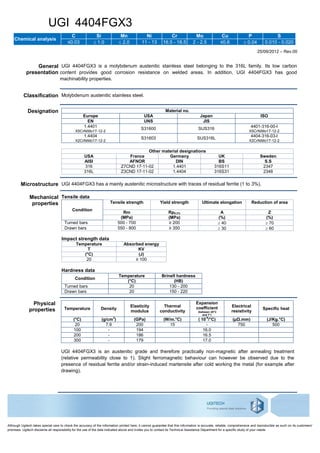
UGI 4404FGX3 is a molybdenum austenitic stainless steel belonging to the 316L family. Its low carbon
content provides good corrosion resistance on welded areas. In addition, UGI 4404FGX3 has good
machinability properties.
Classification Molybdenum austenitic stainless steel.
Designation Material no.
Europe USA Japan ISO
EN UNS JIS
1.4401
X5CrNiMo17-12-2
S31600 SUS316
4401-316-00-I
X5CrNiMo17-12-2
1.4404
X2CrNiMo17-12-2
S31603 SUS316L
4404-316-03-I
X2CrNiMo17-12-2
Other material designations
USA France Germany UK Sweden
AISI AFNOR DIN BS S.S
316 Z7CND 17-11-02 1.4401 316S11 2347
316L Z3CND 17-11-02 1.4404 316S31 2348
Microstructure UGI 4404FGX3 has a mainly austenitic microstructure with traces of residual ferrite (1 to 3%).
Mechanical
properties
Tensile data
Condition
Tensile strength Yield strength Ultimate elongation Reduction of area
Rm Rp0.2% A Z
(MPa) (MPa) (%) (%)
Turned bars 500 - 700 ≥ 200  40  70
Drawn bars 550 - 800 ≥ 350  30  60
Impact strength data
Temperature Absorbed energy
T KV
(°C) (J)
20 ≥ 100
Hardness data
Condition
Temperature Brinell hardness
(°C) (HB)
Turned bars 20 130 - 200
Drawn bars 20 150 - 220
Physical
properties Temperature Density
Elasticity
modulus
Thermal
conductivity
Expansion
coefficient
(between 20°C
and T°)
Electrical
resistivity
Specific heat
(°C) (g/cm3
) (GPa) (W/m.°C) ( 10-6
/°C) (µΩ.mm) (J/Kg.°C)
20 7.9 200 15 - 750 500
100 - 194 16.0
200 - 186 16.5
300 - 179 17.0
UGI 4404FGX3 is an austenitic grade and therefore practically non-magnetic after annealing treatment
(relative permeability close to 1). Slight ferromagnetic behaviour can however be observed due to the
presence of residual ferrite and/or strain-induced martensite after cold working the metal (for example after
drawing).
UGI 4404FGX3
Chemical analysis
C Si Mn Ni Cr Mo Cu P S
≤0.03  1.0  2.0 11 - 13 16.5 - 18.5 2 - 2.5 ≤0.6  0.04 0.010 - 0.020
25/09/2012 – Rev.00
Avenue Paul Girod
73403 UGINE Cedex – France
www.ugitech.com
2
Although Ugitech takes special care to check the accuracy of the information printed here, it cannot guarantee that this information is accurate, reliable, comprehensive and reproducible as such on its
customers' premises. Ugitech disclaims all responsibility for the use of the data indicated above and invites you to contact its Technical Assistance Department for a specific study of your needs.
Corrosion
resistance
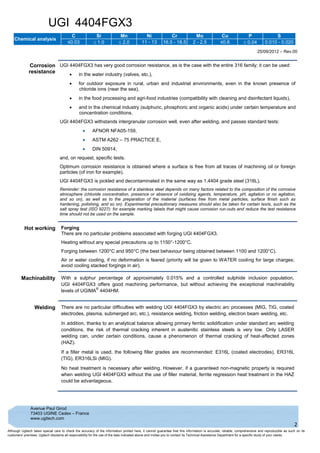
UGI 4404FGX3 has very good corrosion resistance, as is the case with the entire 316 family; it can be used:
 in the water industry (valves, etc.),
 for outdoor exposure in rural, urban and industrial environments, even in the known presence of
chloride ions (near the sea),
 in the food processing and agri-food industries (compatibility with cleaning and disinfectant liquids),
 and in the chemical industry (sulphuric, phosphoric and organic acids) under certain temperature and
concentration conditions.
UGI 4404FGX3 withstands intergranular corrosion well, even after welding, and passes standard tests:
 AFNOR NFA05-159,
 ASTM A262 – 75 PRACTICE E,
 DIN 50914,
and, on request, specific tests.
Optimum corrosion resistance is obtained where a surface is free from all traces of machining oil or foreign
particles (of iron for example).
UGI 4404FGX3 is pickled and decontaminated in the same way as 1.4404 grade steel (316L).
Reminder: the corrosion resistance of a stainless steel depends on many factors related to the composition of the corrosive
atmosphere (chloride concentration, presence or absence of oxidizing agents, temperature, pH, agitation or no agitation,
and so on), as well as to the preparation of the material (surfaces free from metal particles, surface finish such as
hardening, polishing, and so on). Experimental precautionary measures should also be taken for certain tests, such as the
salt spray test (ISO 9227): for example marking labels that might cause corrosion run-outs and reduce the test resistance
time should not be used on the sample.
Hot working Forging
There are no particular problems associated with forging UGI 4404FGX3.
Heating without any special precautions up to 1150°-1200°C.
Forging between 1200°C and 950°C (the best behaviour being obtained between 1100 and 1200°C).
Air or water cooling, if no deformation is feared (priority will be given to WATER cooling for large charges;
avoid cooling stacked forgings in air).
Machinability With a sulphur percentage of approximately 0.015% and a controlled sulphide inclusion population,
UGI 4404FGX3 offers good machining performance, but without achieving the exceptional machinability
levels of UGIMA
®
4404HM.
Welding There are no particular difficulties with welding UGI 4404FGX3 by electric arc processes (MIG, TIG, coated
electrodes, plasma, submerged arc, etc.), resistance welding, friction welding, electron beam welding, etc.
In addition, thanks to an analytical balance allowing primary ferritic solidification under standard arc welding
conditions, the risk of thermal cracking inherent in austenitic stainless steels is very low. Only LASER
welding can, under certain conditions, cause a phenomenon of thermal cracking of heat-affected zones
(HAZ).
If a filler metal is used, the following filler grades are recommended: E316L (coated electrodes), ER316L
(TIG), ER316LSi (MIG).
No heat treatment is necessary after welding. However, if a guaranteed non-magnetic property is required
when welding UGI 4404FGX3 without the use of filler material, ferrite regression heat treatment in the HAZ
could be advantageous.
UGI 4404FGX3
Chemical analysis
C Si Mn Ni Cr Mo Cu P S
≤0.03  1.0  2.0 11 - 13 16.5 - 18.5 2 - 2.5 ≤0.6  0.04 0.010 - 0.020
25/09/2012 – Rev.00
Avenue Paul Girod
73403 UGINE Cedex – France
www.ugitech.com
3
Although Ugitech takes special care to check the accuracy of the information printed here, it cannot guarantee that this information is accurate, reliable, comprehensive and reproducible as such on its
customers' premises. Ugitech disclaims all responsibility for the use of the data indicated above and invites you to contact its Technical Assistance Department for a specific study of your needs.
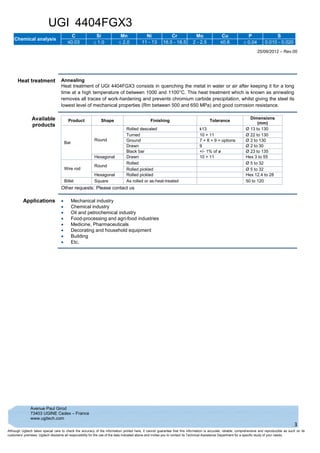
Heat treatment Annealing
Heat treatment of UGI 4404FGX3 consists in quenching the metal in water or air after keeping it for a long
time at a high temperature of between 1000 and 1100°C. This heat treatment which is known as annealing
removes all traces of work-hardening and prevents chromium carbide precipitation, whilst giving the steel its
lowest level of mechanical properties (Rm between 500 and 650 MPa) and good corrosion resistance.
Available
products
Product Shape Finishing Tolerance
Dimensions
(mm)
Bar
Round
Rolled descaled k13 Ø 13 to 130
Turned 10 + 11 Ø 22 to 130
Ground 7 + 8 + 9 + options Ø 2 to 130
Drawn 9 Ø 2 to 30
Black bar +/- 1% of ø Ø 23 to 135
Hexagonal Drawn 10 + 11 Hex 3 to 55
Wire rod
Round
Rolled Ø 5 to 32
Rolled pickled Ø 5 to 32
Hexagonal Rolled pickled Hex 12.4 to 28
Billet Square As rolled or as-heat-treated 50 to 120
Other requests: Please contact us
Applications  Mechanical industry
 Chemical industry
 Oil and petrochemical industry
 Food-processing and agri-food industries
 Medicine, Pharmaceuticals
 Decorating and household equipment
 Building
 Etc.

Ged 2396

  • 1.
    UGI 4404FGX3 Chemical analysis CSi Mn Ni Cr Mo Cu P S ≤0.03  1.0  2.0 11 - 13 16.5 - 18.5 2 - 2.5 ≤0.6  0.04 0.010 - 0.020 25/09/2012 – Rev.00 Although Ugitech takes special care to check the accuracy of the information printed here, it cannot guarantee that this information is accurate, reliable, comprehensive and reproducible as such on its customers' premises. Ugitech disclaims all responsibility for the use of the data indicated above and invites you to contact its Technical Assistance Department for a specific study of your needs. General presentation UGI 4404FGX3 is a molybdenum austenitic stainless steel belonging to the 316L family. Its low carbon content provides good corrosion resistance on welded areas. In addition, UGI 4404FGX3 has good machinability properties. Classification Molybdenum austenitic stainless steel. Designation Material no. Europe USA Japan ISO EN UNS JIS 1.4401 X5CrNiMo17-12-2 S31600 SUS316 4401-316-00-I X5CrNiMo17-12-2 1.4404 X2CrNiMo17-12-2 S31603 SUS316L 4404-316-03-I X2CrNiMo17-12-2 Other material designations USA France Germany UK Sweden AISI AFNOR DIN BS S.S 316 Z7CND 17-11-02 1.4401 316S11 2347 316L Z3CND 17-11-02 1.4404 316S31 2348 Microstructure UGI 4404FGX3 has a mainly austenitic microstructure with traces of residual ferrite (1 to 3%). Mechanical properties Tensile data Condition Tensile strength Yield strength Ultimate elongation Reduction of area Rm Rp0.2% A Z (MPa) (MPa) (%) (%) Turned bars 500 - 700 ≥ 200  40  70 Drawn bars 550 - 800 ≥ 350  30  60 Impact strength data Temperature Absorbed energy T KV (°C) (J) 20 ≥ 100 Hardness data Condition Temperature Brinell hardness (°C) (HB) Turned bars 20 130 - 200 Drawn bars 20 150 - 220 Physical properties Temperature Density Elasticity modulus Thermal conductivity Expansion coefficient (between 20°C and T°) Electrical resistivity Specific heat (°C) (g/cm3 ) (GPa) (W/m.°C) ( 10-6 /°C) (µΩ.mm) (J/Kg.°C) 20 7.9 200 15 - 750 500 100 - 194 16.0 200 - 186 16.5 300 - 179 17.0 UGI 4404FGX3 is an austenitic grade and therefore practically non-magnetic after annealing treatment (relative permeability close to 1). Slight ferromagnetic behaviour can however be observed due to the presence of residual ferrite and/or strain-induced martensite after cold working the metal (for example after drawing).
  • 2.
    UGI 4404FGX3 Chemical analysis CSi Mn Ni Cr Mo Cu P S ≤0.03  1.0  2.0 11 - 13 16.5 - 18.5 2 - 2.5 ≤0.6  0.04 0.010 - 0.020 25/09/2012 – Rev.00 Avenue Paul Girod 73403 UGINE Cedex – France www.ugitech.com 2 Although Ugitech takes special care to check the accuracy of the information printed here, it cannot guarantee that this information is accurate, reliable, comprehensive and reproducible as such on its customers' premises. Ugitech disclaims all responsibility for the use of the data indicated above and invites you to contact its Technical Assistance Department for a specific study of your needs. Corrosion resistance UGI 4404FGX3 has very good corrosion resistance, as is the case with the entire 316 family; it can be used:  in the water industry (valves, etc.),  for outdoor exposure in rural, urban and industrial environments, even in the known presence of chloride ions (near the sea),  in the food processing and agri-food industries (compatibility with cleaning and disinfectant liquids),  and in the chemical industry (sulphuric, phosphoric and organic acids) under certain temperature and concentration conditions. UGI 4404FGX3 withstands intergranular corrosion well, even after welding, and passes standard tests:  AFNOR NFA05-159,  ASTM A262 – 75 PRACTICE E,  DIN 50914, and, on request, specific tests. Optimum corrosion resistance is obtained where a surface is free from all traces of machining oil or foreign particles (of iron for example). UGI 4404FGX3 is pickled and decontaminated in the same way as 1.4404 grade steel (316L). Reminder: the corrosion resistance of a stainless steel depends on many factors related to the composition of the corrosive atmosphere (chloride concentration, presence or absence of oxidizing agents, temperature, pH, agitation or no agitation, and so on), as well as to the preparation of the material (surfaces free from metal particles, surface finish such as hardening, polishing, and so on). Experimental precautionary measures should also be taken for certain tests, such as the salt spray test (ISO 9227): for example marking labels that might cause corrosion run-outs and reduce the test resistance time should not be used on the sample. Hot working Forging There are no particular problems associated with forging UGI 4404FGX3. Heating without any special precautions up to 1150°-1200°C. Forging between 1200°C and 950°C (the best behaviour being obtained between 1100 and 1200°C). Air or water cooling, if no deformation is feared (priority will be given to WATER cooling for large charges; avoid cooling stacked forgings in air). Machinability With a sulphur percentage of approximately 0.015% and a controlled sulphide inclusion population, UGI 4404FGX3 offers good machining performance, but without achieving the exceptional machinability levels of UGIMA ® 4404HM. Welding There are no particular difficulties with welding UGI 4404FGX3 by electric arc processes (MIG, TIG, coated electrodes, plasma, submerged arc, etc.), resistance welding, friction welding, electron beam welding, etc. In addition, thanks to an analytical balance allowing primary ferritic solidification under standard arc welding conditions, the risk of thermal cracking inherent in austenitic stainless steels is very low. Only LASER welding can, under certain conditions, cause a phenomenon of thermal cracking of heat-affected zones (HAZ). If a filler metal is used, the following filler grades are recommended: E316L (coated electrodes), ER316L (TIG), ER316LSi (MIG). No heat treatment is necessary after welding. However, if a guaranteed non-magnetic property is required when welding UGI 4404FGX3 without the use of filler material, ferrite regression heat treatment in the HAZ could be advantageous.
  • 3.
    UGI 4404FGX3 Chemical analysis CSi Mn Ni Cr Mo Cu P S ≤0.03  1.0  2.0 11 - 13 16.5 - 18.5 2 - 2.5 ≤0.6  0.04 0.010 - 0.020 25/09/2012 – Rev.00 Avenue Paul Girod 73403 UGINE Cedex – France www.ugitech.com 3 Although Ugitech takes special care to check the accuracy of the information printed here, it cannot guarantee that this information is accurate, reliable, comprehensive and reproducible as such on its customers' premises. Ugitech disclaims all responsibility for the use of the data indicated above and invites you to contact its Technical Assistance Department for a specific study of your needs. Heat treatment Annealing Heat treatment of UGI 4404FGX3 consists in quenching the metal in water or air after keeping it for a long time at a high temperature of between 1000 and 1100°C. This heat treatment which is known as annealing removes all traces of work-hardening and prevents chromium carbide precipitation, whilst giving the steel its lowest level of mechanical properties (Rm between 500 and 650 MPa) and good corrosion resistance. Available products Product Shape Finishing Tolerance Dimensions (mm) Bar Round Rolled descaled k13 Ø 13 to 130 Turned 10 + 11 Ø 22 to 130 Ground 7 + 8 + 9 + options Ø 2 to 130 Drawn 9 Ø 2 to 30 Black bar +/- 1% of ø Ø 23 to 135 Hexagonal Drawn 10 + 11 Hex 3 to 55 Wire rod Round Rolled Ø 5 to 32 Rolled pickled Ø 5 to 32 Hexagonal Rolled pickled Hex 12.4 to 28 Billet Square As rolled or as-heat-treated 50 to 120 Other requests: Please contact us Applications  Mechanical industry  Chemical industry  Oil and petrochemical industry  Food-processing and agri-food industries  Medicine, Pharmaceuticals  Decorating and household equipment  Building  Etc.