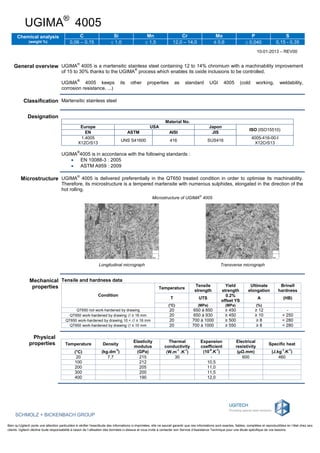
UGIMA®
4005
Chemical analysis
(weight %)
C Si Mn Cr Mo P S
0,06 – 0,15  1,0  1,5 12,0 – 14,0 ≤ 0,6  0,040 0,15 - 0,35
10-01-2013 – REV00
SCHMOLZ + BICKENBACH GROUP
Bien qu’Ugitech porte une attention particulière à vérifier l'exactitude des informations ci-imprimées, elle ne saurait garantir que ces informations sont exactes, fiables, complètes et reproductibles en l’état chez ses
clients. Ugitech décline toute responsabilité à raison de l’utilisation des données ci-dessus et vous invite à contacter son Service d’Assistance Technique pour une étude spécifique de vos besoins.
General overview UGIMA
®
4005 is a martensitic stainless steel containing 12 to 14% chromium with a machinability improvement
of 15 to 30% thanks to the UGIMA
®
process which enables its oxide inclusions to be controlled.
UGIMA
®
4005 keeps its other properties as standard UGI 4005 (cold working, weldability,
corrosion resistance, ...)
Classification Martensitic stainless steel
Designation
Material No.
Europe USA Japon
ISO (ISO15510)
EN ASTM AISI JIS
1.4005
X12CrS13
UNS S41600 416 SUS416
4005-416-00-I
X12CrS13
UGIMA
®
4005 is in accordance with the following standards :
 EN 10088-3 : 2005
 ASTM A959 : 2009
Microstructure UGIMA
®
4005 is delivered preferentially in the QT650 treated condition in order to optimise its machinability.
Therefore, its microstructure is a tempered martensite with numerous sulphides, elongated in the direction of the
hot rolling.
Microstructure of UGIMA®
4005
Longitudinal micrograph Transverse micrograph
Mechanical
properties
Tensile and hardness data
Condition
Temperature
Tensile
strength
Yield
strength
Ultimate
elongation
Brinell
hardness
T UTS
0.2%
offset YS
A (HB)
(°C) (MPa) (MPa) (%)
QT650 not work-hardened by drawing 20 650 à 850 ≥ 450 ≥ 12 -
QT650 work-hardened by drawing  ≥ 16 mm 20 650 à 930 ≥ 450 ≥ 10 < 250
QT650 work-hardened by drawing 10 <  ≤ 16 mm 20 700 à 1000 ≥ 500 ≥ 8 < 280
QT650 work-hardened by drawing  ≤ 10 mm 20 700 à 1000 ≥ 550 ≥ 8 < 280
Physical
properties Temperature Density
Elasticity
modulus
Thermal
conductivity
Expansion
coefficient
Electrical
resistivity
Specific heat
(°C) (kg.dm-3
) (GPa) W.m-1
.K-1
) (10-6
.K-1
) (µΩ.mm) (J.kg-1
.K-1
)
20 7,7 215 30 - 600 460
100 212 10,5
200 205 11,0
300 200 11,5
400 190 12,0
UGIMA®
4005
Chemical analysis
(weight %)
C Si Mn Cr Mo P S
0.06 - 0.15  1.0  1,5 12.0 - 14.0 ≤ 0.6  0.040 0,15 - 0,35
10-01-2013 – REV00
SCHMOLZ + BICKENBACH GROUP
2
Bien qu’Ugitech porte une attention particulière à vérifier l'exactitude des informations ci-imprimées, elle ne saurait garantir que ces informations sont exactes, fiables, complètes et reproductibles en l’état chez
ses clients. Ugitech décline toute responsabilité à raison de l’utilisation des données ci-dessus et vous invite à contacter son Service d’Assistance Technique pour une étude spécifique de vos besoins.
Corrosion
resistance
Corrosion resistance properties of UGIMA
®
4005 are globally the same as those of a standard UGI 4005.
Therefore, storage in an area with low humidity is to be preferred.
Localised corrosion
Pitting corrosion
The following figure shows the pitting potential expressed in mV/SCE; it is measured in a saline environment with
a pH of 6.6 at 23°C and a sodium chloride concentration of 0.002M (116 mg/l, i.e. 0.01%). This kind of
measurement on resulphurised low chromium stainless steel is always highly dispersed and UGIMA® 4005
shows, in this test, dispersion slightly over that of a standard UGI 4005.
Hot working Forging
UGIMA
®
4005 can be forged but it is not suited to severe upsetting operations. The following forging conditions
are recommended:
- Heating temperature between 1150°C and 1220°C
- Forging temperature between 950°C and 1220°C
- Slow cooling rate after forging (furnace or vermiculite)
Machinability Thanks to its controlled oxide inclusions, UGIMA
®
4005 presents an excellent machinability, significantly over
that of a standard 1.4005 like UGI 4005. For identical cutting conditions, UGIMA
®
4005 allows tool wear rates far
below that of observed when cutting a standard 1.4005.
It allows significant productivity increases without decreasing the tool life duration. As examples, the following
table shows for two different cutting tools the VB15/0.15 * measured in turning on UGIMA
®
4005 and UGI 4005 hot
rolled bars comparatively.
VB15/0,15 in turning (without lubricant)
Grade
SECO TM2000
CNMG 120408-MF4
SUMITOMO AC610M
CNMG 120408-GU
UGI 4005 340 m/min 380 m/min
UGIMA
®
4005 ≥ 490 m/min ≥ 510 m/min
* VB15/0.15: cutting speed inducing a tool flank wear of 0,15mm in 15 min of effective cutting for a depth of cut of 1,5 mm and a
feed rate of 0,25 mm/rev (see standard NF ISO 3685).
Welding As a standard 1.4005 like UGI 4005, UGIMA
®
4005 is weldable by most arc welding processes (GMAW, GTAW
with or without filler wire, SMAW, SAW, ...), by laser, resistance welding (spot or seam welding), friction or
electron beam welding processes, ...
Thanks to a “as welded” martensitic structure in Welded metal (WM) as well as in Heat Affected Zone (HAZ) [if
welding without filler wire], UGIMA
®
4005, as well as a standard 1.4005, is not subject to intergranular corrosion
phenomenon due to chromium carbide precipitation and grain boundary déchromisation.
In GMAW and GTAW, the protection gas must be without nitrogen, nor hydrogen, in order to avoid an increasing
risk of hydrogen embrittlement typical of martensitic grades. For the same reason, in SMAW, the electrodes
UGIMA®
4005
Chemical analysis
(weight %)
C Si Mn Cr Mo P S
0.06 - 0.15  1.0  1,5 12.0 - 14.0 ≤ 0.6  0.040 0,15 - 0,35
10-01-2013 – REV00
SCHMOLZ + BICKENBACH GROUP
3
Bien qu’Ugitech porte une attention particulière à vérifier l'exactitude des informations ci-imprimées, elle ne saurait garantir que ces informations sont exactes, fiables, complètes et reproductibles en l’état chez
ses clients. Ugitech décline toute responsabilité à raison de l’utilisation des données ci-dessus et vous invite à contacter son Service d’Assistance Technique pour une étude spécifique de vos besoins.
must be oven-dried (in order to eliminate the residual water present in the coating of electrodes, which can
increase the hydrogen content in the weld).
Because of its quite low carbon content, UGIMA
®
4005 can be arc welded without pre-heating of parts to be
welded. However, a tempering treatment between 200 and 300°C is needed most of the time to improve the
toughness of the HAZ (and that of WM in case of welding without filler wire or with a homogeneous filler wire).
With a homogeneous filler wire, heat treatments between 300 and 550°C are prohibited in order to avoid a fine
carbide precipitation inducing embrittlement of the HAZ and WM.
In case of austenitic filler wire (309L, 308L, ...), a heat treatment between 200 and 300°C can also be used to
improve the HAZ toughness. Heat treatments at higher temperature are prohibited in order to avoid risks of C
migration from HAZ into the WM, which could induce corrosion resistance decrease of the WM.
Heat treatment Annealing
To lower the mechanical properties of UGIMA
®
4005, make a heat treatment of several hours between 745 and
825°C followed by a slow air cooling.
Quenching
To quench UGIMA
®
4005, make a heat treatment between 950°C and 1000°C followed by air or oil cooling.
Tempering
The choice for the tempering temperature depends on the mechanical properties needed (see the graph
hereunder). It is better to avoid temperatures between 400 and 550°C which induce a toughness decrease.
0
5
10
15
20
25
30
35
200
400
600
800
1000
1200
1400
1600
200 300 400 500 600 700 800
TS;0.2%YS(MPa)
Tempering temperature (2h/air cooling)
Tempering curve of UGIMA® 4005
Tensilestrenght
0.2%Yield strength
Elongation
Charpyimpact strength
El(%);KV(daJ/cm²)
Surface
treatment
The possible surface treatments are the same as those used for a standard 1.4005 such as UGI4005.
Available
products
Product Shape Finishing Tolerance Dimensions (mm)
Bars
Round
Hot rolled – Descaled bars k13
22-77 (every mm)
80-115 (every 5 mm)
Cold finished – turned h11 - h10 22-115
Cold finished – turned & polished
h11 - h10
h9
22-115
22-55
Ground bars h9 - h8 - h7 22-115
Cold finished – drawn h9 5-30
Hexagone Cold finished - drawn h11 3-55
Other finishes, tolerances, sizes, profiles on request
Applications Grade used in numerous applications where high machinability is necessary (i.e. for screw machining
of very high number of parts), and when corrosion resistance is not a critical deciding factor.
 Process industry : connectors, fixing
 Automotive industry : injectors
This grade can also be used for its magnetic properties in its annealed condition (solenoid valves).
Avenue Paul Girod
73403 UGINE Cedex - France
www.ugitech.com

Ged 2406

  • 1.
    UGIMA® 4005 Chemical analysis (weight %) CSi Mn Cr Mo P S 0,06 – 0,15  1,0  1,5 12,0 – 14,0 ≤ 0,6  0,040 0,15 - 0,35 10-01-2013 – REV00 SCHMOLZ + BICKENBACH GROUP Bien qu’Ugitech porte une attention particulière à vérifier l'exactitude des informations ci-imprimées, elle ne saurait garantir que ces informations sont exactes, fiables, complètes et reproductibles en l’état chez ses clients. Ugitech décline toute responsabilité à raison de l’utilisation des données ci-dessus et vous invite à contacter son Service d’Assistance Technique pour une étude spécifique de vos besoins. General overview UGIMA ® 4005 is a martensitic stainless steel containing 12 to 14% chromium with a machinability improvement of 15 to 30% thanks to the UGIMA ® process which enables its oxide inclusions to be controlled. UGIMA ® 4005 keeps its other properties as standard UGI 4005 (cold working, weldability, corrosion resistance, ...) Classification Martensitic stainless steel Designation Material No. Europe USA Japon ISO (ISO15510) EN ASTM AISI JIS 1.4005 X12CrS13 UNS S41600 416 SUS416 4005-416-00-I X12CrS13 UGIMA ® 4005 is in accordance with the following standards :  EN 10088-3 : 2005  ASTM A959 : 2009 Microstructure UGIMA ® 4005 is delivered preferentially in the QT650 treated condition in order to optimise its machinability. Therefore, its microstructure is a tempered martensite with numerous sulphides, elongated in the direction of the hot rolling. Microstructure of UGIMA® 4005 Longitudinal micrograph Transverse micrograph Mechanical properties Tensile and hardness data Condition Temperature Tensile strength Yield strength Ultimate elongation Brinell hardness T UTS 0.2% offset YS A (HB) (°C) (MPa) (MPa) (%) QT650 not work-hardened by drawing 20 650 à 850 ≥ 450 ≥ 12 - QT650 work-hardened by drawing  ≥ 16 mm 20 650 à 930 ≥ 450 ≥ 10 < 250 QT650 work-hardened by drawing 10 <  ≤ 16 mm 20 700 à 1000 ≥ 500 ≥ 8 < 280 QT650 work-hardened by drawing  ≤ 10 mm 20 700 à 1000 ≥ 550 ≥ 8 < 280 Physical properties Temperature Density Elasticity modulus Thermal conductivity Expansion coefficient Electrical resistivity Specific heat (°C) (kg.dm-3 ) (GPa) W.m-1 .K-1 ) (10-6 .K-1 ) (µΩ.mm) (J.kg-1 .K-1 ) 20 7,7 215 30 - 600 460 100 212 10,5 200 205 11,0 300 200 11,5 400 190 12,0
  • 2.
    UGIMA® 4005 Chemical analysis (weight %) CSi Mn Cr Mo P S 0.06 - 0.15  1.0  1,5 12.0 - 14.0 ≤ 0.6  0.040 0,15 - 0,35 10-01-2013 – REV00 SCHMOLZ + BICKENBACH GROUP 2 Bien qu’Ugitech porte une attention particulière à vérifier l'exactitude des informations ci-imprimées, elle ne saurait garantir que ces informations sont exactes, fiables, complètes et reproductibles en l’état chez ses clients. Ugitech décline toute responsabilité à raison de l’utilisation des données ci-dessus et vous invite à contacter son Service d’Assistance Technique pour une étude spécifique de vos besoins. Corrosion resistance Corrosion resistance properties of UGIMA ® 4005 are globally the same as those of a standard UGI 4005. Therefore, storage in an area with low humidity is to be preferred. Localised corrosion Pitting corrosion The following figure shows the pitting potential expressed in mV/SCE; it is measured in a saline environment with a pH of 6.6 at 23°C and a sodium chloride concentration of 0.002M (116 mg/l, i.e. 0.01%). This kind of measurement on resulphurised low chromium stainless steel is always highly dispersed and UGIMA® 4005 shows, in this test, dispersion slightly over that of a standard UGI 4005. Hot working Forging UGIMA ® 4005 can be forged but it is not suited to severe upsetting operations. The following forging conditions are recommended: - Heating temperature between 1150°C and 1220°C - Forging temperature between 950°C and 1220°C - Slow cooling rate after forging (furnace or vermiculite) Machinability Thanks to its controlled oxide inclusions, UGIMA ® 4005 presents an excellent machinability, significantly over that of a standard 1.4005 like UGI 4005. For identical cutting conditions, UGIMA ® 4005 allows tool wear rates far below that of observed when cutting a standard 1.4005. It allows significant productivity increases without decreasing the tool life duration. As examples, the following table shows for two different cutting tools the VB15/0.15 * measured in turning on UGIMA ® 4005 and UGI 4005 hot rolled bars comparatively. VB15/0,15 in turning (without lubricant) Grade SECO TM2000 CNMG 120408-MF4 SUMITOMO AC610M CNMG 120408-GU UGI 4005 340 m/min 380 m/min UGIMA ® 4005 ≥ 490 m/min ≥ 510 m/min * VB15/0.15: cutting speed inducing a tool flank wear of 0,15mm in 15 min of effective cutting for a depth of cut of 1,5 mm and a feed rate of 0,25 mm/rev (see standard NF ISO 3685). Welding As a standard 1.4005 like UGI 4005, UGIMA ® 4005 is weldable by most arc welding processes (GMAW, GTAW with or without filler wire, SMAW, SAW, ...), by laser, resistance welding (spot or seam welding), friction or electron beam welding processes, ... Thanks to a “as welded” martensitic structure in Welded metal (WM) as well as in Heat Affected Zone (HAZ) [if welding without filler wire], UGIMA ® 4005, as well as a standard 1.4005, is not subject to intergranular corrosion phenomenon due to chromium carbide precipitation and grain boundary déchromisation. In GMAW and GTAW, the protection gas must be without nitrogen, nor hydrogen, in order to avoid an increasing risk of hydrogen embrittlement typical of martensitic grades. For the same reason, in SMAW, the electrodes
  • 3.
    UGIMA® 4005 Chemical analysis (weight %) CSi Mn Cr Mo P S 0.06 - 0.15  1.0  1,5 12.0 - 14.0 ≤ 0.6  0.040 0,15 - 0,35 10-01-2013 – REV00 SCHMOLZ + BICKENBACH GROUP 3 Bien qu’Ugitech porte une attention particulière à vérifier l'exactitude des informations ci-imprimées, elle ne saurait garantir que ces informations sont exactes, fiables, complètes et reproductibles en l’état chez ses clients. Ugitech décline toute responsabilité à raison de l’utilisation des données ci-dessus et vous invite à contacter son Service d’Assistance Technique pour une étude spécifique de vos besoins. must be oven-dried (in order to eliminate the residual water present in the coating of electrodes, which can increase the hydrogen content in the weld). Because of its quite low carbon content, UGIMA ® 4005 can be arc welded without pre-heating of parts to be welded. However, a tempering treatment between 200 and 300°C is needed most of the time to improve the toughness of the HAZ (and that of WM in case of welding without filler wire or with a homogeneous filler wire). With a homogeneous filler wire, heat treatments between 300 and 550°C are prohibited in order to avoid a fine carbide precipitation inducing embrittlement of the HAZ and WM. In case of austenitic filler wire (309L, 308L, ...), a heat treatment between 200 and 300°C can also be used to improve the HAZ toughness. Heat treatments at higher temperature are prohibited in order to avoid risks of C migration from HAZ into the WM, which could induce corrosion resistance decrease of the WM. Heat treatment Annealing To lower the mechanical properties of UGIMA ® 4005, make a heat treatment of several hours between 745 and 825°C followed by a slow air cooling. Quenching To quench UGIMA ® 4005, make a heat treatment between 950°C and 1000°C followed by air or oil cooling. Tempering The choice for the tempering temperature depends on the mechanical properties needed (see the graph hereunder). It is better to avoid temperatures between 400 and 550°C which induce a toughness decrease. 0 5 10 15 20 25 30 35 200 400 600 800 1000 1200 1400 1600 200 300 400 500 600 700 800 TS;0.2%YS(MPa) Tempering temperature (2h/air cooling) Tempering curve of UGIMA® 4005 Tensilestrenght 0.2%Yield strength Elongation Charpyimpact strength El(%);KV(daJ/cm²) Surface treatment The possible surface treatments are the same as those used for a standard 1.4005 such as UGI4005. Available products Product Shape Finishing Tolerance Dimensions (mm) Bars Round Hot rolled – Descaled bars k13 22-77 (every mm) 80-115 (every 5 mm) Cold finished – turned h11 - h10 22-115 Cold finished – turned & polished h11 - h10 h9 22-115 22-55 Ground bars h9 - h8 - h7 22-115 Cold finished – drawn h9 5-30 Hexagone Cold finished - drawn h11 3-55 Other finishes, tolerances, sizes, profiles on request Applications Grade used in numerous applications where high machinability is necessary (i.e. for screw machining of very high number of parts), and when corrosion resistance is not a critical deciding factor.  Process industry : connectors, fixing  Automotive industry : injectors This grade can also be used for its magnetic properties in its annealed condition (solenoid valves). Avenue Paul Girod 73403 UGINE Cedex - France www.ugitech.com