16 April 2015 – REV 00
Technical
documentation
UGI®
4418 AIR
1
Chemical
analysis (%)
C Si Mn Ni Cr Mo Cu N P S
≤0.060  0.6  1.5 4.0- 5.0 15.0 - 17.0 0.8 - 1.2  0.5 0.020  0.030  0.005
Ugitech SA
Avenue Paul Girod, CS90100, F-73403 UGINE Cedex, www.ugitech.com
Although Ugitech takes special care to check the accuracy of the information printed here, it
cannot guarantee that this information is accurate, reliable, comprehensive and reproducible as
such on its customers' premises.
Ugitech disclaims all responsibility for the use of the data indicated above and invites you to
contact its Technical Assistance Department for a specific study of your needs.
General presentation:
UGI®
4418 AIR stainless steel is a low-carbon super-martensitic grade with the addition of nickel. It is specifically
designed for the aerospace market. It combines high mechanical strength with excellent resilience and very good
corrosion resistance, considerably higher than those of conventional high-carbon Fe-Cr-C martensitic steels. This
grade exhibits excellent cryogenic properties.
Classification:
Martensitic stainless steel
Designation:
Material No. or designation
Europe USA Japan ISO Others
ISO EN 10088-3
EN 4631; EN 4628
UNS JIS ISO 15510
Ex AIR 9160-C
standard
1.4418
(X4CrNiMo16-5-1)
- - 4418-431-77-E Z8CND17-04
Microstructure:
In the quenched and tempered state, the UGI®
4418 AIR microstructure consists predominantly of tempered
martensitic. It may contain traces of ferrite (less than 5%) and residual austenite, depending on the diameter and
the heat treatments used.
Microstructure of UGI
®
4418 AIR in the QT900 quenched and tempered state (longitudinal direction x200)
The microcleanliness guarantees are as follows (rating as per ASTM E45/method A):
Inclusion type
Sulphides
A
Alumina
B
Silicates
C
Globular oxides
D
Fine ≤ 2.0 ≤ 2.0 ≤ 2.0 ≤ 2.0
Thick < 2.0 < 2.0 < 2.0 < 2.0
UGI®
4418 AIR is also available in an electro-slag-remelted (ESR) version.
16 April 2015 – REV 00
Technical
documentation
UGI®
4418 AIR
2
Chemical
analysis (%)
C Si Mn Ni Cr Mo Cu N P S
≤0.060  0.6  1.5 4.0- 5.0 15.0 - 17.0 0.8 - 1.2  0.5 0.020  0.030  0.005
Ugitech SA
Avenue Paul Girod, CS90100, F-73403 UGINE Cedex, www.ugitech.com
Although Ugitech takes special care to check the accuracy of the information printed here, it
cannot guarantee that this information is accurate, reliable, comprehensive and reproducible as
such on its customers' premises.
Ugitech disclaims all responsibility for the use of the data indicated above and invites you to
contact its Technical Assistance Department for a specific study of your needs.
Mechanical properties:
Quenched and tempered turned bars
Heat
treatment
Diameter Direction Temperature
Tensile
strength
Yield
strength
Ultimate
elongation
Resilience Hardness
Ø T Rm Rp0.2 A KV HBW
(mm) (°C) (MPa) (MPa) (%) (J)
Annealed  200 20 < 293
QT900 *
 75
L 20 900 to 1050  700  16  120 269 to 331
L -40  70
> 75
T 20 900 to 1050  700  12  60 269 to 331
T -40  35
QT1100
 75 L 20 1100 to 1250  900  14  100 337 to 380
> 75 T 20 1100 to 1250  900 8  50 337 to 380
QT1150 **
 75
L 20 1150 to 1300  900  14  100 341 to 401
L -30  60
> 75
T 20 1150 to 1300  900  8  50 341 to 401
T -30  20
* : to EN 4631; ** : to EN 4628
Physical properties
Tempera-
ture
Density
Elasticity
modulus
Thermal
conductivity
Expansion
coefficient
between 20°C
and T
Electrical
resistivity
Specific
heat
Magnetizable
(°C) (kg/dm
3
) (GPa) (W/m.°C) (x 10
-6
K
-1
) (µΩ.mm) (J/kg/K) -
20 7.7 200 15 - 800 430 Yes
100 195 10.3
200 185 10.8
300 175 11.2
400 170 11.6
Corrosion resistance
Due to its high percentage of nickel, chromium and molybdenum and its low carbon content, UGI®
4418 AIR has
good corrosion resistance.
Localized corrosion
Pitting corrosion
The pitting potentials were measured as specified in ISO 15158-2014 in a solution containing 0.02M
NaCl at 23°C. UGI®
4418 AIR also has far better pitting corrosion resistance than a 13% Cr martensitic
(type 1.4006). The results show that the pitting corrosion resistance of UGI®
4418 AIR is similar to that of
1.4542 and 1.4307 (containing 0.020% of sulphur).
Grade Pitting potential
(mV/ECS at ± 20 mV)
1.4006 (410) 185
1.4307 (304L) 400
1.4542 (17-4PH) 380
UGI
®
4418 AIR 375
16 April 2015 – REV 00
Technical
documentation
UGI®
4418 AIR
3
Chemical
analysis (%)
C Si Mn Ni Cr Mo Cu N P S
≤0.060  0.6  1.5 4.0- 5.0 15.0 - 17.0 0.8 - 1.2  0.5 0.020  0.030  0.005
Ugitech SA
Avenue Paul Girod, CS90100, F-73403 UGINE Cedex, www.ugitech.com
Although Ugitech takes special care to check the accuracy of the information printed here, it
cannot guarantee that this information is accurate, reliable, comprehensive and reproducible as
such on its customers' premises.
Ugitech disclaims all responsibility for the use of the data indicated above and invites you to
contact its Technical Assistance Department for a specific study of your needs.
Intergranular corrosion
Its structure and composition make UGI®
4418 AIR insensitive to intergranular corrosion.
Hot forming
Forging
Heating between 1150°C and 1200°C is recommended. Hot forming (forging) must preferably be carried out at a
temperature of between 1200°C and 900°C, followed by air cooling. The behaviour of UGI®
4418 AIR during
forging is equivalent to that of a type 1.4301 austenitic grade.
Full heat treatment, austenitizing/quenching followed by tempering, is recommended after hot forming.
Cold forming
UGI®
4418 AIR can be cold formed by conventional cold-working processes (bar drawing, wire drawing, forming,
profiling, etc.). Its high mechanical properties require particular attention. After or during cold-forming operations,
quenching may be necessary to soften the grade. In the event of high levels of deformation, a complete
quenching and tempering process is recommended.
Welding
UGI®
4418 AIR can be welded by electric arc (GMAW, GTAW, SMAW, etc.) and by most other processes (spot
welding, seam welding, LASER, etc.). Due to its low percentage of carbon and its nickel content, UGI®
4418 AIR
is easier to weld than most martensitic stainless steels.
Low-carbon martensite combined with finely dispersed residual austenite gives the heat-affected zones (HAZ) of
UGI®
4418 AIR excellent toughness in the as-welded condition. UGI®
4418 AIR is therefore only slightly
susceptible to cold cracking after welding and it is not normally necessary to preheat the parts, unless the parts to
be welded are very thick or their geometry is liable to generate high stress concentrations at the welds after
cooling (in this case, preheating at 100-120°C is recommended).
If the Weld Metal (WM) does not require the mechanical properties of UGI®
4418 AIR, an austenitic grade such as
A316LM or A316LT can be used as filler metal. Post-weld heat treatment is then generally not necessary.
Where the WM must have the same mechanical properties as those of UGI®
4418 AIR, a homogeneous filler
metal must be used (such as “16 5 1”). In this case, post weld heat treatment at 580-600°C is recommended.
For GMAW with homogeneous filler metal, a slightly oxidizing shielding gas such as Ar + 1-2% CO2 will be
chosen to avoid too high a percentage of oxygen in the WM, thus ensuring good impact properties for these
WMs.
Heat treatment
Softening
UGI®
4418 AIR is difficult to soften due to its chemical composition leading to a very low transformation point
(Ac1). Soft annealing is generally carried out between 600 and 650°C.
16 April 2015 – REV 00
Technical
documentation
UGI®
4418 AIR
4
Chemical
analysis (%)
C Si Mn Ni Cr Mo Cu N P S
≤0.060  0.6  1.5 4.0- 5.0 15.0 - 17.0 0.8 - 1.2  0.5 0.020  0.030  0.005
Ugitech SA
Avenue Paul Girod, CS90100, F-73403 UGINE Cedex, www.ugitech.com
Although Ugitech takes special care to check the accuracy of the information printed here, it
cannot guarantee that this information is accurate, reliable, comprehensive and reproducible as
such on its customers' premises.
Ugitech disclaims all responsibility for the use of the data indicated above and invites you to
contact its Technical Assistance Department for a specific study of your needs.
Quenching
UGI®
4418 AIR quenching heat treatment consists of austenitizing between 1010°C and 1060°C, followed by oil
quenching (or air quenching for smaller sections). To limit the risks of quenching cracks, tempering must be
carried out as soon as possible after the quenching operation, after returning to the ambient temperature.
Tempering
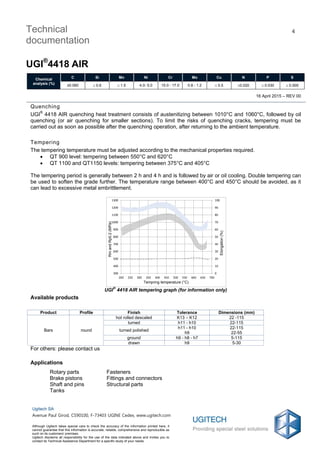
The tempering temperature must be adjusted according to the mechanical properties required.
 QT 900 level: tempering between 550°C and 620°C
 QT 1100 and QT1150 levels: tempering between 375°C and 405°C
The tempering period is generally between 2 h and 4 h and is followed by air or oil cooling. Double tempering can
be used to soften the grade further. The temperature range between 400°C and 450°C should be avoided, as it
can lead to excessive metal embrittlement.
UGI
®
4418 AIR tempering graph (for information only)
Available products
Product Profile Finish Tolerance Dimensions (mm)
Bars round
hot rolled descaled K13 – K12 22 -115
turned h11 - h10 22-115
turned polished
h11 - h10
h9
22-115
22-55
ground h9 - h8 - h7 5-115
drawn h9 5-30
For others: please contact us
Applications
Rotary parts Fasteners
Brake pistons Fittings and connectors
Shaft and pins Structural parts
Tanks
0
10
20
30
40
50
60
70
80
90
100
300
400
500
600
700
800
900
1000
1100
1200
1300
200 250 300 350 400 450 500 550 600 650 700
Allongement(%)
RmetRp0.2(MPa)
Température de revenu (°C)
RmandRp0.2(MPa)
Elongation(%)
Tempring temperature (°C)

Ged 2502

  • 1.
    16 April 2015– REV 00 Technical documentation UGI® 4418 AIR 1 Chemical analysis (%) C Si Mn Ni Cr Mo Cu N P S ≤0.060  0.6  1.5 4.0- 5.0 15.0 - 17.0 0.8 - 1.2  0.5 0.020  0.030  0.005 Ugitech SA Avenue Paul Girod, CS90100, F-73403 UGINE Cedex, www.ugitech.com Although Ugitech takes special care to check the accuracy of the information printed here, it cannot guarantee that this information is accurate, reliable, comprehensive and reproducible as such on its customers' premises. Ugitech disclaims all responsibility for the use of the data indicated above and invites you to contact its Technical Assistance Department for a specific study of your needs. General presentation: UGI® 4418 AIR stainless steel is a low-carbon super-martensitic grade with the addition of nickel. It is specifically designed for the aerospace market. It combines high mechanical strength with excellent resilience and very good corrosion resistance, considerably higher than those of conventional high-carbon Fe-Cr-C martensitic steels. This grade exhibits excellent cryogenic properties. Classification: Martensitic stainless steel Designation: Material No. or designation Europe USA Japan ISO Others ISO EN 10088-3 EN 4631; EN 4628 UNS JIS ISO 15510 Ex AIR 9160-C standard 1.4418 (X4CrNiMo16-5-1) - - 4418-431-77-E Z8CND17-04 Microstructure: In the quenched and tempered state, the UGI® 4418 AIR microstructure consists predominantly of tempered martensitic. It may contain traces of ferrite (less than 5%) and residual austenite, depending on the diameter and the heat treatments used. Microstructure of UGI ® 4418 AIR in the QT900 quenched and tempered state (longitudinal direction x200) The microcleanliness guarantees are as follows (rating as per ASTM E45/method A): Inclusion type Sulphides A Alumina B Silicates C Globular oxides D Fine ≤ 2.0 ≤ 2.0 ≤ 2.0 ≤ 2.0 Thick < 2.0 < 2.0 < 2.0 < 2.0 UGI® 4418 AIR is also available in an electro-slag-remelted (ESR) version.
  • 2.
    16 April 2015– REV 00 Technical documentation UGI® 4418 AIR 2 Chemical analysis (%) C Si Mn Ni Cr Mo Cu N P S ≤0.060  0.6  1.5 4.0- 5.0 15.0 - 17.0 0.8 - 1.2  0.5 0.020  0.030  0.005 Ugitech SA Avenue Paul Girod, CS90100, F-73403 UGINE Cedex, www.ugitech.com Although Ugitech takes special care to check the accuracy of the information printed here, it cannot guarantee that this information is accurate, reliable, comprehensive and reproducible as such on its customers' premises. Ugitech disclaims all responsibility for the use of the data indicated above and invites you to contact its Technical Assistance Department for a specific study of your needs. Mechanical properties: Quenched and tempered turned bars Heat treatment Diameter Direction Temperature Tensile strength Yield strength Ultimate elongation Resilience Hardness Ø T Rm Rp0.2 A KV HBW (mm) (°C) (MPa) (MPa) (%) (J) Annealed  200 20 < 293 QT900 *  75 L 20 900 to 1050  700  16  120 269 to 331 L -40  70 > 75 T 20 900 to 1050  700  12  60 269 to 331 T -40  35 QT1100  75 L 20 1100 to 1250  900  14  100 337 to 380 > 75 T 20 1100 to 1250  900 8  50 337 to 380 QT1150 **  75 L 20 1150 to 1300  900  14  100 341 to 401 L -30  60 > 75 T 20 1150 to 1300  900  8  50 341 to 401 T -30  20 * : to EN 4631; ** : to EN 4628 Physical properties Tempera- ture Density Elasticity modulus Thermal conductivity Expansion coefficient between 20°C and T Electrical resistivity Specific heat Magnetizable (°C) (kg/dm 3 ) (GPa) (W/m.°C) (x 10 -6 K -1 ) (µΩ.mm) (J/kg/K) - 20 7.7 200 15 - 800 430 Yes 100 195 10.3 200 185 10.8 300 175 11.2 400 170 11.6 Corrosion resistance Due to its high percentage of nickel, chromium and molybdenum and its low carbon content, UGI® 4418 AIR has good corrosion resistance. Localized corrosion Pitting corrosion The pitting potentials were measured as specified in ISO 15158-2014 in a solution containing 0.02M NaCl at 23°C. UGI® 4418 AIR also has far better pitting corrosion resistance than a 13% Cr martensitic (type 1.4006). The results show that the pitting corrosion resistance of UGI® 4418 AIR is similar to that of 1.4542 and 1.4307 (containing 0.020% of sulphur). Grade Pitting potential (mV/ECS at ± 20 mV) 1.4006 (410) 185 1.4307 (304L) 400 1.4542 (17-4PH) 380 UGI ® 4418 AIR 375
  • 3.
    16 April 2015– REV 00 Technical documentation UGI® 4418 AIR 3 Chemical analysis (%) C Si Mn Ni Cr Mo Cu N P S ≤0.060  0.6  1.5 4.0- 5.0 15.0 - 17.0 0.8 - 1.2  0.5 0.020  0.030  0.005 Ugitech SA Avenue Paul Girod, CS90100, F-73403 UGINE Cedex, www.ugitech.com Although Ugitech takes special care to check the accuracy of the information printed here, it cannot guarantee that this information is accurate, reliable, comprehensive and reproducible as such on its customers' premises. Ugitech disclaims all responsibility for the use of the data indicated above and invites you to contact its Technical Assistance Department for a specific study of your needs. Intergranular corrosion Its structure and composition make UGI® 4418 AIR insensitive to intergranular corrosion. Hot forming Forging Heating between 1150°C and 1200°C is recommended. Hot forming (forging) must preferably be carried out at a temperature of between 1200°C and 900°C, followed by air cooling. The behaviour of UGI® 4418 AIR during forging is equivalent to that of a type 1.4301 austenitic grade. Full heat treatment, austenitizing/quenching followed by tempering, is recommended after hot forming. Cold forming UGI® 4418 AIR can be cold formed by conventional cold-working processes (bar drawing, wire drawing, forming, profiling, etc.). Its high mechanical properties require particular attention. After or during cold-forming operations, quenching may be necessary to soften the grade. In the event of high levels of deformation, a complete quenching and tempering process is recommended. Welding UGI® 4418 AIR can be welded by electric arc (GMAW, GTAW, SMAW, etc.) and by most other processes (spot welding, seam welding, LASER, etc.). Due to its low percentage of carbon and its nickel content, UGI® 4418 AIR is easier to weld than most martensitic stainless steels. Low-carbon martensite combined with finely dispersed residual austenite gives the heat-affected zones (HAZ) of UGI® 4418 AIR excellent toughness in the as-welded condition. UGI® 4418 AIR is therefore only slightly susceptible to cold cracking after welding and it is not normally necessary to preheat the parts, unless the parts to be welded are very thick or their geometry is liable to generate high stress concentrations at the welds after cooling (in this case, preheating at 100-120°C is recommended). If the Weld Metal (WM) does not require the mechanical properties of UGI® 4418 AIR, an austenitic grade such as A316LM or A316LT can be used as filler metal. Post-weld heat treatment is then generally not necessary. Where the WM must have the same mechanical properties as those of UGI® 4418 AIR, a homogeneous filler metal must be used (such as “16 5 1”). In this case, post weld heat treatment at 580-600°C is recommended. For GMAW with homogeneous filler metal, a slightly oxidizing shielding gas such as Ar + 1-2% CO2 will be chosen to avoid too high a percentage of oxygen in the WM, thus ensuring good impact properties for these WMs. Heat treatment Softening UGI® 4418 AIR is difficult to soften due to its chemical composition leading to a very low transformation point (Ac1). Soft annealing is generally carried out between 600 and 650°C.
  • 4.
    16 April 2015– REV 00 Technical documentation UGI® 4418 AIR 4 Chemical analysis (%) C Si Mn Ni Cr Mo Cu N P S ≤0.060  0.6  1.5 4.0- 5.0 15.0 - 17.0 0.8 - 1.2  0.5 0.020  0.030  0.005 Ugitech SA Avenue Paul Girod, CS90100, F-73403 UGINE Cedex, www.ugitech.com Although Ugitech takes special care to check the accuracy of the information printed here, it cannot guarantee that this information is accurate, reliable, comprehensive and reproducible as such on its customers' premises. Ugitech disclaims all responsibility for the use of the data indicated above and invites you to contact its Technical Assistance Department for a specific study of your needs. Quenching UGI® 4418 AIR quenching heat treatment consists of austenitizing between 1010°C and 1060°C, followed by oil quenching (or air quenching for smaller sections). To limit the risks of quenching cracks, tempering must be carried out as soon as possible after the quenching operation, after returning to the ambient temperature. Tempering The tempering temperature must be adjusted according to the mechanical properties required.  QT 900 level: tempering between 550°C and 620°C  QT 1100 and QT1150 levels: tempering between 375°C and 405°C The tempering period is generally between 2 h and 4 h and is followed by air or oil cooling. Double tempering can be used to soften the grade further. The temperature range between 400°C and 450°C should be avoided, as it can lead to excessive metal embrittlement. UGI ® 4418 AIR tempering graph (for information only) Available products Product Profile Finish Tolerance Dimensions (mm) Bars round hot rolled descaled K13 – K12 22 -115 turned h11 - h10 22-115 turned polished h11 - h10 h9 22-115 22-55 ground h9 - h8 - h7 5-115 drawn h9 5-30 For others: please contact us Applications Rotary parts Fasteners Brake pistons Fittings and connectors Shaft and pins Structural parts Tanks 0 10 20 30 40 50 60 70 80 90 100 300 400 500 600 700 800 900 1000 1100 1200 1300 200 250 300 350 400 450 500 550 600 650 700 Allongement(%) RmetRp0.2(MPa) Température de revenu (°C) RmandRp0.2(MPa) Elongation(%) Tempring temperature (°C)