29-05-2015 – REV 01
Technical Data Sheet
UGI®
4545 AIR - UGI®
15-5PH AIR
1
Chemical composition
(%)
C Si Mn Ni Cr Cu Mo Nb P S
≤ 0.07 ≤ 0.6 ≤ 1,0 4.5 – 5.5 14.5 – 15.3 2.5 – 4.0 ≤ 0.5
 5xC
≤ 0.45
≤ 0.025 ≤ 0.005
Ugitech SA
Avenue Paul Girod, CS90100, 73403 UGINE Cedex, www.ugitech.com
Although Ugitech takes special care to verify the exactitude of the information printed here, it
cannot guarantee that this information is exact, reliable, complete and reproducible as such by its
customers. Ugitech refuses all responsibility for the use of the data indicated above and invites
you to contact its Technical Assistance Department for a specific study of your needs.
General presentation:
UGI®
15-5PH AIR or UGI®
4545 AIR is a PH (Precipitation Hardening) martensitic stainless steel of premium qual-
ity, mainly designed for aerospace purposes. It is used for parts requiring a combination of high strength and high
toughness. This grade also presents a good resistance to fatigue failure. This is an Electro-Slag Remelted mate-
rial (according to AMS 5659 type 2) using the most advanced technology in this field. This elaboration allows a
good homogeneity and isotropy of the structure and high mechanical properties in longitudinal but also transverse
direction.
Classification:
Martensitic stainless steel with Cu precipitation hardening
Designation and general standards
UGI®
15-5PH AIR complies with the most demanding general specifications (AMS, EN, WL, ASTM) and cus-
tomer’s ones
EN WL AMS ASTM Other
EN 2815, EN 2817
EN 2821
AMS 5659 ASTM A564M
X5CrNiCu15-5 1.4545 UNS S15500
XM12
UNS S15500
15-5PH
E-Z5CNU15
Melting Process
EAF + AOD + ESR refining (type 2 of the AMS 5659). The refining process reduces and disperses inclusions, and
it minimizes alloy segregation during solidification to obtain a good structural homogeneity.
Microstructure
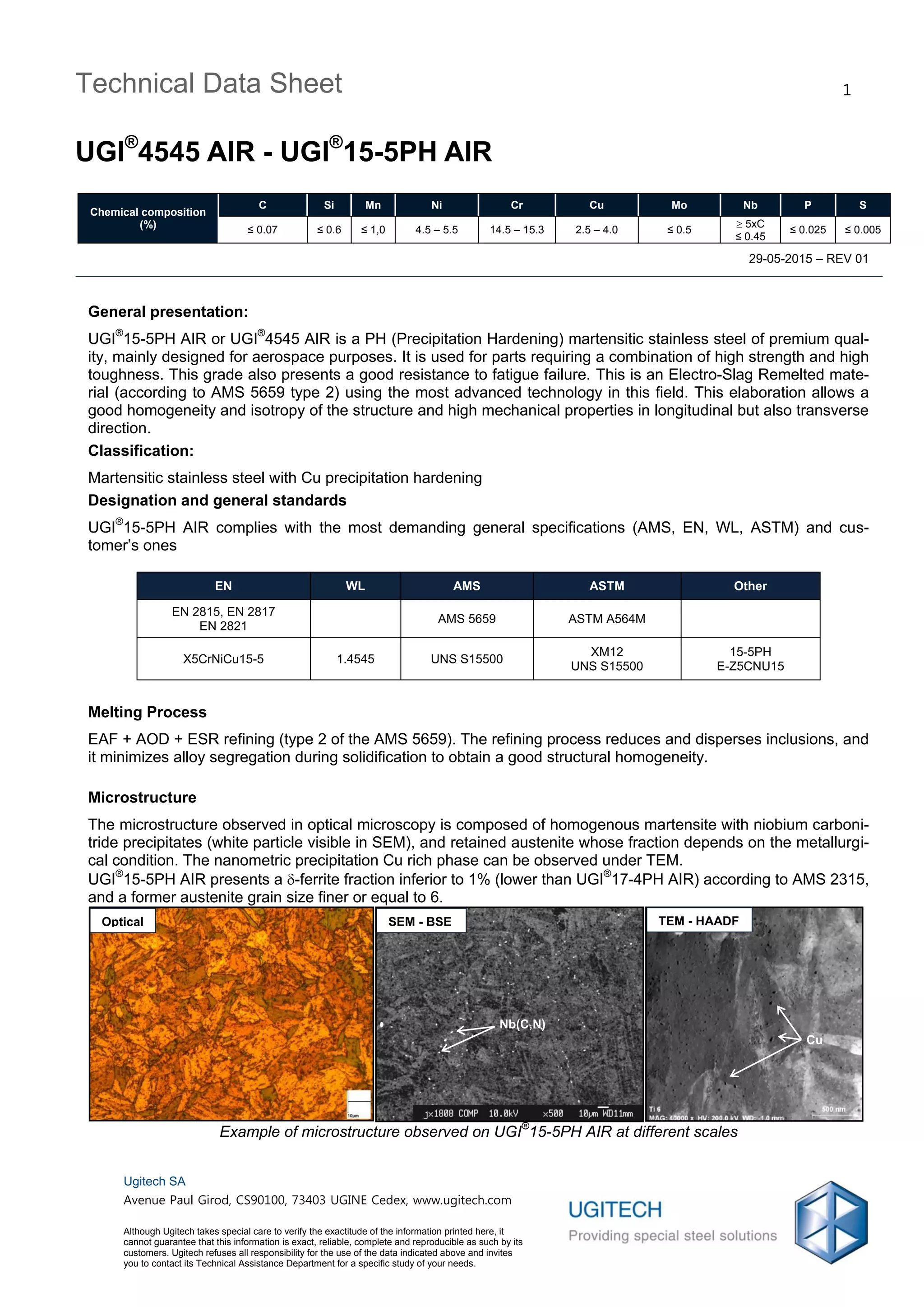
The microstructure observed in optical microscopy is composed of homogenous martensite with niobium carboni-
tride precipitates (white particle visible in SEM), and retained austenite whose fraction depends on the metallurgi-
cal condition. The nanometric precipitation Cu rich phase can be observed under TEM.
UGI®
15-5PH AIR presents a -ferrite fraction inferior to 1% (lower than UGI®
17-4PH AIR) according to AMS 2315,
and a former austenite grain size finer or equal to 6.
Example of microstructure observed on UGI®
15-5PH AIR at different scales
SEM - BSEOptical TEM - HAADF
Nb(C,N)
Cu
29-05-2015 – REV 01
Technical Data Sheet
UGI®
4545 AIR - UGI®
15-5PH AIR
2
Chemical composition
(%)
C Si Mn Ni Cr Cu Mo Nb P S
≤ 0.07 ≤ 0.6 ≤ 1,0 4.5 – 5.5 14.5 – 15.3 2.5 – 4.0 ≤ 0.5
 5xC
≤ 0.45
≤ 0.025 ≤ 0.005
Ugitech SA
Avenue Paul Girod, CS90100, 73403 UGINE Cedex, www.ugitech.com
Although Ugitech takes special care to verify the exactitude of the information printed here, it
cannot guarantee that this information is exact, reliable, complete and reproducible as such by its
customers. Ugitech refuses all responsibility for the use of the data indicated above and invites
you to contact its Technical Assistance Department for a specific study of your needs.
Physical properties
The table below shows the values of physical properties for UGI®
15-5PH AIR. These values are dependent on
the metallurgical condition; please contact us for additional information.
Temperature Density
thermal ex-
pansion be-
tween 20°C
and T
Young’s
modulus
Thermal
conductivity
Electrical
resistivity
Specific
heat
Magnetic
properties
[°C] [kg/dm3] [10
-6
K
-1
] [GPa] [W/(m.K)] [µΩ.cm] [J/(kg.K)]
20 7.8 200 16 71 500
ferromagnetic
100 10.5 195
200 11.1 185
300 11.5 175
400 11.9 170
Heat treatments and guaranteed levels of mechanical properties
Heat treatments carried out on UGI®
15-5PH AIR are composed of two steps:
- Austenitisation, whose purpose is to get alloying elements especially Cu into supersaturated martensite
- Aging, whose purpose is to precipitate Cu (precipitation hardening) and, in some case to form reverted
austenite to increase toughness. The mechanical properties, trade-off between strength and toughness,
are adjusted by the aging temperature.
Austenitisation
Solution annealing is performed around 1030-1050°C, and is interrupted by oil quenching or alternatively by air
cooling for small section parts. In this condition (called condition A) hardness is intermediate because Cu precipi-
tation hardening is not effective. Hence, the A-condition is often chosen to carry out machining or cold forming
operations. In that case, we recommend performing a stress relief treatment at 300°C for 1 hour after austenitisa-
tion, in order to stabilize the material and avoid quench-cracking issues.
Aging
Aging treatments are performed after solution treatment to make Cu rich phases precipitate and adjust mechani-
cal properties. After aging, the material is in the solution and aged condition, also called H-condition. Aging treat-
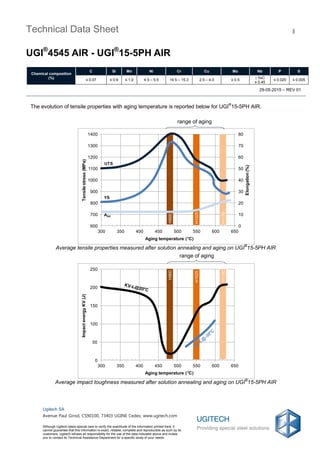
ments can be performed between 480°C (condition H900) and 620°C (condition H1150). The condition H900 cor-
responds to the peak of hardening, for which the Cu precipitates induce a maximum of hardness. For higher tem-
perature the hardness/strength decreases when increasing aging temperature, due to the growth of the precipi-
tates. Beyond 580°C some reverted austenite is formed during the aging which results in a increase of the tough-
ness but a drop of the strength. The condition H1025 is often chosen by customers because it leads to an optimal
trade-off between strength and toughness.
29-05-2015 – REV 01
Technical Data Sheet
UGI®
4545 AIR - UGI®
15-5PH AIR
3
Chemical composition
(%)
C Si Mn Ni Cr Cu Mo Nb P S
≤ 0.07 ≤ 0.6 ≤ 1,0 4.5 – 5.5 14.5 – 15.3 2.5 – 4.0 ≤ 0.5
 5xC
≤ 0.45
≤ 0.025 ≤ 0.005
Ugitech SA
Avenue Paul Girod, CS90100, 73403 UGINE Cedex, www.ugitech.com
Although Ugitech takes special care to verify the exactitude of the information printed here, it
cannot guarantee that this information is exact, reliable, complete and reproducible as such by its
customers. Ugitech refuses all responsibility for the use of the data indicated above and invites
you to contact its Technical Assistance Department for a specific study of your needs.
The evolution of tensile properties with aging temperature is reported below for UGI®
15-5PH AIR.
Average tensile properties measured after solution annealing and aging on UGI®
15-5PH AIR
Average impact toughness measured after solution annealing and aging on UGI®
15-5PH AIR
0
10
20
30
40
50
60
70
80
600
700
800
900
1000
1100
1200
1300
1400
300 350 400 450 500 550 600 650
Elongation(%)
Tensilestress(MPa)
Aging temperature ( C)
UTS
YS
A5d
H900
H1025
H1150
0
50
100
150
200
250
300 350 400 450 500 550 600 650
ImpactenergyKV(J)
Aging temperature ( C)
H1025
H1150
H900
range of aging
range of aging
29-05-2015 – REV 01
Technical Data Sheet
UGI®
4545 AIR - UGI®
15-5PH AIR
4
Chemical composition
(%)
C Si Mn Ni Cr Cu Mo Nb P S
≤ 0.07 ≤ 0.6 ≤ 1,0 4.5 – 5.5 14.5 – 15.3 2.5 – 4.0 ≤ 0.5
 5xC
≤ 0.45
≤ 0.025 ≤ 0.005
Ugitech SA
Avenue Paul Girod, CS90100, 73403 UGINE Cedex, www.ugitech.com
Although Ugitech takes special care to verify the exactitude of the information printed here, it
cannot guarantee that this information is exact, reliable, complete and reproducible as such by its
customers. Ugitech refuses all responsibility for the use of the data indicated above and invites
you to contact its Technical Assistance Department for a specific study of your needs.
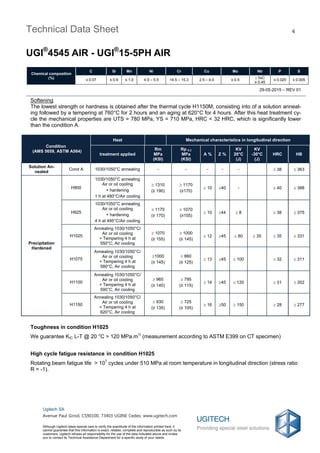
Softening
The lowest strength or hardness is obtained after the thermal cycle H1150M, consisting into of a solution anneal-
ing followed by a tempering at 760°C for 2 hours and an aging at 620°C for 4 hours. After this heat treatment cy-
cle the mechanical properties are UTS = 780 MPa, YS = 710 MPa, HRC < 32 HRC, which is significantly lower
than the condition A.
Condition
(AMS 5659, ASTM A564)
Heat Mechanical characteristics in longitudinal direction
treatment applied
Rm
MPa
(KSI)
Rp 0.2
MPa
(KSI)
A % Z %
KV
20°C
(J)
KV
-30°C
(J)
HRC HB
Solution An-
nealed
Cond A 1030/1050°C annealing - - - - -  38  363
Precipitation
Hardened
H900
1030/1050°C annealing
Air or oil cooling
+ hardening
1 h at 480°C/Air cooling
 1310
(≥ 190)
 1170
(≥170)
 10 40 -  40  388
H925
1030/1050°C annealing
Air or oil cooling
+ hardening
4 h at 495°C/Air cooling
 1170
(≥ 170)
 1070
(≥155)
 10 44  8  38  375
H1025
Annealing 1030/1050°C/
Air or oil cooling
+ Tempering 4 h at
550°C, Air cooling
 1070
(≥ 155)
 1000
(≥ 145)
 12 45  80  35  35  331
H1075
Annealing 1030/1050°C/
Air or oil cooling
+ Tempering 4 h at
580°C, Air cooling
1000
(≥ 145)
 860
(≥ 125)
 13 45  100  32  311
H1100
Annealing 1030/1050°C/
Air or oil cooling
+ Tempering 4 h at
590°C, Air cooling
 965
(≥ 140)
 795
(≥ 115)
 14 45  120  31  302
H1150
Annealing 1030/1050°C/
Air or oil cooling
+ Tempering 4 h at
620°C, Air cooling
 930
(≥ 135)
 725
(≥ 105)
 16 50  150  28  277
Toughness in condition H1025
We guarantee KIC L-T @ 20 °C > 120 MPa.m½
(measurement according to ASTM E399 on CT specimen)
High cycle fatigue resistance in condition H1025
Rotating beam fatigue life > 107
cycles under 510 MPa at room temperature in longitudinal direction (stress ratio
R = -1).
29-05-2015 – REV 01
Technical Data Sheet
UGI®
4545 AIR - UGI®
15-5PH AIR
5
Chemical composition
(%)
C Si Mn Ni Cr Cu Mo Nb P S
≤ 0.07 ≤ 0.6 ≤ 1,0 4.5 – 5.5 14.5 – 15.3 2.5 – 4.0 ≤ 0.5
 5xC
≤ 0.45
≤ 0.025 ≤ 0.005
Ugitech SA
Avenue Paul Girod, CS90100, 73403 UGINE Cedex, www.ugitech.com
Although Ugitech takes special care to verify the exactitude of the information printed here, it
cannot guarantee that this information is exact, reliable, complete and reproducible as such by its
customers. Ugitech refuses all responsibility for the use of the data indicated above and invites
you to contact its Technical Assistance Department for a specific study of your needs.
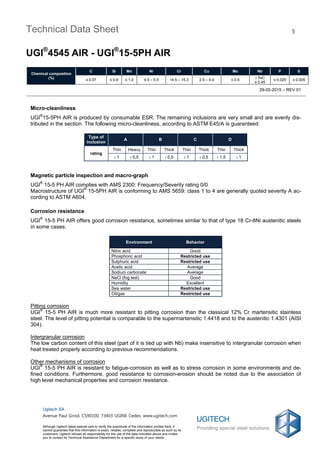
Micro-cleanliness
UGI®
15-5PH AIR is produced by consumable ESR. The remaining inclusions are very small and are evenly dis-
tributed in the section. The following micro-cleanliness, according to ASTM E45/A is guaranteed:
Type of
inclusion
A B C D
rating
Thin Heavy Thin Thick Thin Thick Thin Thick
‹ 1 ‹ 0,5 ‹ 1 ‹ 0,5 ‹ 1 ‹ 0,5 ‹ 1,5 ‹ 1
Magnetic particle inspection and macro-graph
UGI®
15-5 PH AIR complies with AMS 2300: Frequency/Severity rating 0/0
Macrostructure of UGI®
15-5PH AIR is conforming to AMS 5659: class 1 to 4 are generally quoted severity A ac-
cording to ASTM A604.
Corrosion resistance
UGI®
15-5 PH AIR offers good corrosion resistance, sometimes similar to that of type 18 Cr-8Ni austenitic steels
in some cases.
Environment Behavior
Nitric acid Good
Phosphoric acid Restricted use
Sulphuric acid Restricted use
Acetic acid Average
Sodium carbonate Average
NaCl (fog test) Good
Humidity Excellent
Sea water Restricted use
Oil/gas Restricted use
Pitting corrosion
UGI®
15-5 PH AIR is much more resistant to pitting corrosion than the classical 12% Cr martensitic stainless
steel. The level of pitting potential is comparable to the supermartensitic 1.4418 and to the austenitic 1.4301 (AISI
304).
Intergranular corrosion
The low carbon content of this steel (part of it is tied up with Nb) make insensitive to intergranular corrosion when
heat treated properly according to previous recommendations.
Other mechanisms of corrosion
UGI®
15-5 PH AIR is resistant to fatigue-corrosion as well as to stress corrosion in some environments and de-
fined conditions. Furthermore, good resistance to corrosion-erosion should be noted due to the association of
high level mechanical properties and corrosion resistance.
29-05-2015 – REV 01
Technical Data Sheet
UGI®
4545 AIR - UGI®
15-5PH AIR
6
Chemical composition
(%)
C Si Mn Ni Cr Cu Mo Nb P S
≤ 0.07 ≤ 0.6 ≤ 1,0 4.5 – 5.5 14.5 – 15.3 2.5 – 4.0 ≤ 0.5
 5xC
≤ 0.45
≤ 0.025 ≤ 0.005
Ugitech SA
Avenue Paul Girod, CS90100, 73403 UGINE Cedex, www.ugitech.com
Although Ugitech takes special care to verify the exactitude of the information printed here, it
cannot guarantee that this information is exact, reliable, complete and reproducible as such by its
customers. Ugitech refuses all responsibility for the use of the data indicated above and invites
you to contact its Technical Assistance Department for a specific study of your needs.
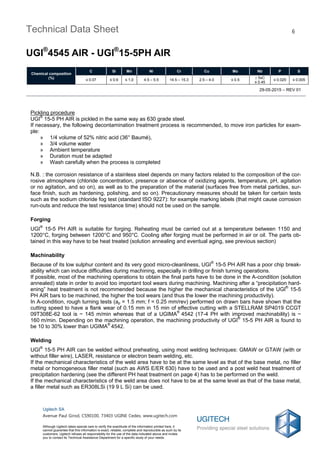
Pickling procedure
UGI®
15-5 PH AIR is pickled in the same way as 630 grade steel.
If necessary, the following decontamination treatment process is recommended, to move iron particles for exam-
ple:
» 1/4 volume of 52% nitric acid (36° Baumé),
» 3/4 volume water
» Ambient temperature
» Duration must be adapted
» Wash carefully when the process is completed
N.B. : the corrosion resistance of a stainless steel depends on many factors related to the composition of the cor-
rosive atmosphere (chloride concentration, presence or absence of oxidizing agents, temperature, pH, agitation
or no agitation, and so on), as well as to the preparation of the material (surfaces free from metal particles, sur-
face finish, such as hardening, polishing, and so on). Precautionary measures should be taken for certain tests
such as the sodium chloride fog test (standard ISO 9227): for example marking labels (that might cause corrosion
run-outs and reduce the test resistance time) should not be used on the sample.
Forging
UGI®
15-5 PH AIR is suitable for forging. Reheating must be carried out at a temperature between 1150 and
1200°C, forging between 1200°C and 950°C. Cooling after forging must be performed in air or oil. The parts ob-
tained in this way have to be heat treated (solution annealing and eventual aging, see previous section)
Machinability
Because of its low sulphur content and its very good micro-cleanliness, UGI®
15-5 PH AIR has a poor chip break-
ability which can induce difficulties during machining, especially in drilling or finish turning operations.
If possible, most of the machining operations to obtain the final parts have to be done in the A-condition (solution
annealed) state in order to avoid too important tool wears during machining. Machining after a “precipitation hard-
ening” heat treatment is not recommended because the higher the mechanical characteristics of the UGI®
15-5
PH AIR bars to be machined, the higher the tool wears (and thus the lower the machining productivity).
In A-condition, rough turning tests (ap = 1.5 mm; f = 0.25 mm/rev) performed on drawn bars have shown that the
cutting speed to have a flank wear of 0.15 mm in 15 min of effective cutting with a STELLRAM SP4019 CCGT
09T308E-62 tool is ~ 145 m/min whereas that of a UGIMA®
4542 (17-4 PH with improved machinability) is ~
160 m/min. Depending on the machining operation, the machining productivity of UGI®
15-5 PH AIR is found to
be 10 to 30% lower than UGIMA®
4542.
Welding
UGI®
15-5 PH AIR can be welded without preheating, using most welding techniques: GMAW or GTAW (with or
without filler wire), LASER, resistance or electron beam welding, etc.
If the mechanical characteristics of the weld area have to be at the same level as that of the base metal, no filler
metal or homogeneous filler metal (such as AWS E/ER 630) have to be used and a post weld heat treatment of
precipitation hardening (see the different PH heat treatment on page 4) has to be performed on the weld.
If the mechanical characteristics of the weld area does not have to be at the same level as that of the base metal,
a filler metal such as ER308LSi (19 9 L Si) can be used.
29-05-2015 – REV 01
Technical Data Sheet
UGI®
4545 AIR - UGI®
15-5PH AIR
7
Chemical composition
(%)
C Si Mn Ni Cr Cu Mo Nb P S
≤ 0.07 ≤ 0.6 ≤ 1,0 4.5 – 5.5 14.5 – 15.3 2.5 – 4.0 ≤ 0.5
 5xC
≤ 0.45
≤ 0.025 ≤ 0.005
Ugitech SA
Avenue Paul Girod, CS90100, 73403 UGINE Cedex, www.ugitech.com
Although Ugitech takes special care to verify the exactitude of the information printed here, it
cannot guarantee that this information is exact, reliable, complete and reproducible as such by its
customers. Ugitech refuses all responsibility for the use of the data indicated above and invites
you to contact its Technical Assistance Department for a specific study of your needs.
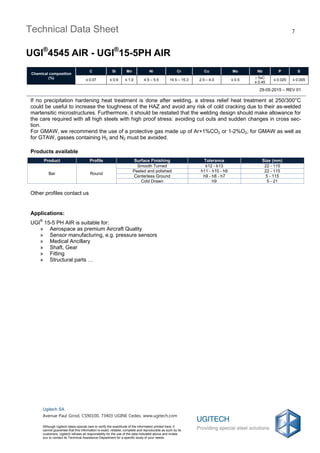
If no precipitation hardening heat treatment is done after welding, a stress relief heat treatment at 250/300°C
could be useful to increase the toughness of the HAZ and avoid any risk of cold cracking due to their as-welded
martensitic microstructures. Furthermore, it should be restated that the welding design should make allowance for
the care required with all high steels with high proof stress: avoiding cut outs and sudden changes in cross sec-
tion.
For GMAW, we recommend the use of a protective gas made up of Ar+1%CO2 or 1-2%O2; for GMAW as well as
for GTAW, gasses containing H2 and N2 must be avoided.
Products available
Product Profile Surface Finishing Tolerance Size (mm)
Bar Round
Smooth Turned k12 - k13 22 - 115
Peeled and polished h11 - h10 - h9 22 - 115
Centerless Ground h9 - h8 - h7 5 - 115
Cold Drawn h9 5 - 21
Other profiles contact us
Applications:
UGI®
15-5 PH AIR is suitable for:
» Aerospace as premium Aircraft Quality
» Sensor manufacturing, e.g. pressure sensors
» Medical Ancillary
» Shaft, Gear
» Fitting
» Structural parts …

Ged 2504

  • 1.
    29-05-2015 – REV01 Technical Data Sheet UGI® 4545 AIR - UGI® 15-5PH AIR 1 Chemical composition (%) C Si Mn Ni Cr Cu Mo Nb P S ≤ 0.07 ≤ 0.6 ≤ 1,0 4.5 – 5.5 14.5 – 15.3 2.5 – 4.0 ≤ 0.5  5xC ≤ 0.45 ≤ 0.025 ≤ 0.005 Ugitech SA Avenue Paul Girod, CS90100, 73403 UGINE Cedex, www.ugitech.com Although Ugitech takes special care to verify the exactitude of the information printed here, it cannot guarantee that this information is exact, reliable, complete and reproducible as such by its customers. Ugitech refuses all responsibility for the use of the data indicated above and invites you to contact its Technical Assistance Department for a specific study of your needs. General presentation: UGI® 15-5PH AIR or UGI® 4545 AIR is a PH (Precipitation Hardening) martensitic stainless steel of premium qual- ity, mainly designed for aerospace purposes. It is used for parts requiring a combination of high strength and high toughness. This grade also presents a good resistance to fatigue failure. This is an Electro-Slag Remelted mate- rial (according to AMS 5659 type 2) using the most advanced technology in this field. This elaboration allows a good homogeneity and isotropy of the structure and high mechanical properties in longitudinal but also transverse direction. Classification: Martensitic stainless steel with Cu precipitation hardening Designation and general standards UGI® 15-5PH AIR complies with the most demanding general specifications (AMS, EN, WL, ASTM) and cus- tomer’s ones EN WL AMS ASTM Other EN 2815, EN 2817 EN 2821 AMS 5659 ASTM A564M X5CrNiCu15-5 1.4545 UNS S15500 XM12 UNS S15500 15-5PH E-Z5CNU15 Melting Process EAF + AOD + ESR refining (type 2 of the AMS 5659). The refining process reduces and disperses inclusions, and it minimizes alloy segregation during solidification to obtain a good structural homogeneity. Microstructure The microstructure observed in optical microscopy is composed of homogenous martensite with niobium carboni- tride precipitates (white particle visible in SEM), and retained austenite whose fraction depends on the metallurgi- cal condition. The nanometric precipitation Cu rich phase can be observed under TEM. UGI® 15-5PH AIR presents a -ferrite fraction inferior to 1% (lower than UGI® 17-4PH AIR) according to AMS 2315, and a former austenite grain size finer or equal to 6. Example of microstructure observed on UGI® 15-5PH AIR at different scales SEM - BSEOptical TEM - HAADF Nb(C,N) Cu
  • 2.
    29-05-2015 – REV01 Technical Data Sheet UGI® 4545 AIR - UGI® 15-5PH AIR 2 Chemical composition (%) C Si Mn Ni Cr Cu Mo Nb P S ≤ 0.07 ≤ 0.6 ≤ 1,0 4.5 – 5.5 14.5 – 15.3 2.5 – 4.0 ≤ 0.5  5xC ≤ 0.45 ≤ 0.025 ≤ 0.005 Ugitech SA Avenue Paul Girod, CS90100, 73403 UGINE Cedex, www.ugitech.com Although Ugitech takes special care to verify the exactitude of the information printed here, it cannot guarantee that this information is exact, reliable, complete and reproducible as such by its customers. Ugitech refuses all responsibility for the use of the data indicated above and invites you to contact its Technical Assistance Department for a specific study of your needs. Physical properties The table below shows the values of physical properties for UGI® 15-5PH AIR. These values are dependent on the metallurgical condition; please contact us for additional information. Temperature Density thermal ex- pansion be- tween 20°C and T Young’s modulus Thermal conductivity Electrical resistivity Specific heat Magnetic properties [°C] [kg/dm3] [10 -6 K -1 ] [GPa] [W/(m.K)] [µΩ.cm] [J/(kg.K)] 20 7.8 200 16 71 500 ferromagnetic 100 10.5 195 200 11.1 185 300 11.5 175 400 11.9 170 Heat treatments and guaranteed levels of mechanical properties Heat treatments carried out on UGI® 15-5PH AIR are composed of two steps: - Austenitisation, whose purpose is to get alloying elements especially Cu into supersaturated martensite - Aging, whose purpose is to precipitate Cu (precipitation hardening) and, in some case to form reverted austenite to increase toughness. The mechanical properties, trade-off between strength and toughness, are adjusted by the aging temperature. Austenitisation Solution annealing is performed around 1030-1050°C, and is interrupted by oil quenching or alternatively by air cooling for small section parts. In this condition (called condition A) hardness is intermediate because Cu precipi- tation hardening is not effective. Hence, the A-condition is often chosen to carry out machining or cold forming operations. In that case, we recommend performing a stress relief treatment at 300°C for 1 hour after austenitisa- tion, in order to stabilize the material and avoid quench-cracking issues. Aging Aging treatments are performed after solution treatment to make Cu rich phases precipitate and adjust mechani- cal properties. After aging, the material is in the solution and aged condition, also called H-condition. Aging treat- ments can be performed between 480°C (condition H900) and 620°C (condition H1150). The condition H900 cor- responds to the peak of hardening, for which the Cu precipitates induce a maximum of hardness. For higher tem- perature the hardness/strength decreases when increasing aging temperature, due to the growth of the precipi- tates. Beyond 580°C some reverted austenite is formed during the aging which results in a increase of the tough- ness but a drop of the strength. The condition H1025 is often chosen by customers because it leads to an optimal trade-off between strength and toughness.
  • 3.
    29-05-2015 – REV01 Technical Data Sheet UGI® 4545 AIR - UGI® 15-5PH AIR 3 Chemical composition (%) C Si Mn Ni Cr Cu Mo Nb P S ≤ 0.07 ≤ 0.6 ≤ 1,0 4.5 – 5.5 14.5 – 15.3 2.5 – 4.0 ≤ 0.5  5xC ≤ 0.45 ≤ 0.025 ≤ 0.005 Ugitech SA Avenue Paul Girod, CS90100, 73403 UGINE Cedex, www.ugitech.com Although Ugitech takes special care to verify the exactitude of the information printed here, it cannot guarantee that this information is exact, reliable, complete and reproducible as such by its customers. Ugitech refuses all responsibility for the use of the data indicated above and invites you to contact its Technical Assistance Department for a specific study of your needs. The evolution of tensile properties with aging temperature is reported below for UGI® 15-5PH AIR. Average tensile properties measured after solution annealing and aging on UGI® 15-5PH AIR Average impact toughness measured after solution annealing and aging on UGI® 15-5PH AIR 0 10 20 30 40 50 60 70 80 600 700 800 900 1000 1100 1200 1300 1400 300 350 400 450 500 550 600 650 Elongation(%) Tensilestress(MPa) Aging temperature ( C) UTS YS A5d H900 H1025 H1150 0 50 100 150 200 250 300 350 400 450 500 550 600 650 ImpactenergyKV(J) Aging temperature ( C) H1025 H1150 H900 range of aging range of aging
  • 4.
    29-05-2015 – REV01 Technical Data Sheet UGI® 4545 AIR - UGI® 15-5PH AIR 4 Chemical composition (%) C Si Mn Ni Cr Cu Mo Nb P S ≤ 0.07 ≤ 0.6 ≤ 1,0 4.5 – 5.5 14.5 – 15.3 2.5 – 4.0 ≤ 0.5  5xC ≤ 0.45 ≤ 0.025 ≤ 0.005 Ugitech SA Avenue Paul Girod, CS90100, 73403 UGINE Cedex, www.ugitech.com Although Ugitech takes special care to verify the exactitude of the information printed here, it cannot guarantee that this information is exact, reliable, complete and reproducible as such by its customers. Ugitech refuses all responsibility for the use of the data indicated above and invites you to contact its Technical Assistance Department for a specific study of your needs. Softening The lowest strength or hardness is obtained after the thermal cycle H1150M, consisting into of a solution anneal- ing followed by a tempering at 760°C for 2 hours and an aging at 620°C for 4 hours. After this heat treatment cy- cle the mechanical properties are UTS = 780 MPa, YS = 710 MPa, HRC < 32 HRC, which is significantly lower than the condition A. Condition (AMS 5659, ASTM A564) Heat Mechanical characteristics in longitudinal direction treatment applied Rm MPa (KSI) Rp 0.2 MPa (KSI) A % Z % KV 20°C (J) KV -30°C (J) HRC HB Solution An- nealed Cond A 1030/1050°C annealing - - - - -  38  363 Precipitation Hardened H900 1030/1050°C annealing Air or oil cooling + hardening 1 h at 480°C/Air cooling  1310 (≥ 190)  1170 (≥170)  10 40 -  40  388 H925 1030/1050°C annealing Air or oil cooling + hardening 4 h at 495°C/Air cooling  1170 (≥ 170)  1070 (≥155)  10 44  8  38  375 H1025 Annealing 1030/1050°C/ Air or oil cooling + Tempering 4 h at 550°C, Air cooling  1070 (≥ 155)  1000 (≥ 145)  12 45  80  35  35  331 H1075 Annealing 1030/1050°C/ Air or oil cooling + Tempering 4 h at 580°C, Air cooling 1000 (≥ 145)  860 (≥ 125)  13 45  100  32  311 H1100 Annealing 1030/1050°C/ Air or oil cooling + Tempering 4 h at 590°C, Air cooling  965 (≥ 140)  795 (≥ 115)  14 45  120  31  302 H1150 Annealing 1030/1050°C/ Air or oil cooling + Tempering 4 h at 620°C, Air cooling  930 (≥ 135)  725 (≥ 105)  16 50  150  28  277 Toughness in condition H1025 We guarantee KIC L-T @ 20 °C > 120 MPa.m½ (measurement according to ASTM E399 on CT specimen) High cycle fatigue resistance in condition H1025 Rotating beam fatigue life > 107 cycles under 510 MPa at room temperature in longitudinal direction (stress ratio R = -1).
  • 5.
    29-05-2015 – REV01 Technical Data Sheet UGI® 4545 AIR - UGI® 15-5PH AIR 5 Chemical composition (%) C Si Mn Ni Cr Cu Mo Nb P S ≤ 0.07 ≤ 0.6 ≤ 1,0 4.5 – 5.5 14.5 – 15.3 2.5 – 4.0 ≤ 0.5  5xC ≤ 0.45 ≤ 0.025 ≤ 0.005 Ugitech SA Avenue Paul Girod, CS90100, 73403 UGINE Cedex, www.ugitech.com Although Ugitech takes special care to verify the exactitude of the information printed here, it cannot guarantee that this information is exact, reliable, complete and reproducible as such by its customers. Ugitech refuses all responsibility for the use of the data indicated above and invites you to contact its Technical Assistance Department for a specific study of your needs. Micro-cleanliness UGI® 15-5PH AIR is produced by consumable ESR. The remaining inclusions are very small and are evenly dis- tributed in the section. The following micro-cleanliness, according to ASTM E45/A is guaranteed: Type of inclusion A B C D rating Thin Heavy Thin Thick Thin Thick Thin Thick ‹ 1 ‹ 0,5 ‹ 1 ‹ 0,5 ‹ 1 ‹ 0,5 ‹ 1,5 ‹ 1 Magnetic particle inspection and macro-graph UGI® 15-5 PH AIR complies with AMS 2300: Frequency/Severity rating 0/0 Macrostructure of UGI® 15-5PH AIR is conforming to AMS 5659: class 1 to 4 are generally quoted severity A ac- cording to ASTM A604. Corrosion resistance UGI® 15-5 PH AIR offers good corrosion resistance, sometimes similar to that of type 18 Cr-8Ni austenitic steels in some cases. Environment Behavior Nitric acid Good Phosphoric acid Restricted use Sulphuric acid Restricted use Acetic acid Average Sodium carbonate Average NaCl (fog test) Good Humidity Excellent Sea water Restricted use Oil/gas Restricted use Pitting corrosion UGI® 15-5 PH AIR is much more resistant to pitting corrosion than the classical 12% Cr martensitic stainless steel. The level of pitting potential is comparable to the supermartensitic 1.4418 and to the austenitic 1.4301 (AISI 304). Intergranular corrosion The low carbon content of this steel (part of it is tied up with Nb) make insensitive to intergranular corrosion when heat treated properly according to previous recommendations. Other mechanisms of corrosion UGI® 15-5 PH AIR is resistant to fatigue-corrosion as well as to stress corrosion in some environments and de- fined conditions. Furthermore, good resistance to corrosion-erosion should be noted due to the association of high level mechanical properties and corrosion resistance.
  • 6.
    29-05-2015 – REV01 Technical Data Sheet UGI® 4545 AIR - UGI® 15-5PH AIR 6 Chemical composition (%) C Si Mn Ni Cr Cu Mo Nb P S ≤ 0.07 ≤ 0.6 ≤ 1,0 4.5 – 5.5 14.5 – 15.3 2.5 – 4.0 ≤ 0.5  5xC ≤ 0.45 ≤ 0.025 ≤ 0.005 Ugitech SA Avenue Paul Girod, CS90100, 73403 UGINE Cedex, www.ugitech.com Although Ugitech takes special care to verify the exactitude of the information printed here, it cannot guarantee that this information is exact, reliable, complete and reproducible as such by its customers. Ugitech refuses all responsibility for the use of the data indicated above and invites you to contact its Technical Assistance Department for a specific study of your needs. Pickling procedure UGI® 15-5 PH AIR is pickled in the same way as 630 grade steel. If necessary, the following decontamination treatment process is recommended, to move iron particles for exam- ple: » 1/4 volume of 52% nitric acid (36° Baumé), » 3/4 volume water » Ambient temperature » Duration must be adapted » Wash carefully when the process is completed N.B. : the corrosion resistance of a stainless steel depends on many factors related to the composition of the cor- rosive atmosphere (chloride concentration, presence or absence of oxidizing agents, temperature, pH, agitation or no agitation, and so on), as well as to the preparation of the material (surfaces free from metal particles, sur- face finish, such as hardening, polishing, and so on). Precautionary measures should be taken for certain tests such as the sodium chloride fog test (standard ISO 9227): for example marking labels (that might cause corrosion run-outs and reduce the test resistance time) should not be used on the sample. Forging UGI® 15-5 PH AIR is suitable for forging. Reheating must be carried out at a temperature between 1150 and 1200°C, forging between 1200°C and 950°C. Cooling after forging must be performed in air or oil. The parts ob- tained in this way have to be heat treated (solution annealing and eventual aging, see previous section) Machinability Because of its low sulphur content and its very good micro-cleanliness, UGI® 15-5 PH AIR has a poor chip break- ability which can induce difficulties during machining, especially in drilling or finish turning operations. If possible, most of the machining operations to obtain the final parts have to be done in the A-condition (solution annealed) state in order to avoid too important tool wears during machining. Machining after a “precipitation hard- ening” heat treatment is not recommended because the higher the mechanical characteristics of the UGI® 15-5 PH AIR bars to be machined, the higher the tool wears (and thus the lower the machining productivity). In A-condition, rough turning tests (ap = 1.5 mm; f = 0.25 mm/rev) performed on drawn bars have shown that the cutting speed to have a flank wear of 0.15 mm in 15 min of effective cutting with a STELLRAM SP4019 CCGT 09T308E-62 tool is ~ 145 m/min whereas that of a UGIMA® 4542 (17-4 PH with improved machinability) is ~ 160 m/min. Depending on the machining operation, the machining productivity of UGI® 15-5 PH AIR is found to be 10 to 30% lower than UGIMA® 4542. Welding UGI® 15-5 PH AIR can be welded without preheating, using most welding techniques: GMAW or GTAW (with or without filler wire), LASER, resistance or electron beam welding, etc. If the mechanical characteristics of the weld area have to be at the same level as that of the base metal, no filler metal or homogeneous filler metal (such as AWS E/ER 630) have to be used and a post weld heat treatment of precipitation hardening (see the different PH heat treatment on page 4) has to be performed on the weld. If the mechanical characteristics of the weld area does not have to be at the same level as that of the base metal, a filler metal such as ER308LSi (19 9 L Si) can be used.
  • 7.
    29-05-2015 – REV01 Technical Data Sheet UGI® 4545 AIR - UGI® 15-5PH AIR 7 Chemical composition (%) C Si Mn Ni Cr Cu Mo Nb P S ≤ 0.07 ≤ 0.6 ≤ 1,0 4.5 – 5.5 14.5 – 15.3 2.5 – 4.0 ≤ 0.5  5xC ≤ 0.45 ≤ 0.025 ≤ 0.005 Ugitech SA Avenue Paul Girod, CS90100, 73403 UGINE Cedex, www.ugitech.com Although Ugitech takes special care to verify the exactitude of the information printed here, it cannot guarantee that this information is exact, reliable, complete and reproducible as such by its customers. Ugitech refuses all responsibility for the use of the data indicated above and invites you to contact its Technical Assistance Department for a specific study of your needs. If no precipitation hardening heat treatment is done after welding, a stress relief heat treatment at 250/300°C could be useful to increase the toughness of the HAZ and avoid any risk of cold cracking due to their as-welded martensitic microstructures. Furthermore, it should be restated that the welding design should make allowance for the care required with all high steels with high proof stress: avoiding cut outs and sudden changes in cross sec- tion. For GMAW, we recommend the use of a protective gas made up of Ar+1%CO2 or 1-2%O2; for GMAW as well as for GTAW, gasses containing H2 and N2 must be avoided. Products available Product Profile Surface Finishing Tolerance Size (mm) Bar Round Smooth Turned k12 - k13 22 - 115 Peeled and polished h11 - h10 - h9 22 - 115 Centerless Ground h9 - h8 - h7 5 - 115 Cold Drawn h9 5 - 21 Other profiles contact us Applications: UGI® 15-5 PH AIR is suitable for: » Aerospace as premium Aircraft Quality » Sensor manufacturing, e.g. pressure sensors » Medical Ancillary » Shaft, Gear » Fitting » Structural parts …