Digital literacies and 21st century
skills: the students’ game design
and development experience
Cesar C. Navarrete
Learning Technologies
Curriculum & Instruction
University of Texas at Austin
EdMedia 2014, Tampere, Finland
Game Design & Development
• Constructivist Learning environment
• Constructionist approach involving
productivity skills
• Technology-engaged learning
• Computational thinking
Digital Literacies
• Design literacy
• Visual & Media literacy
• Text(&ing) literacy
• Gaming literacy
• Technology literacy
• Code literacy, etc.
Hockly, (2012)
21st Century skills
• Creative Thinking
• Collaboration
• Problem solving
Problem
Solving
Collaboration
Creative
Thinking
Research Questions
• What are students’ perceptions of game
design and programming in terms of digital
literacy skills?
• How does game design support student the
foundational 21st century skill?
Method
• Mixed-methods
• Data sources
Survey questionnaire--CTPSCI
Selected individual student interviews
Student produced game artifacts
Classroom observations
Setting
• Public Charter school in a southwestern US state
• Student population included students 6-9th grade
Hispanic
85%
African
American
12%
White, Not
Hispanic
3%
Students not in
special
populations 46%
Exited ELL
Students, 16%
ELL Students,
24%
ELL/SPED
Students, 5% SPED Students,
9%
Game construction
• Daily technology class for all students
• Flash based games with Action Script 2.0
• Project-based
• Online wiki design and development support
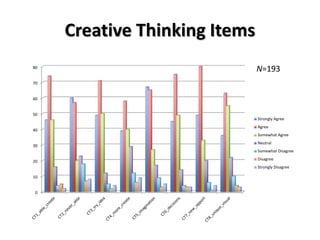
Creative Thinking Survey Items
Item Mean
Standard
Deviation
CT1 I am able to create new, original
games in design class 5.62 1.24
CT2 I am NEVER able to create original
games in design class 5.34 1.71
CT3 I am able to try new, original ideas
when I design games. 5.65 1.25
CT4 I am able to be MORE creative in
game design class than in my other
classes.
5.15 1.59
CT5 I can use my imagination in game
design class.
5.70 1.44
Creative Thinking Items
0
10
20
30
40
50
60
70
80
Strongly Agree
Agree
Somewhat Agree
Neutral
Somewhat Disagree
Disagree
Strongly Disagree
N=193
Collaboration Items
0
10
20
30
40
50
60
70
80
Strongly Agree
Agree
Somewhat Agree
Neutral
Somewhat Disagree
Disagree
Strongly Disagree
N=193
Problem Solving Items
0
10
20
30
40
50
60
70
80
PS1_solve_problem PS2_never_solve PS3_learn PS4_learn_code PS5_info_decide
Strongly Agree
Agree
Somewhat Agree
Neutral
Somewhat Disagree
Disagree
Strongly Disagree
N=193
Survey Open Responses
• “I love my game design class because I can be creative I
can learn some stuff that I never new what to do and
I'm verry happy that I'm taking this class”
• “I really like the game design class because it is really
fun creating games. I also like to learn new things, and
here I am learning how to create my own game.
Whenever I fix a problem with the codes to make my
game work, I feel like I am able to do a lot. Game
design class is really cool and I like helping people so
they can learn how to do the things on their own.”
Code Talk: “Hard fun”
• I like Game Designing games and I like to draw
the pictures. But the most thing I don't like
about it is the coding.
• I don't Like this class that much because is
hard working with codes.
Student Interviews
• Antonio in grade 7:
“It’s pretty fun but it’s kind of complicated with all the
codes you have to put in to make a game. You have to
design it first, make a game prototype and plan it out and
add or take away from your game, the game prototype
design. And, it’s pretty fun though. You learn from your
mistakes.”
• Terri in grade 9:
“I think it helps because, just to see other people’s point of
view, about how their imagination is, what they would do
and you can get an idea of how, if you make it like theirs or
make it your own way, in a better way of being more
original.”
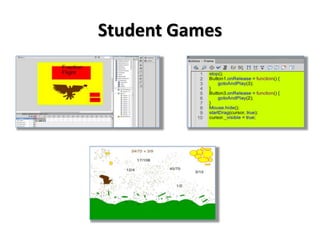
Student Games
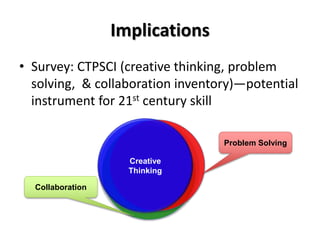
Implications
• Survey: CTPSCI (creative thinking, problem
solving, & collaboration inventory)—potential
instrument for 21st century skill
Problem Solving
Collaboration
Creative
Thinking
Digital literacies in Game construction
1 Language-based literacies:
linguistic codes
2 Information-based literacies:
filtering the wealth of information
3 Connection-based literacies:
networks and participatory
4 Re-design-based literacies:
design and re-purpose media
Pegrum(2011;Dudeney,Hockly,&
Pegrum2012)
Engaged Learning
• Deep-level embodied
learning—active,
authentic, engaged
learning
• K-12 Instructional
design—Creating
educational games
Further research
• CTPSCI (creative thinking, problem solving, &
collaboration inventory)—use in other settings
or population
• Digital literacies—framing with empirical
study—code literacy
Thank you!
• Questions?
Contact information:
Cesar C. Navarrete
Learning Technologies
Curriculum & Instruction
ccnavarrete@utexas.edu
University of Texas at Austin
Austin, TX

Middle School Game Development Research

  • 1.
    Digital literacies and21st century skills: the students’ game design and development experience Cesar C. Navarrete Learning Technologies Curriculum & Instruction University of Texas at Austin EdMedia 2014, Tampere, Finland
  • 2.
    Game Design &Development • Constructivist Learning environment • Constructionist approach involving productivity skills • Technology-engaged learning • Computational thinking
  • 3.
    Digital Literacies • Designliteracy • Visual & Media literacy • Text(&ing) literacy • Gaming literacy • Technology literacy • Code literacy, etc. Hockly, (2012)
  • 4.
    21st Century skills •Creative Thinking • Collaboration • Problem solving Problem Solving Collaboration Creative Thinking
  • 5.
    Research Questions • Whatare students’ perceptions of game design and programming in terms of digital literacy skills? • How does game design support student the foundational 21st century skill?
  • 6.
    Method • Mixed-methods • Datasources Survey questionnaire--CTPSCI Selected individual student interviews Student produced game artifacts Classroom observations
  • 7.
    Setting • Public Charterschool in a southwestern US state • Student population included students 6-9th grade Hispanic 85% African American 12% White, Not Hispanic 3% Students not in special populations 46% Exited ELL Students, 16% ELL Students, 24% ELL/SPED Students, 5% SPED Students, 9%
  • 8.
    Game construction • Dailytechnology class for all students • Flash based games with Action Script 2.0 • Project-based • Online wiki design and development support
  • 9.
    Creative Thinking SurveyItems Item Mean Standard Deviation CT1 I am able to create new, original games in design class 5.62 1.24 CT2 I am NEVER able to create original games in design class 5.34 1.71 CT3 I am able to try new, original ideas when I design games. 5.65 1.25 CT4 I am able to be MORE creative in game design class than in my other classes. 5.15 1.59 CT5 I can use my imagination in game design class. 5.70 1.44
  • 10.
    Creative Thinking Items 0 10 20 30 40 50 60 70 80 StronglyAgree Agree Somewhat Agree Neutral Somewhat Disagree Disagree Strongly Disagree N=193
  • 11.
    Collaboration Items 0 10 20 30 40 50 60 70 80 Strongly Agree Agree SomewhatAgree Neutral Somewhat Disagree Disagree Strongly Disagree N=193
  • 12.
    Problem Solving Items 0 10 20 30 40 50 60 70 80 PS1_solve_problemPS2_never_solve PS3_learn PS4_learn_code PS5_info_decide Strongly Agree Agree Somewhat Agree Neutral Somewhat Disagree Disagree Strongly Disagree N=193
  • 13.
    Survey Open Responses •“I love my game design class because I can be creative I can learn some stuff that I never new what to do and I'm verry happy that I'm taking this class” • “I really like the game design class because it is really fun creating games. I also like to learn new things, and here I am learning how to create my own game. Whenever I fix a problem with the codes to make my game work, I feel like I am able to do a lot. Game design class is really cool and I like helping people so they can learn how to do the things on their own.”
  • 14.
    Code Talk: “Hardfun” • I like Game Designing games and I like to draw the pictures. But the most thing I don't like about it is the coding. • I don't Like this class that much because is hard working with codes.
  • 15.
    Student Interviews • Antonioin grade 7: “It’s pretty fun but it’s kind of complicated with all the codes you have to put in to make a game. You have to design it first, make a game prototype and plan it out and add or take away from your game, the game prototype design. And, it’s pretty fun though. You learn from your mistakes.” • Terri in grade 9: “I think it helps because, just to see other people’s point of view, about how their imagination is, what they would do and you can get an idea of how, if you make it like theirs or make it your own way, in a better way of being more original.”
  • 16.
  • 17.
    Implications • Survey: CTPSCI(creative thinking, problem solving, & collaboration inventory)—potential instrument for 21st century skill Problem Solving Collaboration Creative Thinking
  • 18.
    Digital literacies inGame construction 1 Language-based literacies: linguistic codes 2 Information-based literacies: filtering the wealth of information 3 Connection-based literacies: networks and participatory 4 Re-design-based literacies: design and re-purpose media Pegrum(2011;Dudeney,Hockly,& Pegrum2012)
  • 19.
    Engaged Learning • Deep-levelembodied learning—active, authentic, engaged learning • K-12 Instructional design—Creating educational games
  • 20.
    Further research • CTPSCI(creative thinking, problem solving, & collaboration inventory)—use in other settings or population • Digital literacies—framing with empirical study—code literacy
  • 21.
    Thank you! • Questions? Contactinformation: Cesar C. Navarrete Learning Technologies Curriculum & Instruction ccnavarrete@utexas.edu University of Texas at Austin Austin, TX

Editor's Notes

  • #5 I am somewhat reluctant in continuing to use the term 21st century skills, but this is the consensus
  • #18 Eigenvalues = 8.88 Eigenvalues = 1.48 Eigenvalues = 1.35 % of Variance = 44.40 % of Variance = 7.39 % of Variance = 6.73
  • #19 Text-based literacy: Code literacy; Numeracy Hypertext literacy: navigation capacity Information literacy Visual/multimedia literacy   (Hockley 2012)