Quest2Teach
Leveling up the digital literacy of teacher candidates
ANNA ARICI
DIRECTOR OF QUEST2TEACH
LEARNING SCIENTIST, CENTER FOR GAMES & IMPACT
MARY LOU FULTON TEACHERS COLLEGE
TEMPE CAMPUS, FARMER 140
www.quest2teach.org
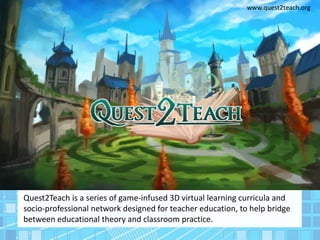
Quest2Teach is a series of game-infused 3D virtual learning curricula and
socio-professional network designed for teacher education, to help bridge
between educational theory and classroom practice.
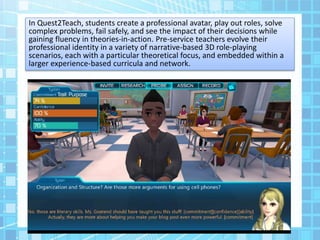
In Quest2Teach, students create a professional avatar, play out roles, solve
complex problems, fail safely, and see the impact of their decisions while
gaining fluency in theories-in-action. Pre-service teachers evolve their
professional identity in a variety of narrative-based 3D role-playing
scenarios, each with a particular theoretical focus, and embedded within a
larger experience-based curricula and network.
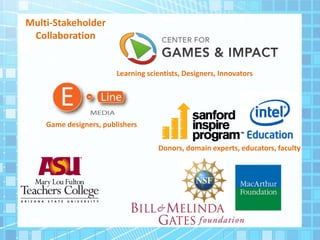
Learning scientists, Designers, Innovators
Game designers, publishers
Donors, domain experts, educators, faculty
Multi-Stakeholder
Collaboration
Why Immersive Games
for Teacher Education?
• Initially arose out of our PD for middle school
game curricula (QuestAtlantis)
• Most teachers seeking out our games were 10-20
year veterans, not digital natives
• Goal to instill these digital skills and pedagogies in
pre-service training
• Teaching, like medicine and law, is a professional
practice lends itself to immersive simulations
• The game curricula serve as a bridge connecting
coursework theory and its application in the field
• Allows future teachers to try out new roles, fail
safely, and see the impact of their decisions
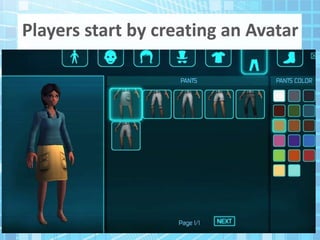
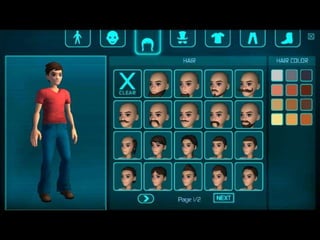
Players start by creating an Avatar
Protagonist in a nuanced
and authentic Narrative
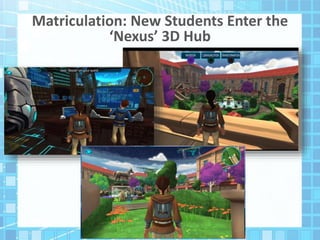
Matriculation: New Students Enter the
‘Nexus’ 3D Hub
‘Games for learning are not just
software, but game-enabled curricula,
meant to be guided and optimized by
the instructor …’
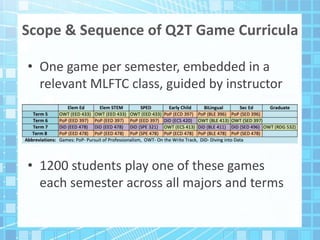
Scope & Sequence of Q2T Game Curricula
• One game per semester, embedded in a
relevant MLFTC class, guided by instructor
• 1200 students play one of these games
each semester across all majors and terms
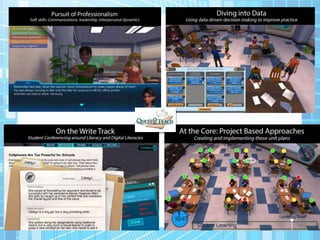
Pursuit of Professionalism (PoP)
Problem Scenario: Pedagogical
Differences with your Mentor
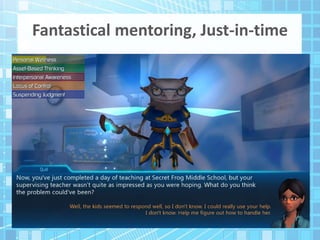
Fantastical mentoring, Just-in-time
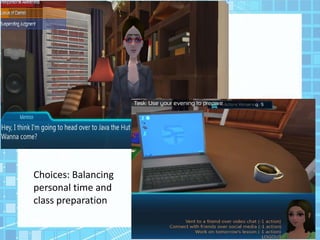
Choices: Balancing
personal time and
class preparation
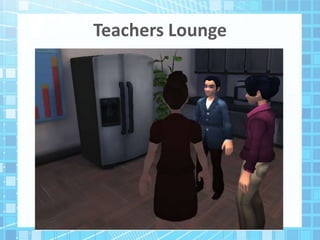
Teachers Lounge
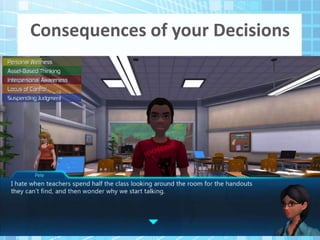
Consequences of your Decisions
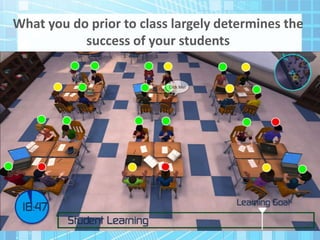
What you do prior to class largely determines the
success of your students
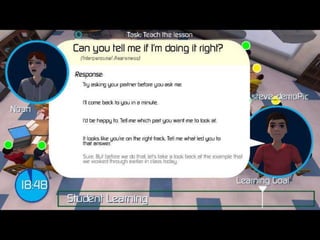
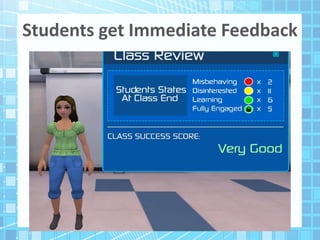
Students get Immediate Feedback
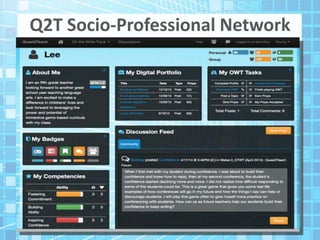
Q2T Socio-Professional Network
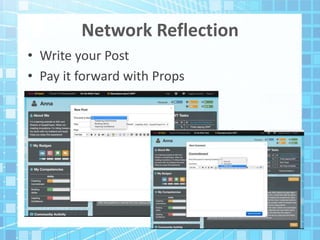
Network Reflection
• Write your Post
• Pay it forward with Props
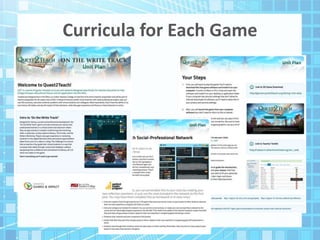
Curricula for Each Game
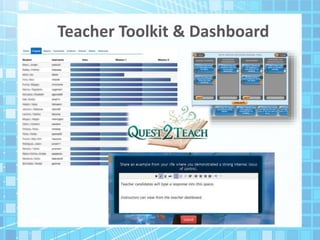
Teacher Toolkit & Dashboard
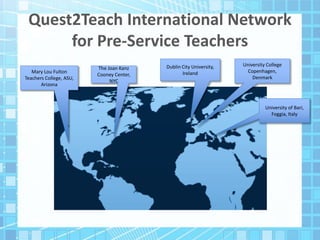
Quest2Teach International Network
for Pre-Service Teachers
Mary Lou Fulton
Teachers College, ASU,
Arizona
Dublin City University,
Ireland
University College
Copenhagen,
Denmark
University of Bari,
Foggia, Italy
The Joan Kanz
Cooney Center,
NYC
Research Findings
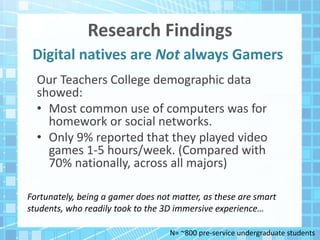
Our Teachers College demographic data
showed:
• Most common use of computers was for
homework or social networks.
• Only 9% reported that they played video
games 1-5 hours/week. (Compared with
70% nationally, across all majors)
Digital natives are Not always Gamers
Fortunately, being a gamer does not matter, as these are smart
students, who readily took to the 3D immersive experience…
N= ~800 pre-service undergraduate students
Positive Results
In addition to significant gains in learning and engagement:
• 99% said the activity was engaging
• 92% found the game challenging to some degree, with the mode
being ‘moderately challenged’
• 98% felt successful in this game
• 98% felt the game was meaningful as preparation for teaching
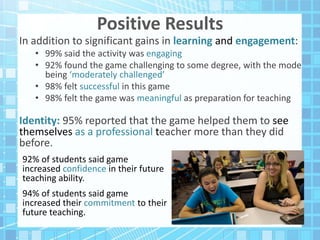
Identity: 95% reported that the game helped them to see
themselves as a professional teacher more than they did
before.
92% of students said game
increased confidence in their future
teaching ability.
94% of students said game
increased their commitment to their
future teaching.
Research Findings
Students appreciated the ability to play out roles as a
professional educator and solve authentic problems.
• Fail safely, and see the consequences of their decisions.
– “I appreciated the fact that it was safe. You could make mistakes and
it wasn’t a big deal, like it would be with real students.”
• Gain practice in the ‘language of education’.
– “I like how this game gave us scripts for handling conversations. I
think that’s huge. Sometimes we know what we’re supposed to say
but it’s hard to find the words.”
• Identity shift from student to teacher.
– “This was a significant shift out of not being a student anymore, you
know? We are in the professional world now, and we need to see
ourselves as teachers. This game was a shift into ‘real life.’
Research Findings
• Deeply invested in the relationships and narrative of the game
– “I didn’t expect it, but I was really invested in these (virtual)
students. You could see their emotions light up when you gave
good feedback or their faces crumble if you said something too
strong. I really wanted to do it right and see them succeed!”
• Many felt better equipped to handle difficult interactions in the
real world.
– “This game allowed me to practice how to be respectful in a
disagreement, it gave me skills in interpersonal relationships and
how to work better with others.”
• Comparison study showed active
learning as 1st person protagonist,
learning ‘skills’ and ‘language’,
rather than passively ‘learning
about’ the theory.
Findings: Ecology of Implementation
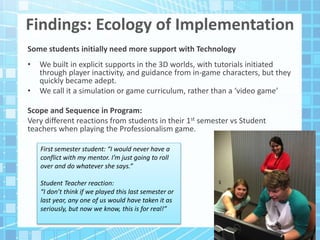
Some students initially need more support with Technology
• We built in explicit supports in the 3D worlds, with tutorials initiated
through player inactivity, and guidance from in-game characters, but they
quickly became adept.
• We call it a simulation or game curriculum, rather than a ‘video game’
Scope and Sequence in Program:
Very different reactions from students in their 1st semester vs Student
teachers when playing the Professionalism game.
First semester student: “I would never have a
conflict with my mentor. I’m just going to roll
over and do whatever she says.”
Student Teacher reaction:
“I don’t think if we played this last semester or
last year, any one of us would have taken it as
seriously, but now we know, this is for real!”
Two years later…
• The same students who found the Professionalism game largely
irrelevant early on in their program were given the same game
curriculum in their student teaching course two years later. These
students expressed how vastly different the experience was now that
they were experienced professionals about to enter the field.
• “The last time I played, I have to admit, all the choices all looked the
same. I was like, ‘I guess I’ll just click this one and see what happens!’
But this time I was like, ‘Wow! This is really common sense!’ I could tell
I had grown as a professional, it was so second nature.”
• “The first time I played the game and my mentor (NPC) didn’t like my
lesson plan I quickly backed down and said, ‘Oh, I’m sorry! I’ll change it,
or just go with yours’. This time around though, I had the confidence to
stand up for myself, and even the experience to say how I felt the
students were learning well with my plan. I was able to chose
professional ways to support my own plan.”
Forcing a choice…
“The ah-ha moment for me was when in the game the
teacher was blaming the kids for the chaos, and how ‘they
just don’t care’. Which is exactly what I hear at my site. All
the teachers, and even the principal, say that there’s really
nothing we can do because these students are so
challenging. And in the game I found myself agreeing with
that teacher, it’s the kids fault. But then the game stopped
me and my game mentor popped in to explain that there
are a lot of things I can do, and within my control. I was so
used to ‘it’s the kids, it’s the kids, it’s the kids’, but now,
after experiencing this (game), it makes me want to go
back and try something new with my kids. I’m starting to
wonder if it really could be all the kids as a collective, or if
we as teachers need to do something different.”
To Do List:
To set up your class:
• Send me your name, course and roster
– Download ‘.csv file’ from Blackboard
– anna.arici@asu.edu
• I’ll send you login to Game/Teacher Toolkit and all materials
To teach the game curriculum: 2 weeks prior
• Read the Curriculum Guide
• Play the Game in preparation
• Post a guiding question in the Network
• Try logging in AT YOUR SITE (you may need to VPN)
• Send out Student Handout so they can download and bring laptops
with game installed to next class
• Then facilitate in class
• Log in to the Teacher Toolkit to monitor progress and to give
feedback as they complete missions
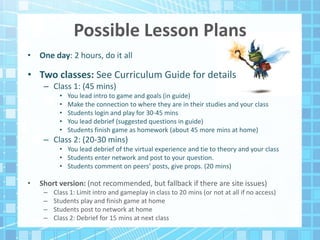
Possible Lesson Plans
• One day: 2 hours, do it all
• Two classes: See Curriculum Guide for details
– Class 1: (45 mins)
• You lead intro to game and goals (in guide)
• Make the connection to where they are in their studies and your class
• Students login and play for 30-45 mins
• You lead debrief (suggested questions in guide)
• Students finish game as homework (about 45 more mins at home)
– Class 2: (20-30 mins)
• You lead debrief of the virtual experience and tie to theory and your class
• Students enter network and post to your question.
• Students comment on peers’ posts, give props. (20 mins)
• Short version: (not recommended, but fallback if there are site issues)
– Class 1: Limit intro and gameplay in class to 20 mins (or not at all if no access)
– Students play and finish game at home
– Students post to network at home
– Class 2: Debrief for 15 mins at next class
Handouts
You will receive links to all needed materials:
• URLs to download game and login to network
• Game Curriculum (lesson plan)
• Network Guide
• Teacher Toolkit Guide
• Student handout (with download instructions)
• How to download .csv file roster from
Blackboard
• How to VPN (if your site blocks access to ASU)
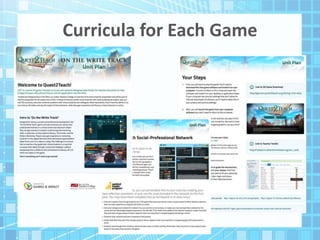
Curricula for Each Game

Quest2Teach Overview for Clinical Experience Instructors

  • 1.
    Quest2Teach Leveling up thedigital literacy of teacher candidates ANNA ARICI DIRECTOR OF QUEST2TEACH LEARNING SCIENTIST, CENTER FOR GAMES & IMPACT MARY LOU FULTON TEACHERS COLLEGE TEMPE CAMPUS, FARMER 140
  • 2.
    www.quest2teach.org Quest2Teach is aseries of game-infused 3D virtual learning curricula and socio-professional network designed for teacher education, to help bridge between educational theory and classroom practice.
  • 3.
    In Quest2Teach, studentscreate a professional avatar, play out roles, solve complex problems, fail safely, and see the impact of their decisions while gaining fluency in theories-in-action. Pre-service teachers evolve their professional identity in a variety of narrative-based 3D role-playing scenarios, each with a particular theoretical focus, and embedded within a larger experience-based curricula and network.
  • 4.
    Learning scientists, Designers,Innovators Game designers, publishers Donors, domain experts, educators, faculty Multi-Stakeholder Collaboration
  • 5.
    Why Immersive Games forTeacher Education? • Initially arose out of our PD for middle school game curricula (QuestAtlantis) • Most teachers seeking out our games were 10-20 year veterans, not digital natives • Goal to instill these digital skills and pedagogies in pre-service training • Teaching, like medicine and law, is a professional practice lends itself to immersive simulations • The game curricula serve as a bridge connecting coursework theory and its application in the field • Allows future teachers to try out new roles, fail safely, and see the impact of their decisions
  • 6.
    Players start bycreating an Avatar
  • 8.
    Protagonist in anuanced and authentic Narrative
  • 10.
    Matriculation: New StudentsEnter the ‘Nexus’ 3D Hub
  • 11.
    ‘Games for learningare not just software, but game-enabled curricula, meant to be guided and optimized by the instructor …’
  • 12.
    Scope & Sequenceof Q2T Game Curricula • One game per semester, embedded in a relevant MLFTC class, guided by instructor • 1200 students play one of these games each semester across all majors and terms
  • 13.
    Pursuit of Professionalism(PoP) Problem Scenario: Pedagogical Differences with your Mentor
  • 14.
  • 15.
    Choices: Balancing personal timeand class preparation
  • 16.
  • 17.
  • 18.
    What you doprior to class largely determines the success of your students
  • 20.
  • 21.
  • 22.
    Network Reflection • Writeyour Post • Pay it forward with Props
  • 23.
  • 24.
  • 25.
    Quest2Teach International Network forPre-Service Teachers Mary Lou Fulton Teachers College, ASU, Arizona Dublin City University, Ireland University College Copenhagen, Denmark University of Bari, Foggia, Italy The Joan Kanz Cooney Center, NYC
  • 26.
    Research Findings Our TeachersCollege demographic data showed: • Most common use of computers was for homework or social networks. • Only 9% reported that they played video games 1-5 hours/week. (Compared with 70% nationally, across all majors) Digital natives are Not always Gamers Fortunately, being a gamer does not matter, as these are smart students, who readily took to the 3D immersive experience… N= ~800 pre-service undergraduate students
  • 27.
    Positive Results In additionto significant gains in learning and engagement: • 99% said the activity was engaging • 92% found the game challenging to some degree, with the mode being ‘moderately challenged’ • 98% felt successful in this game • 98% felt the game was meaningful as preparation for teaching Identity: 95% reported that the game helped them to see themselves as a professional teacher more than they did before. 92% of students said game increased confidence in their future teaching ability. 94% of students said game increased their commitment to their future teaching.
  • 28.
    Research Findings Students appreciatedthe ability to play out roles as a professional educator and solve authentic problems. • Fail safely, and see the consequences of their decisions. – “I appreciated the fact that it was safe. You could make mistakes and it wasn’t a big deal, like it would be with real students.” • Gain practice in the ‘language of education’. – “I like how this game gave us scripts for handling conversations. I think that’s huge. Sometimes we know what we’re supposed to say but it’s hard to find the words.” • Identity shift from student to teacher. – “This was a significant shift out of not being a student anymore, you know? We are in the professional world now, and we need to see ourselves as teachers. This game was a shift into ‘real life.’
  • 29.
    Research Findings • Deeplyinvested in the relationships and narrative of the game – “I didn’t expect it, but I was really invested in these (virtual) students. You could see their emotions light up when you gave good feedback or their faces crumble if you said something too strong. I really wanted to do it right and see them succeed!” • Many felt better equipped to handle difficult interactions in the real world. – “This game allowed me to practice how to be respectful in a disagreement, it gave me skills in interpersonal relationships and how to work better with others.” • Comparison study showed active learning as 1st person protagonist, learning ‘skills’ and ‘language’, rather than passively ‘learning about’ the theory.
  • 30.
    Findings: Ecology ofImplementation Some students initially need more support with Technology • We built in explicit supports in the 3D worlds, with tutorials initiated through player inactivity, and guidance from in-game characters, but they quickly became adept. • We call it a simulation or game curriculum, rather than a ‘video game’ Scope and Sequence in Program: Very different reactions from students in their 1st semester vs Student teachers when playing the Professionalism game. First semester student: “I would never have a conflict with my mentor. I’m just going to roll over and do whatever she says.” Student Teacher reaction: “I don’t think if we played this last semester or last year, any one of us would have taken it as seriously, but now we know, this is for real!”
  • 31.
    Two years later… •The same students who found the Professionalism game largely irrelevant early on in their program were given the same game curriculum in their student teaching course two years later. These students expressed how vastly different the experience was now that they were experienced professionals about to enter the field. • “The last time I played, I have to admit, all the choices all looked the same. I was like, ‘I guess I’ll just click this one and see what happens!’ But this time I was like, ‘Wow! This is really common sense!’ I could tell I had grown as a professional, it was so second nature.” • “The first time I played the game and my mentor (NPC) didn’t like my lesson plan I quickly backed down and said, ‘Oh, I’m sorry! I’ll change it, or just go with yours’. This time around though, I had the confidence to stand up for myself, and even the experience to say how I felt the students were learning well with my plan. I was able to chose professional ways to support my own plan.”
  • 32.
    Forcing a choice… “Theah-ha moment for me was when in the game the teacher was blaming the kids for the chaos, and how ‘they just don’t care’. Which is exactly what I hear at my site. All the teachers, and even the principal, say that there’s really nothing we can do because these students are so challenging. And in the game I found myself agreeing with that teacher, it’s the kids fault. But then the game stopped me and my game mentor popped in to explain that there are a lot of things I can do, and within my control. I was so used to ‘it’s the kids, it’s the kids, it’s the kids’, but now, after experiencing this (game), it makes me want to go back and try something new with my kids. I’m starting to wonder if it really could be all the kids as a collective, or if we as teachers need to do something different.”
  • 33.
    To Do List: Toset up your class: • Send me your name, course and roster – Download ‘.csv file’ from Blackboard – anna.arici@asu.edu • I’ll send you login to Game/Teacher Toolkit and all materials To teach the game curriculum: 2 weeks prior • Read the Curriculum Guide • Play the Game in preparation • Post a guiding question in the Network • Try logging in AT YOUR SITE (you may need to VPN) • Send out Student Handout so they can download and bring laptops with game installed to next class • Then facilitate in class • Log in to the Teacher Toolkit to monitor progress and to give feedback as they complete missions
  • 34.
    Possible Lesson Plans •One day: 2 hours, do it all • Two classes: See Curriculum Guide for details – Class 1: (45 mins) • You lead intro to game and goals (in guide) • Make the connection to where they are in their studies and your class • Students login and play for 30-45 mins • You lead debrief (suggested questions in guide) • Students finish game as homework (about 45 more mins at home) – Class 2: (20-30 mins) • You lead debrief of the virtual experience and tie to theory and your class • Students enter network and post to your question. • Students comment on peers’ posts, give props. (20 mins) • Short version: (not recommended, but fallback if there are site issues) – Class 1: Limit intro and gameplay in class to 20 mins (or not at all if no access) – Students play and finish game at home – Students post to network at home – Class 2: Debrief for 15 mins at next class
  • 35.
    Handouts You will receivelinks to all needed materials: • URLs to download game and login to network • Game Curriculum (lesson plan) • Network Guide • Teacher Toolkit Guide • Student handout (with download instructions) • How to download .csv file roster from Blackboard • How to VPN (if your site blocks access to ASU)
  • 36.

Editor's Notes

  • #4 Mastery approach, they can replay for better outcomes, not graded on final score, but up to instructor.
  • #5 So we decided, wouldn’t it be great to not only train teachers in these pedagogies, but to do it in their formative years of training? And also offer it as PD to in-service teachers. At that same time, the dean of ASU’s MLFTC, Mari Koerner was bringing together a stellar team of game scholars and learning scientists, with the goal of infusing innovation to the Teachers College. So 3 years ago, Quest2Teach began to form. Massive collaboration with really bright people, all of whom bring their own toolkits, affordances and expertise.
  • #9 What’s exciting about these gaming technologies is that they can create nuanced scenarios, where you are the protagonist with multiple trajectories through the game. Our students love this it’s a great way to engage them.
  • #10 Each game is related to a specific theory, which is already part of the teachers college curriculum and standards, and we embed these experiences within their relevant coursework. Brought in content area experts for each of the games
  • #22 Badges aren’t just token rewards, but they unlock new learning opportunities, because you’ve demonstrated your expertise. Give props to others, similar to endorsements in LinkedIn, to highlight that someone is doing really great work. Incredibly motivational.
  • #25 No matter how sophisticated the backend management system for teachers, and unit plans we gave them, many teachers would take their students into the computer lab, have them log in, and then they’d go get coffee. And these were really exciting, inquiry-based teachers, who just didn’t understand their new role in these technologies. Another interesting finding, the teachers that typically came to us for games were 10-20 year veterans. Many were too overwhelmed in their early years of teaching to add something novel. The solution? Build these pedagogies and experiences into teacher education.
  • #27 Really compelling. design-based implementation research cycles were used to simultaneously inform both learning theory and subsequent design iterations, as well as uncover the best practices for reaching our students with these innovations. Uncovering the optimal ‘ecology of implementation’ to really help our preservice teachers. The good news…. (on next slide)
  • #28 What’s really exciting, is that inexperience with games doesn’t matter! They are so bright and capable of learning these new technologies, they just needed the opportunity. The MLFTC provides that now through immersing students in these experiences during their pre-service education.
  • #31 What are the best practices for delivering these new innovations? We’ve uncovered an ‘Ecology of Implementation’ or best context and practices for maximizing the take up and impact of these games for our pre-service teachers.