Greatest Common Factor
and Least Common
Multiples
GCF and LCM
Greatest Common Factor
What is the difference
between a factor and a
multiple?
Give me an example of
a factor of 15
Least Common
Multiples
Give me an example
of a multiple of 15
What is the difference
between a factor and a
multiple?
GCF
How would you
find the GCF of 60
and 96?
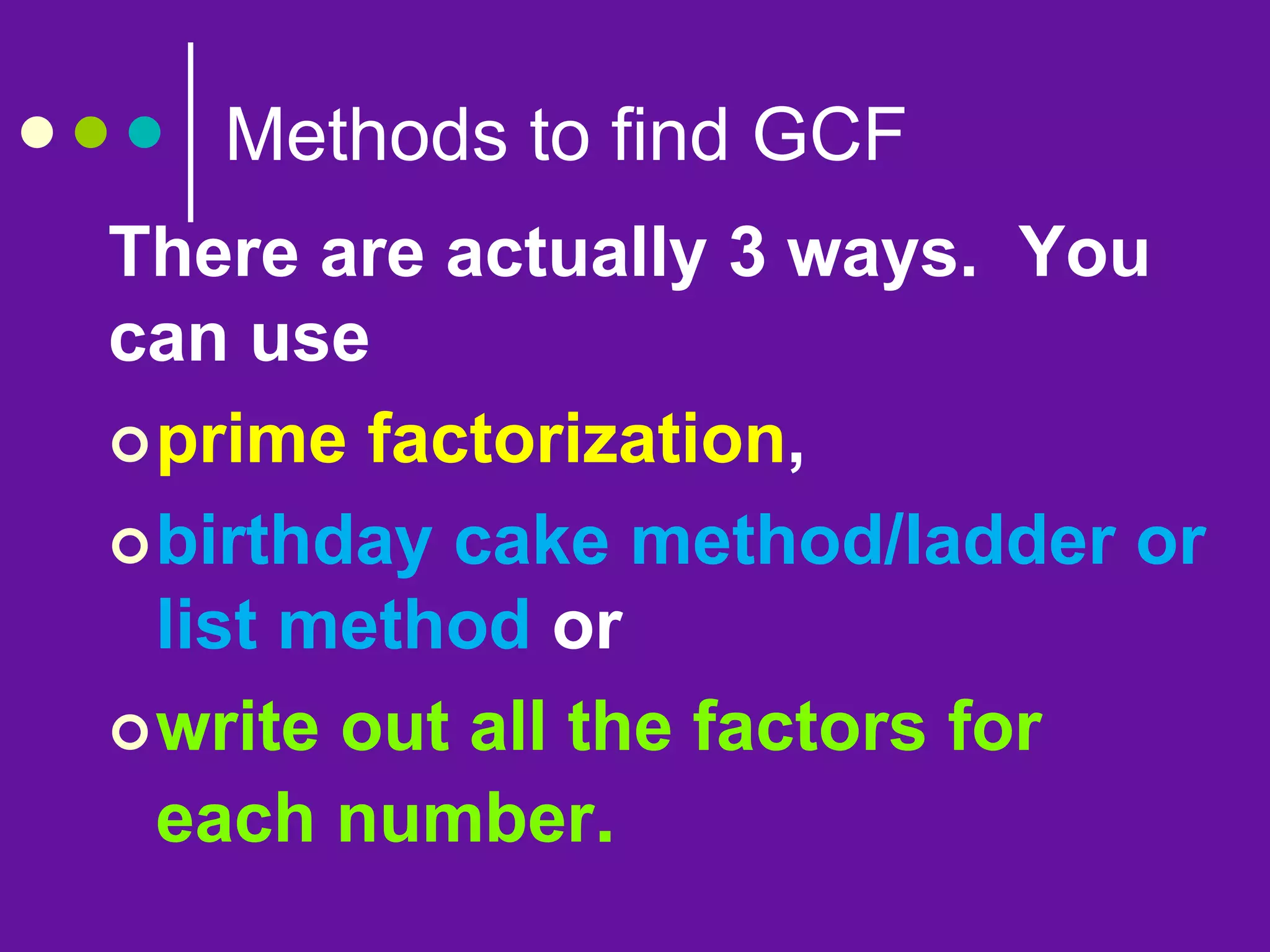
Methods to find GCF
There are actually 3 ways. You
can use
prime factorization,
birthday cake method/ladder or
list method or
write out all the factors for
each number.
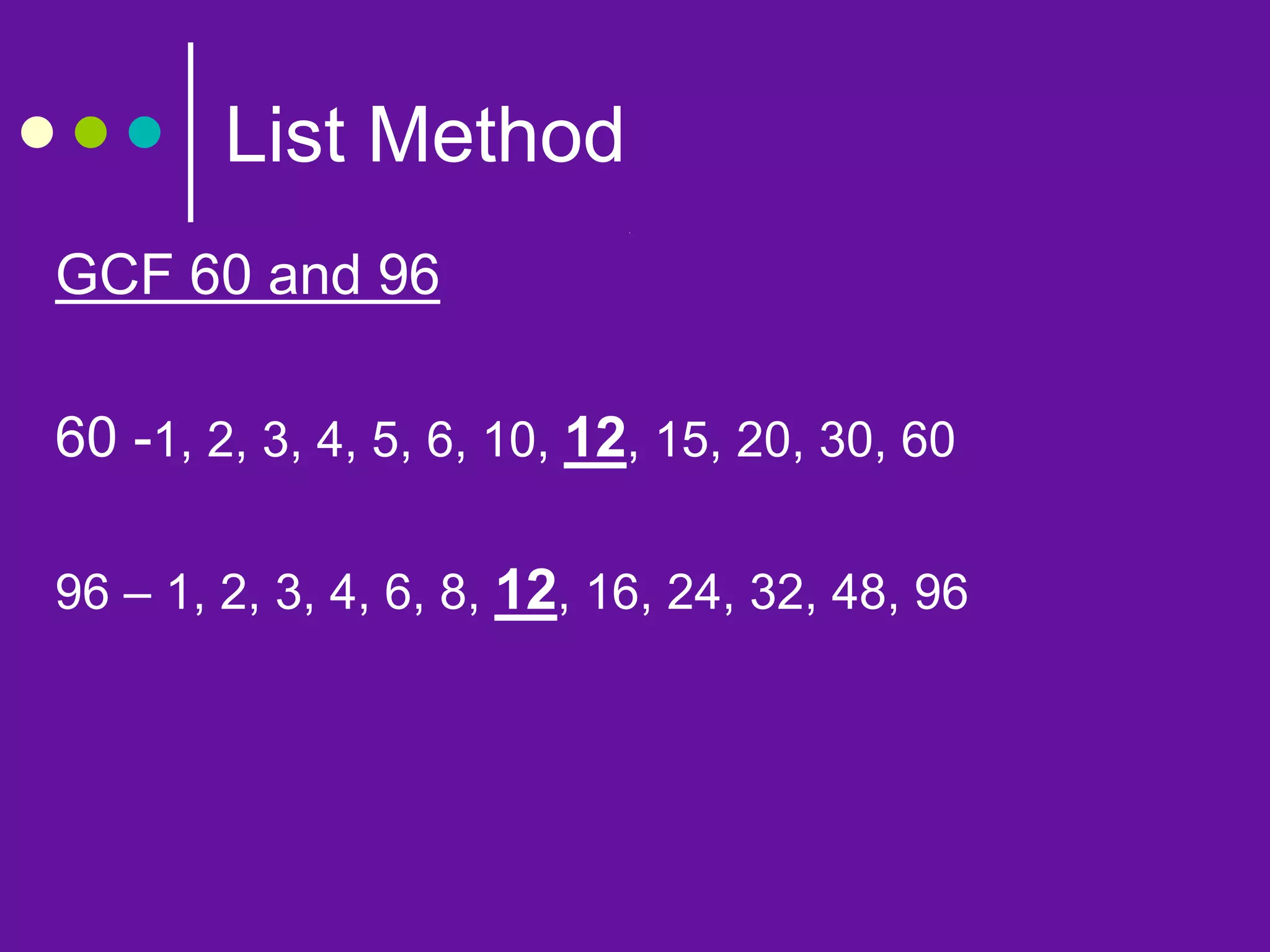
List Method
GCF 60 and 96
60 -1, 2, 3, 4, 5, 6, 10, 12, 15, 20, 30, 60
96 – 1, 2, 3, 4, 6, 8, 12, 16, 24, 32, 48, 96
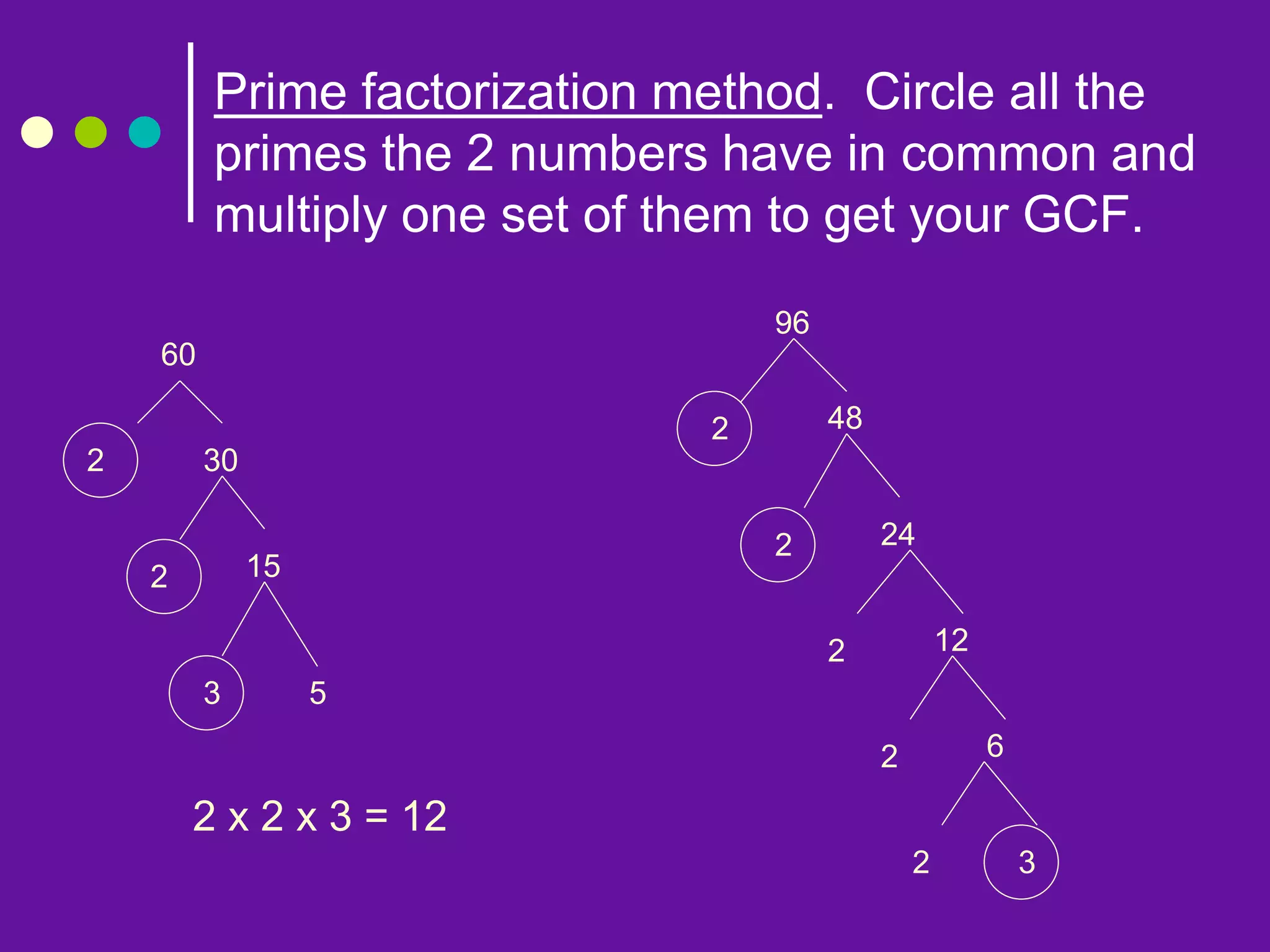
Prime factorization method. Circle all the
primes the 2 numbers have in common and
multiply one set of them to get your GCF.
60
2 30
2 15
3 5
96
2 48
2 24
2 12
2 6
2 3
2 x 2 x 3 = 12
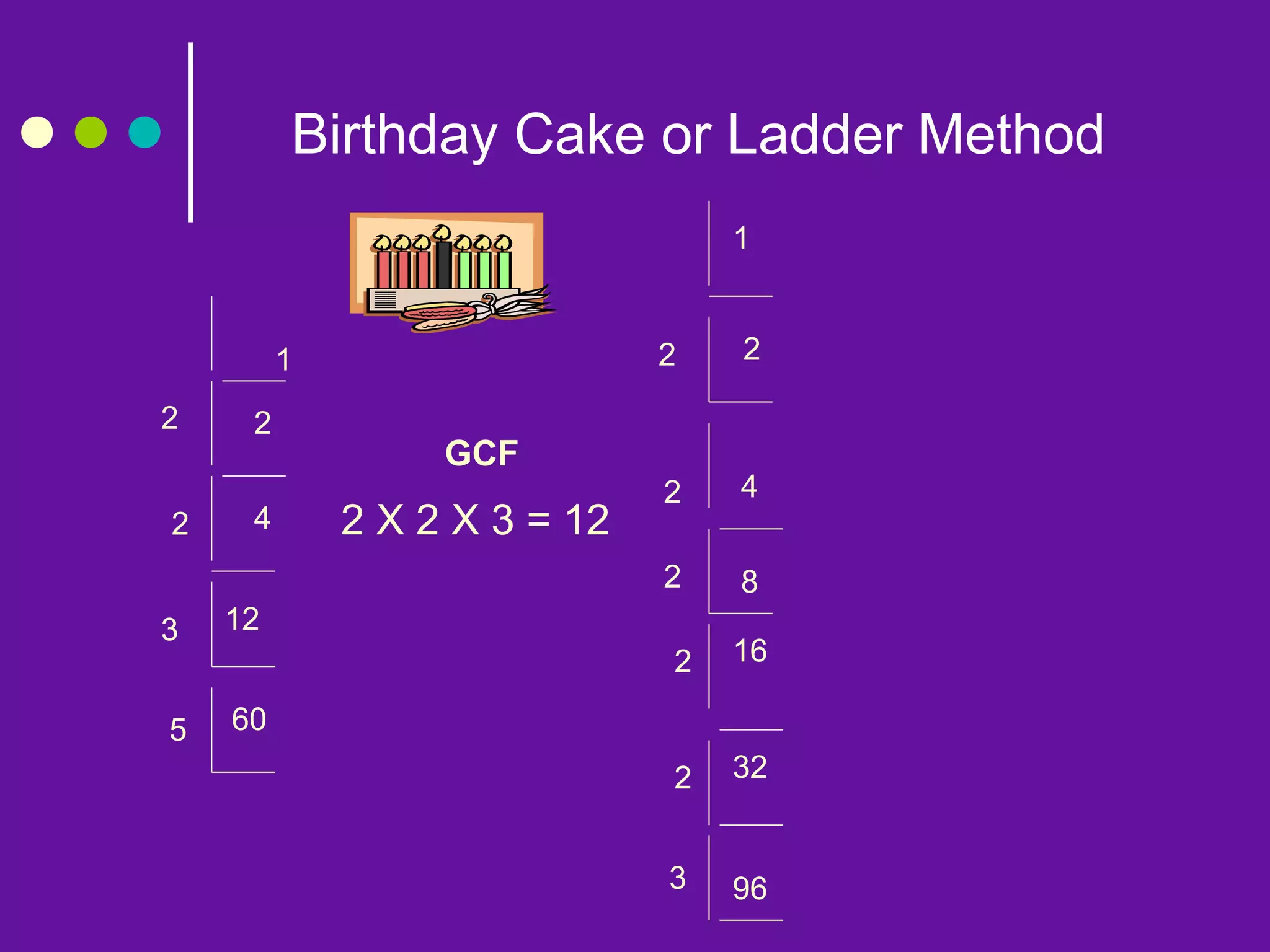
Birthday Cake or Ladder Method
60
5
12
3
2 4
2
2
2
1
2
4
8
16
32
96
2
1
2
2
2
3
2 X 2 X 3 = 12
GCF
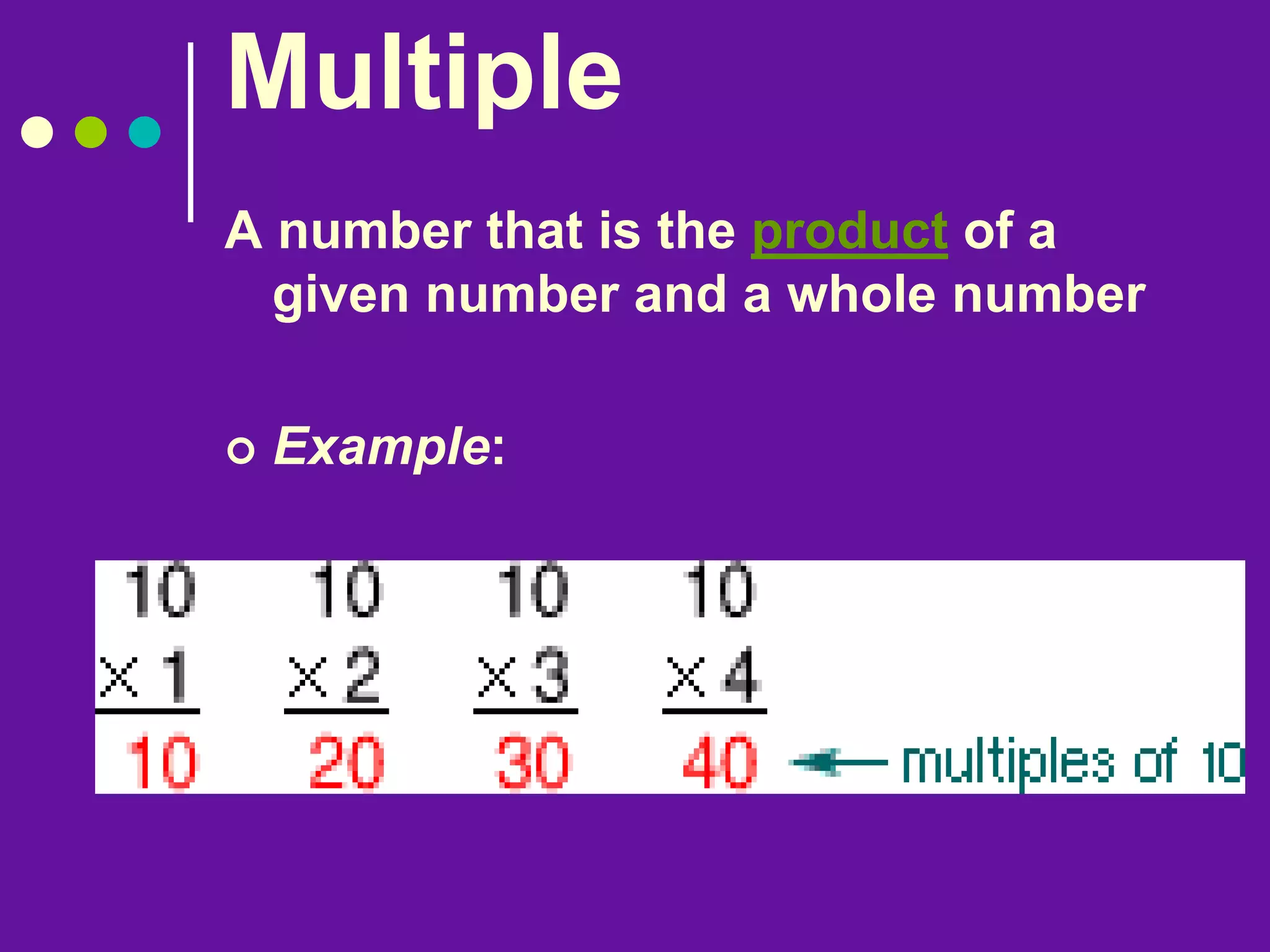
Multiple
A number that is the product of a
given number and a whole number
 Example:
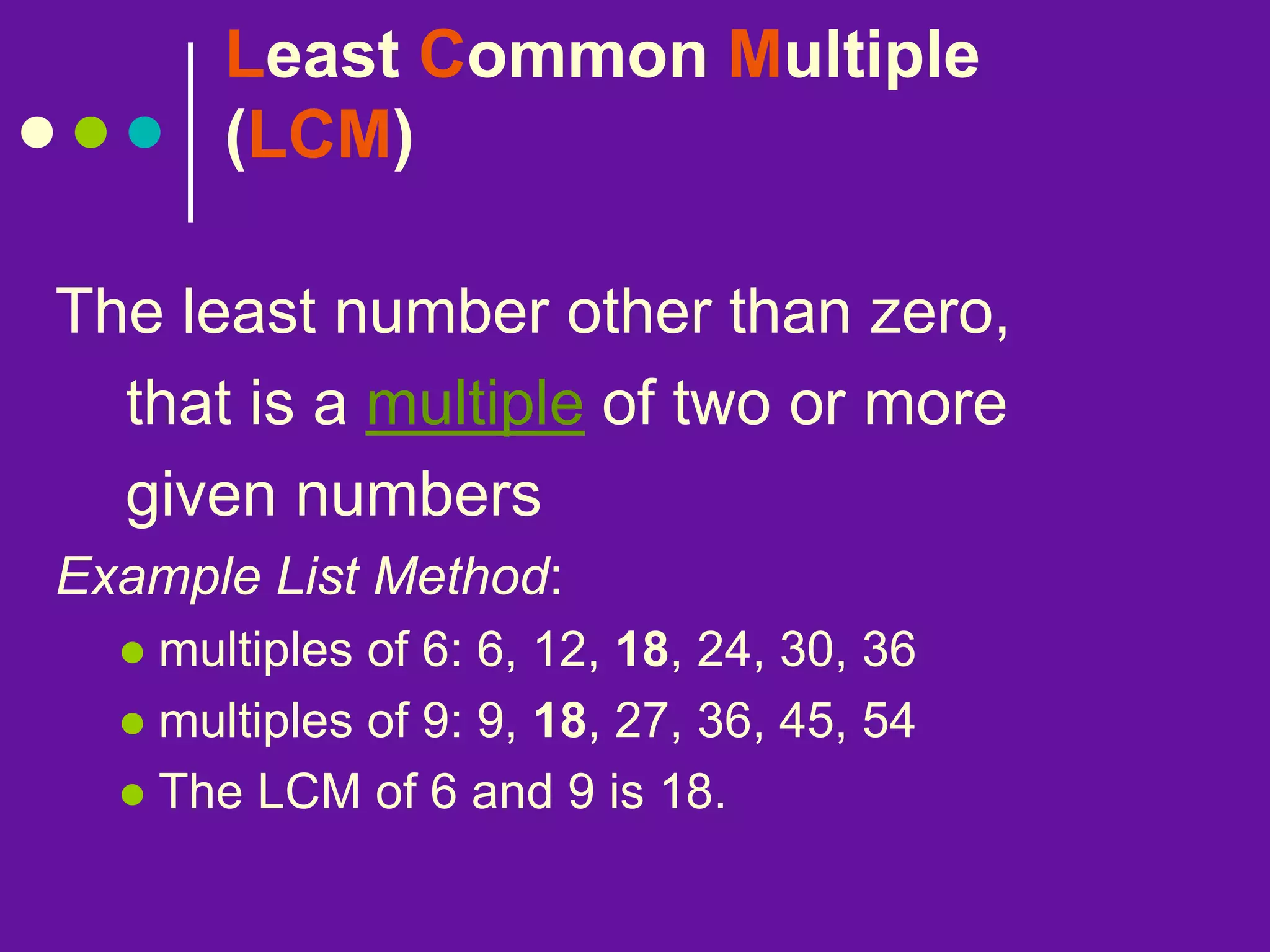
Least Common Multiple
(LCM)
The least number other than zero,
that is a multiple of two or more
given numbers
Example List Method:
 multiples of 6: 6, 12, 18, 24, 30, 36
 multiples of 9: 9, 18, 27, 36, 45, 54
 The LCM of 6 and 9 is 18.
Least Common Multiple
(LCM)
There are 3 ways to find the LCM.
 list the multiples of the numbers
 multiply the numbers times each other
and divide by the GCF.
 You can use the Indian Method/Ladder
Method (you must divide by prime
numbers only).
Find the LCM of 12 and 18
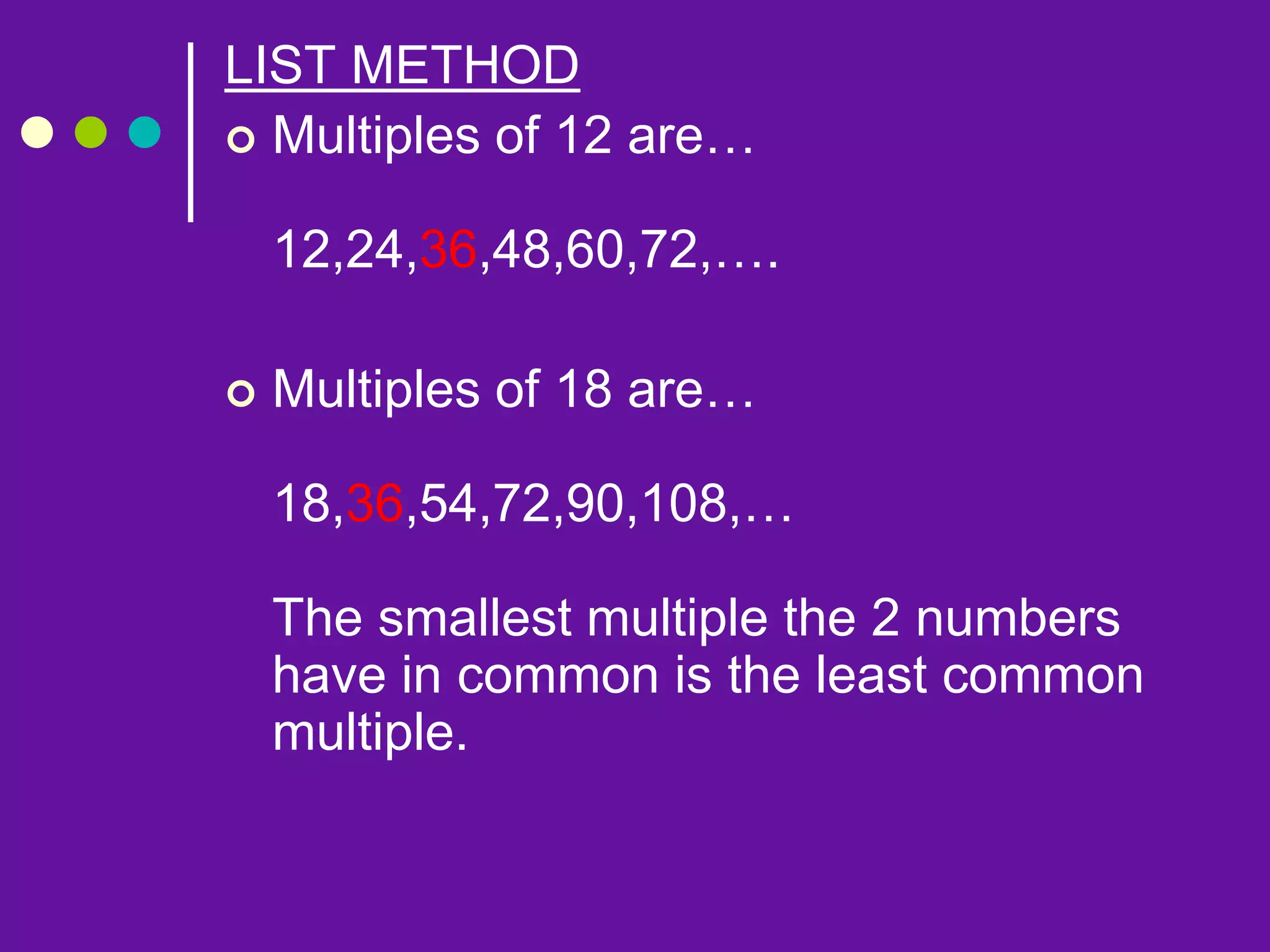
LIST METHOD
 Multiples of 12 are…
12,24,36,48,60,72,….
 Multiples of 18 are…
18,36,54,72,90,108,…
The smallest multiple the 2 numbers
have in common is the least common
multiple.
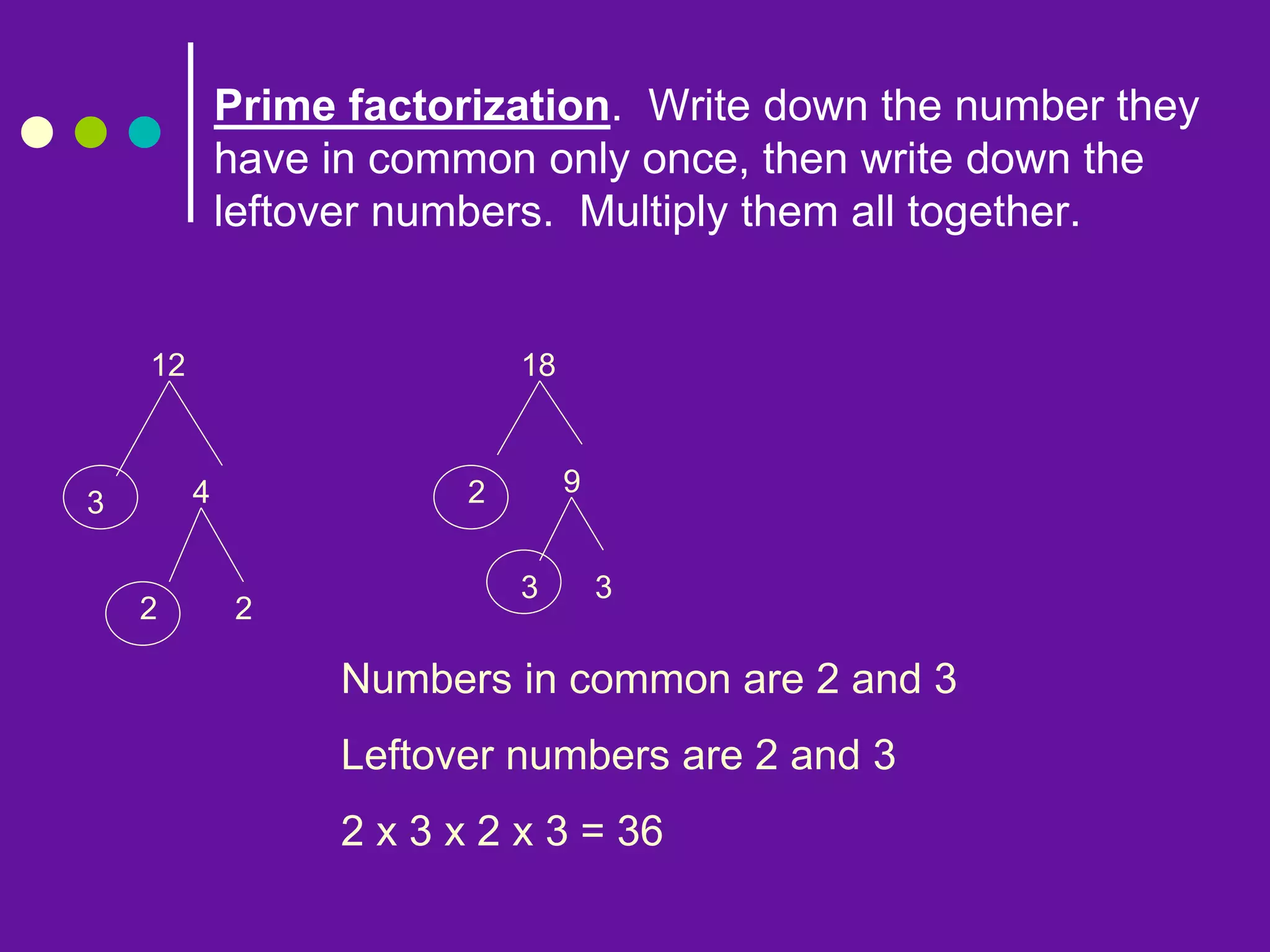
Prime factorization. Write down the number they
have in common only once, then write down the
leftover numbers. Multiply them all together.
12
3 4
2 2
18
2 9
3 3
Numbers in common are 2 and 3
Leftover numbers are 2 and 3
2 x 3 x 2 x 3 = 36
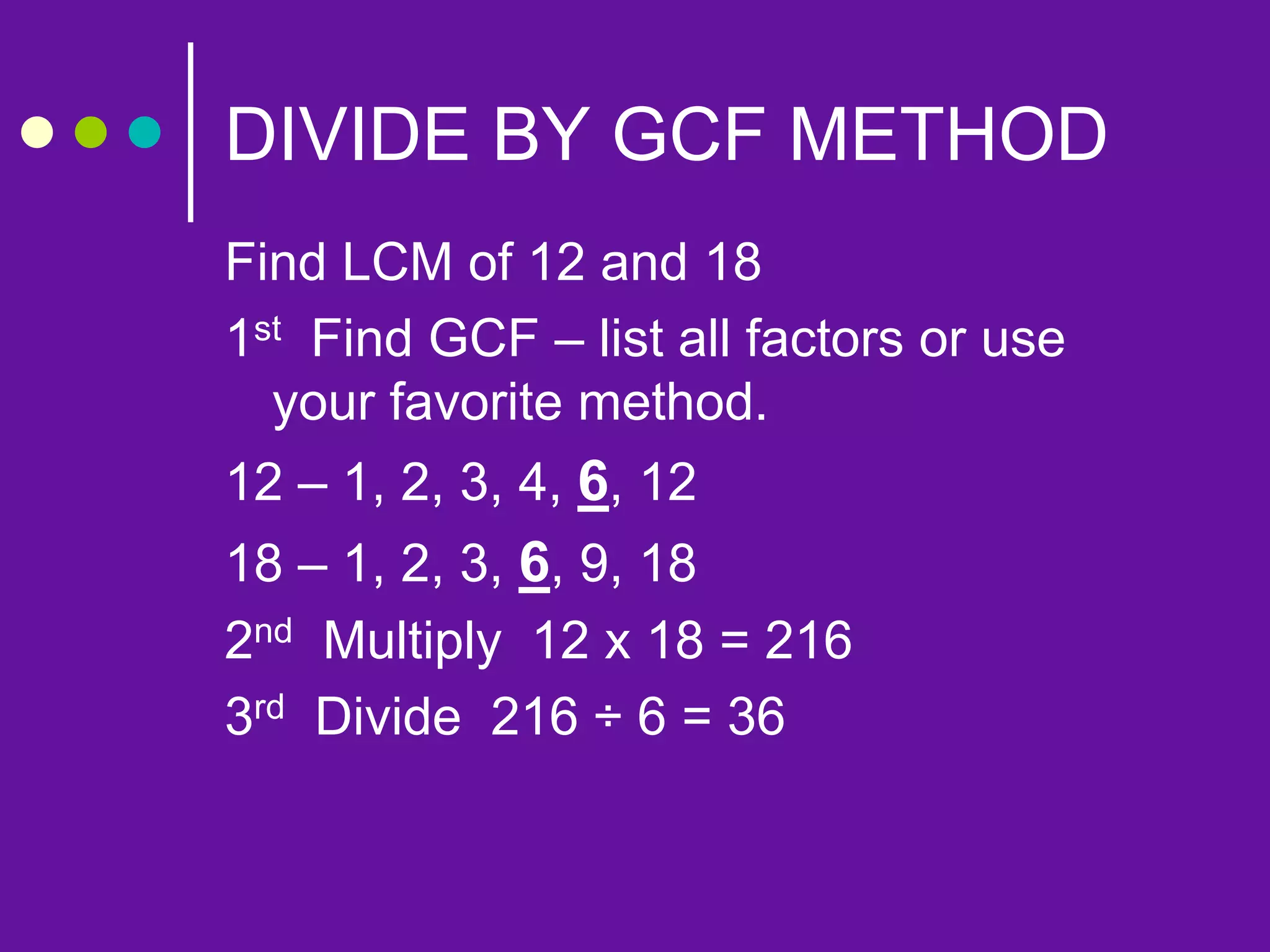
DIVIDE BY GCF METHOD
Find LCM of 12 and 18
1st Find GCF – list all factors or use
your favorite method.
12 – 1, 2, 3, 4, 6, 12
18 – 1, 2, 3, 6, 9, 18
2nd Multiply 12 x 18 = 216
3rd Divide 216 ÷ 6 = 36
Find the LCM of 35, 420
and 245
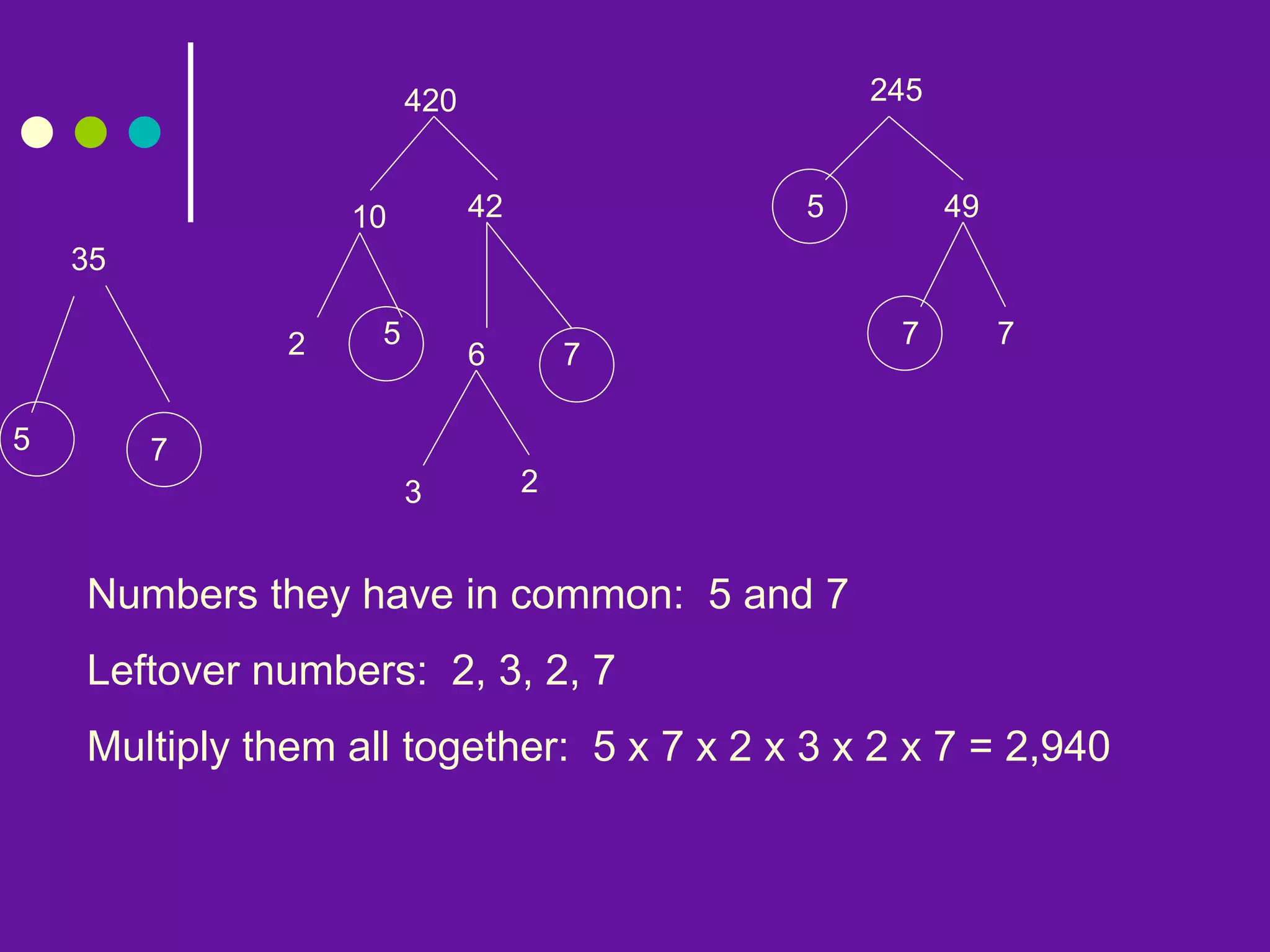
35
5 7
420
10 42
2 5
6 7
3 2
245
5 49
7 7
Numbers they have in common: 5 and 7
Leftover numbers: 2, 3, 2, 7
Multiply them all together: 5 x 7 x 2 x 3 x 2 x 7 = 2,940
GCF and LCM
Problem Solving
How can you tell if a word problem
requires you to use Greatest
Common Factor or Least Common
Multiple to solve?
GCF and LCM
Problem Solving
First, use the KWL method for
approaching all problems…
 K: What do you know?
 W: What do you want to know
 L: What did you learn?
If it is a GCF Problem
 What is the question asking us?
 Do we have to split things into smaller
sections?
 Are we trying to figure out how many
people we can invite?
 Are we trying to arrange something
into rows or groups?
GCF Example: Applying
what we have learned…
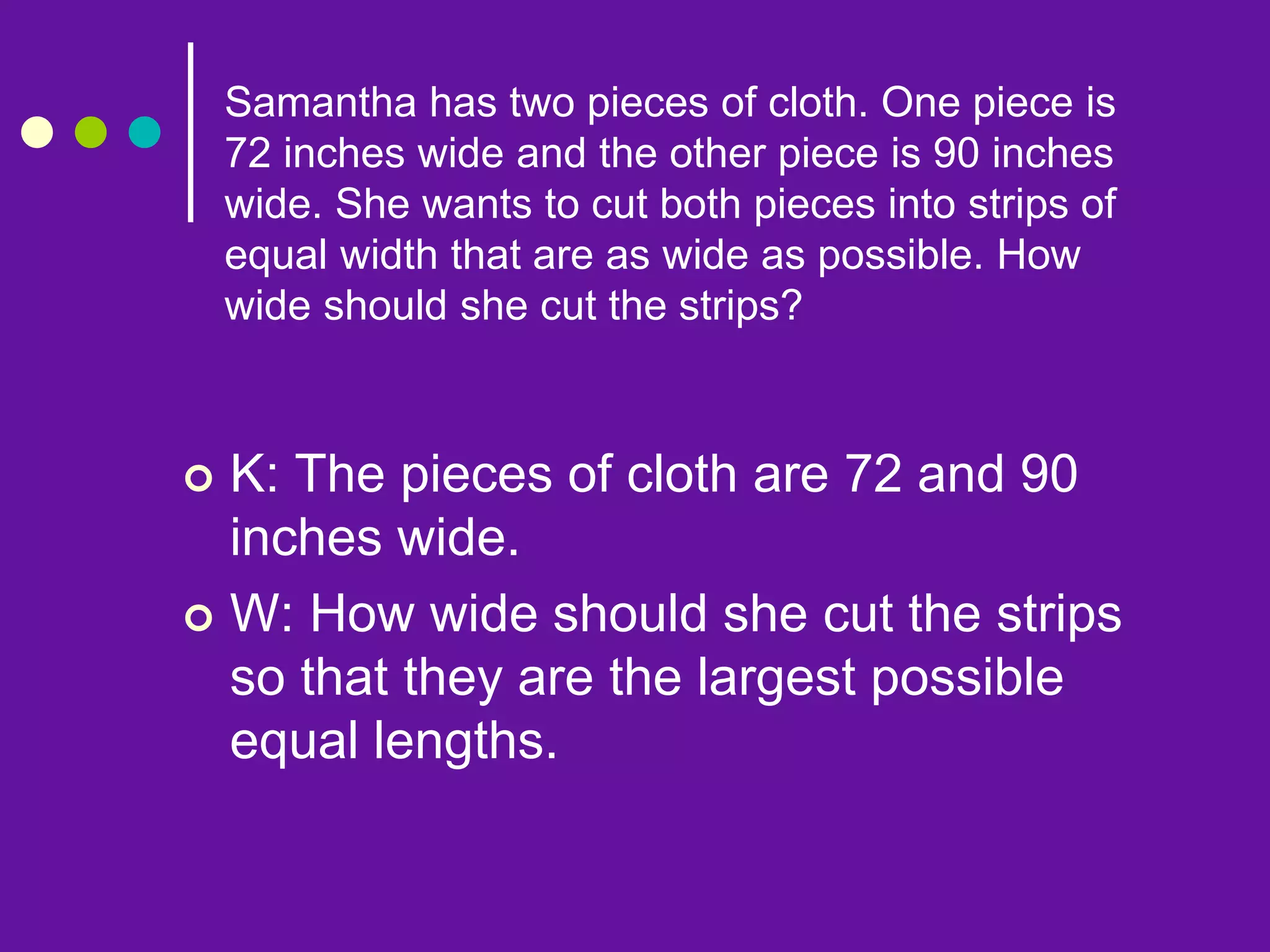
 Samantha has two pieces of cloth.
One piece is 72 inches wide and the
other piece is 90 inches wide. She
wants to cut both pieces into strips of
equal width that are as wide as
possible. How wide should she cut the
strips?
Samantha has two pieces of cloth. One piece is
72 inches wide and the other piece is 90 inches
wide. She wants to cut both pieces into strips of
equal width that are as wide as possible. How
wide should she cut the strips?
 K: The pieces of cloth are 72 and 90
inches wide.
 W: How wide should she cut the strips
so that they are the largest possible
equal lengths.
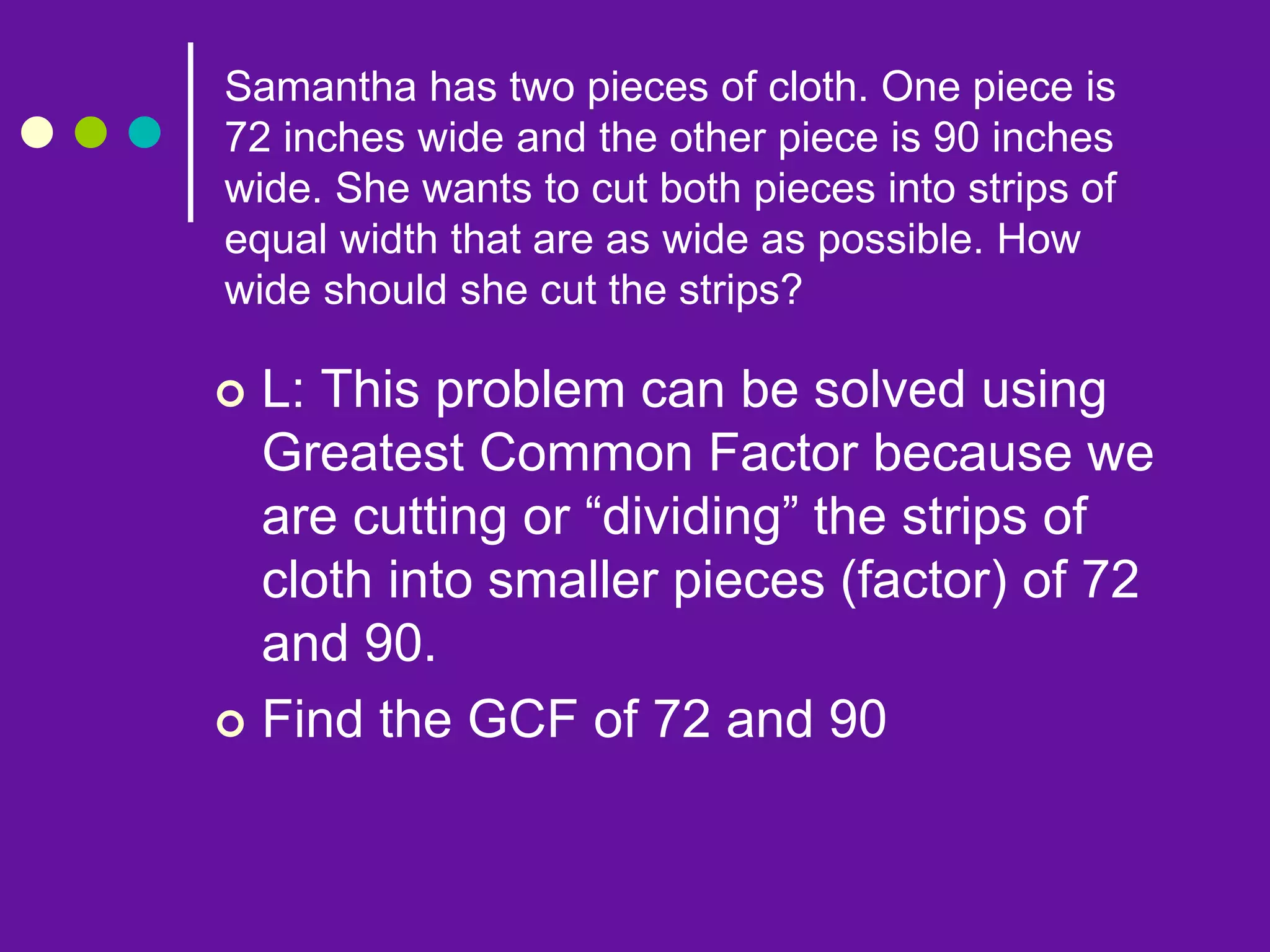
 L: This problem can be solved using
Greatest Common Factor because we
are cutting or “dividing” the strips of
cloth into smaller pieces (factor) of 72
and 90.
 Find the GCF of 72 and 90
Samantha has two pieces of cloth. One piece is
72 inches wide and the other piece is 90 inches
wide. She wants to cut both pieces into strips of
equal width that are as wide as possible. How
wide should she cut the strips?
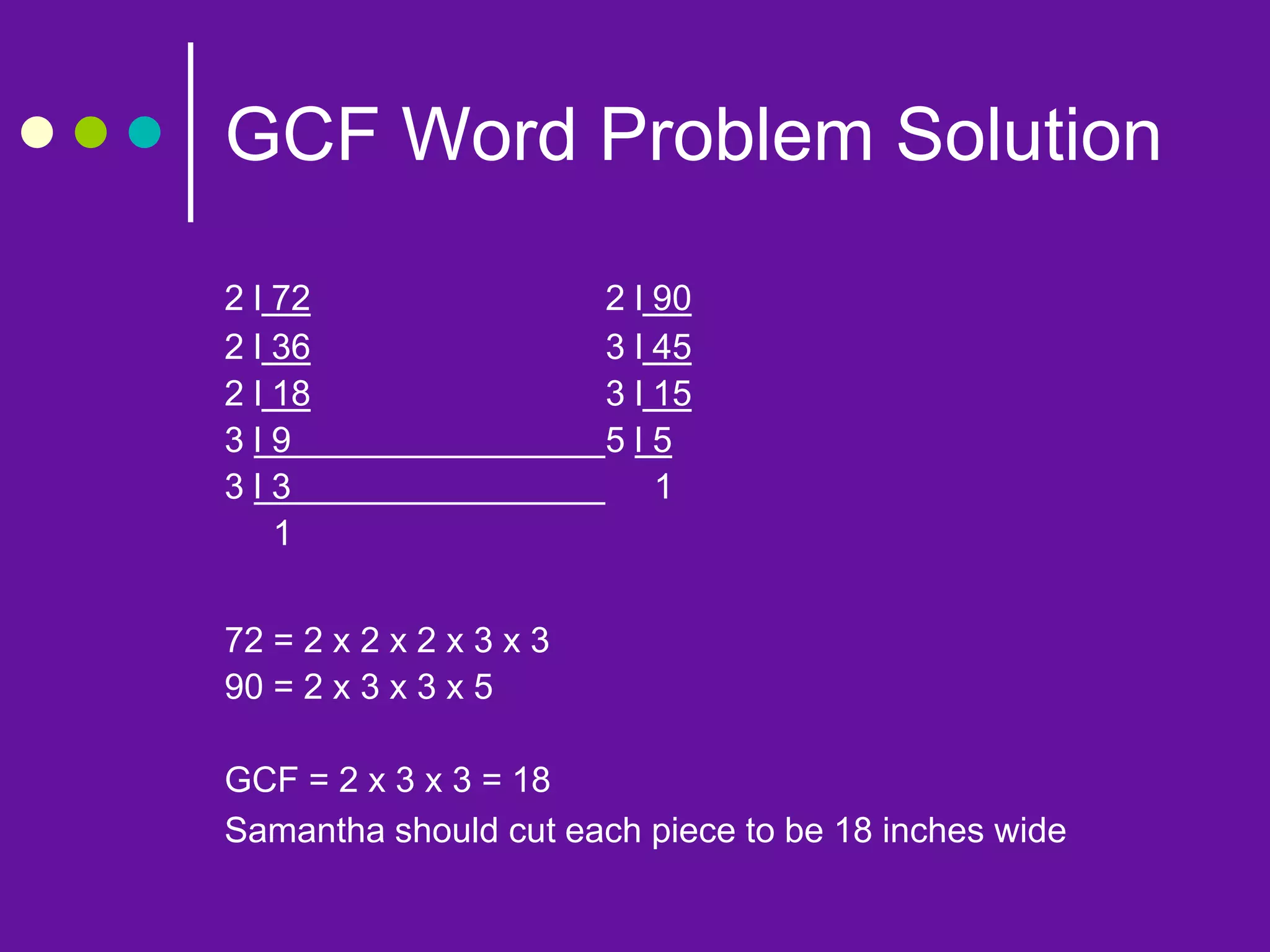
GCF Word Problem Solution
2 l 72 2 l 90
2 l 36 3 l 45
2 l 18 3 l 15
3 l 9 5 l 5
3 l 3 1
1
72 = 2 x 2 x 2 x 3 x 3
90 = 2 x 3 x 3 x 5
GCF = 2 x 3 x 3 = 18
Samantha should cut each piece to be 18 inches wide
If it is an LCM Problem
 What is the question asking us?
 Do we have an event that is or will be
repeating over and over?
 Will we have to purchase or get
multiple items in order to have
enough?
 Are we trying to figure out when
something will happen again at the
same time?
LCM Example: Applying
what we have learned…
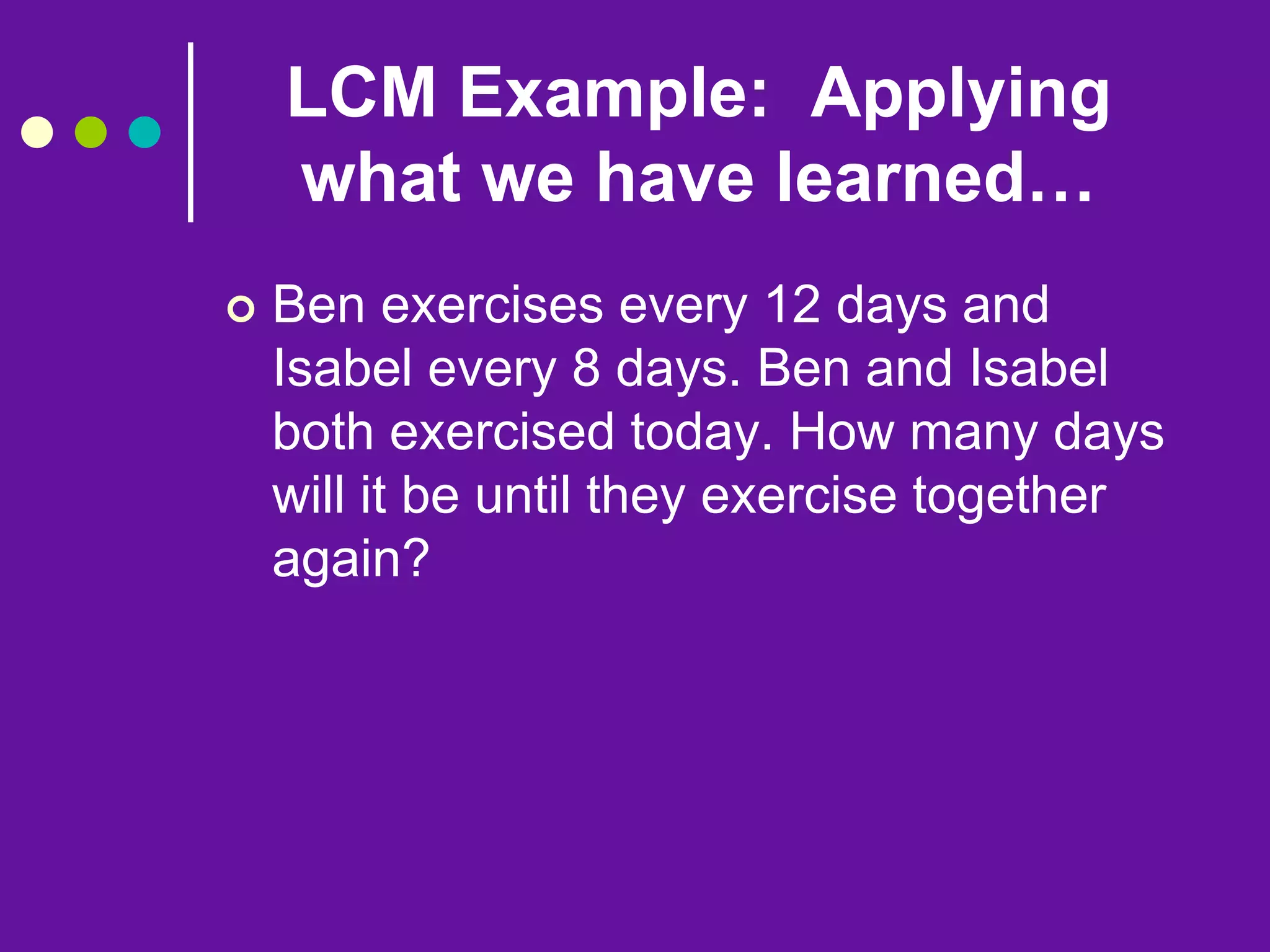
 Ben exercises every 12 days and
Isabel every 8 days. Ben and Isabel
both exercised today. How many days
will it be until they exercise together
again?
Ben exercises every 12 days and Isabel every
8 days. Ben and Isabel both exercised today.
How many days will it be until they exercise
together again?
 K: Ben exercises every 12 days and
Isabel every 8 days and they both
exercised today.
 W: How many days is it until they will
both exercise on the same day again.
 L: This problem can be solved using
Least Common Multiple. We are trying
to figure out when will be the next time
they are exercising together.
 Find the LCM of 12 and 8.
Ben exercises every 12 days and Isabel every
8 days. Ben and Isabel both exercised today.
How many days will it be until they exercise
together again?
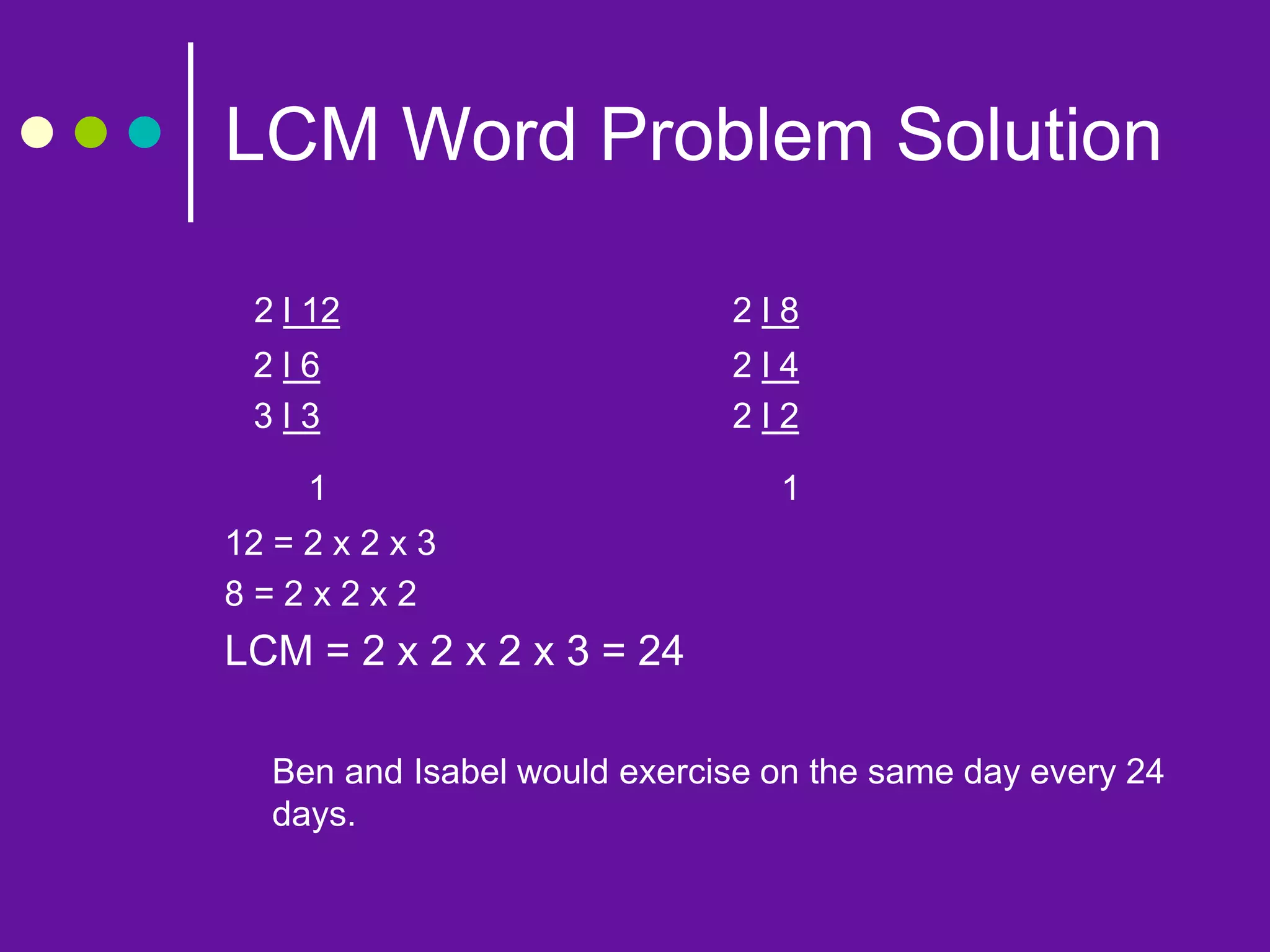
LCM Word Problem Solution
2 l 12 2 l 8
2 l 6 2 l 4
3 l 3 2 l 2
1 1
12 = 2 x 2 x 3
8 = 2 x 2 x 2
LCM = 2 x 2 x 2 x 3 = 24
Ben and Isabel would exercise on the same day every 24
days.
QUIZ!!!!!!
 On a sheet of notebook paper, tell
whether the following word problems
could be solved using GCF or LCM…
 Also Solve Questions 5 - 8
 Write it out in the KWL format you
have just learned.
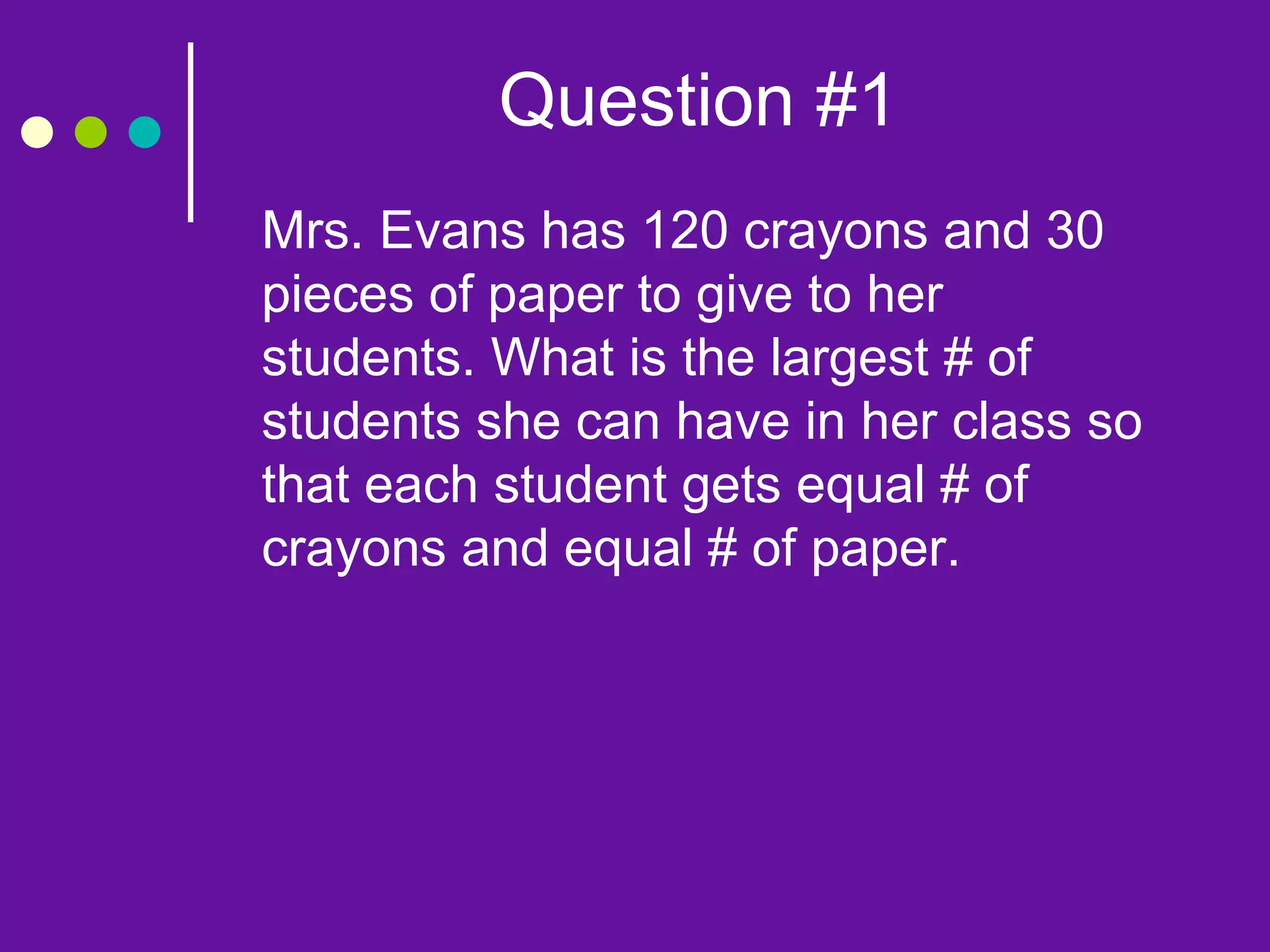
Question #1
Mrs. Evans has 120 crayons and 30
pieces of paper to give to her
students. What is the largest # of
students she can have in her class so
that each student gets equal # of
crayons and equal # of paper.
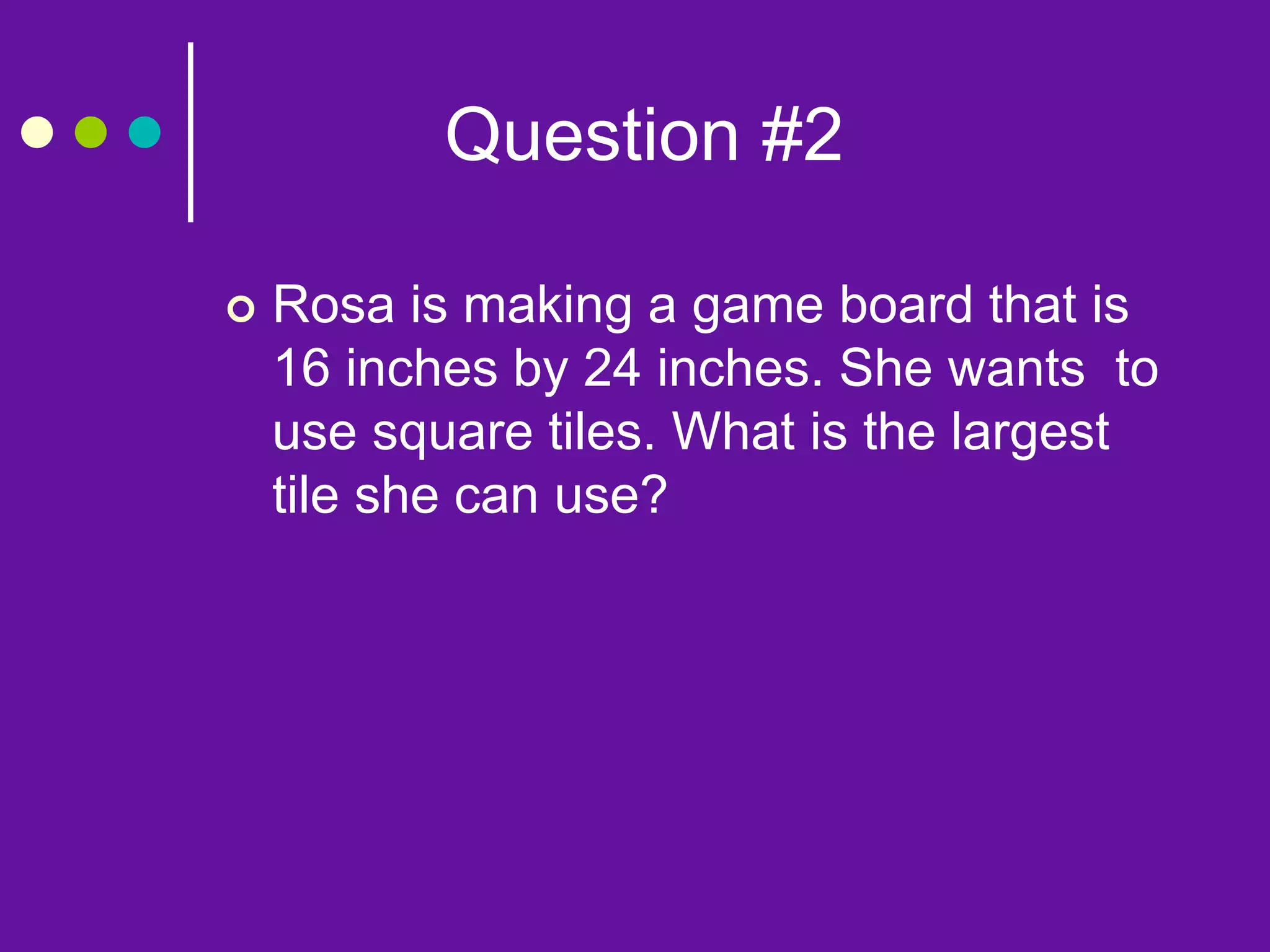
Question #2
 Rosa is making a game board that is
16 inches by 24 inches. She wants to
use square tiles. What is the largest
tile she can use?
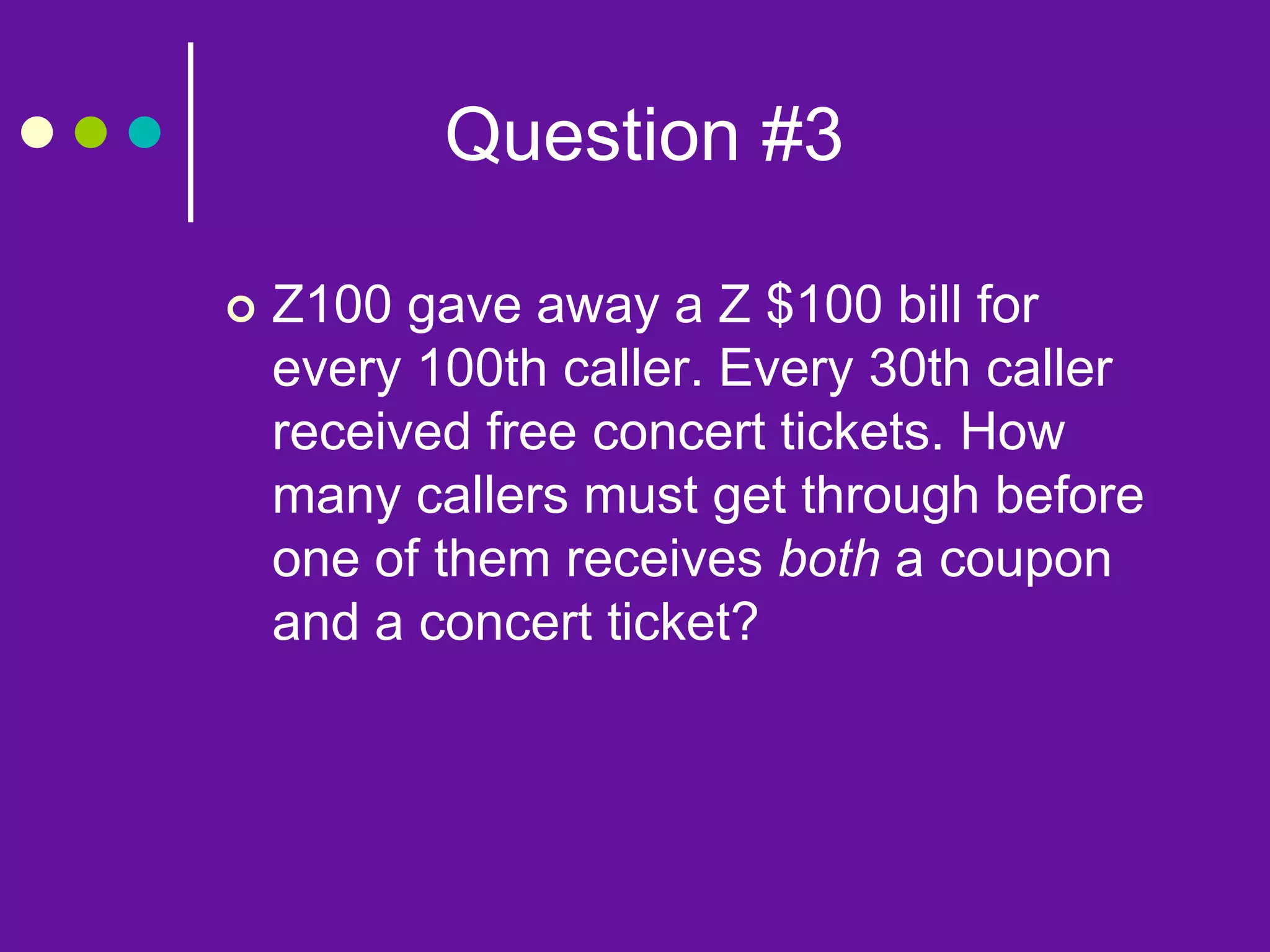
Question #3
 Z100 gave away a Z $100 bill for
every 100th caller. Every 30th caller
received free concert tickets. How
many callers must get through before
one of them receives both a coupon
and a concert ticket?
Question #4
 Two bikers are riding a circular path.
The first rider completes a round in 12
minutes. The second rider completes
a round in 18 minutes. If they both
started at the same place and time
and go in the same direction, after
how many minutes will they meet
again at the starting point?
Question #5
Solve the following:
 Sean has 8-inch pieces of toy train
track and Ruth has 18-inch pieces of
train track. How many of each piece
would each child need to build tracks
that are equal in length?
Question #6
Solve the following:
 I am planting 50 apple trees and 30
peach trees. I want the same number
and type of trees per row. What is the
maximum number of trees I can plant
per row?
Question # 7
Solve the following:
 Two faucets are dripping. One faucet
will drip every 4 seconds and the
other faucet drips every 9 seconds. If
a drop of water falls from both faucets
at the same, how many seconds will it
be before you see the faucets drip at
the same time again?
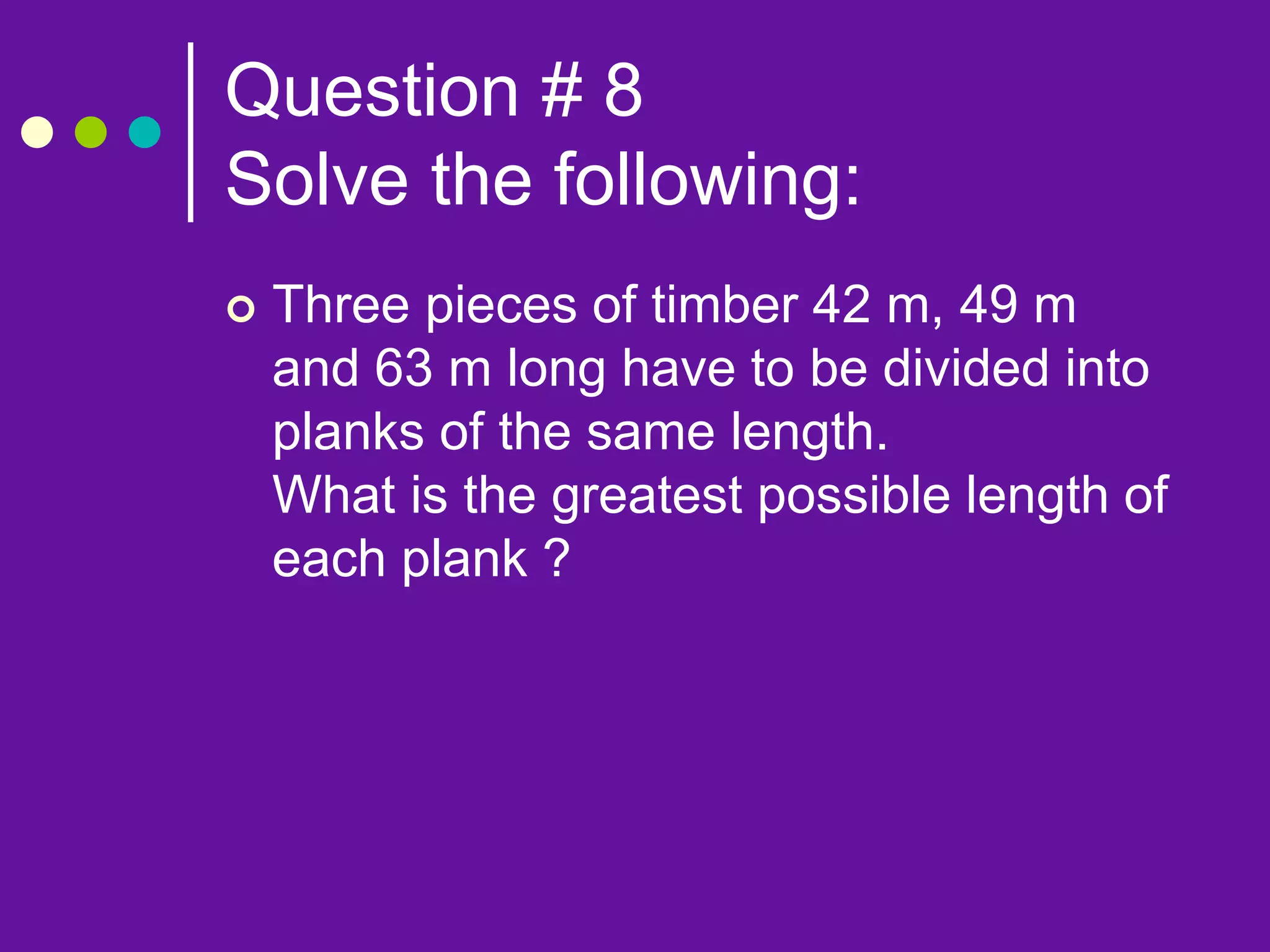
Question # 8
Solve the following:
 Three pieces of timber 42 m, 49 m
and 63 m long have to be divided into
planks of the same length.
What is the greatest possible length of
each plank ?
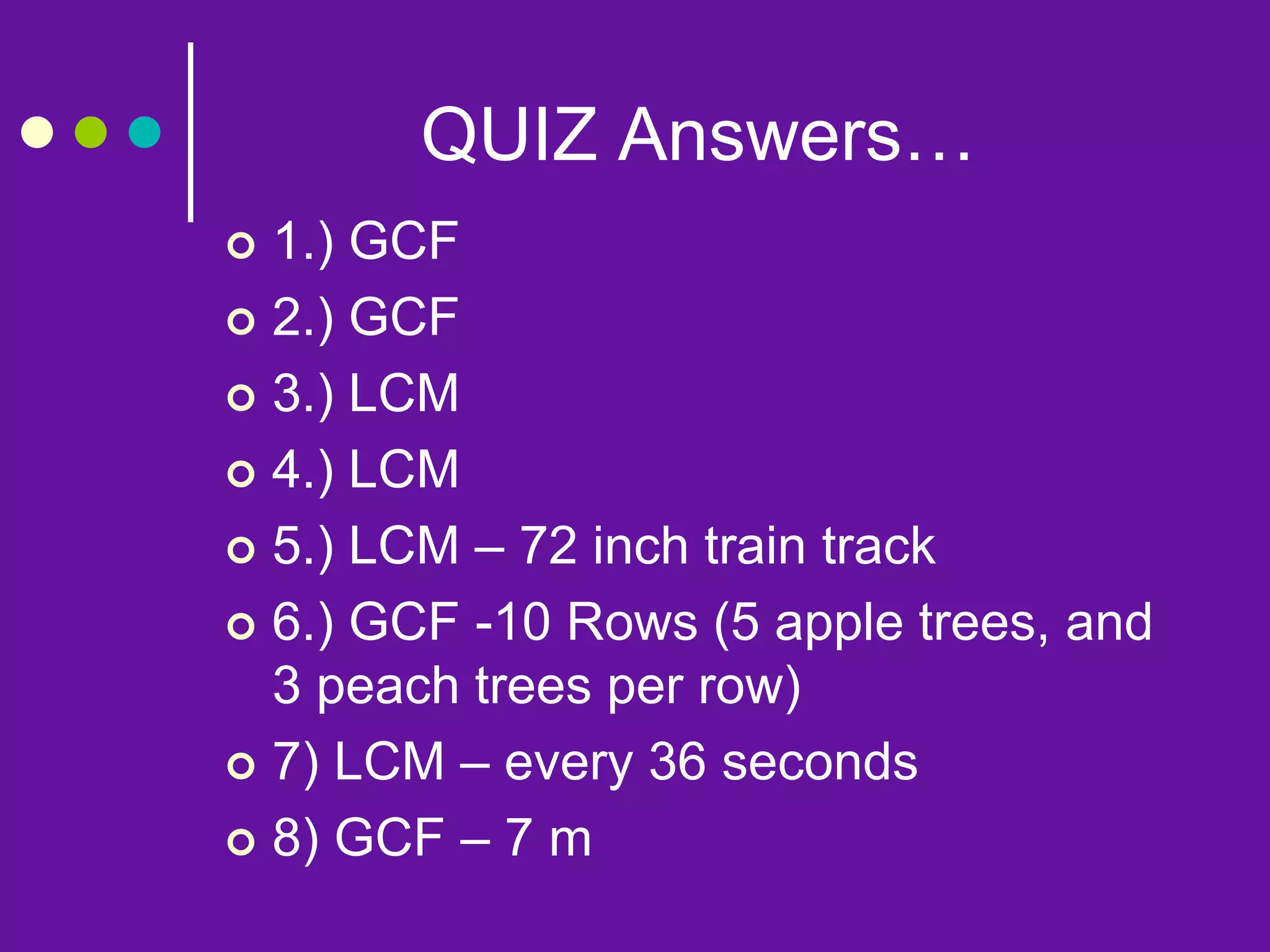
QUIZ Answers…
 1.) GCF
 2.) GCF
 3.) LCM
 4.) LCM
 5.) LCM – 72 inch train track
 6.) GCF -10 Rows (5 apple trees, and
3 peach trees per row)
 7) LCM – every 36 seconds
 8) GCF – 7 m

GCF LCM Notes.pdf

  • 1.
    Greatest Common Factor andLeast Common Multiples GCF and LCM
  • 2.
    Greatest Common Factor Whatis the difference between a factor and a multiple? Give me an example of a factor of 15
  • 3.
    Least Common Multiples Give mean example of a multiple of 15 What is the difference between a factor and a multiple?
  • 4.
    GCF How would you findthe GCF of 60 and 96?
  • 5.
    Methods to findGCF There are actually 3 ways. You can use prime factorization, birthday cake method/ladder or list method or write out all the factors for each number.
  • 6.
    List Method GCF 60and 96 60 -1, 2, 3, 4, 5, 6, 10, 12, 15, 20, 30, 60 96 – 1, 2, 3, 4, 6, 8, 12, 16, 24, 32, 48, 96
  • 7.
    Prime factorization method.Circle all the primes the 2 numbers have in common and multiply one set of them to get your GCF. 60 2 30 2 15 3 5 96 2 48 2 24 2 12 2 6 2 3 2 x 2 x 3 = 12
  • 8.
    Birthday Cake orLadder Method 60 5 12 3 2 4 2 2 2 1 2 4 8 16 32 96 2 1 2 2 2 3 2 X 2 X 3 = 12 GCF
  • 9.
    Multiple A number thatis the product of a given number and a whole number  Example:
  • 10.
    Least Common Multiple (LCM) Theleast number other than zero, that is a multiple of two or more given numbers Example List Method:  multiples of 6: 6, 12, 18, 24, 30, 36  multiples of 9: 9, 18, 27, 36, 45, 54  The LCM of 6 and 9 is 18.
  • 11.
    Least Common Multiple (LCM) Thereare 3 ways to find the LCM.  list the multiples of the numbers  multiply the numbers times each other and divide by the GCF.  You can use the Indian Method/Ladder Method (you must divide by prime numbers only). Find the LCM of 12 and 18
  • 12.
    LIST METHOD  Multiplesof 12 are… 12,24,36,48,60,72,….  Multiples of 18 are… 18,36,54,72,90,108,… The smallest multiple the 2 numbers have in common is the least common multiple.
  • 13.
    Prime factorization. Writedown the number they have in common only once, then write down the leftover numbers. Multiply them all together. 12 3 4 2 2 18 2 9 3 3 Numbers in common are 2 and 3 Leftover numbers are 2 and 3 2 x 3 x 2 x 3 = 36
  • 14.
    DIVIDE BY GCFMETHOD Find LCM of 12 and 18 1st Find GCF – list all factors or use your favorite method. 12 – 1, 2, 3, 4, 6, 12 18 – 1, 2, 3, 6, 9, 18 2nd Multiply 12 x 18 = 216 3rd Divide 216 ÷ 6 = 36
  • 15.
    Find the LCMof 35, 420 and 245
  • 16.
    35 5 7 420 10 42 25 6 7 3 2 245 5 49 7 7 Numbers they have in common: 5 and 7 Leftover numbers: 2, 3, 2, 7 Multiply them all together: 5 x 7 x 2 x 3 x 2 x 7 = 2,940
  • 17.
    GCF and LCM ProblemSolving How can you tell if a word problem requires you to use Greatest Common Factor or Least Common Multiple to solve?
  • 18.
    GCF and LCM ProblemSolving First, use the KWL method for approaching all problems…  K: What do you know?  W: What do you want to know  L: What did you learn?
  • 19.
    If it isa GCF Problem  What is the question asking us?  Do we have to split things into smaller sections?  Are we trying to figure out how many people we can invite?  Are we trying to arrange something into rows or groups?
  • 20.
    GCF Example: Applying whatwe have learned…  Samantha has two pieces of cloth. One piece is 72 inches wide and the other piece is 90 inches wide. She wants to cut both pieces into strips of equal width that are as wide as possible. How wide should she cut the strips?
  • 21.
    Samantha has twopieces of cloth. One piece is 72 inches wide and the other piece is 90 inches wide. She wants to cut both pieces into strips of equal width that are as wide as possible. How wide should she cut the strips?  K: The pieces of cloth are 72 and 90 inches wide.  W: How wide should she cut the strips so that they are the largest possible equal lengths.
  • 22.
     L: Thisproblem can be solved using Greatest Common Factor because we are cutting or “dividing” the strips of cloth into smaller pieces (factor) of 72 and 90.  Find the GCF of 72 and 90 Samantha has two pieces of cloth. One piece is 72 inches wide and the other piece is 90 inches wide. She wants to cut both pieces into strips of equal width that are as wide as possible. How wide should she cut the strips?
  • 23.
    GCF Word ProblemSolution 2 l 72 2 l 90 2 l 36 3 l 45 2 l 18 3 l 15 3 l 9 5 l 5 3 l 3 1 1 72 = 2 x 2 x 2 x 3 x 3 90 = 2 x 3 x 3 x 5 GCF = 2 x 3 x 3 = 18 Samantha should cut each piece to be 18 inches wide
  • 24.
    If it isan LCM Problem  What is the question asking us?  Do we have an event that is or will be repeating over and over?  Will we have to purchase or get multiple items in order to have enough?  Are we trying to figure out when something will happen again at the same time?
  • 25.
    LCM Example: Applying whatwe have learned…  Ben exercises every 12 days and Isabel every 8 days. Ben and Isabel both exercised today. How many days will it be until they exercise together again?
  • 26.
    Ben exercises every12 days and Isabel every 8 days. Ben and Isabel both exercised today. How many days will it be until they exercise together again?  K: Ben exercises every 12 days and Isabel every 8 days and they both exercised today.  W: How many days is it until they will both exercise on the same day again.
  • 27.
     L: Thisproblem can be solved using Least Common Multiple. We are trying to figure out when will be the next time they are exercising together.  Find the LCM of 12 and 8. Ben exercises every 12 days and Isabel every 8 days. Ben and Isabel both exercised today. How many days will it be until they exercise together again?
  • 28.
    LCM Word ProblemSolution 2 l 12 2 l 8 2 l 6 2 l 4 3 l 3 2 l 2 1 1 12 = 2 x 2 x 3 8 = 2 x 2 x 2 LCM = 2 x 2 x 2 x 3 = 24 Ben and Isabel would exercise on the same day every 24 days.
  • 29.
    QUIZ!!!!!!  On asheet of notebook paper, tell whether the following word problems could be solved using GCF or LCM…  Also Solve Questions 5 - 8  Write it out in the KWL format you have just learned.
  • 30.
    Question #1 Mrs. Evanshas 120 crayons and 30 pieces of paper to give to her students. What is the largest # of students she can have in her class so that each student gets equal # of crayons and equal # of paper.
  • 31.
    Question #2  Rosais making a game board that is 16 inches by 24 inches. She wants to use square tiles. What is the largest tile she can use?
  • 32.
    Question #3  Z100gave away a Z $100 bill for every 100th caller. Every 30th caller received free concert tickets. How many callers must get through before one of them receives both a coupon and a concert ticket?
  • 33.
    Question #4  Twobikers are riding a circular path. The first rider completes a round in 12 minutes. The second rider completes a round in 18 minutes. If they both started at the same place and time and go in the same direction, after how many minutes will they meet again at the starting point?
  • 34.
    Question #5 Solve thefollowing:  Sean has 8-inch pieces of toy train track and Ruth has 18-inch pieces of train track. How many of each piece would each child need to build tracks that are equal in length?
  • 35.
    Question #6 Solve thefollowing:  I am planting 50 apple trees and 30 peach trees. I want the same number and type of trees per row. What is the maximum number of trees I can plant per row?
  • 36.
    Question # 7 Solvethe following:  Two faucets are dripping. One faucet will drip every 4 seconds and the other faucet drips every 9 seconds. If a drop of water falls from both faucets at the same, how many seconds will it be before you see the faucets drip at the same time again?
  • 37.
    Question # 8 Solvethe following:  Three pieces of timber 42 m, 49 m and 63 m long have to be divided into planks of the same length. What is the greatest possible length of each plank ?
  • 38.
    QUIZ Answers…  1.)GCF  2.) GCF  3.) LCM  4.) LCM  5.) LCM – 72 inch train track  6.) GCF -10 Rows (5 apple trees, and 3 peach trees per row)  7) LCM – every 36 seconds  8) GCF – 7 m