2/6/2023 1
• Definition: Method of introducing a tube through nose
into stomach for feeding purpose.
• A NGT is a soft rubber or plastic tube that is inserted
through a nostril and into the stomach.
Purpose
– To administer tube feedings and medications to
clients unable to eat by mouth or swallow a sufficient
diet
2/6/2023 2
– To lavage (wash) the stomach in case of poisoning or
overdose of medications
– To remove stomach contents for laboratory analysis.
– To establish a means for suctioning stomach contents
to prevent gastric distention, nausea, and vomiting
2/6/2023 3
• equipment for NGT.docx
2/6/2023 4
• Contraindications
• Child with epistaxis by gravity
• Child with nasal polyp
• Cleft palate or any other congenital
abnormalities around the nose and mouth
2/6/2023 5
2/6/2023 6
• It is the irrigation or washing out of the stomach.
Purpose
• To remove alcoholic, narcotic or any other poisoning which
has been swallowed.
• To introduce ice water or normal saline solution in tackling
bleeding.
• To cleanse the stomach before operation.
• To relieve congestion, there by stimulating peristalsis
• For diagnostic purposes.
2/6/2023 7
• Gastric lavage.docx
2/6/2023 8
2/6/2023 9
• It is the withdrawal of fluid or gas from a cavity by suction.
Purpose
• To prevent or relieve distention following abdominal
operation.
• In case of gastrointestinal obstruction, to remove the stomach
or gastric contents.
• To keep the stomach empty before an emergency abdominal
operation is done.
• To aspirate the stomach contents for diagnostic purposes.
2/6/2023 10
There are two types of gastric aspiration
• Intermittent method: Suction is done as condition
required and as ordered.
• Continuous method: attached to a drainage bag.
There are two types of supplying suction.
• Simple suction by the use of a syringe
• An electric suction machine
2/6/2023 11
• Equipment for gastric aspiration.docx
2/6/2023 12
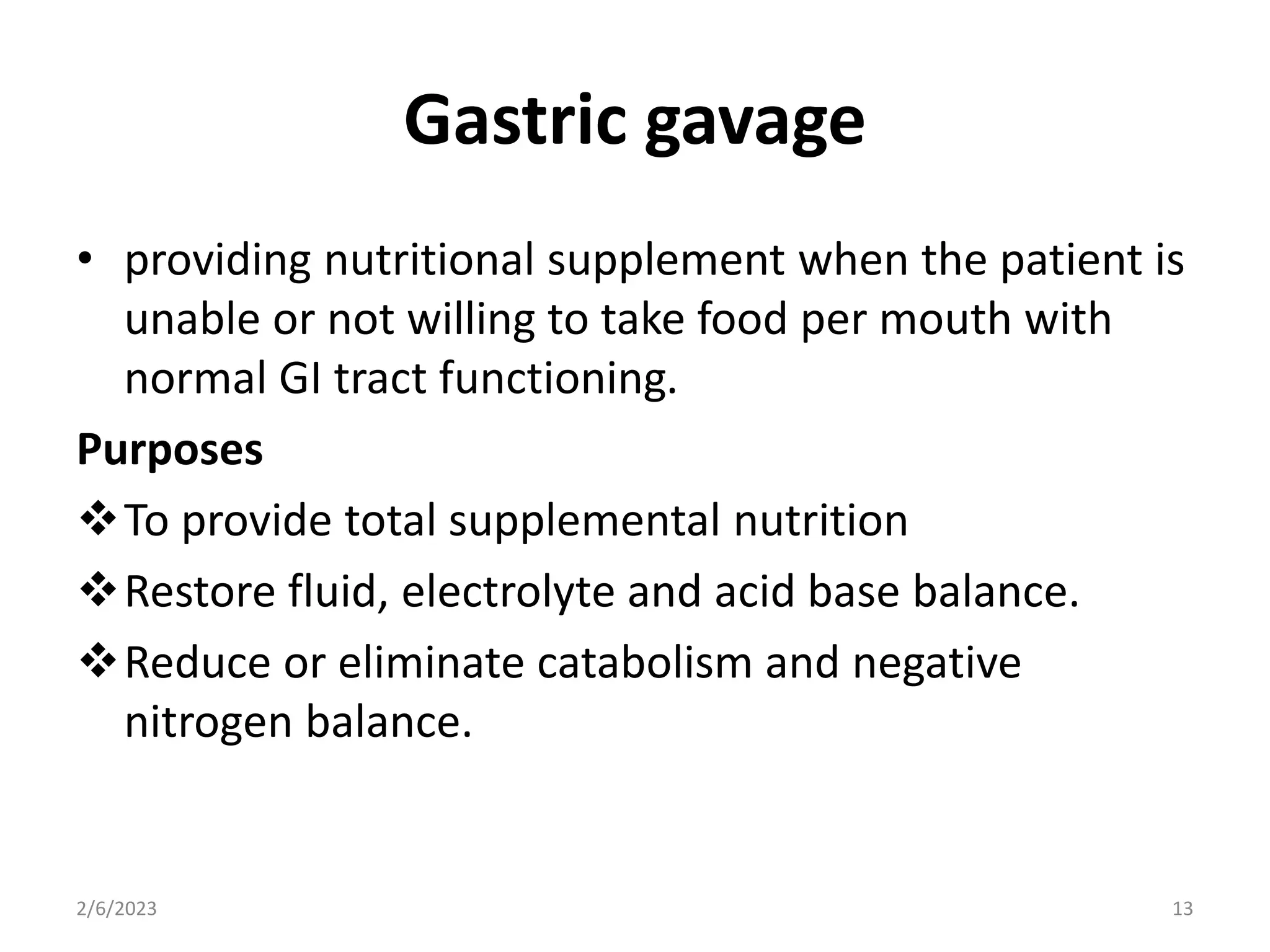
Gastric gavage
• providing nutritional supplement when the patient is
unable or not willing to take food per mouth with
normal GI tract functioning.
Purposes
To provide total supplemental nutrition
Restore fluid, electrolyte and acid base balance.
Reduce or eliminate catabolism and negative
nitrogen balance.
2/6/2023 13
• Equipment for Gastric Gavage.doc
2/6/2023 14
complications
• Diarrhoea
• Nausea/ vomiting
• Cramping/ gas
• ™
Constipation
• ™
Aspiration pneumonia
• ™
Tube displacement
• ™
Tube obstruction
• ™
Nasopharengeal irritation
• ™
Hyperglycaemia
2/6/2023 15
NGT Removal
• process of withdrawing the nasogastric tube which
was placed in client’s stomach for different purpose
• NG tube is removed:-
-when clients nutritional status doesn’t warrant EN
therapy
- Providing decompression of gastric contents no
longer needed
2/6/2023 16
• Procedure of NGT removal .doc
2/6/2023 17
2/6/2023 18
• Surgical operation in which an opening for a tube is
made through the wall of the stomach and joined to an
opening in the adjacent abdominal wall.
• It allows food and liquids to be placed directly into the
stomach via a tube when the esophagus is affected by
disease or recovering from surgery
• Used to give food to a patient who has a gastrostomy
2/6/2023 19
• Regurgitation and aspiration are less likely to occur with
gastrostomy than NG feedings
• Gastrostomy is preferred for prolonged enteral nutrition
support (longer than 4 weeks).
• It is preferred over NG tube feeding in the patient who is
comatose because the gastro esophageal sphincter
remains intact
• It allows clients greater mobility than gastric or duodenal
tube feeding and enables client to feed themselves.
2/6/2023 20
• Equipment for gastrostomy.docx
2/6/2023 21
The patient with Gastrostomy
Assessment
• Evaluate the patient’s skin condition and determine
whether a delay in a healing at the tube insertion site.
• Asses the patient’s fluid and nutritional need.
• Inspect the tube for proper maintenance and the incision
for sign of infection.
• Evaluate the patient response to the change in body
image and his/her understanding of the feeding methods.
2/6/2023 22
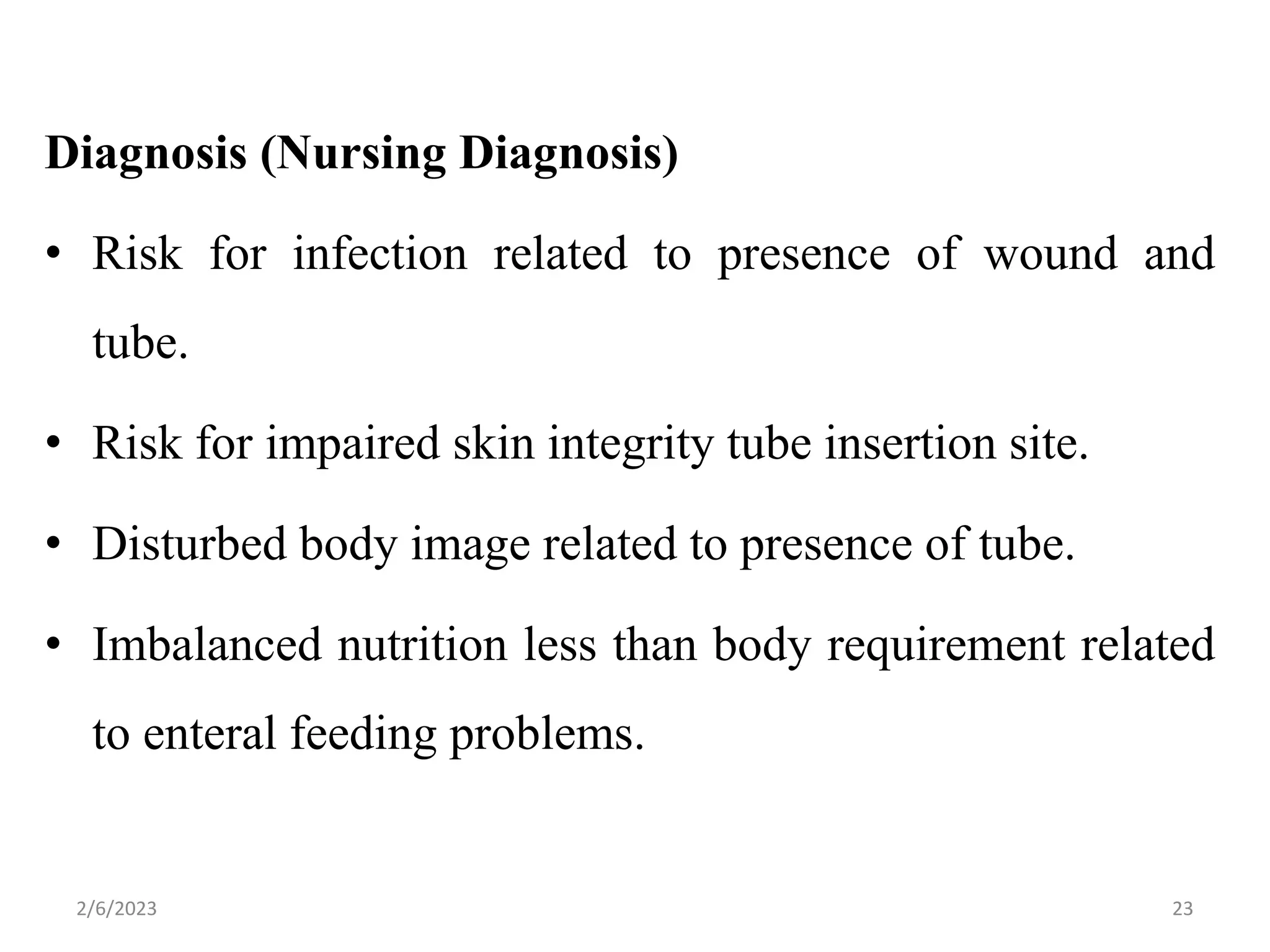
Diagnosis (Nursing Diagnosis)
• Risk for infection related to presence of wound and
tube.
• Risk for impaired skin integrity tube insertion site.
• Disturbed body image related to presence of tube.
• Imbalanced nutrition less than body requirement related
to enteral feeding problems.
2/6/2023 23
Planning and goals
• Attaining an optimal level of nutrition
• Preventing infection
• Maintaining skin integrity
• Enhancing coping
• Adjusting to change in body image
• Preventing complication
2/6/2023 24
Nursing Intervention
• Applying a small dressing over the tube insertion site.
• Wash the area around the tube with soap and water daily
removes any encrustation with saline solution.
• Calm discussion of the purpose and routine of
gastrostomy feeding.
• Closely monitor the V/s of the patient.
2/6/2023 25
• Evaluation
• Achieves an adequate intake of nutrients
• Is free from infection and skin breakdown.
• Adjust to change in body image.
• Avoid complication
2/6/2023 26
Potential complication
• Wound infection
• Cellulites
• Leakage and abdominal wall abscess.
• GI bleeding
• Constipation or diarrhea
• Aspiration
2/6/2023 27

NGT.pptx

  • 1.
  • 2.
    • Definition: Methodof introducing a tube through nose into stomach for feeding purpose. • A NGT is a soft rubber or plastic tube that is inserted through a nostril and into the stomach. Purpose – To administer tube feedings and medications to clients unable to eat by mouth or swallow a sufficient diet 2/6/2023 2
  • 3.
    – To lavage(wash) the stomach in case of poisoning or overdose of medications – To remove stomach contents for laboratory analysis. – To establish a means for suctioning stomach contents to prevent gastric distention, nausea, and vomiting 2/6/2023 3
  • 4.
    • equipment forNGT.docx 2/6/2023 4
  • 5.
    • Contraindications • Childwith epistaxis by gravity • Child with nasal polyp • Cleft palate or any other congenital abnormalities around the nose and mouth 2/6/2023 5
  • 6.
  • 7.
    • It isthe irrigation or washing out of the stomach. Purpose • To remove alcoholic, narcotic or any other poisoning which has been swallowed. • To introduce ice water or normal saline solution in tackling bleeding. • To cleanse the stomach before operation. • To relieve congestion, there by stimulating peristalsis • For diagnostic purposes. 2/6/2023 7
  • 8.
  • 9.
  • 10.
    • It isthe withdrawal of fluid or gas from a cavity by suction. Purpose • To prevent or relieve distention following abdominal operation. • In case of gastrointestinal obstruction, to remove the stomach or gastric contents. • To keep the stomach empty before an emergency abdominal operation is done. • To aspirate the stomach contents for diagnostic purposes. 2/6/2023 10
  • 11.
    There are twotypes of gastric aspiration • Intermittent method: Suction is done as condition required and as ordered. • Continuous method: attached to a drainage bag. There are two types of supplying suction. • Simple suction by the use of a syringe • An electric suction machine 2/6/2023 11
  • 12.
    • Equipment forgastric aspiration.docx 2/6/2023 12
  • 13.
    Gastric gavage • providingnutritional supplement when the patient is unable or not willing to take food per mouth with normal GI tract functioning. Purposes To provide total supplemental nutrition Restore fluid, electrolyte and acid base balance. Reduce or eliminate catabolism and negative nitrogen balance. 2/6/2023 13
  • 14.
    • Equipment forGastric Gavage.doc 2/6/2023 14
  • 15.
    complications • Diarrhoea • Nausea/vomiting • Cramping/ gas • ™ Constipation • ™ Aspiration pneumonia • ™ Tube displacement • ™ Tube obstruction • ™ Nasopharengeal irritation • ™ Hyperglycaemia 2/6/2023 15
  • 16.
    NGT Removal • processof withdrawing the nasogastric tube which was placed in client’s stomach for different purpose • NG tube is removed:- -when clients nutritional status doesn’t warrant EN therapy - Providing decompression of gastric contents no longer needed 2/6/2023 16
  • 17.
    • Procedure ofNGT removal .doc 2/6/2023 17
  • 18.
  • 19.
    • Surgical operationin which an opening for a tube is made through the wall of the stomach and joined to an opening in the adjacent abdominal wall. • It allows food and liquids to be placed directly into the stomach via a tube when the esophagus is affected by disease or recovering from surgery • Used to give food to a patient who has a gastrostomy 2/6/2023 19
  • 20.
    • Regurgitation andaspiration are less likely to occur with gastrostomy than NG feedings • Gastrostomy is preferred for prolonged enteral nutrition support (longer than 4 weeks). • It is preferred over NG tube feeding in the patient who is comatose because the gastro esophageal sphincter remains intact • It allows clients greater mobility than gastric or duodenal tube feeding and enables client to feed themselves. 2/6/2023 20
  • 21.
    • Equipment forgastrostomy.docx 2/6/2023 21
  • 22.
    The patient withGastrostomy Assessment • Evaluate the patient’s skin condition and determine whether a delay in a healing at the tube insertion site. • Asses the patient’s fluid and nutritional need. • Inspect the tube for proper maintenance and the incision for sign of infection. • Evaluate the patient response to the change in body image and his/her understanding of the feeding methods. 2/6/2023 22
  • 23.
    Diagnosis (Nursing Diagnosis) •Risk for infection related to presence of wound and tube. • Risk for impaired skin integrity tube insertion site. • Disturbed body image related to presence of tube. • Imbalanced nutrition less than body requirement related to enteral feeding problems. 2/6/2023 23
  • 24.
    Planning and goals •Attaining an optimal level of nutrition • Preventing infection • Maintaining skin integrity • Enhancing coping • Adjusting to change in body image • Preventing complication 2/6/2023 24
  • 25.
    Nursing Intervention • Applyinga small dressing over the tube insertion site. • Wash the area around the tube with soap and water daily removes any encrustation with saline solution. • Calm discussion of the purpose and routine of gastrostomy feeding. • Closely monitor the V/s of the patient. 2/6/2023 25
  • 26.
    • Evaluation • Achievesan adequate intake of nutrients • Is free from infection and skin breakdown. • Adjust to change in body image. • Avoid complication 2/6/2023 26
  • 27.
    Potential complication • Woundinfection • Cellulites • Leakage and abdominal wall abscess. • GI bleeding • Constipation or diarrhea • Aspiration 2/6/2023 27