GER/GERD
Maunish Patel
What is GER/GERD?
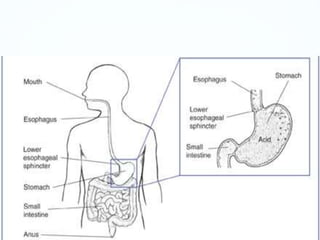
Gastroesophageal Reflux (GER) occurs when stomach contents
flow back up into the esophagus—the muscular tube that carries
food and liquids from the mouth to the stomach. GER is also
called acid reflux or acid regurgitation.
Gastroesophageal Reflux Disease (GERD) is a more serious,
chronic form of GER. GER that occurs more than twice a week for
a few weeks could be GERD, which over time can lead to more
serious health problems.
What causes GERD?
 GERD can occur when the lower esophageal sphincter
becomes weak or relaxes when it should not, causing stomach
contents to rise up into the esophagus.
 Hiatal hernias may also cause GERD. Hiatal hernias occur
when the upper part of the stomach moves up into the chest.
The stomach can slip through an opening found in the
diaphragm. Hiatal hernias may cause GERD because of the
stomach acid flowing back up through the opening; however,
most produce no symptoms.
…Other causes
 obesity
 pregnancy
 certain medications, such as asthma medications, CCB’s, many
antihistamines, pain killers, sedatives, and antidepressants
 smoking, or inhaling secondhand smoke
 certain foods and beverages such as chocolate, coffee,
peppermint, greasy or spicy foods, tomato products, and
alcoholic or caffeinated beverages
 eating 2 to 3 hours before sleep
What are the symptoms of
GERD?
The main symptom of GERD is frequent heartburn, though some adults with
GERD do not have heartburn.
 a dry, chronic cough
 wheezing
 asthma and recurrent pneumonia
 nausea
 vomiting
 a sore throat, hoarseness, or laryngitis
 difficulty swallowing or painful swallowing
 pain in the chest or the upper part of the abdomen
 dental erosion and bad breath
How is GERD diagnosed?
 Upper GI series – During the procedure, the person will stand
or sit in front of an x-ray machine and drink barium, a chalky
liquid. Barium coats the esophagus, stomach, and small
intestine so the radiologist and gastroenterologist can see
theses organs’ shapes more clearly on x-rays. The barium
shows problems related to GERD, such as hiatal hernias. While
an upper GI series cannot detect mild irritation, the test can
detect esophageal strictures—narrowing of the esophagus that
can result from GERD—as well as ulcers, or sores.
 Upper endoscopy – A gastroenterologist carefully feeds an
endoscope through the mouth and down the esophagus, then
into the stomach and duodenum. A small camera mounted on
the endoscope transmits a video image to a monitor, allowing
close examination of the intestinal lining. The gastroenterologist
uses the endoscope to take a biopsy of esophageal tissue. A
pathologist then will examine the tissue and determine the
extent of inflammation.
 Esophageal pH monitoring – The most accurate test to detect acid
reflux, esophageal pH monitoring measures the amount of liquid or
acid in the esophagus as the person goes about normal activities,
including eating and sleeping. A gastroenterologist will pass a thin
tube, called a nasogastric probe, through the person’s nose or mouth
to the stomach. The gastroenterologist will then pull the tube back
into the esophagus, where it will be taped to the person’s cheek and
remains in place for 24 hours. The end of the tube in the esophagus
has a small probe to measure when and how much liquid or acid
comes up into the esophagus. The other end of the tube, attached to
a monitor outside the body, shows the measurements taken.
 This test is most useful when combined with a carefully kept diary of
when, what, and how much food the person eats and GERD
symptoms that result. The gastroenterologist can see correlations
between symptoms and certain foods or times of day.
 Esophageal manometry – Esophageal manometry measures
the muscle contractions in the esophagus. The
gastroenterologist passes a soft, thin tube through the person’s
nose into the stomach. The person swallows as the
gastroenterologist pulls the tube slowly back into the
esophagus. A computer measures and records the pressure of
the muscle contractions in different parts of the esophagus. The
test can show if symptoms are due to a weak sphincter muscle.
How is GERD treated?
 Treatment for GERD may involve one or more of the following, depending on
the severity of symptoms: lifestyle changes, medications, or surgery.
Lifestyle Changes
 losing weight, if needed
 wearing loose-fitting clothing around the stomach area, as tight clothing can
constrict the area and increase reflux
 remaining upright for 3 hours after meals
 decreasing fat intake and eating small, frequent meals instead of three large
meals
 raising the head of the bed 6 to 8 inches by securing wood blocks under the
bedposts––just using extra pillows will not help
 avoiding smoking and others who are smoking
Medications
 Antacids
 H2 blockers – (Cimetidine, Famotidine) decrease acid production.
 PPIs – (prazoles) PPIs are more effective than H2 blockers and can relieve
symptoms and heal the esophageal lining in most people with GERD.
Studies show people who take PPIs long term or in high doses are more
likely to have hip, wrist, and spinal fractures. People should take these
medications on an empty stomach in order for stomach acid to activate
them.
 Prokinetics – (Bethanechol, Metoclopramide) help make the stomach
empty faster. However, both Bethanechol and Metoclopramide have side
effects that often limit their use, including nausea, diarrhea, tiredness,
depression, anxiety, and problems with physical movement.
 Antibiotics – (Erythromycin) has been shown to improve gastric emptying.
Erythromycin has fewer side effects than Bethanechol and Metoclopramide;
however, like all antibiotics, it can cause diarrhea.
Surgery
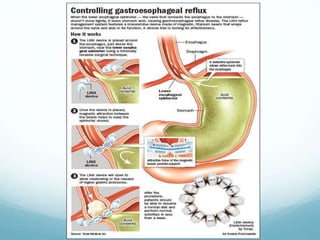
 Fundoplication is an operation to sew the top of the stomach around
the esophagus to add pressure to the lower end of the esophagus
and reduce reflux. A surgeon performs fundoplication using a
laparoscope, a thin tube with a tiny video camera attached to its end.
 Endoscopic techniques, such as endoscopic sewing and
radiofrequency, help control GERD in a small number of people.
Endoscopic sewing uses small stitches to tighten the sphincter
muscle. Radiofrequency creates heat lesions that help tighten the
sphincter muscle. Results may not be as good as laparoscopic
surgery, and these procedures are not commonly used.
What are the complications
of GERD?
Untreated GERD can sometimes cause serious complications over time,
including:
 esophagitis – irritation of the esophagus from refluxed stomach acid
that damages the lining and causes bleeding or ulcers. Adults who
have chronic esophagitis over many years are more likely to develop
precancerous changes in the esophagus.
 strictures that lead to swallowing difficulties.
 respiratory problems, such as trouble breathing.
 Barrett’s esophagus, a condition in which the tissue lining the
esophagus is replaced by tissue similar to the lining of the intestine. A
small number of people with Barrett’s esophagus develop a rare yet
often deadly type of cancer of the esophagus.
THE END

GERD

  • 1.
  • 2.
    What is GER/GERD? GastroesophagealReflux (GER) occurs when stomach contents flow back up into the esophagus—the muscular tube that carries food and liquids from the mouth to the stomach. GER is also called acid reflux or acid regurgitation. Gastroesophageal Reflux Disease (GERD) is a more serious, chronic form of GER. GER that occurs more than twice a week for a few weeks could be GERD, which over time can lead to more serious health problems.
  • 4.
    What causes GERD? GERD can occur when the lower esophageal sphincter becomes weak or relaxes when it should not, causing stomach contents to rise up into the esophagus.  Hiatal hernias may also cause GERD. Hiatal hernias occur when the upper part of the stomach moves up into the chest. The stomach can slip through an opening found in the diaphragm. Hiatal hernias may cause GERD because of the stomach acid flowing back up through the opening; however, most produce no symptoms.
  • 5.
    …Other causes  obesity pregnancy  certain medications, such as asthma medications, CCB’s, many antihistamines, pain killers, sedatives, and antidepressants  smoking, or inhaling secondhand smoke  certain foods and beverages such as chocolate, coffee, peppermint, greasy or spicy foods, tomato products, and alcoholic or caffeinated beverages  eating 2 to 3 hours before sleep
  • 6.
    What are thesymptoms of GERD? The main symptom of GERD is frequent heartburn, though some adults with GERD do not have heartburn.  a dry, chronic cough  wheezing  asthma and recurrent pneumonia  nausea  vomiting  a sore throat, hoarseness, or laryngitis  difficulty swallowing or painful swallowing  pain in the chest or the upper part of the abdomen  dental erosion and bad breath
  • 7.
    How is GERDdiagnosed?  Upper GI series – During the procedure, the person will stand or sit in front of an x-ray machine and drink barium, a chalky liquid. Barium coats the esophagus, stomach, and small intestine so the radiologist and gastroenterologist can see theses organs’ shapes more clearly on x-rays. The barium shows problems related to GERD, such as hiatal hernias. While an upper GI series cannot detect mild irritation, the test can detect esophageal strictures—narrowing of the esophagus that can result from GERD—as well as ulcers, or sores.
  • 8.
     Upper endoscopy– A gastroenterologist carefully feeds an endoscope through the mouth and down the esophagus, then into the stomach and duodenum. A small camera mounted on the endoscope transmits a video image to a monitor, allowing close examination of the intestinal lining. The gastroenterologist uses the endoscope to take a biopsy of esophageal tissue. A pathologist then will examine the tissue and determine the extent of inflammation.
  • 9.
     Esophageal pHmonitoring – The most accurate test to detect acid reflux, esophageal pH monitoring measures the amount of liquid or acid in the esophagus as the person goes about normal activities, including eating and sleeping. A gastroenterologist will pass a thin tube, called a nasogastric probe, through the person’s nose or mouth to the stomach. The gastroenterologist will then pull the tube back into the esophagus, where it will be taped to the person’s cheek and remains in place for 24 hours. The end of the tube in the esophagus has a small probe to measure when and how much liquid or acid comes up into the esophagus. The other end of the tube, attached to a monitor outside the body, shows the measurements taken.  This test is most useful when combined with a carefully kept diary of when, what, and how much food the person eats and GERD symptoms that result. The gastroenterologist can see correlations between symptoms and certain foods or times of day.
  • 10.
     Esophageal manometry– Esophageal manometry measures the muscle contractions in the esophagus. The gastroenterologist passes a soft, thin tube through the person’s nose into the stomach. The person swallows as the gastroenterologist pulls the tube slowly back into the esophagus. A computer measures and records the pressure of the muscle contractions in different parts of the esophagus. The test can show if symptoms are due to a weak sphincter muscle.
  • 11.
    How is GERDtreated?  Treatment for GERD may involve one or more of the following, depending on the severity of symptoms: lifestyle changes, medications, or surgery. Lifestyle Changes  losing weight, if needed  wearing loose-fitting clothing around the stomach area, as tight clothing can constrict the area and increase reflux  remaining upright for 3 hours after meals  decreasing fat intake and eating small, frequent meals instead of three large meals  raising the head of the bed 6 to 8 inches by securing wood blocks under the bedposts––just using extra pillows will not help  avoiding smoking and others who are smoking
  • 12.
    Medications  Antacids  H2blockers – (Cimetidine, Famotidine) decrease acid production.  PPIs – (prazoles) PPIs are more effective than H2 blockers and can relieve symptoms and heal the esophageal lining in most people with GERD. Studies show people who take PPIs long term or in high doses are more likely to have hip, wrist, and spinal fractures. People should take these medications on an empty stomach in order for stomach acid to activate them.  Prokinetics – (Bethanechol, Metoclopramide) help make the stomach empty faster. However, both Bethanechol and Metoclopramide have side effects that often limit their use, including nausea, diarrhea, tiredness, depression, anxiety, and problems with physical movement.  Antibiotics – (Erythromycin) has been shown to improve gastric emptying. Erythromycin has fewer side effects than Bethanechol and Metoclopramide; however, like all antibiotics, it can cause diarrhea.
  • 13.
    Surgery  Fundoplication isan operation to sew the top of the stomach around the esophagus to add pressure to the lower end of the esophagus and reduce reflux. A surgeon performs fundoplication using a laparoscope, a thin tube with a tiny video camera attached to its end.  Endoscopic techniques, such as endoscopic sewing and radiofrequency, help control GERD in a small number of people. Endoscopic sewing uses small stitches to tighten the sphincter muscle. Radiofrequency creates heat lesions that help tighten the sphincter muscle. Results may not be as good as laparoscopic surgery, and these procedures are not commonly used.
  • 15.
    What are thecomplications of GERD? Untreated GERD can sometimes cause serious complications over time, including:  esophagitis – irritation of the esophagus from refluxed stomach acid that damages the lining and causes bleeding or ulcers. Adults who have chronic esophagitis over many years are more likely to develop precancerous changes in the esophagus.  strictures that lead to swallowing difficulties.  respiratory problems, such as trouble breathing.  Barrett’s esophagus, a condition in which the tissue lining the esophagus is replaced by tissue similar to the lining of the intestine. A small number of people with Barrett’s esophagus develop a rare yet often deadly type of cancer of the esophagus.
  • 16.