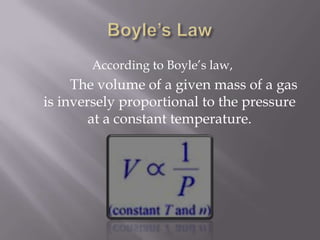

According to Boyle’s law,
The volume of a given mass of a gas
is inversely proportional to the pressure
at a constant temperature.
Given V α 1/P at constant T
Or V=1/P * Constant
Or PV=constant
Or PV= k(constant)
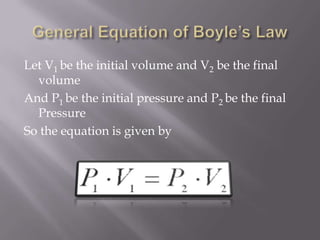
Let V1 be the initial volume and V2 be the final
volume
And P1 be the initial pressure and P2 be the final
Pressure
So the equation is given by
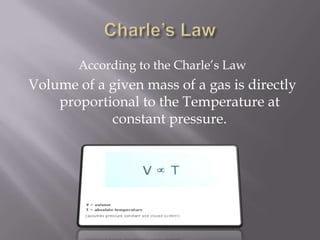
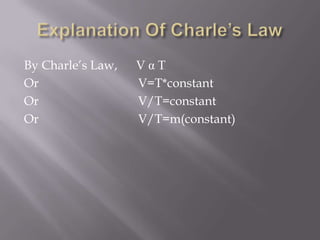
According to the Charle’s Law
Volume of a given mass of a gas is directly
proportional to the Temperature at
constant pressure.
By Charle’s Law, V α T
Or V=T*constant
Or V/T=constant
Or V/T=m(constant)
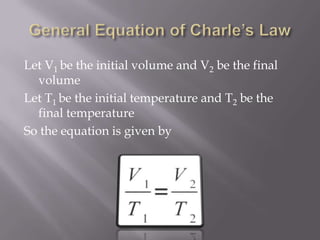
Let V1 be the initial volume and V2 be the final
volume
Let T1 be the initial temperature and T2 be the
final temperature
So the equation is given by
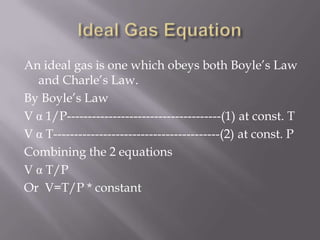
An ideal gas is one which obeys both Boyle’s Law
and Charle’s Law.
By Boyle’s Law
V α 1/P-------------------------------------(1) at const. T
V α T----------------------------------------(2) at const. P
Combining the 2 equations
V α T/P
Or V=T/P * constant
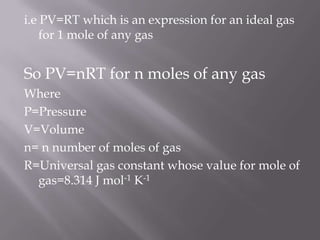
i.e PV=RT which is an expression for an ideal gas
for 1 mole of any gas
So PV=nRT for n moles of any gas
Where
P=Pressure
V=Volume
n= n number of moles of gas
R=Universal gas constant whose value for mole of
gas=8.314 J mol-1 K-1
Ideal gas equation

Ideal gas equation

  • 2.
    According to Boyle’slaw, The volume of a given mass of a gas is inversely proportional to the pressure at a constant temperature.
  • 3.
    Given V α1/P at constant T Or V=1/P * Constant Or PV=constant Or PV= k(constant)
  • 4.
    Let V1 bethe initial volume and V2 be the final volume And P1 be the initial pressure and P2 be the final Pressure So the equation is given by
  • 5.
    According to theCharle’s Law Volume of a given mass of a gas is directly proportional to the Temperature at constant pressure.
  • 6.
    By Charle’s Law,V α T Or V=T*constant Or V/T=constant Or V/T=m(constant)
  • 7.
    Let V1 bethe initial volume and V2 be the final volume Let T1 be the initial temperature and T2 be the final temperature So the equation is given by
  • 8.
    An ideal gasis one which obeys both Boyle’s Law and Charle’s Law. By Boyle’s Law V α 1/P-------------------------------------(1) at const. T V α T----------------------------------------(2) at const. P Combining the 2 equations V α T/P Or V=T/P * constant
  • 9.
    i.e PV=RT whichis an expression for an ideal gas for 1 mole of any gas So PV=nRT for n moles of any gas Where P=Pressure V=Volume n= n number of moles of gas R=Universal gas constant whose value for mole of gas=8.314 J mol-1 K-1