Challenge the future
Delft
University of
Technology
Course IN4303, 2016-2017
Compiler Construction
Guido Wachsmuth, Eelco Visser
Garbage Collection
outline
Garbage Collection
Garbage Collection
Reference counting
• deallocate records with count 0
Mark & sweep
• mark reachable records
• sweep unmarked records
Copying collection
• copy reachable records
Generational collection
• collect only in young generations of records
2
Garbage Collection
Memory Safety & Management
I
3
Garbage Collection
Memory Safety
A program execution is memory safe if
• It only creates valid pointers through standard means
• Only uses a pointer to access memory that belongs to that pointer
Combines temporal safety and spatial safety
4
Access only to memory that pointer owns
Garbage Collection
Spatial Safety
View pointer as triple (p, b, e)
• p is the actual pointer
• b is the based of the memory region it may access
• e is the extent (bounds of that region)
Access allowed iff
• b <= p <= e - sizeof(typeof(p))
Allowed operations
• Pointer arithmetic increments p, leaves b and e alone
• Using &: e determined by size of original type
5
No access to undefined memory
Garbage Collection
Temporal Safety
Temporal safety violation: trying to access undefined memory
• Spatial safety assures it was to a legal region
• Temporal safety assures that region is still in play
Memory region is defined or undefined
Undefined memory is
• unallocated
• uninitialized
• deallocated (dangling pointers)
6
safety guarantees
Garbage Collection
Memory Management
Manual memory management
• malloc, free in C
• Easy to accidentally free memory that is still in use
• Pointer arithmetic is unsafe
Automated memory management
• Spatial safety: references are opaque (no pointer arithmetic)
• (+ array bounds checking)
• Temporal safety: no dangling pointers (only free unreachable memory)
7
Garbage Collection
Garbage Collector
Terminology
• objects that are referenced are live
• objects that are not referenced are dead (garbage)
• objects are allocated on the heap
Responsibilities
• allocating memory
• ensuring live objects remain in memory
• garbage collection: recovering memory from dead objects
8
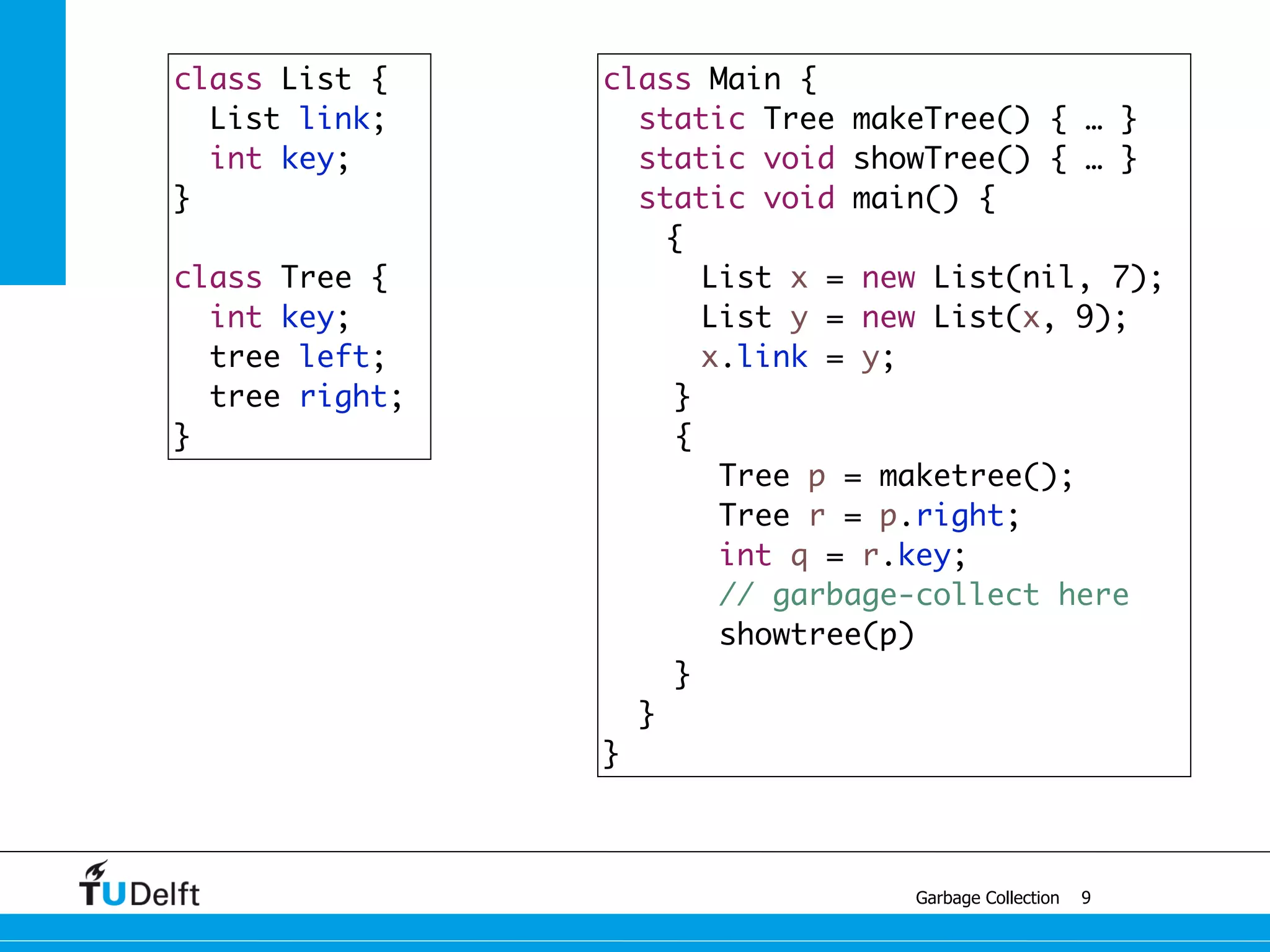
Garbage Collection 9
class List {
List link;
int key;
}
class Tree {
int key;
tree left;
tree right;
}
class Main {
static Tree makeTree() { … }
static void showTree() { … }
static void main() {
{
List x = new List(nil, 7);
List y = new List(x, 9);
x.link = y;
}
{
Tree p = maketree();
Tree r = p.right;
int q = r.key;
// garbage-collect here
showtree(p)
}
}
}
Garbage Collection 10
● 37 ●
12 ● ● ● 715 ● ● 37 ● ● 59 ● ● ● 9 20 ● ●
p q r
class List {
List link;
int key;
}
class Tree {
int key;
tree left;
tree right;
}
class Main {
static Tree makeTree() { … }
static void showTree() { … }
static void main() {
{
List x = new List(nil, 7);
List y = new List(x, 9);
x.link = y;
}
{
Tree p = maketree();
Tree r = p.right;
int q = r.key;
// garbage-collect here
showtree(r)
}
}
}
Garbage Collection
Reference Counting
II
11
idea
Garbage Collection
Reference Counting
Counts
• how many pointers point to each record?
• store with each record
Counting
• extra instructions
Deallocate
• put on freelist
• recursive deallocation on allocation
12
compiler instrumentation
Garbage Collection
Reference Counting
13
x.f := p
z := x.f
c := z.count
c := c - 1
z.count := c
if (c == 0) put z on free list
x.f := p
c := p.count
c := c + 1
p.count := c
● 37 ●
12 ● ● ● 715 ● ● 37 ● ● 59 ● ● ● 9 20 ● ●
p q r
example
Garbage Collection
Reference Counting
14
1 1 1 2 1 111 1
notes
Garbage Collection
Reference Counting
Cycles
• memory leaks
• break cycles explicitly
• occasional mark & sweep collection
Expensive
• fetch, decrease, store old reference counter
• possible deallocation
• fetch, increase, store new reference counter
15
programming languages
Garbage Collection
Reference Counting
Languages with automatic reference counting
• Objective-C, Swift
Dealing with cycles
• strong reference: counts as a reference
• weak reference: can be nil, does not count
• unowned references: cannot be nil, does not count
16
Garbage Collection
Mark & Sweep
III
17
idea
Garbage Collection
Mark & Sweep
Mark
• mark reachable records
• start at variables (roots)
• follow references
Sweep
• marked records: unmark
• unmarked records: deallocate
• linked list of free records
18
12 ● ●
● 37 ●
15 ● ● 37 ● ● 59 ● ● 20 ● ●● 9● 7
p q r
example
Garbage Collection
Marking
19
roots
12 ● ● 15 ● ● 37 ● ● 59 ● ● 20 ● ●
● 37 ●
● 9● 7
p q r
example
Garbage Collection
Sweeping
20
●
f
freelist
Garbage Collection
Mark phase:
foreach r in roots
DFS(r)
21
Sweep phase:
p := first address in heap
while p < last address in heap
if p.marked
p.marked := false
else
f1 := first field in p
p.f1 := freelist
free list := p
p := p + sizeof( p )
algorithms
Mark & Sweep
function DFS(x)
if pointer(x) & !x.marked
x.marked := true
foreach f in fields(x)
DFS(f)
costs
Garbage Collection
Mark & Sweep
Instructions
• R reachable words in heap of size H
• Mark: c1 * R
• Sweep: c2 * H
• Reclaimed: H - R words
• Instructions per word reclaimed: 


(c1 * R + c2 * H) / (H - R)
• if (H >> R) cost per allocated word ~ c2
22
costs
Garbage Collection
Mark & Sweep
Memory
• DFS is recursive
• maximum depth: longest path in graph of reachable data
• worst case: H
• | stack of activation records | > H
Measures
• explicit stack
• pointer reversal
23
Garbage Collection
function DFS(x)
if pointer(x) & !x.marked
x.marked = true
foreach f in fields(x)
DFS(f)
24
function DFS(x)
if pointer(x) & !x.marked
x.marked = true
t = 1 ; stack[t] = x
while t > 0
x = stack[t] ; t = t - 1
foreach f in fields(x)
if pointer(f) & !f.marked
f.marked = true
t = t + 1 ; stack[t] = f
algorithms
Marking: DFS with Explicit Stack
Garbage Collection
function DFS(x)
if pointer(x) & x.done < 0
x.done = 0 ; t = nil
while true
if x.done < x.fields.size
y = x.fields[x.done]
if pointer(y) & y.done < 0
x.fields[x.done] = t ; t = x ; x = y ; x.done = 0
else
x.done = x.done + 1
else
y = x; x = t
if t = nil then return
t = x.fields[x.done]; x.fields[x.done] = y
x.done = x.done + 1
25
marking without memory overhead
Marking: DFS with Pointer Reversal
12 ● ●
● 37 ●
15 ● ● 37 ● ● 59 ● ● 20 ● ●● 9● 7
p q r
pointer reversals
Garbage Collection
Recap: Marking
26
notes
Garbage Collection
Mark & Sweep
Sweeping
• independent of marking algorithm
• several freelists (per record size)
• split free records for allocation
Fragmentation
• external: many free records of small size
• internal: too-large record with unused memory inside
27
Garbage Collection
Copying Collection
IV
28
idea
Garbage Collection
Copying Collection
Spaces
• fromspace & tospace
• switch roles after copy
Copy
• traverse reachability graph
• copy from fromspace to tospace
• fromspace unreachable, free memory
• tospace compact, no fragmentation
29
idea
Garbage Collection
Copying Collection
30
roots roots
from-
space
to-
space
from-
space
to-
space
next
limit
next
limit
Garbage Collection
function Forward(p)
if p in fromspace
if p.f1 in tospace
return p.f1
else
foreach f in fields of p
next.f := p.f
p.f1 := next
next := next + sizeof(p)
return p.f1
else return p
31
function BFS()
next := scan := start(tospace)
foreach r in roots
r = Forward(r)
while scan < next
foreach f in fields of scan
scan.f = Forward(scan.f)
scan = scan + sizeof(scan)
algorithms
Copying Collection
● 37 ●
12 ● ● ● 715 ● ● 37 ● ● 59 ● ● ● 9 20 ● ●
p q r
example
Garbage Collection
Copying Collection
32
15 ● ●
●
37 ● ●
●
15 ● ●
● 37 ●
12 ● ● ● 715 ● ● 37 ● ● 59 ● ● ● 9 20 ● ●
p q r
Garbage Collection
Copying Collection
33
●
37 ● ●
●
12 ● ●
●
20 ● ●
●
59 ● ●
●
locality
Garbage Collection
Copying Collection
Adjacent records
• likely to be unrelated
Pointers to records in records
• likely to be accessed
• likely to be far apart
Solution
• depth-first copy: slow pointer reversals
• hybrid copy algorithm
34
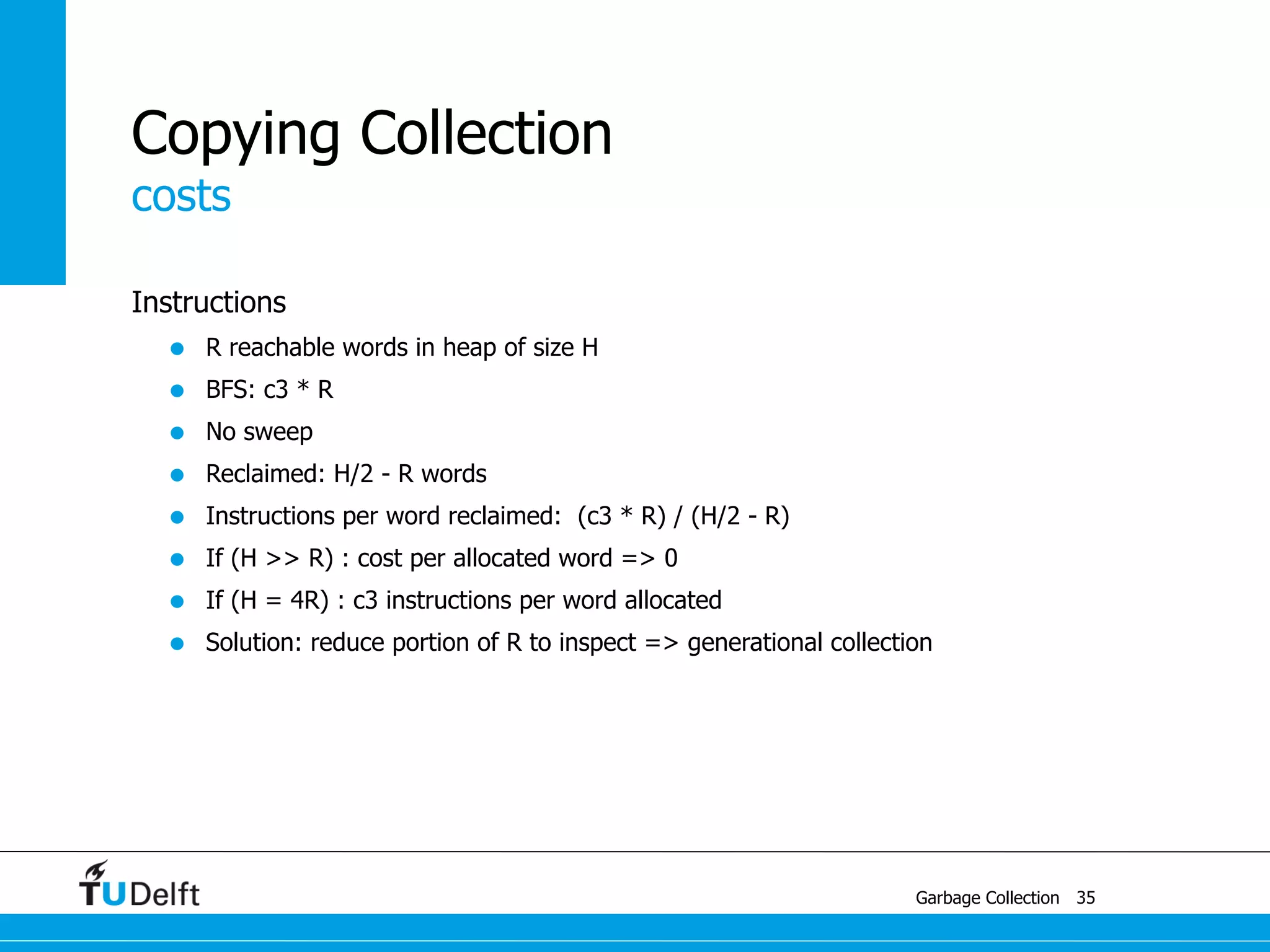
costs
Garbage Collection
Copying Collection
Instructions
• R reachable words in heap of size H
• BFS: c3 * R
• No sweep
• Reclaimed: H/2 - R words
• Instructions per word reclaimed: (c3 * R) / (H/2 - R)
• If (H >> R) : cost per allocated word => 0
• If (H = 4R) : c3 instructions per word allocated
• Solution: reduce portion of R to inspect => generational collection
35
Garbage Collection
Generational Collection
V
36
idea
Garbage Collection
Generational Collection
Generations
• young data: likely to die soon
• old data: likely to survive for more collections
• divide heap, collect younger generations more frequently
Collection
• roots: variables & pointers from older to younger generations
• preserve pointers to old generations
• promote objects to older generations
37
idea
Garbage Collection
Generational Collection
38
roots
remembered
set
G0
G1
G2
remembered
set
G1
G2
roots
G0
costs
Garbage Collection
Generational Collection
Instructions
• R reachable words in heap of size H
• BFS: c3 * R
• No sweep
• 10% of youngest generation is live: H/R = 10
• Instructions per word reclaimed: 

(c3 * R) / (H - R) = (c3 * R) / (10R - R) ~= c3/10
• Adding to remembered set: 10 instructions per update
39
idea
Garbage Collection
Incremental Collection
Interrupt by garbage collector undesirable
• interactive, real-time programs
Incremental / concurrent garbage collection
• interleave collector and mutator (program)
• incremental: per request of mutator
• concurrent: in between mutator operations
Tricolor marking
• White: not visited
• Grey: visited (marked or copied), children not visited
• Black: object and children marked
40
Garbage Collection
Summary
VI
41
summary
Garbage Collection
Algorithms
How can we collect unreachable records on the heap?
• reference counts
• mark reachable records, sweep unreachable records
• copy reachable records
How can we reduce heap space needed for garbage collection?
• pointer-reversal
• breadth-first search
• hybrid algorithms
42
summary
Garbage Collection
Design Choices
Serial vs Parallel
• garbage collection as sequential or parallel process
Concurrent vs Stop-the-World
• concurrently with application or stop application
Compacting vs Non-compacting vs Copying
• compact collected space
• free list contains non-compacted chunks
• copy live objects to new space; from-space is non-fragmented
43
summary
Garbage Collection
Performance Metrics
Throughput
• percentage of time not spent in garbage collection
GC overhead
• percentage of time spent in garbage collection
Pause time
• length of time execution is stopped during garbage collection
Frequency of collection
• how often collection occurs
Footprint
• measure of (heap) size
44
practice
Garbage Collection
Garbage Collection in Java HotSpot VM
Serial collector
• young generation: copying collection
• old generation: mark-sweep-compact collection
Parallel collector
• young generation: stop-the-world copying collection in parallel
• old generation: same as serial
Parallel compacting collector
• young generation: same as parallel
• old generation: roots divided in threads, marking live objects in parallel, …
Concurrent Mark-Sweep (CMS) collector
• stop-the-world initial marking and re-marking
• concurrent marking and sweeping
45
learn more
Garbage Collection
Literature
Andrew W. Appel, Jens Palsberg. Modern Compiler Implementation in Java,
2nd edition, 2002.
Sun Microsystems. Memory Management in the Java HotSpotTM Virtual
Machine, April 2006.
46
Garbage Collection
copyrights
47
Garbage Collection 48
attribution & copyrights
Garbage Collection
Pictures
Slide 1:
Trash by Vladimer Shioshvili, some rights reserved
Slide 4:
Gravel Pile by kenjonbro, some rights reserved
Slide 19:
Typhoo by Dominica Williamson, some rights reserved
Slide 30:
Romantic Pigeon Date by Harald Hoyer, some rights reserved
49

Garbage Collection

  • 1.
    Challenge the future Delft Universityof Technology Course IN4303, 2016-2017 Compiler Construction Guido Wachsmuth, Eelco Visser Garbage Collection
  • 2.
    outline Garbage Collection Garbage Collection Referencecounting • deallocate records with count 0 Mark & sweep • mark reachable records • sweep unmarked records Copying collection • copy reachable records Generational collection • collect only in young generations of records 2
  • 3.
  • 4.
    Garbage Collection Memory Safety Aprogram execution is memory safe if • It only creates valid pointers through standard means • Only uses a pointer to access memory that belongs to that pointer Combines temporal safety and spatial safety 4
  • 5.
    Access only tomemory that pointer owns Garbage Collection Spatial Safety View pointer as triple (p, b, e) • p is the actual pointer • b is the based of the memory region it may access • e is the extent (bounds of that region) Access allowed iff • b <= p <= e - sizeof(typeof(p)) Allowed operations • Pointer arithmetic increments p, leaves b and e alone • Using &: e determined by size of original type 5
  • 6.
    No access toundefined memory Garbage Collection Temporal Safety Temporal safety violation: trying to access undefined memory • Spatial safety assures it was to a legal region • Temporal safety assures that region is still in play Memory region is defined or undefined Undefined memory is • unallocated • uninitialized • deallocated (dangling pointers) 6
  • 7.
    safety guarantees Garbage Collection MemoryManagement Manual memory management • malloc, free in C • Easy to accidentally free memory that is still in use • Pointer arithmetic is unsafe Automated memory management • Spatial safety: references are opaque (no pointer arithmetic) • (+ array bounds checking) • Temporal safety: no dangling pointers (only free unreachable memory) 7
  • 8.
    Garbage Collection Garbage Collector Terminology •objects that are referenced are live • objects that are not referenced are dead (garbage) • objects are allocated on the heap Responsibilities • allocating memory • ensuring live objects remain in memory • garbage collection: recovering memory from dead objects 8
  • 9.
    Garbage Collection 9 classList { List link; int key; } class Tree { int key; tree left; tree right; } class Main { static Tree makeTree() { … } static void showTree() { … } static void main() { { List x = new List(nil, 7); List y = new List(x, 9); x.link = y; } { Tree p = maketree(); Tree r = p.right; int q = r.key; // garbage-collect here showtree(p) } } }
  • 10.
    Garbage Collection 10 ●37 ● 12 ● ● ● 715 ● ● 37 ● ● 59 ● ● ● 9 20 ● ● p q r class List { List link; int key; } class Tree { int key; tree left; tree right; } class Main { static Tree makeTree() { … } static void showTree() { … } static void main() { { List x = new List(nil, 7); List y = new List(x, 9); x.link = y; } { Tree p = maketree(); Tree r = p.right; int q = r.key; // garbage-collect here showtree(r) } } }
  • 11.
  • 12.
    idea Garbage Collection Reference Counting Counts •how many pointers point to each record? • store with each record Counting • extra instructions Deallocate • put on freelist • recursive deallocation on allocation 12
  • 13.
    compiler instrumentation Garbage Collection ReferenceCounting 13 x.f := p z := x.f c := z.count c := c - 1 z.count := c if (c == 0) put z on free list x.f := p c := p.count c := c + 1 p.count := c
  • 14.
    ● 37 ● 12● ● ● 715 ● ● 37 ● ● 59 ● ● ● 9 20 ● ● p q r example Garbage Collection Reference Counting 14 1 1 1 2 1 111 1
  • 15.
    notes Garbage Collection Reference Counting Cycles •memory leaks • break cycles explicitly • occasional mark & sweep collection Expensive • fetch, decrease, store old reference counter • possible deallocation • fetch, increase, store new reference counter 15
  • 16.
    programming languages Garbage Collection ReferenceCounting Languages with automatic reference counting • Objective-C, Swift Dealing with cycles • strong reference: counts as a reference • weak reference: can be nil, does not count • unowned references: cannot be nil, does not count 16
  • 17.
  • 18.
    idea Garbage Collection Mark &Sweep Mark • mark reachable records • start at variables (roots) • follow references Sweep • marked records: unmark • unmarked records: deallocate • linked list of free records 18
  • 19.
    12 ● ● ●37 ● 15 ● ● 37 ● ● 59 ● ● 20 ● ●● 9● 7 p q r example Garbage Collection Marking 19 roots
  • 20.
    12 ● ●15 ● ● 37 ● ● 59 ● ● 20 ● ● ● 37 ● ● 9● 7 p q r example Garbage Collection Sweeping 20 ● f freelist
  • 21.
    Garbage Collection Mark phase: foreachr in roots DFS(r) 21 Sweep phase: p := first address in heap while p < last address in heap if p.marked p.marked := false else f1 := first field in p p.f1 := freelist free list := p p := p + sizeof( p ) algorithms Mark & Sweep function DFS(x) if pointer(x) & !x.marked x.marked := true foreach f in fields(x) DFS(f)
  • 22.
    costs Garbage Collection Mark &Sweep Instructions • R reachable words in heap of size H • Mark: c1 * R • Sweep: c2 * H • Reclaimed: H - R words • Instructions per word reclaimed: 
 
 (c1 * R + c2 * H) / (H - R) • if (H >> R) cost per allocated word ~ c2 22
  • 23.
    costs Garbage Collection Mark &Sweep Memory • DFS is recursive • maximum depth: longest path in graph of reachable data • worst case: H • | stack of activation records | > H Measures • explicit stack • pointer reversal 23
  • 24.
    Garbage Collection function DFS(x) ifpointer(x) & !x.marked x.marked = true foreach f in fields(x) DFS(f) 24 function DFS(x) if pointer(x) & !x.marked x.marked = true t = 1 ; stack[t] = x while t > 0 x = stack[t] ; t = t - 1 foreach f in fields(x) if pointer(f) & !f.marked f.marked = true t = t + 1 ; stack[t] = f algorithms Marking: DFS with Explicit Stack
  • 25.
    Garbage Collection function DFS(x) ifpointer(x) & x.done < 0 x.done = 0 ; t = nil while true if x.done < x.fields.size y = x.fields[x.done] if pointer(y) & y.done < 0 x.fields[x.done] = t ; t = x ; x = y ; x.done = 0 else x.done = x.done + 1 else y = x; x = t if t = nil then return t = x.fields[x.done]; x.fields[x.done] = y x.done = x.done + 1 25 marking without memory overhead Marking: DFS with Pointer Reversal
  • 26.
    12 ● ● ●37 ● 15 ● ● 37 ● ● 59 ● ● 20 ● ●● 9● 7 p q r pointer reversals Garbage Collection Recap: Marking 26
  • 27.
    notes Garbage Collection Mark &Sweep Sweeping • independent of marking algorithm • several freelists (per record size) • split free records for allocation Fragmentation • external: many free records of small size • internal: too-large record with unused memory inside 27
  • 28.
  • 29.
    idea Garbage Collection Copying Collection Spaces •fromspace & tospace • switch roles after copy Copy • traverse reachability graph • copy from fromspace to tospace • fromspace unreachable, free memory • tospace compact, no fragmentation 29
  • 30.
    idea Garbage Collection Copying Collection 30 rootsroots from- space to- space from- space to- space next limit next limit
  • 31.
    Garbage Collection function Forward(p) ifp in fromspace if p.f1 in tospace return p.f1 else foreach f in fields of p next.f := p.f p.f1 := next next := next + sizeof(p) return p.f1 else return p 31 function BFS() next := scan := start(tospace) foreach r in roots r = Forward(r) while scan < next foreach f in fields of scan scan.f = Forward(scan.f) scan = scan + sizeof(scan) algorithms Copying Collection
  • 32.
    ● 37 ● 12● ● ● 715 ● ● 37 ● ● 59 ● ● ● 9 20 ● ● p q r example Garbage Collection Copying Collection 32 15 ● ● ● 37 ● ● ●
  • 33.
    15 ● ● ●37 ● 12 ● ● ● 715 ● ● 37 ● ● 59 ● ● ● 9 20 ● ● p q r Garbage Collection Copying Collection 33 ● 37 ● ● ● 12 ● ● ● 20 ● ● ● 59 ● ● ●
  • 34.
    locality Garbage Collection Copying Collection Adjacentrecords • likely to be unrelated Pointers to records in records • likely to be accessed • likely to be far apart Solution • depth-first copy: slow pointer reversals • hybrid copy algorithm 34
  • 35.
    costs Garbage Collection Copying Collection Instructions •R reachable words in heap of size H • BFS: c3 * R • No sweep • Reclaimed: H/2 - R words • Instructions per word reclaimed: (c3 * R) / (H/2 - R) • If (H >> R) : cost per allocated word => 0 • If (H = 4R) : c3 instructions per word allocated • Solution: reduce portion of R to inspect => generational collection 35
  • 36.
  • 37.
    idea Garbage Collection Generational Collection Generations •young data: likely to die soon • old data: likely to survive for more collections • divide heap, collect younger generations more frequently Collection • roots: variables & pointers from older to younger generations • preserve pointers to old generations • promote objects to older generations 37
  • 38.
  • 39.
    costs Garbage Collection Generational Collection Instructions •R reachable words in heap of size H • BFS: c3 * R • No sweep • 10% of youngest generation is live: H/R = 10 • Instructions per word reclaimed: 
 (c3 * R) / (H - R) = (c3 * R) / (10R - R) ~= c3/10 • Adding to remembered set: 10 instructions per update 39
  • 40.
    idea Garbage Collection Incremental Collection Interruptby garbage collector undesirable • interactive, real-time programs Incremental / concurrent garbage collection • interleave collector and mutator (program) • incremental: per request of mutator • concurrent: in between mutator operations Tricolor marking • White: not visited • Grey: visited (marked or copied), children not visited • Black: object and children marked 40
  • 41.
  • 42.
    summary Garbage Collection Algorithms How canwe collect unreachable records on the heap? • reference counts • mark reachable records, sweep unreachable records • copy reachable records How can we reduce heap space needed for garbage collection? • pointer-reversal • breadth-first search • hybrid algorithms 42
  • 43.
    summary Garbage Collection Design Choices Serialvs Parallel • garbage collection as sequential or parallel process Concurrent vs Stop-the-World • concurrently with application or stop application Compacting vs Non-compacting vs Copying • compact collected space • free list contains non-compacted chunks • copy live objects to new space; from-space is non-fragmented 43
  • 44.
    summary Garbage Collection Performance Metrics Throughput •percentage of time not spent in garbage collection GC overhead • percentage of time spent in garbage collection Pause time • length of time execution is stopped during garbage collection Frequency of collection • how often collection occurs Footprint • measure of (heap) size 44
  • 45.
    practice Garbage Collection Garbage Collectionin Java HotSpot VM Serial collector • young generation: copying collection • old generation: mark-sweep-compact collection Parallel collector • young generation: stop-the-world copying collection in parallel • old generation: same as serial Parallel compacting collector • young generation: same as parallel • old generation: roots divided in threads, marking live objects in parallel, … Concurrent Mark-Sweep (CMS) collector • stop-the-world initial marking and re-marking • concurrent marking and sweeping 45
  • 46.
    learn more Garbage Collection Literature AndrewW. Appel, Jens Palsberg. Modern Compiler Implementation in Java, 2nd edition, 2002. Sun Microsystems. Memory Management in the Java HotSpotTM Virtual Machine, April 2006. 46
  • 47.
  • 48.
  • 49.
    attribution & copyrights GarbageCollection Pictures Slide 1: Trash by Vladimer Shioshvili, some rights reserved Slide 4: Gravel Pile by kenjonbro, some rights reserved Slide 19: Typhoo by Dominica Williamson, some rights reserved Slide 30: Romantic Pigeon Date by Harald Hoyer, some rights reserved 49